“Challenges for Quality
Teachers in Present
Scenario”
Presented by- YASHASWINEE SAHOO
Contents
•Teaching as a Profession
•Is This Profession Really Challenging?
•How can we improve our standards of
Teaching?
•Conclusion
Content
Teaching as a Profession
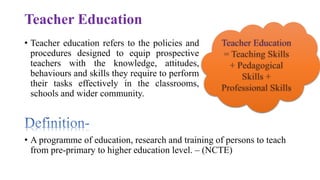
Teacher Education
• Teacher education refers to the policies and
procedures designed to equip prospective
teachers with the knowledge, attitudes,
behaviours and skills they require to perform
their tasks effectively in the classrooms,
schools and wider community.
• A programme of education, research and training of persons to teach
from pre-primary to higher education level. – (NCTE)
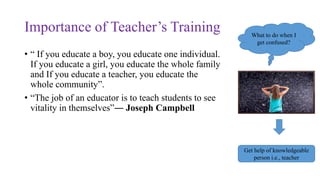
Importance of Teacher’s Training
• “ If you educate a boy, you educate one individual.
If you educate a girl, you educate the whole family
and If you educate a teacher, you educate the
whole community”.
• “The job of an educator is to teach students to see
vitality in themselves”― Joseph Campbell
What to do when I
get confused?
Get help of knowledgeable
person i.e., teacher
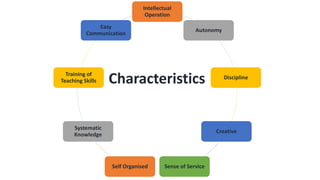
Intellectual
Operation
Autonomy
Discipline
Creative
Sense of Service
Self Organised
Systematic
Knowledge
Training of
Teaching Skills
Easy
Communication
Characteristics
Is Teaching As a
Profession Really
Challenging?
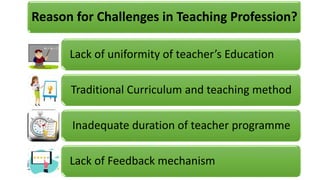
Reason for Challenges in Teaching Profession?
Lack of uniformity of teacher’s Education
Traditional Curriculum and teaching method
Inadequate duration of teacher programme
Lack of Feedback mechanism
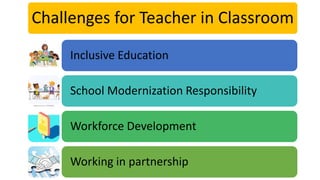
Challenges for Teacher in Classroom
Inclusive Education
School Modernization Responsibility
Workforce Development
Working in partnership
Inclusive Education
• Inclusive education is about how we develop and design our schools,
classrooms, programs and activities so that all students learn and
participate together.
• Inclusive education is about ensuring access to quality education for
all students by effectively meeting their diverse needs in a way that is
responsive, accepting, respectful and supportive. Students participate
in the education program in a common learning environment with
support to diminish and remove barriers and obstacles that may lead
to exclusion.
Inclusive education allows students of all backgrounds to learn
and grow side by side, to the benefit of all.
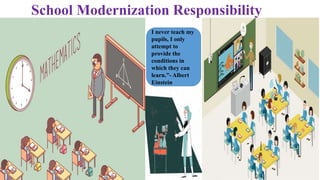
School Modernization Responsibility
I never teach my
pupils, I only
attempt to
provide the
conditions in
which they can
learn.”- Albert
Einstein
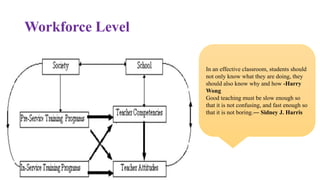
Workforce Level
In an effective classroom, students should
not only know what they are doing, they
should also know why and how -Harry
Wong
Good teaching must be slow enough so
that it is not confusing, and fast enough so
that it is not boring.― Sidney J. Harris
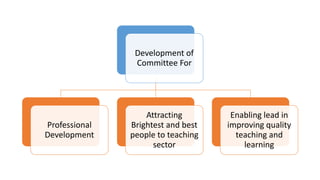
Development of
Committee For
Professional
Development
Attracting
Brightest and best
people to teaching
sector
Enabling lead in
improving quality
teaching and
learning
Working in Partnership
• Partnership is defined as mutual benefit and challenges with
discipline of the institution.
• Stake holders means who invests money for the purpose of
development, this also involves risk.
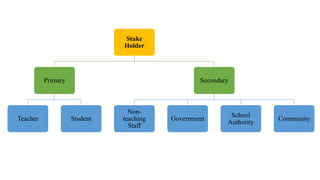
• The stake holders can be of two types primary and secondary.
Primary stake holder includes teachers and students whereas
secondary includes non-teaching staff, government, school authority,
community and parents.
Stake
Holder
Primary
Teacher Student
Secondary
Non-
teaching
Staff
Government
School
Authority
Community
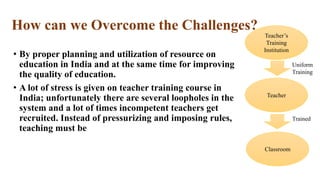
How can we Overcome the Challenges?
• By proper planning and utilization of resource on
education in India and at the same time for improving
the quality of education.
• A lot of stress is given on teacher training course in
India; unfortunately there are several loopholes in the
system and a lot of times incompetent teachers get
recruited. Instead of pressurizing and imposing rules,
teaching must be
Teacher’s
Training
Institution
Teacher
Classroom
Trained
Uniform
Training
• Emphasizes learning as a self-learning participatory process taking
place in social context of learner‘s as well as wider social context of
the community to nation as a whole.
• Puts full faith in self learning capacity of school children and student
teacher and evolving proper educative programme for education.
• Views the learner as an active participative person in learning.
His/her capabilities or potentials are seen not as fixed but capable
of development through experiences.
Conclusion
• By Professional development, attracting brightest and best people to
teaching sector and enabling lead in improving quality teaching and
learning.
• By upgrading knowledge of already existing teachers
• Primary stake holder includes teachers and students whereas secondary
includes non-teaching staff, government, school authority, community and
parents support required.
• By making learning environment conducive using innovative and creative
techniques.
The all play a vital role in improving the quality of education in present day
scenario.

Challenges for quality teachers in present scenario

  • 1.
    “Challenges for Quality Teachersin Present Scenario” Presented by- YASHASWINEE SAHOO
  • 2.
    Contents •Teaching as aProfession •Is This Profession Really Challenging? •How can we improve our standards of Teaching? •Conclusion Content
  • 4.
    Teaching as aProfession
  • 5.
    Teacher Education • Teachereducation refers to the policies and procedures designed to equip prospective teachers with the knowledge, attitudes, behaviours and skills they require to perform their tasks effectively in the classrooms, schools and wider community. • A programme of education, research and training of persons to teach from pre-primary to higher education level. – (NCTE)
  • 6.
    Importance of Teacher’sTraining • “ If you educate a boy, you educate one individual. If you educate a girl, you educate the whole family and If you educate a teacher, you educate the whole community”. • “The job of an educator is to teach students to see vitality in themselves”― Joseph Campbell What to do when I get confused? Get help of knowledgeable person i.e., teacher
  • 7.
    Intellectual Operation Autonomy Discipline Creative Sense of Service SelfOrganised Systematic Knowledge Training of Teaching Skills Easy Communication Characteristics
  • 8.
    Is Teaching Asa Profession Really Challenging?
  • 9.
    Reason for Challengesin Teaching Profession? Lack of uniformity of teacher’s Education Traditional Curriculum and teaching method Inadequate duration of teacher programme Lack of Feedback mechanism
  • 10.
    Challenges for Teacherin Classroom Inclusive Education School Modernization Responsibility Workforce Development Working in partnership
  • 13.
    Inclusive Education • Inclusiveeducation is about how we develop and design our schools, classrooms, programs and activities so that all students learn and participate together. • Inclusive education is about ensuring access to quality education for all students by effectively meeting their diverse needs in a way that is responsive, accepting, respectful and supportive. Students participate in the education program in a common learning environment with support to diminish and remove barriers and obstacles that may lead to exclusion. Inclusive education allows students of all backgrounds to learn and grow side by side, to the benefit of all.
  • 14.
    School Modernization Responsibility Inever teach my pupils, I only attempt to provide the conditions in which they can learn.”- Albert Einstein
  • 15.
    Workforce Level In aneffective classroom, students should not only know what they are doing, they should also know why and how -Harry Wong Good teaching must be slow enough so that it is not confusing, and fast enough so that it is not boring.― Sidney J. Harris
  • 16.
    Development of Committee For Professional Development Attracting Brightestand best people to teaching sector Enabling lead in improving quality teaching and learning
  • 17.
    Working in Partnership •Partnership is defined as mutual benefit and challenges with discipline of the institution. • Stake holders means who invests money for the purpose of development, this also involves risk. • The stake holders can be of two types primary and secondary. Primary stake holder includes teachers and students whereas secondary includes non-teaching staff, government, school authority, community and parents.
  • 18.
  • 19.
    How can weOvercome the Challenges? • By proper planning and utilization of resource on education in India and at the same time for improving the quality of education. • A lot of stress is given on teacher training course in India; unfortunately there are several loopholes in the system and a lot of times incompetent teachers get recruited. Instead of pressurizing and imposing rules, teaching must be Teacher’s Training Institution Teacher Classroom Trained Uniform Training
  • 20.
    • Emphasizes learningas a self-learning participatory process taking place in social context of learner‘s as well as wider social context of the community to nation as a whole. • Puts full faith in self learning capacity of school children and student teacher and evolving proper educative programme for education. • Views the learner as an active participative person in learning. His/her capabilities or potentials are seen not as fixed but capable of development through experiences.
  • 21.
    Conclusion • By Professionaldevelopment, attracting brightest and best people to teaching sector and enabling lead in improving quality teaching and learning. • By upgrading knowledge of already existing teachers • Primary stake holder includes teachers and students whereas secondary includes non-teaching staff, government, school authority, community and parents support required. • By making learning environment conducive using innovative and creative techniques. The all play a vital role in improving the quality of education in present day scenario.

Editor's Notes

  • #7 Like the teachers training standards the level of standards of the community or society depends.