REFLECTIVE
TEACHING

Susan Murphy, Librarian
Lansing Community College
murphs12@lcc.edu
An unexamined life is
not worth living .
Socrates
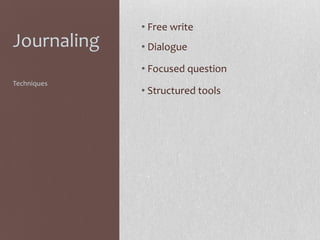
Journaling

• Free write
• Dialogue
• Focused question

Techniques

• Structured tools
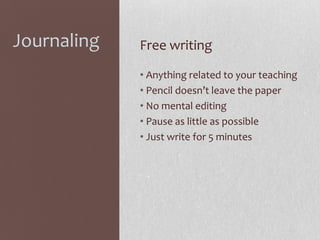
Journaling

Free writing
• Anything related to your teaching
• Pencil doesn’t leave the paper
• No mental editing
• Pause as little as possible
• Just write for 5 minutes
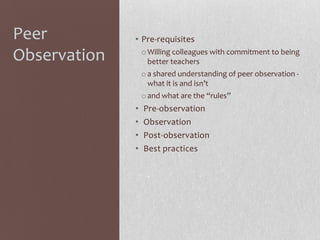
Peer
Observation

• Pre-requisites
o Willing colleagues with commitment to being
better teachers
o a shared understanding of peer observation what it is and isn’t
o and what are the “rules”

•
•
•
•

Pre-observation
Observation
Post-observation
Best practices
Peer
Observation

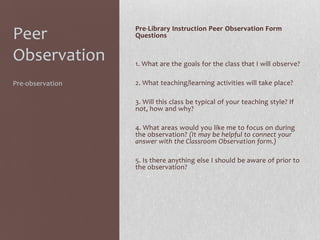
Pre-Library Instruction Peer Observation Form
Questions

Pre-observation

2. What teaching/learning activities will take place?

1. What are the goals for the class that I will observe?

3. Will this class be typical of your teaching style? If
not, how and why?
4. What areas would you like me to focus on during
the observation? (It may be helpful to connect your
answer with the Classroom Observation form.)
5. Is there anything else I should be aware of prior to
the observation?
Peer
Observation

Pre-Library Instruction Peer Observation Form
Questions

Pre-observation

2. What teaching/learning activities will take place?

1. What are the goals for the class that I will observe?

3. Will this class be typical of your teaching style? If
not, how and why?
4. What areas would you like me to focus on during
the observation? (It may be helpful to connect your
answer with the Classroom Observation form.)
5. Is there anything else I should be aware of prior to
the observation?
Peer
Observation
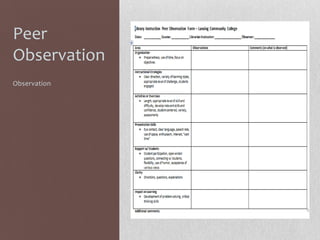
Observation
Peer
Observation
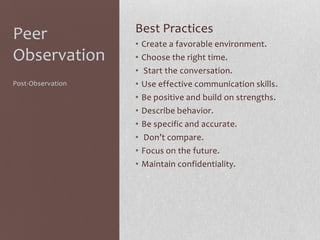
Post-Observation

Best Practices
•
•
•
•
•
•
•
•
•
•

Create a favorable environment.
Choose the right time.
Start the conversation.
Use effective communication skills.
Be positive and build on strengths.
Describe behavior.
Be specific and accurate.
Don’t compare.
Focus on the future.
Maintain confidentiality.
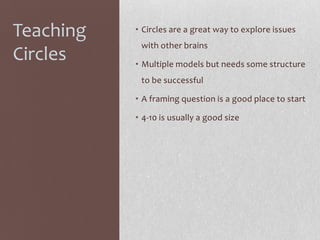
Teaching
Circles

• Circles are a great way to explore issues
with other brains
• Multiple models but needs some structure
to be successful
• A framing question is a good place to start
• 4-10 is usually a good size
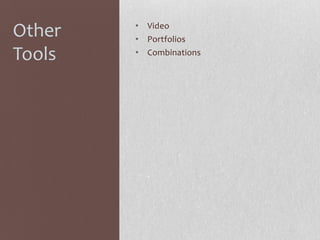
Other
Tools

• Video
• Portfolios
• Combinations
Barriers to
Reflection

So…
• We know that it’s a good idea to
reflect on our teaching so why
don’t we?
• How can we work over under
through these barriers?
Presentation and documents
http://www.slideshare.net/SusanMurphyLCC

Resources

Documents include a list of books and
websites as well as documents such as peer
observation forms and best practices.
Conclusion

• What is most important is
not how you reflect but that
you do!
• Finally, take a minute and
write down
• one way you are going to reflect
on your instruction and
• how you are going to make it
happen

Reflective Teaching - MLA 2013