Presented by: M PATIDAR
Date: 08-April-2024
Contents
 Traditional Teaching: An Introduction
 Role of Teachers & Learners in Traditional Method of
Teaching
 Active Learning Strategies: An Introduction
 Key Principles Behind Active Learning Strategies
 Active Learning Strategies: Examples
 Implementations of Active Learning Strategies
 Difference Between Active Learning and Traditional
Teaching
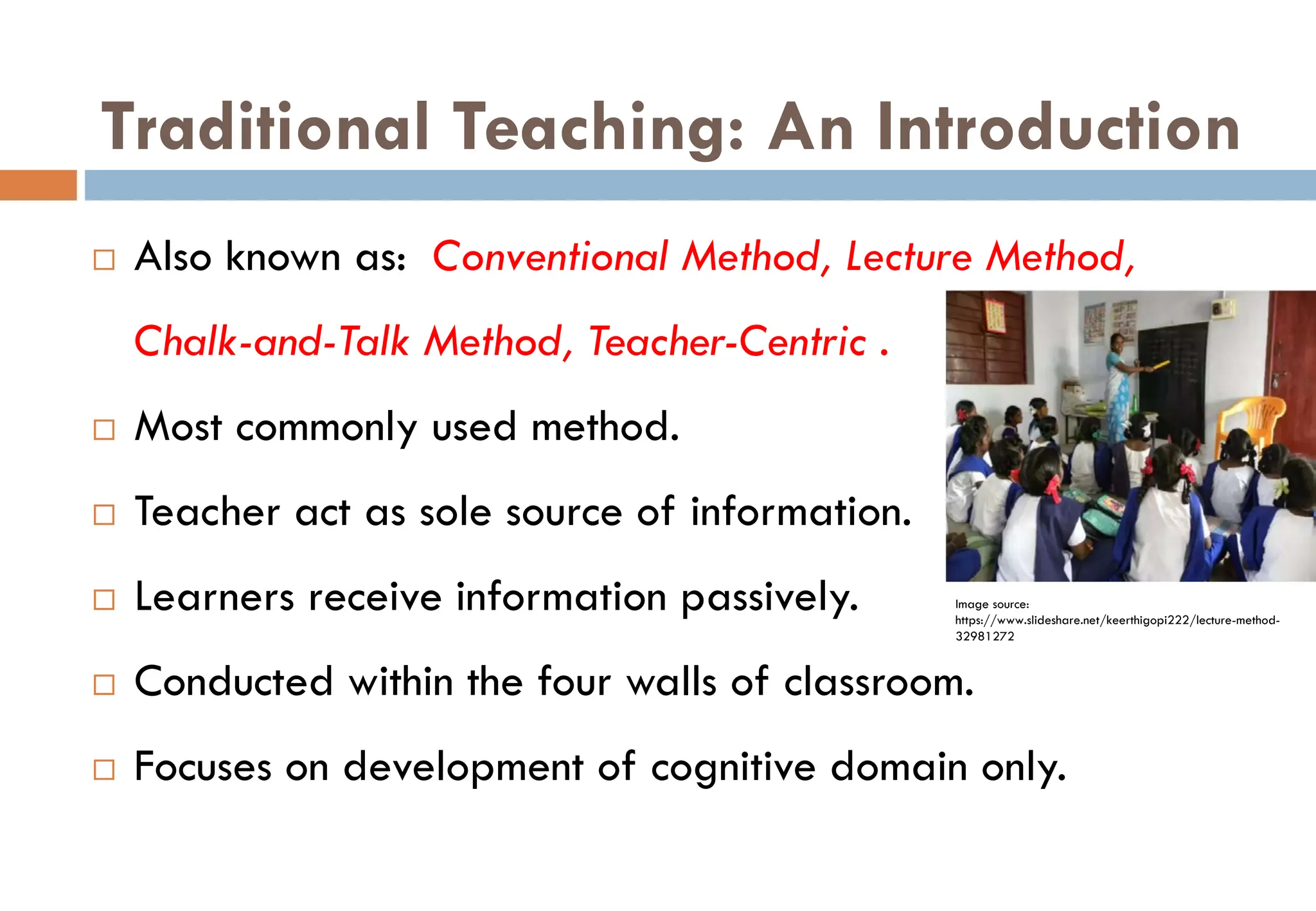
Traditional Teaching: An Introduction
Image source:
https://www.slideshare.net/keerthigopi222/lecture-method-
32981272
 Also known as: Conventional Method, Lecture Method,
Chalk-and-Talk Method, Teacher-Centric .
 Most commonly used method.
 Teacher act as sole source of information.
 Learners receive information passively.
 Conducted within the four walls of classroom.
 Focuses on development of cognitive domain only.
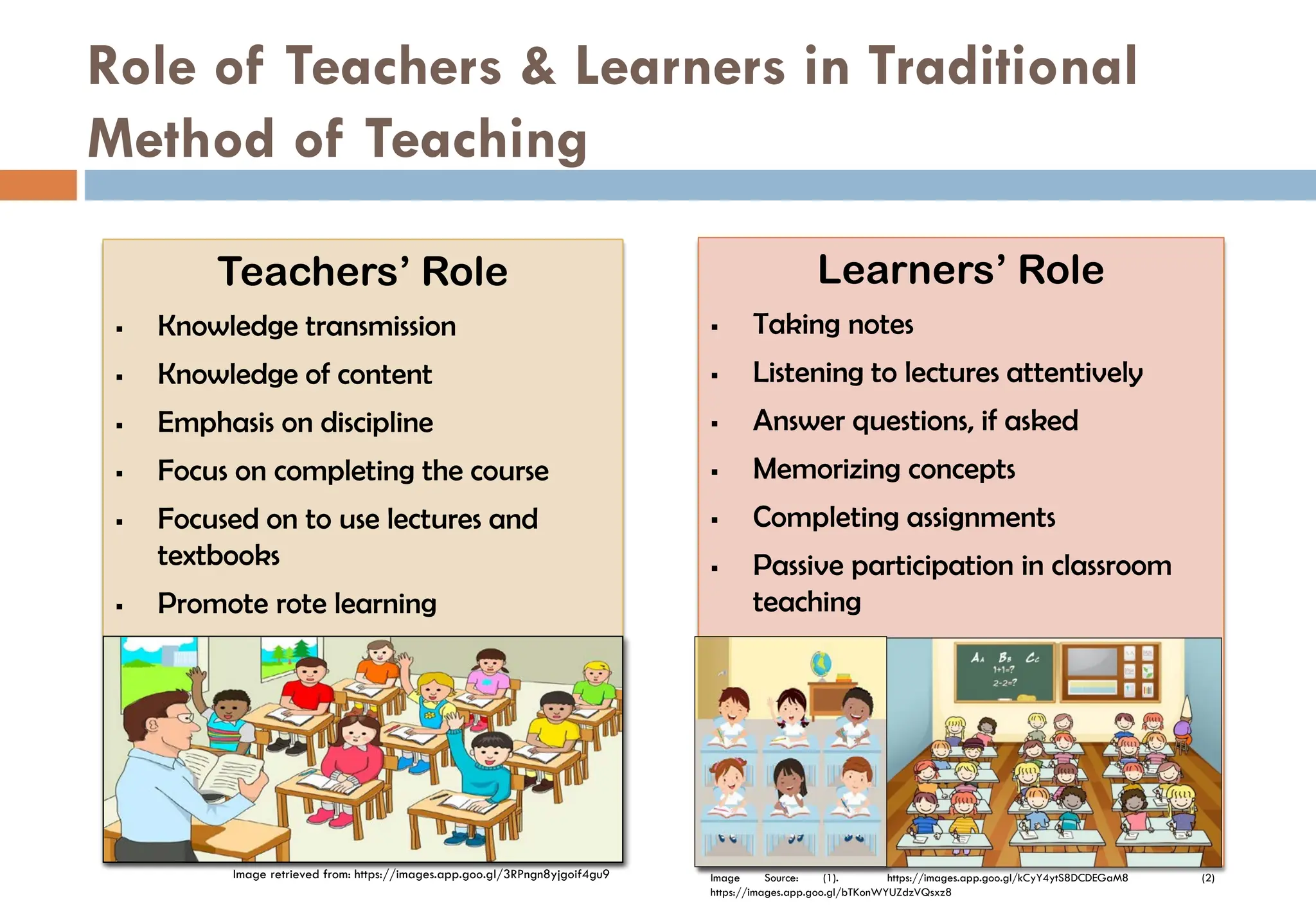
Role of Teachers & Learners in Traditional
Method of Teaching
Teachers’ Role
 Knowledge transmission
 Knowledge of content
 Emphasis on discipline
 Focus on completing the course
 Focused on to use lectures and
textbooks
 Promote rote learning
Learners’ Role
 Taking notes
 Listening to lectures attentively
 Answer questions, if asked
 Memorizing concepts
 Completing assignments
 Passive participation in classroom
teaching
Image Source: (1). https://images.app.goo.gl/kCyY4ytS8DCDEGaM8 (2)
https://images.app.goo.gl/bTKonWYUZdzVQsxz8
Image retrieved from: https://images.app.goo.gl/3RPngn8yjgoif4gu9
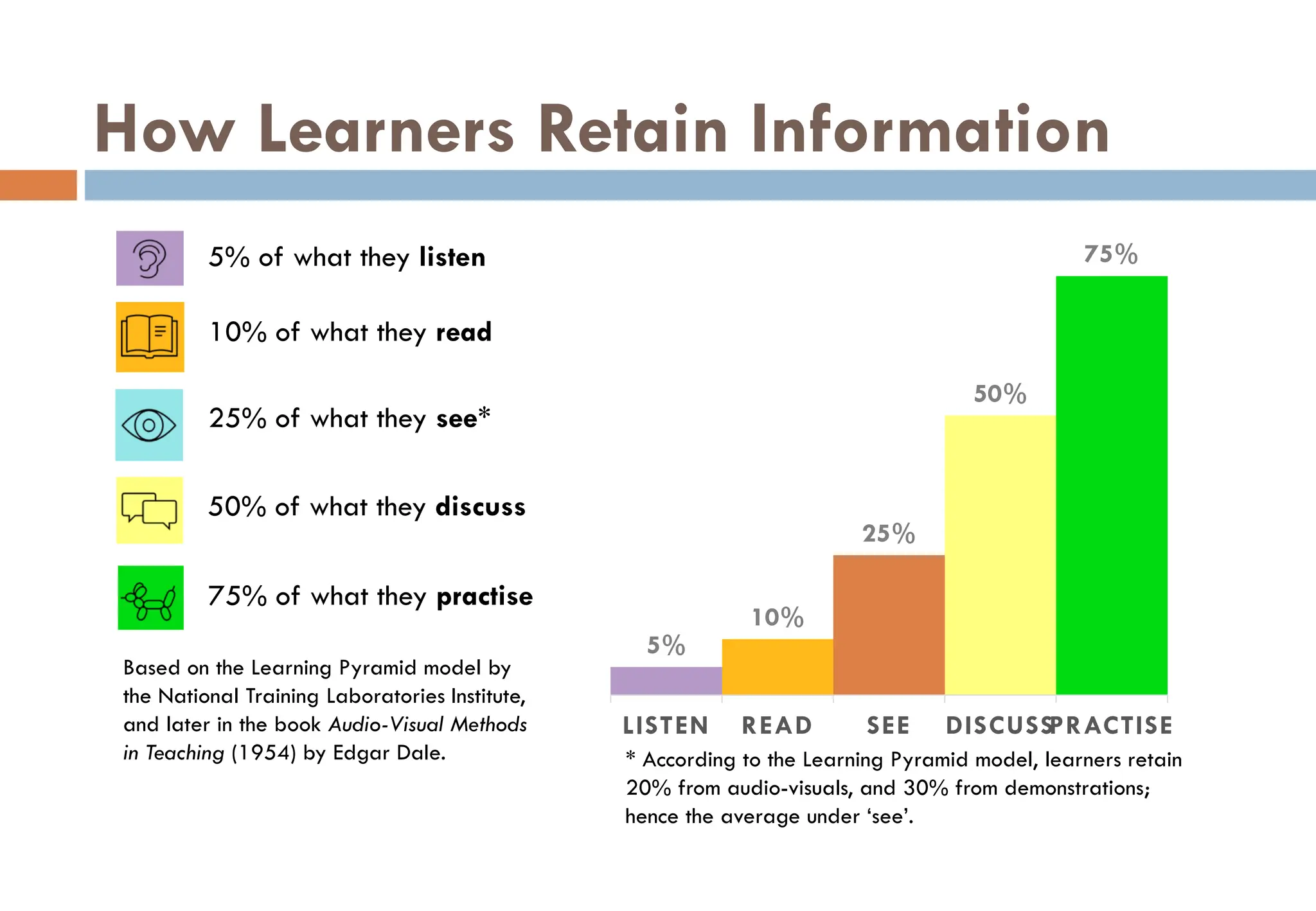
How Learners Retain Information
10% of what they read
25% of what they see*
50% of what they discuss
75% of what they practise
5% of what they listen
Based on the Learning Pyramid model by
the National Training Laboratories Institute,
and later in the book Audio-Visual Methods
in Teaching (1954) by Edgar Dale.
5%
10%
25%
50%
75%
LISTEN READ SEE DISCUSSPRACTISE
* According to the Learning Pyramid model, learners retain
20% from audio-visuals, and 30% from demonstrations;
hence the average under ‘see’.
Continue…..
 From the graph it is clear that traditional teaching ensure
maximum retention of information at students level is 25
percentage.
 It is because, it dose not provide platform to students for
classroom discussion.
 Also it dose not engage students in classroom practical
work.
 It promotes one way communication in classroom.
Questions ???
 Which methods ensure maximum retention of concepts
at learner level?
 Which types of teaching methods as a teacher we
have to adopt in over classroom that promotes
concept understanding rather than rote memorization
of concepts ?
 How to teach in over classroom that ensures the
overall development of learners’ cognitive, affective
& psychomotor domain?
Active Learning Strategies
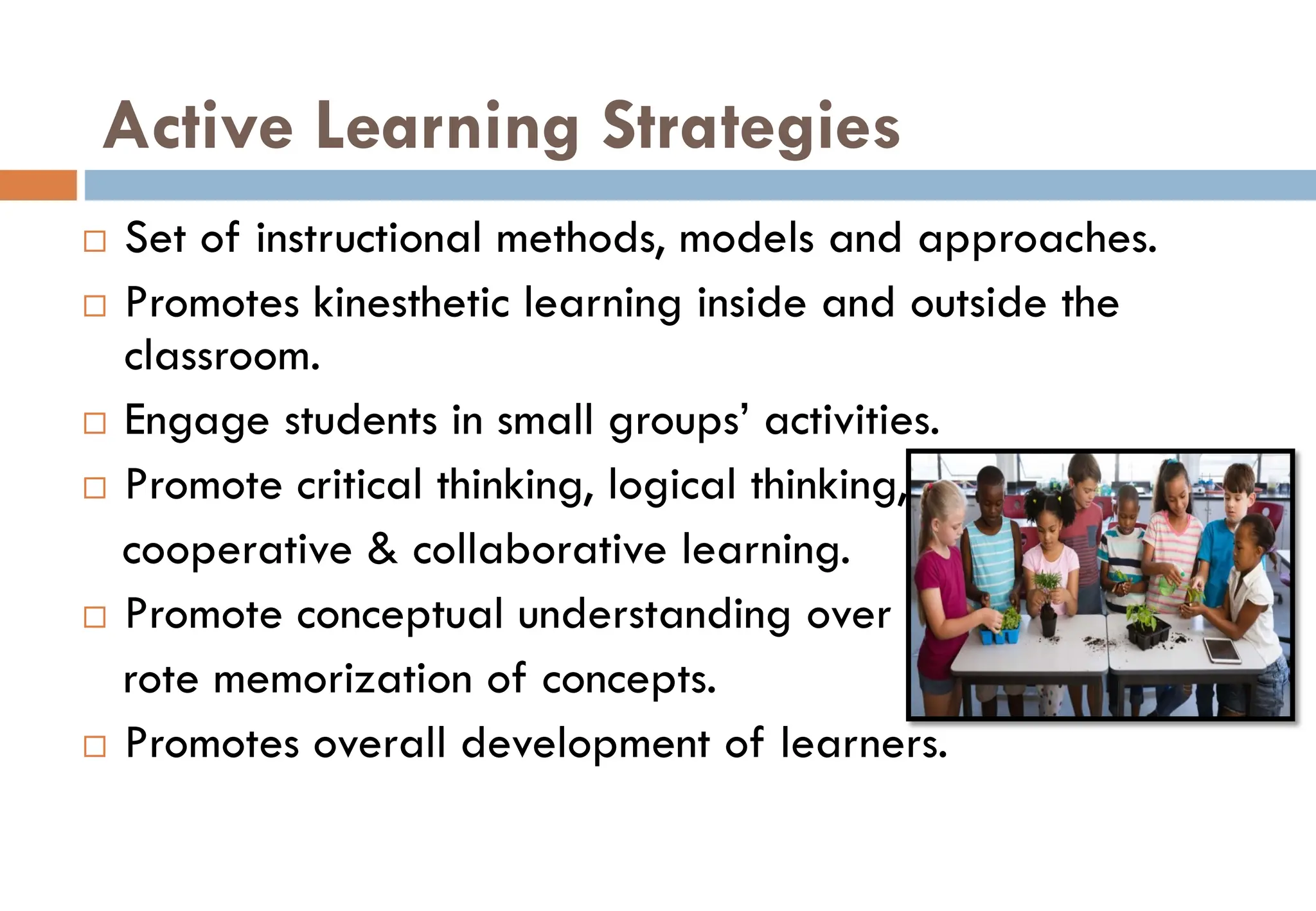
 Set of instructional methods, models and approaches.
 Promotes kinesthetic learning inside and outside the
classroom.
 Engage students in small groups’ activities.
 Promote critical thinking, logical thinking,
cooperative & collaborative learning.
 Promote conceptual understanding over
rote memorization of concepts.
 Promotes overall development of learners.
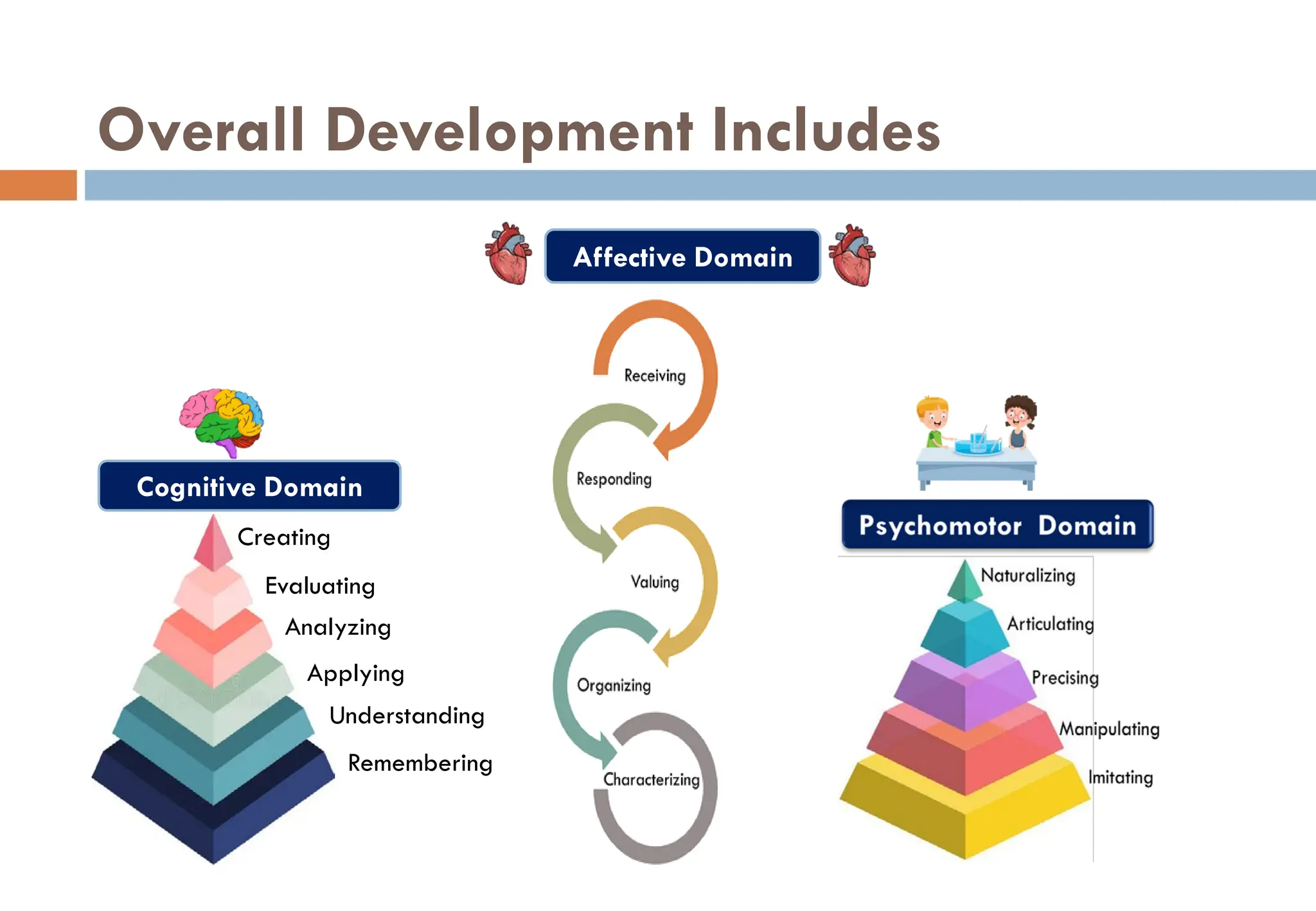
Overall Development Includes
Cognitive Domain
Creating
Evaluating
Analyzing
Applying
Understanding
Remembering
Affective Domain
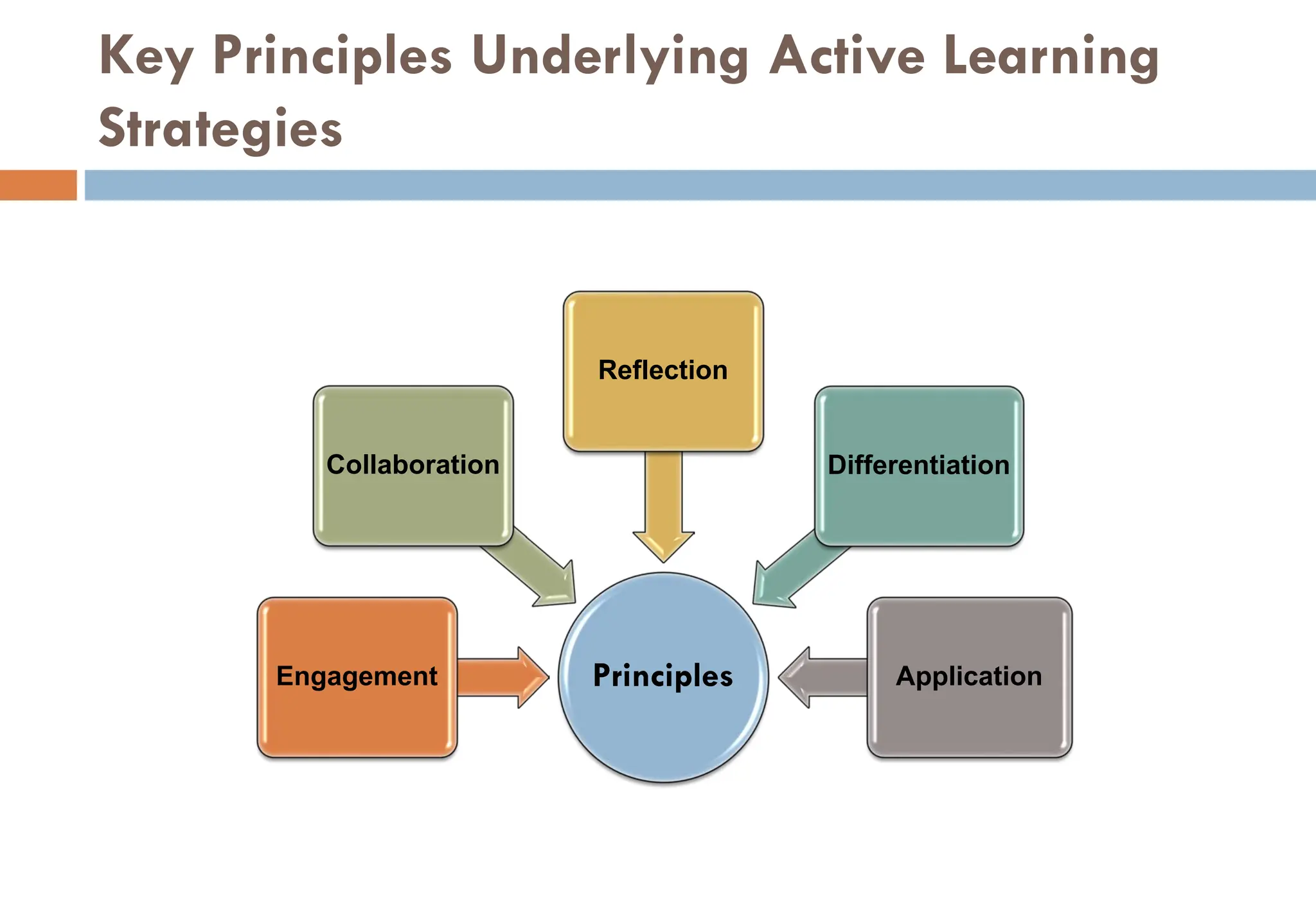
Key Principles Underlying Active Learning
Strategies
Principles
Engagement
Collaboration
Reflection
Differentiation
Application
Role of Teachers & Learners in Active
Learning Strategies
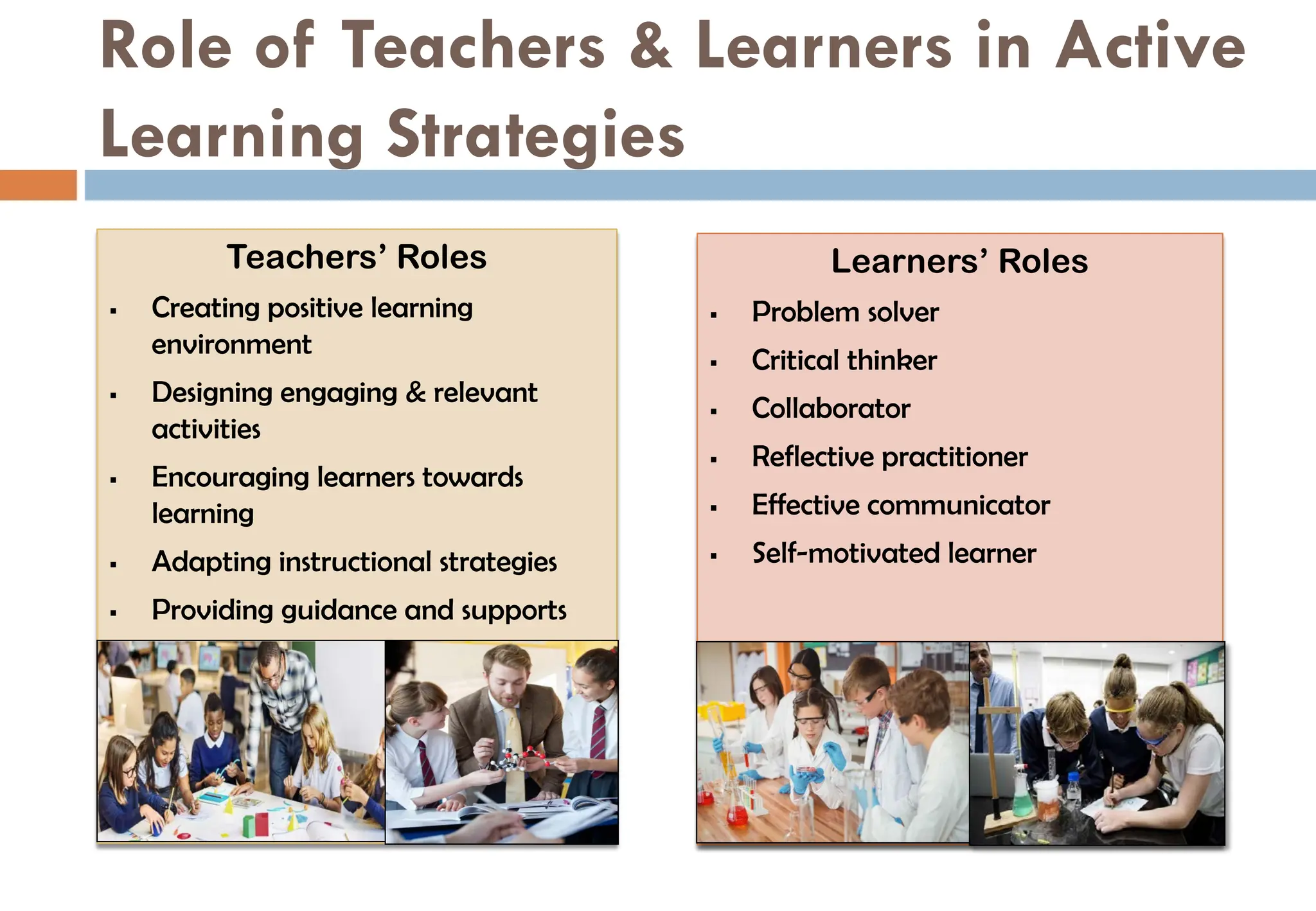
Teachers’ Roles
 Creating positive learning
environment
 Designing engaging & relevant
activities
 Encouraging learners towards
learning
 Adapting instructional strategies
 Providing guidance and supports
 Providing resources
Learners’ Roles
 Problem solver
 Critical thinker
 Collaborator
 Reflective practitioner
 Effective communicator
 Self-motivated learner
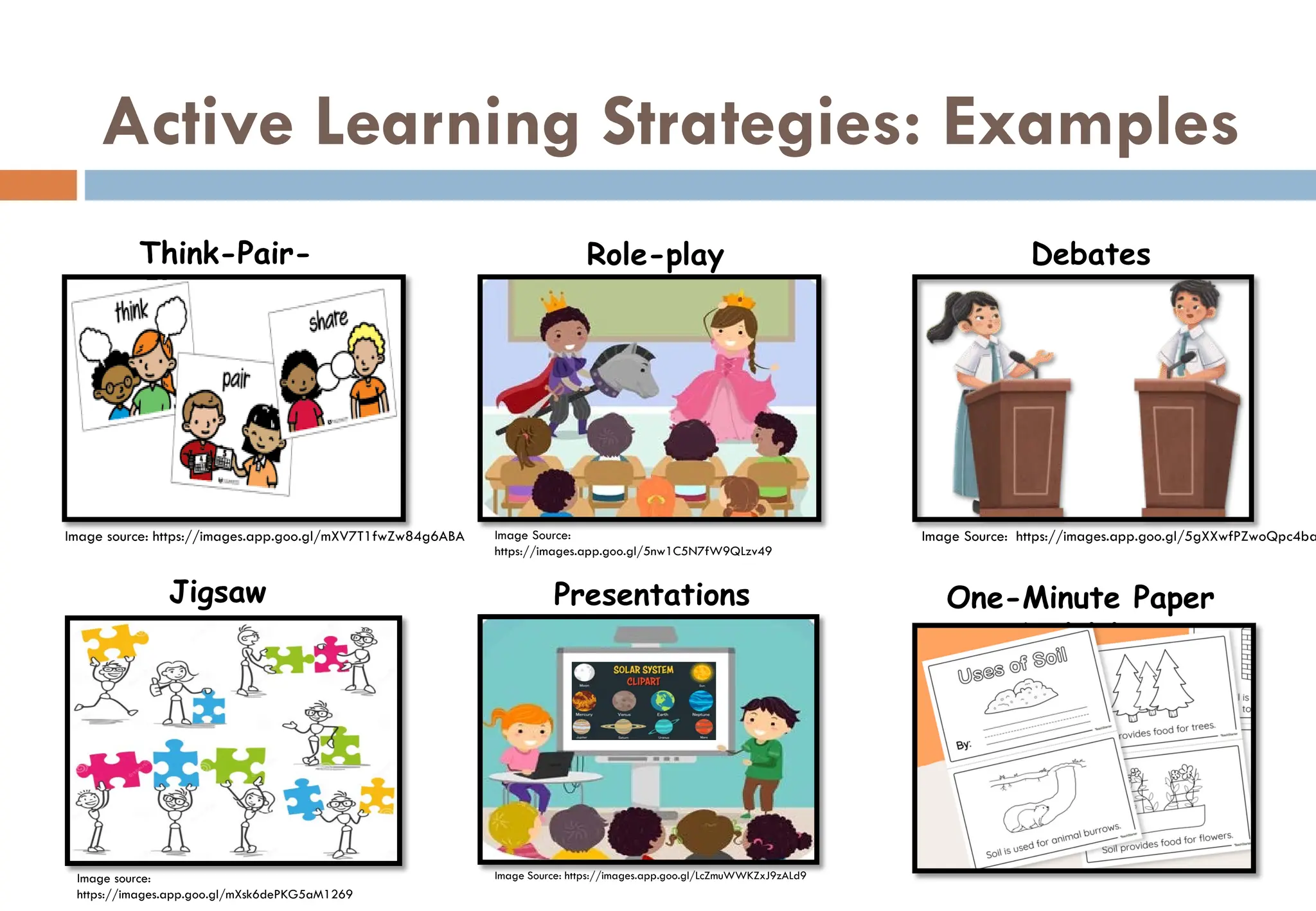
Active Learning Strategies: Examples
Think-Pair-
Share
Jigsaw
Debates
Presentations One-Minute Paper
Activities
Role-play
Image source: https://images.app.goo.gl/mXV7T1fwZw84g6ABA Image Source: https://images.app.goo.gl/5gXXwfPZwoQpc4ba
Image source:
https://images.app.goo.gl/mXsk6dePKG5aM1269
Image Source:
https://images.app.goo.gl/5nw1C5N7fW9QLzv49
Image Source: https://images.app.goo.gl/LcZmuWWKZxJ9zALd9
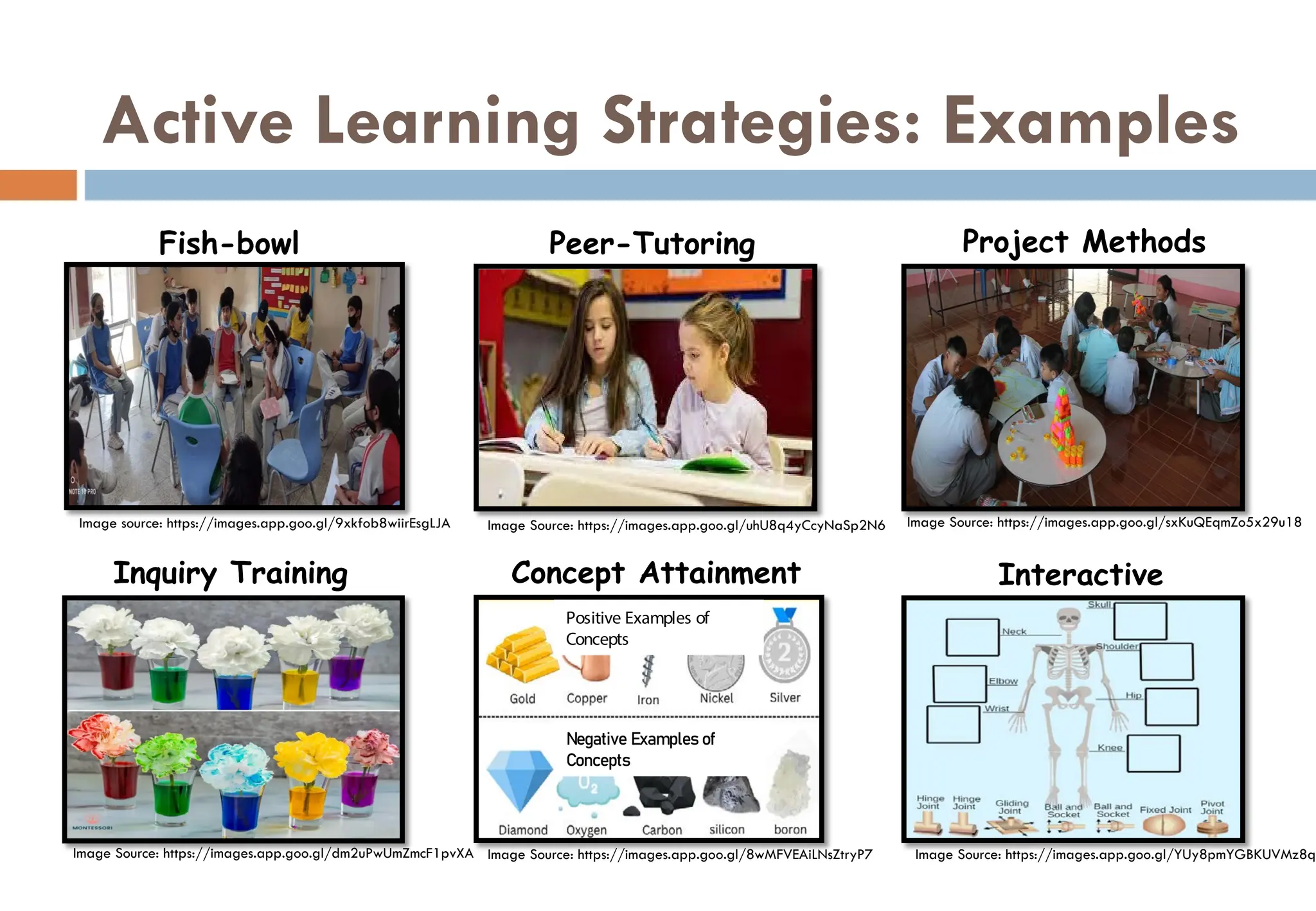
Active Learning Strategies: Examples
Fish-bowl
Inquiry Training
Model
Project Methods
Concept Attainment
Model
Interactive
Worksheets
Peer-Tutoring
Positive Examples of
Concepts
Negative Examplesof
Concepts
Image source: https://images.app.goo.gl/9xkfob8wiirEsgLJA Image Source: https://images.app.goo.gl/sxKuQEqmZo5x29u18
Image Source: https://images.app.goo.gl/uhU8q4yCcyNaSp2N6
Image Source: https://images.app.goo.gl/YUy8pmYGBKUVMz8q
Image Source: https://images.app.goo.gl/8wMFVEAiLNsZtryP7
Image Source: https://images.app.goo.gl/dm2uPwUmZmcF1pvXA
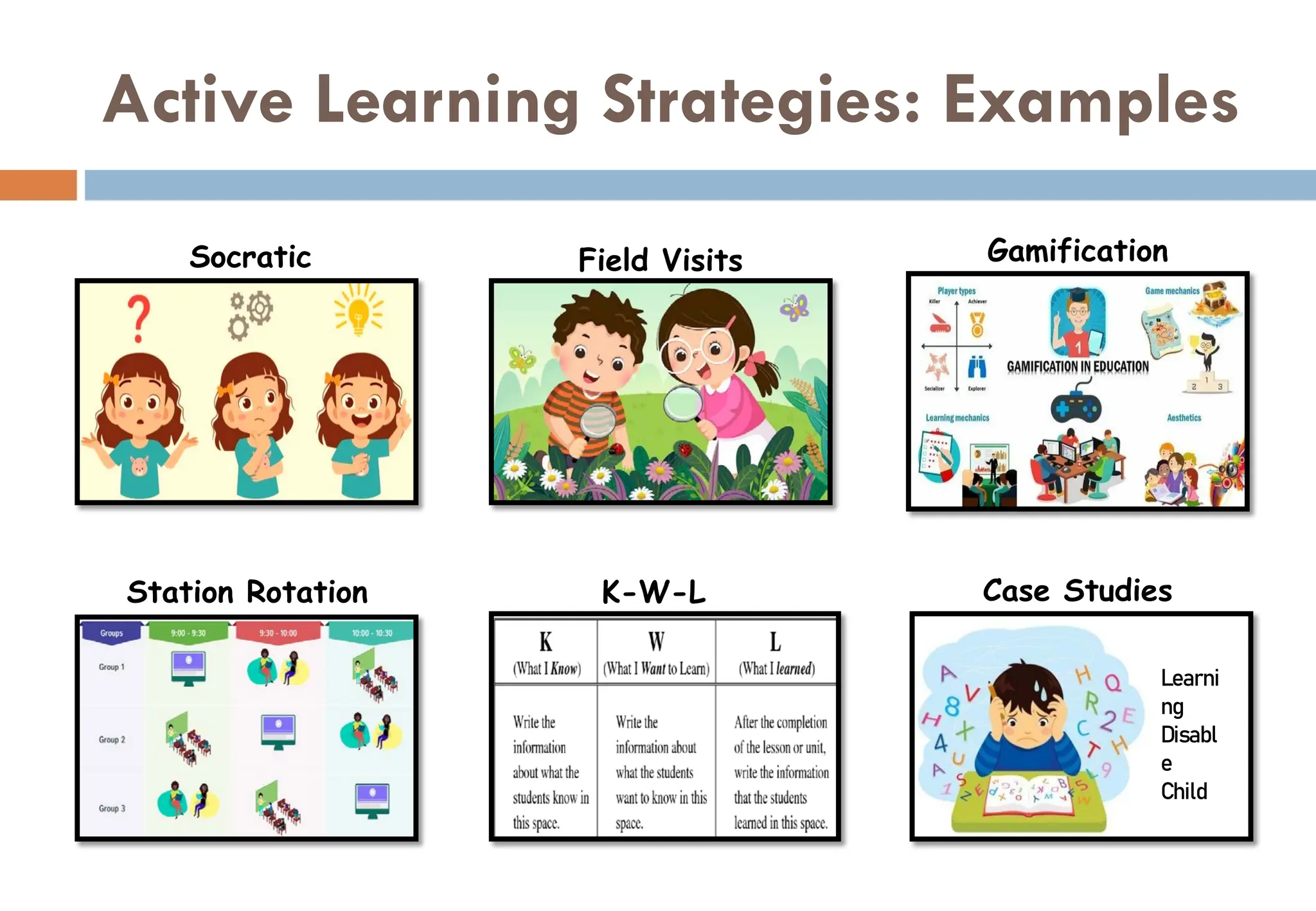
Active Learning Strategies: Examples
Socratic
Questioning
Station Rotation
Model
Gamification
K-W-L Case Studies
Field Visits
Learni
ng
Disabl
e
Child
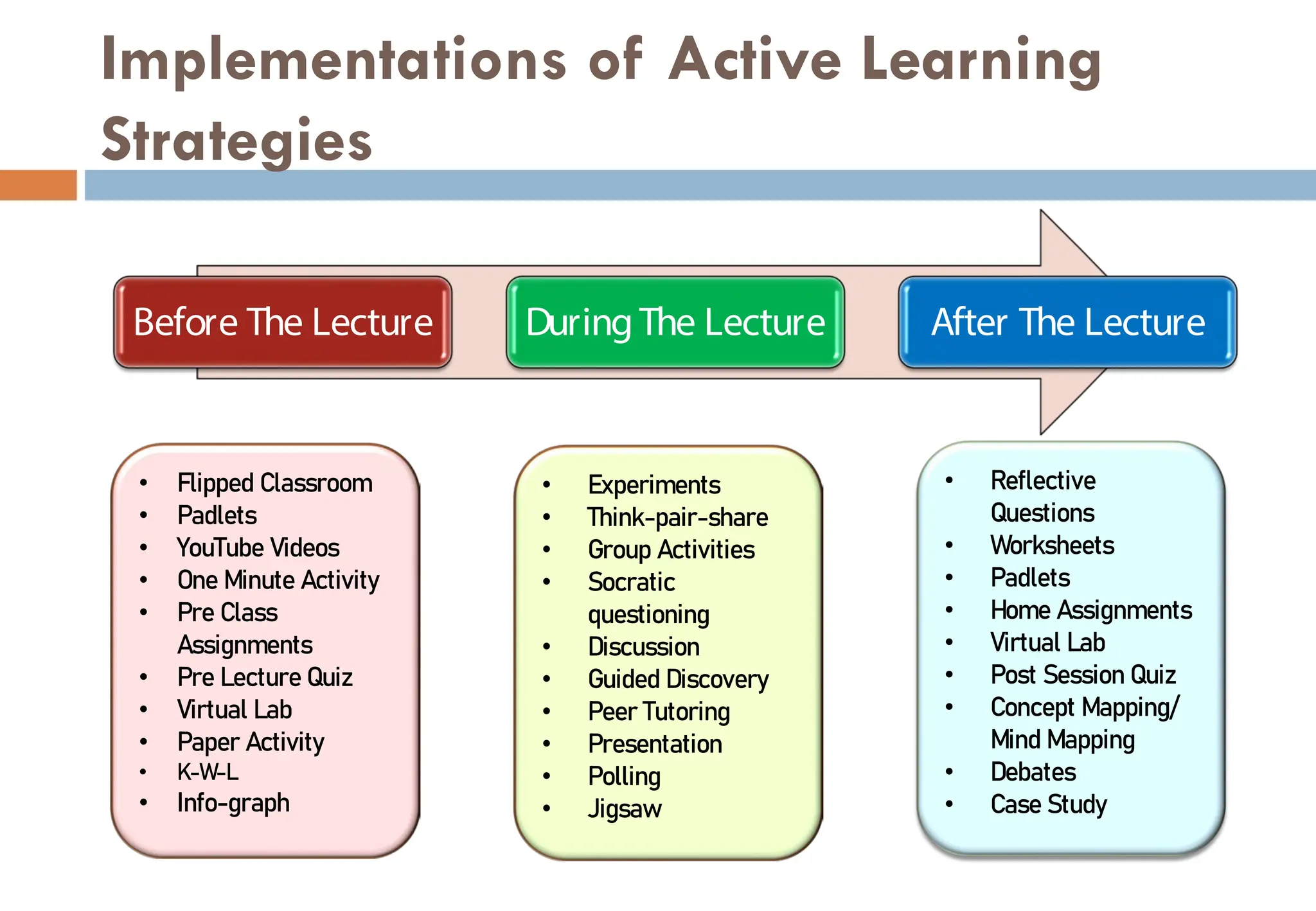
Implementations of Active Learning
Strategies
Before The Lecture DuringThe Lecture After The Lecture
• Flipped Classroom
• Padlets
• YouTube Videos
• One Minute Activity
• Pre Class
Assignments
• Pre LectureQuiz
• Virtual Lab
• Paper Activity
• K-W-L
• Info-graph
• Reflective
Questions
• Worksheets
• Padlets
• Home Assignments
• Virtual Lab
• Post SessionQuiz
• Concept Mapping/
Mind Mapping
• Debates
• CaseStudy
• Experiments
• Think-pair-share
• Group Activities
• Socratic
questioning
• Discussion
• Guided Discovery
• Peer Tutoring
• Presentation
• Polling
• Jigsaw
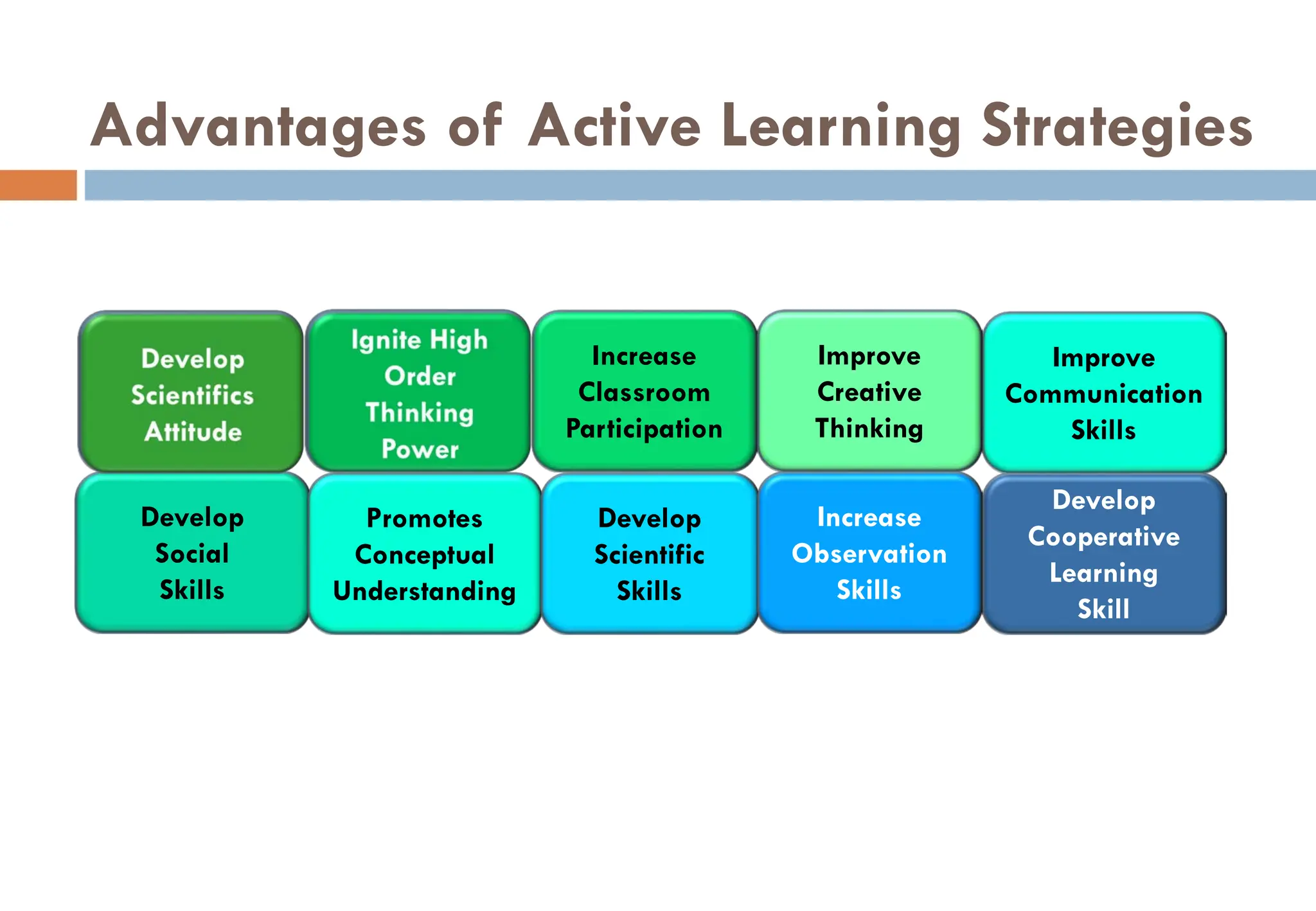
Advantages of Active Learning Strategies
Develop
Social
Skills
Develop
Cooperative
Learning
Skill
Improve
Communication
Skills
Promotes
Conceptual
Understanding
Develop
Scientific
Skills
Increase
Classroom
Participation
Improve
Creative
Thinking
Increase
Observation
Skills
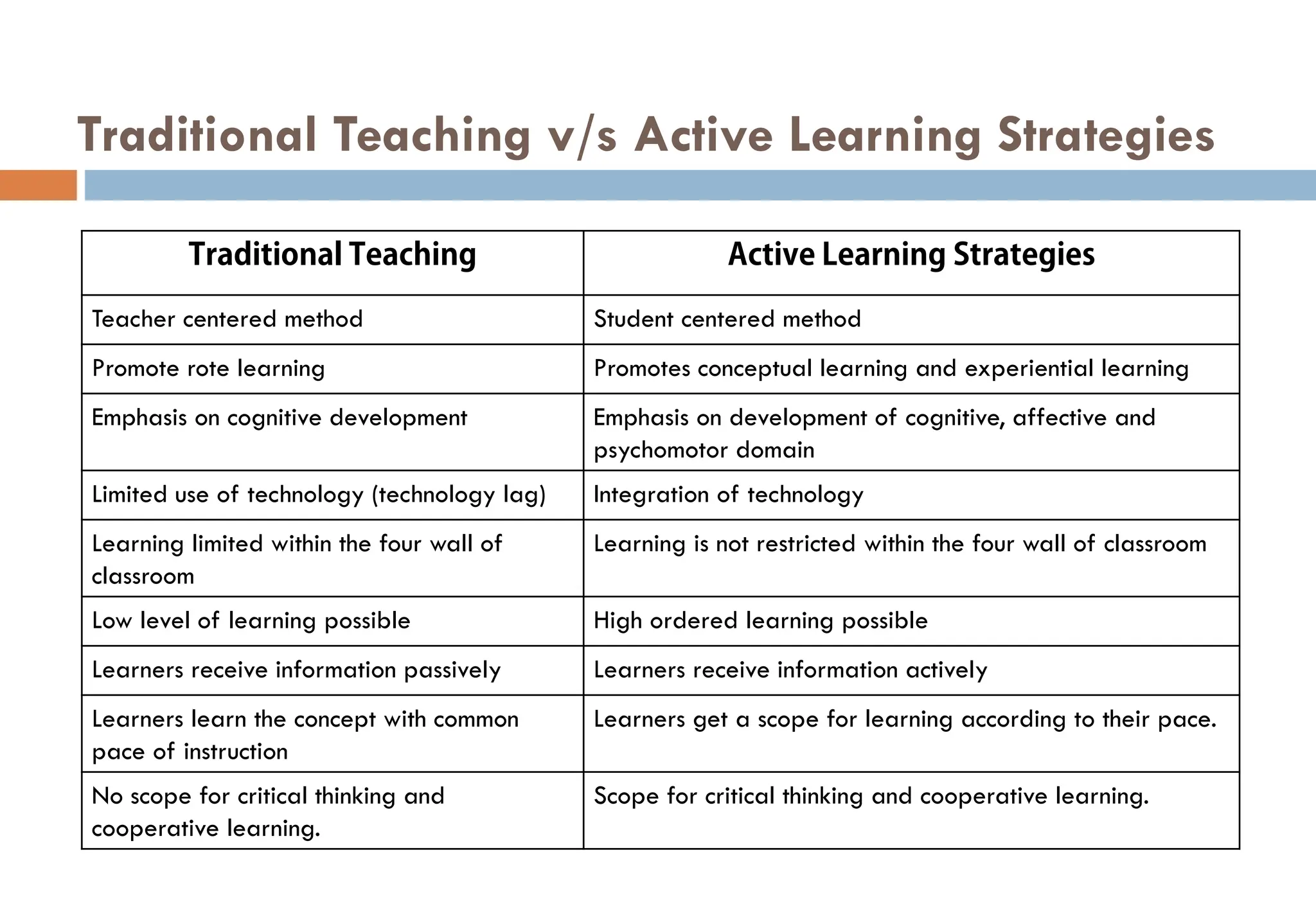
Traditional Teaching v/s Active Learning Strategies
Traditional Teaching Active Learning Strategies
Teacher centered method Student centered method
Promote rote learning Promotes conceptual learning and experiential learning
Emphasis on cognitive development Emphasis on development of cognitive, affective and
psychomotor domain
Limited use of technology (technology lag) Integration of technology
Learning limited within the four wall of
classroom
Learning is not restricted within the four wall of classroom
Low level of learning possible High ordered learning possible
Learners receive information passively Learners receive information actively
Learners learn the concept with common
pace of instruction
Learners get a scope for learning according to their pace.
No scope for critical thinking and
cooperative learning.
Scope for critical thinking and cooperative learning.
Questions
Active Learning Strategies (in short ALS).pdf

Active Learning Strategies (in short ALS).pdf

  • 1.
    Presented by: MPATIDAR Date: 08-April-2024
  • 2.
    Contents  Traditional Teaching:An Introduction  Role of Teachers & Learners in Traditional Method of Teaching  Active Learning Strategies: An Introduction  Key Principles Behind Active Learning Strategies  Active Learning Strategies: Examples  Implementations of Active Learning Strategies  Difference Between Active Learning and Traditional Teaching
  • 3.
    Traditional Teaching: AnIntroduction Image source: https://www.slideshare.net/keerthigopi222/lecture-method- 32981272  Also known as: Conventional Method, Lecture Method, Chalk-and-Talk Method, Teacher-Centric .  Most commonly used method.  Teacher act as sole source of information.  Learners receive information passively.  Conducted within the four walls of classroom.  Focuses on development of cognitive domain only.
  • 4.
    Role of Teachers& Learners in Traditional Method of Teaching Teachers’ Role  Knowledge transmission  Knowledge of content  Emphasis on discipline  Focus on completing the course  Focused on to use lectures and textbooks  Promote rote learning Learners’ Role  Taking notes  Listening to lectures attentively  Answer questions, if asked  Memorizing concepts  Completing assignments  Passive participation in classroom teaching Image Source: (1). https://images.app.goo.gl/kCyY4ytS8DCDEGaM8 (2) https://images.app.goo.gl/bTKonWYUZdzVQsxz8 Image retrieved from: https://images.app.goo.gl/3RPngn8yjgoif4gu9
  • 5.
    How Learners RetainInformation 10% of what they read 25% of what they see* 50% of what they discuss 75% of what they practise 5% of what they listen Based on the Learning Pyramid model by the National Training Laboratories Institute, and later in the book Audio-Visual Methods in Teaching (1954) by Edgar Dale. 5% 10% 25% 50% 75% LISTEN READ SEE DISCUSSPRACTISE * According to the Learning Pyramid model, learners retain 20% from audio-visuals, and 30% from demonstrations; hence the average under ‘see’.
  • 6.
    Continue…..  From thegraph it is clear that traditional teaching ensure maximum retention of information at students level is 25 percentage.  It is because, it dose not provide platform to students for classroom discussion.  Also it dose not engage students in classroom practical work.  It promotes one way communication in classroom.
  • 7.
    Questions ???  Whichmethods ensure maximum retention of concepts at learner level?  Which types of teaching methods as a teacher we have to adopt in over classroom that promotes concept understanding rather than rote memorization of concepts ?  How to teach in over classroom that ensures the overall development of learners’ cognitive, affective & psychomotor domain?
  • 8.
    Active Learning Strategies Set of instructional methods, models and approaches.  Promotes kinesthetic learning inside and outside the classroom.  Engage students in small groups’ activities.  Promote critical thinking, logical thinking, cooperative & collaborative learning.  Promote conceptual understanding over rote memorization of concepts.  Promotes overall development of learners.
  • 9.
    Overall Development Includes CognitiveDomain Creating Evaluating Analyzing Applying Understanding Remembering Affective Domain
  • 10.
    Key Principles UnderlyingActive Learning Strategies Principles Engagement Collaboration Reflection Differentiation Application
  • 11.
    Role of Teachers& Learners in Active Learning Strategies Teachers’ Roles  Creating positive learning environment  Designing engaging & relevant activities  Encouraging learners towards learning  Adapting instructional strategies  Providing guidance and supports  Providing resources Learners’ Roles  Problem solver  Critical thinker  Collaborator  Reflective practitioner  Effective communicator  Self-motivated learner
  • 12.
    Active Learning Strategies:Examples Think-Pair- Share Jigsaw Debates Presentations One-Minute Paper Activities Role-play Image source: https://images.app.goo.gl/mXV7T1fwZw84g6ABA Image Source: https://images.app.goo.gl/5gXXwfPZwoQpc4ba Image source: https://images.app.goo.gl/mXsk6dePKG5aM1269 Image Source: https://images.app.goo.gl/5nw1C5N7fW9QLzv49 Image Source: https://images.app.goo.gl/LcZmuWWKZxJ9zALd9
  • 13.
    Active Learning Strategies:Examples Fish-bowl Inquiry Training Model Project Methods Concept Attainment Model Interactive Worksheets Peer-Tutoring Positive Examples of Concepts Negative Examplesof Concepts Image source: https://images.app.goo.gl/9xkfob8wiirEsgLJA Image Source: https://images.app.goo.gl/sxKuQEqmZo5x29u18 Image Source: https://images.app.goo.gl/uhU8q4yCcyNaSp2N6 Image Source: https://images.app.goo.gl/YUy8pmYGBKUVMz8q Image Source: https://images.app.goo.gl/8wMFVEAiLNsZtryP7 Image Source: https://images.app.goo.gl/dm2uPwUmZmcF1pvXA
  • 14.
    Active Learning Strategies:Examples Socratic Questioning Station Rotation Model Gamification K-W-L Case Studies Field Visits Learni ng Disabl e Child
  • 15.
    Implementations of ActiveLearning Strategies Before The Lecture DuringThe Lecture After The Lecture • Flipped Classroom • Padlets • YouTube Videos • One Minute Activity • Pre Class Assignments • Pre LectureQuiz • Virtual Lab • Paper Activity • K-W-L • Info-graph • Reflective Questions • Worksheets • Padlets • Home Assignments • Virtual Lab • Post SessionQuiz • Concept Mapping/ Mind Mapping • Debates • CaseStudy • Experiments • Think-pair-share • Group Activities • Socratic questioning • Discussion • Guided Discovery • Peer Tutoring • Presentation • Polling • Jigsaw
  • 16.
    Advantages of ActiveLearning Strategies Develop Social Skills Develop Cooperative Learning Skill Improve Communication Skills Promotes Conceptual Understanding Develop Scientific Skills Increase Classroom Participation Improve Creative Thinking Increase Observation Skills
  • 17.
    Traditional Teaching v/sActive Learning Strategies Traditional Teaching Active Learning Strategies Teacher centered method Student centered method Promote rote learning Promotes conceptual learning and experiential learning Emphasis on cognitive development Emphasis on development of cognitive, affective and psychomotor domain Limited use of technology (technology lag) Integration of technology Learning limited within the four wall of classroom Learning is not restricted within the four wall of classroom Low level of learning possible High ordered learning possible Learners receive information passively Learners receive information actively Learners learn the concept with common pace of instruction Learners get a scope for learning according to their pace. No scope for critical thinking and cooperative learning. Scope for critical thinking and cooperative learning.
  • 18.