PACKAGING
TEXTILES
By
S. BALAMURUGAN
(17MT61)
INTRODUCTION
 Packaging textiles include all textile packing
material for industrial, agricultural and other goods
 It is used to contain, carry, store, and protect goods
 Packing material demand and economic growth,
industrial production and trade
 Growing need for reusable packages & containers
gives a new opportunities for textile products
 Technical textiles, used in packaging & subsequent
transportation are called “PACKTECH.”
TEXTILE MATERIALS USED IN
CONSUMER PACKING
 Polyolefin Woven Sacks (excluding FIBC)
 Flexible Intermediate Bulk Containers (FIBC)
 Leno bags
 Wrapping fabric
 Jute Hessian and Sacks (including Food grade
jute bags)
 Soft luggage products (TT component)
 Tea-bags (filter paper)
 Twine & string for tying packages
 Food soaker pads
CONTRIBUTION OF TEXTILE
MATERIALS IN USAGE OF PACKTECH
 Polyolefin Woven Sacks (excluding FIBC)
account for around 50% of technical textile
consumption under Packtech
 Followed by jute hessian & sacks with around
30% share
 FIBC & wrapping fabrics account for around
20% of the total usage
 Usage of technical textile in soft luggage
products, leno bags is less than 5% of total
usage in packtech
POLYOLEFIN WOVEN SACKS
(EXCLUDING FIBC)
 Versatile packaging material
 Used widely in the packing of cement, fertilizers,
thermo plastic raw materials, food grains, sugar,
chemicals, cattle feed, salt etc.
 Advantages:
 Higher strength
 Light weight
 Minimal seepage
 Moisture proof
 Long lasting
 Cheaper (as it can be reused)
FLEXIBLE INTERMEDIATE BULK
CONTAINERS (FIBC)
 Popularly known as ‘Jumbo bags’
 Similar to HDPE/PP bags but that of a larger size
 The most cost effective & ideal types of packaging
for shipping & storing dry bulk products
 Produced from tubular or flat polypropylene
 Capacity 500 – 4000 kg
 Weight varies from 900 gm to 3 kg
 Types of FIBC bags:
1. Panel type
2. Circular woven
3. Baffle type (Square bags)
ADVANTAGES OF FIBC
 Low cost of material handling, inclusive wastage
of material
 Easy filling & discharge
 Savings in loading & unloading time due to ease
of handling
 Low weight package for transport
 Built in safety factor of at least 5:1 on nominal
load
 Transportation of empty FIBC’s is cheap & space
saving
 Good chemical & organic resistance
 Eco-friendly, since product is recyclable
USES OF FIBC
 Used in bulk packaging of
1. Polymers, such as PET & PVC
2. Petrochemicals, such as DMT, PTA & PET chips
3. Minerals, such as bentonite, alumina, ebonite, magnesite,
minerals ores etc.
4. Agro-products, such as wheat, rice, starch & sugar
5. Chemicals, such as carbon black, dyes & fertilizers
6. Oil cakes (powder form)
7. Detergents
8. Oat meal
9. Clay, mica & feldspar
10. Cement
11. Pharmaceuticals
12. Fish meal
LENO BAGS
 Excellent for packing & preserving vegetables like
onion, potato, ginger etc. and fruits like raw
mango, coconut etc.
 It is made up of netted fabrics of virgin
polypropylene (PP) with color master batch
Advantages:
 Superior aesthetics
 Excellent mechanical prop.
 Chemically inert
 Ease in handling & storage
 Reusable & recyclable
 Cost effective
 Suitable for dry skin vegetables & cold storage
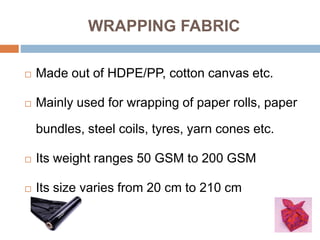
WRAPPING FABRIC
 Made out of HDPE/PP, cotton canvas etc.
 Mainly used for wrapping of paper rolls, paper
bundles, steel coils, tyres, yarn cones etc.
 Its weight ranges 50 GSM to 200 GSM
 Its size varies from 20 cm to 210 cm
JUTE HESSIAN & SACKS
Jute hessian:
 Also termed as ‘Burlap’
 The most preferred packaging material for all
of kinds of goods
 Used for bags & many other coarse fabric
uses such as wrappers, wall coverings etc.
 Also used in the upholstery & home furniture
 It meets the latest international standards for
food safety
JUTE HESSIAN & SACKS
Jute sacks:
 Available in plain or twill weaves
 Sacking refers to coarser or heavy cloths
 Used primarily for sacks for packaging materials
 Have a great demand because of the openness of
the weave, which allows air to circulate while
protecting the contents
 Sacking bags, specifically used for the purpose of
storing agro based products, are known as ‘Hydro
carbon free bags’
SOFT LUGGAGE
 The luggage industry is classified into hard luggage &
soft luggage
 Hard luggage are mainly the large travel bags made
from plastic
 Soft luggage is made out of woven fabrics like nylon &
PET
 It includes uprights, totes & duffle bags which
available with or without wheels and handles
 Its becoming more popular due to ease of carry, as it
is light & flexible
 Due to cost effectiveness & lightweight, more & more
people are shifting from hard luggage to soft goods
TEA BAGS
 It consist of a filter paper pouch with a thread,
which holds the tea powder & tag
 Tea bag filter paper is made with a blend of
wood & vegetable fibers
 It is non-woven material having 12 gsm to 17
gsm
TWINE & STRING FOR TYING
PACKAGES
 Used for all type of packaging
 High knot strength
 Low elongation
 Good resistance to friction
FOOD SOAKER PADS
As it’s name implies, it is designed to soak excess
blood & moisture produce in food trays
Perforated PE film/Non woven provides more rapid, all-
around absorption of excessive fluids are absorbed from
the bottom of the pad and lock in the pad
High quality SAP and cellulose can improve absorption
capacity, and specifically retention capacity of liquid
under external pressure
This will prevent the product leaking onto or out of the
packaging
CONCLUSIONS
Packaging textile is a growing field with concerns
on
 Eco-friendliness
 Bio-degradable
 Re-usable
 Cost effective
REFERENCES
[1]http://www.companiesandmarkets.com/MarketInsight/Textiles-and-
Clothing/TechnicalTextiles-Market/NI6995.
[2]https://www.textilesintelligence.com/tisttm/index.com.
[3] http://www.technicaltextile.net/packaging-textiles/
[4] http://www.bch.in/index.html
[5]http://butekom.com/docs/sunumlar/2013.10.09_Teknik_Tekstil/Ambalaj_Tek
stilleriAli_Ruzgar.pdf
[6] http://textilelearner.blogspot.com.tr/2013/01/packtech-textile-packaging-
material.html
[7]Horrocks, A.R., Anand, S.C., 2000, Handbook of Technical Textiles,
Woodhead Publishing Series in Textiles No. 12, UK
THANK YOU!

Packaging textiles

  • 1.
  • 2.
    INTRODUCTION  Packaging textilesinclude all textile packing material for industrial, agricultural and other goods  It is used to contain, carry, store, and protect goods  Packing material demand and economic growth, industrial production and trade  Growing need for reusable packages & containers gives a new opportunities for textile products  Technical textiles, used in packaging & subsequent transportation are called “PACKTECH.”
  • 3.
    TEXTILE MATERIALS USEDIN CONSUMER PACKING  Polyolefin Woven Sacks (excluding FIBC)  Flexible Intermediate Bulk Containers (FIBC)  Leno bags  Wrapping fabric  Jute Hessian and Sacks (including Food grade jute bags)  Soft luggage products (TT component)  Tea-bags (filter paper)  Twine & string for tying packages  Food soaker pads
  • 4.
    CONTRIBUTION OF TEXTILE MATERIALSIN USAGE OF PACKTECH  Polyolefin Woven Sacks (excluding FIBC) account for around 50% of technical textile consumption under Packtech  Followed by jute hessian & sacks with around 30% share  FIBC & wrapping fabrics account for around 20% of the total usage  Usage of technical textile in soft luggage products, leno bags is less than 5% of total usage in packtech
  • 5.
    POLYOLEFIN WOVEN SACKS (EXCLUDINGFIBC)  Versatile packaging material  Used widely in the packing of cement, fertilizers, thermo plastic raw materials, food grains, sugar, chemicals, cattle feed, salt etc.  Advantages:  Higher strength  Light weight  Minimal seepage  Moisture proof  Long lasting  Cheaper (as it can be reused)
  • 6.
    FLEXIBLE INTERMEDIATE BULK CONTAINERS(FIBC)  Popularly known as ‘Jumbo bags’  Similar to HDPE/PP bags but that of a larger size  The most cost effective & ideal types of packaging for shipping & storing dry bulk products  Produced from tubular or flat polypropylene  Capacity 500 – 4000 kg  Weight varies from 900 gm to 3 kg  Types of FIBC bags: 1. Panel type 2. Circular woven 3. Baffle type (Square bags)
  • 7.
    ADVANTAGES OF FIBC Low cost of material handling, inclusive wastage of material  Easy filling & discharge  Savings in loading & unloading time due to ease of handling  Low weight package for transport  Built in safety factor of at least 5:1 on nominal load  Transportation of empty FIBC’s is cheap & space saving  Good chemical & organic resistance  Eco-friendly, since product is recyclable
  • 8.
    USES OF FIBC Used in bulk packaging of 1. Polymers, such as PET & PVC 2. Petrochemicals, such as DMT, PTA & PET chips 3. Minerals, such as bentonite, alumina, ebonite, magnesite, minerals ores etc. 4. Agro-products, such as wheat, rice, starch & sugar 5. Chemicals, such as carbon black, dyes & fertilizers 6. Oil cakes (powder form) 7. Detergents 8. Oat meal 9. Clay, mica & feldspar 10. Cement 11. Pharmaceuticals 12. Fish meal
  • 9.
    LENO BAGS  Excellentfor packing & preserving vegetables like onion, potato, ginger etc. and fruits like raw mango, coconut etc.  It is made up of netted fabrics of virgin polypropylene (PP) with color master batch Advantages:  Superior aesthetics  Excellent mechanical prop.  Chemically inert  Ease in handling & storage  Reusable & recyclable  Cost effective  Suitable for dry skin vegetables & cold storage
  • 10.
    WRAPPING FABRIC  Madeout of HDPE/PP, cotton canvas etc.  Mainly used for wrapping of paper rolls, paper bundles, steel coils, tyres, yarn cones etc.  Its weight ranges 50 GSM to 200 GSM  Its size varies from 20 cm to 210 cm
  • 11.
    JUTE HESSIAN &SACKS Jute hessian:  Also termed as ‘Burlap’  The most preferred packaging material for all of kinds of goods  Used for bags & many other coarse fabric uses such as wrappers, wall coverings etc.  Also used in the upholstery & home furniture  It meets the latest international standards for food safety
  • 12.
    JUTE HESSIAN &SACKS Jute sacks:  Available in plain or twill weaves  Sacking refers to coarser or heavy cloths  Used primarily for sacks for packaging materials  Have a great demand because of the openness of the weave, which allows air to circulate while protecting the contents  Sacking bags, specifically used for the purpose of storing agro based products, are known as ‘Hydro carbon free bags’
  • 13.
    SOFT LUGGAGE  Theluggage industry is classified into hard luggage & soft luggage  Hard luggage are mainly the large travel bags made from plastic  Soft luggage is made out of woven fabrics like nylon & PET  It includes uprights, totes & duffle bags which available with or without wheels and handles  Its becoming more popular due to ease of carry, as it is light & flexible  Due to cost effectiveness & lightweight, more & more people are shifting from hard luggage to soft goods
  • 14.
    TEA BAGS  Itconsist of a filter paper pouch with a thread, which holds the tea powder & tag  Tea bag filter paper is made with a blend of wood & vegetable fibers  It is non-woven material having 12 gsm to 17 gsm
  • 15.
    TWINE & STRINGFOR TYING PACKAGES  Used for all type of packaging  High knot strength  Low elongation  Good resistance to friction
  • 16.
    FOOD SOAKER PADS Asit’s name implies, it is designed to soak excess blood & moisture produce in food trays Perforated PE film/Non woven provides more rapid, all- around absorption of excessive fluids are absorbed from the bottom of the pad and lock in the pad High quality SAP and cellulose can improve absorption capacity, and specifically retention capacity of liquid under external pressure This will prevent the product leaking onto or out of the packaging
  • 17.
    CONCLUSIONS Packaging textile isa growing field with concerns on  Eco-friendliness  Bio-degradable  Re-usable  Cost effective
  • 18.
  • 19.