HAWASSA UNIVERSITY
Faculty Of Manufacturing
Department Of Textile and Garment Engineering
Technical Textiles Seminar
AGROTEXTILES
By: Group 1 members
Contents
Introduction
Fibers for Agro-Textiles
Techniques of manufacturing Agro-Textiles
Properties needed for Agro Textiles
Advantage of Agro Textile
Application of Agro Textile
Market of Agro Textile
AGROTEXTILES
Common saying:
"Agriculture is the backbone of our country’s economy"
Textile products are widely used in Agriculture
throughout the world.
Do you think textile can be the backbone of
Agriculture?"
Introduction
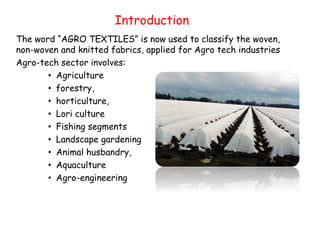
The word “AGRO TEXTILES” is now used to classify the woven,
non-woven and knitted fabrics, applied for Agro tech industries
Agro-tech sector involves:
• Agriculture
• forestry,
• horticulture,
• Lori culture
• Fishing segments
• Landscape gardening
• Animal husbandry,
• Aquaculture
• Agro-engineering
Continued…
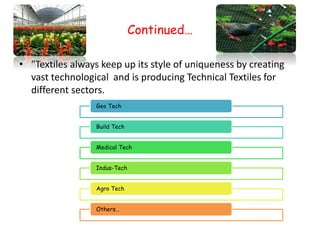
• "Textiles always keep up its style of uniqueness by creating
vast technological and is producing Technical Textiles for
different sectors.
Geo Tech
Build Tech
Medical Tech
Indus-Tech
Agro Tech
Others…
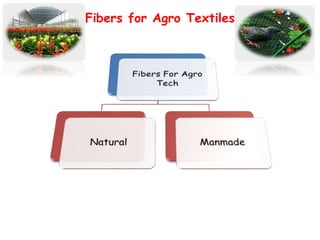
Fibers for Agro Textiles
Agro Tech Fibers
Manmade fibers
• Nylon
• Polyester
• Polyethylene
• Polyolefin
• Polypropylene
Natural fibers
– Jute
– Wool
– Coir
– Sisal
– Flax
– Hemp
Manmade or Natural Fibers?
• Man made fibers are preferred for agricultural
products than the natural fibers.
Why manmade fibers?
• Favorable price performance ratio
• Ease of transport
• Space saving storage
• Long service life.
What is good about natural fibers?
Natural fibers:
– After some year degrade and act as natural
fertilizers
– Important where the following properties are
desired
• High moisture retention
• Wet strength
• Biodegradability
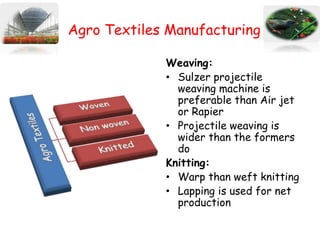
Agro Textiles Manufacturing
Weaving:
• Sulzer projectile
weaving machine is
preferable than Air jet
or Rapier
• Projectile weaving is
wider than the formers
do
Knitting:
• Warp than weft knitting
• Lapping is used for net
production
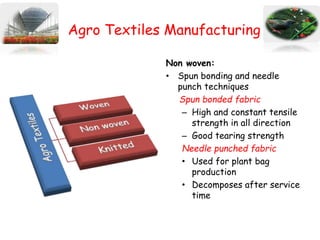
Agro Textiles Manufacturing
Non woven:
• Spun bonding and needle
punch techniques
Spun bonded fabric
– High and constant tensile
strength in all direction
– Good tearing strength
Needle punched fabric
• Used for plant bag
production
• Decomposes after service
time
Properties Needed
For Agro-Textiles
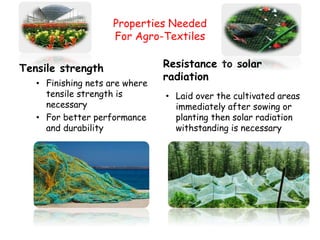
Tensile strength
• Finishing nets are where
tensile strength is
necessary
• For better performance
and durability
Resistance to solar
radiation
• Laid over the cultivated areas
immediately after sowing or
planting then solar radiation
withstanding is necessary
Continued…
Bio degradability
• Natural polymer gives the
advantage of bio-
degradation but has low
service life when compared
to the synthetics.
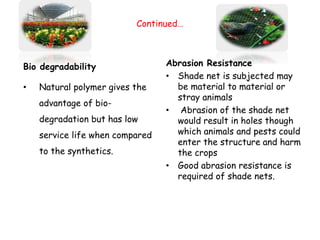
Abrasion Resistance
• Shade net is subjected may
be material to material or
stray animals
• Abrasion of the shade net
would result in holes though
which animals and pests could
enter the structure and harm
the crops
• Good abrasion resistance is
required of shade nets.
Continued…
High potential to retain
water:
• Fiber materials which
allow taking in much
water and by filling in
super-absorbers
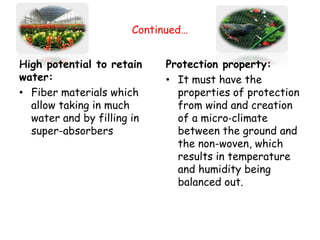
Protection property:
• It must have the
properties of protection
from wind and creation
of a micro‐climate
between the ground and
the non-woven, which
results in temperature
and humidity being
balanced out.
Continued…
Resistance to
microorganisms
• It must resistant to
microorganism to
protect the living being.
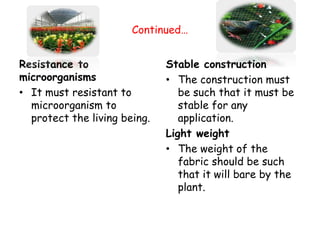
Stable construction
• The construction must
be such that it must be
stable for any
application.
Light weight
• The weight of the
fabric should be such
that it will bare by the
plant.
Advantage of Agro Textiles
They :
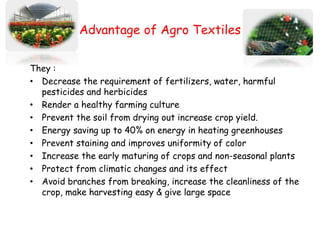
• Decrease the requirement of fertilizers, water, harmful
pesticides and herbicides
• Render a healthy farming culture
• Prevent the soil from drying out increase crop yield.
• Energy saving up to 40% on energy in heating greenhouses
• Prevent staining and improves uniformity of color
• Increase the early maturing of crops and non-seasonal plants
• Protect from climatic changes and its effect
• Avoid branches from breaking, increase the cleanliness of the
crop, make harvesting easy & give large space
Application
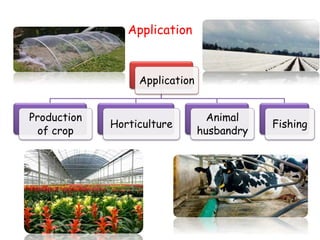
Application
Production
of crop
Horticulture
Animal
husbandry
Fishing
Application
For crop production
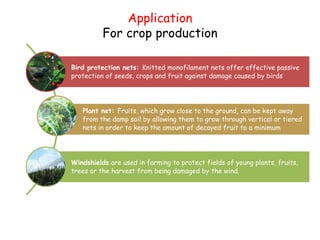
Bird protection nets: Knitted monofilament nets offer effective passive
protection of seeds, crops and fruit against damage caused by birds
Plant net: Fruits, which grow close to the ground, can be kept away
from the damp soil by allowing them to grow through vertical or tiered
nets in order to keep the amount of decayed fruit to a minimum
Windshields are used in farming to protect fields of young plants, fruits,
trees or the harvest from being damaged by the wind.
Application
For Crop Production
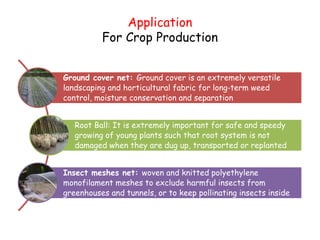
Ground cover net: Ground cover is an extremely versatile
landscaping and horticultural fabric for long‐term weed
control, moisture conservation and separation
Root Ball: It is extremely important for safe and speedy
growing of young plants such that root system is not
damaged when they are dug up, transported or replanted
Insect meshes net: woven and knitted polyethylene
monofilament meshes to exclude harmful insects from
greenhouses and tunnels, or to keep pollinating insects inside
Application
For Crop Production
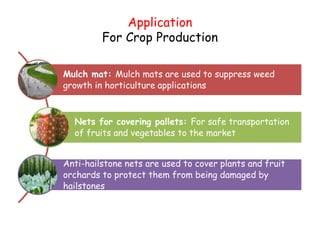
Mulch mat: Mulch mats are used to suppress weed
growth in horticulture applications
Nets for covering pallets: For safe transportation
of fruits and vegetables to the market
Anti-hailstone nets are used to cover plants and fruit
orchards to protect them from being damaged by
hailstones
Application
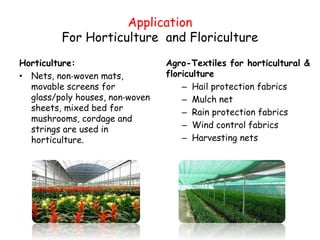
For Horticulture and Floriculture
Horticulture:
• Nets, non‐woven mats,
movable screens for
glass/poly houses, non‐woven
sheets, mixed bed for
mushrooms, cordage and
strings are used in
horticulture.
Agro-Textiles for horticultural &
floriculture
– Hail protection fabrics
– Mulch net
– Rain protection fabrics
– Wind control fabrics
– Harvesting nets
Application
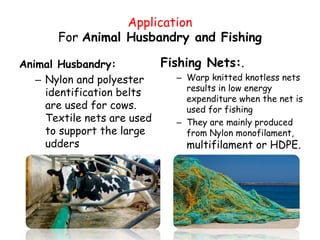
For Animal Husbandry and Fishing
Animal Husbandry:
– Nylon and polyester
identification belts
are used for cows.
Textile nets are used
to support the large
udders
Fishing Nets:.
– Warp knitted knotless nets
results in low energy
expenditure when the net is
used for fishing
– They are mainly produced
from Nylon monofilament,
multifilament or HDPE.
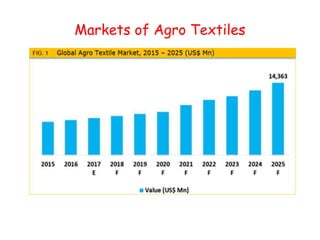
Markets of Agro Textiles
Agrotextiles

Agrotextiles

  • 1.
    HAWASSA UNIVERSITY Faculty OfManufacturing Department Of Textile and Garment Engineering Technical Textiles Seminar AGROTEXTILES By: Group 1 members
  • 2.
    Contents Introduction Fibers for Agro-Textiles Techniquesof manufacturing Agro-Textiles Properties needed for Agro Textiles Advantage of Agro Textile Application of Agro Textile Market of Agro Textile
  • 3.
    AGROTEXTILES Common saying: "Agriculture isthe backbone of our country’s economy" Textile products are widely used in Agriculture throughout the world. Do you think textile can be the backbone of Agriculture?"
  • 4.
    Introduction The word “AGROTEXTILES” is now used to classify the woven, non-woven and knitted fabrics, applied for Agro tech industries Agro-tech sector involves: • Agriculture • forestry, • horticulture, • Lori culture • Fishing segments • Landscape gardening • Animal husbandry, • Aquaculture • Agro-engineering
  • 5.
    Continued… • "Textiles alwayskeep up its style of uniqueness by creating vast technological and is producing Technical Textiles for different sectors. Geo Tech Build Tech Medical Tech Indus-Tech Agro Tech Others…
  • 6.
  • 7.
    Agro Tech Fibers Manmadefibers • Nylon • Polyester • Polyethylene • Polyolefin • Polypropylene Natural fibers – Jute – Wool – Coir – Sisal – Flax – Hemp
  • 8.
    Manmade or NaturalFibers? • Man made fibers are preferred for agricultural products than the natural fibers. Why manmade fibers? • Favorable price performance ratio • Ease of transport • Space saving storage • Long service life.
  • 9.
    What is goodabout natural fibers? Natural fibers: – After some year degrade and act as natural fertilizers – Important where the following properties are desired • High moisture retention • Wet strength • Biodegradability
  • 10.
    Agro Textiles Manufacturing Weaving: •Sulzer projectile weaving machine is preferable than Air jet or Rapier • Projectile weaving is wider than the formers do Knitting: • Warp than weft knitting • Lapping is used for net production
  • 11.
    Agro Textiles Manufacturing Nonwoven: • Spun bonding and needle punch techniques Spun bonded fabric – High and constant tensile strength in all direction – Good tearing strength Needle punched fabric • Used for plant bag production • Decomposes after service time
  • 12.
    Properties Needed For Agro-Textiles Tensilestrength • Finishing nets are where tensile strength is necessary • For better performance and durability Resistance to solar radiation • Laid over the cultivated areas immediately after sowing or planting then solar radiation withstanding is necessary
  • 13.
    Continued… Bio degradability • Naturalpolymer gives the advantage of bio- degradation but has low service life when compared to the synthetics. Abrasion Resistance • Shade net is subjected may be material to material or stray animals • Abrasion of the shade net would result in holes though which animals and pests could enter the structure and harm the crops • Good abrasion resistance is required of shade nets.
  • 14.
    Continued… High potential toretain water: • Fiber materials which allow taking in much water and by filling in super-absorbers Protection property: • It must have the properties of protection from wind and creation of a micro‐climate between the ground and the non-woven, which results in temperature and humidity being balanced out.
  • 15.
    Continued… Resistance to microorganisms • Itmust resistant to microorganism to protect the living being. Stable construction • The construction must be such that it must be stable for any application. Light weight • The weight of the fabric should be such that it will bare by the plant.
  • 16.
    Advantage of AgroTextiles They : • Decrease the requirement of fertilizers, water, harmful pesticides and herbicides • Render a healthy farming culture • Prevent the soil from drying out increase crop yield. • Energy saving up to 40% on energy in heating greenhouses • Prevent staining and improves uniformity of color • Increase the early maturing of crops and non-seasonal plants • Protect from climatic changes and its effect • Avoid branches from breaking, increase the cleanliness of the crop, make harvesting easy & give large space
  • 17.
  • 18.
    Application For crop production Birdprotection nets: Knitted monofilament nets offer effective passive protection of seeds, crops and fruit against damage caused by birds Plant net: Fruits, which grow close to the ground, can be kept away from the damp soil by allowing them to grow through vertical or tiered nets in order to keep the amount of decayed fruit to a minimum Windshields are used in farming to protect fields of young plants, fruits, trees or the harvest from being damaged by the wind.
  • 19.
    Application For Crop Production Groundcover net: Ground cover is an extremely versatile landscaping and horticultural fabric for long‐term weed control, moisture conservation and separation Root Ball: It is extremely important for safe and speedy growing of young plants such that root system is not damaged when they are dug up, transported or replanted Insect meshes net: woven and knitted polyethylene monofilament meshes to exclude harmful insects from greenhouses and tunnels, or to keep pollinating insects inside
  • 20.
    Application For Crop Production Mulchmat: Mulch mats are used to suppress weed growth in horticulture applications Nets for covering pallets: For safe transportation of fruits and vegetables to the market Anti-hailstone nets are used to cover plants and fruit orchards to protect them from being damaged by hailstones
  • 21.
    Application For Horticulture andFloriculture Horticulture: • Nets, non‐woven mats, movable screens for glass/poly houses, non‐woven sheets, mixed bed for mushrooms, cordage and strings are used in horticulture. Agro-Textiles for horticultural & floriculture – Hail protection fabrics – Mulch net – Rain protection fabrics – Wind control fabrics – Harvesting nets
  • 22.
    Application For Animal Husbandryand Fishing Animal Husbandry: – Nylon and polyester identification belts are used for cows. Textile nets are used to support the large udders Fishing Nets:. – Warp knitted knotless nets results in low energy expenditure when the net is used for fishing – They are mainly produced from Nylon monofilament, multifilament or HDPE.
  • 23.