1
IE 5551 -Production Planning and
Inventory Control
Saif Benjaafar
Industrial & Systems Engineering
University of Minnesota
2.
2
Introduction tomethods for managing production,
inventory, and distribution systems
Topics covered include demand forecasting,
capacity planning, production planning and
scheduling, production and inventory control, and
supply chain coordination
Use of quantitative models and analytical tools for
supporting decisions in each of the above areas
Course Objectives
3.
3
Special emphasis willbe given to the link between
operational issues and strategic objectives
Implications of various emerging technologies,
business practices, and government regulations
Course Objectives (Continued…)
4.
4
An introductorycourse in probability and statistics
An introductory course in linear programming
Knowledge of Microsoft Excel & Microsoft Solver
Prerequisites
5.
5
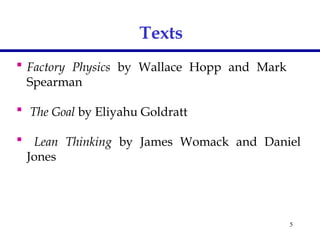
Factory Physicsby Wallace Hopp and Mark
Spearman
The Goal by Eliyahu Goldratt
Lean Thinking by James Womack and Daniel
Jones
Texts
6.
6
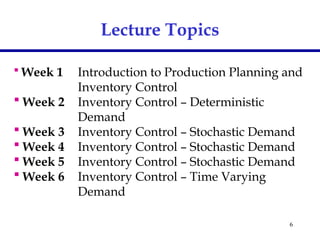
Week 1Introduction to Production Planning and
Inventory Control
Week 2 Inventory Control – Deterministic
Demand
Week 3 Inventory Control – Stochastic Demand
Week 4 Inventory Control – Stochastic Demand
Week 5 Inventory Control – Stochastic Demand
Week 6 Inventory Control – Time Varying
Demand
Lecture Topics
8
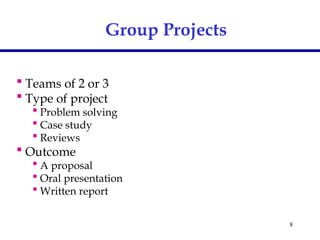
Teams of2 or 3
Type of project
Problem solving
Case study
Reviews
Outcome
A proposal
Oral presentation
Written report
Group Projects
9.
9
A mathematicalmodel
A computer model
Data collection and statistical analysis
Problem Solving
10.
10
Focus on onecompany and document:
managerial practice
use of a technology
decision making processes
Case Studies
11.
11
An industry
An emerging technology
A managerial practice
Academic research
Reviews
15
Energy efficientand sustainable supply chains
Energy consumption
Carbon footprint
Closed loop supply chains
Alternative sourcing, materials, processing
This Year’s Theme
16.
16
Production/Manufacturing
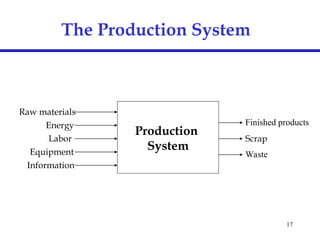
Production/manufacturing is theprocess of converting
raw materials or semi-finished products into finished
products that have value in the market place. This
process involves the contribution of labor, equipment,
energy, and information.
18
Inventory
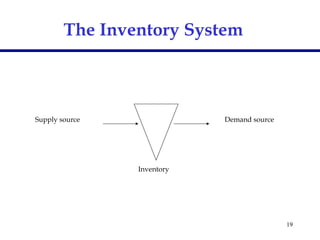
Inventory is bothan input and output of the production
process. Inventory can be in the form of raw materials,
semi-finished, and finished products.
20
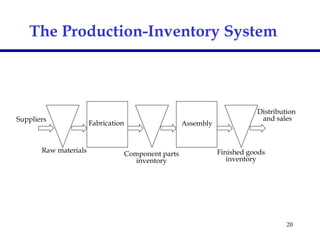
The Production-Inventory System
Rawmaterials
Suppliers
Fabrication
Component parts
inventory
Assembly
Finished goods
inventory
Distribution
and sales
21.
21
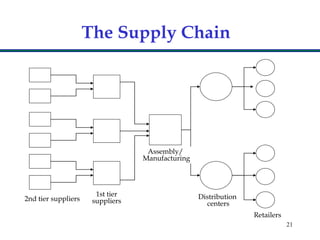
The Supply Chain
2ndtier suppliers
1st tier
suppliers
Assembly/
Manufacturing
Distribution
centers
Retailers
22.
22
Supply Chain Management
SupplyChain Management (SCM) is the set of
functions concerned with the effective utilization of
limited resources that may reside with one or more
independent firms and the management of material,
information, and financial flows within and between
these firms, so as to satisfy customer demands and create
profits for all firms.
23.
23
Production Planning and
InventoryControl
Production planning and inventory control is the subset
of SCM functions that focus on managing production
operations and inventory throughout the supply chain.
25
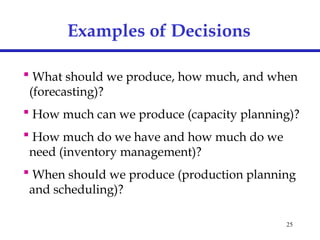
Examples of Decisions
What should we produce, how much, and when
(forecasting)?
How much can we produce (capacity planning)?
How much do we have and how much do we
need (inventory management)?
When should we produce (production planning
and scheduling)?
26.
26
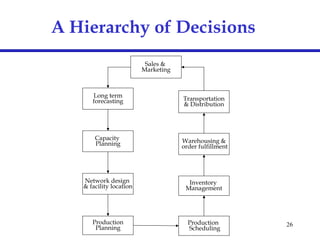
A Hierarchy ofDecisions
Long term
forecasting
Capacity
Planning
Network design
& facility location
Production
Planning
Production
Scheduling
Inventory
Management
Warehousing &
order fulfillment
Transportation
& Distribution
Sales &
Marketing
28
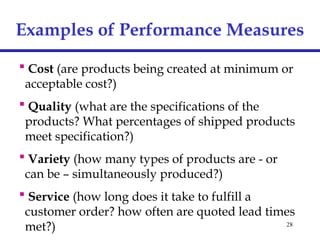
Cost (areproducts being created at minimum or
acceptable cost?)
Quality (what are the specifications of the
products? What percentages of shipped products
meet specification?)
Variety (how many types of products are - or
can be – simultaneously produced?)
Service (how long does it take to fulfill a
customer order? how often are quoted lead times
met?)
Examples of Performance Measures
29.
29
Flexibility (howquickly can existing resources
be reconfigured to produce new products?)
Worker satisfaction (are workers and managers
throughout the supply chain happy and
motivated?)
Safety (are work environments safe for workers
and the surrounding community?)
Environmental impact (how environmentally
friendly are the supply chain processes and the
products?)
Examples of Performance Measures
(continued…)
30.
30
The Bottom Line
Inthe long run, the supply chain must be
profitable by delivering value to the end customer
and to do so over the long run.
32
Classification of theProduction
Process
Production quantity
– Mass production
– Batch production
– Job shop production
33.
33
Classification of theProduction
Process
Production quantity
– Mass production
– Batch production
– Job shop production
Product variety
34.
34
Classification of theProduction
Process
Production quantity
– Mass production
– Batch production
– Job shop production
Product variety
– Single product or product line
– Family of similar products
– One-of-a-kind products
36
Mass Production Systems
Low product variety
High production volumes
Specialized labor
Dedicated equipment
High reconfiguration costs
Make-to-stock production
38
Batch Production Systems
Medium product variety
Products are made in larger lots
products are made to stock
Programmable/reconfigurable equipment
Significant setup costs
46
Classification of Production
Systems(continued…)
Inputs/outputs
– Discrete production systems (discrete inputs and
outputs - cars, computers, machine tools, etc)
– Continuous production systems (continuous inputs
and outputs - chemicals, textiles, food processing,
pharmaceuticals)
– Hybrid systems (Discrete inputs/continuous outputs
or continuous inputs/discrete outputs - steel, plastics,
recycling)
47.
47
Process capabilities
& businessstrategy
Example product attributes: price, quality,
variety, service, demand uncertainty
Example process attributes: cost, quality,
flexibility, lead time
48.
48
A firmmust choose a business strategy - attribute
values for its portfolio of products - that
differentiates it from the competition.
A firm must choose process capabilities, attribute
values for its process, that support its business
strategy.
49.
49
A businessstrategy can be driven by market
opportunities or by a competitive advantage in
process capabilities.
In both cases, there must be a fit between process
capability and business strategy.
50.
50
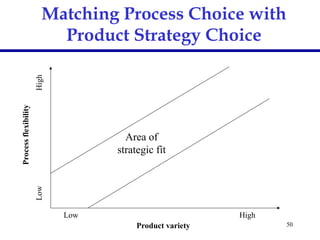
Matching Process Choicewith
Product Strategy Choice
Product variety
Low High
Area of
strategic fit
Low
High
Process
flexibility
51.
51
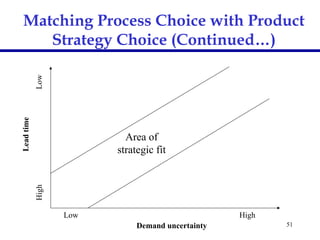
Matching Process Choicewith Product
Strategy Choice (Continued…)
Demand uncertainty
Low High
Area of
strategic fit
High
Low
Lead
time
52.
52
The Evolution ofProcess
Capabilities
Volume (1920/30/40’s)
Cost (1950/60’s)
Quality (1970/80’s)
Time (1980/1990’s)
Flexibility (1990/2000’s)
Mass customization (2000’s & beyond)