LEAN SUPPLY CHAIN MANAGEMENT: A CLEAR PATH TO PROFIT IMPROVEMENT Dan Marino, CPIM Senior Partner Marino Associates, LLC
One of the most aggressive approaches in achieving excellence in Operations is to develop and implement a  Superior  Lean Supply Chain Management process.
Supply Chain Questions How many companies in the room have  buying leverage over their supply base? No leverage Some leverage by product line Major leverage Companies without leverage, how many have successfully implemented Supply Chain Management? How many companies have systems in place and optimized that will support Supply Chain Management? How many companies are or have implemented a successful Supply Chain Management program? How many companies do business off shore and if so how successful is the supply chain process.? How many companies feel that Supply Chain Management is a key strategic goal of senior management?
Best In Class Supply Chain Companies Are Realizing Financial and Operating Advantages over Their Competition   More Responsive to Customer Needs More Responsive to Market Changes More effective in controlling Cost MORE PROFITABLE
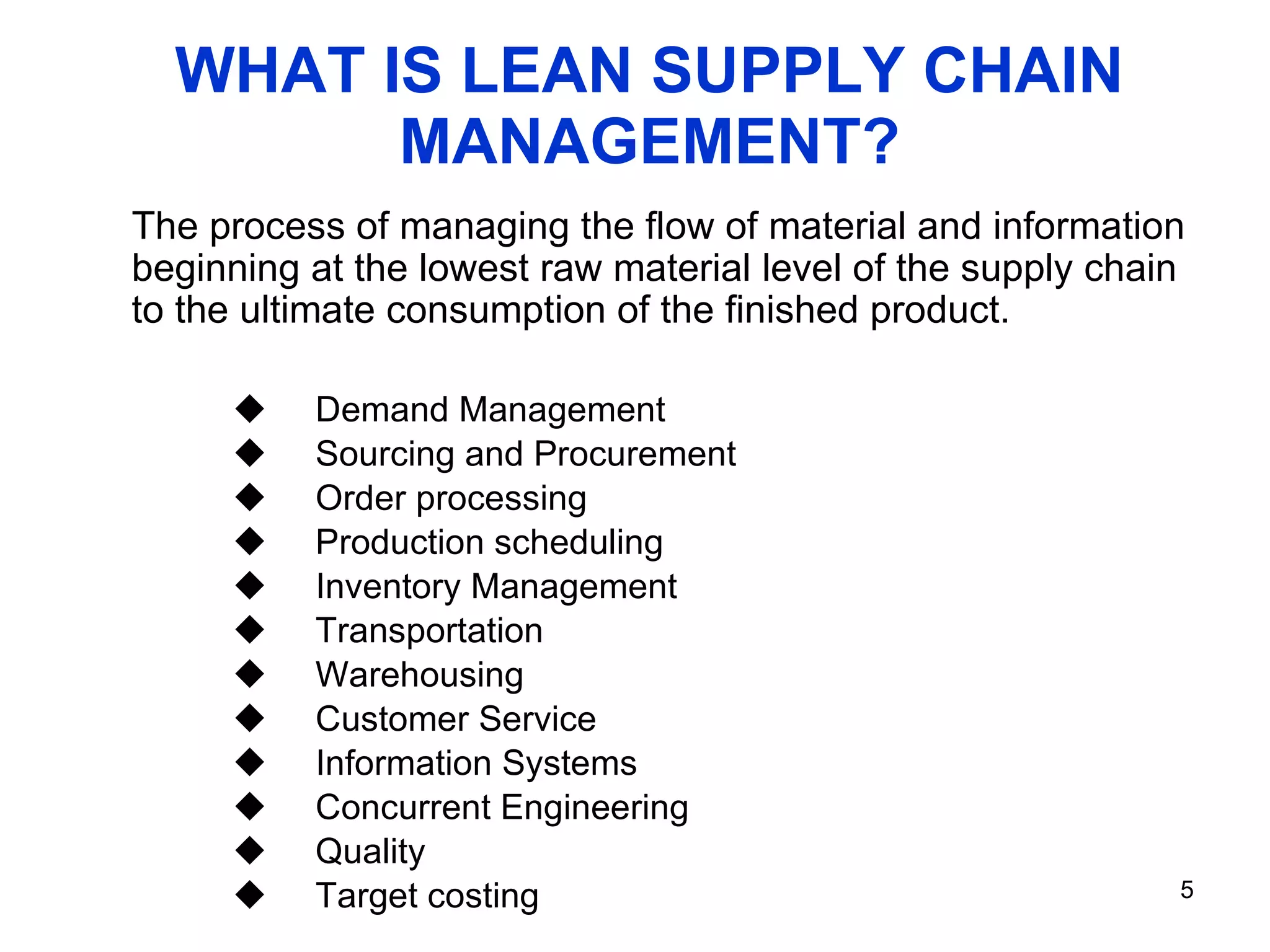
WHAT IS LEAN SUPPLY CHAIN MANAGEMENT? Demand Management Sourcing and Procurement Order processing Production scheduling Inventory Management Transportation Warehousing Customer Service Information Systems Concurrent Engineering Quality Target costing The process of managing the flow of material and information beginning at the lowest raw material level of the supply chain to the ultimate consumption of the finished product.
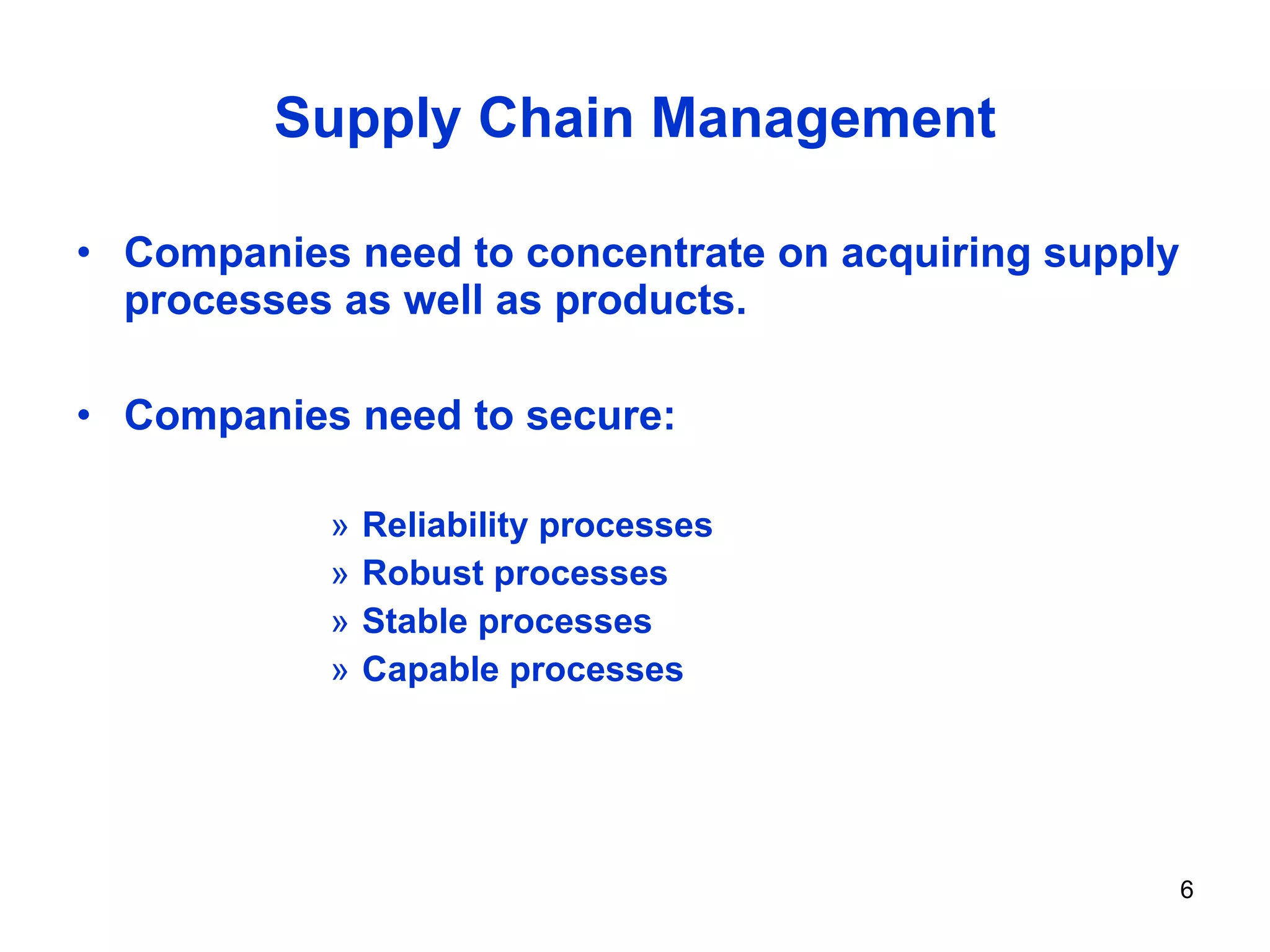
Supply Chain Management Companies need to concentrate on acquiring supply processes as well as products.  Companies need to secure: Reliability processes Robust processes Stable processes  Capable processes
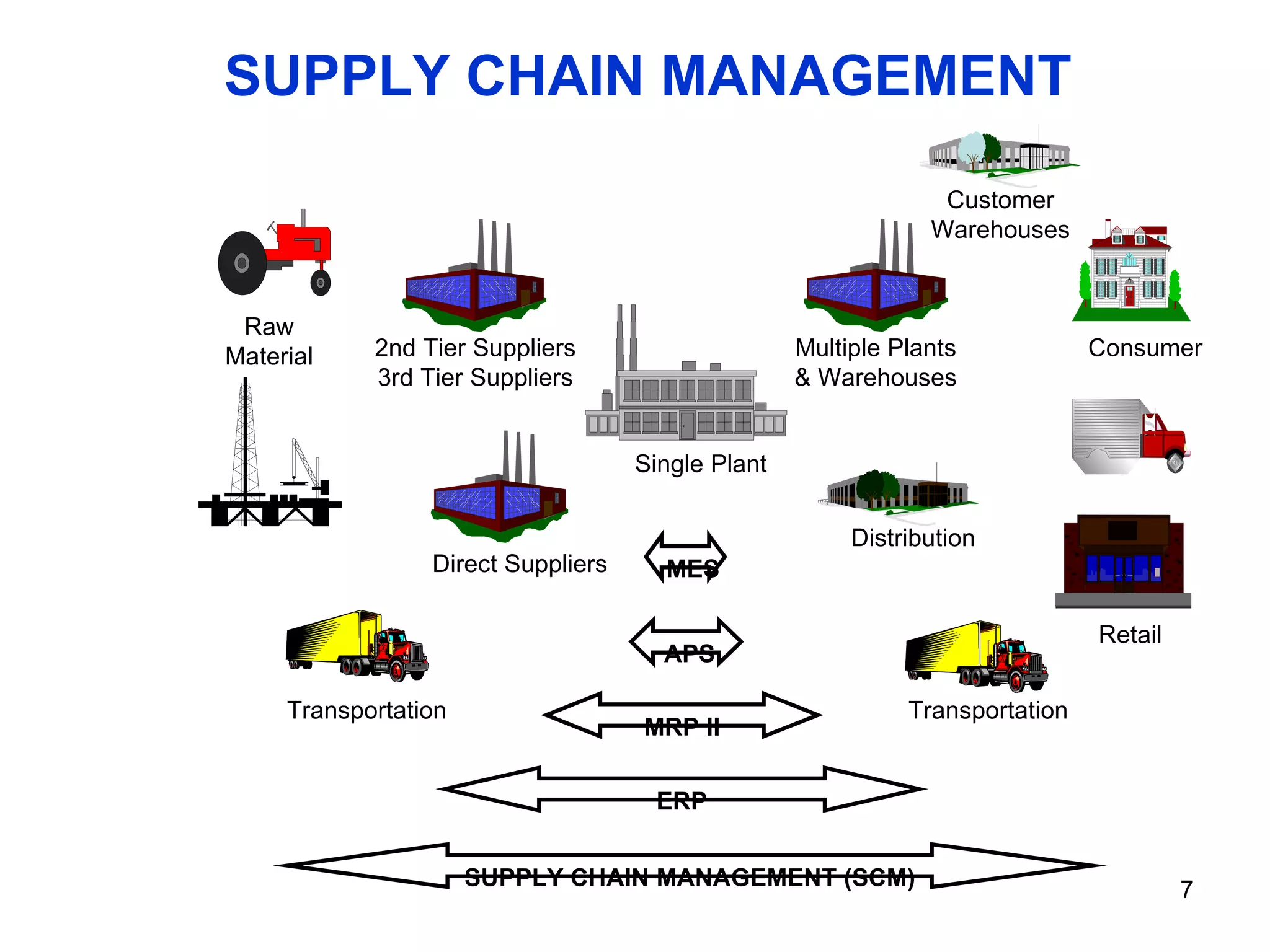
SUPPLY CHAIN MANAGEMENT Raw Material 2nd Tier Suppliers 3rd Tier Suppliers Transportation Direct Suppliers Single Plant Multiple Plants & Warehouses Customer Warehouses Consumer Retail Transportation Distribution MES APS  MRP II ERP SUPPLY CHAIN MANAGEMENT (SCM)
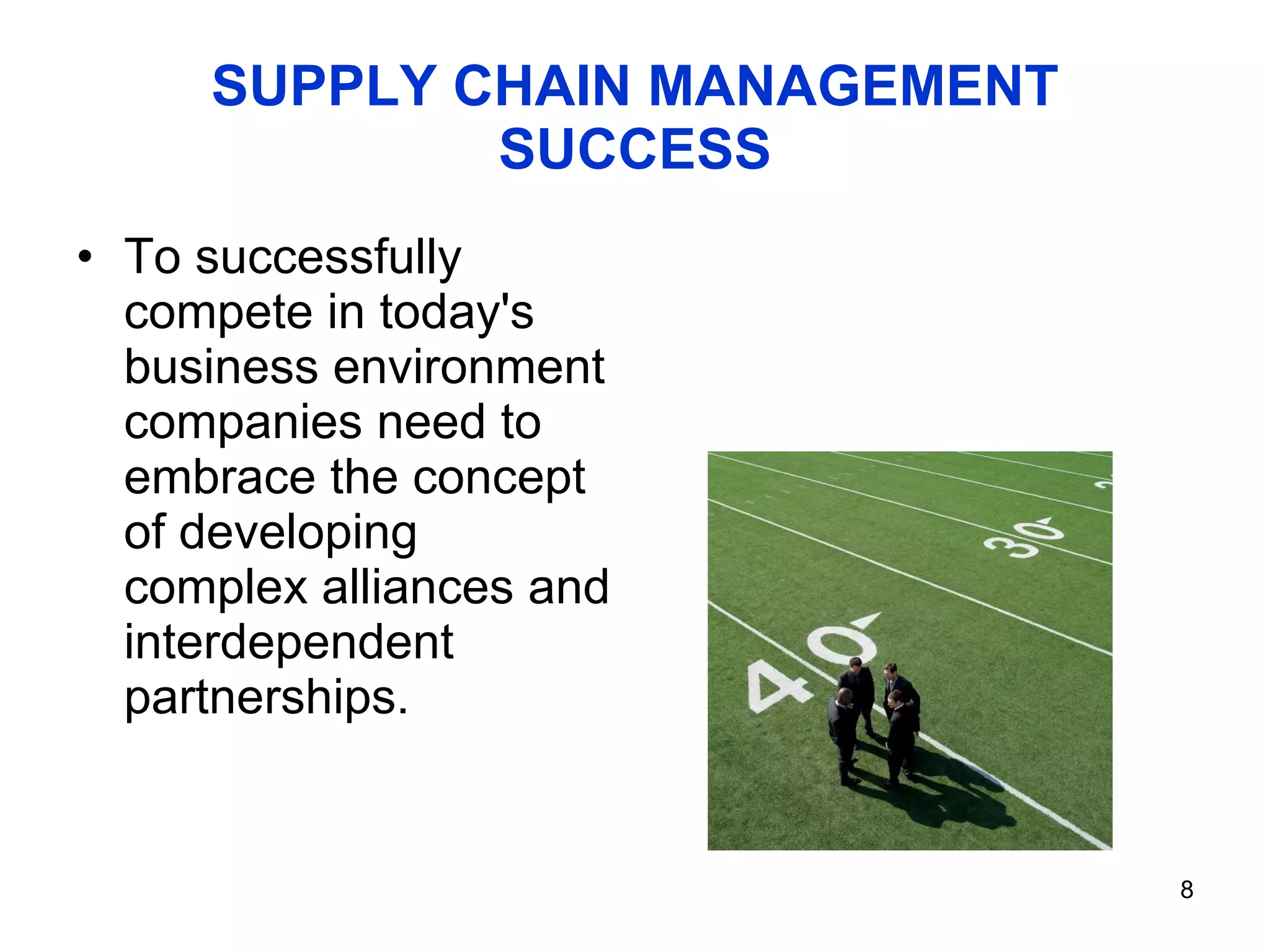
SUPPLY CHAIN MANAGEMENT SUCCESS To successfully compete in today's business environment companies need to embrace the concept of developing complex alliances and interdependent partnerships.
Supply Chain Management Needs to be Company Specific Companies need to develop their own Supply Chain processes, measurements and controls.  Tools Education and Training Goals and Expectations Product Line specific chains Product Line specific goals Supplier specific strategy
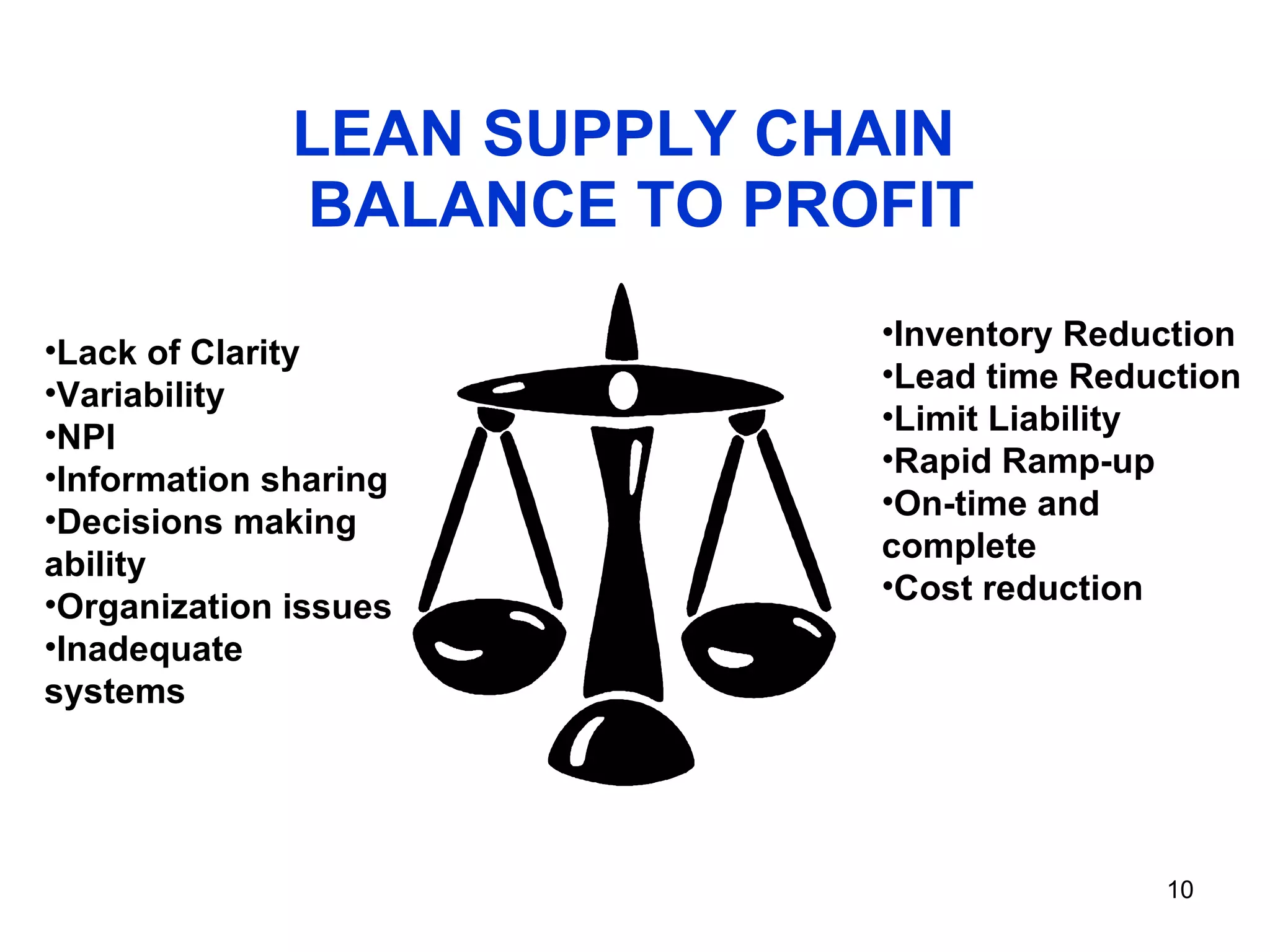
LEAN SUPPLY CHAIN   BALANCE TO PROFIT Lack of Clarity Variability NPI Information sharing Decisions making ability Organization issues Inadequate systems Inventory Reduction Lead time Reduction Limit Liability Rapid Ramp-up On-time and complete Cost reduction
THE RESULTS OF AN UNBALANCED SUPPLY CHAIN Increased cost to expedite Material  Increased cost of premium freight  Increased cost of excessive inventory  Increased cost of excessive set-up charges  Increased customer dissatisfaction Increased profitability decline
TO BRING YOUR SUPPLY CHAIN IN BALANCE COMPANIES NEED TO ASK THESE QUESTIONS Does your company understand the principles of Lean Supply Chain Management? Do you understand your customers’ needs and requirements? Do you understand the roll of Logistics?  Do you understand the operational and financial impact of Lean Supply Chain Management?  Does your management team embrace Lean Supply Chain Management as both a strategy and a process? Do you have the systems, organization and expertise in place to maximize your Lean Supply Chain efforts?
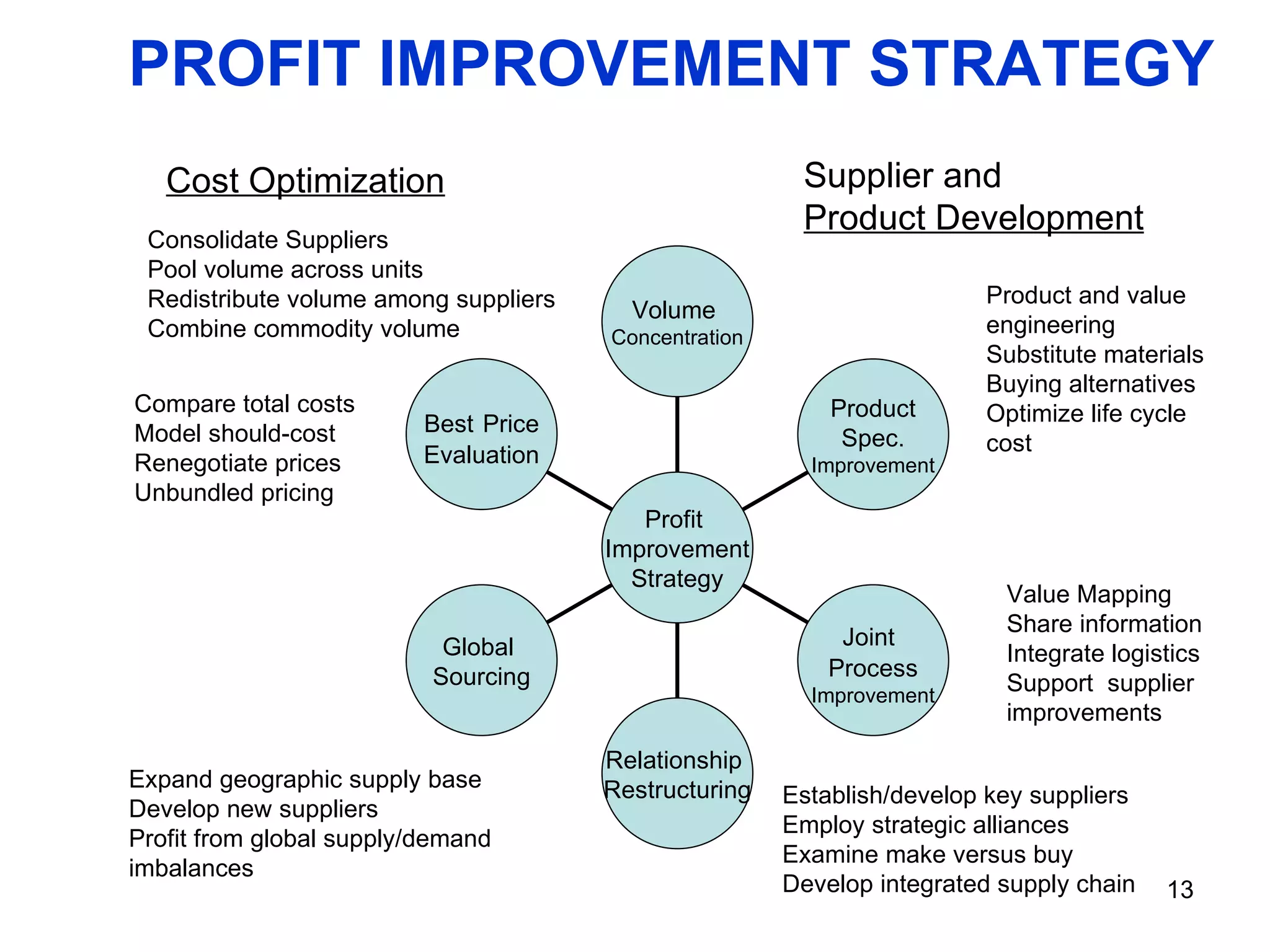
PROFIT IMPROVEMENT STRATEGY Cost Optimization Supplier and Product Development Consolidate Suppliers Pool volume across units Redistribute volume among suppliers Combine commodity volume Compare total costs Model should-cost Renegotiate prices Unbundled pricing Expand geographic supply base Develop new suppliers Profit from global supply/demand imbalances Product and value engineering Substitute materials Buying alternatives Optimize life cycle cost Value Mapping Share information Integrate logistics Support  supplier  improvements Establish/develop key suppliers Employ strategic alliances Examine make versus buy Develop integrated supply chain Best   Price Evaluation Global  Sourcing Relationship  Restructuring Joint   Process Improvement Product Spec. Improvement Volume  Concentration Profit  Improvement Strategy
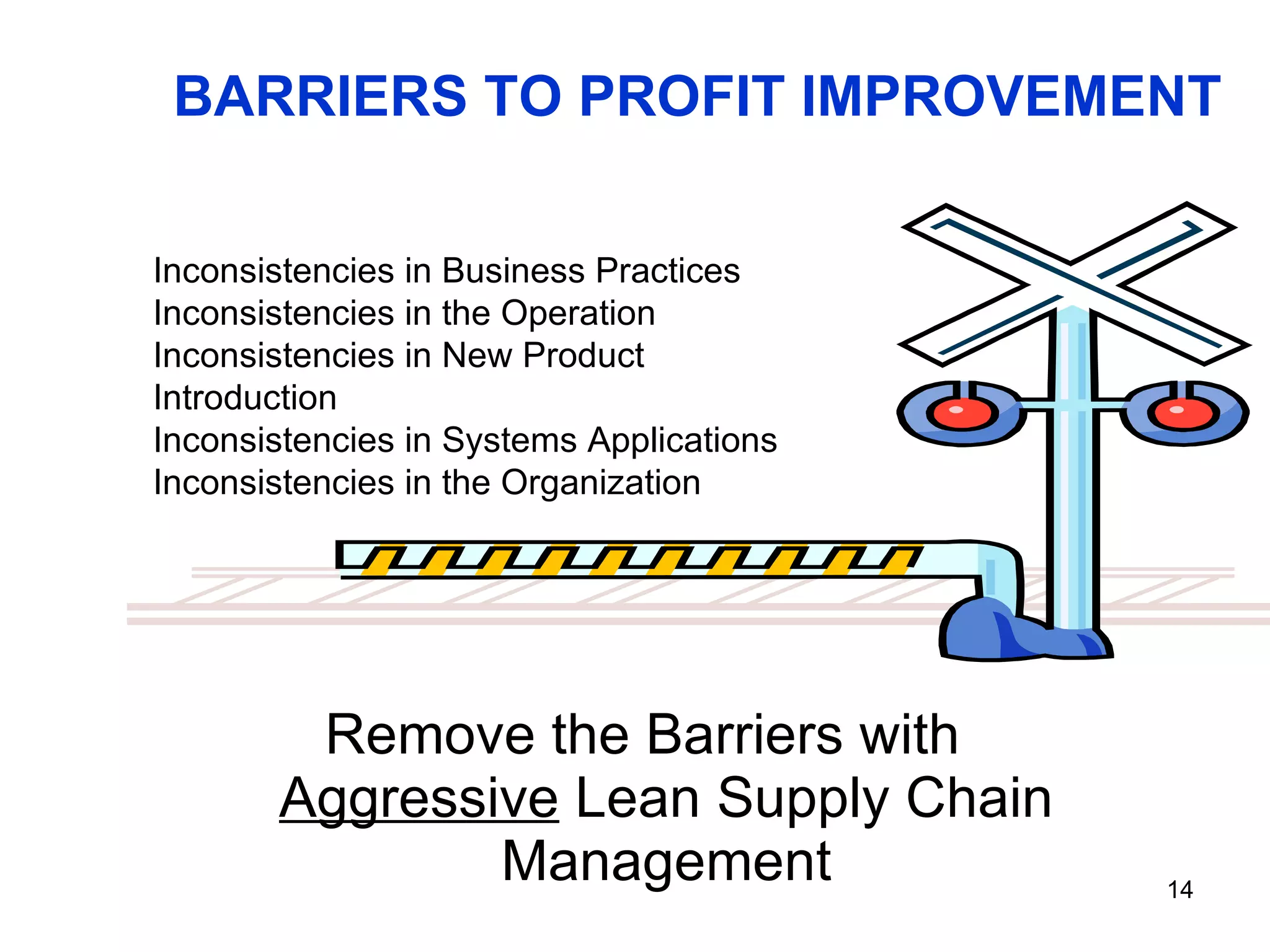
Remove the Barriers with  Aggressive  Lean Supply Chain Management BARRIERS TO PROFIT IMPROVEMENT Inconsistencies in Business Practices  Inconsistencies in the Operation Inconsistencies in New Product Introduction Inconsistencies in Systems Applications Inconsistencies in the Organization
SUPPLY CHAIN TOOLS Supply Chain analysis (value mapping) Consignment Vendor Managed Inventories Inplants (JIT II) Kanban “ Bread Man” Relocating suppliers Container control Transportation control Safety stock (or safety lead time) Target costing Buying capacity
SUPPLY CHAIN RULES Information Sharing Costs Margins Lead-Times Open Systems Development New Product Introduction Risk Reduction Partnership Management
SUPPLY CHAIN MANAGEMENT BUSINESS FORCES Cost Management and Reduction Demand Management: Lead Time Reduction Agility Competitive Pricing  Global Sourcing Outsourcing Software Sophistication Customer Satisfaction Risk Management Market Share and Margin Improvements
CRITICAL ELEMENTS OF  LEAN SUPPLY CHAIN MANAGEMENT Procurement Manufacturing Logistics Demand Management Information / Technology
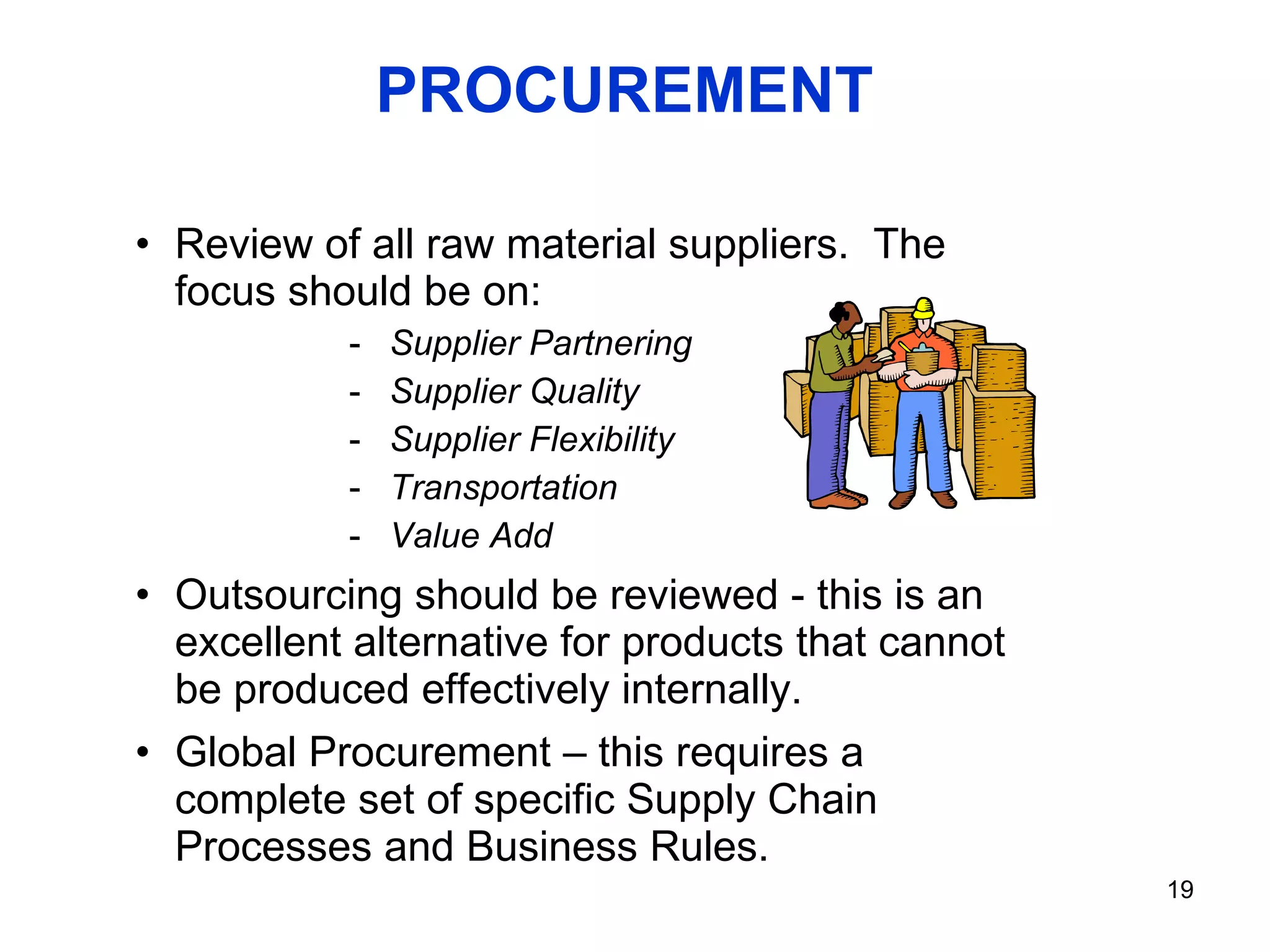
PROCUREMENT Review of all raw material suppliers.  The focus should be on: Supplier Partnering Supplier Quality Supplier Flexibility  Transportation Value Add Outsourcing should be reviewed - this is an excellent alternative for products that cannot be produced effectively internally. Global Procurement – this requires a complete set of specific Supply Chain Processes and Business Rules.
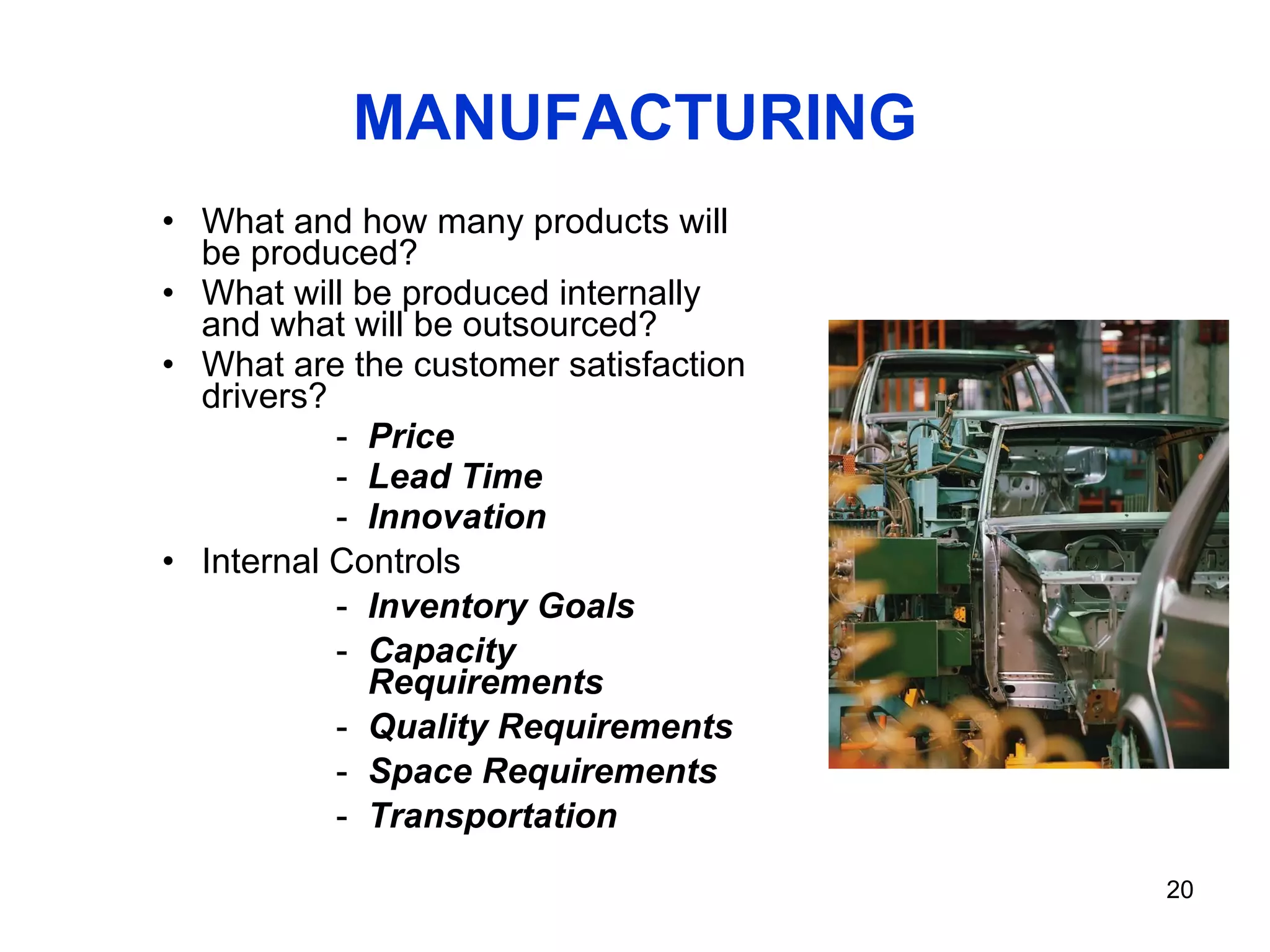
MANUFACTURING What and how many products will be produced? What will be produced internally and what will be outsourced? What are the customer satisfaction drivers? Price Lead Time Innovation Internal Controls Inventory Goals Capacity Requirements Quality Requirements Space Requirements Transportation
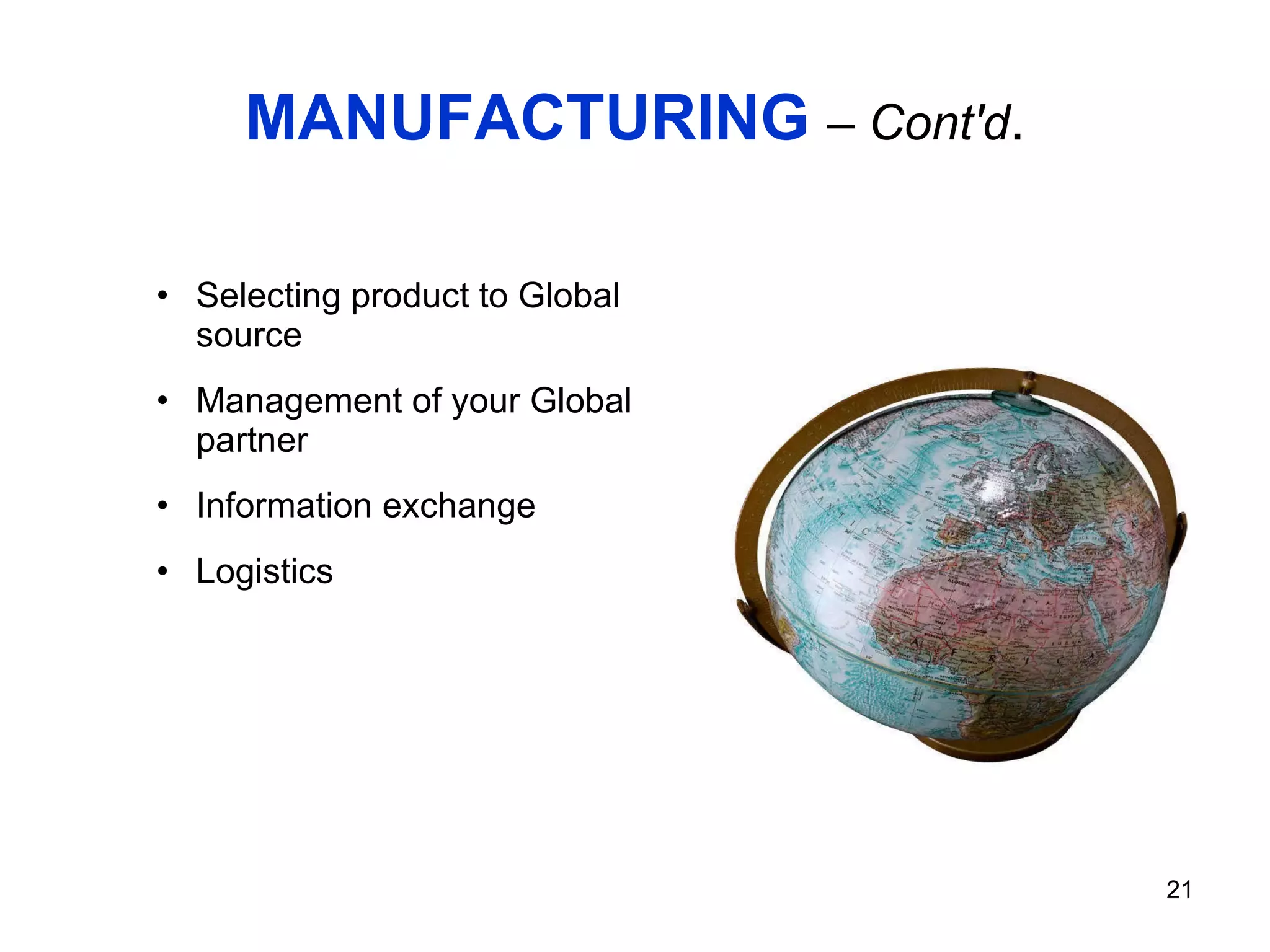
MANUFACTURING  – Cont'd . Selecting product to Global source Management of your Global partner Information exchange Logistics
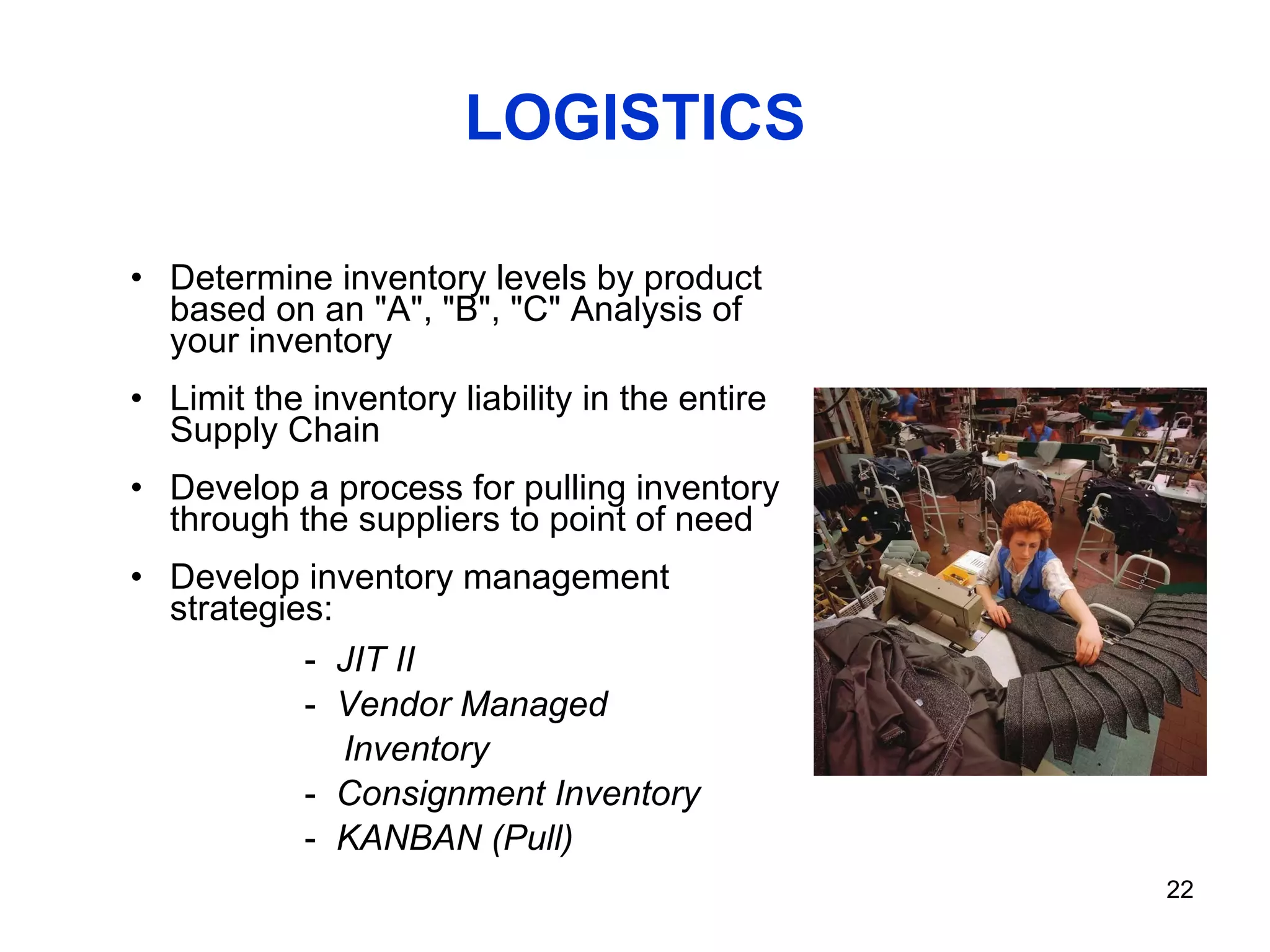
LOGISTICS Determine inventory levels by product based on an "A", "B", "C" Analysis of your inventory Limit the inventory liability in the entire Supply Chain  Develop a process for pulling inventory through the suppliers to point of need Develop inventory management strategies: JIT II Vendor Managed Inventory Consignment Inventory KANBAN (Pull)
LOGISTICS   – Cont'd. Make-to-Stock Strategy (MTS) Make-to-Order Strategy (MTO) Inventory Reduction Goals  Inventory Processes to support Repair and Renovation  Seasonal Demand Patterns Line Fill Rate Requirements Erratic Demand Requirements Many different SKU's Safety Stock Requirements Space Consideration Container Control Capacity Constraints
LOGISTICS   – Cont'd. Customer/Supplier Partnering  (Virtual Corporation) Cross Docking  (Terminals are connecting points, only no inventory staged in these locations) JIT II Distribution Requirements Planning Pull Systems Supplier Certification KANBAN Transportation Management Backhaul Scheduling LTL Control Tariff Management
DEMAND MANAGEMENT The activities that Demand Management supports are: Order Entry Forecasting Order Promising Warehouse Requirements Interplant Orders Service Parts Requirements
DEMAND MANAGEMENT   – Cont’d. The Demand Management Department should also prepare and assist in the management of Capacity Planning in: Order Entry Configuration Engineering Data Administration Shipping Installation Distribution
DEMAND MANAGEMENT   – Cont’d. The Supply side of the business will consider the following: Capacity Machine Manpower Space Supplier Support Transportation Requirement
TECHNOLOGY Electronic Data Interchange  (EDI) Internet Intranet Extranet Supplier Portals Bar Coding Computer ERP Systems with very sophisticated SCM Systems imbedded in the system
TECHNOLOGY QUESTIONS What is the sophistication level of the company and its suppliers? What am I trying to manage? Standard parts procurement Global sourcing and logistics A combination of standard parts procurement and major value add procurement Supplier direct ship to your customers How far back in the supply chain do I want to manage? What key measurements need improvement? Inventory Reduction Quality Improvement Lead-Time Reduction Cost Reduction
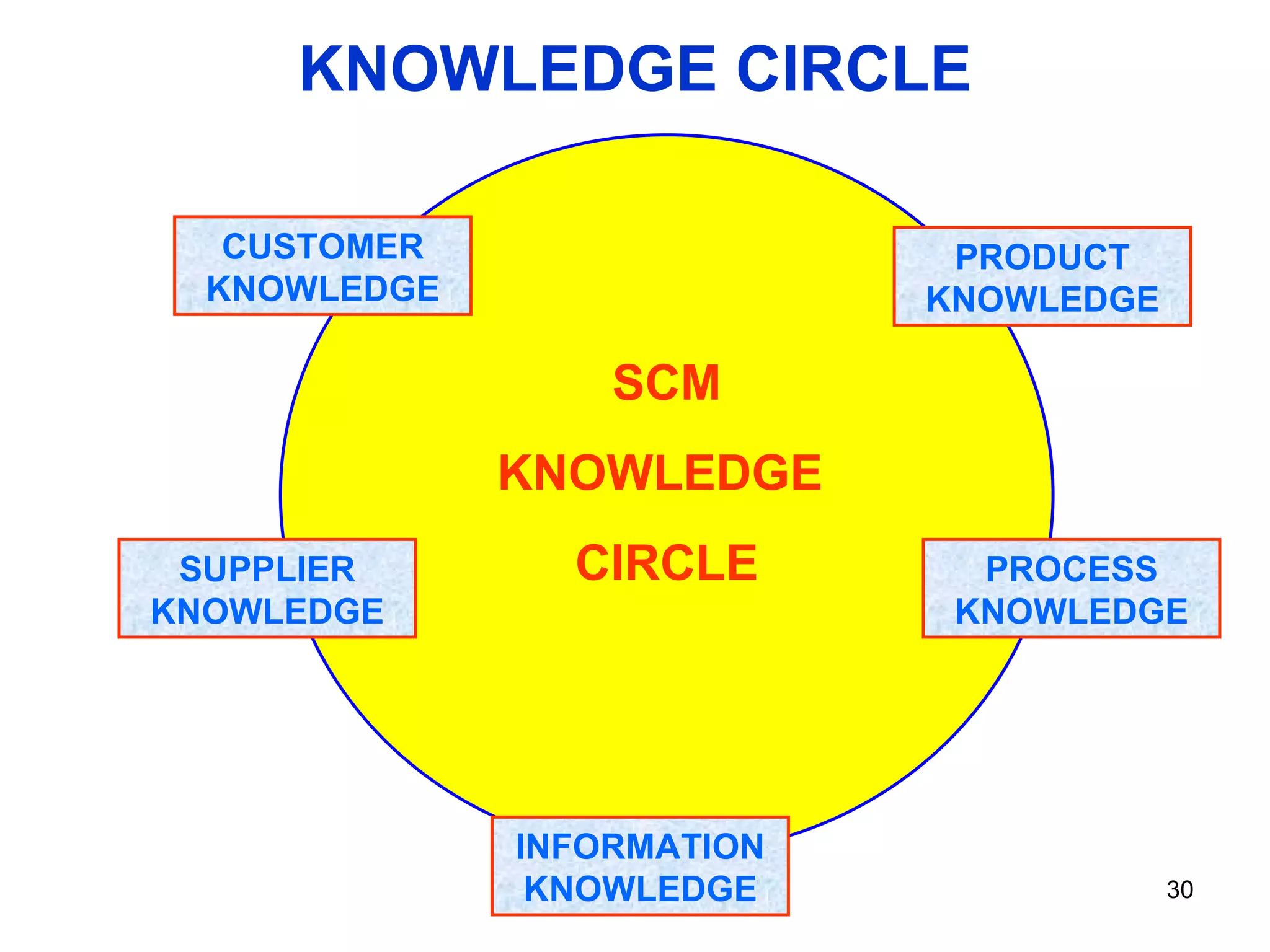
KNOWLEDGE CIRCLE CUSTOMER KNOWLEDGE SCM KNOWLEDGE  CIRCLE SUPPLIER KNOWLEDGE INFORMATION KNOWLEDGE PROCESS KNOWLEDGE PRODUCT KNOWLEDGE
CUSTOMER KNOWLEDGE Locations Demographics Purchasing Potential Demand Patterns Lead Time Requirements
PRODUCT KNOWLEDGE How many products? What percent of sales does each product represent? Where is each product in its product life cycle? What is the typical product mix? What are your margins per product? What are the true costs per product?
PROCESS KNOWLEDGE Understand the Production Process Process Flow Linear Flow Make-to-Order Demand Flow Push Process Pull Process Kanban Just In Time Delivery To Receiving To Point of Use To the Customer
INFORMATION KNOWLEDGE What information is required for effective decision-making at each stage in the Supply Chain? How will data flow between each part of the Supply Chain? Information on dynamics of the Supply Chain must be shared throughout the chain.
SUPPLY CHAIN ASSESSMENT Evaluates Performance and Identifies Opportunities For Improvements in Eight Areas: Organization and structure Business systems environment Customers Suppliers  Training and Education Performance Measurements Product Design and Development Quality
Organization and Structure Does top management have a Supply Chain Vision? Have clear objectives been communicated? Do company and employees work together and understand the importance of building long-term employee/company relationships? Does management aggressively support education for new techniques and technologies?
Business Systems Environment Are the information networks and communication systems reliable? Are there interactive information sharing with customers and suppliers? Is there enterprise-wide systems integration? Is there site systems integration? Do you utilize electronic commerce? Have you introduced the internet for customer communications?
Customers Is there a reporting system in place to notify upper management of customer issues needing resolutions? Are the latest techniques in VMI, Consignment, and Kanban in place for customers? Is the total inventory of supplies between suppliers and customers continually being reduced? Is frequent proactive communication established with all key customers?
Suppliers Is there a detailed plan to reduce the overall number of suppliers? Is an approved supplier list utilized by purchasing and Engineering? Are there clear responsibilities that have been documented between the supplier, schedulers, and buyers? Are the latest techniques in VMI, Consignment, and Kanban in place for suppliers?
Training and Education Does management aggressively support education for new techniques and technologies? Have all levels of management been educated on Supply Chain Management? Have you effectively trained suppliers and customers?
Performance Measurements Is the average lead time for all products continuously reduced? Is there a systematic effort to reduce the overall number of suppliers? Is days on hand inventory measured? How much emphasis is placed on the measurement of purchased price variance?
Product Design and Development Is the concept of concurrent engineering used? Are suppliers and customers allowed to participate in the design of new products? Is target costing in placed during new product introductions?
Quality Are records available to substantiate an adequate supplier quality rating system? Is production problem data recorded, reviewed daily, and is a process in place to resolve those problems that impact the effectiveness of the operation? Is a waste reduction program in place where progress is documented and visible throughout the organization?
Managing your company's most expensive asset, material flow, utilizing a supply chain that can rapidly flow information and material can be a significant competitive differentiator.
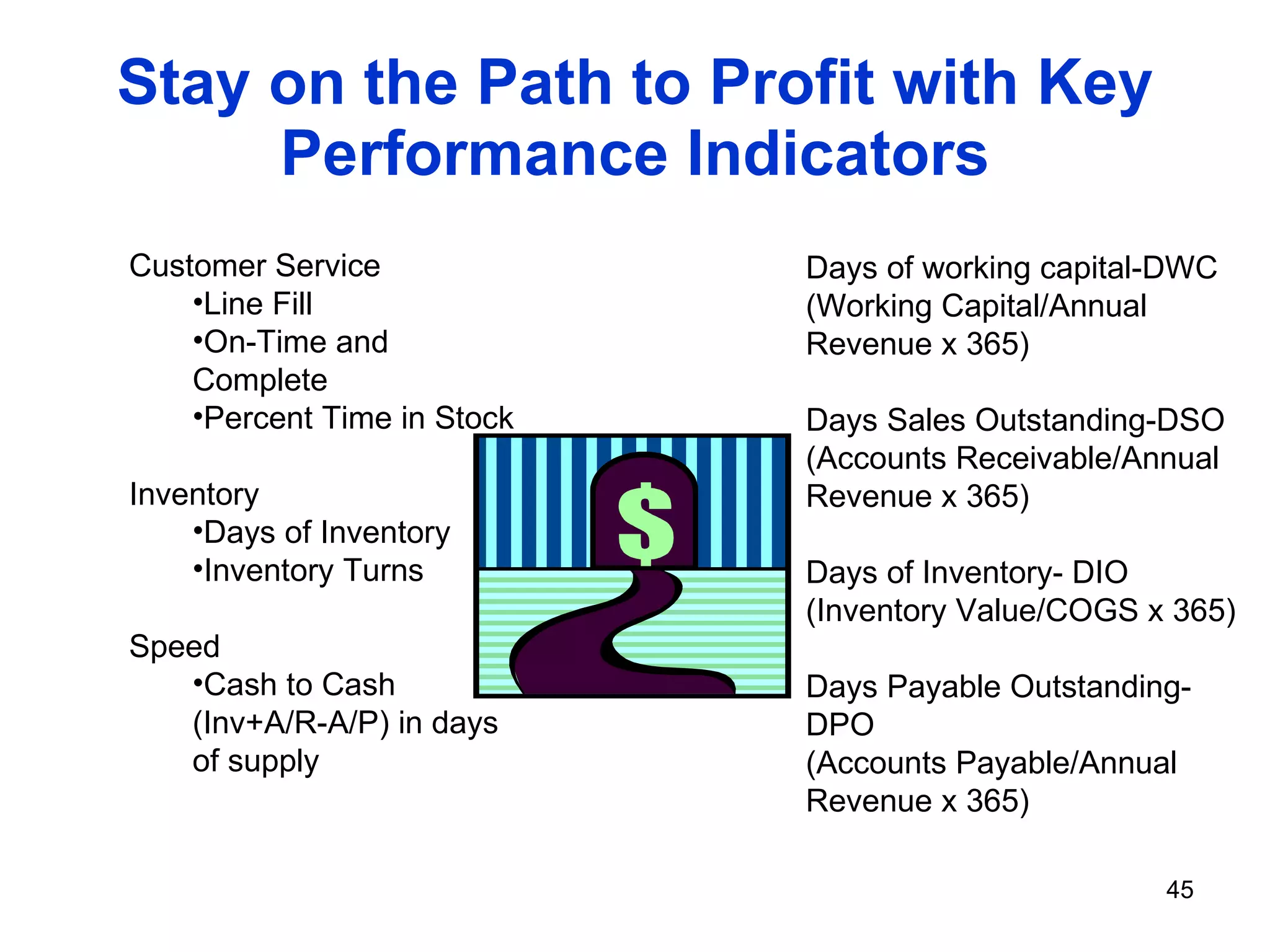
Stay on the Path to Profit with Key Performance Indicators Customer Service Line Fill On-Time and Complete Percent Time in Stock Inventory Days of Inventory Inventory Turns Speed Cash to Cash  (Inv+A/R-A/P) in days of supply Days of working capital-DWC (Working Capital/Annual Revenue x 365) Days Sales Outstanding-DSO (Accounts Receivable/Annual Revenue x 365) Days of Inventory- DIO (Inventory Value/COGS x 365) Days Payable Outstanding- DPO (Accounts Payable/Annual Revenue x 365)
FORWARD THINKING MANAGERS ARE IMPLEMENTING AGGRESSIVE LEAN SCM PROGRAMS AS A PRIMARY STRATEGY TO:   Increase market share  Reduce cost  Reduce Inventories  Improve profits
MARINO ASSOCIATES, LLC Thank you for attending our session and enjoy the rest of your time at the 6 Pack Conference. Please leave us your Business Card and we will Provide you with: Lean Supply Chain Readiness Check List Lean Manufacturing Readiness Check List

Lean Supply Chain Clear Path.

  • 1.
    LEAN SUPPLY CHAINMANAGEMENT: A CLEAR PATH TO PROFIT IMPROVEMENT Dan Marino, CPIM Senior Partner Marino Associates, LLC
  • 2.
    One of themost aggressive approaches in achieving excellence in Operations is to develop and implement a Superior Lean Supply Chain Management process.
  • 3.
    Supply Chain QuestionsHow many companies in the room have buying leverage over their supply base? No leverage Some leverage by product line Major leverage Companies without leverage, how many have successfully implemented Supply Chain Management? How many companies have systems in place and optimized that will support Supply Chain Management? How many companies are or have implemented a successful Supply Chain Management program? How many companies do business off shore and if so how successful is the supply chain process.? How many companies feel that Supply Chain Management is a key strategic goal of senior management?
  • 4.
    Best In ClassSupply Chain Companies Are Realizing Financial and Operating Advantages over Their Competition More Responsive to Customer Needs More Responsive to Market Changes More effective in controlling Cost MORE PROFITABLE
  • 5.
    WHAT IS LEANSUPPLY CHAIN MANAGEMENT? Demand Management Sourcing and Procurement Order processing Production scheduling Inventory Management Transportation Warehousing Customer Service Information Systems Concurrent Engineering Quality Target costing The process of managing the flow of material and information beginning at the lowest raw material level of the supply chain to the ultimate consumption of the finished product.
  • 6.
    Supply Chain ManagementCompanies need to concentrate on acquiring supply processes as well as products. Companies need to secure: Reliability processes Robust processes Stable processes Capable processes
  • 7.
    SUPPLY CHAIN MANAGEMENTRaw Material 2nd Tier Suppliers 3rd Tier Suppliers Transportation Direct Suppliers Single Plant Multiple Plants & Warehouses Customer Warehouses Consumer Retail Transportation Distribution MES APS MRP II ERP SUPPLY CHAIN MANAGEMENT (SCM)
  • 8.
    SUPPLY CHAIN MANAGEMENTSUCCESS To successfully compete in today's business environment companies need to embrace the concept of developing complex alliances and interdependent partnerships.
  • 9.
    Supply Chain ManagementNeeds to be Company Specific Companies need to develop their own Supply Chain processes, measurements and controls. Tools Education and Training Goals and Expectations Product Line specific chains Product Line specific goals Supplier specific strategy
  • 10.
    LEAN SUPPLY CHAIN BALANCE TO PROFIT Lack of Clarity Variability NPI Information sharing Decisions making ability Organization issues Inadequate systems Inventory Reduction Lead time Reduction Limit Liability Rapid Ramp-up On-time and complete Cost reduction
  • 11.
    THE RESULTS OFAN UNBALANCED SUPPLY CHAIN Increased cost to expedite Material Increased cost of premium freight Increased cost of excessive inventory Increased cost of excessive set-up charges Increased customer dissatisfaction Increased profitability decline
  • 12.
    TO BRING YOURSUPPLY CHAIN IN BALANCE COMPANIES NEED TO ASK THESE QUESTIONS Does your company understand the principles of Lean Supply Chain Management? Do you understand your customers’ needs and requirements? Do you understand the roll of Logistics? Do you understand the operational and financial impact of Lean Supply Chain Management? Does your management team embrace Lean Supply Chain Management as both a strategy and a process? Do you have the systems, organization and expertise in place to maximize your Lean Supply Chain efforts?
  • 13.
    PROFIT IMPROVEMENT STRATEGYCost Optimization Supplier and Product Development Consolidate Suppliers Pool volume across units Redistribute volume among suppliers Combine commodity volume Compare total costs Model should-cost Renegotiate prices Unbundled pricing Expand geographic supply base Develop new suppliers Profit from global supply/demand imbalances Product and value engineering Substitute materials Buying alternatives Optimize life cycle cost Value Mapping Share information Integrate logistics Support supplier improvements Establish/develop key suppliers Employ strategic alliances Examine make versus buy Develop integrated supply chain Best Price Evaluation Global Sourcing Relationship Restructuring Joint Process Improvement Product Spec. Improvement Volume Concentration Profit Improvement Strategy
  • 14.
    Remove the Barrierswith Aggressive Lean Supply Chain Management BARRIERS TO PROFIT IMPROVEMENT Inconsistencies in Business Practices Inconsistencies in the Operation Inconsistencies in New Product Introduction Inconsistencies in Systems Applications Inconsistencies in the Organization
  • 15.
    SUPPLY CHAIN TOOLSSupply Chain analysis (value mapping) Consignment Vendor Managed Inventories Inplants (JIT II) Kanban “ Bread Man” Relocating suppliers Container control Transportation control Safety stock (or safety lead time) Target costing Buying capacity
  • 16.
    SUPPLY CHAIN RULESInformation Sharing Costs Margins Lead-Times Open Systems Development New Product Introduction Risk Reduction Partnership Management
  • 17.
    SUPPLY CHAIN MANAGEMENTBUSINESS FORCES Cost Management and Reduction Demand Management: Lead Time Reduction Agility Competitive Pricing Global Sourcing Outsourcing Software Sophistication Customer Satisfaction Risk Management Market Share and Margin Improvements
  • 18.
    CRITICAL ELEMENTS OF LEAN SUPPLY CHAIN MANAGEMENT Procurement Manufacturing Logistics Demand Management Information / Technology
  • 19.
    PROCUREMENT Review ofall raw material suppliers. The focus should be on: Supplier Partnering Supplier Quality Supplier Flexibility Transportation Value Add Outsourcing should be reviewed - this is an excellent alternative for products that cannot be produced effectively internally. Global Procurement – this requires a complete set of specific Supply Chain Processes and Business Rules.
  • 20.
    MANUFACTURING What andhow many products will be produced? What will be produced internally and what will be outsourced? What are the customer satisfaction drivers? Price Lead Time Innovation Internal Controls Inventory Goals Capacity Requirements Quality Requirements Space Requirements Transportation
  • 21.
    MANUFACTURING –Cont'd . Selecting product to Global source Management of your Global partner Information exchange Logistics
  • 22.
    LOGISTICS Determine inventorylevels by product based on an "A", "B", "C" Analysis of your inventory Limit the inventory liability in the entire Supply Chain Develop a process for pulling inventory through the suppliers to point of need Develop inventory management strategies: JIT II Vendor Managed Inventory Consignment Inventory KANBAN (Pull)
  • 23.
    LOGISTICS – Cont'd. Make-to-Stock Strategy (MTS) Make-to-Order Strategy (MTO) Inventory Reduction Goals Inventory Processes to support Repair and Renovation Seasonal Demand Patterns Line Fill Rate Requirements Erratic Demand Requirements Many different SKU's Safety Stock Requirements Space Consideration Container Control Capacity Constraints
  • 24.
    LOGISTICS – Cont'd. Customer/Supplier Partnering (Virtual Corporation) Cross Docking (Terminals are connecting points, only no inventory staged in these locations) JIT II Distribution Requirements Planning Pull Systems Supplier Certification KANBAN Transportation Management Backhaul Scheduling LTL Control Tariff Management
  • 25.
    DEMAND MANAGEMENT Theactivities that Demand Management supports are: Order Entry Forecasting Order Promising Warehouse Requirements Interplant Orders Service Parts Requirements
  • 26.
    DEMAND MANAGEMENT – Cont’d. The Demand Management Department should also prepare and assist in the management of Capacity Planning in: Order Entry Configuration Engineering Data Administration Shipping Installation Distribution
  • 27.
    DEMAND MANAGEMENT – Cont’d. The Supply side of the business will consider the following: Capacity Machine Manpower Space Supplier Support Transportation Requirement
  • 28.
    TECHNOLOGY Electronic DataInterchange (EDI) Internet Intranet Extranet Supplier Portals Bar Coding Computer ERP Systems with very sophisticated SCM Systems imbedded in the system
  • 29.
    TECHNOLOGY QUESTIONS Whatis the sophistication level of the company and its suppliers? What am I trying to manage? Standard parts procurement Global sourcing and logistics A combination of standard parts procurement and major value add procurement Supplier direct ship to your customers How far back in the supply chain do I want to manage? What key measurements need improvement? Inventory Reduction Quality Improvement Lead-Time Reduction Cost Reduction
  • 30.
    KNOWLEDGE CIRCLE CUSTOMERKNOWLEDGE SCM KNOWLEDGE CIRCLE SUPPLIER KNOWLEDGE INFORMATION KNOWLEDGE PROCESS KNOWLEDGE PRODUCT KNOWLEDGE
  • 31.
    CUSTOMER KNOWLEDGE LocationsDemographics Purchasing Potential Demand Patterns Lead Time Requirements
  • 32.
    PRODUCT KNOWLEDGE Howmany products? What percent of sales does each product represent? Where is each product in its product life cycle? What is the typical product mix? What are your margins per product? What are the true costs per product?
  • 33.
    PROCESS KNOWLEDGE Understandthe Production Process Process Flow Linear Flow Make-to-Order Demand Flow Push Process Pull Process Kanban Just In Time Delivery To Receiving To Point of Use To the Customer
  • 34.
    INFORMATION KNOWLEDGE Whatinformation is required for effective decision-making at each stage in the Supply Chain? How will data flow between each part of the Supply Chain? Information on dynamics of the Supply Chain must be shared throughout the chain.
  • 35.
    SUPPLY CHAIN ASSESSMENTEvaluates Performance and Identifies Opportunities For Improvements in Eight Areas: Organization and structure Business systems environment Customers Suppliers Training and Education Performance Measurements Product Design and Development Quality
  • 36.
    Organization and StructureDoes top management have a Supply Chain Vision? Have clear objectives been communicated? Do company and employees work together and understand the importance of building long-term employee/company relationships? Does management aggressively support education for new techniques and technologies?
  • 37.
    Business Systems EnvironmentAre the information networks and communication systems reliable? Are there interactive information sharing with customers and suppliers? Is there enterprise-wide systems integration? Is there site systems integration? Do you utilize electronic commerce? Have you introduced the internet for customer communications?
  • 38.
    Customers Is therea reporting system in place to notify upper management of customer issues needing resolutions? Are the latest techniques in VMI, Consignment, and Kanban in place for customers? Is the total inventory of supplies between suppliers and customers continually being reduced? Is frequent proactive communication established with all key customers?
  • 39.
    Suppliers Is therea detailed plan to reduce the overall number of suppliers? Is an approved supplier list utilized by purchasing and Engineering? Are there clear responsibilities that have been documented between the supplier, schedulers, and buyers? Are the latest techniques in VMI, Consignment, and Kanban in place for suppliers?
  • 40.
    Training and EducationDoes management aggressively support education for new techniques and technologies? Have all levels of management been educated on Supply Chain Management? Have you effectively trained suppliers and customers?
  • 41.
    Performance Measurements Isthe average lead time for all products continuously reduced? Is there a systematic effort to reduce the overall number of suppliers? Is days on hand inventory measured? How much emphasis is placed on the measurement of purchased price variance?
  • 42.
    Product Design andDevelopment Is the concept of concurrent engineering used? Are suppliers and customers allowed to participate in the design of new products? Is target costing in placed during new product introductions?
  • 43.
    Quality Are recordsavailable to substantiate an adequate supplier quality rating system? Is production problem data recorded, reviewed daily, and is a process in place to resolve those problems that impact the effectiveness of the operation? Is a waste reduction program in place where progress is documented and visible throughout the organization?
  • 44.
    Managing your company'smost expensive asset, material flow, utilizing a supply chain that can rapidly flow information and material can be a significant competitive differentiator.
  • 45.
    Stay on thePath to Profit with Key Performance Indicators Customer Service Line Fill On-Time and Complete Percent Time in Stock Inventory Days of Inventory Inventory Turns Speed Cash to Cash (Inv+A/R-A/P) in days of supply Days of working capital-DWC (Working Capital/Annual Revenue x 365) Days Sales Outstanding-DSO (Accounts Receivable/Annual Revenue x 365) Days of Inventory- DIO (Inventory Value/COGS x 365) Days Payable Outstanding- DPO (Accounts Payable/Annual Revenue x 365)
  • 46.
    FORWARD THINKING MANAGERSARE IMPLEMENTING AGGRESSIVE LEAN SCM PROGRAMS AS A PRIMARY STRATEGY TO: Increase market share Reduce cost Reduce Inventories Improve profits
  • 47.
    MARINO ASSOCIATES, LLCThank you for attending our session and enjoy the rest of your time at the 6 Pack Conference. Please leave us your Business Card and we will Provide you with: Lean Supply Chain Readiness Check List Lean Manufacturing Readiness Check List