Optimizing the Supply Chain: 
Gaining Competitive Advantage through 
Supply Chain Management 
SPE Online Presentation 
January 22, 2004 
G.H. Associates 
Lebanon, NJ 
908-832-2207
Presentation Outline 
zIntroduction-Changing face of manufacturing and customer needs 
zWhat is the “supply chain” 
zProductivity in the supply chain 
zDeveloping a supply chain strategy 
zRole of information technology 
zTips for getting started
Introduction 
zWhy is Supply Chain Management becoming an important competitive tool?
Trends in Manufacturing 
zOEM manufacturers made 75 percent of a product’s components 25 years ago 
zToday make only 25 percent of those components 
–Balance produced by strategic supplier/partners 
–Increasing reliability on design partners to help to develop new products 
–Distributors are playing a more important role
Trends in Manufacturing 
zManufacturing base shifting from traditional regions to emerging economies 
–85% of business machine and telecommunication manufacturing has migrated to the Far East 
–75%+ of small appliances are produced in Far East 
–60% of housewares are manufactured outside NA 
–More and more automotive components are sourced from Eastern Europe, Brazil or China.
Trends in Manufacturing 
zAll industry groups have experienced some degree of migration 
–Manufacturing is evolving to a global enterprise.
Trends in Manufacturing 
zConcept design and development is still controlled from the product marketer
Trends in Manufacturing 
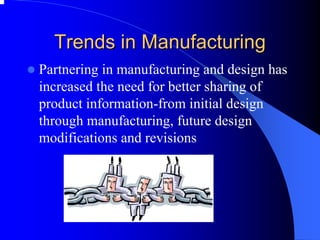
zPartnering in manufacturing and design has increased the need for better sharing of product information-from initial design through manufacturing, future design modifications and revisions
Challenges 
zMost industry sectors are experiencing increased pressure to: 
–Reduce costs 
–Improve efficiency 
–Increase innovation rate 
–Uncover opportunities around outsourcing and collaborative product development 
–Improve “time to market”
Problem/Opportunity 
zFaced with slow growth and pricing pressures manufacturing companies 
–Have undergone increasing mergers and acquisitions to achieve economies of scale 
–Reduced supplier base
Problem/Opportunity 
–New technology must offer performance benefits at no increased cost 
–Quality and service are increasingly regarded as givens
Problem/Opportunity 
–R&D budgets are reflecting more 
co-developments with suppliers 
–More outsourcing
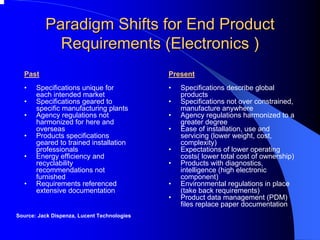
Paradigm Shifts for End Product 
Requirements (Electronics ) 
Present 
•Specifications describe global products 
•Specifications not over constrained, manufacture anywhere 
•Agency regulations harmonized to a greater degree 
•Ease of installation, use and servicing (lower weight, cost, complexity) 
•Expectations of lower operating costs( lower total cost of ownership) 
•Products with diagnostics, intelligence (high electronic component) 
•Environmental regulations in place (take back requirements) 
•Product data management (PDM) files replace paper documentation 
Past 
•Specifications unique for each intended market 
•Specifications geared to specific manufacturing plants 
•Agency regulations not harmonized for here and overseas 
•Products specifications geared to trained installation professionals 
•Energy efficiency and recyclability recommendations not furnished 
•Requirements referenced extensive documentation 
Source: Jack Dispenza, Lucent Technologies
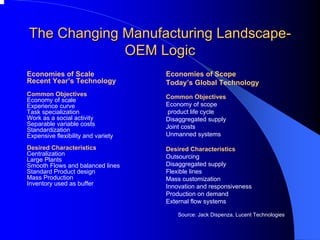
The Changing Manufacturing Landscape Landscape- 
OEM Logic 
Economies of Scale 
Recent Year’s Technology 
Common Objectives 
Economy of scale 
Experience curve 
Task specialization 
Work as a social activity 
Separable variable costs 
Standardization 
Expensive flexibility and variety 
Desired Characteristics 
Centralization 
Large Plants 
Smooth Flows and balanced lines 
Standard Product design 
Mass Production 
Inventory used as buffer 
Economies of Scope 
Today’s Global Technology 
Common Objectives 
Economy of scope 
product life cycle 
Disaggregated supply 
Joint costs 
Unmanned systems 
Desired Characteristics 
Outsourcing 
Disaggregated supply 
Flexible lines 
Mass customization 
Innovation and responsiveness 
Production on demand 
External flow systems 
Source: Jack Dispenza, Lucent Technologies
As OEMs Continue to Outsource 
zR&D organizations 
–Need to remain innovative 
–Provide knowledge reservoirs outside corporate limits 
–Provide state of the art quality measures
As OEMs Continue to Outsource 
zContract Manufacturers 
–Handle lower volume and custom made products 
–Compliment their manufacturing technology with that of traditional and highly specialized suppliers
As OEMs Continue to Outsource 
zTraditional suppliers 
–Need to forge relationships with global manufacturing suppliers 
–Continue to implement new process and material technologies to create new competitive space 
–Provide more services
Tactical to the Strategic 
zUnderstanding your customers and markets can help you determine where to look in the supply chain for efficiencies and opportunities. 
zProvide value-add either in manufacturing technology or services-bring “solutions”
Thus Thus…… 
zWith the trend toward global marketing and manufacturing 
–Short term, the “extended supply chain” presents an opportunity for competitive advantage 
–Longer term, managing the supply chain efficiently and effectively will need to become a critical core competency for most companies
What is the Supply Chain?
Definition of Supply Chain 
zNeeds clarification 
–Some see it as leveraging suppliers 
–Largely event based
Beyond Sourcing Tools 
zManufacturers have realized a quick and measurable ROI from simple, tactical event based e-sourcing tools 
–15% savings and cycle time reductions of 90% 
–35% of firms with $100MM or more spend use e- auctions but only still less than 5% of the spend 
zMore strategic sourcing can sustain these improvements, add value and competitive advantage.
Manufacturing and the 
Supply Chain 
zInitial efforts were to assist the procurement function and the selling function with little integration 
zPortals-buying and design-made an effort to enhance collaboration but did not sufficiently educate to the benefits or adequately meet need 
zInventory management and logistics have come to the forefront 
–Re-think JIT 
The “extended supply chain”offers untapped potential for improved profitability and competitive advantage
Supply Chain 
zThe linked set of resources and processes that begins with the sourcing of raw material and extends through the delivery of end items to the final customer. 
zIt includes the transformation of these materials into intermediate and finished products, and the distribution of these finished products to customers.
Supply Chain 
zIt includes vendors, manufacturing facilities, logistics providers, internal distribution centers, distributors, wholesalers and all other entities that lead up to final customer acceptance
Supply Chain 
zThe extended supply chain for a given company may also include secondary vendors to their immediate vendors, and the customers of their immediate customers
Supply Chain 
zSupply chains exist in both service and manufacturing 
organizations, although the complexity of the chain may 
vary greatly from industry to industry and firm to firm.
Definition of Supply Chain 
zAny function internally or externally that impacts the customer 
zSourcing 
zManufacturing 
zOperations 
zMarketing 
zAsset/Inventory management 
zDistribution 
zCustomer service 
zTechnical support
Broader Definition 
““Extended Supply Chain Chain”” 
zOffers potential opportunity at every step 
–R&D/Collaboration 
–Order management and fulfillment 
–Invoicing and payment 
–Capacity utilization 
–Inventory and work in process 
–Strategic management of the customer portfolio
Manufacturing Supply Chain 
zOptimizing the supply chain requires understanding the market and analyzing the areas that have the greatest impact on the business process
Supply Chain 
Management(SCM) 
zTwo sets of processes with different time horizons 
–Supply chain planning –process of managing the strategic and tactical operations 
–Supply chain execution-involves the tactical steps necessary to meet the demands of the plan
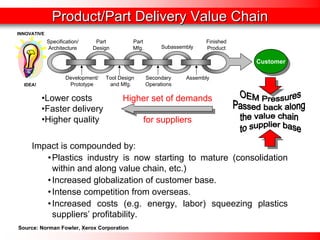
Product/Part Delivery Value ChainProduct/Chain 
IDEA! 
•Lower costs 
•Faster delivery 
•Higher quality Higher set of demandsfor suppliersSpecification/ ArchitectureDevelopment/ PrototypePartDesignTool Designand Mfg. PartMfg. SecondaryOperationsSubassemblyAssemblyFinishedProductCustomerCustomerINNOVATIVE 
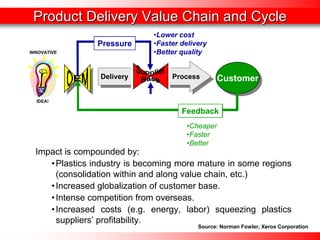
Impact is compounded by: 
•Plastics industry is now starting to mature (consolidation within and along value chain, etc.) 
•Increased globalization of customer base. 
•Intense competition from overseas. 
•Increased costs (e.g. energy, labor) squeezing plastics suppliers’profitability. 
Source: Norman Fowler, Xerox Corporation
Product Delivery Value Chain and CycleProduct CycleDeliveryProcessSupplierBaseSupplierBaseCustomerCustomerOEMOEM•Cheaper•Faster•BetterFeedbackImpact is compounded by: •Plastics industry is becoming more mature in some regions (consolidation within and along value chain, etc.) •Increased globalization of customer base. •Intense competition from overseas. •Increased costs (e.g. energy, labor) squeezing plastics suppliers’profitability. IDEA! INNOVATIVE•Lower cost•Faster delivery•Better qualityPressureFeedback•Better•qualityPressureSource: Norman Fowler, Xerox Corporation
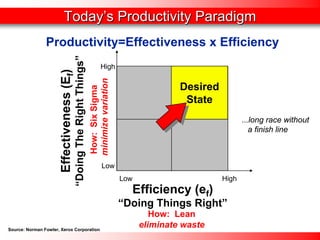
TodayToday’’s Productivity Paradigms ParadigmEfficiency (ef) “Doing Things Right” ...long race without a finish lineProductivity=? Effectiveness (Ef) “Doing The Right Things” HighHighLowLowDesiredStateHow: Leaneliminate waste How: Six Sigmaminimize variation Productivity=Effectiveness x Efficiency 
Source: Norman Fowler, Xerox Corporation
Lean Manufacturing 
zAn overall methodology that seeks to minimize the resources required 
for production by eliminating waste (non-value added activities) that 
inflate costs, lead times and inventory requirements, and emphasizing 
the use of preventive maintenance , quality improvement programs, 
pull systems and flexible work forces and production facilities. 
zPrinciples of lean include zero waiting time, zero inventory, scheduling 
(internal customer pull instead of push system), batch to flow (cut 
batch sizes), line balancing and cutting actual process times. 
zFocus is eliminating waste: unnecessary motion, overproduction and 
work in process
Six Sigma 
zA vision of quality which equates with only 3.4 defects per million opportunities for each product or service transaction. 
zAn increase in performance and decrease in process variation lead to defect reduction and improvement in profits, employee morale and quality of product. 
zA continual improvement process-strives for perfection
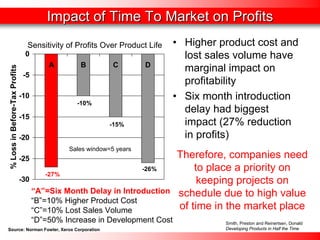
Impact of Time To Market on ProfitsImpact Profits-30-25-20-15-10-50ABCD % Loss in Before-Tax Profits “A”=Six Month Delay in Introduction“B”=10% Higher Product Cost“C”=10% Lost Sales Volume“D”=50% Increase in Development CostSales window=5 yearsTherefore, companies need to place a priority on keeping projects on schedule due to high value of time in the market placeSensitivity of Profits Over Product LifeSmith, Preston and Reinertsen, Donald Developing Products in Half the Time•Higher product cost and lost sales volume have marginal impact on profitability•Six month introduction delay had biggest impact (27% reduction in profits) -27% -10% -15% -26% Source: Norman Fowler, Xerox Corporation
Extended Enterprise Delivery ProcessExtended Process 
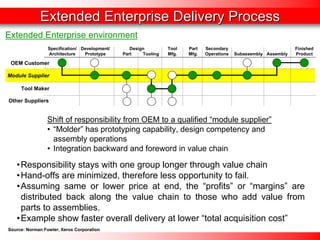
Extended Enterprise environmentSpecification/ ArchitectureDevelopment/ PrototypeDesignPartToolingToolMfg. PartMfg. SecondaryOperationsSubassemblyAssemblyFinishedProductOEM CustomerModule SupplierTool MakerOther Suppliers 
Shift of responsibility from OEM to a qualified “module supplier” 
•“Molder”has prototyping capability, design competency and assembly operations 
•Integration backward and foreword in value chain 
•Responsibility stays with one group longer through value chain 
•Hand-offs are minimized, therefore less opportunity to fail. 
•Assuming same or lower price at end, the “profits”or “margins”are distributed back along the value chain to those who add value from parts to assemblies. 
•Example show faster overall delivery at lower “total acquisition cost” 
Source: Norman Fowler, Xerox Corporation
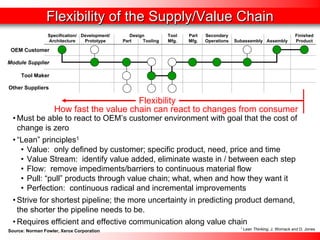
Flexibility of the Supply/Value ChainFlexibility ChainFlexibilityHow fast the value chain can react to changes from consumer•Must be able to react to OEM’s customer environment with goal that the cost of change is zero•“Lean”principles1•Value: only defined by customer; specific product, need, price and time•Value Stream: identify value added, eliminate waste in / between each step •Flow: remove impediments/barriers to continuous material flow•Pull: “pull”products through value chain; what, when and how they want it•Perfection: continuous radical and incremental improvements•Strive for shortest pipeline; the more uncertainty in predictingproduct demand, the shorter the pipeline needs to be. •Requires efficient and effective communication along value chain1 Lean Thinking, J. Womack and D. JonesSpecification/ ArchitectureDevelopment/ PrototypeDesignPartToolingToolMfg. PartMfg. SecondaryOperationsSubassemblyAssemblyFinishedProductOEM CustomerModule SupplierTool MakerOther SuppliersSource: Norman Fowler, Xerox Corporation
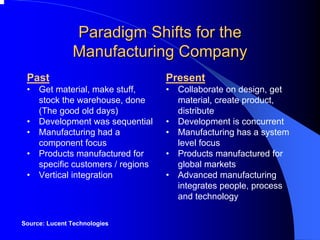
Paradigm Shifts for the 
Manufacturing Company 
Past 
•Get material, make stuff, stock the warehouse, done (The good old days) 
•Development was sequential 
•Manufacturing had a component focus 
•Products manufactured for specific customers / regions 
•Vertical integration 
Present 
•Collaborate on design, get material, create product, distribute 
•Development is concurrent 
•Manufacturing has a system level focus 
•Products manufactured for global markets 
•Advanced manufacturing integrates people, process and technology 
Source: Lucent Technologies
How to Develop a Supply 
Chain Strategy
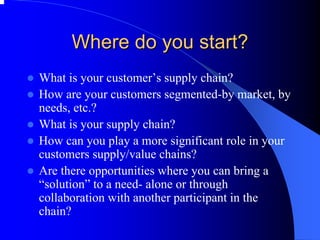
Where do you start? 
zWhat is your customer’s supply chain? 
zHow are your customers segmented-by market, by needs, etc.? 
zWhat is your supply chain? 
zHow can you play a more significant role in your customers supply/value chains? 
zAre there opportunities where you can bring a “solution”to a need-alone or through collaboration with another participant in the chain?
Where do you start? 
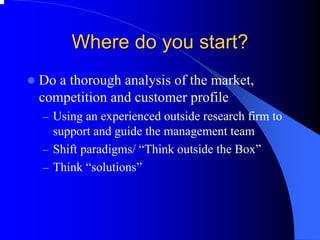
zDo a thorough analysis of the market, competition and customer profile 
–Using an experienced outside research firm to support and guide the management team 
–Shift paradigms/ “Think outside the Box” 
–Think “solutions”
Where do you start? 
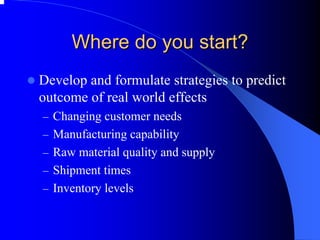
zDevelop and formulate strategies to predict outcome of real world effects 
–Changing customer needs 
–Manufacturing capability 
–Raw material quality and supply 
–Shipment times 
–Inventory levels
Modeling 
zRequires identifying and measuring the critical variables: 
–Market dynamics 
–Customer needs 
–Optimal inventory levels 
–Understanding critical core competencies 
–Establishing supplier partnerships to provide non-core but critical service needs.
Embrace Philosophies of 
Continuous Improvement 
zFirst-Lean Manufacturing 
zThen -Six Sigma
Role of Information 
Technology
Operations vs. Technology 
zTechnology is a toolnot an end in itself 
zOperation focus is critical to understand how to benefit from IT 
zIT assists in enabling speed and flexibility
Operations vs. Technology 
zSince the Internet bubble burst, companies have been event focused-they demand a faster return from IT companies 
zIn 2004, manufacturing companies are beginning to invest again in technology solutions that address the edge of the enterprise
Tools 
zPhilosophies that provide framework-e.g. Lean Manufacturing (www.mep.org) 
zDecision support tools (modeling), e.g. Ronamax(www.ronamax.com) 
zSupply Chain Council 
(www.supply-chain.org)developed the 
SCOR reference model (Supply Chain 
Operations Reference)
Tools Tools-Technology 
•ERP software-e.g. IQMS 
zSupply Chain management-examples 
–IFS 
–I2 
–Manugistics 
–SAP 
–Ingenuus 
zCollaborative software-e.g. Co-Create
Ten Traits of Outstanding 
Supply Organizations 
(Purchasing Magazine, G.H.Associates March 2003) 
zCommitment from the CEO/President to Supply Chain importance 
zUnderstanding role in creating and satisfying customers 
zSuppliers are our friends –not adversaries 
zBest practices are in place and followed 
zSeamless supply chain management 
zTeam-based decision making 
zA culture of value engineering/value analysis 
zOpenness to innovation 
zFocus on best suppliers 
zContinuous quality improvement
Opportunity to Create a New 
Value Proposition 
•Suppliers are driven to compete predominately on a unit manufacturing cost (UMC) basis by OEMs against formidable offshore competitors. •As an industry, we need to find that new competitive plane and offer a value proposition that will yield a new and more robust competitive advantage. “..I believe that the pure product era is coming to a close. Products wrapped in services are what will provide sustainable revenue and profit for business in the net economy.We are looking at every product and seeing how we can wrap that in service to make it more valuable to our customers, more efficient for us to distribute, more powerful in the market place.” Carly FiorinaCEO, HPE-service World 2000Paris, France, March 13, 2000
““How to to”” Conclusions 
zA thorough understanding of customers and markets served is needed to identify supply chain opportunity 
zLean Manufacturing and Six Sigma philosophies need to be in practice 
zTechnology is a tool to enable supply chain flexibility and speed.
““Strategic Strategic”” Conclusions 
zSupply chain management needs to become an integral part of the business strategy 
–Developing a supply chain strategy will improve profitability 
–Managing the enhanced supply chain offers opportunities for sustainable competitive advantage 
zBetter to seize the opportunity than play catch up!
Contact Information 
Margaret H. Baumann 
G.H.Associates 
36 Guinea Hollow Rd. 
Lebanon, NJ 08833 
Phone: 908-832-2207 
Fax:908-832-9307 
E-mail: mhbaumann@earthlink.net 
Website: www.gh-associates.com

Online presentation-supply chain

  • 1.
    Optimizing the SupplyChain: Gaining Competitive Advantage through Supply Chain Management SPE Online Presentation January 22, 2004 G.H. Associates Lebanon, NJ 908-832-2207
  • 2.
    Presentation Outline zIntroduction-Changingface of manufacturing and customer needs zWhat is the “supply chain” zProductivity in the supply chain zDeveloping a supply chain strategy zRole of information technology zTips for getting started
  • 3.
    Introduction zWhy isSupply Chain Management becoming an important competitive tool?
  • 4.
    Trends in Manufacturing zOEM manufacturers made 75 percent of a product’s components 25 years ago zToday make only 25 percent of those components –Balance produced by strategic supplier/partners –Increasing reliability on design partners to help to develop new products –Distributors are playing a more important role
  • 5.
    Trends in Manufacturing zManufacturing base shifting from traditional regions to emerging economies –85% of business machine and telecommunication manufacturing has migrated to the Far East –75%+ of small appliances are produced in Far East –60% of housewares are manufactured outside NA –More and more automotive components are sourced from Eastern Europe, Brazil or China.
  • 6.
    Trends in Manufacturing zAll industry groups have experienced some degree of migration –Manufacturing is evolving to a global enterprise.
  • 7.
    Trends in Manufacturing zConcept design and development is still controlled from the product marketer
  • 8.
    Trends in Manufacturing zPartnering in manufacturing and design has increased the need for better sharing of product information-from initial design through manufacturing, future design modifications and revisions
  • 9.
    Challenges zMost industrysectors are experiencing increased pressure to: –Reduce costs –Improve efficiency –Increase innovation rate –Uncover opportunities around outsourcing and collaborative product development –Improve “time to market”
  • 10.
    Problem/Opportunity zFaced withslow growth and pricing pressures manufacturing companies –Have undergone increasing mergers and acquisitions to achieve economies of scale –Reduced supplier base
  • 11.
    Problem/Opportunity –New technologymust offer performance benefits at no increased cost –Quality and service are increasingly regarded as givens
  • 12.
    Problem/Opportunity –R&D budgetsare reflecting more co-developments with suppliers –More outsourcing
  • 13.
    Paradigm Shifts forEnd Product Requirements (Electronics ) Present •Specifications describe global products •Specifications not over constrained, manufacture anywhere •Agency regulations harmonized to a greater degree •Ease of installation, use and servicing (lower weight, cost, complexity) •Expectations of lower operating costs( lower total cost of ownership) •Products with diagnostics, intelligence (high electronic component) •Environmental regulations in place (take back requirements) •Product data management (PDM) files replace paper documentation Past •Specifications unique for each intended market •Specifications geared to specific manufacturing plants •Agency regulations not harmonized for here and overseas •Products specifications geared to trained installation professionals •Energy efficiency and recyclability recommendations not furnished •Requirements referenced extensive documentation Source: Jack Dispenza, Lucent Technologies
  • 14.
    The Changing ManufacturingLandscape Landscape- OEM Logic Economies of Scale Recent Year’s Technology Common Objectives Economy of scale Experience curve Task specialization Work as a social activity Separable variable costs Standardization Expensive flexibility and variety Desired Characteristics Centralization Large Plants Smooth Flows and balanced lines Standard Product design Mass Production Inventory used as buffer Economies of Scope Today’s Global Technology Common Objectives Economy of scope product life cycle Disaggregated supply Joint costs Unmanned systems Desired Characteristics Outsourcing Disaggregated supply Flexible lines Mass customization Innovation and responsiveness Production on demand External flow systems Source: Jack Dispenza, Lucent Technologies
  • 15.
    As OEMs Continueto Outsource zR&D organizations –Need to remain innovative –Provide knowledge reservoirs outside corporate limits –Provide state of the art quality measures
  • 16.
    As OEMs Continueto Outsource zContract Manufacturers –Handle lower volume and custom made products –Compliment their manufacturing technology with that of traditional and highly specialized suppliers
  • 17.
    As OEMs Continueto Outsource zTraditional suppliers –Need to forge relationships with global manufacturing suppliers –Continue to implement new process and material technologies to create new competitive space –Provide more services
  • 18.
    Tactical to theStrategic zUnderstanding your customers and markets can help you determine where to look in the supply chain for efficiencies and opportunities. zProvide value-add either in manufacturing technology or services-bring “solutions”
  • 19.
    Thus Thus…… zWiththe trend toward global marketing and manufacturing –Short term, the “extended supply chain” presents an opportunity for competitive advantage –Longer term, managing the supply chain efficiently and effectively will need to become a critical core competency for most companies
  • 20.
    What is theSupply Chain?
  • 21.
    Definition of SupplyChain zNeeds clarification –Some see it as leveraging suppliers –Largely event based
  • 22.
    Beyond Sourcing Tools zManufacturers have realized a quick and measurable ROI from simple, tactical event based e-sourcing tools –15% savings and cycle time reductions of 90% –35% of firms with $100MM or more spend use e- auctions but only still less than 5% of the spend zMore strategic sourcing can sustain these improvements, add value and competitive advantage.
  • 23.
    Manufacturing and the Supply Chain zInitial efforts were to assist the procurement function and the selling function with little integration zPortals-buying and design-made an effort to enhance collaboration but did not sufficiently educate to the benefits or adequately meet need zInventory management and logistics have come to the forefront –Re-think JIT The “extended supply chain”offers untapped potential for improved profitability and competitive advantage
  • 24.
    Supply Chain zThelinked set of resources and processes that begins with the sourcing of raw material and extends through the delivery of end items to the final customer. zIt includes the transformation of these materials into intermediate and finished products, and the distribution of these finished products to customers.
  • 25.
    Supply Chain zItincludes vendors, manufacturing facilities, logistics providers, internal distribution centers, distributors, wholesalers and all other entities that lead up to final customer acceptance
  • 26.
    Supply Chain zTheextended supply chain for a given company may also include secondary vendors to their immediate vendors, and the customers of their immediate customers
  • 27.
    Supply Chain zSupplychains exist in both service and manufacturing organizations, although the complexity of the chain may vary greatly from industry to industry and firm to firm.
  • 28.
    Definition of SupplyChain zAny function internally or externally that impacts the customer zSourcing zManufacturing zOperations zMarketing zAsset/Inventory management zDistribution zCustomer service zTechnical support
  • 29.
    Broader Definition ““ExtendedSupply Chain Chain”” zOffers potential opportunity at every step –R&D/Collaboration –Order management and fulfillment –Invoicing and payment –Capacity utilization –Inventory and work in process –Strategic management of the customer portfolio
  • 30.
    Manufacturing Supply Chain zOptimizing the supply chain requires understanding the market and analyzing the areas that have the greatest impact on the business process
  • 31.
    Supply Chain Management(SCM) zTwo sets of processes with different time horizons –Supply chain planning –process of managing the strategic and tactical operations –Supply chain execution-involves the tactical steps necessary to meet the demands of the plan
  • 32.
    Product/Part Delivery ValueChainProduct/Chain IDEA! •Lower costs •Faster delivery •Higher quality Higher set of demandsfor suppliersSpecification/ ArchitectureDevelopment/ PrototypePartDesignTool Designand Mfg. PartMfg. SecondaryOperationsSubassemblyAssemblyFinishedProductCustomerCustomerINNOVATIVE Impact is compounded by: •Plastics industry is now starting to mature (consolidation within and along value chain, etc.) •Increased globalization of customer base. •Intense competition from overseas. •Increased costs (e.g. energy, labor) squeezing plastics suppliers’profitability. Source: Norman Fowler, Xerox Corporation
  • 33.
    Product Delivery ValueChain and CycleProduct CycleDeliveryProcessSupplierBaseSupplierBaseCustomerCustomerOEMOEM•Cheaper•Faster•BetterFeedbackImpact is compounded by: •Plastics industry is becoming more mature in some regions (consolidation within and along value chain, etc.) •Increased globalization of customer base. •Intense competition from overseas. •Increased costs (e.g. energy, labor) squeezing plastics suppliers’profitability. IDEA! INNOVATIVE•Lower cost•Faster delivery•Better qualityPressureFeedback•Better•qualityPressureSource: Norman Fowler, Xerox Corporation
  • 34.
    TodayToday’’s Productivity ParadigmsParadigmEfficiency (ef) “Doing Things Right” ...long race without a finish lineProductivity=? Effectiveness (Ef) “Doing The Right Things” HighHighLowLowDesiredStateHow: Leaneliminate waste How: Six Sigmaminimize variation Productivity=Effectiveness x Efficiency Source: Norman Fowler, Xerox Corporation
  • 35.
    Lean Manufacturing zAnoverall methodology that seeks to minimize the resources required for production by eliminating waste (non-value added activities) that inflate costs, lead times and inventory requirements, and emphasizing the use of preventive maintenance , quality improvement programs, pull systems and flexible work forces and production facilities. zPrinciples of lean include zero waiting time, zero inventory, scheduling (internal customer pull instead of push system), batch to flow (cut batch sizes), line balancing and cutting actual process times. zFocus is eliminating waste: unnecessary motion, overproduction and work in process
  • 36.
    Six Sigma zAvision of quality which equates with only 3.4 defects per million opportunities for each product or service transaction. zAn increase in performance and decrease in process variation lead to defect reduction and improvement in profits, employee morale and quality of product. zA continual improvement process-strives for perfection
  • 37.
    Impact of TimeTo Market on ProfitsImpact Profits-30-25-20-15-10-50ABCD % Loss in Before-Tax Profits “A”=Six Month Delay in Introduction“B”=10% Higher Product Cost“C”=10% Lost Sales Volume“D”=50% Increase in Development CostSales window=5 yearsTherefore, companies need to place a priority on keeping projects on schedule due to high value of time in the market placeSensitivity of Profits Over Product LifeSmith, Preston and Reinertsen, Donald Developing Products in Half the Time•Higher product cost and lost sales volume have marginal impact on profitability•Six month introduction delay had biggest impact (27% reduction in profits) -27% -10% -15% -26% Source: Norman Fowler, Xerox Corporation
  • 38.
    Extended Enterprise DeliveryProcessExtended Process Extended Enterprise environmentSpecification/ ArchitectureDevelopment/ PrototypeDesignPartToolingToolMfg. PartMfg. SecondaryOperationsSubassemblyAssemblyFinishedProductOEM CustomerModule SupplierTool MakerOther Suppliers Shift of responsibility from OEM to a qualified “module supplier” •“Molder”has prototyping capability, design competency and assembly operations •Integration backward and foreword in value chain •Responsibility stays with one group longer through value chain •Hand-offs are minimized, therefore less opportunity to fail. •Assuming same or lower price at end, the “profits”or “margins”are distributed back along the value chain to those who add value from parts to assemblies. •Example show faster overall delivery at lower “total acquisition cost” Source: Norman Fowler, Xerox Corporation
  • 39.
    Flexibility of theSupply/Value ChainFlexibility ChainFlexibilityHow fast the value chain can react to changes from consumer•Must be able to react to OEM’s customer environment with goal that the cost of change is zero•“Lean”principles1•Value: only defined by customer; specific product, need, price and time•Value Stream: identify value added, eliminate waste in / between each step •Flow: remove impediments/barriers to continuous material flow•Pull: “pull”products through value chain; what, when and how they want it•Perfection: continuous radical and incremental improvements•Strive for shortest pipeline; the more uncertainty in predictingproduct demand, the shorter the pipeline needs to be. •Requires efficient and effective communication along value chain1 Lean Thinking, J. Womack and D. JonesSpecification/ ArchitectureDevelopment/ PrototypeDesignPartToolingToolMfg. PartMfg. SecondaryOperationsSubassemblyAssemblyFinishedProductOEM CustomerModule SupplierTool MakerOther SuppliersSource: Norman Fowler, Xerox Corporation
  • 40.
    Paradigm Shifts forthe Manufacturing Company Past •Get material, make stuff, stock the warehouse, done (The good old days) •Development was sequential •Manufacturing had a component focus •Products manufactured for specific customers / regions •Vertical integration Present •Collaborate on design, get material, create product, distribute •Development is concurrent •Manufacturing has a system level focus •Products manufactured for global markets •Advanced manufacturing integrates people, process and technology Source: Lucent Technologies
  • 41.
    How to Developa Supply Chain Strategy
  • 42.
    Where do youstart? zWhat is your customer’s supply chain? zHow are your customers segmented-by market, by needs, etc.? zWhat is your supply chain? zHow can you play a more significant role in your customers supply/value chains? zAre there opportunities where you can bring a “solution”to a need-alone or through collaboration with another participant in the chain?
  • 43.
    Where do youstart? zDo a thorough analysis of the market, competition and customer profile –Using an experienced outside research firm to support and guide the management team –Shift paradigms/ “Think outside the Box” –Think “solutions”
  • 44.
    Where do youstart? zDevelop and formulate strategies to predict outcome of real world effects –Changing customer needs –Manufacturing capability –Raw material quality and supply –Shipment times –Inventory levels
  • 45.
    Modeling zRequires identifyingand measuring the critical variables: –Market dynamics –Customer needs –Optimal inventory levels –Understanding critical core competencies –Establishing supplier partnerships to provide non-core but critical service needs.
  • 46.
    Embrace Philosophies of Continuous Improvement zFirst-Lean Manufacturing zThen -Six Sigma
  • 47.
  • 48.
    Operations vs. Technology zTechnology is a toolnot an end in itself zOperation focus is critical to understand how to benefit from IT zIT assists in enabling speed and flexibility
  • 49.
    Operations vs. Technology zSince the Internet bubble burst, companies have been event focused-they demand a faster return from IT companies zIn 2004, manufacturing companies are beginning to invest again in technology solutions that address the edge of the enterprise
  • 50.
    Tools zPhilosophies thatprovide framework-e.g. Lean Manufacturing (www.mep.org) zDecision support tools (modeling), e.g. Ronamax(www.ronamax.com) zSupply Chain Council (www.supply-chain.org)developed the SCOR reference model (Supply Chain Operations Reference)
  • 51.
    Tools Tools-Technology •ERPsoftware-e.g. IQMS zSupply Chain management-examples –IFS –I2 –Manugistics –SAP –Ingenuus zCollaborative software-e.g. Co-Create
  • 52.
    Ten Traits ofOutstanding Supply Organizations (Purchasing Magazine, G.H.Associates March 2003) zCommitment from the CEO/President to Supply Chain importance zUnderstanding role in creating and satisfying customers zSuppliers are our friends –not adversaries zBest practices are in place and followed zSeamless supply chain management zTeam-based decision making zA culture of value engineering/value analysis zOpenness to innovation zFocus on best suppliers zContinuous quality improvement
  • 53.
    Opportunity to Createa New Value Proposition •Suppliers are driven to compete predominately on a unit manufacturing cost (UMC) basis by OEMs against formidable offshore competitors. •As an industry, we need to find that new competitive plane and offer a value proposition that will yield a new and more robust competitive advantage. “..I believe that the pure product era is coming to a close. Products wrapped in services are what will provide sustainable revenue and profit for business in the net economy.We are looking at every product and seeing how we can wrap that in service to make it more valuable to our customers, more efficient for us to distribute, more powerful in the market place.” Carly FiorinaCEO, HPE-service World 2000Paris, France, March 13, 2000
  • 54.
    ““How to to””Conclusions zA thorough understanding of customers and markets served is needed to identify supply chain opportunity zLean Manufacturing and Six Sigma philosophies need to be in practice zTechnology is a tool to enable supply chain flexibility and speed.
  • 55.
    ““Strategic Strategic”” Conclusions zSupply chain management needs to become an integral part of the business strategy –Developing a supply chain strategy will improve profitability –Managing the enhanced supply chain offers opportunities for sustainable competitive advantage zBetter to seize the opportunity than play catch up!
  • 56.
    Contact Information MargaretH. Baumann G.H.Associates 36 Guinea Hollow Rd. Lebanon, NJ 08833 Phone: 908-832-2207 Fax:908-832-9307 E-mail: mhbaumann@earthlink.net Website: www.gh-associates.com