

INTRODUCTION TO RESEARCH
METHODOLOGY
Zeeshan Akhtar (M.Phil, B.Optom)
Asst Professor
Sushant School of Health Sciences
INTRODUCTION TO RESEARCH
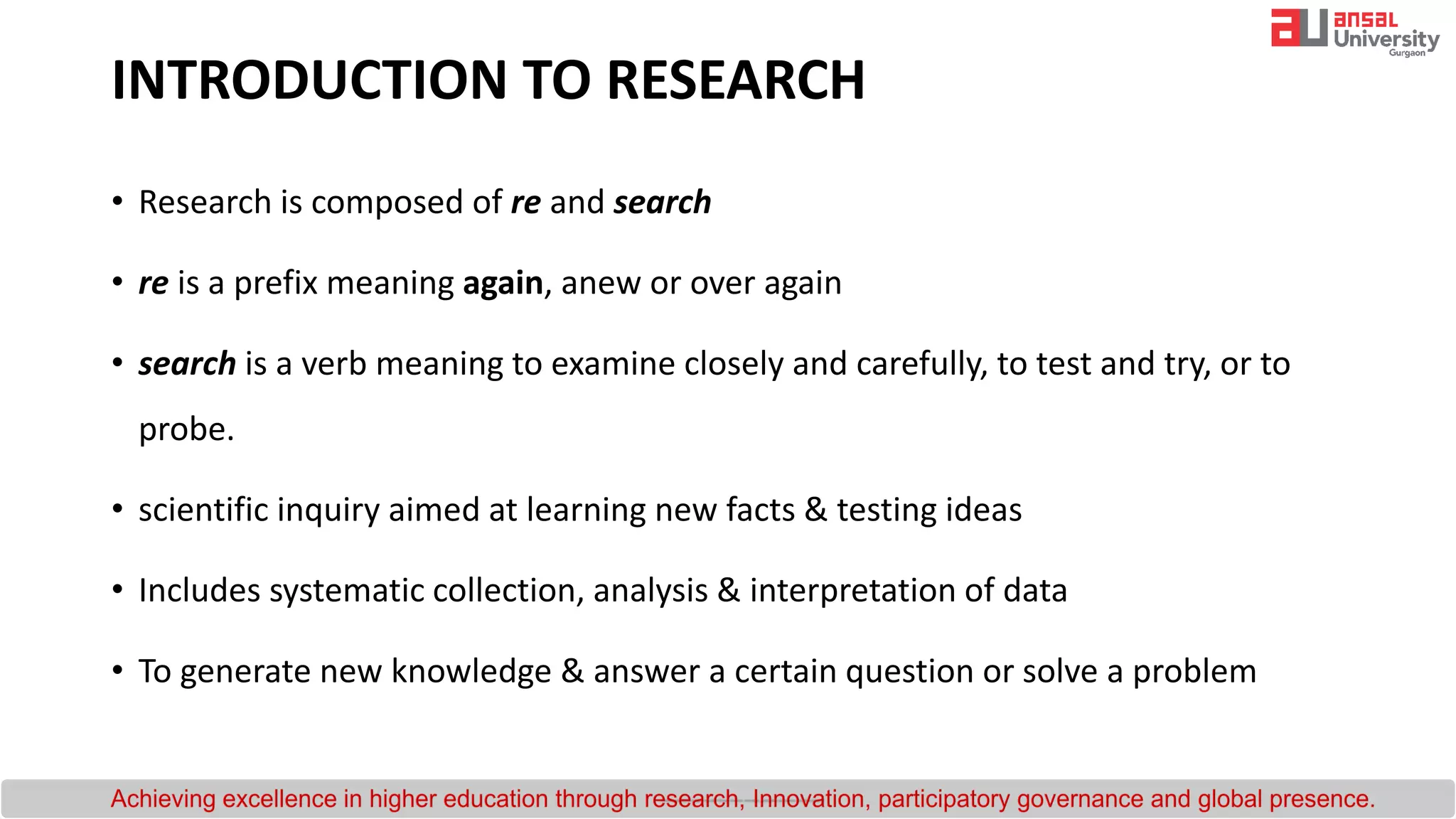
• Research is composed of re and search
• re is a prefix meaning again, anew or over again
• search is a verb meaning to examine closely and carefully, to test and try, or to
probe.
• scientific inquiry aimed at learning new facts & testing ideas
• Includes systematic collection, analysis & interpretation of data
• To generate new knowledge & answer a certain question or solve a problem
RESEARCH PROCESS GUIDELINES
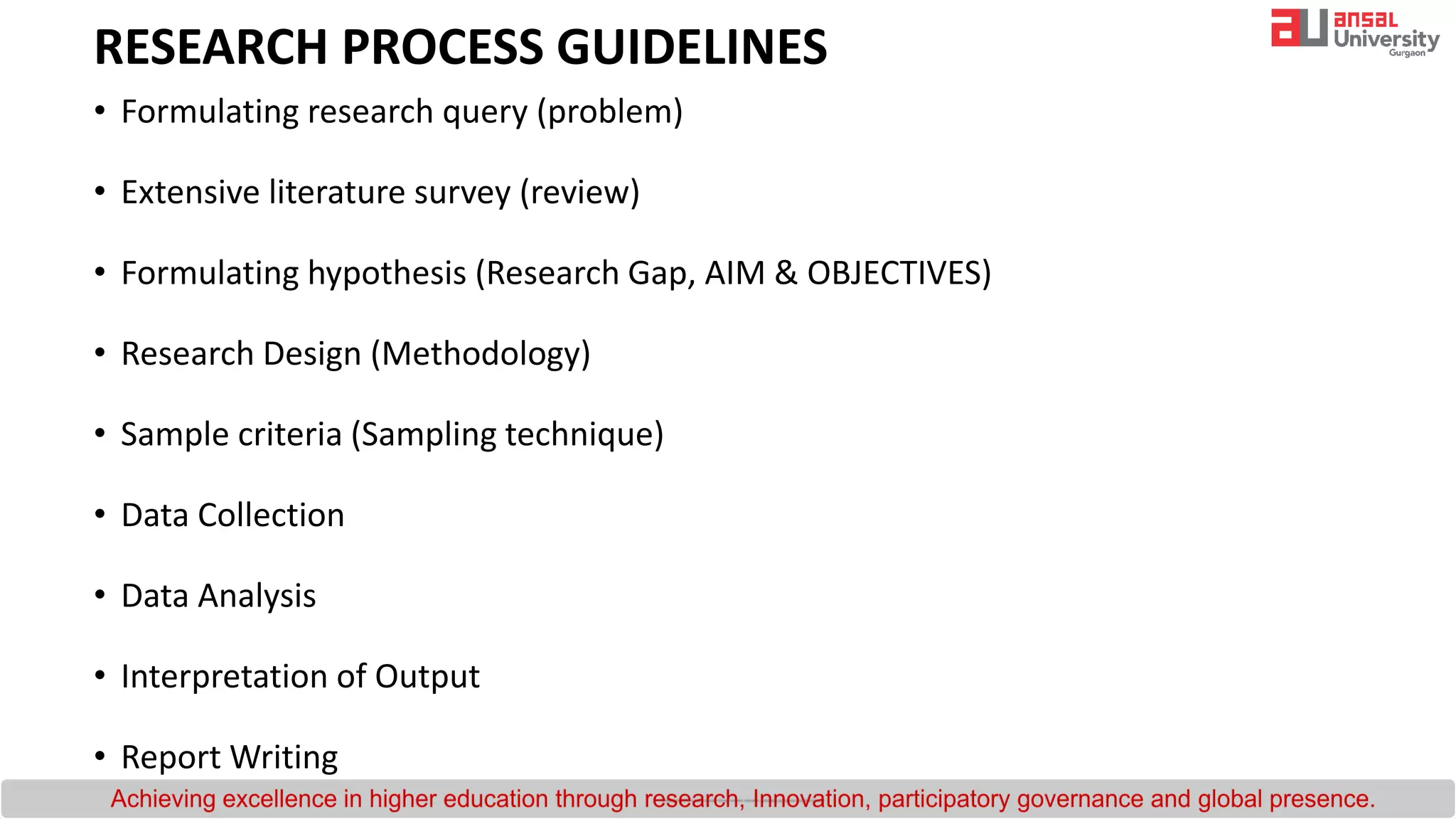
• Formulating research query (problem)
• Extensive literature survey (review)
• Formulating hypothesis (Research Gap, AIM & OBJECTIVES)
• Research Design (Methodology)
• Sample criteria (Sampling technique)
• Data Collection
• Data Analysis
• Interpretation of Output
• Report Writing
QUALITIES OF GOOD RESEARCH
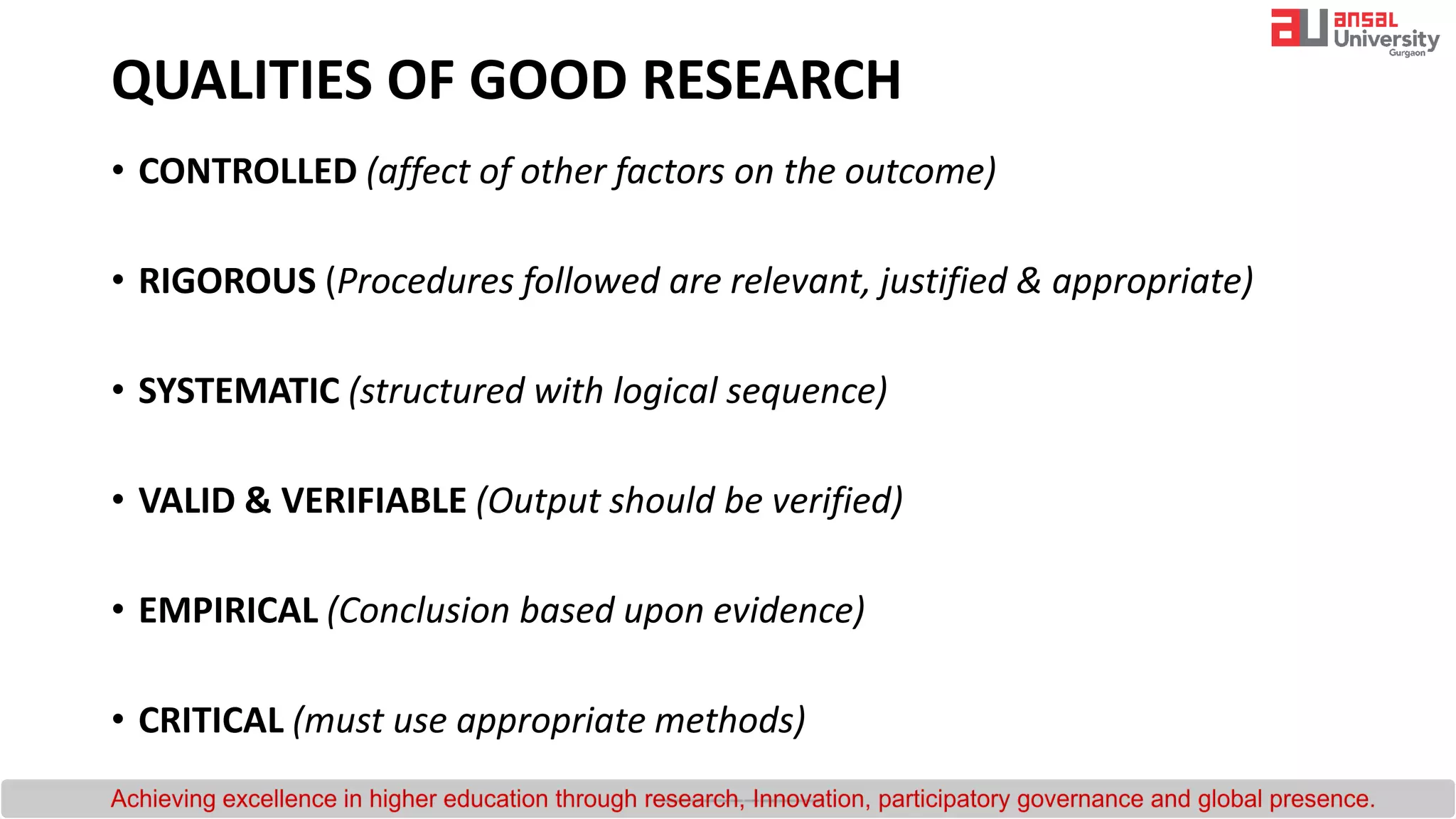
• CONTROLLED (affect of other factors on the outcome)
• RIGOROUS (Procedures followed are relevant, justified & appropriate)
• SYSTEMATIC (structured with logical sequence)
• VALID & VERIFIABLE (Output should be verified)
• EMPIRICAL (Conclusion based upon evidence)
• CRITICAL (must use appropriate methods)
RESEARCH FORMULATION (IDEA)
• Thought & IDEA
• Passion (To contribute)
• Through other researches
• Through clinical practice
• And should be beneficial to larger community
LITERATURE REVIEW
• To understand existing relevant research information
• Background & existing current knowledge
• Helps in developing conceptual framework
• Helpful in topic selection & refinement
• Helps in identify research gap and inconsistent findings
• Critical review of articles
STEPS IN LITERATURE
• Selecting a review topic
• Searching the literature
• Gathering, reading and analysing the literature
• Writing the review
LITERATURE SEARCH
• Computer & Electronic database
• CINAHL (Cumulative Index of Nursing Journals related to nursing and
health and Allied Health Literature) related publications
• Cochrane Library (Systematic reviews of the literature on medicine,
nursing and professions allied to health)
• Pubmed / MEDLINE A service of the National Library of Medicine and
additional life science journals
• Google Scholar
• Cross referencing
• Key words ( Most Common method)
• Good idea to consider alternative key words (e.g. Amblyopia/Lazy Eye)
• Another strategy is combining keywords. To help with these combinations
many databases use commands called‘Booleanoperators’.The most common
Boolean operators are
• ‘AND’,‘OR’and‘NOT’
• AND Look for articles that include all the identified keywords
• OR Look for articles that include any of the identified keywords
• NOT Exclude articles that contain this specific keyword
LITERATURE SEARCH CONT…
SOURCES OF LITERATURE
• Primary Source: Usually a report by the original researchers of a
study
• Secondary Source: Description or summary by somebody other than
the original researcher, e.g. a review article
• Conceptual/Theoretical: Papers concerned with description or analysis of
theories or concepts associated with the topic
• Anecdotal/Opinion/Clinical: Views or opinions about the subject that
are not research, review or theoretical in nature. Clinical may be case
studies or reports from clinical settings
AIM & OBJECTIVES (HYPOTHESIS FORMULATION)
• Identify Literature Gap
• Generate the hypothesis
• Define objectives
• Methods of Hypothesis testing
MATERIALS & METHODS
• Methods of testing
• STUDY Design
• Sample selection criteria (inclusion criteria)
• Sampling techniques
• Data Collection techniques
• Data handling
• BIAS
• Confounders
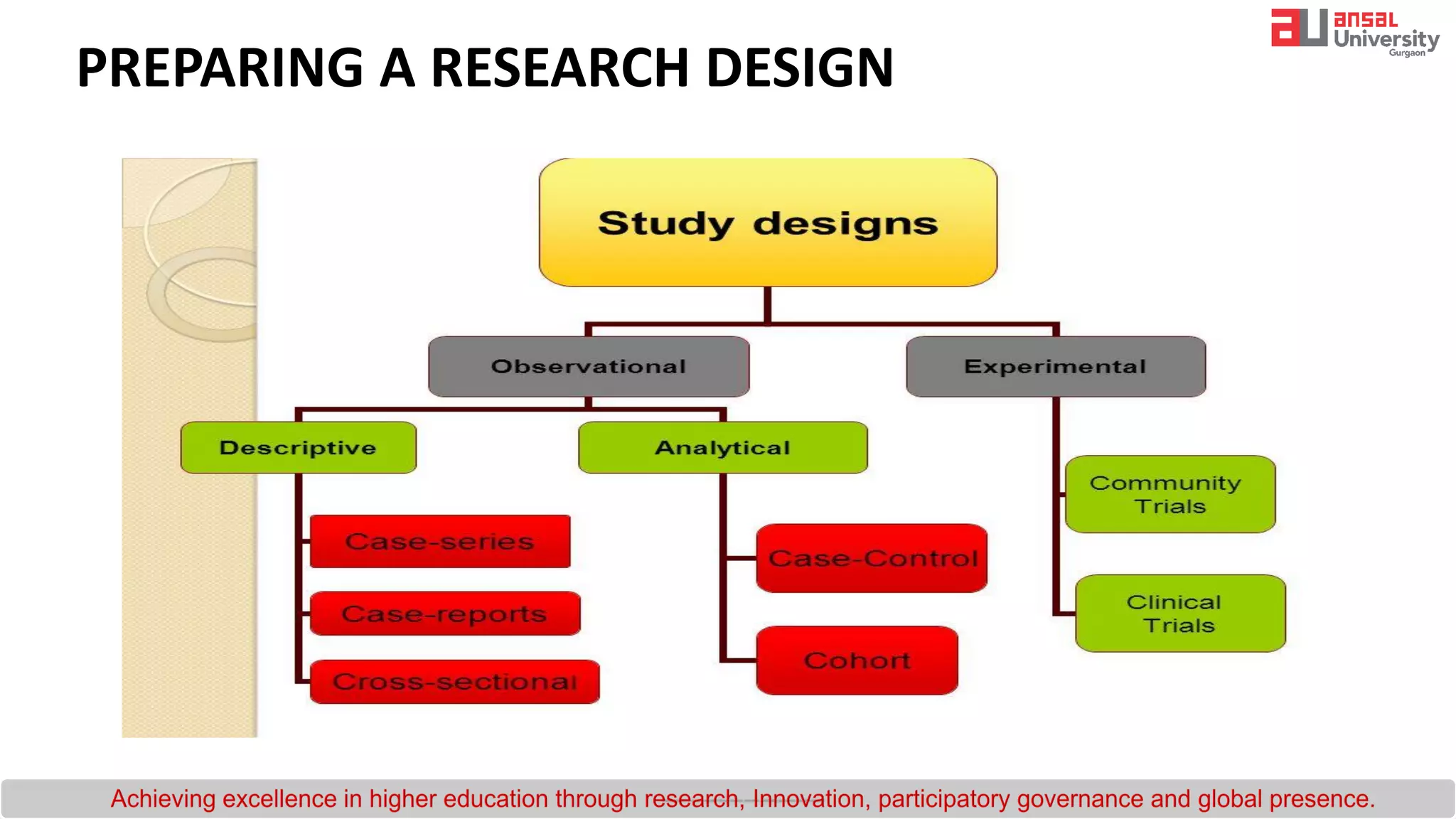
PREPARING A RESEARCH DESIGN
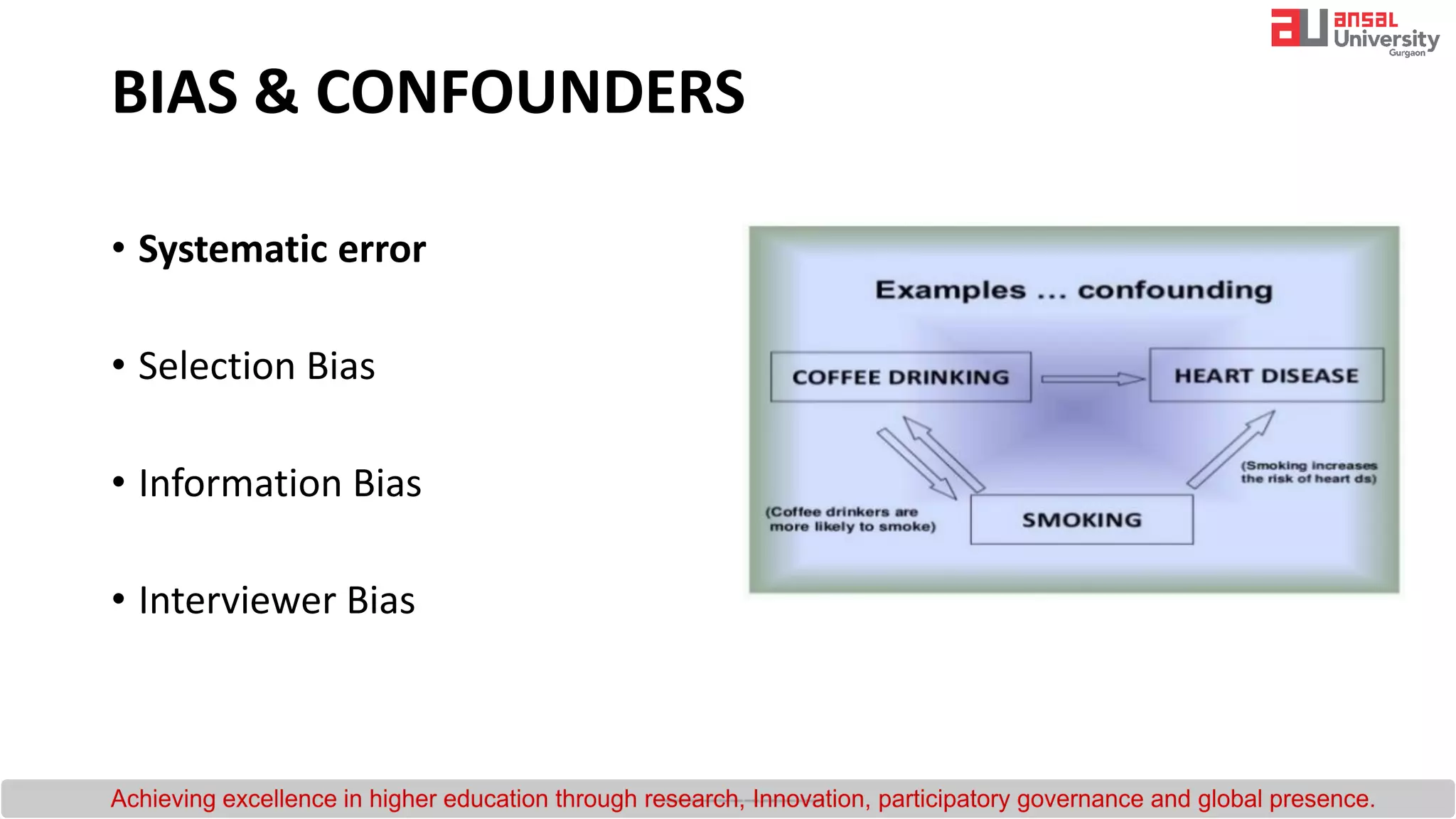
BIAS & CONFOUNDERS
• Systematic error
• Selection Bias
• Information Bias
• Interviewer Bias
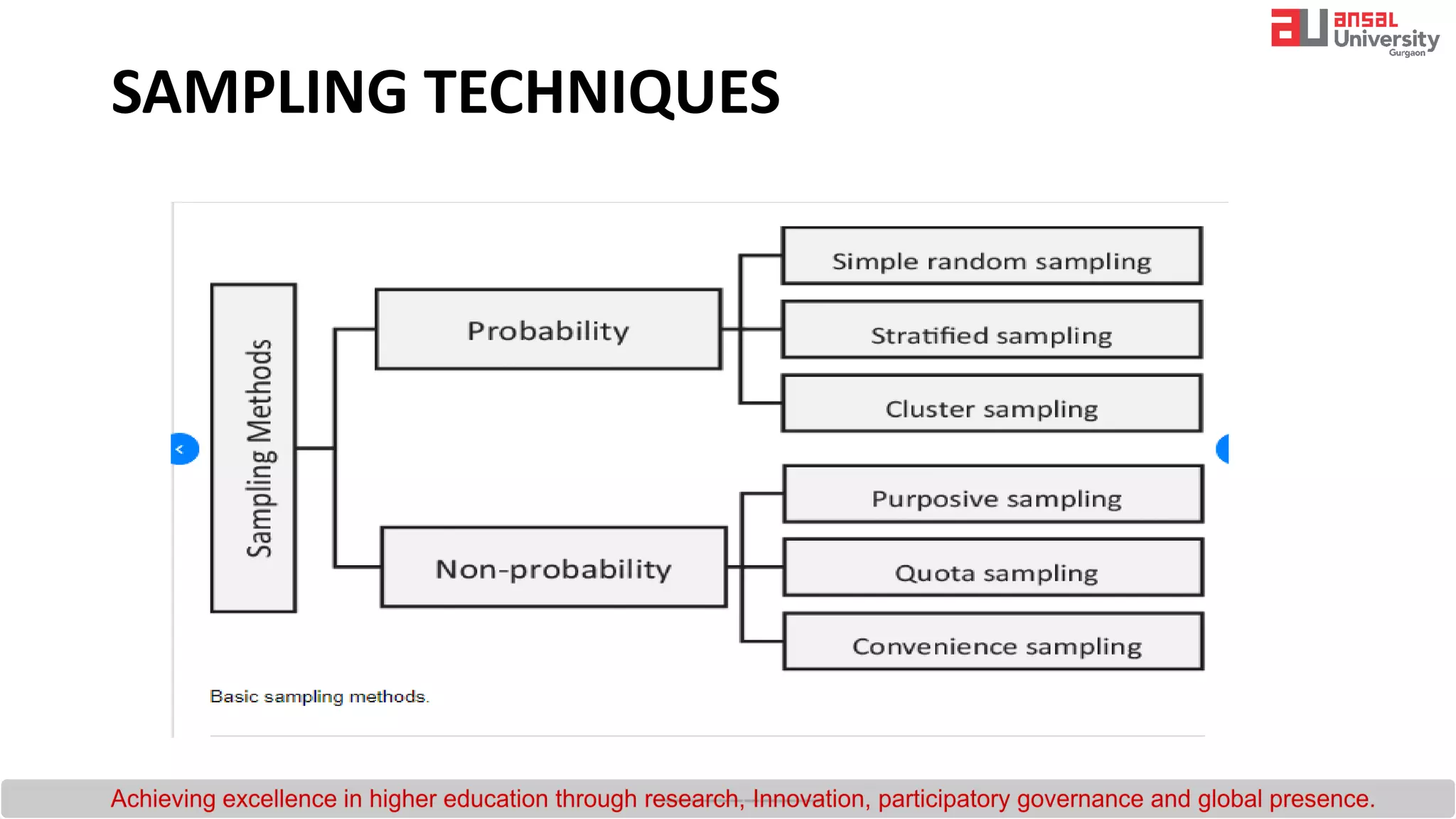
SAMPLING TECHNIQUES
DATA COLLECTION
• DATA COLLECTION METHODS & TECHNIQUES
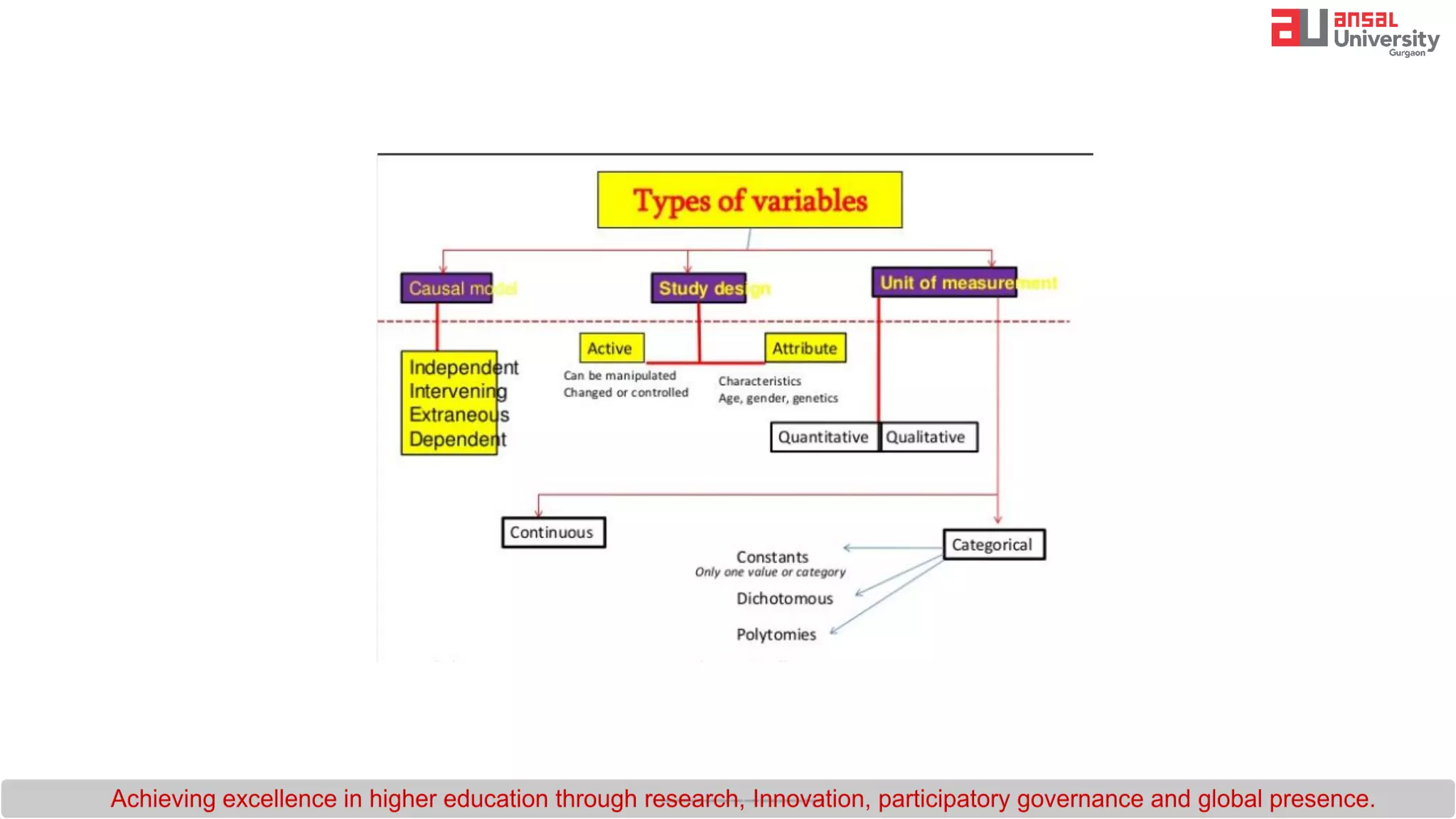
• TYPES OF DATA & VARIABLE
• DATA ANALYSIS (DATA HANDLING)
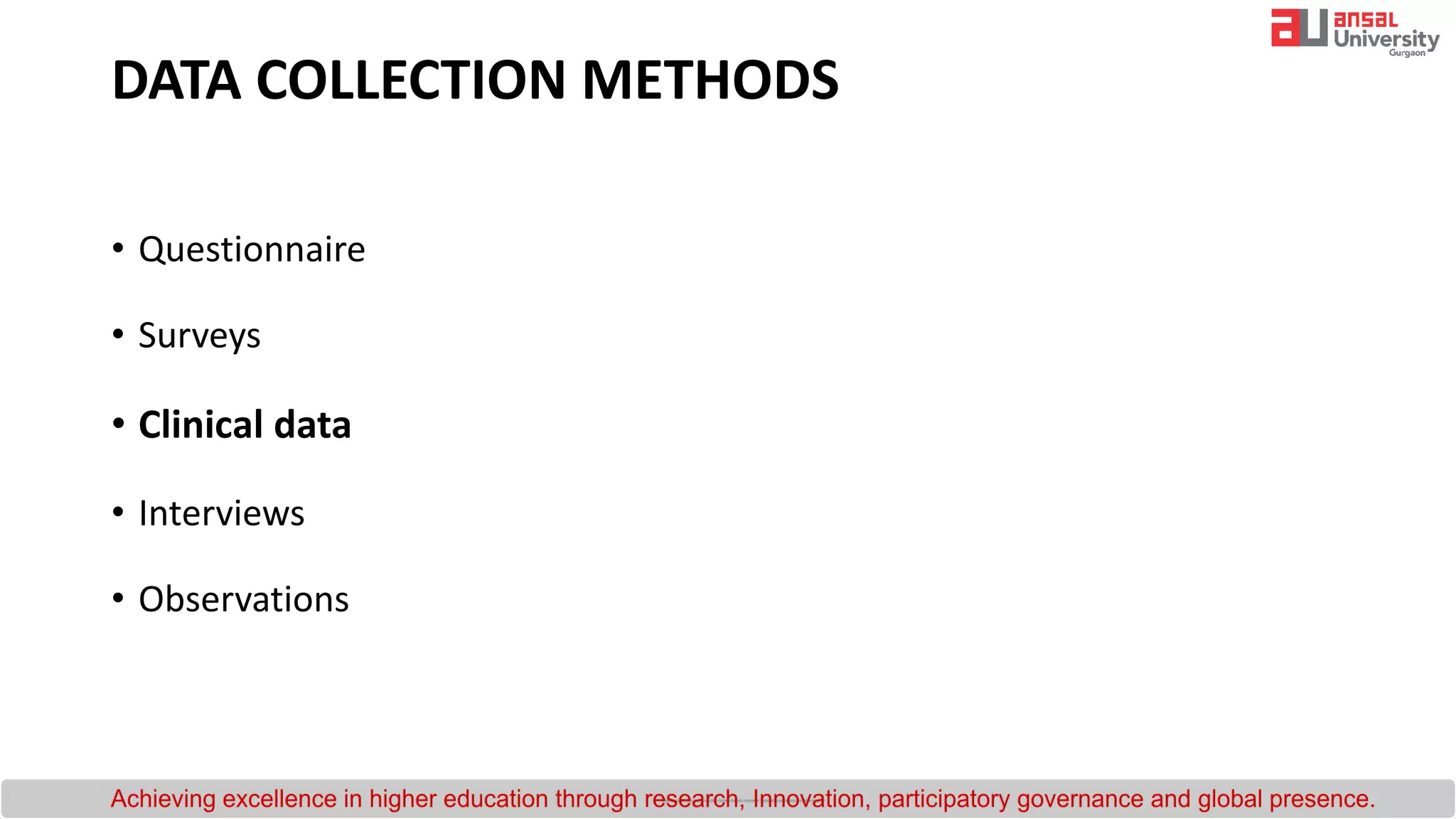
DATA COLLECTION METHODS
• Questionnaire
• Surveys
• Clinical data
• Interviews
• Observations
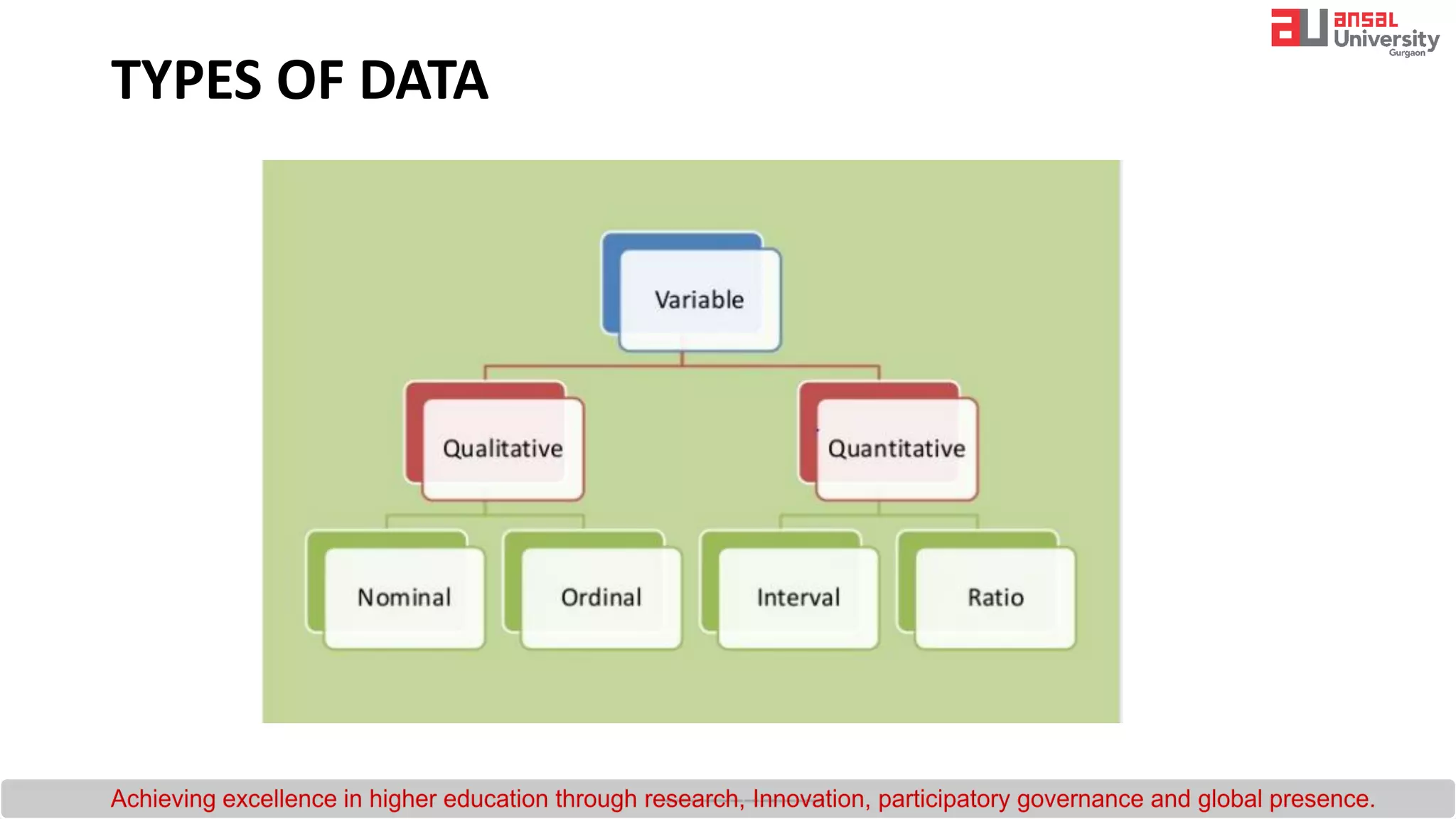
TYPES OF DATA
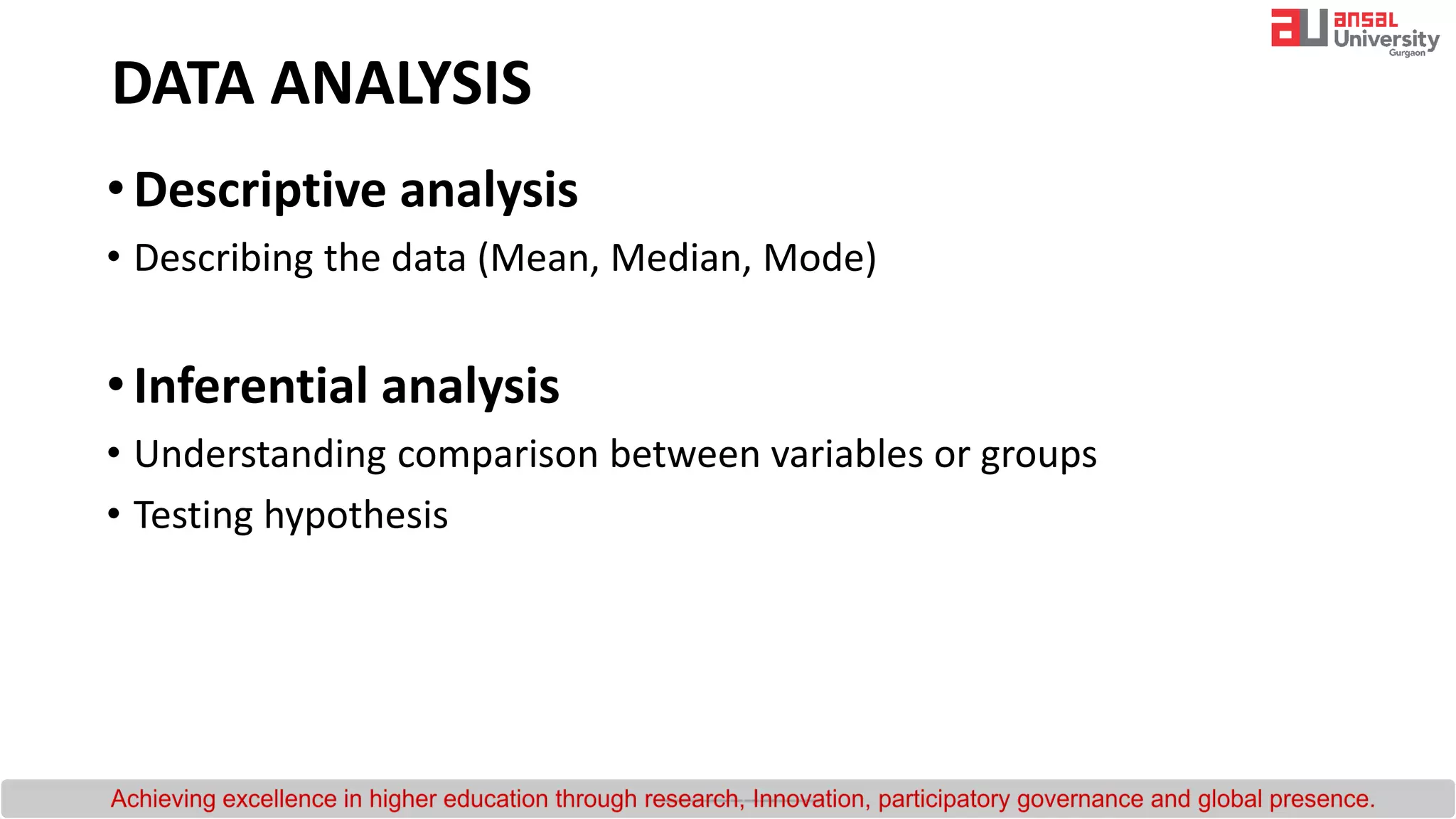
•Descriptive analysis
• Describing the data (Mean, Median, Mode)
•Inferential analysis
• Understanding comparison between variables or groups
• Testing hypothesis
DATA ANALYSIS
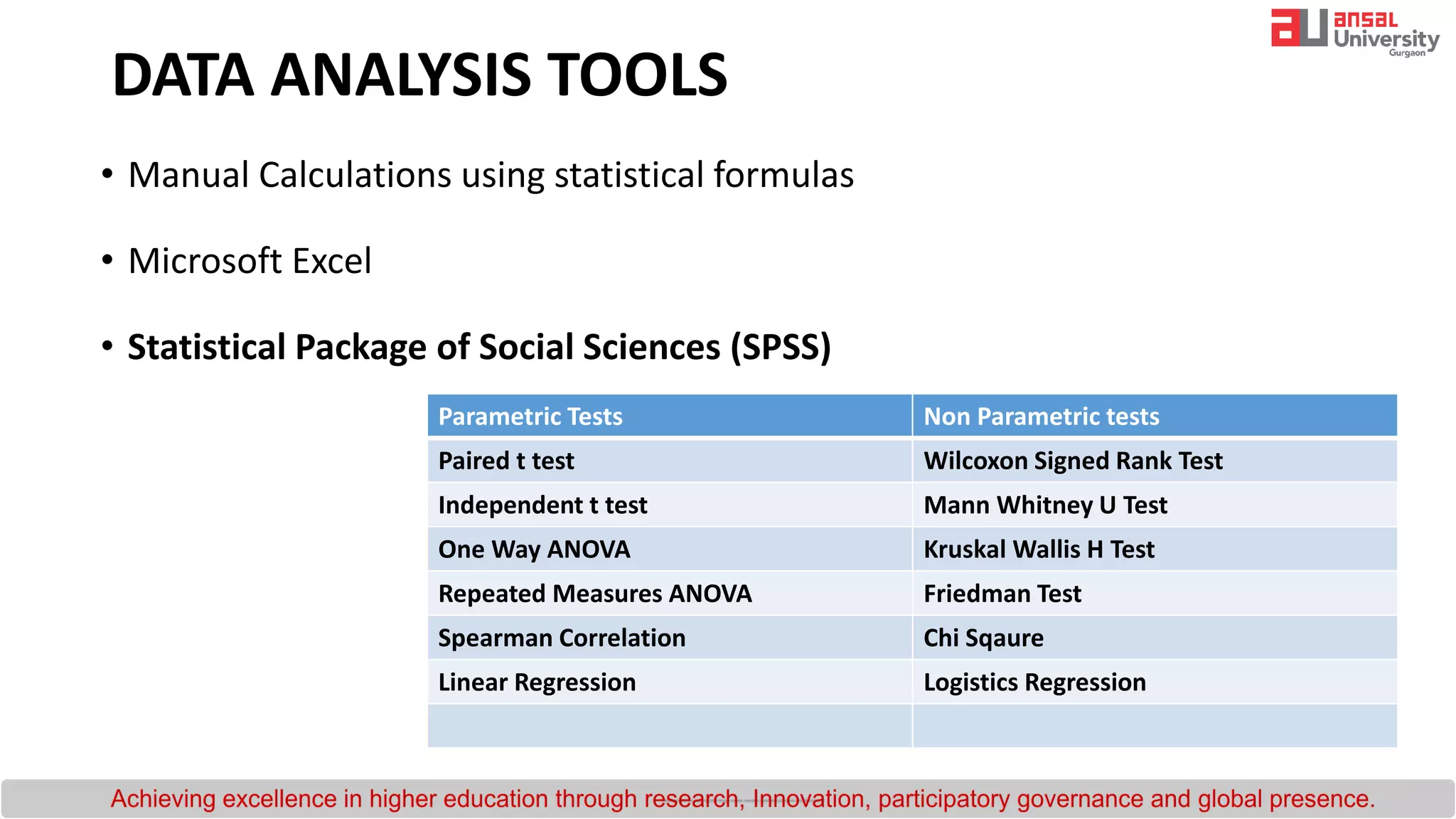
• Manual Calculations using statistical formulas
• Microsoft Excel
• Statistical Package of Social Sciences (SPSS)
DATA ANALYSIS TOOLS
Parametric Tests Non Parametric tests
Paired t test Wilcoxon Signed Rank Test
Independent t test Mann Whitney U Test
One Way ANOVA Kruskal Wallis H Test
Repeated Measures ANOVA Friedman Test
Spearman Correlation Chi Sqaure
Linear Regression Logistics Regression
DATA INTERPRETATION
• Task to draw conclusion
• Requires statistical output understanding
• Explaining significance of output
• May trigger some new questions
• Based on hypothesis
REPORT WRITING
• In the form of thesis or manuscript
• It Contains
• Preliminary pages (Title, Acknowledgement, Abbreviations etc)
• Main body text (Introduction, methodology, result, discussion, conclusion)
• End of Report (appendices, references, bibliography)
Thank You
formulating the research problem;
• (2) extensive literature survey;
• (3) developing the hypothesis;
• (4) preparing the research design;
• (5) determining sample design;
• (6) collecting the data;
• (7) execution of the project;
• (8) analysis of data;
• (9) hypothesis testing;
• (10) generalisations and interpretation,
• (11) preparation of the report or presentation of the results ,i. e., formal
write-up of conclusions reached.
RESEARCH PROCESS GUIDELINES

Introduction To Research Methodology

  • 1.
    INTRODUCTION TO RESEARCH METHODOLOGY ZeeshanAkhtar (M.Phil, B.Optom) Asst Professor Sushant School of Health Sciences
  • 2.
    INTRODUCTION TO RESEARCH •Research is composed of re and search • re is a prefix meaning again, anew or over again • search is a verb meaning to examine closely and carefully, to test and try, or to probe. • scientific inquiry aimed at learning new facts & testing ideas • Includes systematic collection, analysis & interpretation of data • To generate new knowledge & answer a certain question or solve a problem
  • 3.
    RESEARCH PROCESS GUIDELINES •Formulating research query (problem) • Extensive literature survey (review) • Formulating hypothesis (Research Gap, AIM & OBJECTIVES) • Research Design (Methodology) • Sample criteria (Sampling technique) • Data Collection • Data Analysis • Interpretation of Output • Report Writing
  • 4.
    QUALITIES OF GOODRESEARCH • CONTROLLED (affect of other factors on the outcome) • RIGOROUS (Procedures followed are relevant, justified & appropriate) • SYSTEMATIC (structured with logical sequence) • VALID & VERIFIABLE (Output should be verified) • EMPIRICAL (Conclusion based upon evidence) • CRITICAL (must use appropriate methods)
  • 5.
    RESEARCH FORMULATION (IDEA) •Thought & IDEA • Passion (To contribute) • Through other researches • Through clinical practice • And should be beneficial to larger community
  • 6.
    LITERATURE REVIEW • Tounderstand existing relevant research information • Background & existing current knowledge • Helps in developing conceptual framework • Helpful in topic selection & refinement • Helps in identify research gap and inconsistent findings • Critical review of articles
  • 7.
    STEPS IN LITERATURE •Selecting a review topic • Searching the literature • Gathering, reading and analysing the literature • Writing the review
  • 8.
    LITERATURE SEARCH • Computer& Electronic database • CINAHL (Cumulative Index of Nursing Journals related to nursing and health and Allied Health Literature) related publications • Cochrane Library (Systematic reviews of the literature on medicine, nursing and professions allied to health) • Pubmed / MEDLINE A service of the National Library of Medicine and additional life science journals • Google Scholar • Cross referencing
  • 9.
    • Key words( Most Common method) • Good idea to consider alternative key words (e.g. Amblyopia/Lazy Eye) • Another strategy is combining keywords. To help with these combinations many databases use commands called‘Booleanoperators’.The most common Boolean operators are • ‘AND’,‘OR’and‘NOT’ • AND Look for articles that include all the identified keywords • OR Look for articles that include any of the identified keywords • NOT Exclude articles that contain this specific keyword LITERATURE SEARCH CONT…
  • 10.
    SOURCES OF LITERATURE •Primary Source: Usually a report by the original researchers of a study • Secondary Source: Description or summary by somebody other than the original researcher, e.g. a review article • Conceptual/Theoretical: Papers concerned with description or analysis of theories or concepts associated with the topic • Anecdotal/Opinion/Clinical: Views or opinions about the subject that are not research, review or theoretical in nature. Clinical may be case studies or reports from clinical settings
  • 11.
    AIM & OBJECTIVES(HYPOTHESIS FORMULATION) • Identify Literature Gap • Generate the hypothesis • Define objectives • Methods of Hypothesis testing
  • 12.
    MATERIALS & METHODS •Methods of testing • STUDY Design • Sample selection criteria (inclusion criteria) • Sampling techniques • Data Collection techniques • Data handling • BIAS • Confounders
  • 13.
  • 14.
    BIAS & CONFOUNDERS •Systematic error • Selection Bias • Information Bias • Interviewer Bias
  • 15.
  • 16.
    DATA COLLECTION • DATACOLLECTION METHODS & TECHNIQUES • TYPES OF DATA & VARIABLE • DATA ANALYSIS (DATA HANDLING)
  • 17.
    DATA COLLECTION METHODS •Questionnaire • Surveys • Clinical data • Interviews • Observations
  • 18.
  • 19.
    •Descriptive analysis • Describingthe data (Mean, Median, Mode) •Inferential analysis • Understanding comparison between variables or groups • Testing hypothesis DATA ANALYSIS
  • 20.
    • Manual Calculationsusing statistical formulas • Microsoft Excel • Statistical Package of Social Sciences (SPSS) DATA ANALYSIS TOOLS Parametric Tests Non Parametric tests Paired t test Wilcoxon Signed Rank Test Independent t test Mann Whitney U Test One Way ANOVA Kruskal Wallis H Test Repeated Measures ANOVA Friedman Test Spearman Correlation Chi Sqaure Linear Regression Logistics Regression
  • 21.
    DATA INTERPRETATION • Taskto draw conclusion • Requires statistical output understanding • Explaining significance of output • May trigger some new questions • Based on hypothesis
  • 22.
    REPORT WRITING • Inthe form of thesis or manuscript • It Contains • Preliminary pages (Title, Acknowledgement, Abbreviations etc) • Main body text (Introduction, methodology, result, discussion, conclusion) • End of Report (appendices, references, bibliography)
  • 23.
  • 26.
    formulating the researchproblem; • (2) extensive literature survey; • (3) developing the hypothesis; • (4) preparing the research design; • (5) determining sample design; • (6) collecting the data; • (7) execution of the project; • (8) analysis of data; • (9) hypothesis testing; • (10) generalisations and interpretation, • (11) preparation of the report or presentation of the results ,i. e., formal write-up of conclusions reached. RESEARCH PROCESS GUIDELINES