NAME: MANDEEP
KAUR
An Introduction
• Research in common parlance refers to a
search for knowledge.
• In fact, research is an art of scientific
investigation.
• “systematized effort to gain new
knowledge.”
DEFINITION
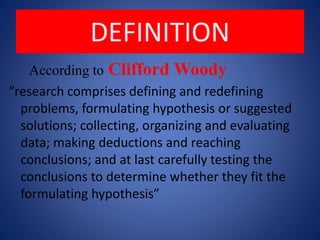
According to Clifford Woody
“research comprises defining and redefining
problems, formulating hypothesis or suggested
solutions; collecting, organizing and evaluating
data; making deductions and reaching
conclusions; and at last carefully testing the
conclusions to determine whether they fit the
formulating hypothesis”
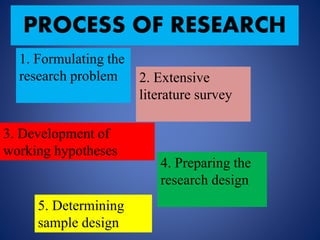
PROCESS OF RESEARCH
1. Formulating the
research problem 2. Extensive
literature survey
3. Development of
working hypotheses
4. Preparing the
research design
5. Determining
sample design
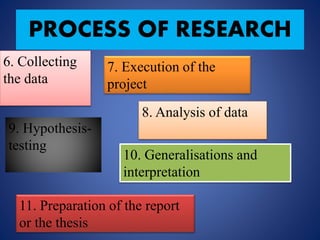
PROCESS OF RESEARCH
6. Collecting
the data
7. Execution of the
project
8. Analysis of data
9. Hypothesis-
testing
10. Generalisations and
interpretation
11. Preparation of the report
or the thesis
1. Formulating the research problem
 FIRST OF ALL WE NEEDS TO FIND THE
PROBLEM . THE PROBLEM MAY BE
EXISTING OF NEW FORMULATED ONE.
 The best way of understanding the problem
is to discuss it with one’s own colleagues or
with those having some expertise in the
matter.
2. Extensive literature survey
Once the problem is
formulated, a brief
summary of it should be
written down.
IN LITERATURE SURVEY WE STUDY
FOLLOWS:
o THE CONCEPTS AND THEORIES.
o REVIEW PREVIOUS RESEARCH FINDINGS.
3. Development of working
hypotheses
HYPOTHESES ARE IN GENERALLY
STAEMENTS WHICH EXPRESS IN THE FORM
MAY BE OR MAY NOT BE
in order to test its logical or
empirical consequences.
Hypothesis should be
specific and
limited to the piece of research
in hand because it has to be
tested.
By following ways
hypothesis can be made:
Discussions with
colleagues and experts about
the problem, data and
records, interviews
4. Preparing the research design
The preparation of the research design, appropriate for a particular
research problem, involves
usually the consideration of the following:
(i) the means of obtaining the information;
(ii) the availability and skills of the researcher and his staff (if any);
(iv) the time available for research; and
(v) the cost factor relating to research, i.e., the finance available for
the purpose
5. Determining sample design
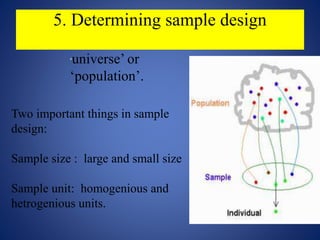
‘universe’ or
‘population’.
Two important things in sample
design:
Sample size : large and small size
Sample unit: homogenious and
hetrogenious units.
Sample design
‘probability
sampling:
1. simple random sampling
2.systematic sampling
3. stratified sampling
4. cluster/area sampling
Non-Probability
sampling:
1. convenience
sampling
2. judgement sampling
3. quota sampling
techniques
6. Collecting the data
considerably in context of
money costs, time and
other resources at the
disposal of the researcher.
It means getting and obtaining
necessary information which is
relevant to research and effects to our
research.
Method of collection of data
1. PRIMARY DATA:
Primary data can be collected
either through experiment or
through survey
1. By observation
2. Through personal interview
3. By mailing of questionnaires
4. Through schedules:
2. SECODARY DATA:
THE DATA WHICH ALREADY
HAS BEEN USED BY OTHERS.
AND AVAILABLE IN PRINTED
OR UNPRINTED FORM like
magzines, newspapers, articles,
books, online data available .
7. Execution of the project
project should be execute in a
systematic
manner and in time.
A careful watch should be
kept for unanticipated factors
in order to keep the survey as
much
realistic as possible.
8. Analysis of data
The analysis of data requires a
number of closely related
operations such as
establishment of
categories, the application of
these categories to raw data
through coding, editing ,
tabulation and then drawing.
statistical inferences.
9. Hypothesis-testing
After analyzing the data as
stated above, the researcher
is in a position to
test the hypotheses, if any,
he had formulated earlier.
Various tests, such as Chi square test, t-test, F-test, by
statisticians
Hypothesis-testing will result in either accepting the
hypothesis
or in rejecting it.
10. Generalizations and interpretation
If a hypothesis is tested and
upheld several times, it may
be possible for the researcher to
arrive at generalization, i.e., to
build a theory.
The process of interpretation may quite often
trigger off new questions which in
turn may lead to further researches
11. Preparation of the reports
Finally, the researcher has to
prepare the report of
what has been done by him.
1. The layout of the report should
be as follows: (i) the preliminary
pages; (ii) the main text,
and (iii) the end matter.
Report should be concise and
express the achieved result.
3. Charts and illustrations in the
main report should be used if
necessary.
Conclusion
Whatever may be the types of research
works and studies, one thing that is
important is that they all meet on the
common ground of scientific method
should be apply there in research.
Research Methodology

Research Methodology

  • 1.
  • 2.
    An Introduction • Researchin common parlance refers to a search for knowledge. • In fact, research is an art of scientific investigation. • “systematized effort to gain new knowledge.”
  • 3.
    DEFINITION According to CliffordWoody “research comprises defining and redefining problems, formulating hypothesis or suggested solutions; collecting, organizing and evaluating data; making deductions and reaching conclusions; and at last carefully testing the conclusions to determine whether they fit the formulating hypothesis”
  • 4.
    PROCESS OF RESEARCH 1.Formulating the research problem 2. Extensive literature survey 3. Development of working hypotheses 4. Preparing the research design 5. Determining sample design
  • 5.
    PROCESS OF RESEARCH 6.Collecting the data 7. Execution of the project 8. Analysis of data 9. Hypothesis- testing 10. Generalisations and interpretation 11. Preparation of the report or the thesis
  • 6.
    1. Formulating theresearch problem  FIRST OF ALL WE NEEDS TO FIND THE PROBLEM . THE PROBLEM MAY BE EXISTING OF NEW FORMULATED ONE.  The best way of understanding the problem is to discuss it with one’s own colleagues or with those having some expertise in the matter.
  • 7.
    2. Extensive literaturesurvey Once the problem is formulated, a brief summary of it should be written down. IN LITERATURE SURVEY WE STUDY FOLLOWS: o THE CONCEPTS AND THEORIES. o REVIEW PREVIOUS RESEARCH FINDINGS.
  • 8.
    3. Development ofworking hypotheses HYPOTHESES ARE IN GENERALLY STAEMENTS WHICH EXPRESS IN THE FORM MAY BE OR MAY NOT BE in order to test its logical or empirical consequences. Hypothesis should be specific and limited to the piece of research in hand because it has to be tested. By following ways hypothesis can be made: Discussions with colleagues and experts about the problem, data and records, interviews
  • 9.
    4. Preparing theresearch design The preparation of the research design, appropriate for a particular research problem, involves usually the consideration of the following: (i) the means of obtaining the information; (ii) the availability and skills of the researcher and his staff (if any); (iv) the time available for research; and (v) the cost factor relating to research, i.e., the finance available for the purpose
  • 10.
    5. Determining sampledesign ‘universe’ or ‘population’. Two important things in sample design: Sample size : large and small size Sample unit: homogenious and hetrogenious units.
  • 11.
    Sample design ‘probability sampling: 1. simplerandom sampling 2.systematic sampling 3. stratified sampling 4. cluster/area sampling Non-Probability sampling: 1. convenience sampling 2. judgement sampling 3. quota sampling techniques
  • 12.
    6. Collecting thedata considerably in context of money costs, time and other resources at the disposal of the researcher. It means getting and obtaining necessary information which is relevant to research and effects to our research.
  • 13.
    Method of collectionof data 1. PRIMARY DATA: Primary data can be collected either through experiment or through survey 1. By observation 2. Through personal interview 3. By mailing of questionnaires 4. Through schedules: 2. SECODARY DATA: THE DATA WHICH ALREADY HAS BEEN USED BY OTHERS. AND AVAILABLE IN PRINTED OR UNPRINTED FORM like magzines, newspapers, articles, books, online data available .
  • 14.
    7. Execution ofthe project project should be execute in a systematic manner and in time. A careful watch should be kept for unanticipated factors in order to keep the survey as much realistic as possible.
  • 15.
    8. Analysis ofdata The analysis of data requires a number of closely related operations such as establishment of categories, the application of these categories to raw data through coding, editing , tabulation and then drawing. statistical inferences.
  • 16.
    9. Hypothesis-testing After analyzingthe data as stated above, the researcher is in a position to test the hypotheses, if any, he had formulated earlier. Various tests, such as Chi square test, t-test, F-test, by statisticians Hypothesis-testing will result in either accepting the hypothesis or in rejecting it.
  • 17.
    10. Generalizations andinterpretation If a hypothesis is tested and upheld several times, it may be possible for the researcher to arrive at generalization, i.e., to build a theory. The process of interpretation may quite often trigger off new questions which in turn may lead to further researches
  • 18.
    11. Preparation ofthe reports Finally, the researcher has to prepare the report of what has been done by him. 1. The layout of the report should be as follows: (i) the preliminary pages; (ii) the main text, and (iii) the end matter. Report should be concise and express the achieved result. 3. Charts and illustrations in the main report should be used if necessary.
  • 19.
    Conclusion Whatever may bethe types of research works and studies, one thing that is important is that they all meet on the common ground of scientific method should be apply there in research.