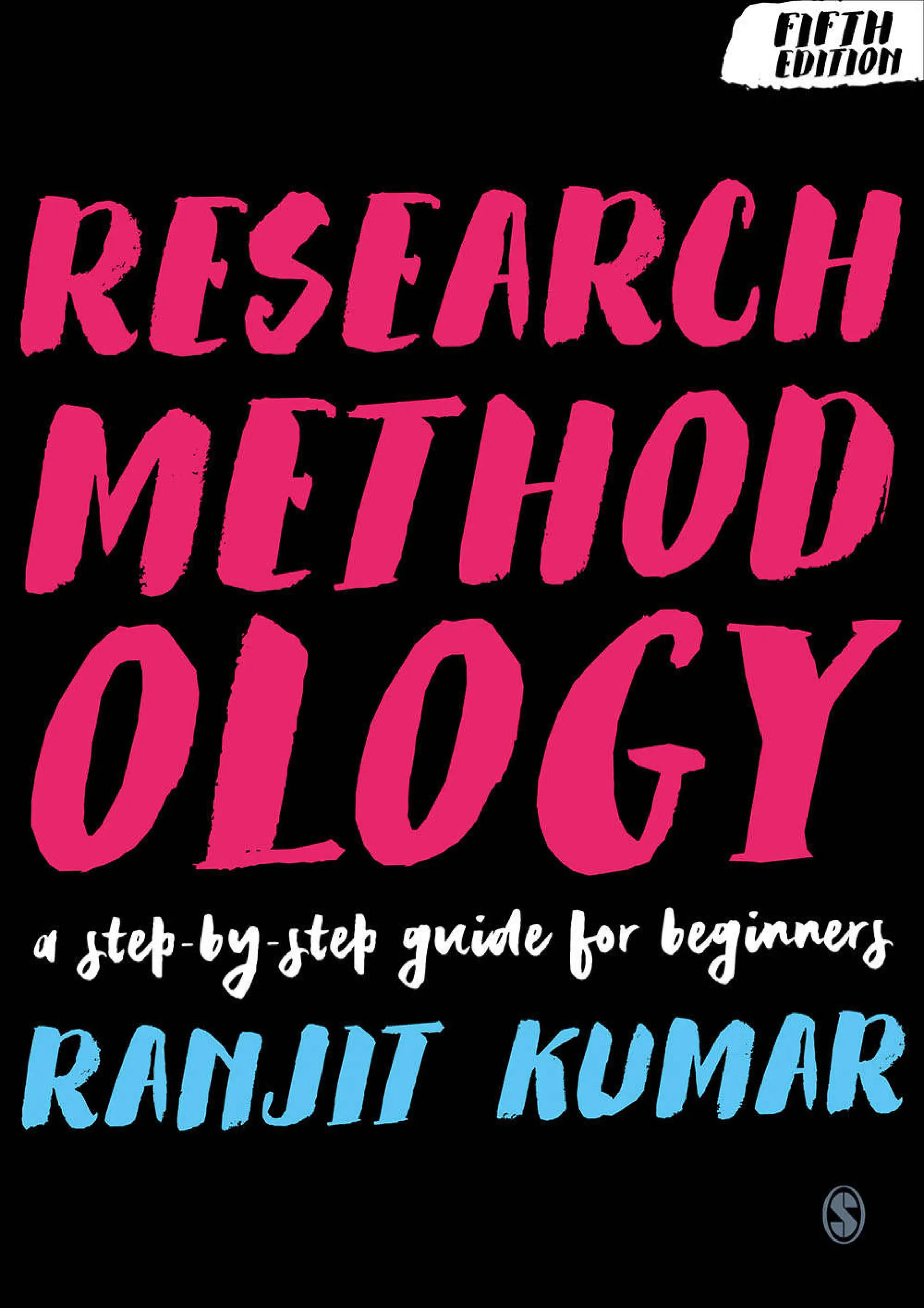
(eBook PDF) Research Methodology: A Step-by-Step Guide for Beginners 5th Edition
(eBook PDF) Research Methodology: A Step-by-Step Guide for Beginners 5th Edition
(eBook PDF) Research Methodology: A Step-by-Step Guide for Beginners 5th Edition
(eBook PDF) Research Methodology: A Step-by-Step Guide for Beginners 5th Edition
(eBook PDF) Research Methodology: A Step-by-Step Guide for Beginners 5th Edition
1.
Quick and EasyEbook Downloads – Start Now at ebookluna.com for Instant Access
(eBook PDF) Research Methodology: A Step-by-Step
Guide for Beginners 5th Edition
https://ebookluna.com/product/ebook-pdf-research-
methodology-a-step-by-step-guide-for-beginners-5th-edition/
OR CLICK BUTTON
DOWLOAD EBOOK
Instantly Access and Download Textbook at https://ebookluna.com
2.
We believe theseproducts will be a great fit for you. Click
the link to download now, or visit ebookluna.com
to discover even more!
(eBook PDF) Patient Assessment Tutorials: A Step-By-Step Guide for the
Dental Hygienist 4th Edition
https://ebookluna.com/product/ebook-pdf-patient-assessment-tutorials-a-
step-by-step-guide-for-the-dental-hygienist-4th-edition/
Microsoft Project 2019 Step by Step (Step by Step (Microsoft)) 1st Edition
- eBook PDF
https://ebookluna.com/download/microsoft-project-2019-step-by-step-step-by-
step-microsoft-ebook-pdf/
(eBook PDF) Applied Strategic Marketing: A Step by Step Approach
https://ebookluna.com/product/ebook-pdf-applied-strategic-marketing-a-step-
by-step-approach/
(eBook PDF) Elementary Statistics: A Step By Step Approach 10th Edition
https://ebookluna.com/product/ebook-pdf-elementary-statistics-a-step-by-
step-approach-10th-edition/
3.
(eBook PDF) ElementaryStatistics: A Step by Step Approach 9th Edition
https://ebookluna.com/product/ebook-pdf-elementary-statistics-a-step-by-
step-approach-9th-edition/
(eBook PDF) SPSS Survival Manual: A Step by Step Guide to Data Analysis
using IBM SPSS 7th Edition
https://ebookluna.com/product/ebook-pdf-spss-survival-manual-a-step-by-
step-guide-to-data-analysis-using-ibm-spss-7th-edition/
Complete Spanish Step-By-Step 1st edition - eBook PDF
https://ebookluna.com/download/complete-spanish-step-by-step-the-fastest-
way-to-achieve-spanish-mastery-ebook-pdf/
SPSS Survival Manual: A step by step guide to data analysis using IBM SPSS
6th Edition Julie Pallant - eBook PDF
https://ebookluna.com/download/spss-survival-manual-a-step-by-step-guide-
to-data-analysis-using-ibm-spss-ebook-pdf/
(eBook PDF) Step-by-Step Medical Coding, 2018 Edition by Carol J. Buck
https://ebookluna.com/product/ebook-pdf-step-by-step-medical-
coding-2018-edition-by-carol-j-buck/
Library of CongressControl Number: 2018952089
British Library Cataloguing in Publication data
A catalogue record for this book is available from the British Library
ISBN 978-1-5264-4989-4
ISBN 978-1-5264-4990-0 (pbk)
Editor: Aly Owen
Production editor: Ian Antcliff
Marketing manager: Ben Griffin-Sherwood
Cover design: Lisa Harper-Wells
Typeset by: C&M Digitals (P) Ltd, Chennai, India
Printed in the UK
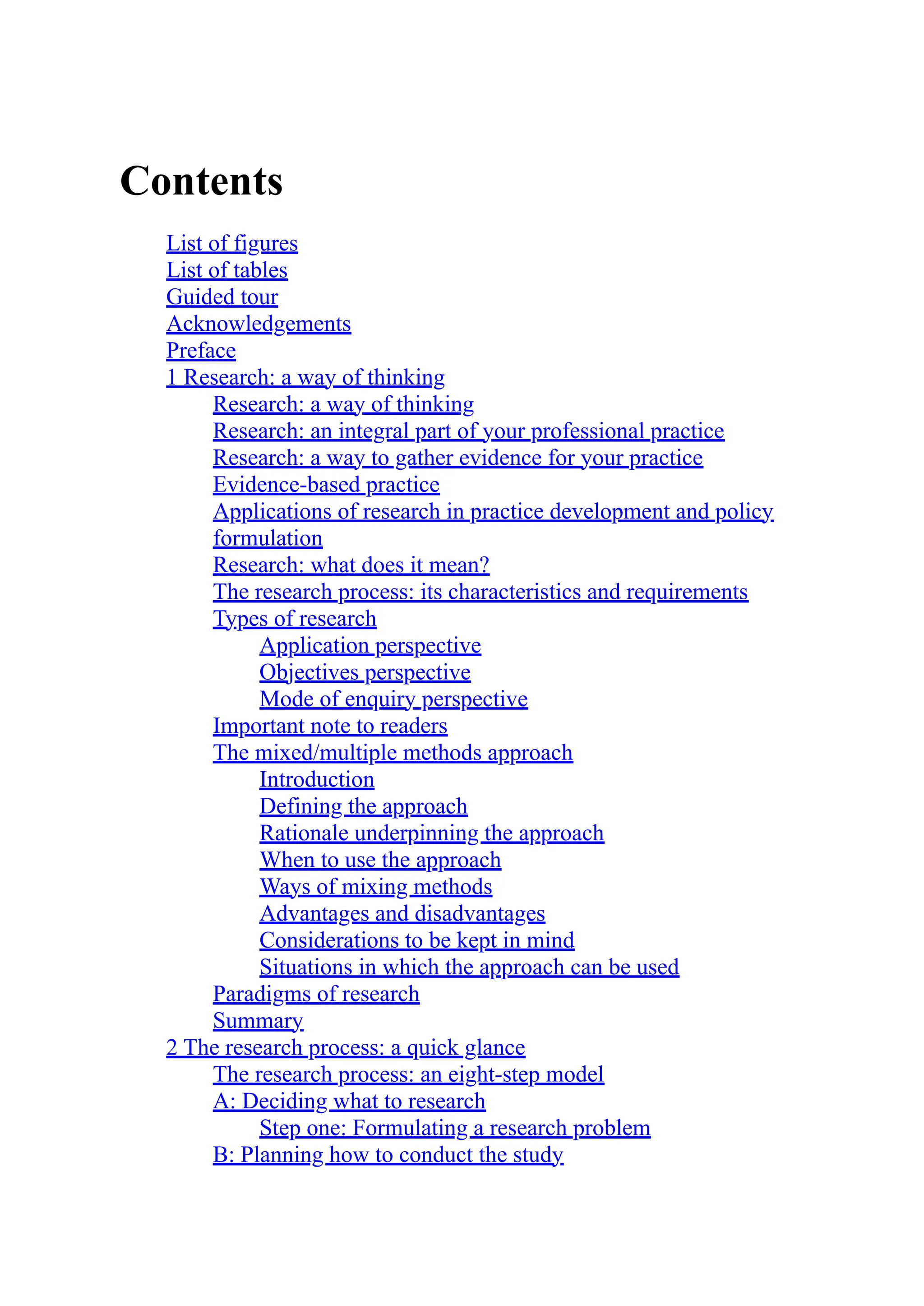
Contents
List of figures
Listof tables
Guided tour
Acknowledgements
Preface
1 Research: a way of thinking
Research: a way of thinking
Research: an integral part of your professional practice
Research: a way to gather evidence for your practice
Evidence-based practice
Applications of research in practice development and policy
formulation
Research: what does it mean?
The research process: its characteristics and requirements
Types of research
Application perspective
Objectives perspective
Mode of enquiry perspective
Important note to readers
The mixed/multiple methods approach
Introduction
Defining the approach
Rationale underpinning the approach
When to use the approach
Ways of mixing methods
Advantages and disadvantages
Considerations to be kept in mind
Situations in which the approach can be used
Paradigms of research
Summary
2 The research process: a quick glance
The research process: an eight-step model
A: Deciding what to research
Step one: Formulating a research problem
B: Planning how to conduct the study
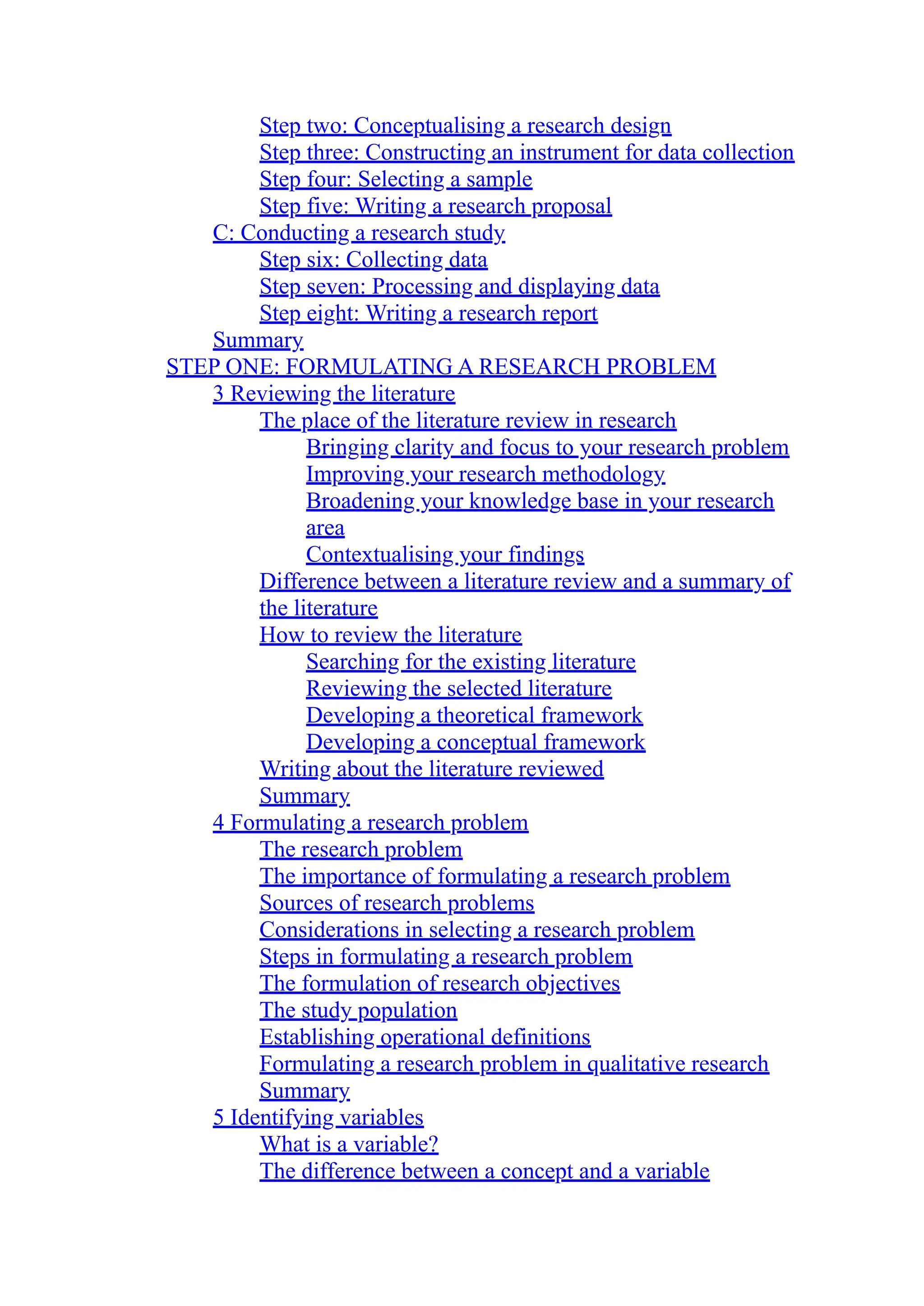
17.
Step two: Conceptualisinga research design
Step three: Constructing an instrument for data collection
Step four: Selecting a sample
Step five: Writing a research proposal
C: Conducting a research study
Step six: Collecting data
Step seven: Processing and displaying data
Step eight: Writing a research report
Summary
STEP ONE: FORMULATING A RESEARCH PROBLEM
3 Reviewing the literature
The place of the literature review in research
Bringing clarity and focus to your research problem
Improving your research methodology
Broadening your knowledge base in your research
area
Contextualising your findings
Difference between a literature review and a summary of
the literature
How to review the literature
Searching for the existing literature
Reviewing the selected literature
Developing a theoretical framework
Developing a conceptual framework
Writing about the literature reviewed
Summary
4 Formulating a research problem
The research problem
The importance of formulating a research problem
Sources of research problems
Considerations in selecting a research problem
Steps in formulating a research problem
The formulation of research objectives
The study population
Establishing operational definitions
Formulating a research problem in qualitative research
Summary
5 Identifying variables
What is a variable?
The difference between a concept and a variable
18.
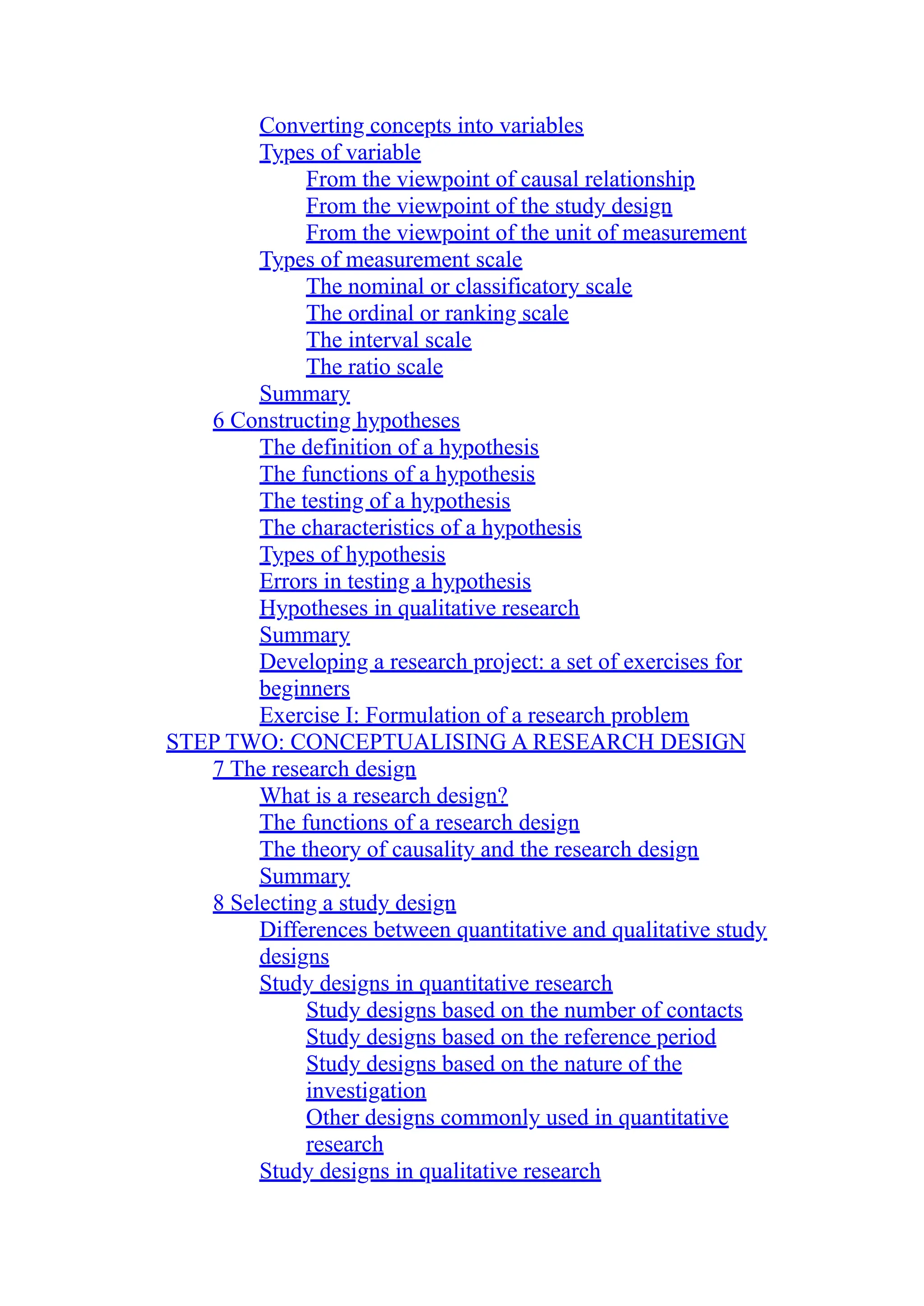
Converting concepts intovariables
Types of variable
From the viewpoint of causal relationship
From the viewpoint of the study design
From the viewpoint of the unit of measurement
Types of measurement scale
The nominal or classificatory scale
The ordinal or ranking scale
The interval scale
The ratio scale
Summary
6 Constructing hypotheses
The definition of a hypothesis
The functions of a hypothesis
The testing of a hypothesis
The characteristics of a hypothesis
Types of hypothesis
Errors in testing a hypothesis
Hypotheses in qualitative research
Summary
Developing a research project: a set of exercises for
beginners
Exercise I: Formulation of a research problem
STEP TWO: CONCEPTUALISING A RESEARCH DESIGN
7 The research design
What is a research design?
The functions of a research design
The theory of causality and the research design
Summary
8 Selecting a study design
Differences between quantitative and qualitative study
designs
Study designs in quantitative research
Study designs based on the number of contacts
Study designs based on the reference period
Study designs based on the nature of the
investigation
Other designs commonly used in quantitative
research
Study designs in qualitative research
19.
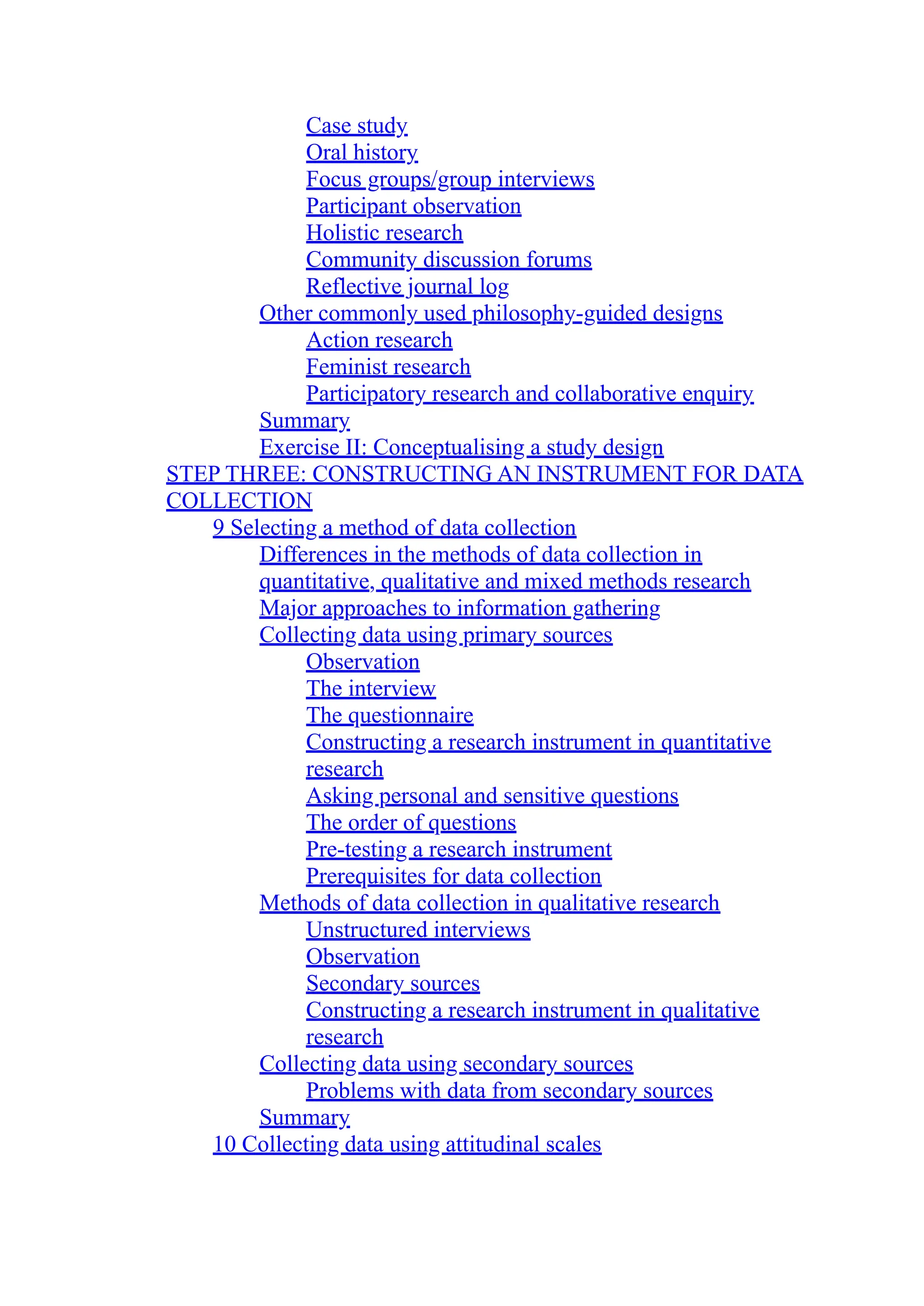
Case study
Oral history
Focusgroups/group interviews
Participant observation
Holistic research
Community discussion forums
Reflective journal log
Other commonly used philosophy-guided designs
Action research
Feminist research
Participatory research and collaborative enquiry
Summary
Exercise II: Conceptualising a study design
STEP THREE: CONSTRUCTING AN INSTRUMENT FOR DATA
COLLECTION
9 Selecting a method of data collection
Differences in the methods of data collection in
quantitative, qualitative and mixed methods research
Major approaches to information gathering
Collecting data using primary sources
Observation
The interview
The questionnaire
Constructing a research instrument in quantitative
research
Asking personal and sensitive questions
The order of questions
Pre-testing a research instrument
Prerequisites for data collection
Methods of data collection in qualitative research
Unstructured interviews
Observation
Secondary sources
Constructing a research instrument in qualitative
research
Collecting data using secondary sources
Problems with data from secondary sources
Summary
10 Collecting data using attitudinal scales
20.
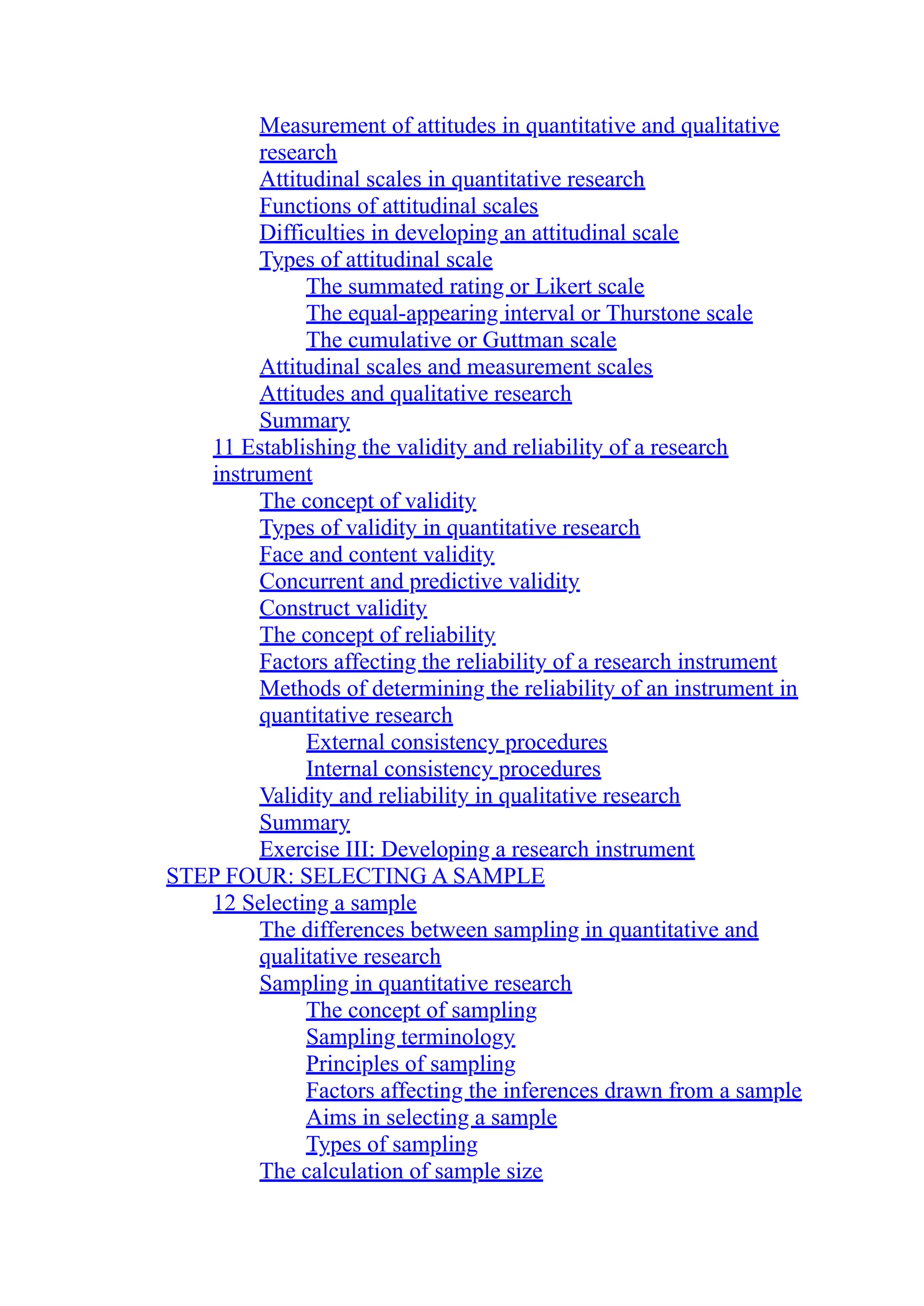
Measurement of attitudesin quantitative and qualitative
research
Attitudinal scales in quantitative research
Functions of attitudinal scales
Difficulties in developing an attitudinal scale
Types of attitudinal scale
The summated rating or Likert scale
The equal-appearing interval or Thurstone scale
The cumulative or Guttman scale
Attitudinal scales and measurement scales
Attitudes and qualitative research
Summary
11 Establishing the validity and reliability of a research
instrument
The concept of validity
Types of validity in quantitative research
Face and content validity
Concurrent and predictive validity
Construct validity
The concept of reliability
Factors affecting the reliability of a research instrument
Methods of determining the reliability of an instrument in
quantitative research
External consistency procedures
Internal consistency procedures
Validity and reliability in qualitative research
Summary
Exercise III: Developing a research instrument
STEP FOUR: SELECTING A SAMPLE
12 Selecting a sample
The differences between sampling in quantitative and
qualitative research
Sampling in quantitative research
The concept of sampling
Sampling terminology
Principles of sampling
Factors affecting the inferences drawn from a sample
Aims in selecting a sample
Types of sampling
The calculation of sample size
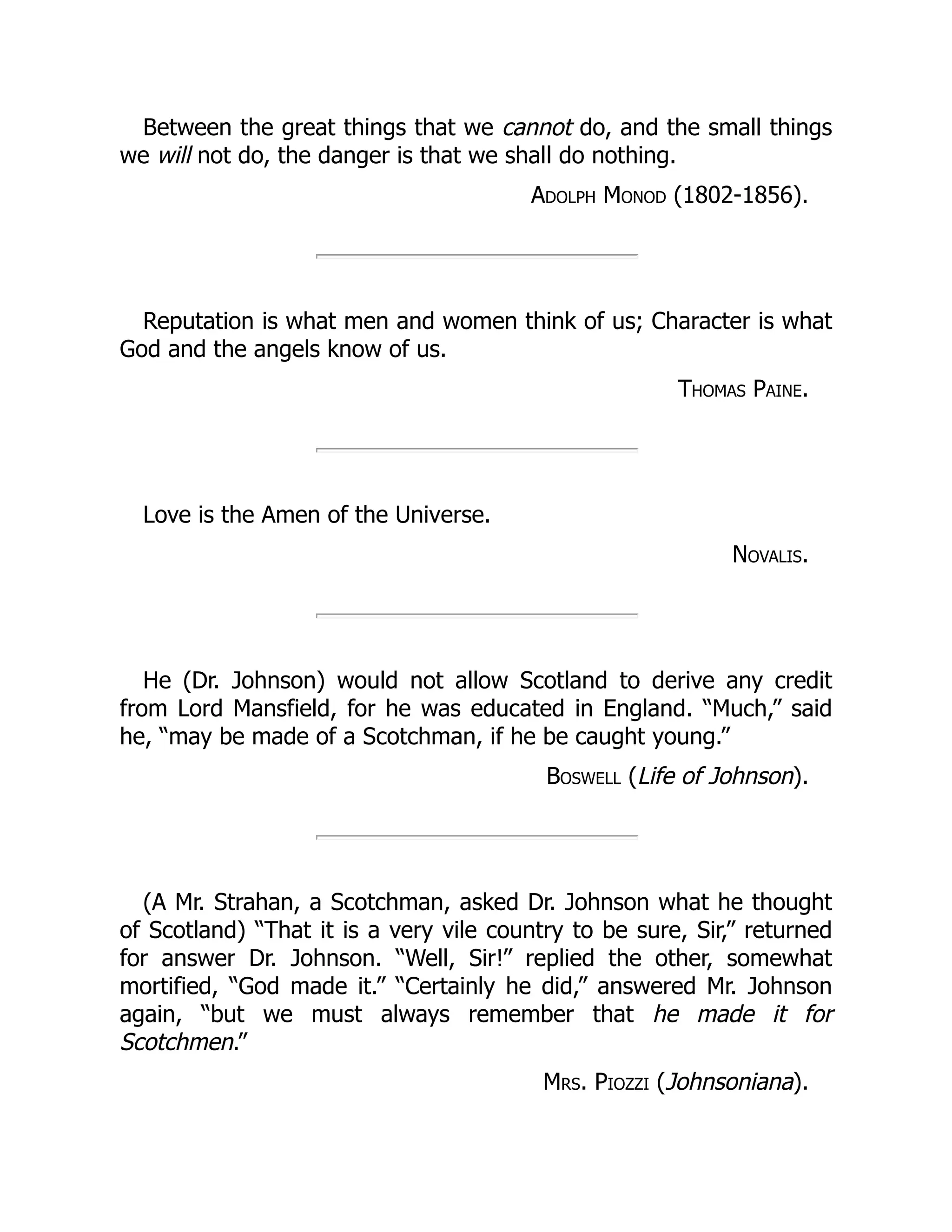
Between the greatthings that we cannot do, and the small things
we will not do, the danger is that we shall do nothing.
Adolph Monod (1802-1856).
Reputation is what men and women think of us; Character is what
God and the angels know of us.
Thomas Paine.
Love is the Amen of the Universe.
Novalis.
He (Dr. Johnson) would not allow Scotland to derive any credit
from Lord Mansfield, for he was educated in England. “Much,” said
he, “may be made of a Scotchman, if he be caught young.”
Boswell (Life of Johnson).
(A Mr. Strahan, a Scotchman, asked Dr. Johnson what he thought
of Scotland) “That it is a very vile country to be sure, Sir,” returned
for answer Dr. Johnson. “Well, Sir!” replied the other, somewhat
mortified, “God made it.” “Certainly he did,” answered Mr. Johnson
again, “but we must always remember that he made it for
Scotchmen.”
Mrs. Piozzi (Johnsoniana).
23.
These are thetwo best of Johnson’s chaffing jibes against Scotchmen. The
neatness of the latter is, to my mind, spoilt by the words at the end, which I have
omitted: “and—comparisons are odious, Mr. Strahan,—but God made hell.” The
following may also be quoted as showing both Johnson and that clever charlatan,
Wilkes, quizzing Boswell (year 1781):
Wilkes: “Pray, Boswell, how much may be got in a year by an advocate at the
Scotch bar?”
Boswell: “I believe two thousand pounds.”
Wilkes: “How can it be possible to spend that money in Scotland?”
Johnson: “Why, Sir, the money may be spent in England; but there is a harder
question. If one man in Scotland gets possession of two thousand pounds, what
remains for all the rest of the nation?”
Many Scotchmen undoubtedly enjoy chaff against themselves and their country,
and I think this was so with Boswell. It is a phase of social psychology that needs
explaining.
In these jokes Johnson was, consciously or not, influenced by the fine Royalist
poet, John Cleveland (1613-1658); but the latter was very much in earnest. He
detested the Scotch for fighting against Charles I. His references to Scotland in
The Rebel Scot are wonderfully clever:—
A land that brings in question and suspense
God’s omnipresence.
And again:—
Had Cain been Scot, God would have changed his doom;
Not forced him wander, but confined him home!
God is present by His essence; which, because it is infinite, cannot
be contained within the limits of any place; and because He is of an
essential purity and spiritual nature, He cannot be undervalued by
being supposed present in the places of unnatural uncleanness:
because, as the sun, reflecting upon the mud of strands and shores,
24.
is unpolluted inits beams, so is God not dishonoured when we
suppose Him in every one of His creatures, and in every part of
every one of them.
Jeremy Taylor (Holy Living, Ch. 1, Sec. 3).
There is an old Scottish proverb, “The sun is no waur for shining on the
midden.”
I dare say Alexander the Great was somewhat staggered in his
plans of conquest by Parmenio’s way of putting things. “After you
have conquered Persia what will you do?” “Then I shall conquer
India.” “After you have conquered India, what will you do?”
“Conquer Scythia.” “And after you have conquered Scythia, what will
you do?” “Sit down and rest.” “Well,” said Parmenio to the conqueror,
“why not sit down and rest now?”
A. K. H. Boyd (The Recreations of a Country Parson).
I include this because it is a good short paraphrase of the actual story of
Pyrrhus and Cineas (Plutarch’s Lives—“Pyrrhus”) and because of the curious
absurdity of attributing such philosophic advice to the warrior, Parmenio. This
general was the only one of Alexander’s old advisers who urged him to invade
Asia! (Plutarch’s Lives—“Alexander”).
Sorrow and care and anxiety may quite well live in Elizabethan
cottages, grown over with honeysuckle and jasmine; and very sad
eyes may look forth from windows around which roses twine.
A. K. H. Boyd (The Recreations of a Country Parson).
This book had a great vogue, but not sufficient merit to preserve it from
oblivion.
Listen to me,as when ye heard our father
Sing long ago the song of other shores—
Listen to me, and then in chorus gather
All your deep voices, as ye pull your oars:
CHORUS.
Fair these broad meads—these hoary woods are grand;
But we are exiles from our father’s land.
From the lone sheiling of the misty island
Mountains divide us, and the waste of seas—
Yet still the blood is strong, the heart is Highland,
And we in dreams behold the Hebrides:
Fair these broad meads, etc.
We ne’er shall tread the fancy-haunted valley,
Where ’tween the dark hills creeps the small clear stream,
In arms around the patriarch banner rally,
Nor see the moon on royal tombstones gleam:
Fair these broad meads, etc.
When the bold kindred, in the time long vanish’d,
Conquered the soil and fortified the keep,—
No seer foretold the children would be banish’d,
That a degenerate Lord might boast his sheep;
Fair these broad meads, etc.
Come foreign rage—let Discord burst in slaughter!
O then for clansmen true, and stern claymore—
The hearts that would have given their blood like water,
Beat heavily beyond the Atlantic roar.
Fair these broad meads—these hoary woods are grand;
But we are exiles from our fathers’ land.
27.
The authorship ofthese verses is uncertain, but it probably lies between John
Galt, author of Annals of the Parish, and Lockhart, son-in-law of Sir Walter Scott.
The verses were quoted by Professor Wilson (Christopher North) in his Noctes
Ambrosianae in Blackwood, Sept., 1829, but, because Wilson was not the author,
they are not reproduced in his collected works (Blackwood, 1855).
A degenerate Lord, &c. This refers to the eviction of the Highland crofters and
cottars. In 1829 the Duke of Hamilton had just cleared the population out of the
Isle of Arran.
Sheiling or Shealing, a hut used by shepherds, fishermen, or others for shelter
when at work at a distance from home.
Love took up the harp of Life, and smote on all the chords with
might;
Smote the chord of Self, that, trembling, passed in music out of
sight.
Tennyson (Locksley Hall).
28.
If thou wouldsthave high God thy soul assure
That she herself shall as herself endure,
Shall in no alien semblance, thine and wise,
Fulfil her and be young in Paradise,
One way I know; forget, forswear, disdain
Thine own best hopes, thine utmost loss and gain,
Till when at last thou scarce rememberest now
If on the earth be such a man as thou,
Nor hast one thought of self-surrender,—no,
For self is none remaining to forego,—
If ever, then shall strong persuasion fall
That in thy giving thou hast gained thine all,
Given the poor present, gained the boundless scope,
And kept thee virgin for the further hope....
When all base thoughts like frighted harpies flown
In her own beauty leave the soul alone;
When Love,—not rosy-flushed as he began,
But Love, still Love, the prisoned God in man,—
Shows his face glorious, shakes his banner free,
Cries like a captain for Eternity:—
O halcyon air across the storms of youth,
O trust him, he is true, he is one with Truth!
Nay, is he Christ? I know not; no man knows
The right name of the heavenly Anterôs,—
But here is God, whatever God may be,
And whomsoe’er we worship, this is He.
F. W. Myers (The Implicit Promise of Immortality).
Anterôs is the god of mutual love, who punishes those who do not return the
love of others, as otherwise his brother Erôs, god of love, will be unhappy.
The fine poem from which this is quoted represents one of the phases of Myers’
experience. It was published in 1882, but written about ten years before. He had
then lost his faith in Christianity, but believed in a future life on grounds based
29.
partly upon philosophyand partly on “vision.” He had those moments of exaltation
when, as he says:
The open secret flashes on the brain,
As if one almost guessed it, almost knew
Whence we have sailed and voyage whereunto.
For entrance into the future life, Love and complete Self-surrender are the best
equipment for the soul.
But all through life I see a Cross,
Where sons of God yield up their breath:
There is no gain except by loss,
There is no life except by death,
There is no vision but by Faith.
Nor glory but by bearing shame,
Nor Justice but by taking blame;
And that Eternal Passion saith,
“Be emptied of glory and right and name.”
W. C. Smith (Olrig Grange).
Life is short, and we have not too much time for gladdening the
lives of those who are travelling the dark road with us. Oh, be swift
to love, make haste to be kind.
Amiel’s Journal.
30.
SELF-SACRIFICE
What though thinearm hath conquered in the fight,—
What though the vanquished yield unto thy sway,
Or riches garnered pave thy golden way,—
Not therefore hast thou gained the sovran height
Of man’s nobility! No halo’s light
From these shall round thee shed its sacred ray;
If these be all thy joy,—then dark thy day,
And darker still thy swift approaching night!
But if in thee more truly than in others
Hath dwelt Love’s charity;—if by thine aid
Others have passed above thee, and if thou,
Though victor, yieldest victory to thy brothers,
Though conquering conquered, and a vassal made—
Then take thy crown, well mayst thou wear it now.
Samuel Waddington.
We bury decay in the earth; we plant in it the perishing; we feed it
with offensive refuse: but nothing grows out of it that is not clean; it
gives us back life and beauty.
Charles Dudley Warner (My Summer in a Garden).
SOUL’S BEAUTY
31.
Under the archof Life, where love and death,
Terror and mystery guard her shrine, I saw
Beauty enthroned; and though her gaze struck awe,
I drew it in as simply as my breath.
Hers are the eyes which, over and beneath,
The sky and sea bend on thee,—which can draw,
By sea or sky or woman, to one law,
The allotted bondman of her palm and wreath.
This is that Lady Beauty, in whose praise
Thy voice and hand shake still,—long known to thee
By flying hair and fluttering hem,—the beat
Following her daily of thy heart and feet,
How passionately and irretrievably,
In what fond flight, how many ways and days!
D. G. Rossetti.
Although Rossetti was not a classical student, he seems here to have arrived at
the Platonic idea of an abstract Beauty, of whose essence are all beautiful things,
“sea or sky or woman.” Love and death, terror and mystery guard her, as a
goddess on her throne, and all lovers of the beautiful are worshippers at her
shrine.
Thinking is only a dream of feeling; a dead feeling; a pale-grey,
feeble life.
Novalis.
A whetstone cannot cut, but it makes iron sharp, and gives it a
keen edge.
32.
Isocrates (436-338 B.C.).
Thisis quoted in Plutarch’s Lives. Isocrates was asked why he taught rhetoric so
much and yet spoke so rarely; and this was his reply. Horace (Ars Poetica 304)
playfully says that he is no longer able to write verses but he will teach others to
write, adding “a whetstone is not used for cutting, but is used for sharpening steel
nevertheless.”
The career of Isocrates, “that old man eloquent,”[31] is extremely interesting.
He preserved his energy and his influence to the end of his long life of 98 years.
From too much love of living,
From hope and fear set free,
We thank with brief thanksgiving
Whatever gods there be
That no life lives for ever;
That dead men rise up never;
That even the weariest river
Winds somewhere safe to sea.
Swinburne (The Garden of Proserpine).
A very musical expression of a very ugly thought.
Women never betray themselves to men as they do to each other.
George Eliot (Middlemarch).
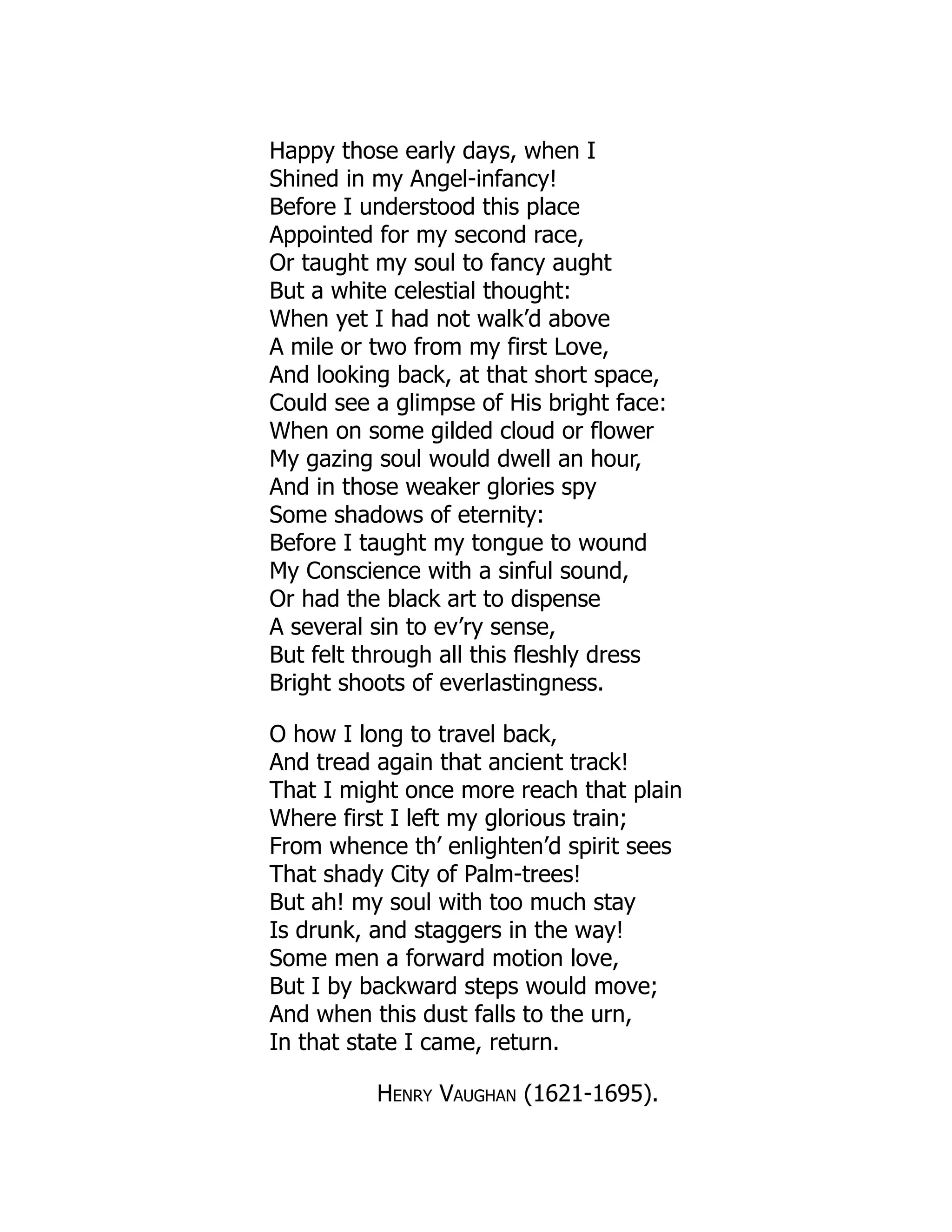
Happy those earlydays, when I
Shined in my Angel-infancy!
Before I understood this place
Appointed for my second race,
Or taught my soul to fancy aught
But a white celestial thought:
When yet I had not walk’d above
A mile or two from my first Love,
And looking back, at that short space,
Could see a glimpse of His bright face:
When on some gilded cloud or flower
My gazing soul would dwell an hour,
And in those weaker glories spy
Some shadows of eternity:
Before I taught my tongue to wound
My Conscience with a sinful sound,
Or had the black art to dispense
A several sin to ev’ry sense,
But felt through all this fleshly dress
Bright shoots of everlastingness.
O how I long to travel back,
And tread again that ancient track!
That I might once more reach that plain
Where first I left my glorious train;
From whence th’ enlighten’d spirit sees
That shady City of Palm-trees!
But ah! my soul with too much stay
Is drunk, and staggers in the way!
Some men a forward motion love,
But I by backward steps would move;
And when this dust falls to the urn,
In that state I came, return.
Henry Vaughan (1621-1695).
35.
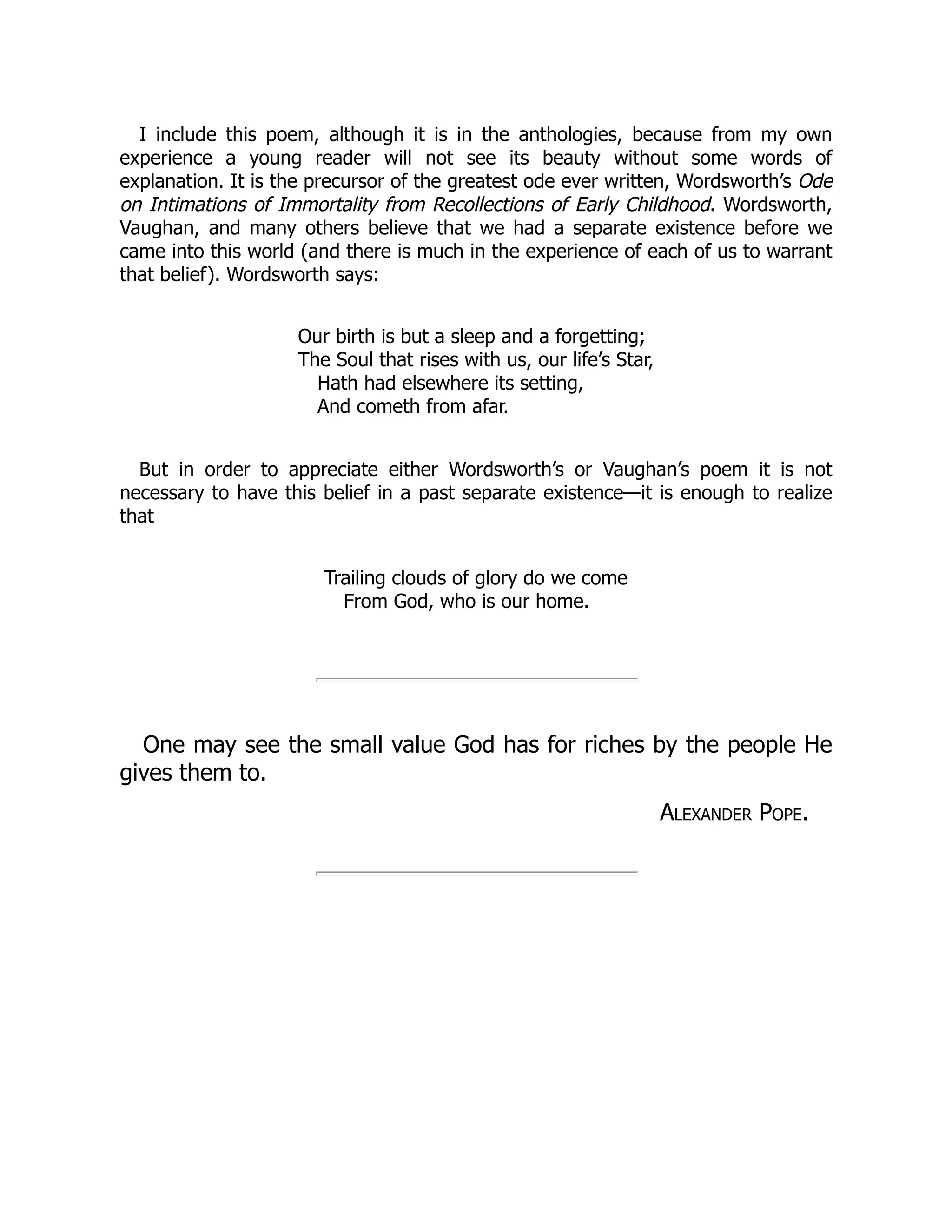
I include thispoem, although it is in the anthologies, because from my own
experience a young reader will not see its beauty without some words of
explanation. It is the precursor of the greatest ode ever written, Wordsworth’s Ode
on Intimations of Immortality from Recollections of Early Childhood. Wordsworth,
Vaughan, and many others believe that we had a separate existence before we
came into this world (and there is much in the experience of each of us to warrant
that belief). Wordsworth says:
Our birth is but a sleep and a forgetting;
The Soul that rises with us, our life’s Star,
Hath had elsewhere its setting,
And cometh from afar.
But in order to appreciate either Wordsworth’s or Vaughan’s poem it is not
necessary to have this belief in a past separate existence—it is enough to realize
that
Trailing clouds of glory do we come
From God, who is our home.
One may see the small value God has for riches by the people He
gives them to.
Alexander Pope.
36.
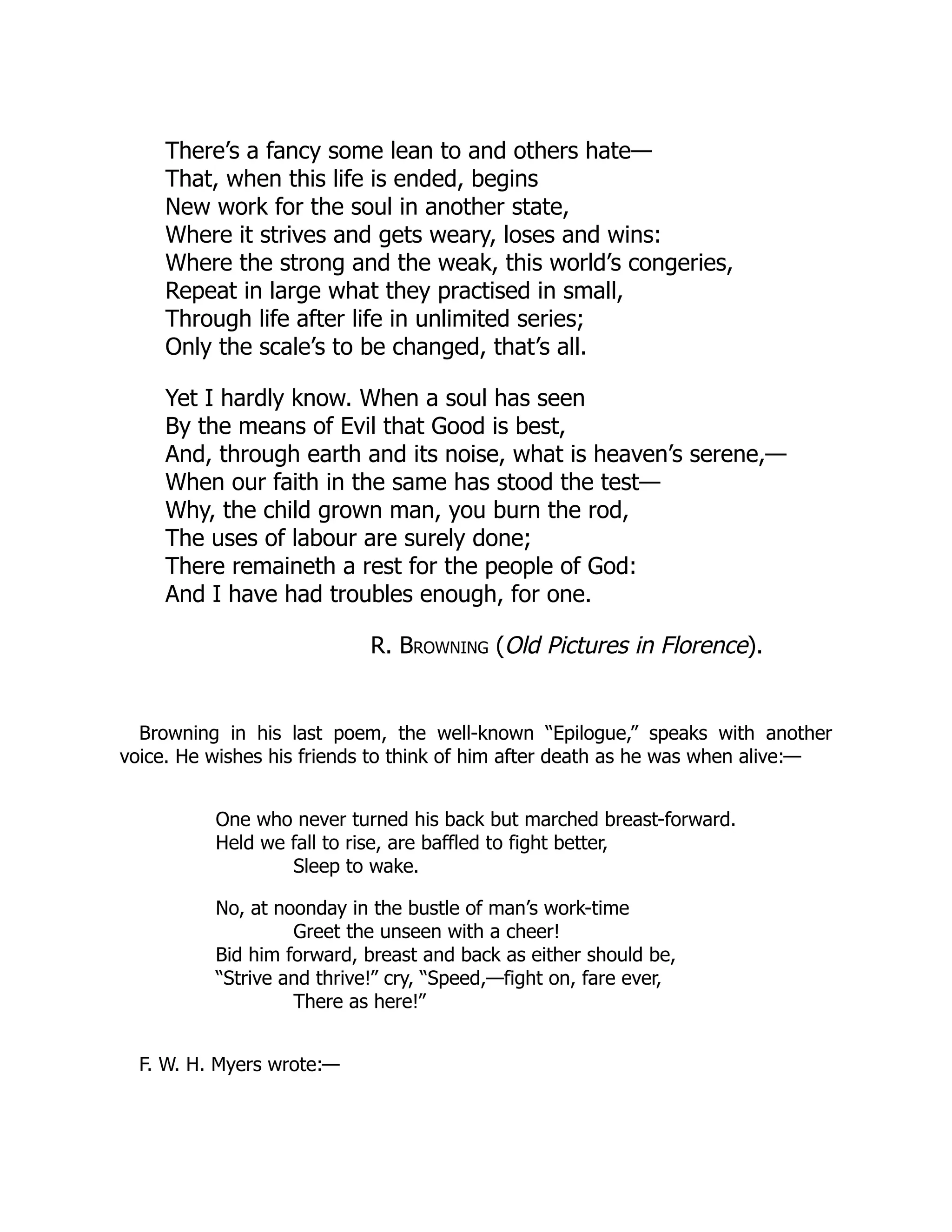
There’s a fancysome lean to and others hate—
That, when this life is ended, begins
New work for the soul in another state,
Where it strives and gets weary, loses and wins:
Where the strong and the weak, this world’s congeries,
Repeat in large what they practised in small,
Through life after life in unlimited series;
Only the scale’s to be changed, that’s all.
Yet I hardly know. When a soul has seen
By the means of Evil that Good is best,
And, through earth and its noise, what is heaven’s serene,—
When our faith in the same has stood the test—
Why, the child grown man, you burn the rod,
The uses of labour are surely done;
There remaineth a rest for the people of God:
And I have had troubles enough, for one.
R. Browning (Old Pictures in Florence).
Browning in his last poem, the well-known “Epilogue,” speaks with another
voice. He wishes his friends to think of him after death as he was when alive:—
One who never turned his back but marched breast-forward.
Held we fall to rise, are baffled to fight better,
Sleep to wake.
No, at noonday in the bustle of man’s work-time
Greet the unseen with a cheer!
Bid him forward, breast and back as either should be,
“Strive and thrive!” cry, “Speed,—fight on, fare ever,
There as here!”
F. W. H. Myers wrote:—
37.
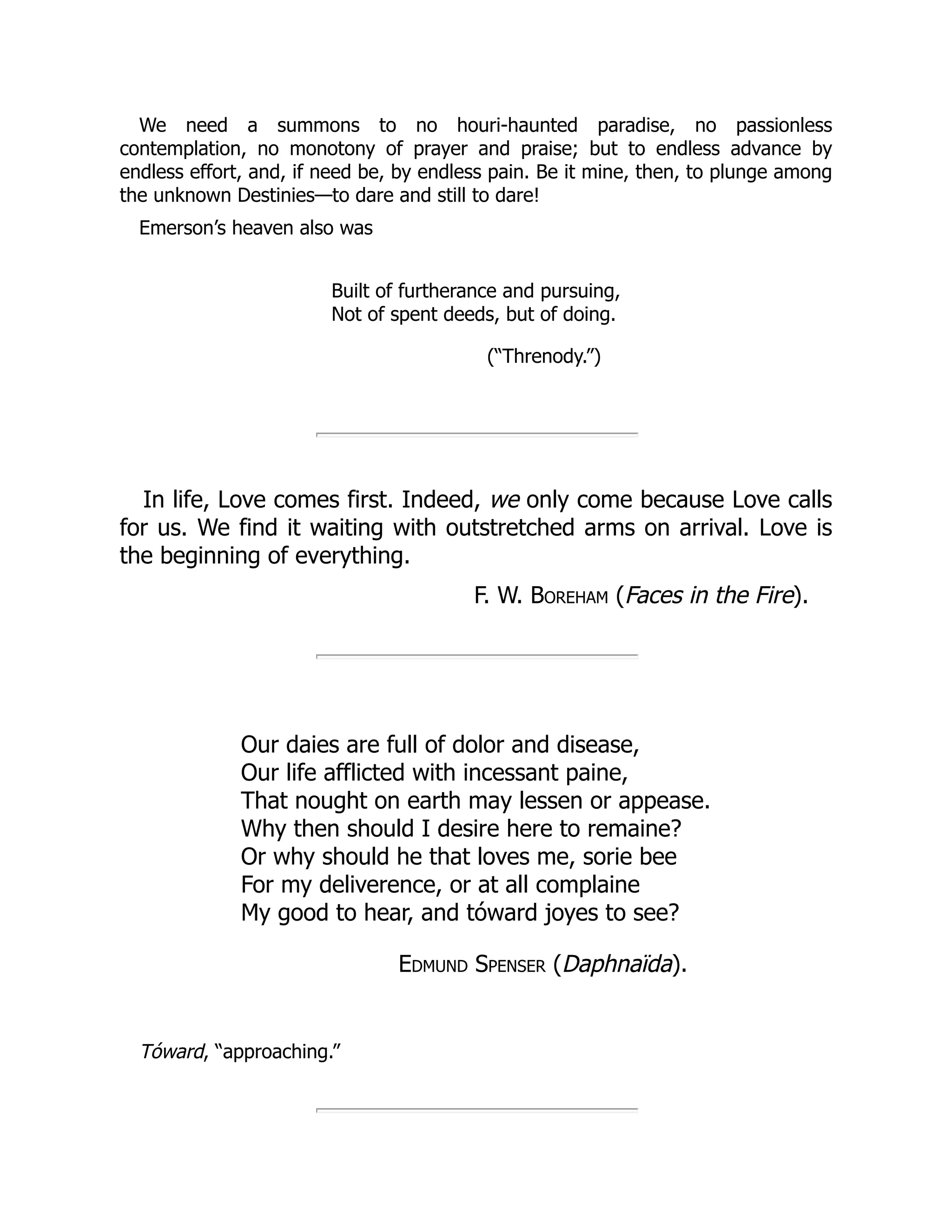
We need asummons to no houri-haunted paradise, no passionless
contemplation, no monotony of prayer and praise; but to endless advance by
endless effort, and, if need be, by endless pain. Be it mine, then, to plunge among
the unknown Destinies—to dare and still to dare!
Emerson’s heaven also was
Built of furtherance and pursuing,
Not of spent deeds, but of doing.
(“Threnody.”)
In life, Love comes first. Indeed, we only come because Love calls
for us. We find it waiting with outstretched arms on arrival. Love is
the beginning of everything.
F. W. Boreham (Faces in the Fire).
Our daies are full of dolor and disease,
Our life afflicted with incessant paine,
That nought on earth may lessen or appease.
Why then should I desire here to remaine?
Or why should he that loves me, sorie bee
For my deliverence, or at all complaine
My good to hear, and tóward joyes to see?
Edmund Spenser (Daphnaïda).
Tóward, “approaching.”
38.
My closing remarkis as to avoiding debates that are in their very
nature interminable.... There is a certain intensity of emotion,
interest, bias or prejudice if you will, that can neither reason nor be
reasoned with. On the purely intellectual side, the disqualifying
circumstances are complexity and vagueness. If a topic necessarily
hauls in numerous other topics of difficulty, the essay may do
something for it, but not the debate. Worst of all is the presence of
several large, ill-defined, and unsettled terms. A not unfrequent case
is a combination of the several defects, each, perhaps, in a small
degree. A tinge of predilection or party, a double or triple
complication of doctrines, and one or two hazy terms will make a
debate that is pretty sure to end as it began. Thus it is that a
question, plausible to appearance, may contain within it capacities of
misunderstanding, cross-purposes, and pointless issues, sufficient to
occupy the long night of Pandemonium, or beguile the journey to
the nearest fixed star.
Alexander Bain (Contemporary Review, April, 1877).
From an address to the Edinburgh University Philosophical Society.
Diogenes, seeing Neptune’s temple with votive pictures of those
saved from wreck, says, “Yea, but where are they painted, that have
been drowned?”
Bacon.
THE BELLE OF THE BALL-ROOM
39.
I saw herat the County Ball:
There, when the sounds of flute and fiddle
Gave signal sweet in that old hall
Of hands across and down the middle,
Hers was the subtlest spell by far
Of all that set young hearts romancing;
She was our queen, our rose, our star;
And then she danced—O Heaven, her dancing!
Through sunny May, through sultry June,
I loved her with a love eternal;
I spoke her praises to the moon,
I wrote them to the Sunday Journal:
My mother laugh’d: I soon found out
That ancient ladies have no feeling;
My father frown’d: but how should gout
See any happiness in kneeling?...
She smiled on many, just for fun,—
I knew that there was nothing in it;
I was the first—the only one
Her heart had thought of for a minute.—
I knew it, for she told me so,
In phrase which was divinely moulded;
She wrote a charming hand,—and oh!
How sweetly all her notes were folded!
...
We parted; months and years roll’d by
We met again four summers after:
Our parting was all sob and sigh;
Our meeting was all mirth and laughter:
For in my heart’s most secret cell
There had been many other lodgers;
And she was not the ball-room’s Belle,
But only—Mrs. Something Rogers!
40.
W. M. Praed.
Acanon of my own in judging verses is that no man has a right to
put into metre what he can as well say out of metre. To which I may
add, as a corollary, that a fortiore he has no right to put into metre
what he can better say out of metre.
W. S. Lilly (Essay on George Eliot).
Aujourd’hui, ce qui ne vaut pas la peine d’être dit, on le chante.
(Now-a-days when a thing is not worth saying they sing it—i.e.
put it in a song.)
Beaumarchais (Le Barbier de Séville, Act I. Sc. I.)
I do not know whether I gave you at any time the details of my
work here, or the principles upon which I have been proceeding....
Some of the work set down includes Ancient Ethics—which is almost
entirely grossly wrong and great rubbish also. This part I have
persistently refused to get up, not because I disliked it, but because
it is decidedly injurious to warp and twist the brain by impressing it
with wrong thoughts and systems—just as it would be insane in the
polisher of a mirror to think it would reflect the external world more
truly, if he gave it a dint here, a scratch there, a bulge in another
place, and so forth. It would take me too long to describe the
details. Suffice it to say that one of the examiners in Mental
Philosophy and in Moral and Political Philosophy is an old, blind
(literally) man of the old school, who gave a very abnormally large
amount of questions relating to Ancient Ethics, and an abnormally
41.
large amount tothe early part of English Ethics—leaving hardly any
marks to be scored by thorough understanding and ability to use the
principles of the subjects.
The consequence was that those, who had crammed up the earlier
text-books and could reproduce them, had an enormous advantage.
This old fogey moreover is strongly anti-Spencerian. Indeed I heard
that he had objected to my answers because “there was too much of
Spencer and myself!” So that instead of criticism and originality, he
avowedly preferred mere reproduction, a good example of the
slavishness of that method of examination predominant mostly,
which, as Spencer wrote to me some time ago, is devised for testing
a man’s “power of acquisition instead of using that which has been
acquired.”
Richard Hodgson (1855-1905) (Letter, Dec., 1881).
This letter was written to me from Cambridge, when Hodgson (see Preface) had
found his immediate prospects blasted by the results of the Moral Science Tripos.
No one was placed in the First Class and he (although at the head of the Tripos)
only in the Second Class. This meant that he had no hope of a Fellowship, which
would have enabled him to go on with original work in philosophy, and he would
have to employ his time in earning a livelihood. Added to this was the cruel
disappointment to his family and friends.
Hodgson was one of the most gifted men that Australia has produced. He had
completed his M.A. and LL.D. courses in Melbourne by 1877, when he was twenty-
two years of age, and then, discarding the profession of the law, left for
Cambridge to read Mental and Moral Science. While still an undergraduate there
he had written an article in reply to T. H. Green, and submitted it to Herbert
Spencer, who highly approved of it, and sent it to the Contemporary. However, as
stated above, Hodgson’s immediate future depended on the result of the
examination. (He was at the time preparing one of the articles he contributed to
Mind, and had in view further original work.)
When the result of the Tripos appeared, Henry Sidgwick and Venn who were
then Lecturers and by far the best Moral Science men in Cambridge, came to
sympathize with Hodgson, on the unfair result. They urged him to go to Germany
so that he might acquire that perfect command of the German language which
was necessary for his philosophic work. On learning that he was not in a position
to do this, Sidgwick insisted—as he said, “in the interests of philosophy”—on
42.
defraying the wholeof the expenses of Hodgson’s residence in Germany. As he
insisted strongly, Hodgson accepted the offer, and went to Jena, armed with a very
flattering letter of introduction from Herbert Spencer to Haeckel.
Almost immediately after his return from Germany the Society for Psychical
Research was founded, and Hodgson joined it. He came to the conclusion that the
work of this Society was more important than any other study, while probably it
would also be of fundamental assistance to philosophy. He went out to India in
1884, and thoroughly exposed Madame Blavatsky and her “Theosophy,” and, from
about 1886, devoted the rest of his life to Psychical Research. Although
maintaining his reading and his intimacy with Henry Sidgwick, William James, and
others, his services practically became lost to philosophy. This, however, does not
affect the important fact illustrated by the Tripos incident. We learn what
ineptitude can exist in a great university, and what grave results must necessarily
follow therefrom.
Although Hodgson was writing under stress of a grievous calamity (yet with a
dauntless heart—see verse on Dedication page), his remarks on Ancient Ethics are
not, in my opinion, exaggerated.
Herbert Spencer’s remark to Hodgson about examinations may also be noted.
43.
Prometheus. And thou,O Mother Earth!
Earth. I hear, I feel
Thy lips are on me, and their touch runs down
Even to the adamantine central gloom
Along these marble nerves; ’tis life, ’tis joy,
And, through my withered, old, and icy frame
The warmth of an immortal youth shoots down
Circling. Henceforth the many children fair
Folded in my sustaining arms; all plants,
And creeping forms, and insects rainbow-winged,
And birds, and beasts, and fish, and human shapes,
Which drew disease and pain from my wan bosom
Draining the poison of despair, shall take
And interchange sweet nutriment.
Shelley (Prometheus Unbound, III, 3).
In Shelley’s great poem, Prometheus is not merely the Titan who, having stolen
fire from heaven to benefit man, was chained to a pillar while an eagle tore at his
vitals, he is the spirit of humanity. Man has (through superstition) given the god,
Zeus, great powers which he uses to enslave and oppress man’s own mind and
body. Ultimately the god is overthrown, Prometheus, the spirit of man, is released,
and the world enters upon its progress towards perfection.
This and the following quotations are from a collection of references to Mother-
Earth.
44.
Say, mysterious Earth!O say, great mother and goddess,
Was it not well with thee then, when first thy lap was ungirdled,
Thy lap to the genial Heaven, the day that he wooed thee and
won thee!...
Myriad myriads of lives teemed forth from the mighty
embracement.
Thousand-fold tribes of dwellers, impelled by thousand-fold
instincts.
Filled, as a dream, the wide waters; the rivers sang on their
channels;
Laughed on their shores the wide seas; the yearning ocean
swelled upward;
Young life lowed through the meadows, the woods, and the
echoing mountains,
Wandered bleating in valleys, and warbled on blossoming
branches.
S. T. Coleridge (Hymn to the Earth).
An imitation of Stolberg’s Hymne an die Erde.
From my wings are shaken the dews that waken
The sweet buds every one,
When rocked to rest on their mother’s breast,
As she dances about the sun.
Shelley (The Cloud).
45.
For Nature everfaithful is
To such as trust her faithfulness.
When the forest shall mislead me,
When the night and morning lie,
When sea and land refuse to feed me,
’Twill be time enough to die.
Then will yet my mother yield
A pillow in her greenest field
Nor the June flowers scorn to cover
The clay of their departed lover.
Emerson (Woodnotes).
Long have I loved what I behold,
The night that calms, the day that cheers;
The common growth of mother-earth
Suffices me—her tears, her mirth,
Her humblest mirth and tears.
Wordsworth (Peter Bell).
So mayst thou live, till like ripe fruit thou drop
Into thy mother’s lap.
Milton (Paradise Lost, XI, 535).
46.
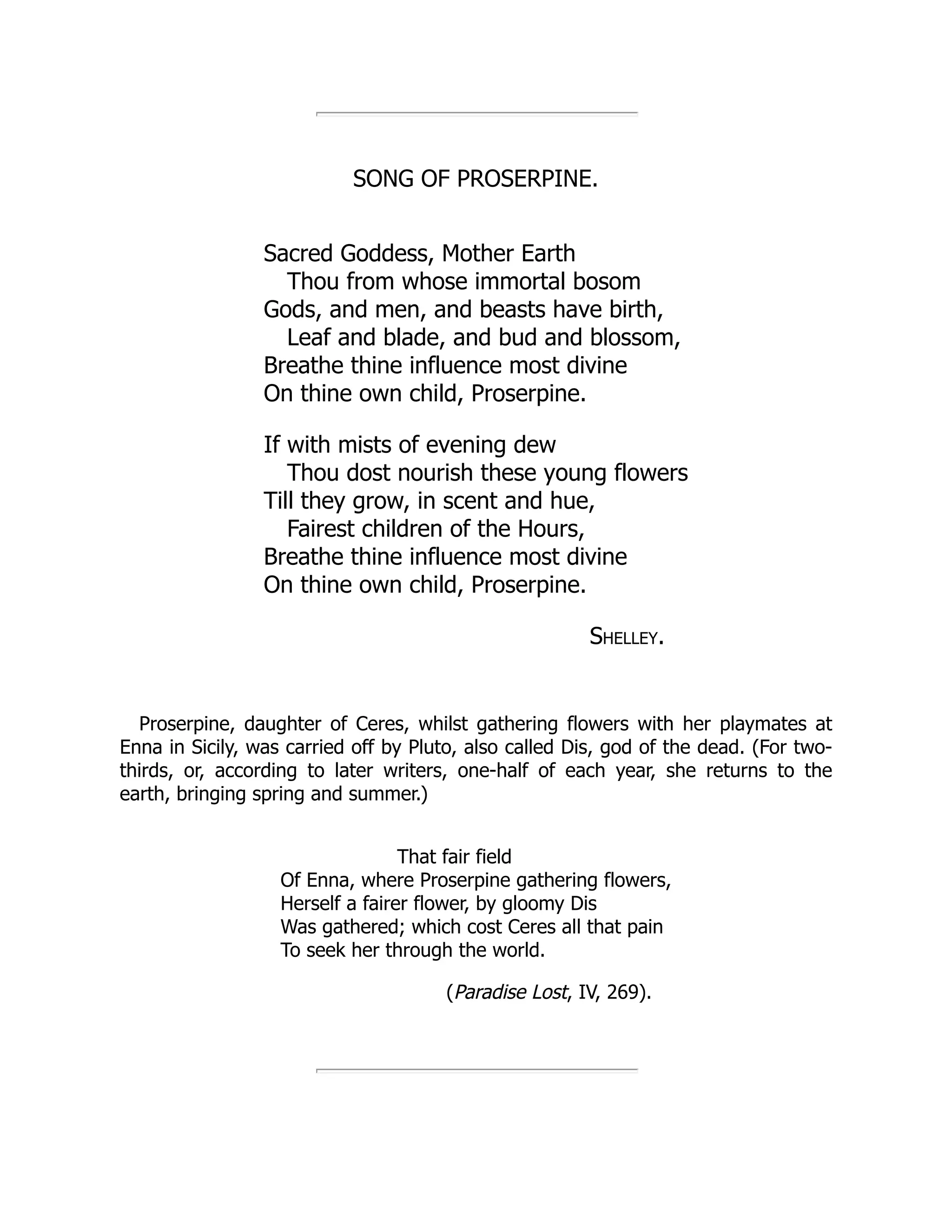
SONG OF PROSERPINE.
SacredGoddess, Mother Earth
Thou from whose immortal bosom
Gods, and men, and beasts have birth,
Leaf and blade, and bud and blossom,
Breathe thine influence most divine
On thine own child, Proserpine.
If with mists of evening dew
Thou dost nourish these young flowers
Till they grow, in scent and hue,
Fairest children of the Hours,
Breathe thine influence most divine
On thine own child, Proserpine.
Shelley.
Proserpine, daughter of Ceres, whilst gathering flowers with her playmates at
Enna in Sicily, was carried off by Pluto, also called Dis, god of the dead. (For two-
thirds, or, according to later writers, one-half of each year, she returns to the
earth, bringing spring and summer.)
That fair field
Of Enna, where Proserpine gathering flowers,
Herself a fairer flower, by gloomy Dis
Was gathered; which cost Ceres all that pain
To seek her through the world.
(Paradise Lost, IV, 269).
47.
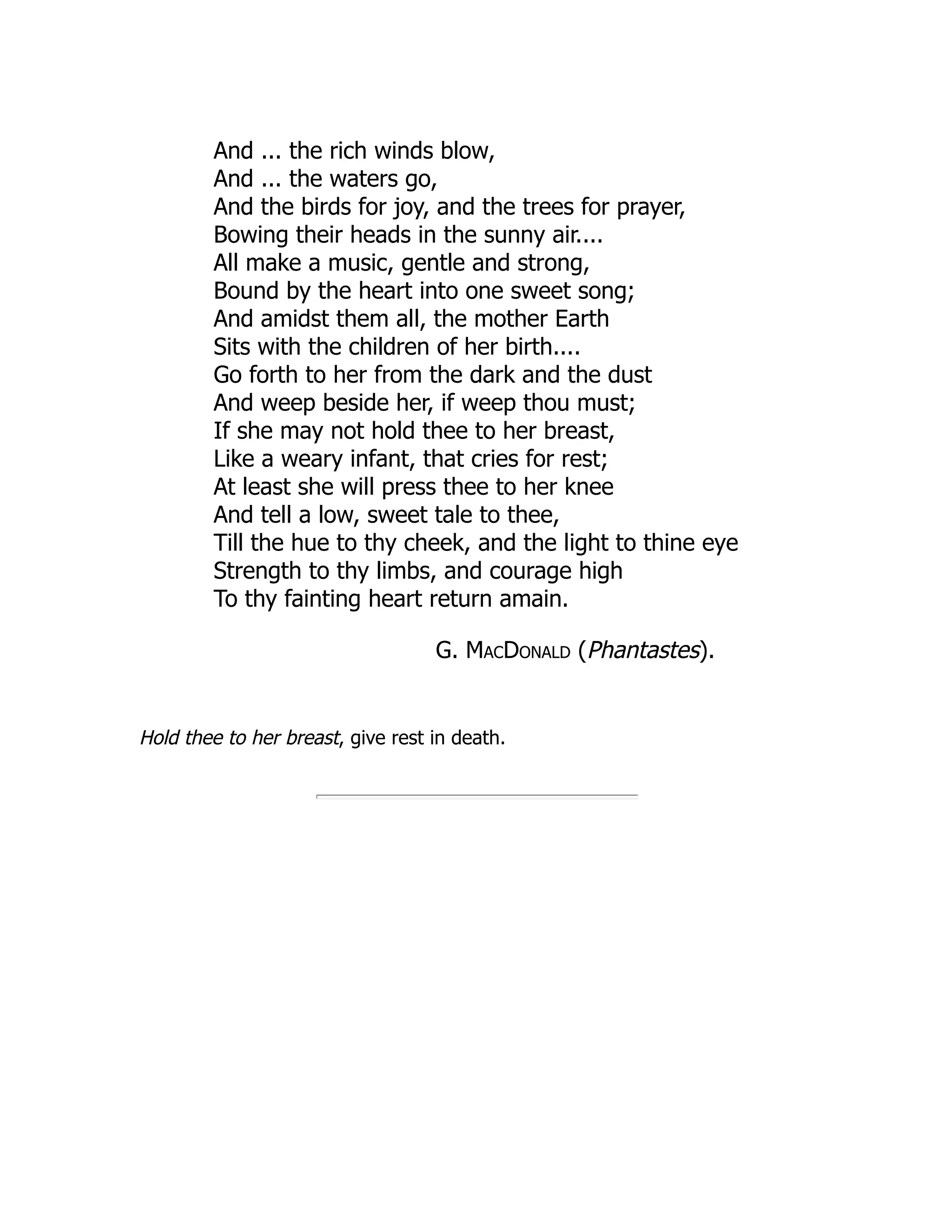
And ... therich winds blow,
And ... the waters go,
And the birds for joy, and the trees for prayer,
Bowing their heads in the sunny air....
All make a music, gentle and strong,
Bound by the heart into one sweet song;
And amidst them all, the mother Earth
Sits with the children of her birth....
Go forth to her from the dark and the dust
And weep beside her, if weep thou must;
If she may not hold thee to her breast,
Like a weary infant, that cries for rest;
At least she will press thee to her knee
And tell a low, sweet tale to thee,
Till the hue to thy cheek, and the light to thine eye
Strength to thy limbs, and courage high
To thy fainting heart return amain.
G. MacDonald (Phantastes).
Hold thee to her breast, give rest in death.
48.
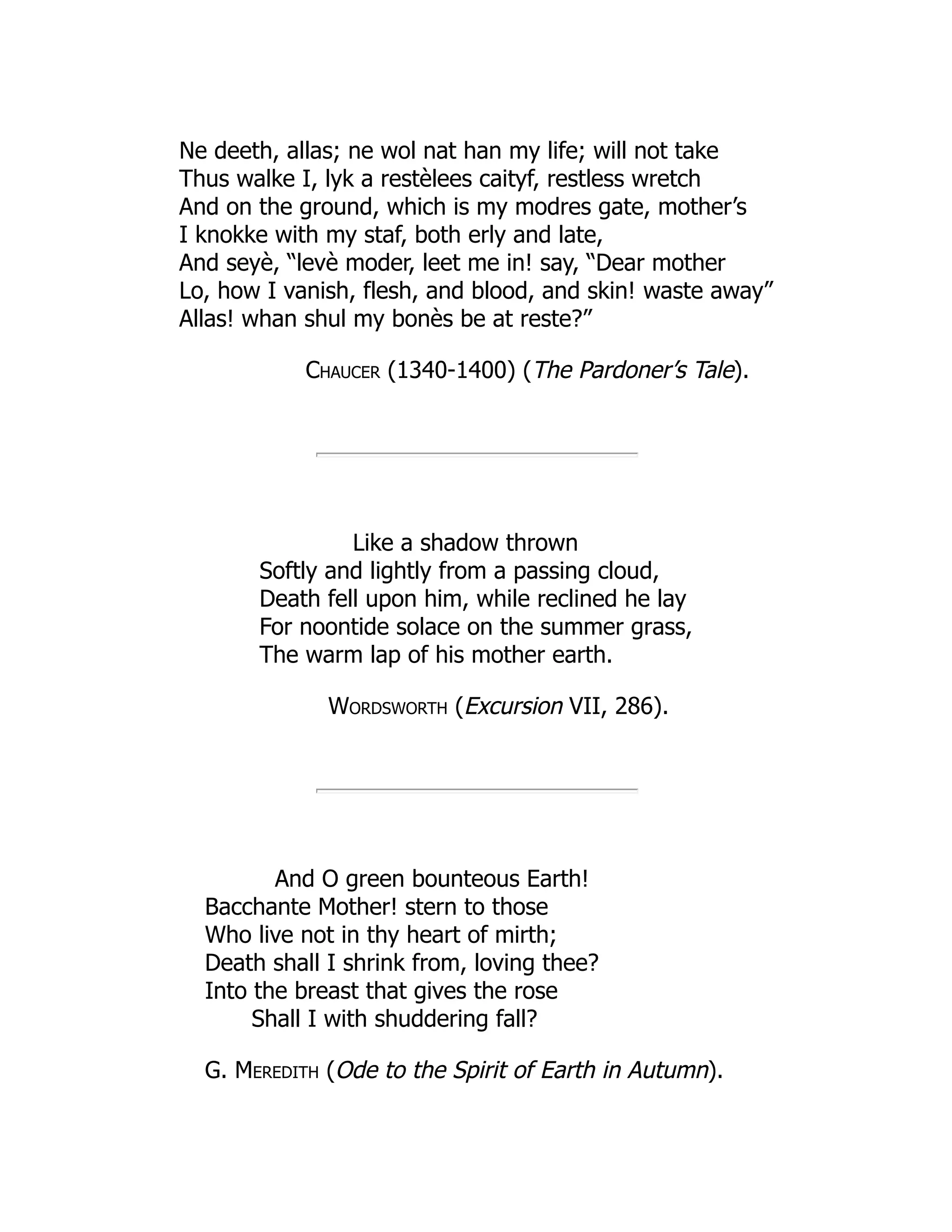
Ne deeth, allas;ne wol nat han my life; will not take
Thus walke I, lyk a restèlees caityf, restless wretch
And on the ground, which is my modres gate, mother’s
I knokke with my staf, both erly and late,
And seyè, “levè moder, leet me in! say, “Dear mother
Lo, how I vanish, flesh, and blood, and skin! waste away”
Allas! whan shul my bonès be at reste?”
Chaucer (1340-1400) (The Pardoner’s Tale).
Like a shadow thrown
Softly and lightly from a passing cloud,
Death fell upon him, while reclined he lay
For noontide solace on the summer grass,
The warm lap of his mother earth.
Wordsworth (Excursion VII, 286).
And O green bounteous Earth!
Bacchante Mother! stern to those
Who live not in thy heart of mirth;
Death shall I shrink from, loving thee?
Into the breast that gives the rose
Shall I with shuddering fall?
G. Meredith (Ode to the Spirit of Earth in Autumn).
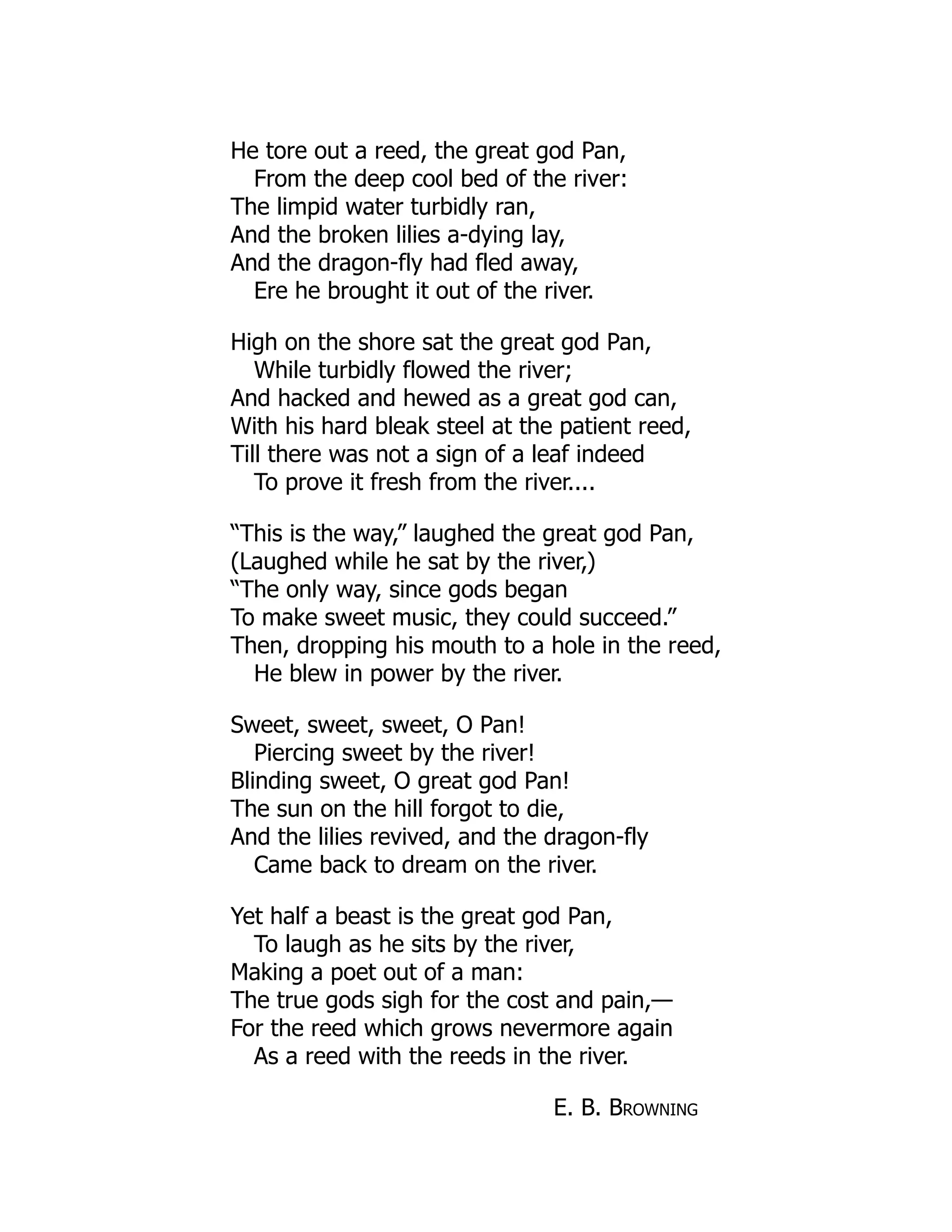
He tore outa reed, the great god Pan,
From the deep cool bed of the river:
The limpid water turbidly ran,
And the broken lilies a-dying lay,
And the dragon-fly had fled away,
Ere he brought it out of the river.
High on the shore sat the great god Pan,
While turbidly flowed the river;
And hacked and hewed as a great god can,
With his hard bleak steel at the patient reed,
Till there was not a sign of a leaf indeed
To prove it fresh from the river....
“This is the way,” laughed the great god Pan,
(Laughed while he sat by the river,)
“The only way, since gods began
To make sweet music, they could succeed.”
Then, dropping his mouth to a hole in the reed,
He blew in power by the river.
Sweet, sweet, sweet, O Pan!
Piercing sweet by the river!
Blinding sweet, O great god Pan!
The sun on the hill forgot to die,
And the lilies revived, and the dragon-fly
Came back to dream on the river.
Yet half a beast is the great god Pan,
To laugh as he sits by the river,
Making a poet out of a man:
The true gods sigh for the cost and pain,—
For the reed which grows nevermore again
As a reed with the reeds in the river.
E. B. Browning
51.
Welcome to ourwebsite – the ideal destination for book lovers and
knowledge seekers. With a mission to inspire endlessly, we offer a
vast collection of books, ranging from classic literary works to
specialized publications, self-development books, and children's
literature. Each book is a new journey of discovery, expanding
knowledge and enriching the soul of the reade
Our website is not just a platform for buying books, but a bridge
connecting readers to the timeless values of culture and wisdom. With
an elegant, user-friendly interface and an intelligent search system,
we are committed to providing a quick and convenient shopping
experience. Additionally, our special promotions and home delivery
services ensure that you save time and fully enjoy the joy of reading.
Let us accompany you on the journey of exploring knowledge and
personal growth!
ebookluna.com











![Isocrates (436-338 B.C.).
This is quoted in Plutarch’s Lives. Isocrates was asked why he taught rhetoric so
much and yet spoke so rarely; and this was his reply. Horace (Ars Poetica 304)
playfully says that he is no longer able to write verses but he will teach others to
write, adding “a whetstone is not used for cutting, but is used for sharpening steel
nevertheless.”
The career of Isocrates, “that old man eloquent,”[31] is extremely interesting.
He preserved his energy and his influence to the end of his long life of 98 years.
From too much love of living,
From hope and fear set free,
We thank with brief thanksgiving
Whatever gods there be
That no life lives for ever;
That dead men rise up never;
That even the weariest river
Winds somewhere safe to sea.
Swinburne (The Garden of Proserpine).
A very musical expression of a very ugly thought.
Women never betray themselves to men as they do to each other.
George Eliot (Middlemarch).](https://image.slidesharecdn.com/9808-250330150353-c2076554/75/eBook-PDF-Research-Methodology-A-Step-by-Step-Guide-for-Beginners-5th-Edition-32-2048.jpg)