Real Time Operating Systems for
Networked Embedded Systems


        Subhashis Banerjee
   Indian Institute of Technology
                 Delhi
             suban@cse.iitd.ac.in

With: Soumyadeb Mitra, Nitin Rajput,
M.Balakrishnan
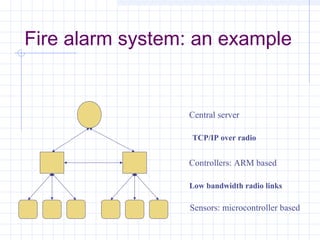
Fire alarm system: an example


                 Central server

                  TCP/IP over radio


                 Controllers: ARM based

                 Low bandwidth radio links

                 Sensors: microcontroller based
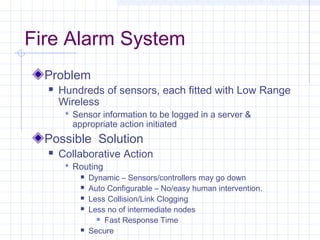
Fire Alarm System
  Problem
     Hundreds of sensors, each fitted with Low Range
      Wireless
        Sensor information to be logged in a server &
         appropriate action initiated
  Possible Solution
     Collaborative Action
        Routing
              Dynamic – Sensors/controllers may go down
              Auto Configurable – No/easy human intervention.
              Less Collision/Link Clogging
              Less no of intermediate nodes
                  Fast Response Time

              Secure
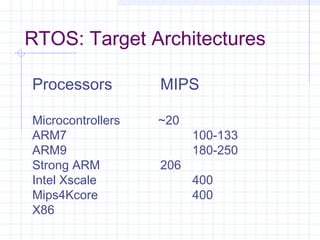
RTOS: Target Architectures

Processors         MIPS

Microcontrollers   ~20
ARM7                     100-133
ARM9                     180-250
Strong ARM         206
Intel Xscale             400
Mips4Kcore               400
X86
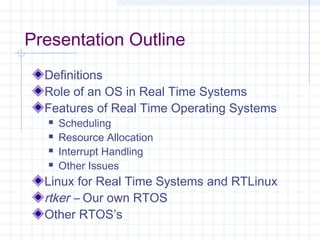
Presentation Outline
  Definitions
  Role of an OS in Real Time Systems
  Features of Real Time Operating Systems
     Scheduling
     Resource Allocation
     Interrupt Handling
     Other Issues
  Linux for Real Time Systems and RTLinux
  rtker – Our own RTOS
  Other RTOS’s
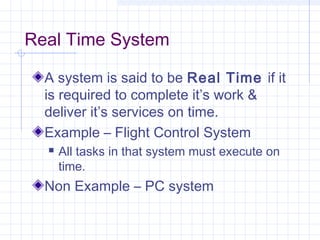
Real Time System

  A system is said to be Real Time if it
  is required to complete it’s work &
  deliver it’s services on time.
  Example – Flight Control System
     All tasks in that system must execute on
      time.
  Non Example – PC system
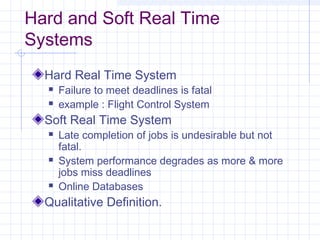
Hard and Soft Real Time
Systems
  Hard Real Time System
     Failure to meet deadlines is fatal
     example : Flight Control System
  Soft Real Time System
     Late completion of jobs is undesirable but not
      fatal.
     System performance degrades as more & more
      jobs miss deadlines
     Online Databases
  Qualitative Definition.
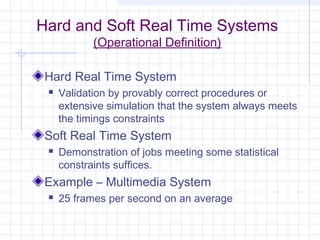
Hard and Soft Real Time Systems
            (Operational Definition)

 Hard Real Time System
    Validation by provably correct procedures or
     extensive simulation that the system always meets
     the timings constraints
 Soft Real Time System
    Demonstration of jobs meeting some statistical
     constraints suffices.
 Example – Multimedia System
    25 frames per second on an average
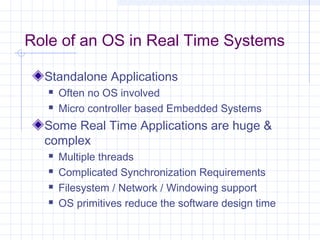
Role of an OS in Real Time Systems

  Standalone Applications
      Often no OS involved
      Micro controller based Embedded Systems
  Some Real Time Applications are huge &
  complex
      Multiple threads
      Complicated Synchronization Requirements
      Filesystem / Network / Windowing support
      OS primitives reduce the software design time
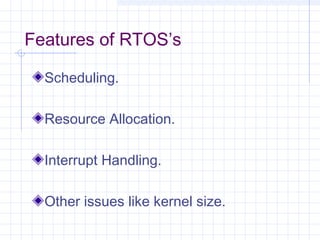
Features of RTOS’s

  Scheduling.

  Resource Allocation.

  Interrupt Handling.

  Other issues like kernel size.
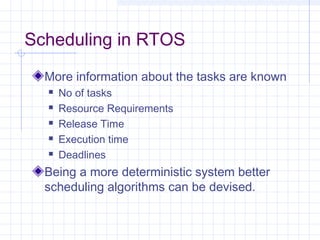
Scheduling in RTOS
  More information about the tasks are known
     No of tasks
     Resource Requirements
     Release Time
     Execution time
     Deadlines
  Being a more deterministic system better
  scheduling algorithms can be devised.
Scheduling Algorithms in RTOS

  Clock Driven Scheduling

  Weighted Round Robin Scheduling

  Priority Scheduling
  (Greedy / List / Event Driven)
Scheduling Algorithms in RTOS (contd)

  Clock Driven
      All parameters about jobs (release time/
       execution time/deadline) known in
       advance.
      Schedule can be computed offline or at
       some regular time instances.
      Minimal runtime overhead.
      Not suitable for many applications.
Scheduling Algorithms in RTOS (contd)

  Weighted Round Robin
      Jobs scheduled in FIFO manner
      Time quantum given to jobs is proportional to it’s
       weight
      Example use : High speed switching network
         QOS guarantee.
      Not suitable for precedence constrained jobs.
         Job A can run only after Job B. No point in giving time
          quantum to Job B before Job A.
Scheduling Algorithms in RTOS (contd)

  Priority Scheduling
  (Greedy/List/Event Driven)
      Processor never left idle when there are
       ready tasks
      Processor allocated to processes
       according to priorities
      Priorities
         static - at design time
         Dynamic - at runtime
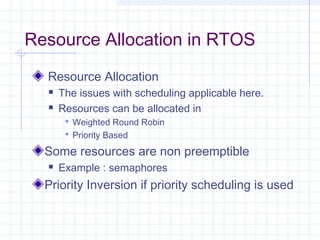
Priority Scheduling

  Earliest Deadline First (EDF)
      Process with earliest deadline given highest
       priority
  Least Slack Time First (LSF)
      slack = relative deadline – execution left
  Rate Monotonic Scheduling (RMS)
      For periodic tasks
      Tasks priority inversely proportional to it’s period
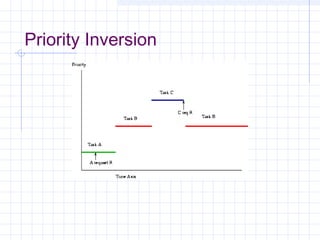
Resource Allocation in RTOS
  Resource Allocation
     The issues with scheduling applicable here.
     Resources can be allocated in
        Weighted Round Robin
        Priority Based

  Some resources are non preemptible
     Example : semaphores
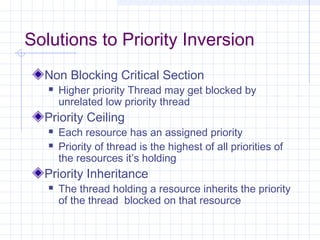
  Priority Inversion if priority scheduling is used
Priority Inversion
Solutions to Priority Inversion
  Non Blocking Critical Section
      Higher priority Thread may get blocked by
       unrelated low priority thread
  Priority Ceiling
      Each resource has an assigned priority
      Priority of thread is the highest of all priorities of
       the resources it’s holding
  Priority Inheritance
      The thread holding a resource inherits the priority
       of the thread blocked on that resource
Other RTOS issues
  Interrupt Latency should be very small
     Kernel has to respond to real time events
     Interrupts should be disabled for minimum
      possible time
  For embedded applications Kernel Size
  should be small
     Should fit in ROM
  Sophisticated features can be removed
     No Virtual Memory
     No Protection
Linux for Real Time Applications
  Scheduling
      Priority Driven Approach
         Optimize average case response time
      Interactive Processes Given Highest Priority
         Aim to reduce response times of processes
      Real Time Processes
         Processes with high priority
         No notion of deadlines
  Resource Allocation
      No support for handling priority inversion
Interrupt Handling in Linux
  Interrupts are disabled in ISR/critical
  sections of the kernel
  No worst case bound on interrupt
  latency avaliable
      eg: Disk Drivers may disable interrupt for
       few hundred milliseconds
  Not suitable for Real Time Applications
      Interrupts may be missed
Other Problems with Linux

  Processes are non preemtible in Kernel
  Mode
     System calls like fork take a lot of time
     High priority thread might wait for a low
      priority thread to complete it’s system call
  Processes are heavy weight
     Context switch takes several hundred
      microseconds
Why Linux
 Coexistence of Real Time Applications
 with non Real Time Ones
     Example http server
 Device Driver Base
 Stability
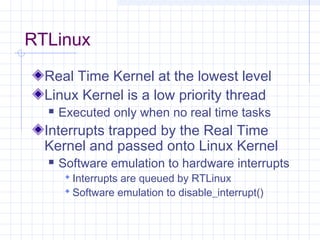
RTLinux
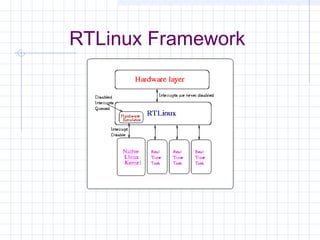
  Real Time Kernel at the lowest level
  Linux Kernel is a low priority thread
     Executed only when no real time tasks
  Interrupts trapped by the Real Time
  Kernel and passed onto Linux Kernel
     Software emulation to hardware interrupts
        Interrupts are queued by RTLinux
        Software emulation to disable_interrupt()
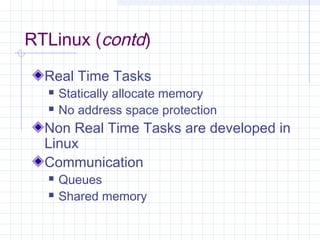
RTLinux (contd)
  Real Time Tasks
     Statically allocate memory
     No address space protection
  Non Real Time Tasks are developed in
  Linux
  Communication
     Queues
     Shared memory
RTLinux Framework
rtker – Our RTOS
  Motivation
     Our own OS
        Full grasp over source code – Easily modifiable, portable

  Features
     Modular Design
        Isolation of Architecture/CPU dependent and
         independent code – Easy to Port
     Pluggable Scheduler
     Two level Interrupt Handling
     Small footprint
     Oskit’s Device Driver Framework
Pluggable Scheduler
  Scheduler - part of the Application
  Kernel interacts with the scheduler
  through an API
  Application developer needs to
  implement the scheduler API
     Can optimize on Data Structures &
      Algorithms for implementing the scheduler
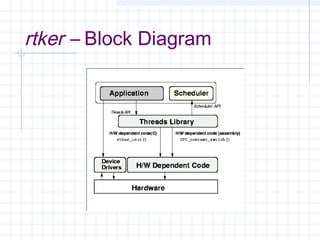
rtker – Block Diagram
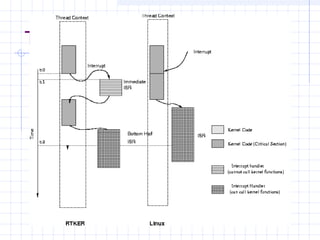
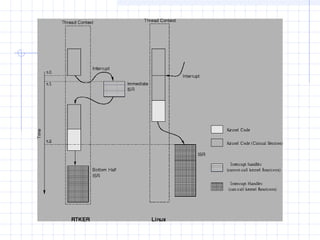
Two Level Interrupt Handling
  Two level Interrupt Handling
     Top Half Interrupt Handler
        Called Immediately – Kernel never disables interrupts
        Cannot invoke thread library functions - Race Conditions
     Bottom Half Interrupt Handler
        Invoked when kernel not in Critical Section
        Can invoke thread library functions

  Very Low Response time (as compared to
  Linux)
Two Level Interrupt Handling
Other Features
  Footprint
     Small footprint (~50kb)
  Oskit’s Device Driver Framework
     Allows direct porting of existing drivers
      from Linux.
     Example – Ethernet Driver of Linux
Other RTOS’s

  LynxOS
     Microkernel Architecture
        Kernel provides scheduling/interrupt handling
     Additional features through Kernel Plug Ins(KPIs)
        TCP/IP stack , Filesystem
        KPI’s are multithreaded
     Memory Protection/ Demand Paging Optional
     Development and Deployment on the same host
        OS support for compilers/debuggers
Other RTOS’s (contd)

  VxWorks
      Monolithic Architecture
      Real Time Posix compliant
      Cross development System
  pSOS
      Object Oriented OS
Peripheral devices and protocols
  • Interfacing
     Serial/parallel ports, USB, I2C, PCMCIA, IDE
  • Communication
     Serial, Ethernet, Low bandwidth radio, IrDA,
     802.11b based devices
  • User Interface
     LCD, Keyboard, Touch sensors, Sound, Digital
     pads, Webcams
  • Sensors
     A variety of sensors using fire, temperature,
     pressure, water level, seismic, sound, vision

Rtos 2

  • 1.
    Real Time OperatingSystems for Networked Embedded Systems Subhashis Banerjee Indian Institute of Technology Delhi suban@cse.iitd.ac.in With: Soumyadeb Mitra, Nitin Rajput, M.Balakrishnan
  • 2.
    Fire alarm system:an example Central server TCP/IP over radio Controllers: ARM based Low bandwidth radio links Sensors: microcontroller based
  • 3.
    Fire Alarm System Problem  Hundreds of sensors, each fitted with Low Range Wireless  Sensor information to be logged in a server & appropriate action initiated Possible Solution  Collaborative Action  Routing  Dynamic – Sensors/controllers may go down  Auto Configurable – No/easy human intervention.  Less Collision/Link Clogging  Less no of intermediate nodes  Fast Response Time  Secure
  • 4.
    RTOS: Target Architectures Processors MIPS Microcontrollers ~20 ARM7 100-133 ARM9 180-250 Strong ARM 206 Intel Xscale 400 Mips4Kcore 400 X86
  • 5.
    Presentation Outline Definitions Role of an OS in Real Time Systems Features of Real Time Operating Systems  Scheduling  Resource Allocation  Interrupt Handling  Other Issues Linux for Real Time Systems and RTLinux rtker – Our own RTOS Other RTOS’s
  • 6.
    Real Time System A system is said to be Real Time if it is required to complete it’s work & deliver it’s services on time. Example – Flight Control System  All tasks in that system must execute on time. Non Example – PC system
  • 7.
    Hard and SoftReal Time Systems Hard Real Time System  Failure to meet deadlines is fatal  example : Flight Control System Soft Real Time System  Late completion of jobs is undesirable but not fatal.  System performance degrades as more & more jobs miss deadlines  Online Databases Qualitative Definition.
  • 8.
    Hard and SoftReal Time Systems (Operational Definition) Hard Real Time System  Validation by provably correct procedures or extensive simulation that the system always meets the timings constraints Soft Real Time System  Demonstration of jobs meeting some statistical constraints suffices. Example – Multimedia System  25 frames per second on an average
  • 9.
    Role of anOS in Real Time Systems Standalone Applications  Often no OS involved  Micro controller based Embedded Systems Some Real Time Applications are huge & complex  Multiple threads  Complicated Synchronization Requirements  Filesystem / Network / Windowing support  OS primitives reduce the software design time
  • 10.
    Features of RTOS’s Scheduling. Resource Allocation. Interrupt Handling. Other issues like kernel size.
  • 11.
    Scheduling in RTOS More information about the tasks are known  No of tasks  Resource Requirements  Release Time  Execution time  Deadlines Being a more deterministic system better scheduling algorithms can be devised.
  • 12.
    Scheduling Algorithms inRTOS Clock Driven Scheduling Weighted Round Robin Scheduling Priority Scheduling (Greedy / List / Event Driven)
  • 13.
    Scheduling Algorithms inRTOS (contd) Clock Driven  All parameters about jobs (release time/ execution time/deadline) known in advance.  Schedule can be computed offline or at some regular time instances.  Minimal runtime overhead.  Not suitable for many applications.
  • 14.
    Scheduling Algorithms inRTOS (contd) Weighted Round Robin  Jobs scheduled in FIFO manner  Time quantum given to jobs is proportional to it’s weight  Example use : High speed switching network  QOS guarantee.  Not suitable for precedence constrained jobs.  Job A can run only after Job B. No point in giving time quantum to Job B before Job A.
  • 15.
    Scheduling Algorithms inRTOS (contd) Priority Scheduling (Greedy/List/Event Driven)  Processor never left idle when there are ready tasks  Processor allocated to processes according to priorities  Priorities  static - at design time  Dynamic - at runtime
  • 16.
    Priority Scheduling Earliest Deadline First (EDF)  Process with earliest deadline given highest priority Least Slack Time First (LSF)  slack = relative deadline – execution left Rate Monotonic Scheduling (RMS)  For periodic tasks  Tasks priority inversely proportional to it’s period
  • 17.
    Resource Allocation inRTOS Resource Allocation  The issues with scheduling applicable here.  Resources can be allocated in  Weighted Round Robin  Priority Based Some resources are non preemptible  Example : semaphores Priority Inversion if priority scheduling is used
  • 18.
  • 19.
    Solutions to PriorityInversion Non Blocking Critical Section  Higher priority Thread may get blocked by unrelated low priority thread Priority Ceiling  Each resource has an assigned priority  Priority of thread is the highest of all priorities of the resources it’s holding Priority Inheritance  The thread holding a resource inherits the priority of the thread blocked on that resource
  • 20.
    Other RTOS issues Interrupt Latency should be very small  Kernel has to respond to real time events  Interrupts should be disabled for minimum possible time For embedded applications Kernel Size should be small  Should fit in ROM Sophisticated features can be removed  No Virtual Memory  No Protection
  • 21.
    Linux for RealTime Applications Scheduling  Priority Driven Approach  Optimize average case response time  Interactive Processes Given Highest Priority  Aim to reduce response times of processes  Real Time Processes  Processes with high priority  No notion of deadlines Resource Allocation  No support for handling priority inversion
  • 22.
    Interrupt Handling inLinux Interrupts are disabled in ISR/critical sections of the kernel No worst case bound on interrupt latency avaliable  eg: Disk Drivers may disable interrupt for few hundred milliseconds Not suitable for Real Time Applications  Interrupts may be missed
  • 23.
    Other Problems withLinux Processes are non preemtible in Kernel Mode  System calls like fork take a lot of time  High priority thread might wait for a low priority thread to complete it’s system call Processes are heavy weight  Context switch takes several hundred microseconds
  • 24.
    Why Linux Coexistenceof Real Time Applications with non Real Time Ones  Example http server Device Driver Base Stability
  • 25.
    RTLinux RealTime Kernel at the lowest level Linux Kernel is a low priority thread  Executed only when no real time tasks Interrupts trapped by the Real Time Kernel and passed onto Linux Kernel  Software emulation to hardware interrupts  Interrupts are queued by RTLinux  Software emulation to disable_interrupt()
  • 26.
    RTLinux (contd) Real Time Tasks  Statically allocate memory  No address space protection Non Real Time Tasks are developed in Linux Communication  Queues  Shared memory
  • 27.
  • 28.
    rtker – OurRTOS Motivation  Our own OS  Full grasp over source code – Easily modifiable, portable Features  Modular Design  Isolation of Architecture/CPU dependent and independent code – Easy to Port  Pluggable Scheduler  Two level Interrupt Handling  Small footprint  Oskit’s Device Driver Framework
  • 29.
    Pluggable Scheduler Scheduler - part of the Application Kernel interacts with the scheduler through an API Application developer needs to implement the scheduler API  Can optimize on Data Structures & Algorithms for implementing the scheduler
  • 30.
  • 31.
    Two Level InterruptHandling Two level Interrupt Handling  Top Half Interrupt Handler  Called Immediately – Kernel never disables interrupts  Cannot invoke thread library functions - Race Conditions  Bottom Half Interrupt Handler  Invoked when kernel not in Critical Section  Can invoke thread library functions Very Low Response time (as compared to Linux)
  • 32.
  • 34.
    Other Features Footprint  Small footprint (~50kb) Oskit’s Device Driver Framework  Allows direct porting of existing drivers from Linux.  Example – Ethernet Driver of Linux
  • 35.
    Other RTOS’s LynxOS  Microkernel Architecture  Kernel provides scheduling/interrupt handling  Additional features through Kernel Plug Ins(KPIs)  TCP/IP stack , Filesystem  KPI’s are multithreaded  Memory Protection/ Demand Paging Optional  Development and Deployment on the same host  OS support for compilers/debuggers
  • 36.
    Other RTOS’s (contd) VxWorks  Monolithic Architecture  Real Time Posix compliant  Cross development System pSOS  Object Oriented OS
  • 37.
    Peripheral devices andprotocols • Interfacing Serial/parallel ports, USB, I2C, PCMCIA, IDE • Communication Serial, Ethernet, Low bandwidth radio, IrDA, 802.11b based devices • User Interface LCD, Keyboard, Touch sensors, Sound, Digital pads, Webcams • Sensors A variety of sensors using fire, temperature, pressure, water level, seismic, sound, vision