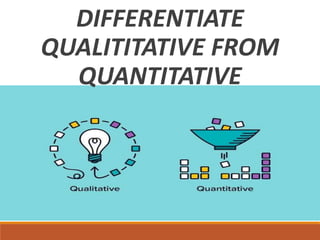
DIFFERENTIATE
QUALITITATIVE FROM
QUANTITATIVE
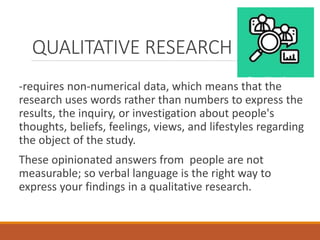
QUALITATIVE RESEARCH
-requires non-numerical data, which means that the
research uses words rather than numbers to express the
results, the inquiry, or investigation about people's
thoughts, beliefs, feelings, views, and lifestyles regarding
the object of the study.
These opinionated answers from people are not
measurable; so verbal language is the right way to
express your findings in a qualitative research.
QUANTITATIVE RESEARCH
-- involves measurement of data.
Thus, it presents research findings
referring to the number or
frequency of something in
numerical forms ( using
percentages, fractions, numbers)
The data you deal with in research are either primary
or secondary data.
Primary data-- are obtained through direct
observation or contact with people, objects, artifacts,
paintings etc.
Secondary data-- if such data have already been
written about or reported on and are available for
reading purposes, they exists as secondary data.
1. SCIENTIFIC OR POSITIVE APPROACH
-- in which you discover and measure information as
well as observe and control variables in an impersonal
manner. Therefore, the data gathering techniques
appropriate for this approach are structured
interviews, questionnaires, and observational
checklists.
Data given by these techniques are expressed through
numbers, which means that this method is suitable for
quantitative research.
2. NATURALISTIC APPROACH
-- uses words, this research approach directs
you to deal with qualitative data that speak
of how people behave toward their
surroundings.
If you want to combine these
two approaches in designing
your research leads you to the
third one, called
TRIANGULATION APPROACH.
TYPES OF
RESEARCH
TYPES OF RESEARCH
1. Based on Application of Research Method--
If it deals with concepts, principles, or abstract things,
it is a pure research.
If it is to apply your chosen research to a societal
problems or issues, finding ways to make positive
changes in society it is called applied research
2. Based on Purpose of the Research
-- Depending on your objective or goal in conducting
research, you do any of these types of research:
DESCRIPTIVE APPROACH
Defining or giving a verbal portrayal
or picture of a person, thing, event,
group situation, etc.
CORRELATIONAL RESEARCH
Shows relationships or
connectedness of two factors,
circumstances, or agents called
variables that affect the
research.
EXPLANATORY RESEARCH
-- Elaborates or explains not just the
reasons behind the relationship of
two factors, but also the ways which
such relationship exists.
EXPLORATORY RESEARCH
To find out how reasonable
or possible it is to conduct a
research study on a certain
topic.
ACTION RESEARCH
Studies an ongoing practice of a
school, organization,
community, etc. That will bring
improvements in the system
INDEPENDENT VARIABLE-- Can stand
alone variable, which means its value
can change without reference to
another variable. It can be controlled or
manipulated
DEPENDENT VARIABLE is a
variable that changes as a
result of the change in the
independent variable.
IDENTIFY THE INDEPENDENT
AND DEPENDENT VARIABLES IN
THE FOLLOWING SITUATIONS
A. An educational researcher tests
the effects of using a particular
teaching strategy on the performance
in mathematics of college students.
b. A medical technologist
studies the effects of using a
certain drug intreating cancer
patients.
A. The independent variable is the teaching
strategy and which class will not. The
dependent variable is the performance in
mathematics of the college students. The
performance may be affected by the teaching
strategy used by the teacher
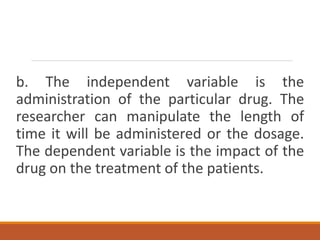
b. The independent variable is the
administration of the particular drug. The
researcher can manipulate the length of
time it will be administered or the dosage.
The dependent variable is the impact of the
drug on the treatment of the patients.
INDIVIDUAL WORK
Directions: Express your judgement or decision
about each line by checking the box representing
your choice. On the lines provided, write your
reasons to justify your agreement or disagreement
on the given statement.
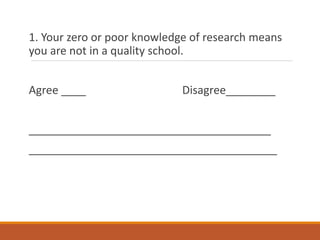
1. Your zero or poor knowledge of research means
you are not in a quality school.
Agree ____ Disagree________
_______________________________________
________________________________________
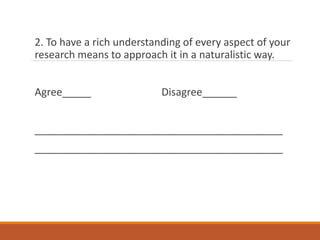
2. To have a rich understanding of every aspect of your
research means to approach it in a naturalistic way.
Agree_____ Disagree______
___________________________________________
___________________________________________
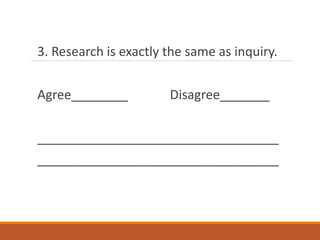
3. Research is exactly the same as inquiry.
Agree________ Disagree_______
__________________________________
__________________________________
4. You behave like a scientist in research.
Agree_____ Disagree________
_____________________________________
_____________________________________
5. How knowledgeable are you about your
surroundings?
How can you know more about people, places,
and things in this world? Share with your
classmates some ways and techniques you
know about becoming knowledgeable about a
lot of things in this world such as those within
your own world, among your friends ,
schoolmates, loved ones, and so on
QUALITATIVE RESEARCH
AND ITS IMPORTANCE IN
DAILY LIFE
If you are curious about a person or a thing, you
are inclined to conduct a qualitative research to
discover such individual's thoughts, feelings, and
attitudes about a certain topic, or to find out
something beneath the surface of an inanimate
thing or the effects of such object or place to some
people. According to (Silverman 2013; Litchman 2013; Walliman 2014; Suter 2012)
CHARACTERISTICS OF
A QUALITATIVE
RESEARCH
1. HUMAN UNDERSTANDING
AND INTERPRETATION-- show an
individua's mental, social and
spiritual understanding of the
world.
2. ACTIVE, POWERFUL, AND
FORCEFUL-- consider varied
was of getting answers, travel
to places for data gathering
3. MULTIPLE RESEARCH
APPROACHES AND METHODS-
Being multi-method research,
applies to all research types
4. SPECIFICITY OF
GENERALIZATION-
Inductive- example before
lecture(specific to general
Deductive- lecture then
example(general to specific)
5. CONTEXTUALIZATION-
To understand human behavior
examine context or situation of an
individual's life-- who, what, why,
how and other circumstances
6. DIVERSIFIED DATA IN REAL- LIFE
SITUATIONS - a qualitative researcher
prefers collecting data in a natural
setting like observing people as they
live and work
7. Abounds with words and visuals-
Words, words, and more words
come in big quantity in this kind of
research.
( pictures, videos, drawing, and
graphs)
8. Internal Analysis--
(emotional, mental, spiritual
characteristics) intermnal
traits of the subject
individuals
TYPES OF
QUALITATIVE
RESEARCH
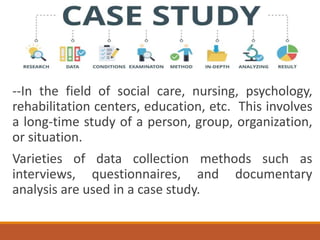
--In the field of social care, nursing, psychology,
rehabilitation centers, education, etc. This involves
a long-time study of a person, group, organization,
or situation.
Varieties of data collection methods such as
interviews, questionnaires, and documentary
analysis are used in a case study.
Falling in the field of anthropology,
ethnography is the study of a
particular cultural group to get a clear
understanding of its organizational
set-up, internal operaion, and
lifestyle
--Is a method of qualitative research that
requires an analysis or examination of the
substance or content of the mode of
communication (letters, books, journals,
photos, video recordings, audio-visual
materials etc.)
“phenomenon” which means something known
through sensory experience, phenomenology
refers to the study of how people find their
experiences meaningful.
Its primary goal is to make people understand
their experiences about death of loved ones,
care for handicapped persons, friendliness of
people etc.
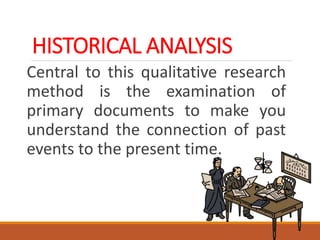
HISTORICAL ANALYSIS
Central to this qualitative research
method is the examination of
primary documents to make you
understand the connection of past
events to the present time.
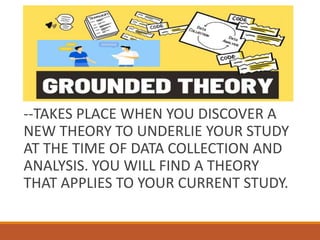
--TAKES PLACE WHEN YOU DISCOVER A
NEW THEORY TO UNDERLIE YOUR STUDY
AT THE TIME OF DATA COLLECTION AND
ANALYSIS. YOU WILL FIND A THEORY
THAT APPLIES TO YOUR CURRENT STUDY.
ADVANTAGES OR
STRENGTHS OF
QUALITATIVE
RESEARCH
1. It adopts a naturalistic
approach to its subject
matter, which means that
those involve in the research
understand things based on
what they find meaningful
2. It promotes a full
understanding of human
behavior or personality
traits in their natural
setting.
3. It is instrument for
positive societal
changes.
4. It engenders respect for
people's individuality as it
demands the researcher's
careful and attentive stand
toward people's world views.
5. It is a way of
understanding and
interpreting social
interactions.
6. It increases the researcher's
interest in the study as it
includes the researcher
experience or background
knowledge in interpreting verbal
and visual data.
7. It offers multiple ways
of acquiring and
examining knowledge
about something
DISADVANTAGES OR
WEAKNESSES OF
QUALITATIVE RESEARCH
1. It involves a lot of
researcher's subjectivity
in data analysis.
2. It is hard to know the
validity or reliability of
the data
3. Its open-ended questions
yield “ data overload” that
equires long-time analysis.
4. It is time-
consuming
5. It ivolves several processes,
which results greatly depend
on the researcher views or
interpretations.
Identifying the
Inquiry and Stating
the Problem
SUBJECT MATTER
OF THE INQUIRY
RESEARCH
GUIDELINES IN CHOOSING A
RESEARCH TOPIC
1. INTEREST IN THE SUBJECT MATTER
-- YOUR INTEREST IN A TOPIC MAY BE
CAUSED BY YOUR RICH BACKGROUND
KNOWLEDGE ABOUT IT AND BY ITS
NOVELTY.
2. AVAILABILITY OF INFORMATION
-- COLLECTING A LOT OF
INFORMATION AS EVIDENCE TO
SUPPORT YOUR CLAIMS ABOUT
YOUR SUBJECT MATTER.
3. TIMELINESS AND RELEVANCE OF
THE TOPIC
THE TOPIC IS RELEVANT IT IF
YIELDS RESULTS THAT ARE
INSTRUMENTAL IN SOCIETAL
IMPROVEMENT.
4. LIMITATIONS ON THE
SUBJECT
THIS MAKES YOU LINK
YOUR CHOOSING WITH
COURSE
REQUIREMENTS.
5. PERSONAL RESOURCES
ASSESS YOUR RESEARCH ABILITIES IN
TERMS OF YOUR FINANCIAL
STANDING HEALTH CONDITION,
MENTAL CAPACITY, NEEDED FACILITIES
AND TIME ALLOTMENT
RESEARCH TOPICS
TO BE AVOIDED
1. CONTROVERSIAL
TOPICS- these are topics
that depend greatly on the
writer's opinion.
2. HIGHLY TECHNICAL SUBJECTS-
researching on topics that require an
advanced study, technical knowledge,
and vast experience is a very difficult
task.
3. Hard-to-investigate
subjects- hard to investigate if
there are no available
materials about it.
4. Too broad subjects-will
prevent you from giving a
concentrated or an in-depth
analysis of the subject matter.
5. Too narrow subjects-
these subjects are so
limited or specific
6. Not clear subjects-
choosing topics like these will
prevent you from having a
clear focus on your paper.
CHOOSING A
RESEARCH TOPIC
1. CHOOSE A TOPIC THAT
TRULY INTERESTS YOU/
EXPERTISE
2.BE SURE OF THE
AVAILABILITY OF
MATERIALS/DATA
3. KEEP IN MIND
YOUR TIME
LIMITATIONS
4. MAINTAIN
INTELLECTUAL
INTEGRITY/ ETHICAL
STANDARDS
5. ENDEAVOR TO
CONTRIBUTE
SOMETHING NOVEL
FORMULATING OF THE
RESEARCH TITLE
1. BRIEF BUT CAPTURE THE
ESSENCE OF THE STUDY
(PURPOSE, LOCALE,
VARIABLES,PARTICIPANTS)
2. IT SHOULD NOT BE
LONG AND SHOULD NOT
BE MORE THAN 20 WORDS
3. AVOID REDUNDANCIES
LIKE “A STUDY OF,” “AN
ANALYSIS OF,” AN
INVESTIGATION OF,”
EXAMPLE RESEARCH TITLE:
PROBLEMS ENCOUNTERED
BY THE STUDENTS IN THE
DIVISION OF CAGAYAN ON
THE IMPLEMENTATION OF
G11 CURRICULUM
RESEARCH PROBLEM
VS.
RESEARCH QUESTION
MEANING OF RESEARCH
PROBLEM
THE WORD “PROBLEM” MAKES YOU
WORRY AND PUSHES YOU TO EXERT
CONSIDERABLE EFFORT IN FINDING
A SOLUTION FOR IT.
When you feel perplexed or
anxious about what to do about
something you are doubtful or
about a question you are incapable
of answering, you then come to
think of conducting research,
investigation, or inquiry.
WHEN YOU DECIDE TO DO
RESEARCH , YOU BEGIN
WITH A PROBLEM THAT
WILL LEAD YOU TO
SPECIFIC TOPIC TO FOCUS
ON.
BACKGROUND
OF THE
PROBLEM
First, spend time getting background
knowledge about the problem that
triggered off your research topic to
discover its relation to what the world,
particularly the experts, professionals,
and learned people know about your
topic.
Also, reading for rich background
ideas about the problem is also
another way to discover some
theories or principles to support
your study. (Braun 2014;
Woodwell 2014)
RESEARCH QUESTIONS
THE RESEARCH PROBLEM ENABLES
YOU TO GENERATE A SET OF
RESEARCH QUESTIONS DEPENDS
ON THE BACKGROUND
KNOWLEDGE YOU HAVE ABOUT
THE TOPIC.
TO GET A GOOD IDEA OF THE PROBLEM,
YOU MUST HAVE A RICH BACKGROUND
KNOWLEDGE ABOUT THE TOPIC
THROUGH THE RRL (REVIEW OF RELATED
LITERATURE) WHICH REQUIRES
INTENSIVE READING ABOUT YOUR TOPIC.
A RESEARCH PROBLEM SERVING
AS AN IMPETUS BEHIND YOUR
DESIRE TO CARRY OUT A
RESEARCH STUDY COMES FROM
MANY SOURCES.
RESEARCH PROBLEM: THE NEED TO HAVE A SAFER,
COMFORTABLE, AND HEALTHFUL WALK OR
TRANSFER OF STUDENTS FROM PLACE TO PLACE IN
THE UST CAMPUS
RESEARCH TOPIC: THE CONSTRUCTION OF A
COVERED PATHWAY IN THE UST CAMPUS
GENERAL QUESTION: WHAT KIND OF COVERED
PATH SHOULD UST CONSTRUCT IN ITS CAMPUS?
SPECIFIC QUESTIONS:
1. WHAT MATERIALS ARE NEEDED FOR THE
CONSTRUCTION OF THE COVERED PATHWAY IN THE
UST CAMPUS?
2. WHAT IS THE WIDTH AND HEIGHT OF THE
COVERED PATH?
3. HOW CAN THE COVERED PATH REALIZE GREEN
ARCHITECTURE?
GUIDELINES IN
FORMULATING
RESEARCH QUESTIONS
1. ESTABLISH A CLEAR RELATION BETWEEN THE RESEARCH
QUESTIONS AND THE PROBLEM OR TOPIC.
2. BASE YOUR RESEARCH QUESTIONS ON YOUR RRL OR
REVIEW OF RELATED LITERATURE BECAUSE EXISTING
PUBLISHED WORKS HELP YOU GET GOOD BACKGROUND
KNOWLEDGE OF THE RESEARCH PROBLEM AND HELP YOU
GAUGE THE PEOPLE'S CURRENT UNDERSTANDING OR
UNFAMILIARITY ABOUT THE TOPIC,
REVIEW OF
RELATED
LITERATURE
LITERATURE-- IS AN ORAL OR WRITTEN
RECORD OF MAN'S SIGNIFICANT
EXPERIENCES THAT ARE ARTISTICALLY
CONVEYED IN A PROSAIC MANNER.
DIRECT - EXPRESSIONS OF
MAN'S KNOWLEDGE OF THE
WORLD ARE IN
BOOKS,PERIODICALS, AND
ONLINE READING MATERIALS.
INDIRECT-- ARE HIS INFERENCES OR
REFLECTIONS OF HIS SURROUNDINGS
THAT ARE NOT WRITTEN OR SPOKEN AT
ALL(RIDLEY 2012)
A REVIEW OF RELATED LITERATURE IS AN ANALYSIS
OF MAN'S WRITTEN OR SPOKEN KNOWLEDGE OF
THE WORLD. YOU EXAMINE REPRESENTATIONS OF
MAN'S THINKING ABOUT THE WORLD TO
DETERMINE THE CONNECTION OF YOUR RESEARCH
WITH WHAT PEOPLE ALREADY KNOW ABOUT IT.
PURPOSES OF REVIEW
RELATED
LITERATURE(RRL)
1. TO OBTAIN BACKGROUND KNOWLEDGE OF
YOUR RESEARCH.
2. TO RELATE YOUR STUDY TO THE CURRENT
CONDITION OR SITUATION OF THE WORLD
3. TO SHOW THE CAPACITY OF YOUR
RESEARCH WORK TO INTRODUCE NEW
KNOWLEDGE
4. TO EXPAND, PROVE, OR DISPROVE THE
FINDINGS OF PREVIOUS RESEARCH STUDIES
CHAPTER 1
THE PROBLEM AND ITS
BACKGROUND
Chapter I heading is capitalized.
The usual parts of this chapter are:
Introduction;
Statement of the Problem;
Significance of the Study;
Scope and Delimitation
Definition of Terms.
Introduction
Guidelines in Writing
Introduction/Rationale
1. Describe the problem-situation by considering
global, national, and local situation.
2. Justify the existence of the problem situation by
citing statistical data and authoritative sources(
related studies and literature,
constitutions,laws,orders,ordinances, circulars,
memorandums, rules)as bases to support the
problem
3. The Introduction/ Rationale must be short as
possible, an average of three pages.
4. Use the deductive line of reasoning, from
macro perspective to micro perspective.
5. Maintain an objective tone throughout the
paper. Keep in mind that a research paper is
formal exposition of a research, not a forum
for personal opinion.
6. The researcher may indicate what is wrong in the
present system and explain his desire to discover
ways of enriching of improving something , thus the
study.
7. At the end of the Introduction, the researcher
should cite motives and justification which
prompted him to conduct such as a study. Thus a
clinching statement is made to relate a background
to the research problem.
STATEMENT OF THE PROBLEM
THERE ARE TWO PROBLEMS TO BE
STATED: THE MAJOR (GENERAL OR MAIN)
PROBLEM AND THE MINOR (SPECIFIC)
PROBLEMS OR SUB-PROBLEMS. THE
GENERAL PROBLEM CONSISTS OF THE
GENERAL PURPOSE OF THE STUDY.
IT IS USUALLY PATTERNED FROM THE
RESEARCH TITLE. THE GENERAL PROBLEM IS
BROKEN DOWN TO SPECIFIC PROBLEMS OR
SUB-PROBLEMS IN ORDER TO RSEARCHABLE.
USUALLY, THE GENERAL PROBLEM STARTS
WITH PHRASE: “ THE STUDY” WHILE THE SUB-
PROBLEMS START WITH; “SPECIFICALLY, THIS
STUDY.”
GUIDELINES IN WRITING
THE SUB-PROBLEMS OF
THE STUDY
1. IT MUST BE COMPLETELY
RESEARCHABLE UNIT.
2. IT IS ARRANGED IN A LOGICAL ORDER
FROM FACTUAL TO ANALYTICAL ORDER
3. IT SHOULD BE SPECIFICALLY , CORRECTLY, AND
GRAMATICALLY WORDED IN THE LANGUAGE OF RESEARCH.
4. IT SHOULD NOT DUPLICATE OR OVERLAP THE OTHER SUB-
PROBLEMS (MUTUALLY EXCLUSIVE DIMENSIONS)
5. IT IS NOT ANSWERABLE BY YES OR NO
6. EACH SPECIFIC PROBLEM HAS A CORRESPONDING
STATISTICAL TOOL
CONCEPTUAL
FRAMEWORK
CONCEPTUAL FRAMEWORK-- IS FIRST KNOWN
AS CONCEPTUAL MAPPING WHIXH WAS
ORIGINALLY DEVELOPED BY JOSEPH NONAH IN
1984.
IT INCLUDES THE SYSTEMS OF CONCEPT,
ASSUMPTIONS, EXPECTATIONS, AND BELIEFS
THAT SUPPORT A RESEARCH STUDY.
A CONCEPT IS IN THE MIND OF THE PERSON
AND THEREFORE IT IS NOT KNOWN BY ANY
OTHER PERSON.
THUS, IT CANNOT BE TESTED JUST LIKE A
THEORY. CONCEPT MUST EXPRESSED OUT IN A
DIAGRAM OR ILLUSTRATION BY IDENTIFYING
THE KEY FACTORS, CONCEPTS, OR VARIABLES OF
THE STUDY.
THIS ILLUSTRATION SERVES AS A GUIDE IN CONDUCTING THE STUDY.
CHAPTER 3
METHODS AND PROCEDURE
IN OTHER SCHOOLS, CHAPTER 3
HEADING IS CALLED METHODOLOGY,
RESEARCH METHODOLOGY, METHODS
AND PROCEDURE OR METHODOLOGY
OF RESEARCH.
RESEACRH METHODOLOGY CONSIST
OF THE FOLLOWING PARTS;
METHOD OF RESEARCH,
RESPONDENTS, RESEARCH
INSTRUMENT/S DATA- GATHERING
PROCEDURE, SOURCES OF DATA, DATA
ANALYSIS
METHOD OF RESEARCH
IN THIS SECTION, THE
RESEARCHER MUST STATE
THE TYPE OF RESEARCH, ITS
MEANING, AND HOW IT IS
APPLICABLE TO THE STUDY.
IF A CERTAIN RESEARCH METHOD IS
USED (DESCRIPTIVE, HISTORICAL,
EXPERIMENTAL, OR ANY OTHET
TYPE) THE PARTICULAR TYPE OF
RESEARCH MUST BE INDICATED.
RESPONDENTS
THE RESPONDENTS ARE THOSE FROM WHOM THE
DATA/INFORMATION ARE TO BE COLLECTED OR GATHERED.
THE RESPONDENTS OF THE STUDY MAY EITHER BE
UNIVERSAL/TOTAL POPULATION OR A SAMPLE FROM A
POPULATION. IN A UNIVERSAL/TOTAL POPULATION ALL
THE MEMBERS OF THAT POPULATION ARE INVOLVED. IF A
SAMPLE IS TAKE FROM A POPULATION APPROPRIATE
FORMULA IS USED. THIS FORMULA MAY EITHER BE
SLOVIN'S FORMULA, IBE'S FORMULA OR THE MAJORITY
RULE FORMULA.
THERE ARE THREE TYPES OF
RESPONDENTS: TRY -OUT, TARGET AND
ACTUAL. TRY-OUT RESPONDENTS ARE
THOSE PEOPLE FROM WHOM THE
TEST/INSTRUMENT IS TRIED OUT OR
PILOTED TO DETERMINE THE
INSTRUMENT'S VALIDITY AND RELIABILITY.
THE TRY-OUT RESPONDENTS SHOULD NOT BE
INVOLVED IN THE ACTUAL STUDY. IN TARGET
RESPONDENTS THEY ARE RESPONDENTS TO
THE FINALIZED/VALIDATED INSTRUMENT,
ALTHOUGH SOME OF THEM MAY NOT BE
ABLE TO RESPOND, ACCOMPLISH OR RETURN
THE DISTRIBUTED INSTRUMENT.
THE ACTUAL RESPONDENTS ARE THOSE WHO
ACTUALLY RESPONDED, ACCOMPLISHED,
AND RETURNED THE INSTRUMENT AND
WHERE THE OBTAINED DATA FROM THEM
ARE USED AS BASES FOR STATISTICAL
ANALYSIS.
SUBJECTS ARE NOT
RESPONDENTS BECAUSE THEY
DO NOT RESPOND.
RESEARCH INSTRUMENT
THIS SECTION OF THE THESIS IS ALSO CALLED
TOOLS OF GATHERING DATA, RESEARCH
TOOLS, INSTRUMENTATION OR
INSTRUMENTATION AND DATA COLLECTION.
THE INSTRUMENT TO BE USED MUST BE
APPROPRIATE TO THE STUDY, VALID AND
RELIABLE.
THE RESEARCHER MUST INDICATE HOW THE ITEMS
IN THE INSTRUMENT WERE FORMULATED; PARTS
OR SECTION OF THE INSTRUMENT MUST BE
EXPLAINED; TO WHOM AND HOW IT WAS
VALIDATED; HOW IT WAS IMPROVED/ MODIFIED
AND INCORPORATED IN THE FINAL FORM; HOW
THE FINAL FORM OF THE INSTRUMENT WAS
USED/DISTRIBUTED TO THE RESPONDENTS.
GUIDELINES IN THE USE OF
RESEARCH INSTRUMENTS
1. SPECIFY THE RESEARCH INSTRUMENT/S USED (MAIN INSTRUMENT
AND SUBSIDIARY INSTRUMENT, IF NEEDED). JUSTIFY THEIR USES.
2. IF THE INSTRUMENT IS CONSTRUCTED BY THE RESEARCHER, HE HAS
TO GIVE DETAILS OF CONSTRUCTION AND DATA ON VALIDITY AND 1.
REALIBILITY
DATA-GATHERING PROCEDURE
THE RESEARCHER SHOULD INDICATE BRIEFLY
HOW THE INVESTIGATION WAS
CONDUCTED. THE CONDUCT OF THE
RESEARCH SHOULD START FROM THE
APPROVAL OF THE PERMIT TO CONDUCT
THE STUDY TO HOW THEIR INSTRUMENT
WAS DISTRIBUTED; WHO WERE GIVEN THE
INSTRUMENT;
IF AN INTERVIEW WAS USED, THE FOLLOWING
MUST BE INDICATED: PREPARATION OF THE
INTERVIEW, TYPES OF INTERVIEW USED, MANNER
OF INTERVIEW, PERSONS INTERVIEWED,
PERCENTAGE OF INTERVIEWED PERSONS, AND ALL
OTHER INCIDENTAL MATTERS.
IN SOME INTERVIEWS, PICTURE ARE TAKEN DURING
THE INTERVIEW TO SUBSTANTIATE THE PROCESS.
MORE RECENTLY, THE VIDEO COVERAGE IS USED FOR
THOSE WHO CAN FINANCIALLY AFFORD. IT IS VERY
EXPENSIVE TO USE, BUT THE COST GIVES A GOOD
RETURN. THIS SECTION IS ALSO CALLED PROCEDURE
OF INVESTIGATION OR RESEARCH PROCEDURE.
SOURCES OF DATA
LOCALE OF THE STUDY
ALSO REFERRED O AS RESEARCH SETTING OR RESEARCH ENVIRONMENT.
THE LOCALE OF THE STUDY IS REQUIRED IN SOME STUDIES SUCH AS
EXPERIMENTAL AND DESCRIPTIVE STUDY. IF THIS SECTION IS INCLUDED,
THE PLACE WHERE THE STUDY IS CONDUCTED AND THE RESONS BEHIND
THE CHOICE OF THE PLACE MUST BE DISCUSSED.
HOW CAN WE FIND
ANSWERS THROUGH DATA
COLLECTION?
1. INTERVIEW
IN RESEARCH, INTERVIEW IS A DATA
GATHERING TECHNIQUE THAT MAKES
YOU VERBALLY ASK SUBJECTS OR
RESPONDENTS QUESTIONS TO GIVE
ANSWERS TO WHAT YOUR RESEARCH
STUDY IS TRYING TO LOOK FOR.
DONE MOSTLY IN QUALITATIVE
RESEARCH STUDIES, INTERVIEW AIMS
AT KNOWING WHAT THE RESPONDENTS
THINK AND FEEL ABOUT THE TOPIC OF
YOUR RESEARCH.
TRADITIONALLY VIEWED, THIS DATA
GATHERING TECHNIQUE OCCURS
BETWEEN YOU, THE RESEARCHER,
AND YOUR RESPONDENTS IN FACE-
TO-FACE SITUATION.
TRADITIONAL OR A MODERN TYPE OF
INTERVIEW, “IT IS A CONVERSATION WITH A
PURPOSE” THAT GIVES DIRECTION TO THE
QUESTION-ANSWER ACTIVITY BETWEEN THE
INTERVIEWER AND THE INTERVIEWEE.
(BABBIE 2014, 137;RUBIN 2011)
TYPES OF INTERVIEW
1. STRUCTURED INTERVIEW
-- THIS IS AN INTERVIEW THAT
REQUIRES THE USE OF AN INTERVIEW
SCHEDULE OR A LIST OF QUESTIONS
ANSWERABLE WITH ONE AND ONLY
ITEM FROM A SET OF ALTERNATIVE
RESPONSES.
YOU, THE RESEARCHER , ARE
COMPLETELY PEGGED AT THE
INTERVIEW SCHEDULE OR
PREPARED LIST OF QUESTIONS.
CHOOSING ONE ANSWER FROM THE
GIVEN SET OF ANSWERS, THE
RESPONDENTS ARE BARRED FROM
GIVING ANSWERS THAT REFLECT
THEIR OWN THINKING OR EMOTIONS
ABOUT THE TOPIC.
2. UNSTRUCTURED
INTERVIEW
-- THE RSPONDENTS ANSWER THE QUESTIONS BASED ON WHAT THEY PERSONALLY
THINK AND FEEL ABOUT IT.
THERE ARE NO SUGGESTED
ANSWERS. THEY PURELY DEPEND
ON THE RESPONDENTS' DECISION -
MAKING SKILLS , GIVING THEM
OPPORTUNITY TO THINK
CRITICALLY ABOUT THE QUESTION.
3. SEMI-STRUCTURED
INTERVIEW
YOU PREPARE A SCHEDULE OR LIST OF QUESTIONS
THAT IS ACCOMPANIED BY A LIST OF EXPRESSIONS
FROM WHERE THE RESPONDENTS CAN PICK OUT
THE CORRECT ANSWER. HOWEVER, AFTER
CHOOSING ONE FROM THE SUGGESTED ANSWERS,
THE RESPONDENTS ANSWER ANOTHER SET OF
QUESTIONS TO MAKE THEM EXPLAIN THE
REASONS BEHIND THEIR CHOICES.
ALLOWING FREEDOM FOR YOU TO CHANGE
THE QUESTIONS AND FOR THE
RESPONDENTS TO THINK OF THEIR OWN
ANSWERS, THIS SEMI-STRUCTURED
INTERVIEW IS A FLEXIBLE AND AN
ORGANIZED TYPE OF INTERVIEW: (RUBIN
2012;BERNARD 2013)
APPROACHES
1. INDIVIDUAL INTERVIEW--
ONLY ONE RESPODENT IS INTERVIEWED HERE. THE
REASON BEHIND THIS ONE-ON-ONE INTERVIEW IS
THE LACK OF TRUST THE INTERVIEWEES HAVE
AMONG THEMSELVES. THIS IS A TIME-CONSUMING
TYPE OF INTERVIEW BECAUSE YOU HAVE TO
INTERVIEW A GROUP OF INTVIEWEWS ONE BY ONE.
2. GROUP INTERVIEW
-- YOU ASK THE QUESTION NOT TO ONE PERSON, BUT TO A
GROUP OF PEOPLE AT THE SAME TIME. RESEARCHERS IN
THIS FIELD, WHOSE PRIMARY AIM IN ADHERING TO THIS
INTERVIEW APPROACH IS TO KNOW PEOPLE'S FOOD
PREFERENCES AND CONSUMER OPINIONS; THEY ALSO CALL
THIS AS FOCUS GROUP INTERVIEW.
3. MEDIATED INTERVIEW
NO FACE -TO-FACE INTERVIEW IS TRUE FOR
THIS INTERVIEW APPROACH BECAUSE THIS
TAKES PLACE THROUGH ELECTRONIC
COMMUNICATION DEVICESSUH AS
TELEPHONES, MOBILE PHONES, EMAIL
AMONG OTHERS.
NONETHELESS, CONSIDER THIS BETTER
BECAUSE OF THE BIG NUMBER OF
RESPONDENTS IT IS CAPABLE OF REACHING
DESPITE THE COST, DISTANCE, AND HUMAN
DISABILITIES AFFECTING THE INTERVIEW.
STEPS IN
CONDUCTING AN
INTERVIEW
STEP 1: GETTING TO KNOW
EACH OTHER
YOUR WARM ACKNOWLEDGEMENT FOR
EACH OTHER MUST LEAD YOU TO DISCUSSING
SEVERAL ASPECTS OF THE INTERVIEW, AS
WHERE YOU HAVE TO DO IT, HOW LONG
SHOULD THE QUESTION-AND-ANSWER BE.
STEP 2: HAVING AN IDEA OF
THE RESEARCH
THIS SECOND STEP REQUIRES YOU TO TELL
THE RESPONDENTS ABOUT THE NATURE
OF THE INTERVIEW-- ITS PURPOSE,
IMPORTANCE, SCOPE , AND SO ON.
STEP 3: STARTING THE
INTERVIEW
YOU OPEN THIS STEP WITH A QUESTION TO
ENCOURAGE THE RESPONDENT TO TALK
ABOUT HIMSELF OR HERSELF INCLUDING HIS
OR HER AGE,FAMILY, CURRENT ACTIVITIES,
AND OTHER THINGS YOU THINK APPEAR
SPECIAL OR INTERESTING TO HIM OR HER.
STEP 4: CONDUCTING THE
INTERVIEW PROPER
In asking a battery questions, you
see to it that you stick to the main
point of your study, the proper
phrasing of questions and to the
sufficient time alloted for answering
each question.
STEP 5: PUTTING AN END TO
THE INTERVIEW
SIGNS OF THE APPROACHING END OF THE INTERVIEW WORK TO ALERT
THE RESPONDENT. THIS STEP ALSO REMINDS YOU OF YOUR
RESPONSIBILITY TO LET THE RESPONDENT BE FREE IN AIRING WHATEVER
DOUBTS OR QUESTIONS HE OR SHE HAS ABOUT THE RESEARCH DESIGN,
METHOD, INTERVIEW TIME, AND OTHER ASPECTS OF THE INTERVIEW.
LIST DOWN ON A PIECE OF PAPER
ALL QUESTIONS YOU PLAN TO ASK
YOUR RESPONDENT AND CALL THIS
LIST OF PREPARED QUESTIONS
SCHEDULE.
STEP 6: PONDERING OVER
INTERVIEW AFTERTHOUGHTS
THIS LAST STEP OF THE INTERVIEW
GIVES THE RESPONDENT THE
OPPORTUNITY TO ASK QUESTIONS
ABOUT THE INTERVIEW ACTIVITY AND
LET HIM OR HER HAVE AN IDEA ABOUT
WHAT WILL HAPPEN NEXT TO THE
INTERVIEW RESULTS.
QUESTIONNAIRE
A QUESTIONNAIRE IS A PAPER CONTAINING A LIST OF
QUESTIONS INCLUDING THE SPECIFIC PLACE AND SPACE IN
THE PAPER WHERE YOU WRITE THE ANSWERS TO THE
QUESTIONS. THIS PREPARED SET OF QUESTIONS ELICITS
FACTUAL OR OPINIONATED ANSWERS FROM THE
RESPONDENT'S THROUGH HIS OR HER ACTS OF CHECKING
ONE CHOSEN ANSWER FROM SEVERAL OPTIONS OR OF
WRITING ON A LINE PROVIDED FOR ANY OPTIONATED
ANSWER. (BABBIE 2013)
PURPOSES OF A
QUESTIONNAIRE
1. TO DISCOVER PEOPLE'S THOUGHTS AND
FEELINGS ABOUT THE TOPIC OF THE RESEARCH
2. TO ASSIST YOU IN CONDUCTING AN EFFECTIVE
FACE-TO-FACE INTERVIEW WITH YOUR
RESPONDENTS
3. TO HELP YOU PLAN HOW TO OBTAIN AND
RECORD THE ANSWERS TO YOUR QUESTIONS
4. TO MAKE THE ANALYSIS ,RECORDING, AND
CODING OF DATA EASIER AND FASTER
TYPES OF QUESTIONNAIRE
1. POSTAL QUESTIONNAIRE
-- AS THE NAME CONNOTES, THIS TYPE OF
QUESTIONNAIRE GOES TO THE RESPONDENT
THROUGH POSTAL SERVICE OR ELECTRONIC
MAIL. IT IS TROUGH THE MAIL OR POSTAL
SYSTEM THAT THE ACCOMPLISHED
QUESTIONNAIRES WILL BE SENT BACK TO
THE RESEARCHERS.
2. SELF-ADMINISTERED QUESTIONNAIRE
-- THIS KIND OF QUESTIONNAIRE MAKES YOU ACT AS THE INTERVIEWER
AND THE INTERVIEWEE AT THE SAME TIME. FIRST, YOU ASK THE
QUESTIONS EITHER IN PERSON OR THROUGH PHONE; THEN, YOU WILL
BE WRITING THE INTERVIEWEE'S ANSWERS ON A PIECE OF PAPER. A
QUESTIONNAIRE LIKE THIS FITS A STRUCTURED KIND OF INTERVIEW. (
BARBOUR 2014)
ADVANTAGES
1. IT IS CHEAP AS IT DOES NOT REQUIRE YOU TO TRAVEL TO HAND THE
QUESTIONNAIRES TO A BIG NUMBER OF RESPONDENTS IN FARAWAY PLACES.
2. IT ENTAILS AN EASY DISTRIBUTION TO RESPONDENTS.
3.IT OFFERS MORE OPPORTUNITY FOR THE RESPONDENTS TO PONDER ON THEIR
RESPONSES
4. IT ENABLES EASY COMPARISON OF ANSWERS BECAUSE OF A CERTAIN DEGREE OF
UNIFORMITY AMONG THE QUESTIONS
5. IT HAS THE CAPACITY TO
ELICIT SPONTANEOUS OR
GENUINE ANSWERS FROM THE
RESPONDENTS.
DISADVANTAGES
1. THERE IS A POSSIBILITY THAT SOME QUESTIONS YOU DISTRIBUTED DO NOT
GO BACK TO YOU, AND THIS PREVENTS YOU FROM GETIING THE DESIRED RATE
OF RESPONSE.
2. CONFUSING AND UNINTERESTING QUESTIONS TO RESPONDENTS FAIL TO
ELICIT THE DESIRED RESPONSES.
3. QWING TO INDIVIDUAL DIFFERENCES BETWEEN THE SELECTED SUBJECTS
AND THOSE IN THE POPULATION, IN GENERAL, THE QUESTIONNAIRE IS HARD
UP IN OBTAINING UNBIASED RESULTS TO REPRESENT THE CHARACTERISTICS
OF THE TARGET POPULATION.
4. IT PREVENTS YOU FROM BEING
WITH THE RESPONDENTS
PHYSICALLY TO HELP THEM
UNLOCK SOME DIFFICULTIES IN
THEIR UNDERSTANDING OF THE
QUESTIONS.
CHAPTER 4
PRESENTATION ,INTERPRETATION AND
ANALYSIS OF DATA
IN THESIS WRITING, THE MOST DIFFICULT
PART TO DEFEND IS CHAPTER 4 BECAUSE
IT IS IN THIS SECTION WHERE YOU WILL
PRESENT THE RESULTS OF THE WHOLE
STUDY.
RESULTS AND
DISCUSSION
SUMMARY,
CONCLUSIONS, AND
RECOMMENDATIONS
This is the last chapter of the thesis and the
most important part because it is here where
the findings and the whole thesis are
summarized; generalizations in the form of
conclusions are made; and the
recommendations for the solutions of
problems discovered in the study are
addressed to those concerned.
SUMMARY
GUIDELINES IN WRITING THE SUMMARY
FINDINGS
1. THERE SHOULD BE A BRIEF STATEMENT
ABOUT THE MAIN PURPOSE OF THE STUDY, THE
POPULATION OF RESPONDENTS, THE PERIOD
OF THE STUDY, METHOD OF RESEARCH USED,
THE RESEARCH INSTRUMENT, AND THE
SAMPLING DESIGN. THERE SHOULD BE NO
EXPLANATIONS MADE.
2. THE FINDINGS MAY BE LUMPED UP ALL
TOGETHER BUT CLARITY DEMANDS THAT
EACH SPECIFIC QUESTION UNDER THE
STATEMENT OF THE PROBLEM MUST BE
WRITTEN FIRST TO BE FOLLOWED BY THE
FINDINGS THAT WOULD ANSWER IT. THE
SPECIFIC QUESTIONS SHOULD FOLLOW THE
ORDER THEY ARE GIVEN UNDER THE
STATEMENT OF THE PROBLEM.
3. THE FINDINGS SHOULD BE TEXTUAL
GENERALIZATIONS, THAT IS SUMMARY OF THE
IMPORTANT DATA CONSISTING OF TEXT AND
NUMBERS. EVERY STATEMENT OF FACT SHOULD
CONSISTS OF WORDS, NUMBERS OR STATISTICAL
MEASURES WOVEN INTO A MEANINGFUL
STATEMENT.
NO DEDUCTION, NOR INFERENCE NOR
INTERPRETATION SHOULD BE MADE
OTHERWISE IT WILL ONLY BE DUPLICATED IN
THE CONCLUSION.
4. ONLY THE IMPORTANT FINDINGS, THE
HIGHLIGHTS OF THE DATA, SHOULD BE
INCLUDED IN THE SUMMARY, ESPECIALLY
THOSE UPON WHICH THE CONCLUSIONS
SHOULD BE BASED.
5. FINDINGS ARE NOT EXPLAINED NOR
ELABORATED UPON ANYMORE. THEY
SHOULD BE STATED AS CONCISELY AS
POSSIBLE.
6. NO NEW DATA SHOULD BE INTRODUCED
IN THE SUMMARY OF FINDINGS.
REFERENCES
APPENDIX

PRACTICAL RESEARCH 1 ( Qualitative Research)PPT.pptx

  • 1.
  • 2.
    QUALITATIVE RESEARCH -requires non-numericaldata, which means that the research uses words rather than numbers to express the results, the inquiry, or investigation about people's thoughts, beliefs, feelings, views, and lifestyles regarding the object of the study. These opinionated answers from people are not measurable; so verbal language is the right way to express your findings in a qualitative research.
  • 3.
    QUANTITATIVE RESEARCH -- involvesmeasurement of data. Thus, it presents research findings referring to the number or frequency of something in numerical forms ( using percentages, fractions, numbers)
  • 4.
    The data youdeal with in research are either primary or secondary data. Primary data-- are obtained through direct observation or contact with people, objects, artifacts, paintings etc. Secondary data-- if such data have already been written about or reported on and are available for reading purposes, they exists as secondary data.
  • 6.
    1. SCIENTIFIC ORPOSITIVE APPROACH -- in which you discover and measure information as well as observe and control variables in an impersonal manner. Therefore, the data gathering techniques appropriate for this approach are structured interviews, questionnaires, and observational checklists. Data given by these techniques are expressed through numbers, which means that this method is suitable for quantitative research.
  • 7.
    2. NATURALISTIC APPROACH --uses words, this research approach directs you to deal with qualitative data that speak of how people behave toward their surroundings.
  • 8.
    If you wantto combine these two approaches in designing your research leads you to the third one, called TRIANGULATION APPROACH.
  • 9.
  • 10.
    TYPES OF RESEARCH 1.Based on Application of Research Method-- If it deals with concepts, principles, or abstract things, it is a pure research. If it is to apply your chosen research to a societal problems or issues, finding ways to make positive changes in society it is called applied research 2. Based on Purpose of the Research -- Depending on your objective or goal in conducting research, you do any of these types of research:
  • 11.
    DESCRIPTIVE APPROACH Defining orgiving a verbal portrayal or picture of a person, thing, event, group situation, etc.
  • 12.
    CORRELATIONAL RESEARCH Shows relationshipsor connectedness of two factors, circumstances, or agents called variables that affect the research.
  • 13.
    EXPLANATORY RESEARCH -- Elaboratesor explains not just the reasons behind the relationship of two factors, but also the ways which such relationship exists.
  • 14.
    EXPLORATORY RESEARCH To findout how reasonable or possible it is to conduct a research study on a certain topic.
  • 15.
    ACTION RESEARCH Studies anongoing practice of a school, organization, community, etc. That will bring improvements in the system
  • 16.
    INDEPENDENT VARIABLE-- Canstand alone variable, which means its value can change without reference to another variable. It can be controlled or manipulated
  • 17.
    DEPENDENT VARIABLE isa variable that changes as a result of the change in the independent variable.
  • 18.
    IDENTIFY THE INDEPENDENT ANDDEPENDENT VARIABLES IN THE FOLLOWING SITUATIONS
  • 19.
    A. An educationalresearcher tests the effects of using a particular teaching strategy on the performance in mathematics of college students.
  • 20.
    b. A medicaltechnologist studies the effects of using a certain drug intreating cancer patients.
  • 21.
    A. The independentvariable is the teaching strategy and which class will not. The dependent variable is the performance in mathematics of the college students. The performance may be affected by the teaching strategy used by the teacher
  • 22.
    b. The independentvariable is the administration of the particular drug. The researcher can manipulate the length of time it will be administered or the dosage. The dependent variable is the impact of the drug on the treatment of the patients.
  • 23.
    INDIVIDUAL WORK Directions: Expressyour judgement or decision about each line by checking the box representing your choice. On the lines provided, write your reasons to justify your agreement or disagreement on the given statement.
  • 24.
    1. Your zeroor poor knowledge of research means you are not in a quality school. Agree ____ Disagree________ _______________________________________ ________________________________________
  • 25.
    2. To havea rich understanding of every aspect of your research means to approach it in a naturalistic way. Agree_____ Disagree______ ___________________________________________ ___________________________________________
  • 26.
    3. Research isexactly the same as inquiry. Agree________ Disagree_______ __________________________________ __________________________________
  • 27.
    4. You behavelike a scientist in research. Agree_____ Disagree________ _____________________________________ _____________________________________
  • 28.
    5. How knowledgeableare you about your surroundings? How can you know more about people, places, and things in this world? Share with your classmates some ways and techniques you know about becoming knowledgeable about a lot of things in this world such as those within your own world, among your friends , schoolmates, loved ones, and so on
  • 29.
    QUALITATIVE RESEARCH AND ITSIMPORTANCE IN DAILY LIFE
  • 30.
    If you arecurious about a person or a thing, you are inclined to conduct a qualitative research to discover such individual's thoughts, feelings, and attitudes about a certain topic, or to find out something beneath the surface of an inanimate thing or the effects of such object or place to some people. According to (Silverman 2013; Litchman 2013; Walliman 2014; Suter 2012)
  • 31.
  • 32.
    1. HUMAN UNDERSTANDING ANDINTERPRETATION-- show an individua's mental, social and spiritual understanding of the world.
  • 33.
    2. ACTIVE, POWERFUL,AND FORCEFUL-- consider varied was of getting answers, travel to places for data gathering
  • 34.
    3. MULTIPLE RESEARCH APPROACHESAND METHODS- Being multi-method research, applies to all research types
  • 35.
    4. SPECIFICITY OF GENERALIZATION- Inductive-example before lecture(specific to general Deductive- lecture then example(general to specific)
  • 36.
    5. CONTEXTUALIZATION- To understandhuman behavior examine context or situation of an individual's life-- who, what, why, how and other circumstances
  • 37.
    6. DIVERSIFIED DATAIN REAL- LIFE SITUATIONS - a qualitative researcher prefers collecting data in a natural setting like observing people as they live and work
  • 38.
    7. Abounds withwords and visuals- Words, words, and more words come in big quantity in this kind of research. ( pictures, videos, drawing, and graphs)
  • 39.
    8. Internal Analysis-- (emotional,mental, spiritual characteristics) intermnal traits of the subject individuals
  • 40.
  • 41.
    --In the fieldof social care, nursing, psychology, rehabilitation centers, education, etc. This involves a long-time study of a person, group, organization, or situation. Varieties of data collection methods such as interviews, questionnaires, and documentary analysis are used in a case study.
  • 42.
    Falling in thefield of anthropology, ethnography is the study of a particular cultural group to get a clear understanding of its organizational set-up, internal operaion, and lifestyle
  • 43.
    --Is a methodof qualitative research that requires an analysis or examination of the substance or content of the mode of communication (letters, books, journals, photos, video recordings, audio-visual materials etc.)
  • 44.
    “phenomenon” which meanssomething known through sensory experience, phenomenology refers to the study of how people find their experiences meaningful. Its primary goal is to make people understand their experiences about death of loved ones, care for handicapped persons, friendliness of people etc.
  • 45.
    HISTORICAL ANALYSIS Central tothis qualitative research method is the examination of primary documents to make you understand the connection of past events to the present time.
  • 46.
    --TAKES PLACE WHENYOU DISCOVER A NEW THEORY TO UNDERLIE YOUR STUDY AT THE TIME OF DATA COLLECTION AND ANALYSIS. YOU WILL FIND A THEORY THAT APPLIES TO YOUR CURRENT STUDY.
  • 47.
  • 48.
    1. It adoptsa naturalistic approach to its subject matter, which means that those involve in the research understand things based on what they find meaningful
  • 49.
    2. It promotesa full understanding of human behavior or personality traits in their natural setting.
  • 50.
    3. It isinstrument for positive societal changes.
  • 51.
    4. It engendersrespect for people's individuality as it demands the researcher's careful and attentive stand toward people's world views.
  • 52.
    5. It isa way of understanding and interpreting social interactions.
  • 53.
    6. It increasesthe researcher's interest in the study as it includes the researcher experience or background knowledge in interpreting verbal and visual data.
  • 54.
    7. It offersmultiple ways of acquiring and examining knowledge about something
  • 55.
  • 56.
    1. It involvesa lot of researcher's subjectivity in data analysis.
  • 57.
    2. It ishard to know the validity or reliability of the data
  • 58.
    3. Its open-endedquestions yield “ data overload” that equires long-time analysis.
  • 59.
    4. It istime- consuming
  • 60.
    5. It ivolvesseveral processes, which results greatly depend on the researcher views or interpretations.
  • 61.
    Identifying the Inquiry andStating the Problem
  • 62.
    SUBJECT MATTER OF THEINQUIRY RESEARCH
  • 63.
    GUIDELINES IN CHOOSINGA RESEARCH TOPIC 1. INTEREST IN THE SUBJECT MATTER -- YOUR INTEREST IN A TOPIC MAY BE CAUSED BY YOUR RICH BACKGROUND KNOWLEDGE ABOUT IT AND BY ITS NOVELTY.
  • 64.
    2. AVAILABILITY OFINFORMATION -- COLLECTING A LOT OF INFORMATION AS EVIDENCE TO SUPPORT YOUR CLAIMS ABOUT YOUR SUBJECT MATTER.
  • 65.
    3. TIMELINESS ANDRELEVANCE OF THE TOPIC THE TOPIC IS RELEVANT IT IF YIELDS RESULTS THAT ARE INSTRUMENTAL IN SOCIETAL IMPROVEMENT.
  • 66.
    4. LIMITATIONS ONTHE SUBJECT THIS MAKES YOU LINK YOUR CHOOSING WITH COURSE REQUIREMENTS.
  • 67.
    5. PERSONAL RESOURCES ASSESSYOUR RESEARCH ABILITIES IN TERMS OF YOUR FINANCIAL STANDING HEALTH CONDITION, MENTAL CAPACITY, NEEDED FACILITIES AND TIME ALLOTMENT
  • 68.
  • 69.
    1. CONTROVERSIAL TOPICS- theseare topics that depend greatly on the writer's opinion.
  • 70.
    2. HIGHLY TECHNICALSUBJECTS- researching on topics that require an advanced study, technical knowledge, and vast experience is a very difficult task.
  • 71.
    3. Hard-to-investigate subjects- hardto investigate if there are no available materials about it.
  • 72.
    4. Too broadsubjects-will prevent you from giving a concentrated or an in-depth analysis of the subject matter.
  • 73.
    5. Too narrowsubjects- these subjects are so limited or specific
  • 74.
    6. Not clearsubjects- choosing topics like these will prevent you from having a clear focus on your paper.
  • 75.
  • 76.
    1. CHOOSE ATOPIC THAT TRULY INTERESTS YOU/ EXPERTISE
  • 77.
    2.BE SURE OFTHE AVAILABILITY OF MATERIALS/DATA
  • 78.
    3. KEEP INMIND YOUR TIME LIMITATIONS
  • 79.
  • 80.
  • 81.
  • 82.
    1. BRIEF BUTCAPTURE THE ESSENCE OF THE STUDY (PURPOSE, LOCALE, VARIABLES,PARTICIPANTS)
  • 83.
    2. IT SHOULDNOT BE LONG AND SHOULD NOT BE MORE THAN 20 WORDS
  • 84.
    3. AVOID REDUNDANCIES LIKE“A STUDY OF,” “AN ANALYSIS OF,” AN INVESTIGATION OF,”
  • 85.
    EXAMPLE RESEARCH TITLE: PROBLEMSENCOUNTERED BY THE STUDENTS IN THE DIVISION OF CAGAYAN ON THE IMPLEMENTATION OF G11 CURRICULUM
  • 86.
  • 87.
    MEANING OF RESEARCH PROBLEM THEWORD “PROBLEM” MAKES YOU WORRY AND PUSHES YOU TO EXERT CONSIDERABLE EFFORT IN FINDING A SOLUTION FOR IT.
  • 88.
    When you feelperplexed or anxious about what to do about something you are doubtful or about a question you are incapable of answering, you then come to think of conducting research, investigation, or inquiry.
  • 89.
    WHEN YOU DECIDETO DO RESEARCH , YOU BEGIN WITH A PROBLEM THAT WILL LEAD YOU TO SPECIFIC TOPIC TO FOCUS ON.
  • 90.
  • 91.
    First, spend timegetting background knowledge about the problem that triggered off your research topic to discover its relation to what the world, particularly the experts, professionals, and learned people know about your topic.
  • 92.
    Also, reading forrich background ideas about the problem is also another way to discover some theories or principles to support your study. (Braun 2014; Woodwell 2014)
  • 93.
  • 94.
    THE RESEARCH PROBLEMENABLES YOU TO GENERATE A SET OF RESEARCH QUESTIONS DEPENDS ON THE BACKGROUND KNOWLEDGE YOU HAVE ABOUT THE TOPIC.
  • 95.
    TO GET AGOOD IDEA OF THE PROBLEM, YOU MUST HAVE A RICH BACKGROUND KNOWLEDGE ABOUT THE TOPIC THROUGH THE RRL (REVIEW OF RELATED LITERATURE) WHICH REQUIRES INTENSIVE READING ABOUT YOUR TOPIC.
  • 96.
    A RESEARCH PROBLEMSERVING AS AN IMPETUS BEHIND YOUR DESIRE TO CARRY OUT A RESEARCH STUDY COMES FROM MANY SOURCES.
  • 97.
    RESEARCH PROBLEM: THENEED TO HAVE A SAFER, COMFORTABLE, AND HEALTHFUL WALK OR TRANSFER OF STUDENTS FROM PLACE TO PLACE IN THE UST CAMPUS RESEARCH TOPIC: THE CONSTRUCTION OF A COVERED PATHWAY IN THE UST CAMPUS GENERAL QUESTION: WHAT KIND OF COVERED PATH SHOULD UST CONSTRUCT IN ITS CAMPUS?
  • 98.
    SPECIFIC QUESTIONS: 1. WHATMATERIALS ARE NEEDED FOR THE CONSTRUCTION OF THE COVERED PATHWAY IN THE UST CAMPUS? 2. WHAT IS THE WIDTH AND HEIGHT OF THE COVERED PATH? 3. HOW CAN THE COVERED PATH REALIZE GREEN ARCHITECTURE?
  • 99.
  • 100.
    1. ESTABLISH ACLEAR RELATION BETWEEN THE RESEARCH QUESTIONS AND THE PROBLEM OR TOPIC. 2. BASE YOUR RESEARCH QUESTIONS ON YOUR RRL OR REVIEW OF RELATED LITERATURE BECAUSE EXISTING PUBLISHED WORKS HELP YOU GET GOOD BACKGROUND KNOWLEDGE OF THE RESEARCH PROBLEM AND HELP YOU GAUGE THE PEOPLE'S CURRENT UNDERSTANDING OR UNFAMILIARITY ABOUT THE TOPIC,
  • 101.
  • 102.
    LITERATURE-- IS ANORAL OR WRITTEN RECORD OF MAN'S SIGNIFICANT EXPERIENCES THAT ARE ARTISTICALLY CONVEYED IN A PROSAIC MANNER.
  • 103.
    DIRECT - EXPRESSIONSOF MAN'S KNOWLEDGE OF THE WORLD ARE IN BOOKS,PERIODICALS, AND ONLINE READING MATERIALS.
  • 104.
    INDIRECT-- ARE HISINFERENCES OR REFLECTIONS OF HIS SURROUNDINGS THAT ARE NOT WRITTEN OR SPOKEN AT ALL(RIDLEY 2012)
  • 105.
    A REVIEW OFRELATED LITERATURE IS AN ANALYSIS OF MAN'S WRITTEN OR SPOKEN KNOWLEDGE OF THE WORLD. YOU EXAMINE REPRESENTATIONS OF MAN'S THINKING ABOUT THE WORLD TO DETERMINE THE CONNECTION OF YOUR RESEARCH WITH WHAT PEOPLE ALREADY KNOW ABOUT IT.
  • 106.
  • 107.
    1. TO OBTAINBACKGROUND KNOWLEDGE OF YOUR RESEARCH. 2. TO RELATE YOUR STUDY TO THE CURRENT CONDITION OR SITUATION OF THE WORLD
  • 108.
    3. TO SHOWTHE CAPACITY OF YOUR RESEARCH WORK TO INTRODUCE NEW KNOWLEDGE 4. TO EXPAND, PROVE, OR DISPROVE THE FINDINGS OF PREVIOUS RESEARCH STUDIES
  • 109.
    CHAPTER 1 THE PROBLEMAND ITS BACKGROUND
  • 110.
    Chapter I headingis capitalized. The usual parts of this chapter are: Introduction; Statement of the Problem; Significance of the Study; Scope and Delimitation Definition of Terms.
  • 111.
  • 112.
    1. Describe theproblem-situation by considering global, national, and local situation. 2. Justify the existence of the problem situation by citing statistical data and authoritative sources( related studies and literature, constitutions,laws,orders,ordinances, circulars, memorandums, rules)as bases to support the problem
  • 113.
    3. The Introduction/Rationale must be short as possible, an average of three pages. 4. Use the deductive line of reasoning, from macro perspective to micro perspective. 5. Maintain an objective tone throughout the paper. Keep in mind that a research paper is formal exposition of a research, not a forum for personal opinion.
  • 114.
    6. The researchermay indicate what is wrong in the present system and explain his desire to discover ways of enriching of improving something , thus the study. 7. At the end of the Introduction, the researcher should cite motives and justification which prompted him to conduct such as a study. Thus a clinching statement is made to relate a background to the research problem.
  • 115.
    STATEMENT OF THEPROBLEM THERE ARE TWO PROBLEMS TO BE STATED: THE MAJOR (GENERAL OR MAIN) PROBLEM AND THE MINOR (SPECIFIC) PROBLEMS OR SUB-PROBLEMS. THE GENERAL PROBLEM CONSISTS OF THE GENERAL PURPOSE OF THE STUDY.
  • 116.
    IT IS USUALLYPATTERNED FROM THE RESEARCH TITLE. THE GENERAL PROBLEM IS BROKEN DOWN TO SPECIFIC PROBLEMS OR SUB-PROBLEMS IN ORDER TO RSEARCHABLE. USUALLY, THE GENERAL PROBLEM STARTS WITH PHRASE: “ THE STUDY” WHILE THE SUB- PROBLEMS START WITH; “SPECIFICALLY, THIS STUDY.”
  • 117.
    GUIDELINES IN WRITING THESUB-PROBLEMS OF THE STUDY
  • 118.
    1. IT MUSTBE COMPLETELY RESEARCHABLE UNIT. 2. IT IS ARRANGED IN A LOGICAL ORDER FROM FACTUAL TO ANALYTICAL ORDER
  • 119.
    3. IT SHOULDBE SPECIFICALLY , CORRECTLY, AND GRAMATICALLY WORDED IN THE LANGUAGE OF RESEARCH. 4. IT SHOULD NOT DUPLICATE OR OVERLAP THE OTHER SUB- PROBLEMS (MUTUALLY EXCLUSIVE DIMENSIONS) 5. IT IS NOT ANSWERABLE BY YES OR NO 6. EACH SPECIFIC PROBLEM HAS A CORRESPONDING STATISTICAL TOOL
  • 120.
  • 121.
    CONCEPTUAL FRAMEWORK-- ISFIRST KNOWN AS CONCEPTUAL MAPPING WHIXH WAS ORIGINALLY DEVELOPED BY JOSEPH NONAH IN 1984. IT INCLUDES THE SYSTEMS OF CONCEPT, ASSUMPTIONS, EXPECTATIONS, AND BELIEFS THAT SUPPORT A RESEARCH STUDY.
  • 122.
    A CONCEPT ISIN THE MIND OF THE PERSON AND THEREFORE IT IS NOT KNOWN BY ANY OTHER PERSON. THUS, IT CANNOT BE TESTED JUST LIKE A THEORY. CONCEPT MUST EXPRESSED OUT IN A DIAGRAM OR ILLUSTRATION BY IDENTIFYING THE KEY FACTORS, CONCEPTS, OR VARIABLES OF THE STUDY.
  • 123.
    THIS ILLUSTRATION SERVESAS A GUIDE IN CONDUCTING THE STUDY.
  • 124.
  • 125.
    IN OTHER SCHOOLS,CHAPTER 3 HEADING IS CALLED METHODOLOGY, RESEARCH METHODOLOGY, METHODS AND PROCEDURE OR METHODOLOGY OF RESEARCH.
  • 126.
    RESEACRH METHODOLOGY CONSIST OFTHE FOLLOWING PARTS; METHOD OF RESEARCH, RESPONDENTS, RESEARCH INSTRUMENT/S DATA- GATHERING PROCEDURE, SOURCES OF DATA, DATA ANALYSIS
  • 127.
    METHOD OF RESEARCH INTHIS SECTION, THE RESEARCHER MUST STATE THE TYPE OF RESEARCH, ITS MEANING, AND HOW IT IS APPLICABLE TO THE STUDY.
  • 128.
    IF A CERTAINRESEARCH METHOD IS USED (DESCRIPTIVE, HISTORICAL, EXPERIMENTAL, OR ANY OTHET TYPE) THE PARTICULAR TYPE OF RESEARCH MUST BE INDICATED.
  • 129.
    RESPONDENTS THE RESPONDENTS ARETHOSE FROM WHOM THE DATA/INFORMATION ARE TO BE COLLECTED OR GATHERED. THE RESPONDENTS OF THE STUDY MAY EITHER BE UNIVERSAL/TOTAL POPULATION OR A SAMPLE FROM A POPULATION. IN A UNIVERSAL/TOTAL POPULATION ALL THE MEMBERS OF THAT POPULATION ARE INVOLVED. IF A SAMPLE IS TAKE FROM A POPULATION APPROPRIATE FORMULA IS USED. THIS FORMULA MAY EITHER BE SLOVIN'S FORMULA, IBE'S FORMULA OR THE MAJORITY RULE FORMULA.
  • 130.
    THERE ARE THREETYPES OF RESPONDENTS: TRY -OUT, TARGET AND ACTUAL. TRY-OUT RESPONDENTS ARE THOSE PEOPLE FROM WHOM THE TEST/INSTRUMENT IS TRIED OUT OR PILOTED TO DETERMINE THE INSTRUMENT'S VALIDITY AND RELIABILITY.
  • 131.
    THE TRY-OUT RESPONDENTSSHOULD NOT BE INVOLVED IN THE ACTUAL STUDY. IN TARGET RESPONDENTS THEY ARE RESPONDENTS TO THE FINALIZED/VALIDATED INSTRUMENT, ALTHOUGH SOME OF THEM MAY NOT BE ABLE TO RESPOND, ACCOMPLISH OR RETURN THE DISTRIBUTED INSTRUMENT.
  • 132.
    THE ACTUAL RESPONDENTSARE THOSE WHO ACTUALLY RESPONDED, ACCOMPLISHED, AND RETURNED THE INSTRUMENT AND WHERE THE OBTAINED DATA FROM THEM ARE USED AS BASES FOR STATISTICAL ANALYSIS.
  • 133.
    SUBJECTS ARE NOT RESPONDENTSBECAUSE THEY DO NOT RESPOND.
  • 134.
    RESEARCH INSTRUMENT THIS SECTIONOF THE THESIS IS ALSO CALLED TOOLS OF GATHERING DATA, RESEARCH TOOLS, INSTRUMENTATION OR INSTRUMENTATION AND DATA COLLECTION. THE INSTRUMENT TO BE USED MUST BE APPROPRIATE TO THE STUDY, VALID AND RELIABLE.
  • 135.
    THE RESEARCHER MUSTINDICATE HOW THE ITEMS IN THE INSTRUMENT WERE FORMULATED; PARTS OR SECTION OF THE INSTRUMENT MUST BE EXPLAINED; TO WHOM AND HOW IT WAS VALIDATED; HOW IT WAS IMPROVED/ MODIFIED AND INCORPORATED IN THE FINAL FORM; HOW THE FINAL FORM OF THE INSTRUMENT WAS USED/DISTRIBUTED TO THE RESPONDENTS.
  • 136.
    GUIDELINES IN THEUSE OF RESEARCH INSTRUMENTS 1. SPECIFY THE RESEARCH INSTRUMENT/S USED (MAIN INSTRUMENT AND SUBSIDIARY INSTRUMENT, IF NEEDED). JUSTIFY THEIR USES. 2. IF THE INSTRUMENT IS CONSTRUCTED BY THE RESEARCHER, HE HAS TO GIVE DETAILS OF CONSTRUCTION AND DATA ON VALIDITY AND 1. REALIBILITY
  • 137.
    DATA-GATHERING PROCEDURE THE RESEARCHERSHOULD INDICATE BRIEFLY HOW THE INVESTIGATION WAS CONDUCTED. THE CONDUCT OF THE RESEARCH SHOULD START FROM THE APPROVAL OF THE PERMIT TO CONDUCT THE STUDY TO HOW THEIR INSTRUMENT WAS DISTRIBUTED; WHO WERE GIVEN THE INSTRUMENT;
  • 138.
    IF AN INTERVIEWWAS USED, THE FOLLOWING MUST BE INDICATED: PREPARATION OF THE INTERVIEW, TYPES OF INTERVIEW USED, MANNER OF INTERVIEW, PERSONS INTERVIEWED, PERCENTAGE OF INTERVIEWED PERSONS, AND ALL OTHER INCIDENTAL MATTERS.
  • 139.
    IN SOME INTERVIEWS,PICTURE ARE TAKEN DURING THE INTERVIEW TO SUBSTANTIATE THE PROCESS. MORE RECENTLY, THE VIDEO COVERAGE IS USED FOR THOSE WHO CAN FINANCIALLY AFFORD. IT IS VERY EXPENSIVE TO USE, BUT THE COST GIVES A GOOD RETURN. THIS SECTION IS ALSO CALLED PROCEDURE OF INVESTIGATION OR RESEARCH PROCEDURE.
  • 140.
  • 141.
    LOCALE OF THESTUDY ALSO REFERRED O AS RESEARCH SETTING OR RESEARCH ENVIRONMENT. THE LOCALE OF THE STUDY IS REQUIRED IN SOME STUDIES SUCH AS EXPERIMENTAL AND DESCRIPTIVE STUDY. IF THIS SECTION IS INCLUDED, THE PLACE WHERE THE STUDY IS CONDUCTED AND THE RESONS BEHIND THE CHOICE OF THE PLACE MUST BE DISCUSSED.
  • 143.
    HOW CAN WEFIND ANSWERS THROUGH DATA COLLECTION?
  • 144.
  • 145.
    IN RESEARCH, INTERVIEWIS A DATA GATHERING TECHNIQUE THAT MAKES YOU VERBALLY ASK SUBJECTS OR RESPONDENTS QUESTIONS TO GIVE ANSWERS TO WHAT YOUR RESEARCH STUDY IS TRYING TO LOOK FOR.
  • 146.
    DONE MOSTLY INQUALITATIVE RESEARCH STUDIES, INTERVIEW AIMS AT KNOWING WHAT THE RESPONDENTS THINK AND FEEL ABOUT THE TOPIC OF YOUR RESEARCH.
  • 147.
    TRADITIONALLY VIEWED, THISDATA GATHERING TECHNIQUE OCCURS BETWEEN YOU, THE RESEARCHER, AND YOUR RESPONDENTS IN FACE- TO-FACE SITUATION.
  • 148.
    TRADITIONAL OR AMODERN TYPE OF INTERVIEW, “IT IS A CONVERSATION WITH A PURPOSE” THAT GIVES DIRECTION TO THE QUESTION-ANSWER ACTIVITY BETWEEN THE INTERVIEWER AND THE INTERVIEWEE. (BABBIE 2014, 137;RUBIN 2011)
  • 149.
  • 150.
    1. STRUCTURED INTERVIEW --THIS IS AN INTERVIEW THAT REQUIRES THE USE OF AN INTERVIEW SCHEDULE OR A LIST OF QUESTIONS ANSWERABLE WITH ONE AND ONLY ITEM FROM A SET OF ALTERNATIVE RESPONSES.
  • 151.
    YOU, THE RESEARCHER, ARE COMPLETELY PEGGED AT THE INTERVIEW SCHEDULE OR PREPARED LIST OF QUESTIONS.
  • 152.
    CHOOSING ONE ANSWERFROM THE GIVEN SET OF ANSWERS, THE RESPONDENTS ARE BARRED FROM GIVING ANSWERS THAT REFLECT THEIR OWN THINKING OR EMOTIONS ABOUT THE TOPIC.
  • 153.
    2. UNSTRUCTURED INTERVIEW -- THERSPONDENTS ANSWER THE QUESTIONS BASED ON WHAT THEY PERSONALLY THINK AND FEEL ABOUT IT.
  • 154.
    THERE ARE NOSUGGESTED ANSWERS. THEY PURELY DEPEND ON THE RESPONDENTS' DECISION - MAKING SKILLS , GIVING THEM OPPORTUNITY TO THINK CRITICALLY ABOUT THE QUESTION.
  • 155.
    3. SEMI-STRUCTURED INTERVIEW YOU PREPAREA SCHEDULE OR LIST OF QUESTIONS THAT IS ACCOMPANIED BY A LIST OF EXPRESSIONS FROM WHERE THE RESPONDENTS CAN PICK OUT THE CORRECT ANSWER. HOWEVER, AFTER CHOOSING ONE FROM THE SUGGESTED ANSWERS, THE RESPONDENTS ANSWER ANOTHER SET OF QUESTIONS TO MAKE THEM EXPLAIN THE REASONS BEHIND THEIR CHOICES.
  • 156.
    ALLOWING FREEDOM FORYOU TO CHANGE THE QUESTIONS AND FOR THE RESPONDENTS TO THINK OF THEIR OWN ANSWERS, THIS SEMI-STRUCTURED INTERVIEW IS A FLEXIBLE AND AN ORGANIZED TYPE OF INTERVIEW: (RUBIN 2012;BERNARD 2013)
  • 157.
    APPROACHES 1. INDIVIDUAL INTERVIEW-- ONLYONE RESPODENT IS INTERVIEWED HERE. THE REASON BEHIND THIS ONE-ON-ONE INTERVIEW IS THE LACK OF TRUST THE INTERVIEWEES HAVE AMONG THEMSELVES. THIS IS A TIME-CONSUMING TYPE OF INTERVIEW BECAUSE YOU HAVE TO INTERVIEW A GROUP OF INTVIEWEWS ONE BY ONE.
  • 158.
    2. GROUP INTERVIEW --YOU ASK THE QUESTION NOT TO ONE PERSON, BUT TO A GROUP OF PEOPLE AT THE SAME TIME. RESEARCHERS IN THIS FIELD, WHOSE PRIMARY AIM IN ADHERING TO THIS INTERVIEW APPROACH IS TO KNOW PEOPLE'S FOOD PREFERENCES AND CONSUMER OPINIONS; THEY ALSO CALL THIS AS FOCUS GROUP INTERVIEW.
  • 159.
    3. MEDIATED INTERVIEW NOFACE -TO-FACE INTERVIEW IS TRUE FOR THIS INTERVIEW APPROACH BECAUSE THIS TAKES PLACE THROUGH ELECTRONIC COMMUNICATION DEVICESSUH AS TELEPHONES, MOBILE PHONES, EMAIL AMONG OTHERS.
  • 160.
    NONETHELESS, CONSIDER THISBETTER BECAUSE OF THE BIG NUMBER OF RESPONDENTS IT IS CAPABLE OF REACHING DESPITE THE COST, DISTANCE, AND HUMAN DISABILITIES AFFECTING THE INTERVIEW.
  • 161.
  • 162.
    STEP 1: GETTINGTO KNOW EACH OTHER YOUR WARM ACKNOWLEDGEMENT FOR EACH OTHER MUST LEAD YOU TO DISCUSSING SEVERAL ASPECTS OF THE INTERVIEW, AS WHERE YOU HAVE TO DO IT, HOW LONG SHOULD THE QUESTION-AND-ANSWER BE.
  • 163.
    STEP 2: HAVINGAN IDEA OF THE RESEARCH THIS SECOND STEP REQUIRES YOU TO TELL THE RESPONDENTS ABOUT THE NATURE OF THE INTERVIEW-- ITS PURPOSE, IMPORTANCE, SCOPE , AND SO ON.
  • 164.
    STEP 3: STARTINGTHE INTERVIEW YOU OPEN THIS STEP WITH A QUESTION TO ENCOURAGE THE RESPONDENT TO TALK ABOUT HIMSELF OR HERSELF INCLUDING HIS OR HER AGE,FAMILY, CURRENT ACTIVITIES, AND OTHER THINGS YOU THINK APPEAR SPECIAL OR INTERESTING TO HIM OR HER.
  • 165.
    STEP 4: CONDUCTINGTHE INTERVIEW PROPER In asking a battery questions, you see to it that you stick to the main point of your study, the proper phrasing of questions and to the sufficient time alloted for answering each question.
  • 166.
    STEP 5: PUTTINGAN END TO THE INTERVIEW SIGNS OF THE APPROACHING END OF THE INTERVIEW WORK TO ALERT THE RESPONDENT. THIS STEP ALSO REMINDS YOU OF YOUR RESPONSIBILITY TO LET THE RESPONDENT BE FREE IN AIRING WHATEVER DOUBTS OR QUESTIONS HE OR SHE HAS ABOUT THE RESEARCH DESIGN, METHOD, INTERVIEW TIME, AND OTHER ASPECTS OF THE INTERVIEW.
  • 167.
    LIST DOWN ONA PIECE OF PAPER ALL QUESTIONS YOU PLAN TO ASK YOUR RESPONDENT AND CALL THIS LIST OF PREPARED QUESTIONS SCHEDULE.
  • 168.
    STEP 6: PONDERINGOVER INTERVIEW AFTERTHOUGHTS THIS LAST STEP OF THE INTERVIEW GIVES THE RESPONDENT THE OPPORTUNITY TO ASK QUESTIONS ABOUT THE INTERVIEW ACTIVITY AND LET HIM OR HER HAVE AN IDEA ABOUT WHAT WILL HAPPEN NEXT TO THE INTERVIEW RESULTS.
  • 169.
  • 170.
    A QUESTIONNAIRE ISA PAPER CONTAINING A LIST OF QUESTIONS INCLUDING THE SPECIFIC PLACE AND SPACE IN THE PAPER WHERE YOU WRITE THE ANSWERS TO THE QUESTIONS. THIS PREPARED SET OF QUESTIONS ELICITS FACTUAL OR OPINIONATED ANSWERS FROM THE RESPONDENT'S THROUGH HIS OR HER ACTS OF CHECKING ONE CHOSEN ANSWER FROM SEVERAL OPTIONS OR OF WRITING ON A LINE PROVIDED FOR ANY OPTIONATED ANSWER. (BABBIE 2013)
  • 171.
    PURPOSES OF A QUESTIONNAIRE 1.TO DISCOVER PEOPLE'S THOUGHTS AND FEELINGS ABOUT THE TOPIC OF THE RESEARCH 2. TO ASSIST YOU IN CONDUCTING AN EFFECTIVE FACE-TO-FACE INTERVIEW WITH YOUR RESPONDENTS 3. TO HELP YOU PLAN HOW TO OBTAIN AND RECORD THE ANSWERS TO YOUR QUESTIONS 4. TO MAKE THE ANALYSIS ,RECORDING, AND CODING OF DATA EASIER AND FASTER
  • 172.
    TYPES OF QUESTIONNAIRE 1.POSTAL QUESTIONNAIRE -- AS THE NAME CONNOTES, THIS TYPE OF QUESTIONNAIRE GOES TO THE RESPONDENT THROUGH POSTAL SERVICE OR ELECTRONIC MAIL. IT IS TROUGH THE MAIL OR POSTAL SYSTEM THAT THE ACCOMPLISHED QUESTIONNAIRES WILL BE SENT BACK TO THE RESEARCHERS.
  • 173.
    2. SELF-ADMINISTERED QUESTIONNAIRE --THIS KIND OF QUESTIONNAIRE MAKES YOU ACT AS THE INTERVIEWER AND THE INTERVIEWEE AT THE SAME TIME. FIRST, YOU ASK THE QUESTIONS EITHER IN PERSON OR THROUGH PHONE; THEN, YOU WILL BE WRITING THE INTERVIEWEE'S ANSWERS ON A PIECE OF PAPER. A QUESTIONNAIRE LIKE THIS FITS A STRUCTURED KIND OF INTERVIEW. ( BARBOUR 2014)
  • 174.
    ADVANTAGES 1. IT ISCHEAP AS IT DOES NOT REQUIRE YOU TO TRAVEL TO HAND THE QUESTIONNAIRES TO A BIG NUMBER OF RESPONDENTS IN FARAWAY PLACES. 2. IT ENTAILS AN EASY DISTRIBUTION TO RESPONDENTS. 3.IT OFFERS MORE OPPORTUNITY FOR THE RESPONDENTS TO PONDER ON THEIR RESPONSES 4. IT ENABLES EASY COMPARISON OF ANSWERS BECAUSE OF A CERTAIN DEGREE OF UNIFORMITY AMONG THE QUESTIONS
  • 175.
    5. IT HASTHE CAPACITY TO ELICIT SPONTANEOUS OR GENUINE ANSWERS FROM THE RESPONDENTS.
  • 176.
    DISADVANTAGES 1. THERE ISA POSSIBILITY THAT SOME QUESTIONS YOU DISTRIBUTED DO NOT GO BACK TO YOU, AND THIS PREVENTS YOU FROM GETIING THE DESIRED RATE OF RESPONSE. 2. CONFUSING AND UNINTERESTING QUESTIONS TO RESPONDENTS FAIL TO ELICIT THE DESIRED RESPONSES. 3. QWING TO INDIVIDUAL DIFFERENCES BETWEEN THE SELECTED SUBJECTS AND THOSE IN THE POPULATION, IN GENERAL, THE QUESTIONNAIRE IS HARD UP IN OBTAINING UNBIASED RESULTS TO REPRESENT THE CHARACTERISTICS OF THE TARGET POPULATION.
  • 177.
    4. IT PREVENTSYOU FROM BEING WITH THE RESPONDENTS PHYSICALLY TO HELP THEM UNLOCK SOME DIFFICULTIES IN THEIR UNDERSTANDING OF THE QUESTIONS.
  • 178.
  • 179.
    IN THESIS WRITING,THE MOST DIFFICULT PART TO DEFEND IS CHAPTER 4 BECAUSE IT IS IN THIS SECTION WHERE YOU WILL PRESENT THE RESULTS OF THE WHOLE STUDY.
  • 180.
  • 181.
  • 182.
    This is thelast chapter of the thesis and the most important part because it is here where the findings and the whole thesis are summarized; generalizations in the form of conclusions are made; and the recommendations for the solutions of problems discovered in the study are addressed to those concerned.
  • 183.
    SUMMARY GUIDELINES IN WRITINGTHE SUMMARY FINDINGS 1. THERE SHOULD BE A BRIEF STATEMENT ABOUT THE MAIN PURPOSE OF THE STUDY, THE POPULATION OF RESPONDENTS, THE PERIOD OF THE STUDY, METHOD OF RESEARCH USED, THE RESEARCH INSTRUMENT, AND THE SAMPLING DESIGN. THERE SHOULD BE NO EXPLANATIONS MADE.
  • 184.
    2. THE FINDINGSMAY BE LUMPED UP ALL TOGETHER BUT CLARITY DEMANDS THAT EACH SPECIFIC QUESTION UNDER THE STATEMENT OF THE PROBLEM MUST BE WRITTEN FIRST TO BE FOLLOWED BY THE FINDINGS THAT WOULD ANSWER IT. THE SPECIFIC QUESTIONS SHOULD FOLLOW THE ORDER THEY ARE GIVEN UNDER THE STATEMENT OF THE PROBLEM.
  • 185.
    3. THE FINDINGSSHOULD BE TEXTUAL GENERALIZATIONS, THAT IS SUMMARY OF THE IMPORTANT DATA CONSISTING OF TEXT AND NUMBERS. EVERY STATEMENT OF FACT SHOULD CONSISTS OF WORDS, NUMBERS OR STATISTICAL MEASURES WOVEN INTO A MEANINGFUL STATEMENT.
  • 186.
    NO DEDUCTION, NORINFERENCE NOR INTERPRETATION SHOULD BE MADE OTHERWISE IT WILL ONLY BE DUPLICATED IN THE CONCLUSION.
  • 187.
    4. ONLY THEIMPORTANT FINDINGS, THE HIGHLIGHTS OF THE DATA, SHOULD BE INCLUDED IN THE SUMMARY, ESPECIALLY THOSE UPON WHICH THE CONCLUSIONS SHOULD BE BASED.
  • 188.
    5. FINDINGS ARENOT EXPLAINED NOR ELABORATED UPON ANYMORE. THEY SHOULD BE STATED AS CONCISELY AS POSSIBLE. 6. NO NEW DATA SHOULD BE INTRODUCED IN THE SUMMARY OF FINDINGS.
  • 189.
  • 190.

Editor's Notes

  • #47  company with a high attrition rate that has not done any research on this area before may choose grounded theory to understand key reasons why people choose to leave.