Elements of a
Research Project
Directed to the Master of Urbanism of the
TU !Delft
!
!
Prepared by Roberto Rocco

!

AR2U090 Methodology for Urbanism
SpatialPlanning
&Strategy
Challenge the future
A Masters degree
A master's degree is an academic degree granted to
individuals who have undergone study demonstrating
a mastery or high-order overview of a specific field of
study or area of professional practice. Within the area
studied, graduates are posited to possess advanced
knowledge of a specialised body of theoretical and
applied topics; high order skills in analysis, critical
evaluation and/or professional application; and the
ability to solve complex problems and think
rigorously and independently.
Source: The Australian Qualification Framewrok http://www.aqf.edu.au/
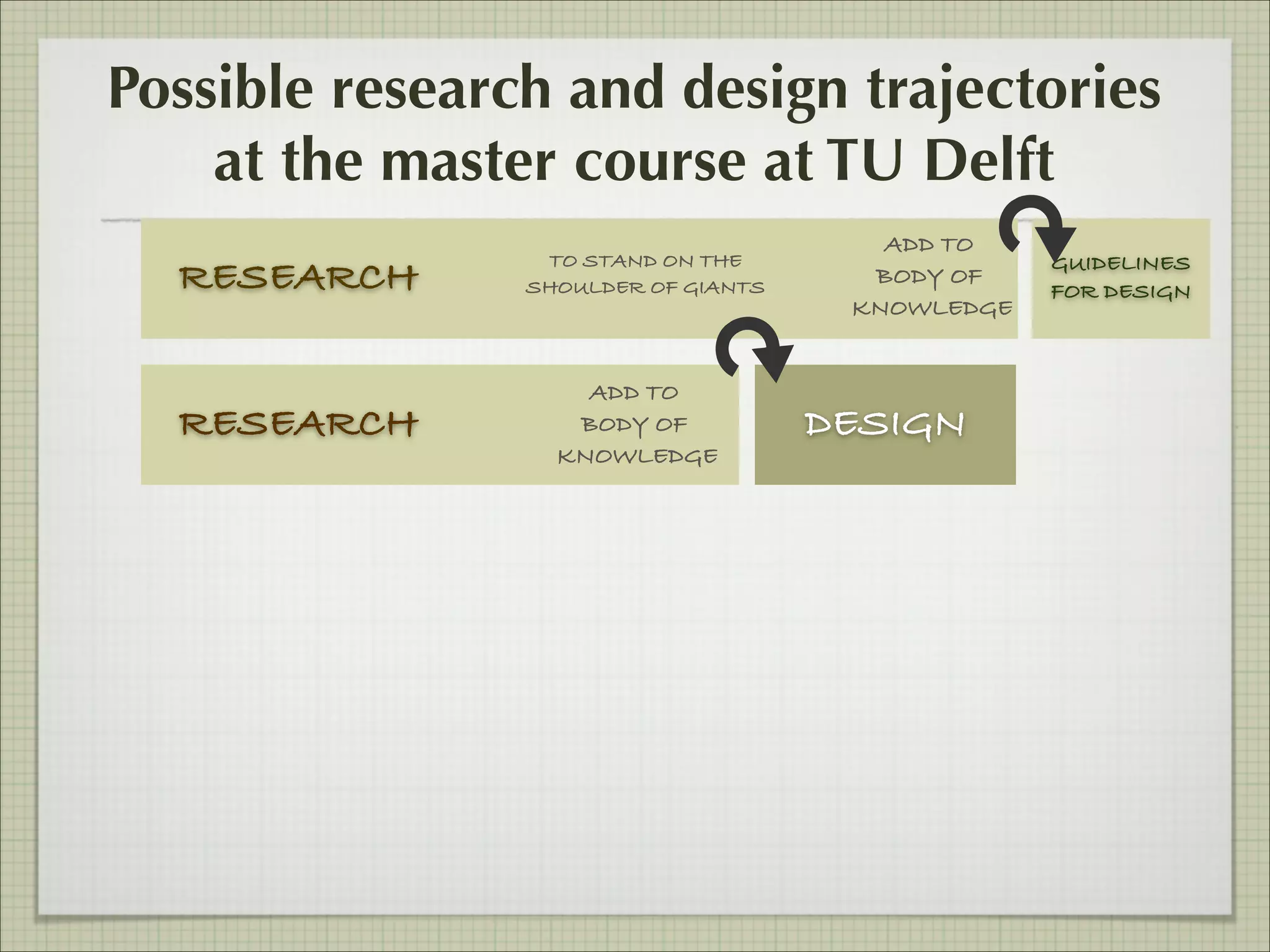
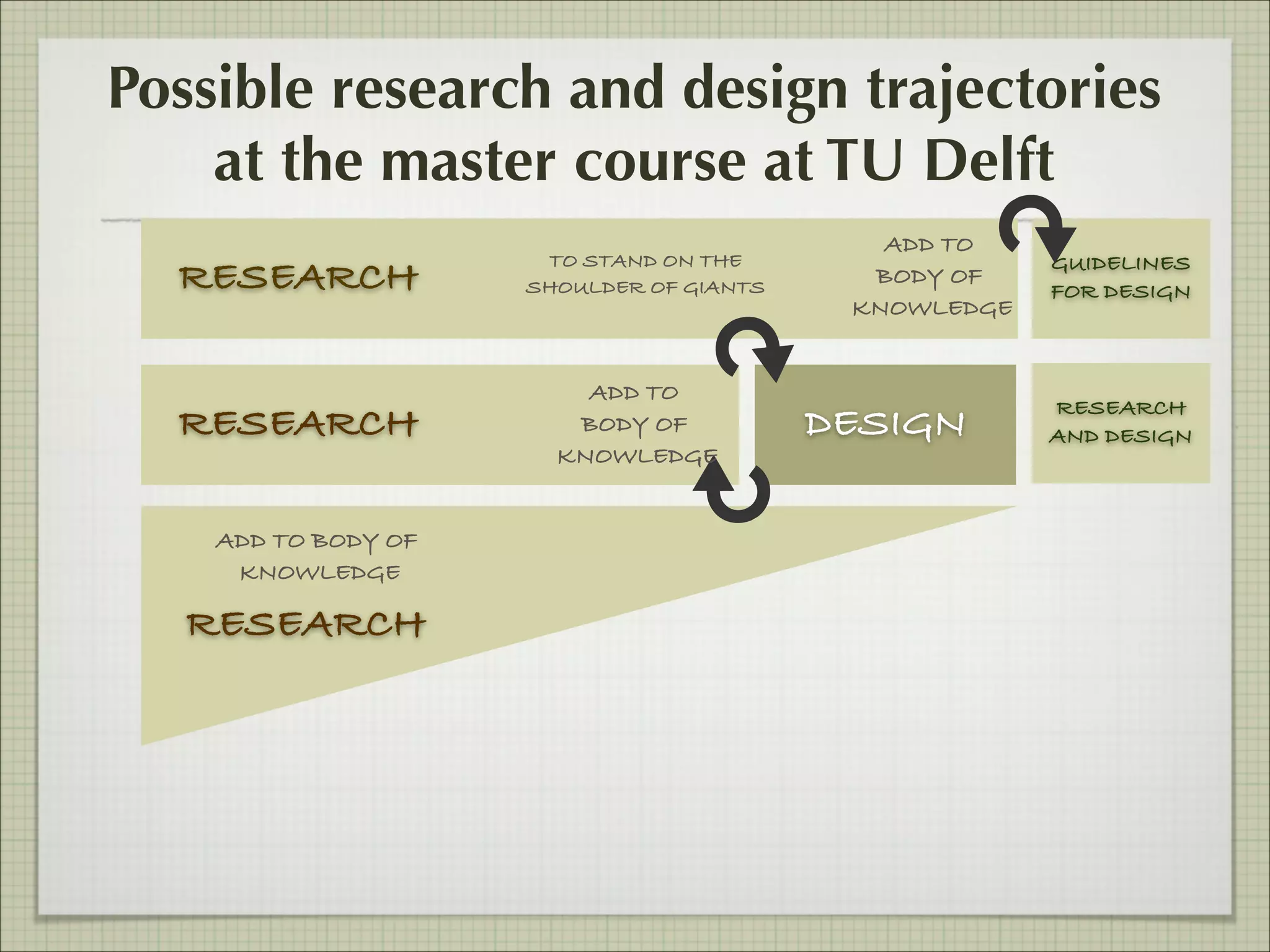
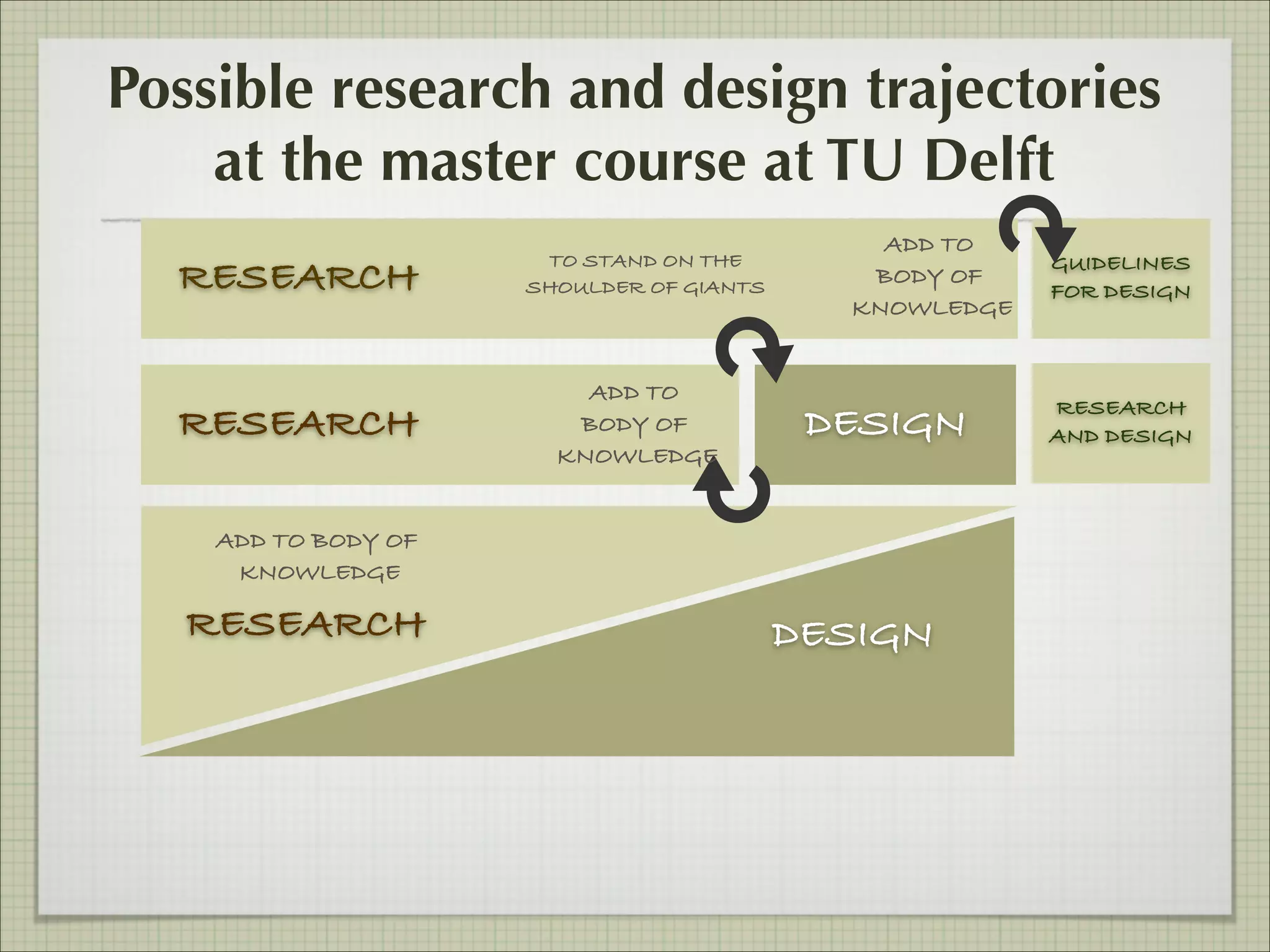
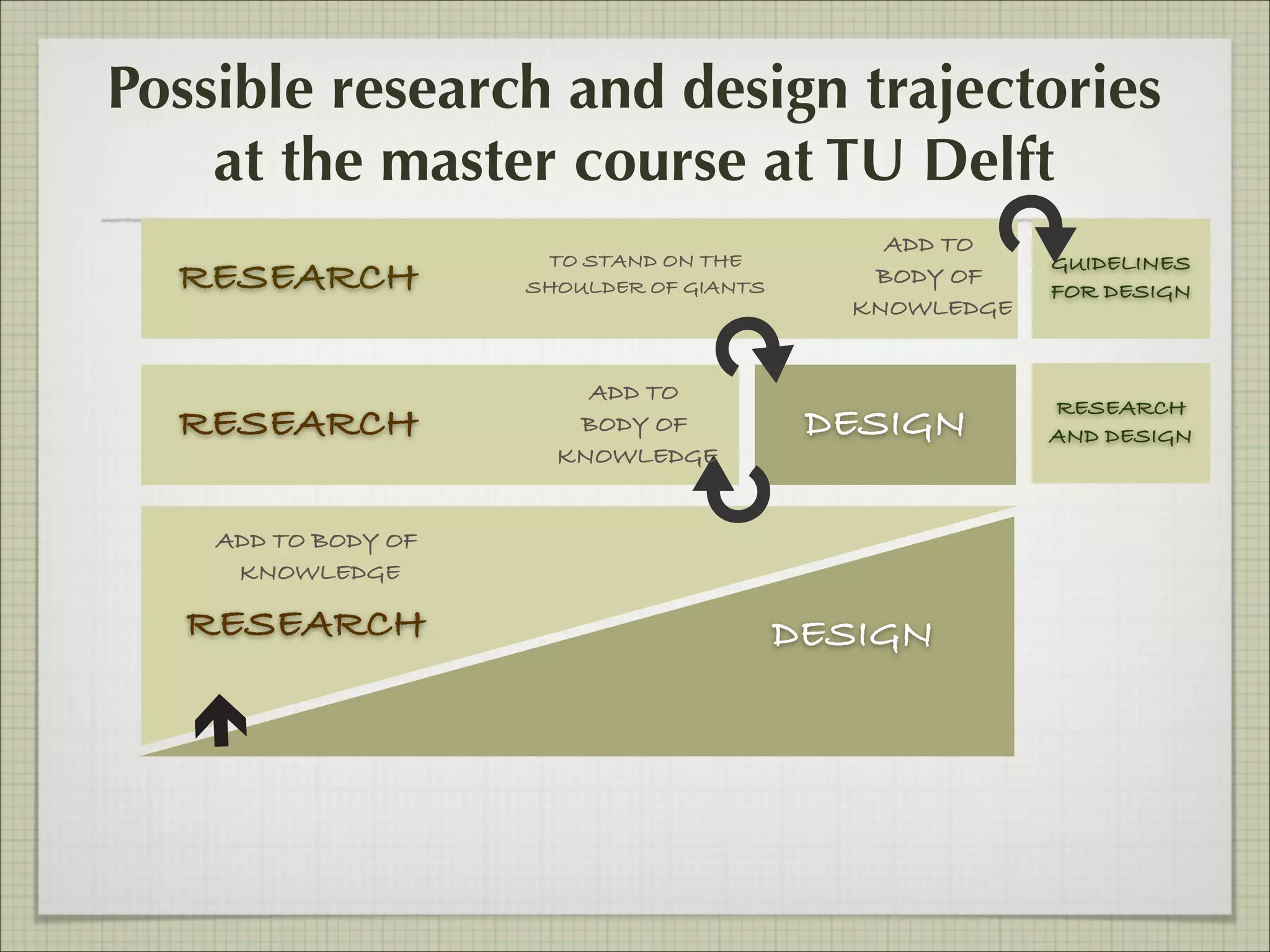
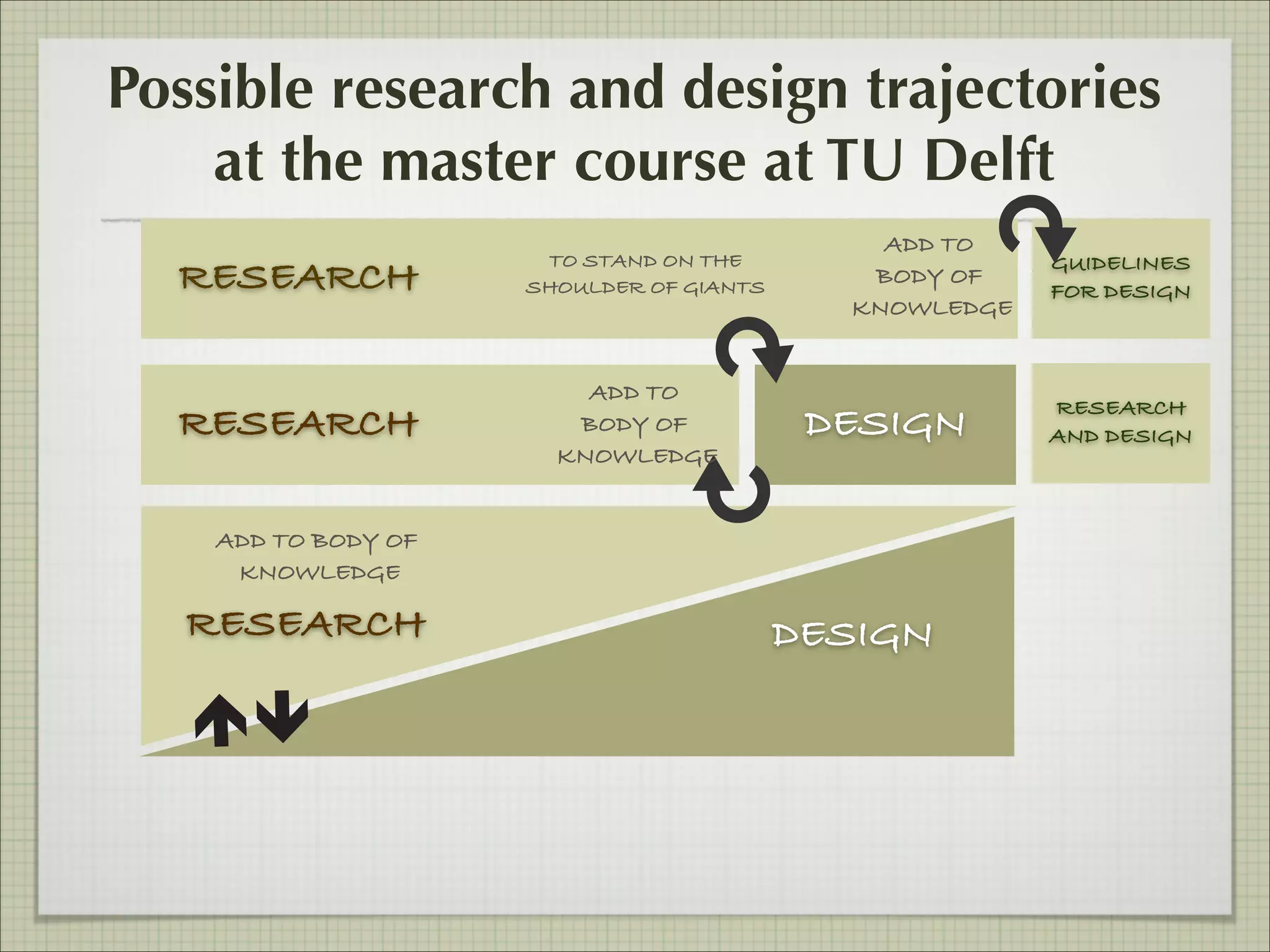
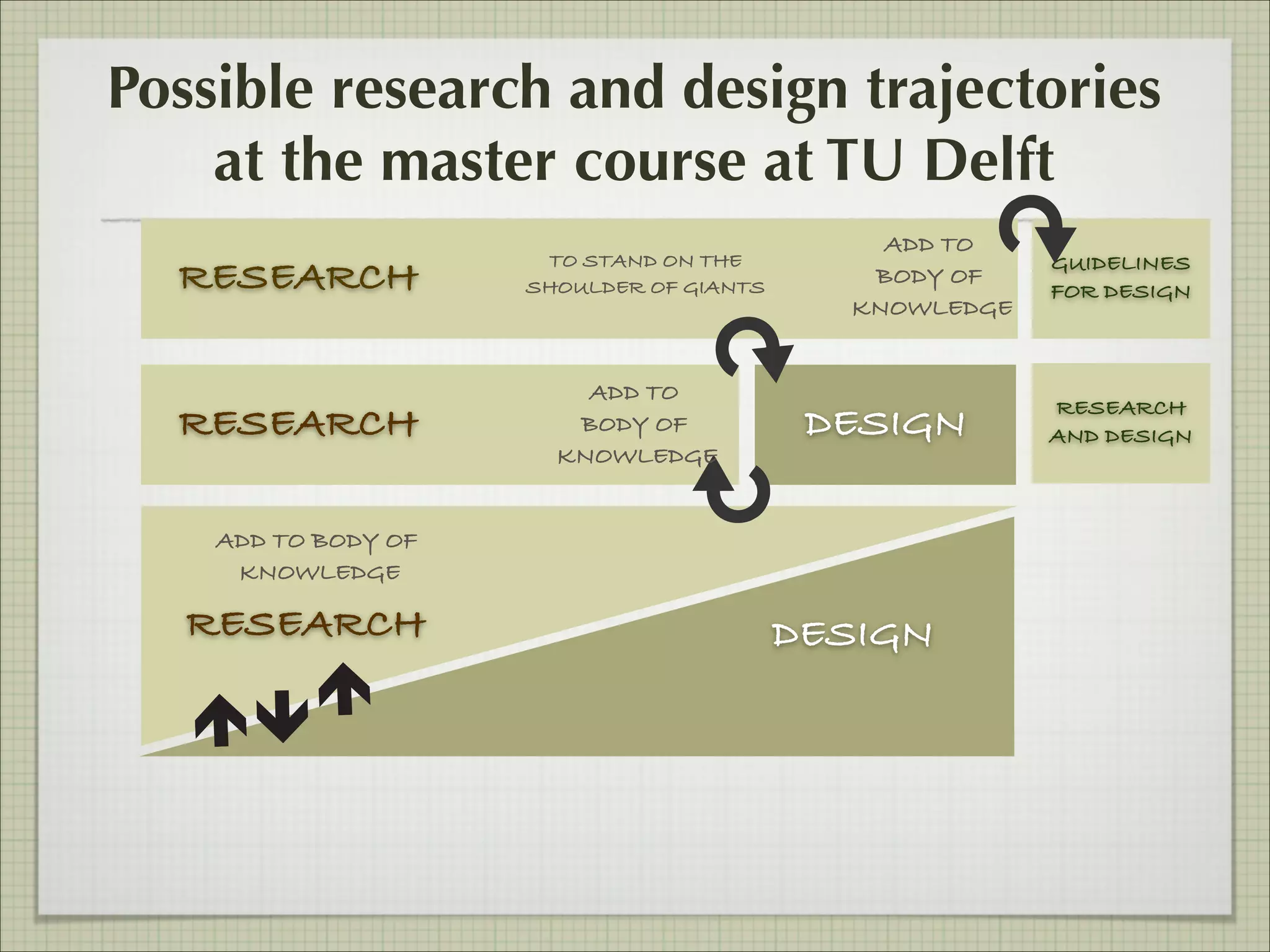
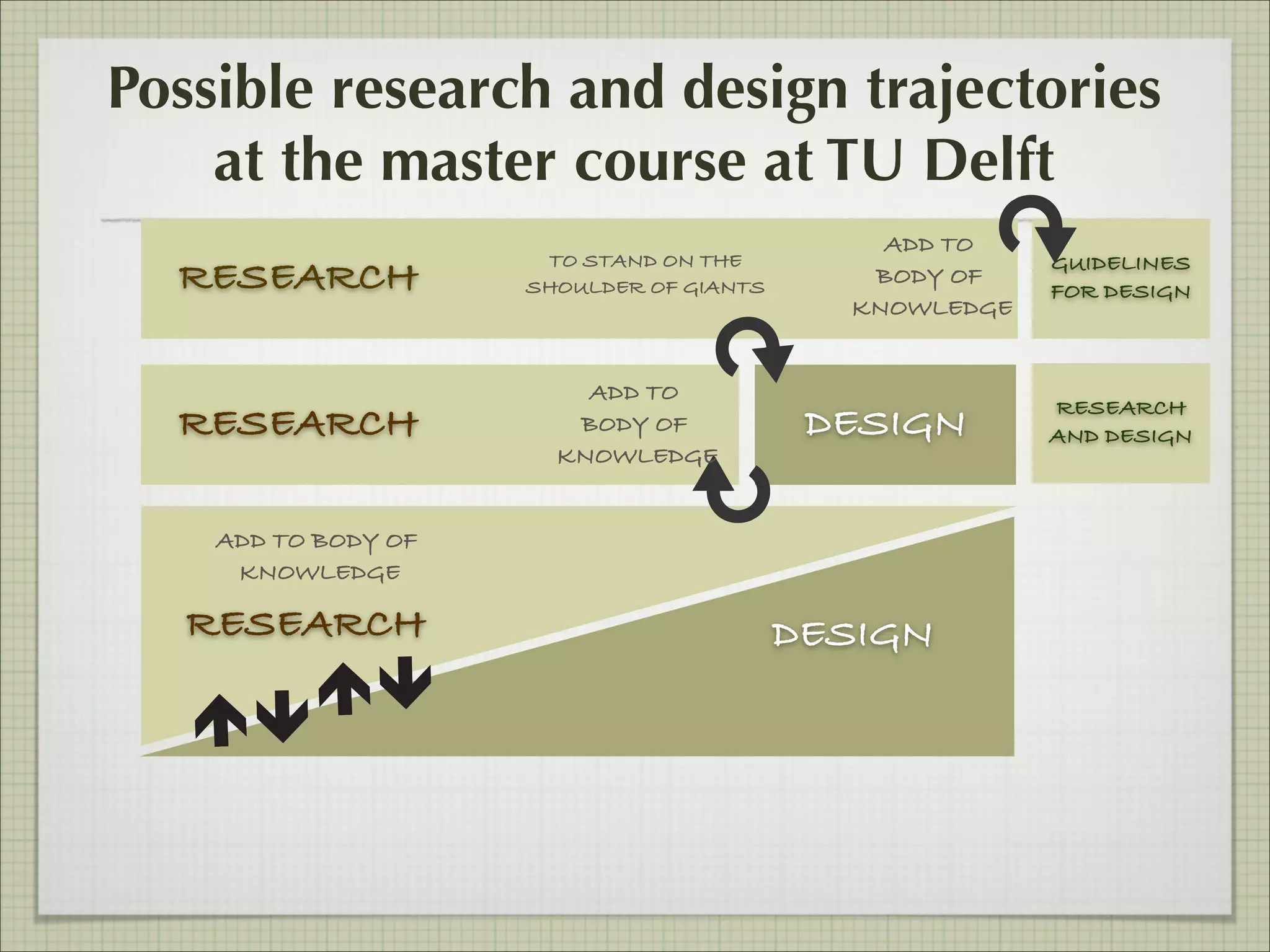
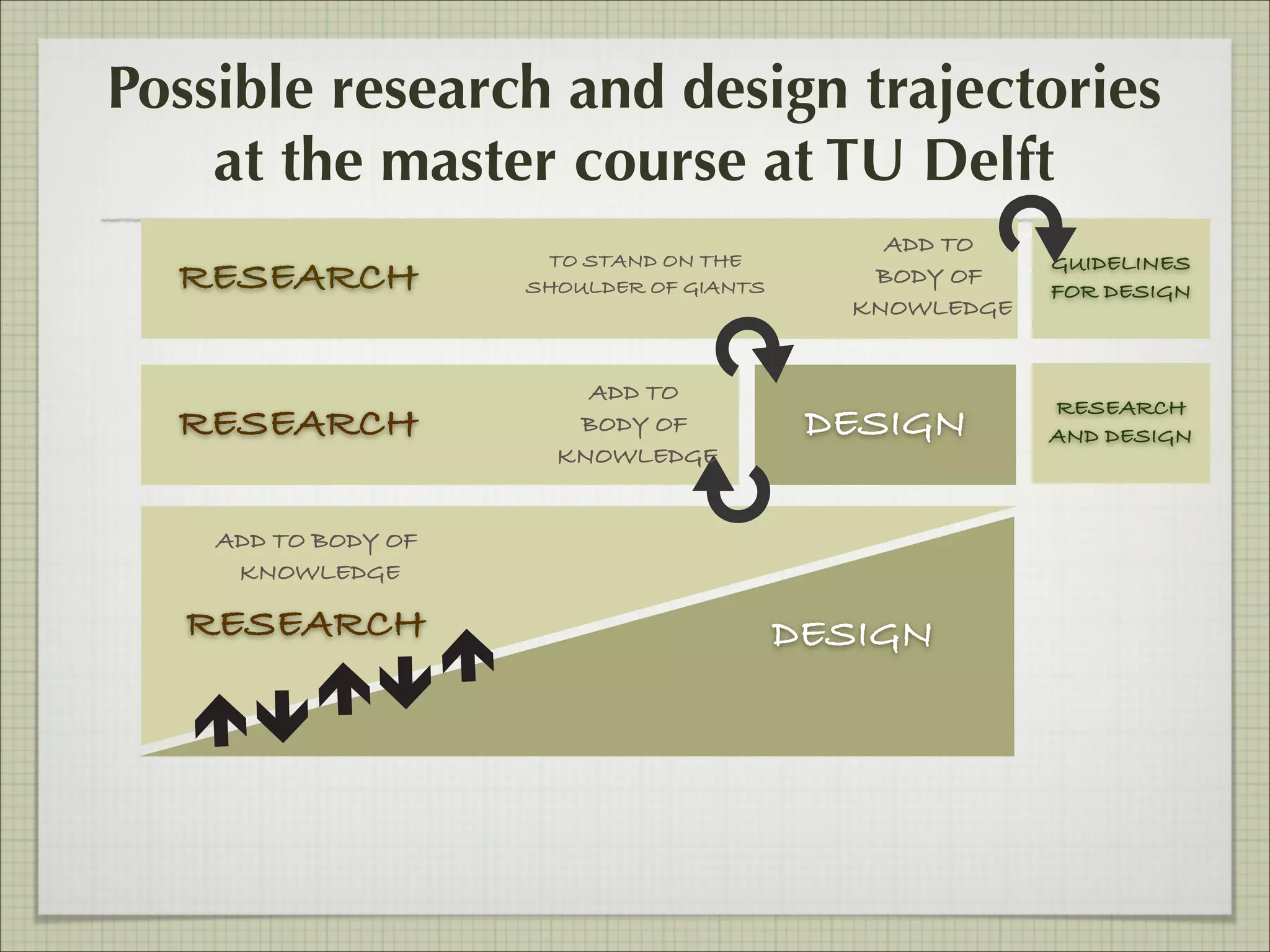
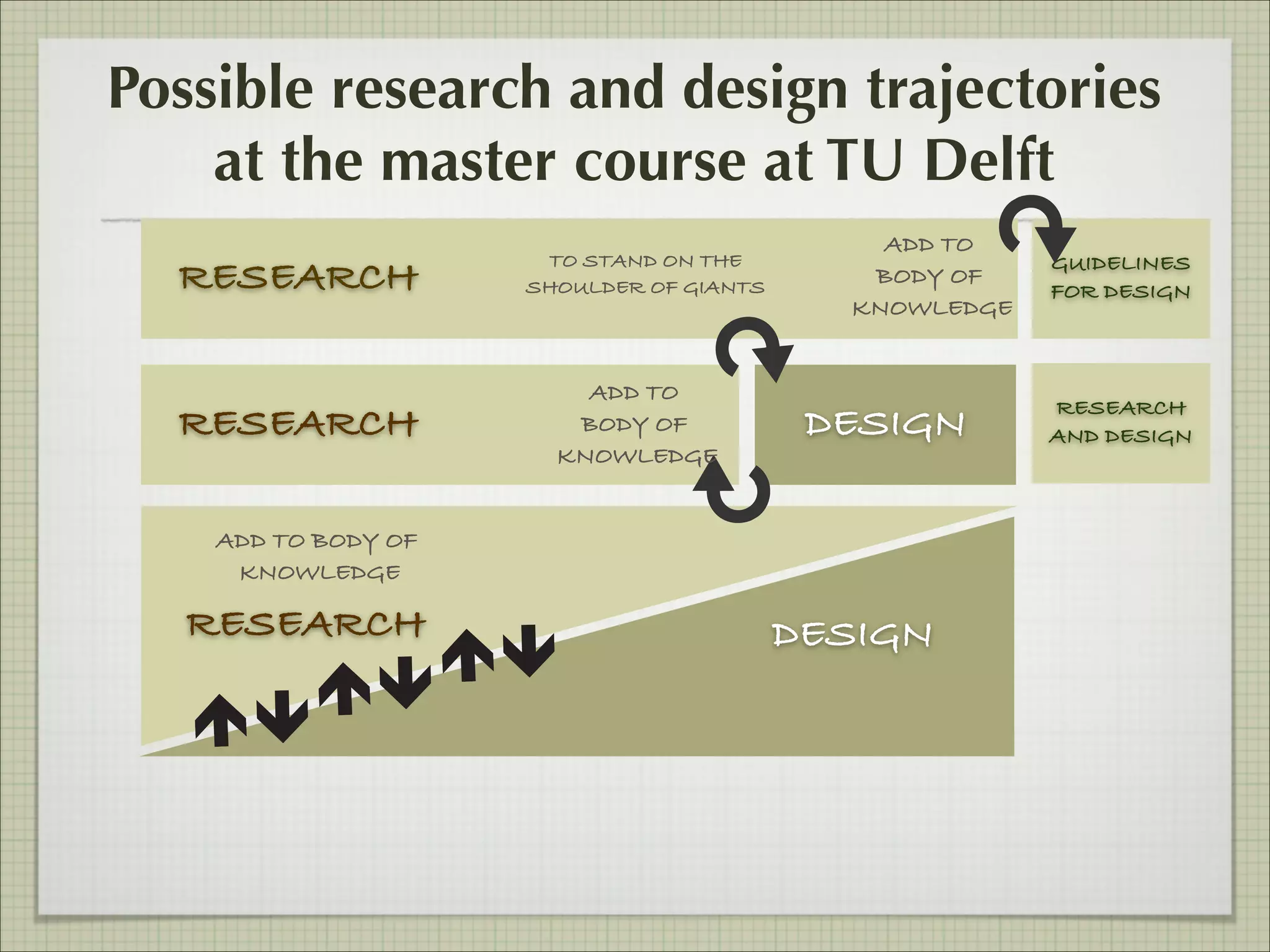
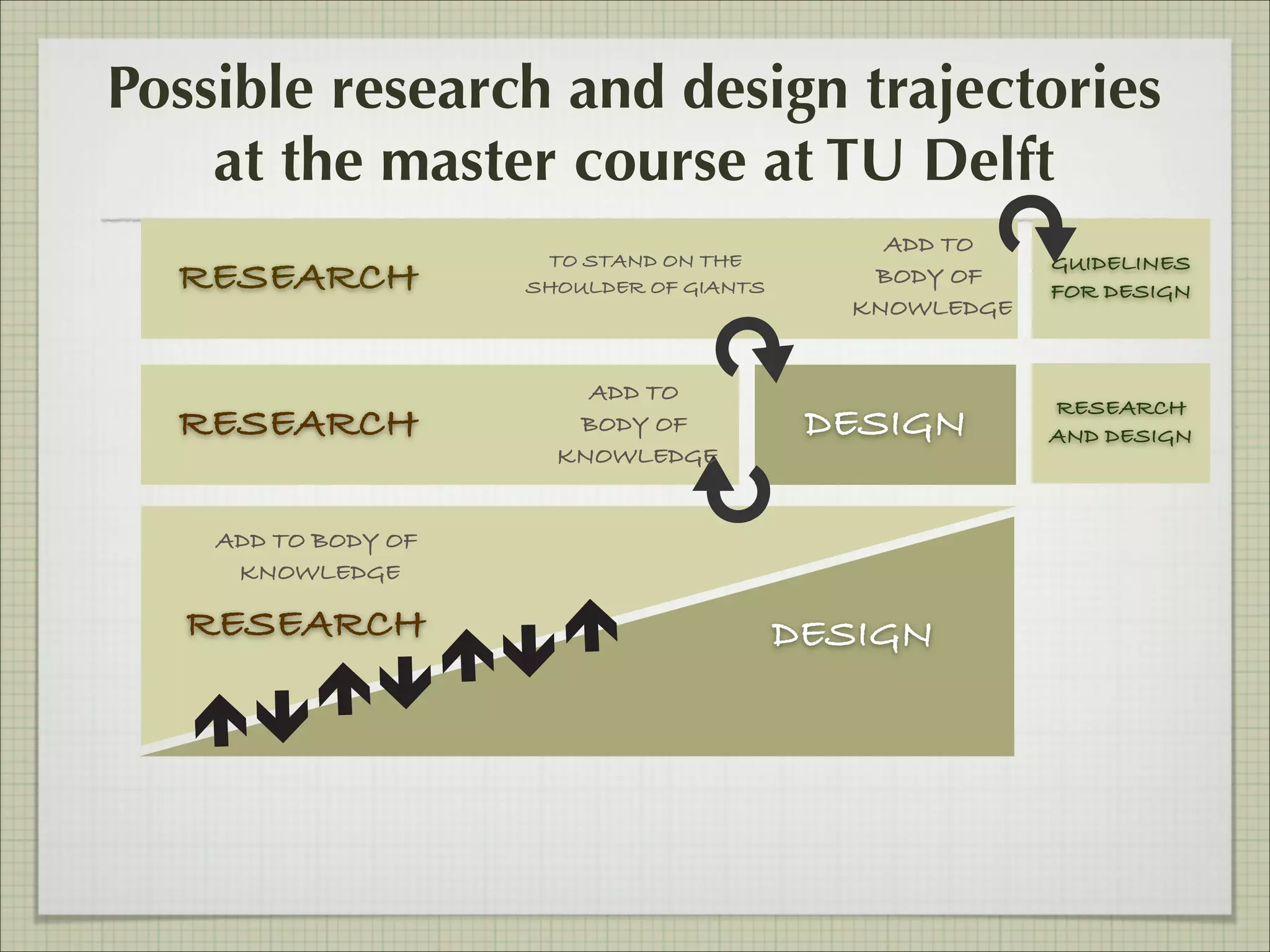
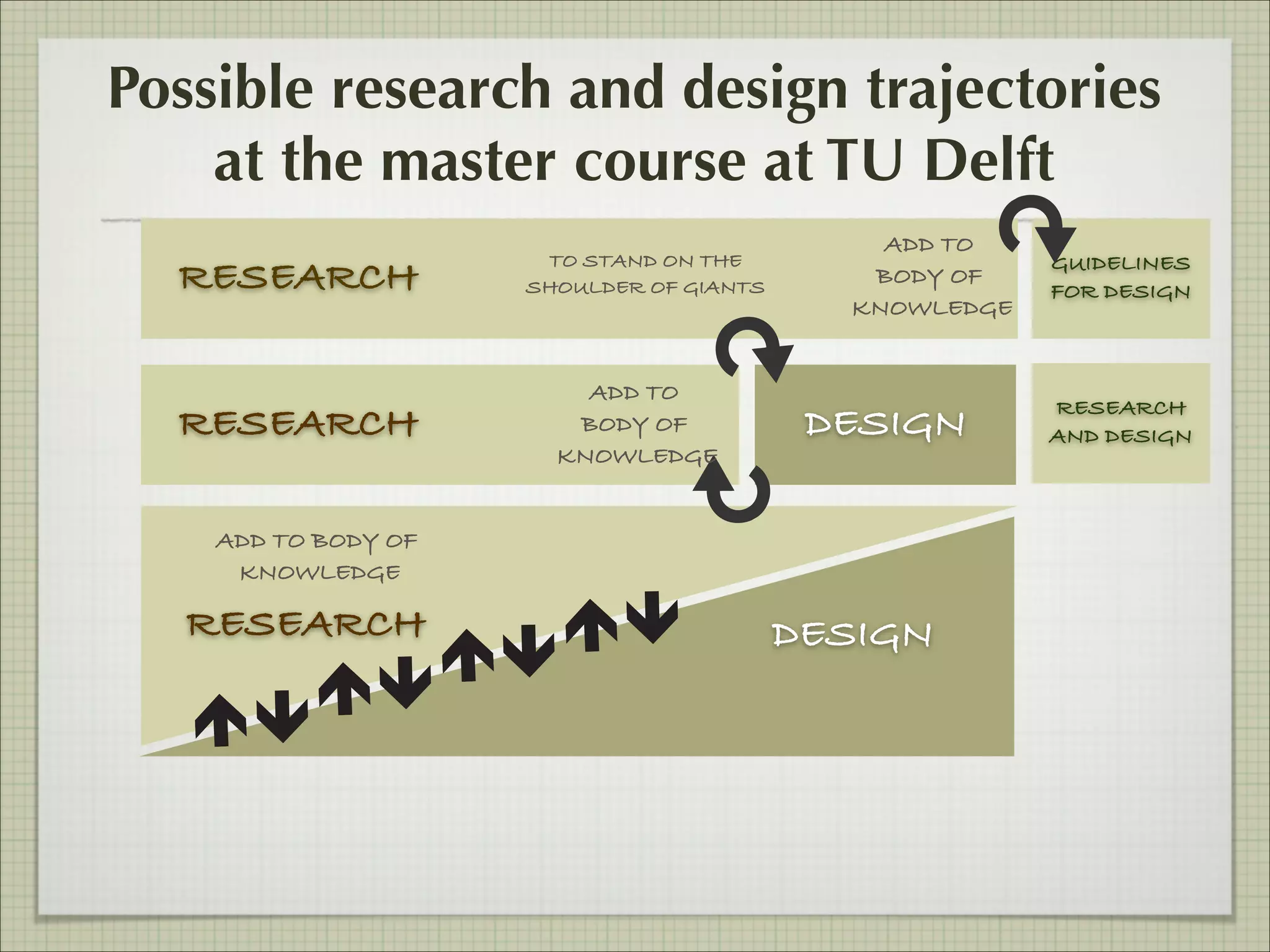
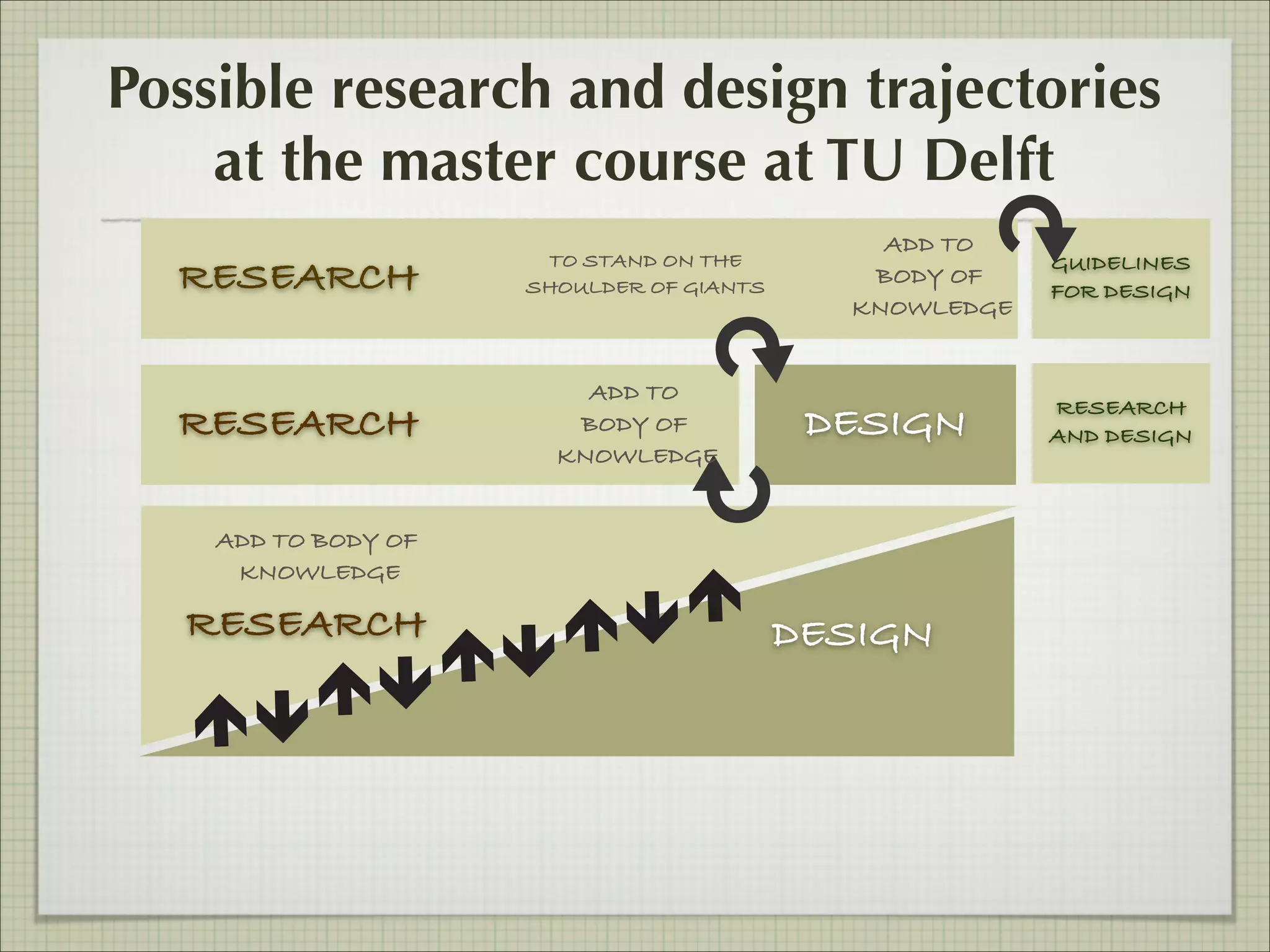
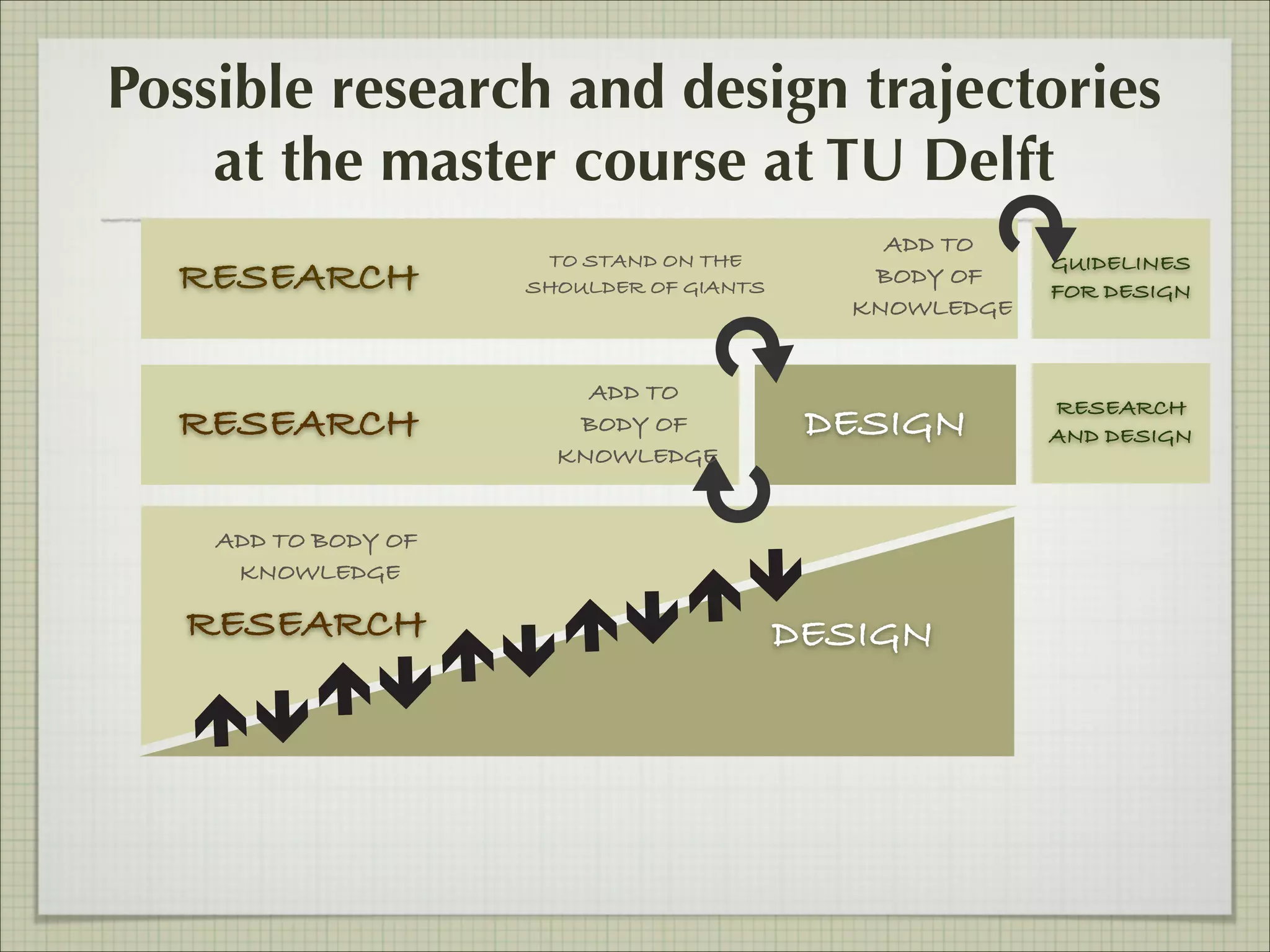
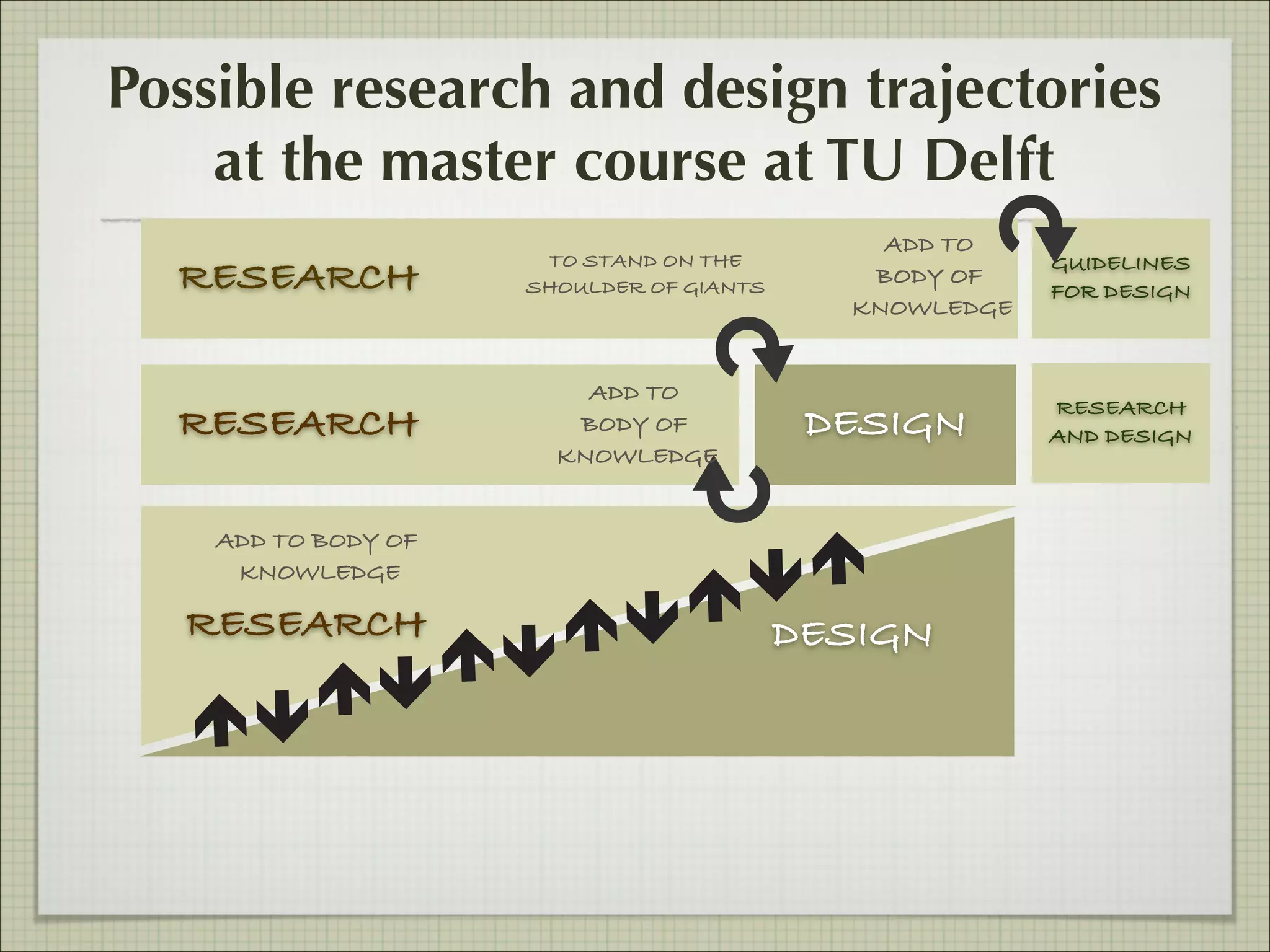
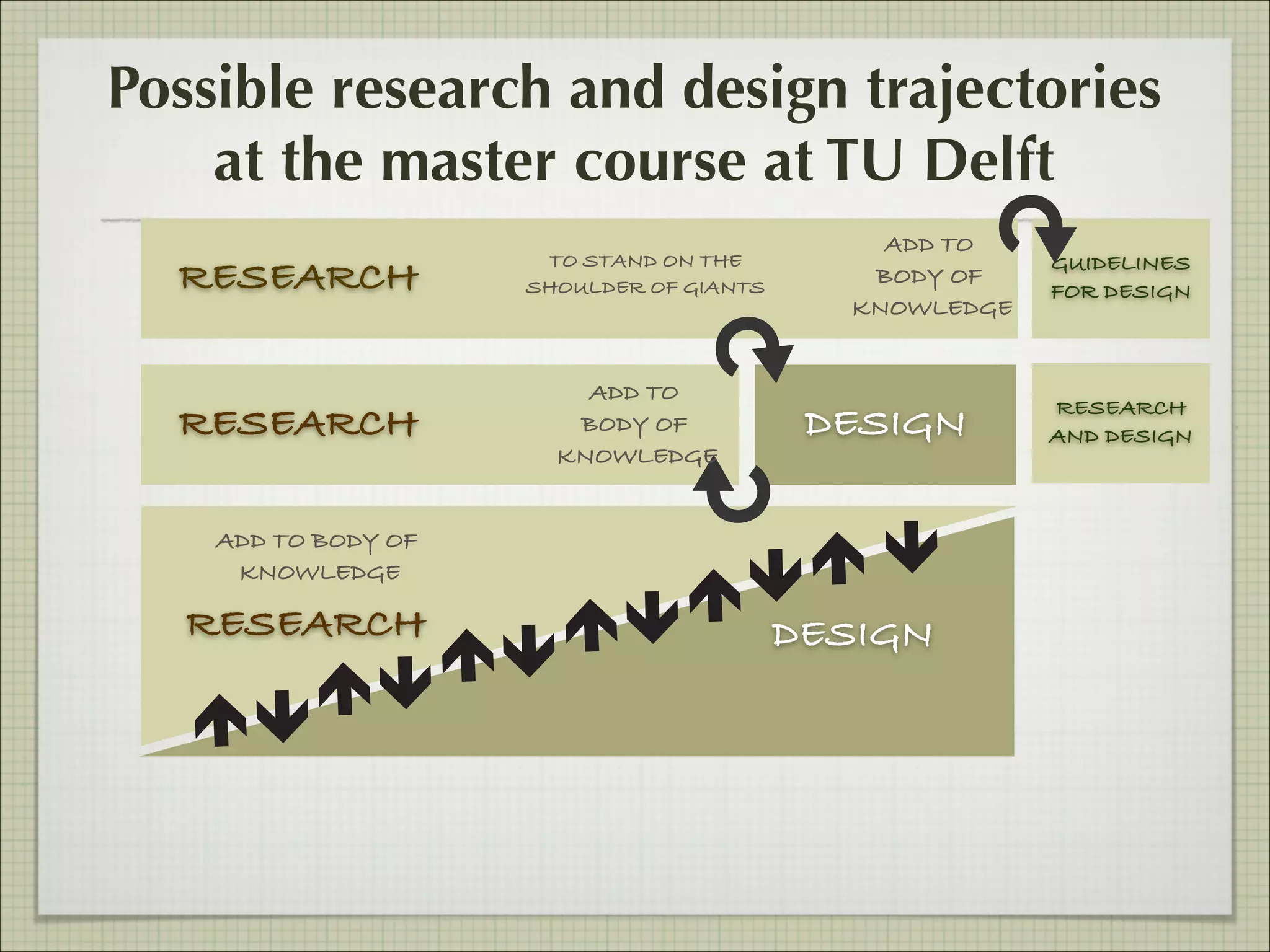
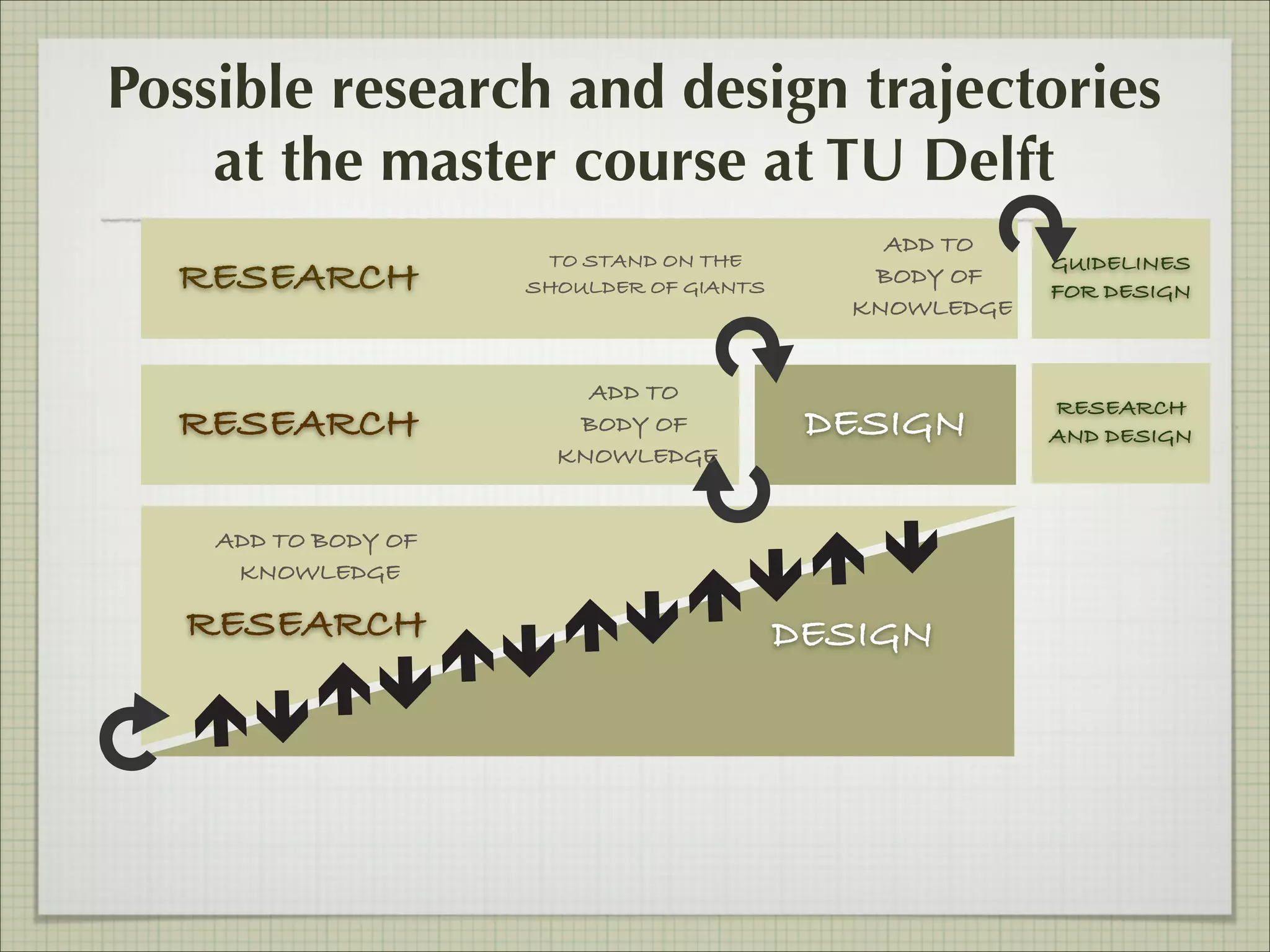
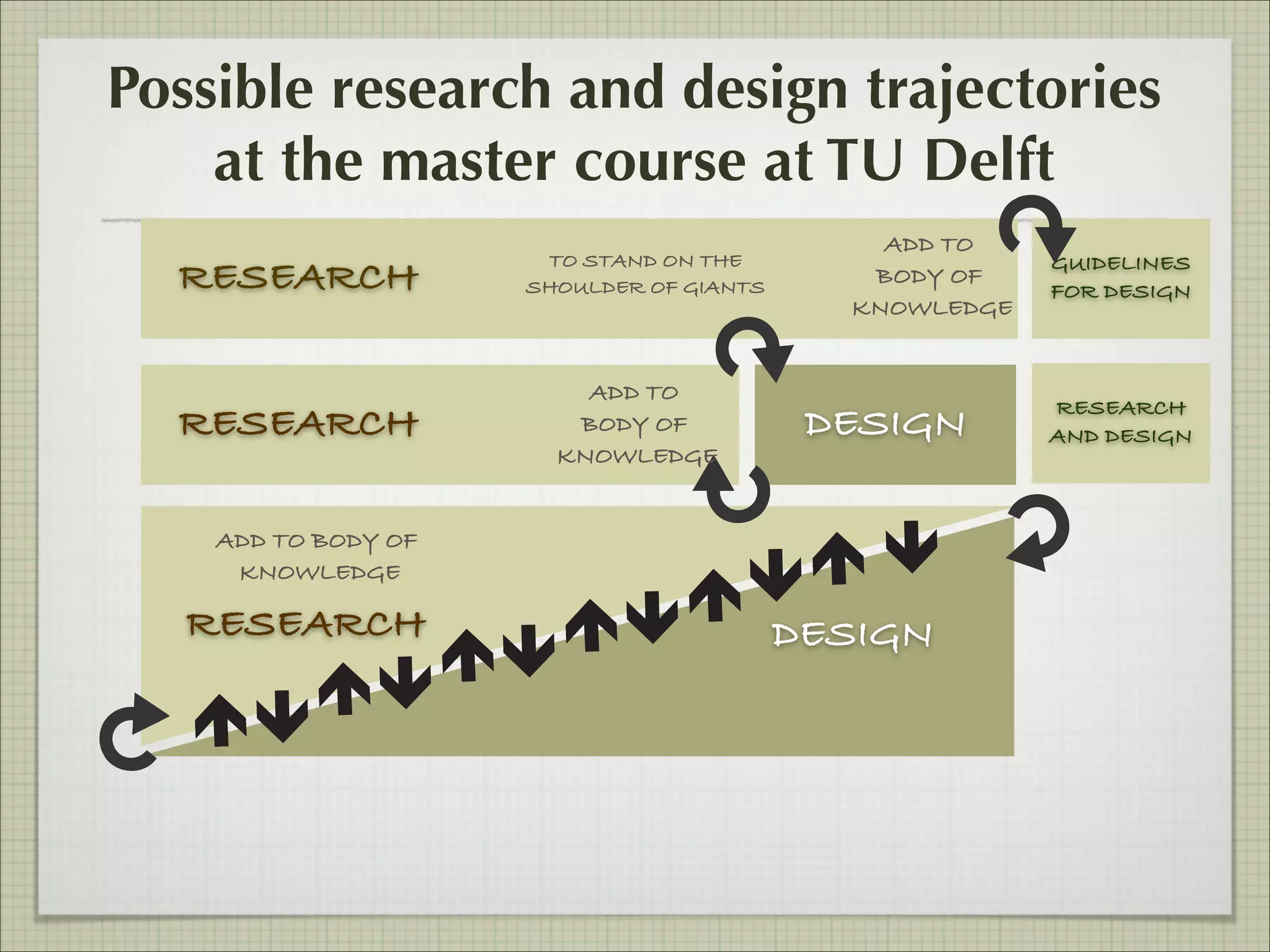
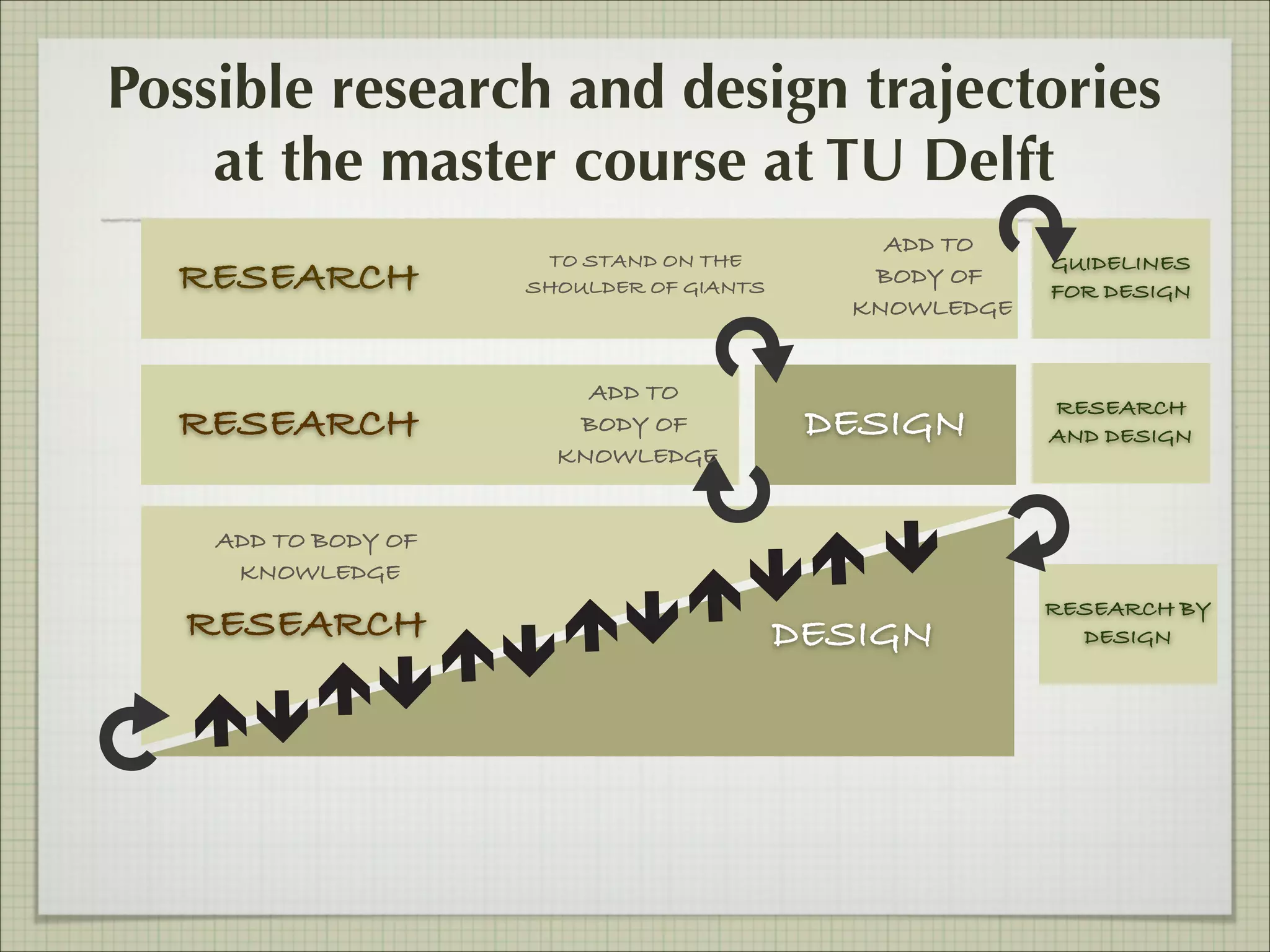
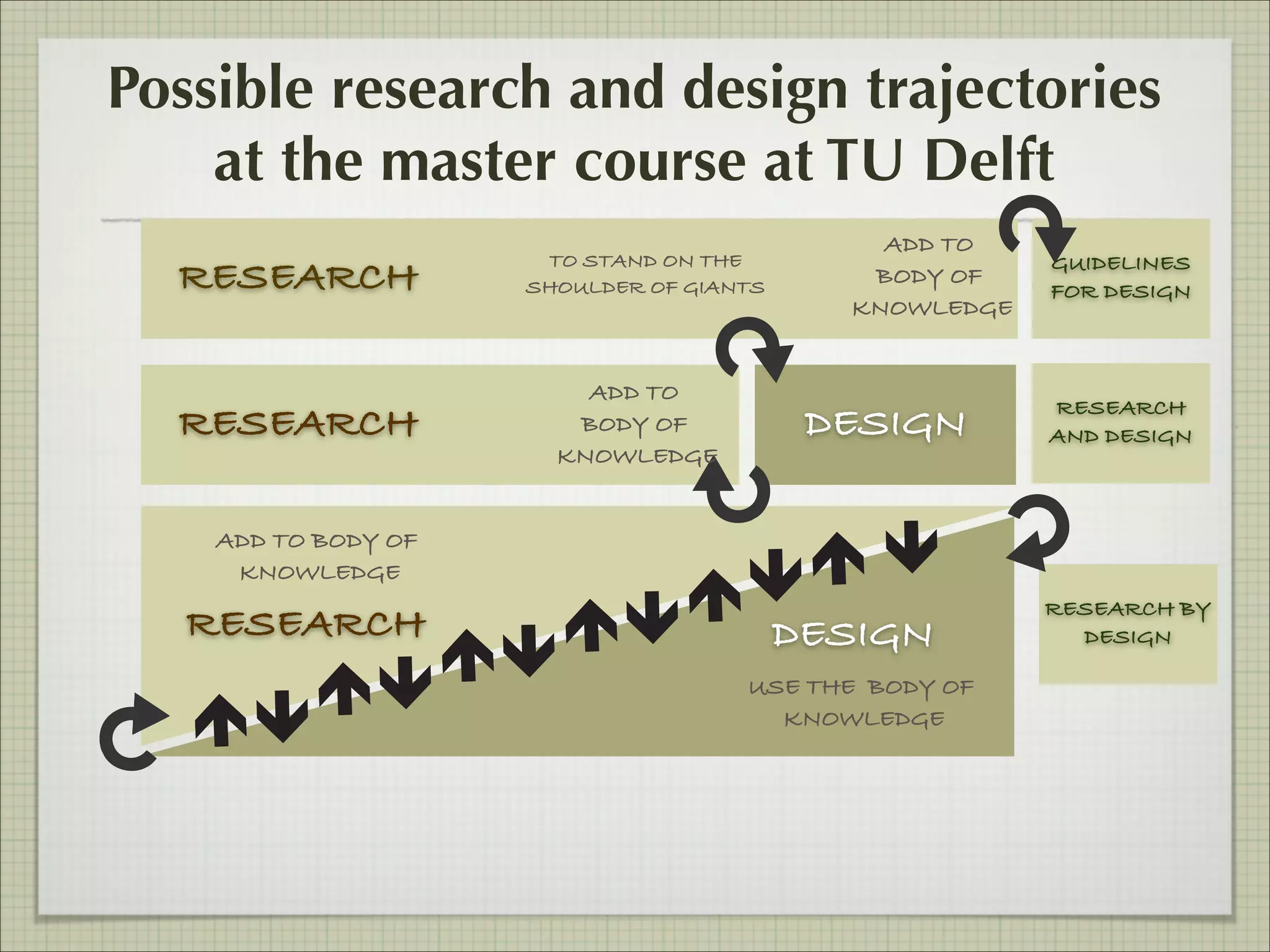
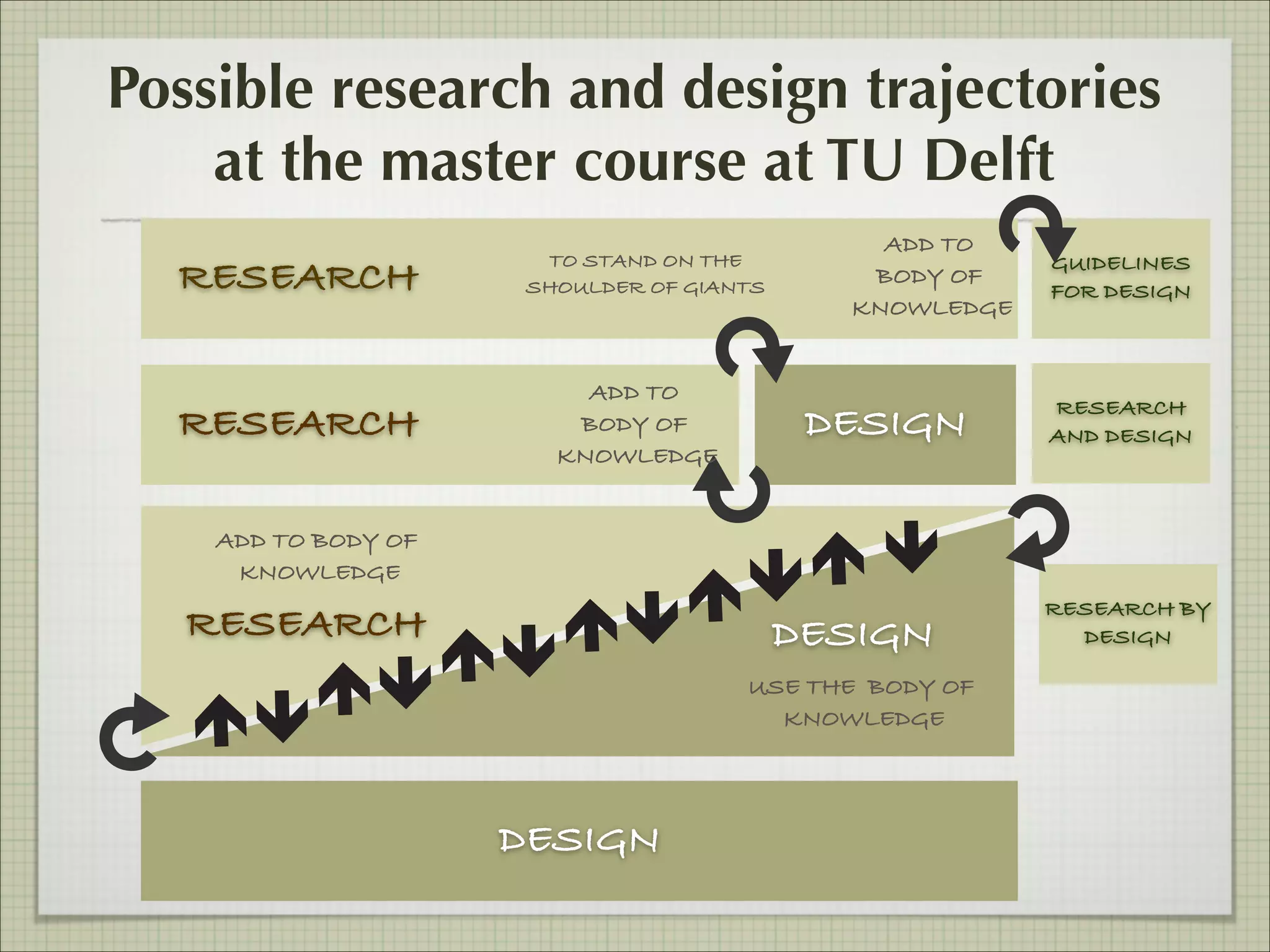
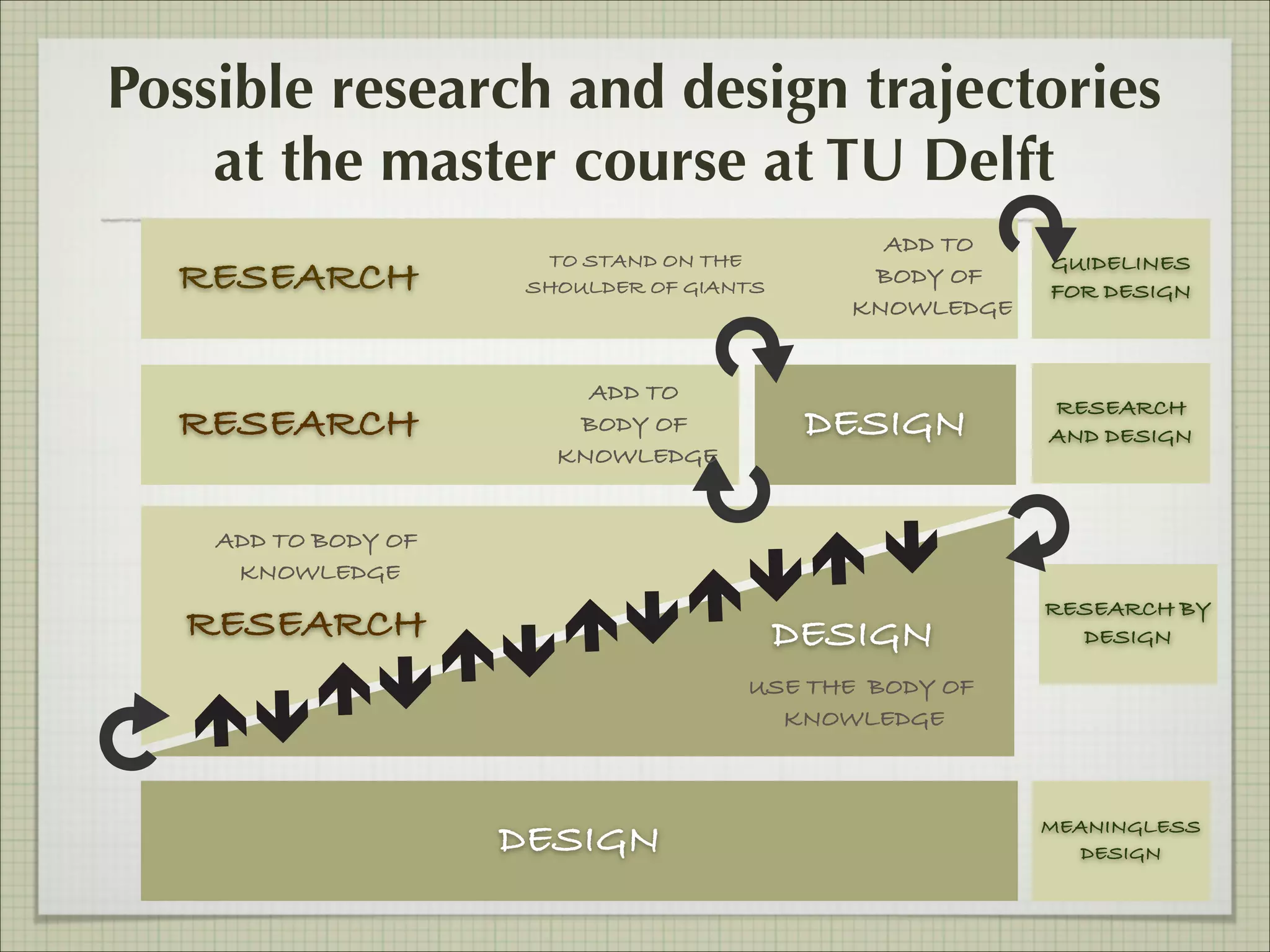
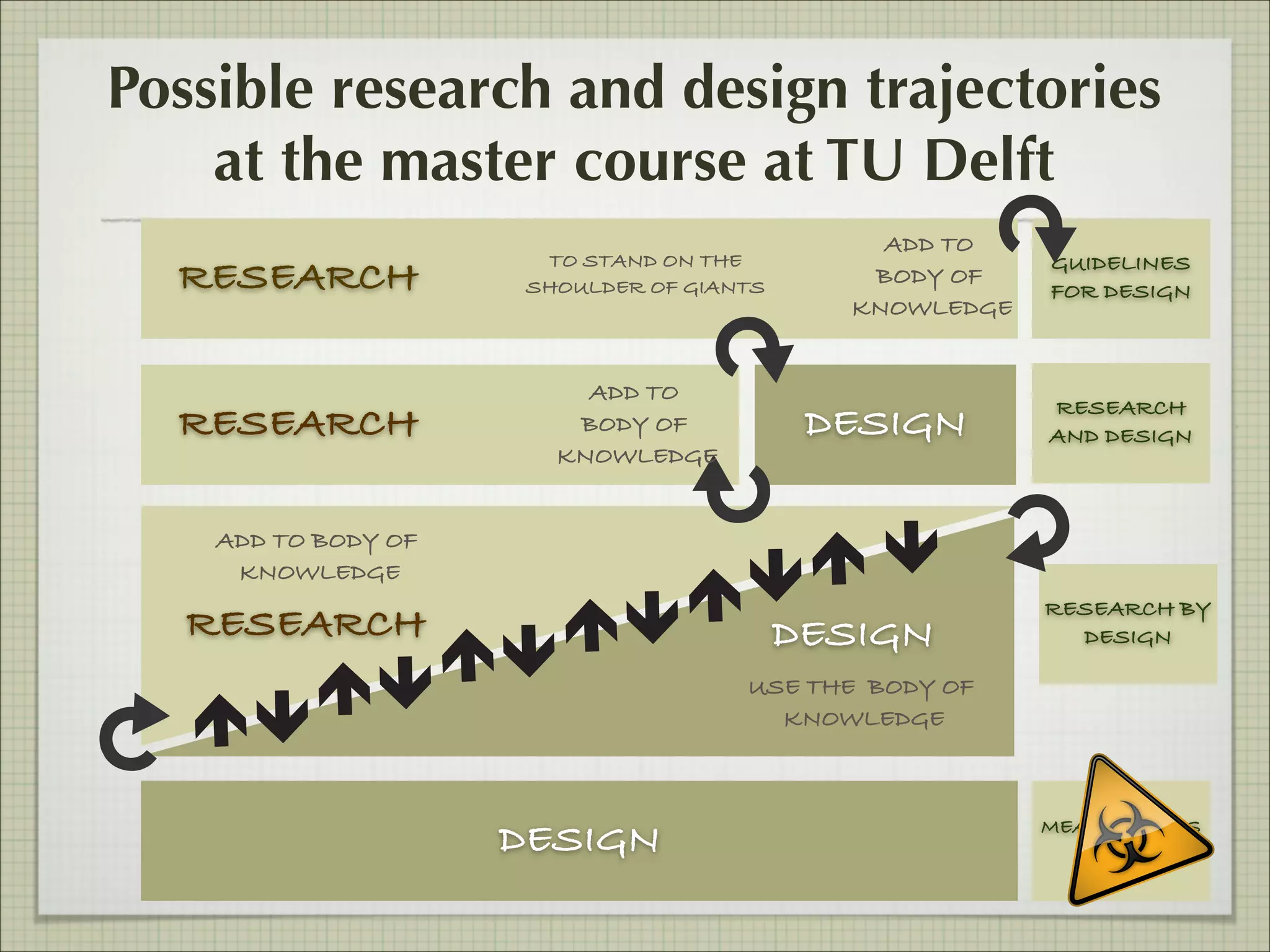
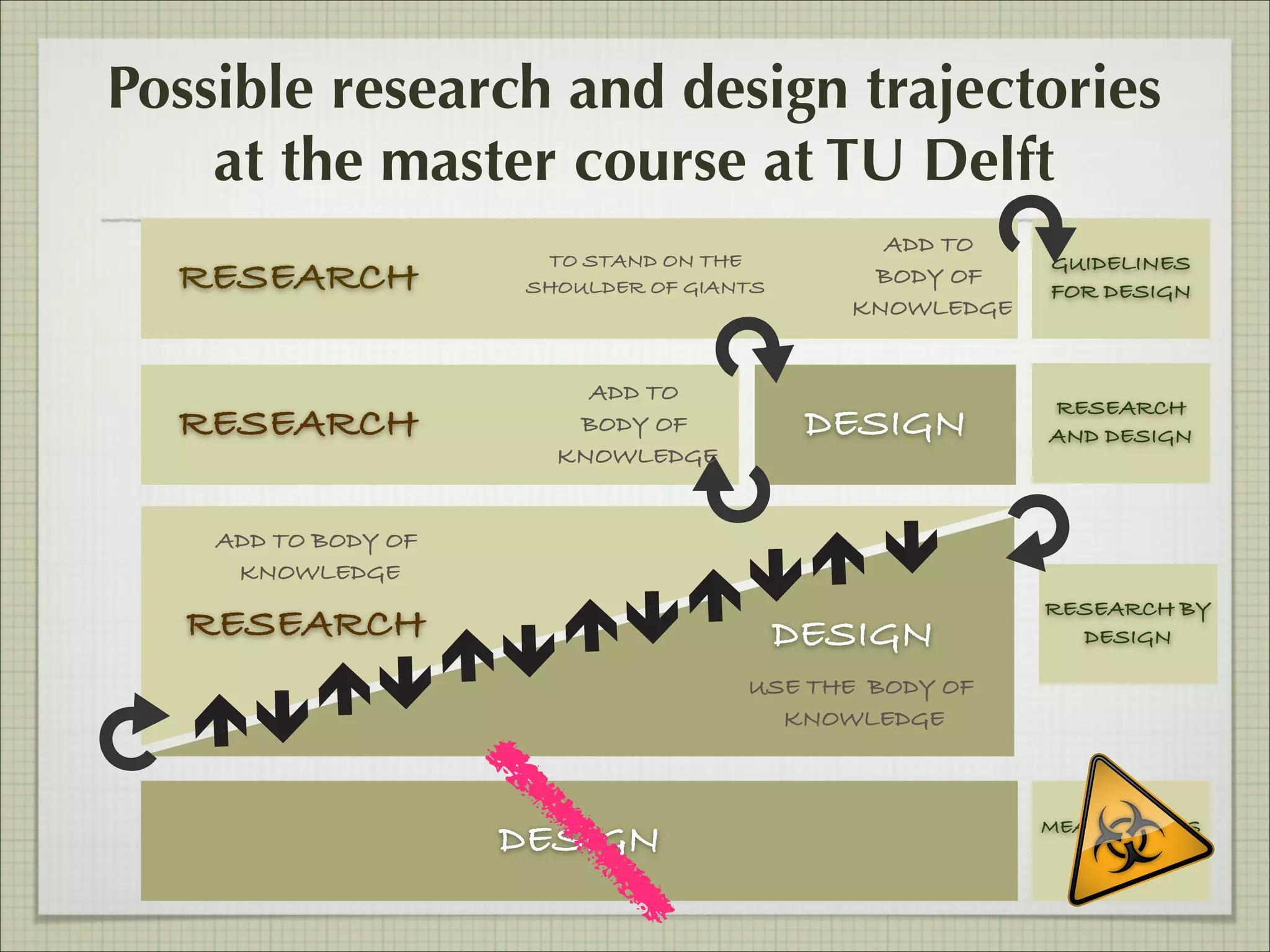
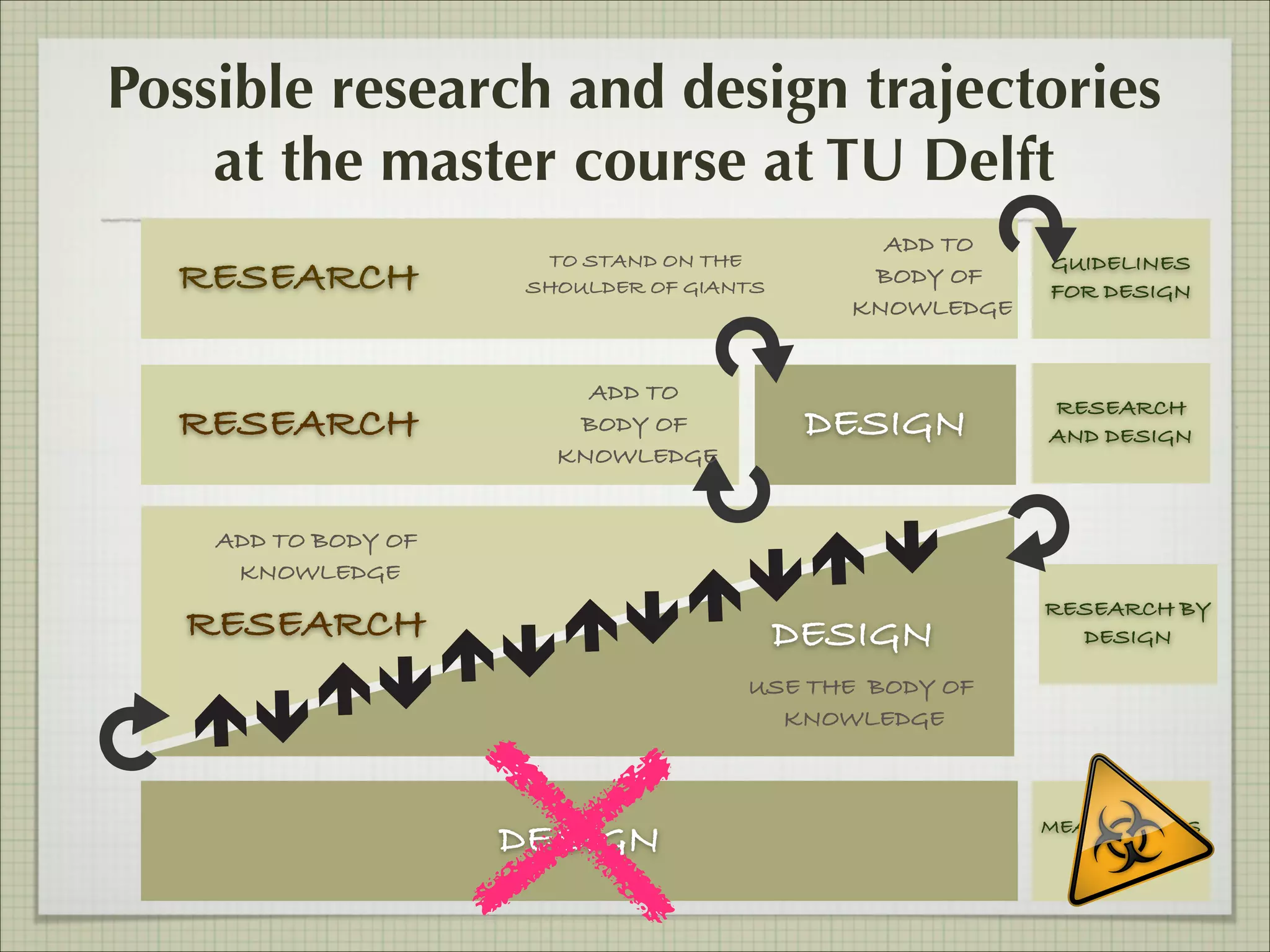
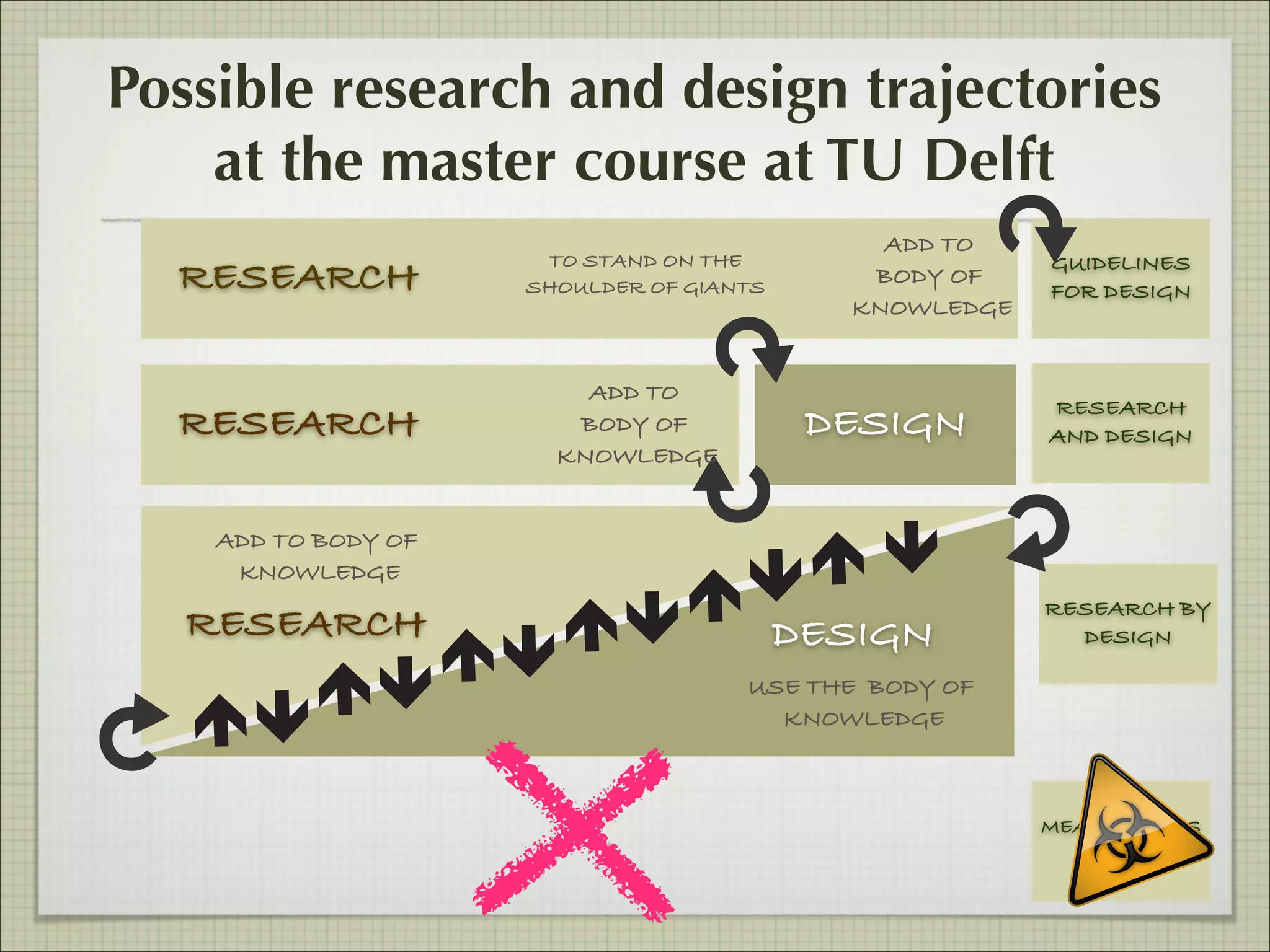
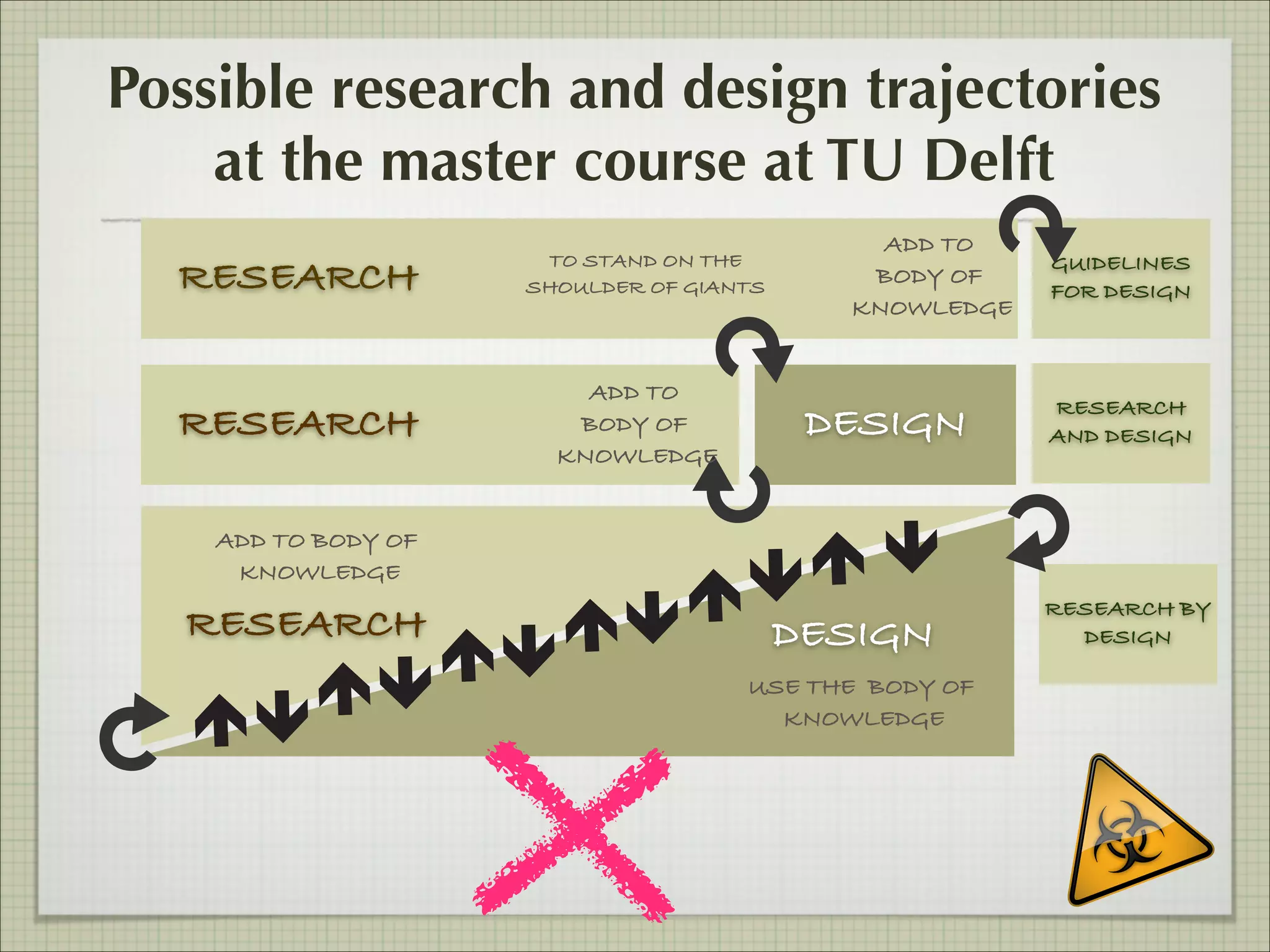
Possible research and design trajectories
at the master course at TU Delft
Possible research and design trajectories
at the master course at TU Delft
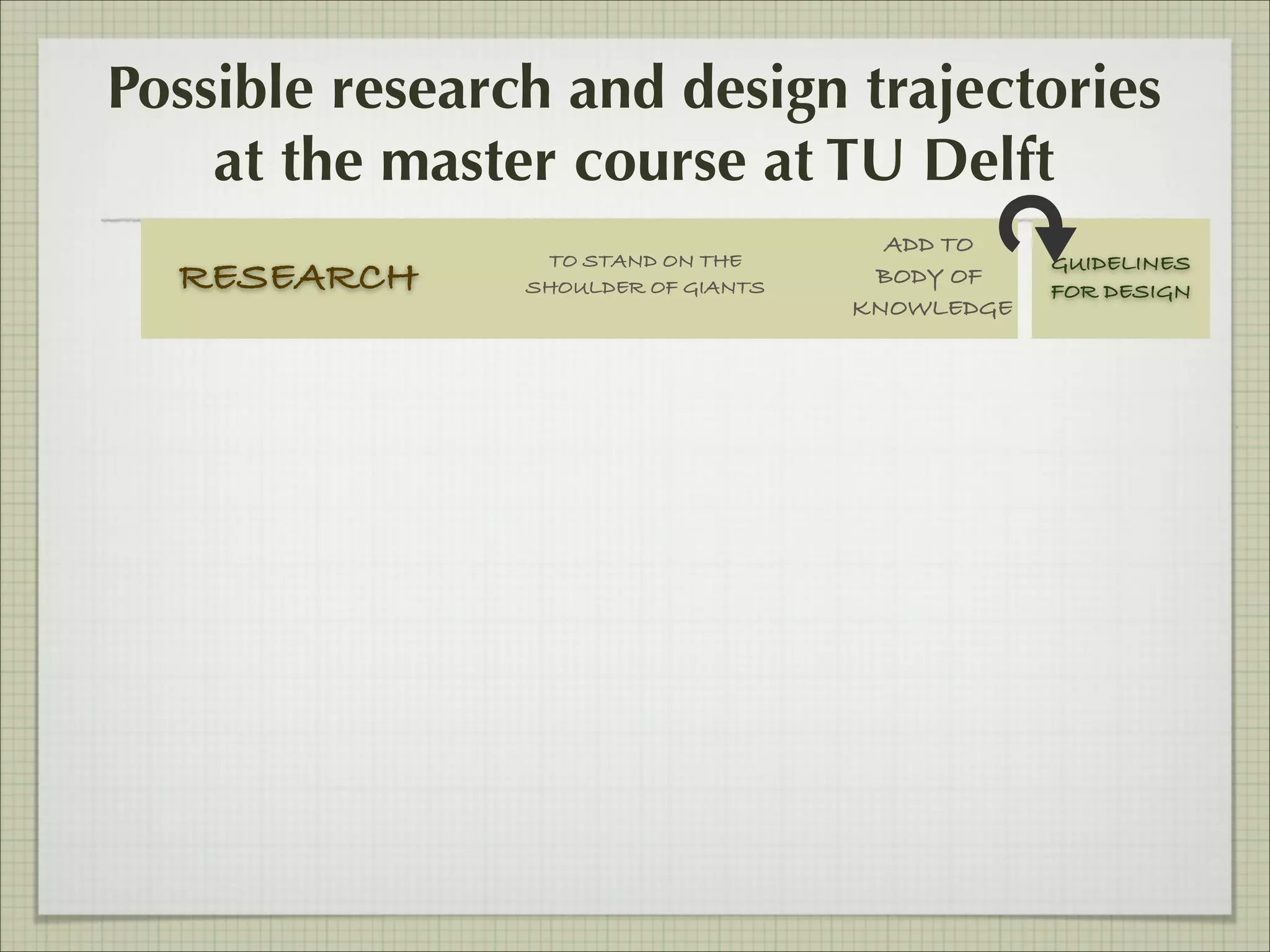
RESEARCH
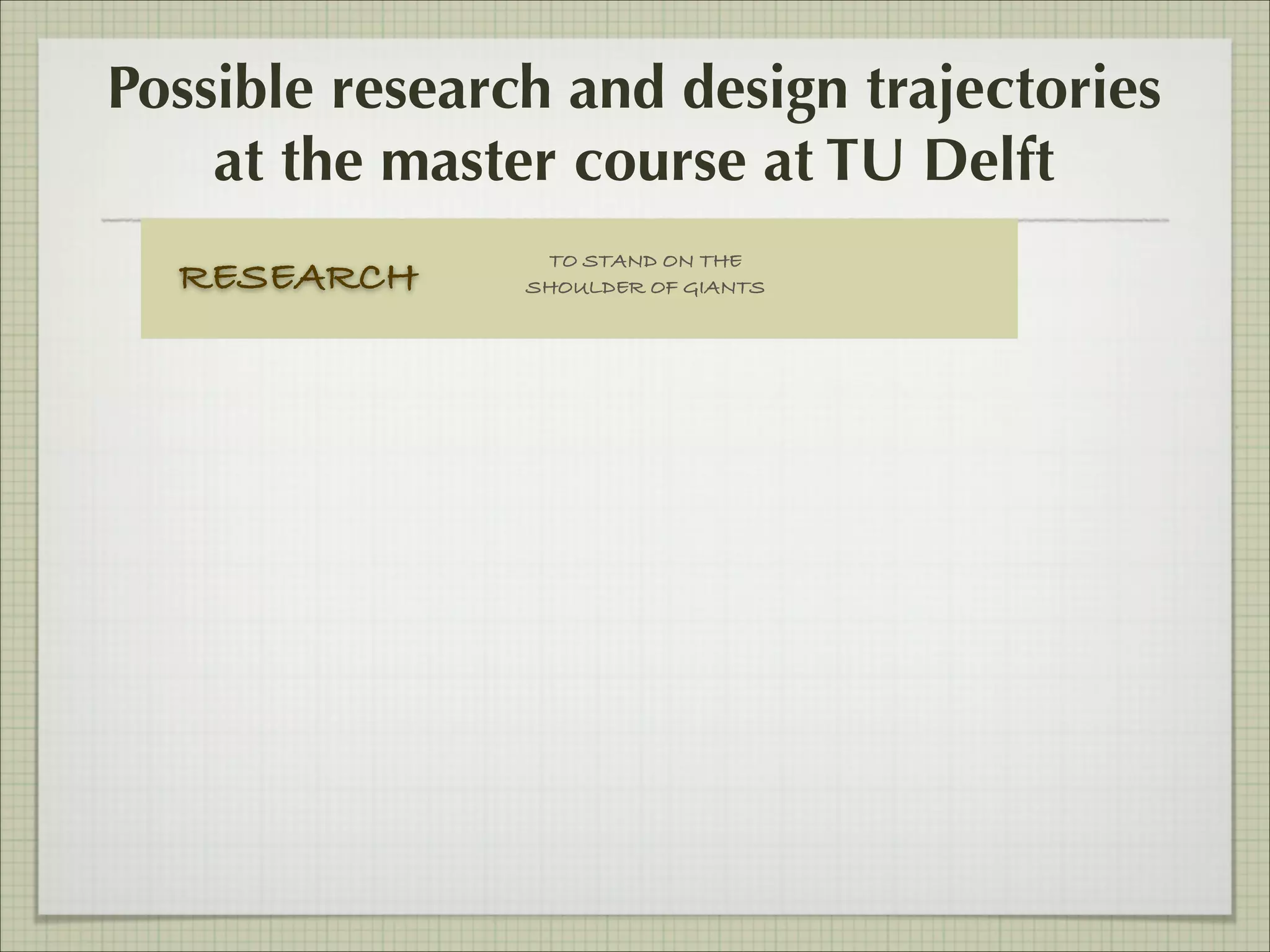
Possible research and design trajectories
at the master course at TU Delft
RESEARCH

TO STAND ON THE
SHOULDER OF GIANTS
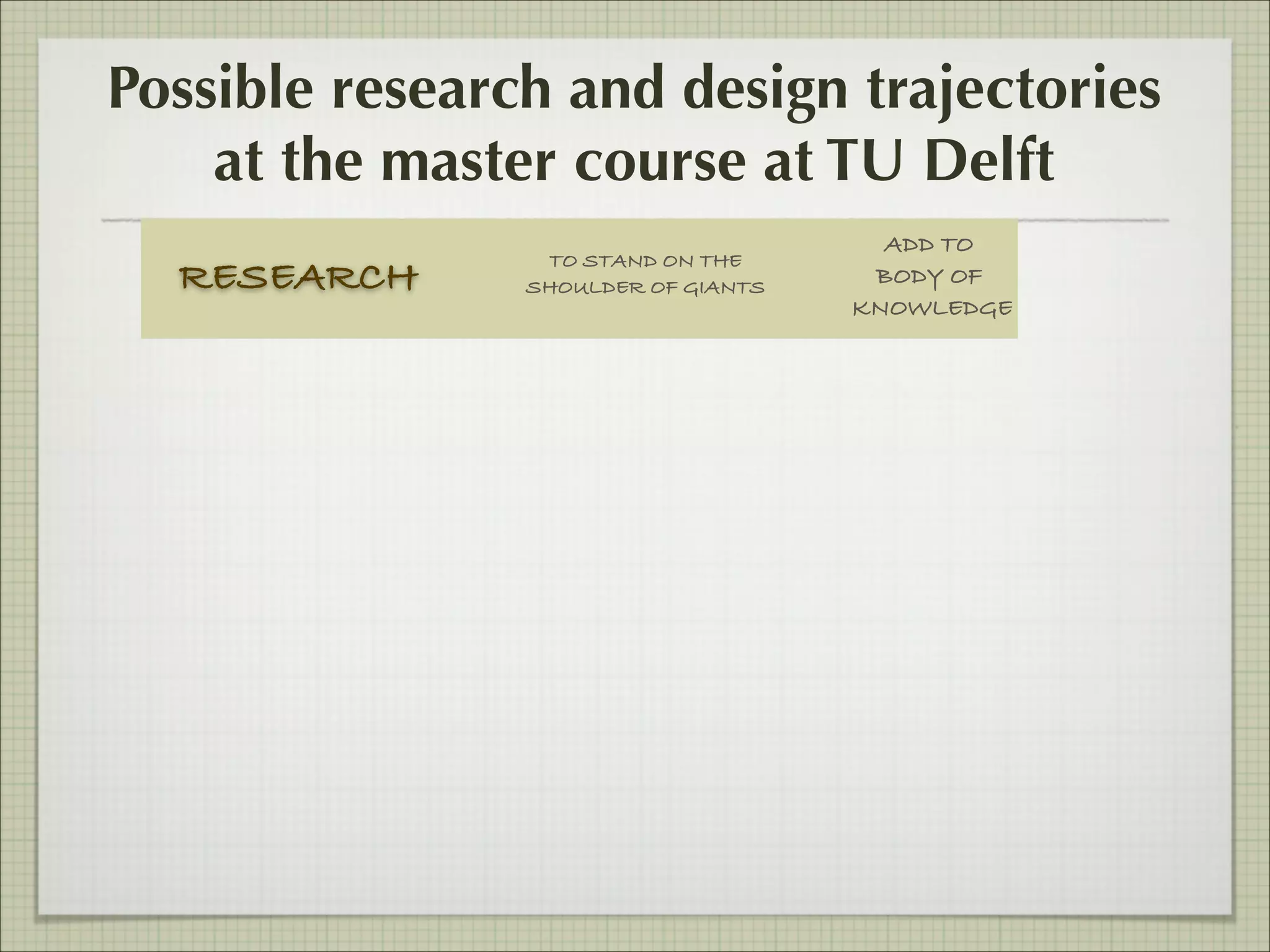
Possible research and design trajectories
at the master course at TU Delft
RESEARCH

TO STAND ON THE
SHOULDER OF GIANTS

ADD TO
BODY OF
KNOWLEDGE
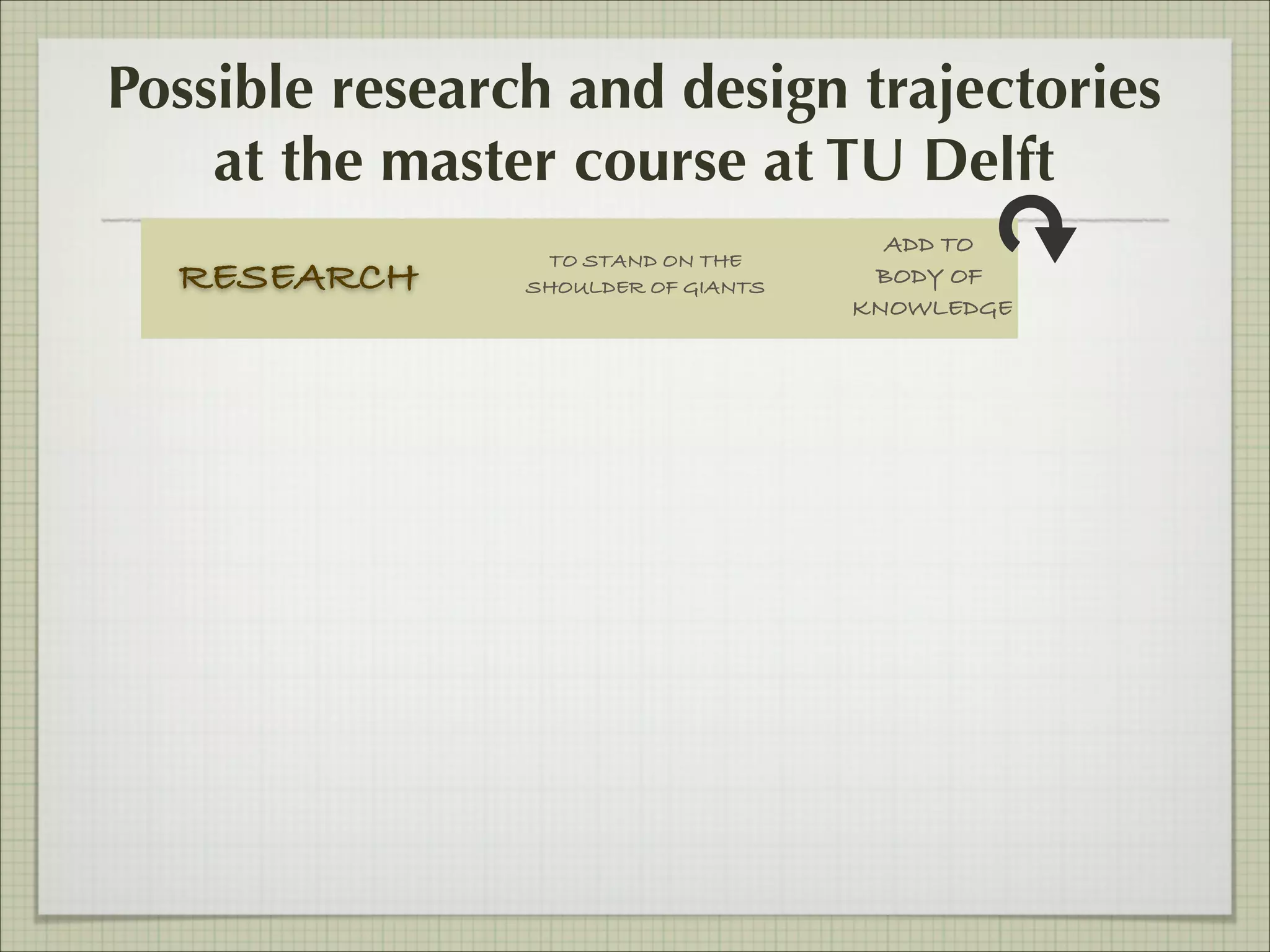
Possible research and design trajectories
at the master course at TU Delft
RESEARCH

TO STAND ON THE
SHOULDER OF GIANTS

ADD TO
BODY OF
KNOWLEDGE
Possible research and design trajectories
at the master course at TU Delft
RESEARCH

TO STAND ON THE
SHOULDER OF GIANTS

ADD TO
BODY OF
KNOWLEDGE

GUIDELINES
FOR DESIGN
Possible research and design trajectories
at the master course at TU Delft
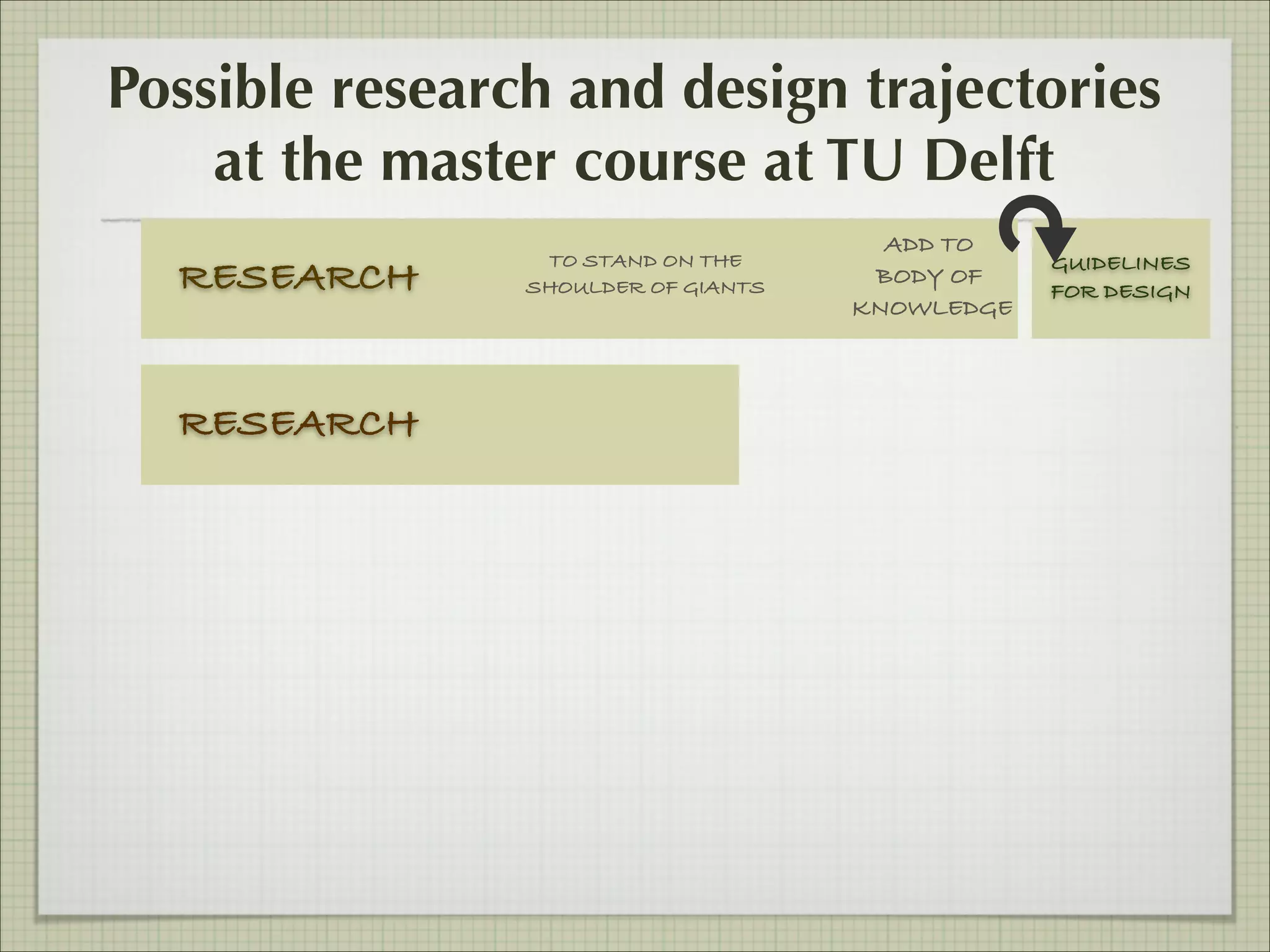
RESEARCH
RESEARCH

TO STAND ON THE
SHOULDER OF GIANTS

ADD TO
BODY OF
KNOWLEDGE

GUIDELINES
FOR DESIGN
Possible research and design trajectories
at the master course at TU Delft
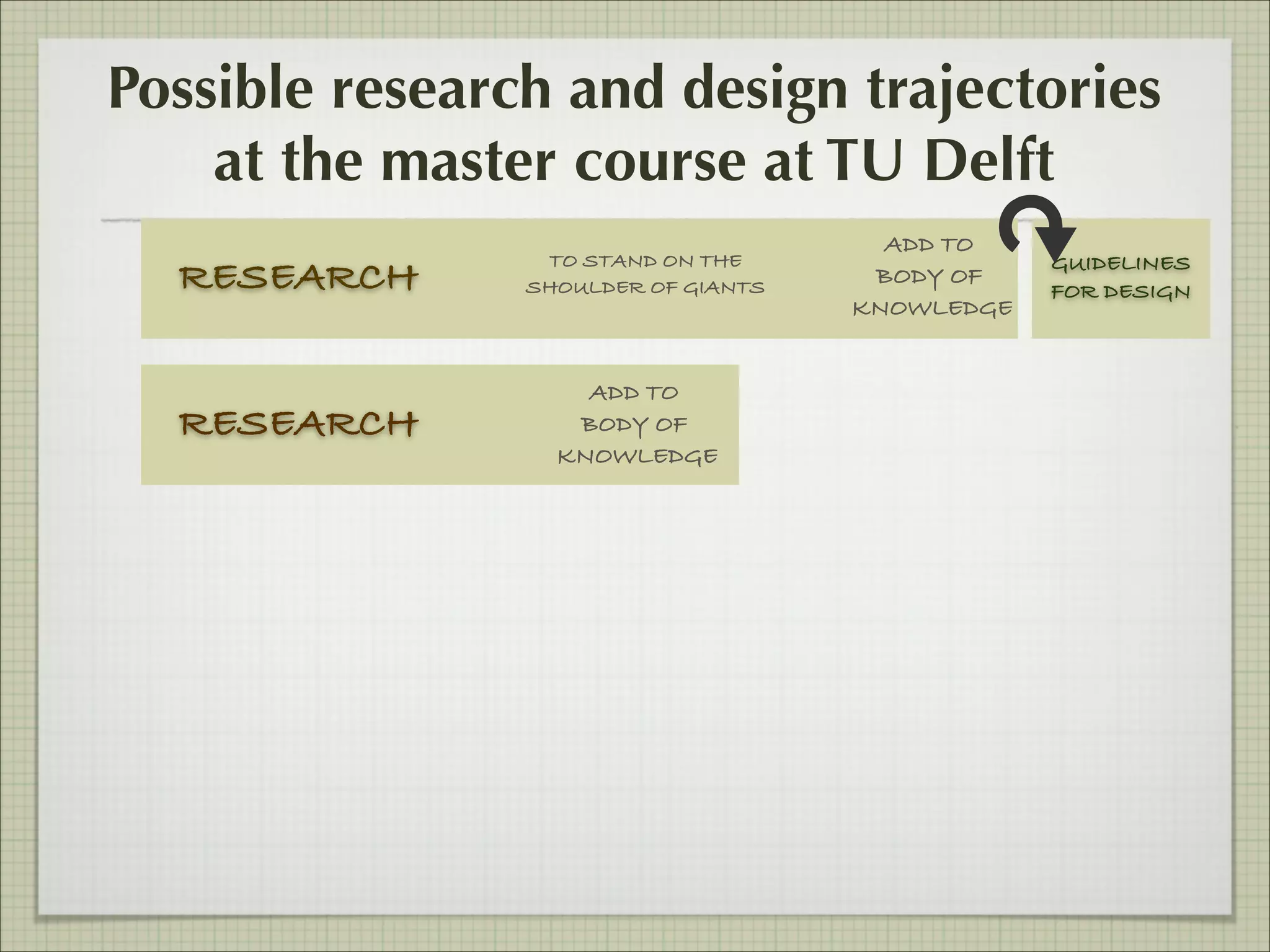
RESEARCH
RESEARCH

TO STAND ON THE
SHOULDER OF GIANTS

ADD TO
BODY OF
KNOWLEDGE

ADD TO
BODY OF
KNOWLEDGE

GUIDELINES
FOR DESIGN
Possible research and design trajectories
at the master course at TU Delft
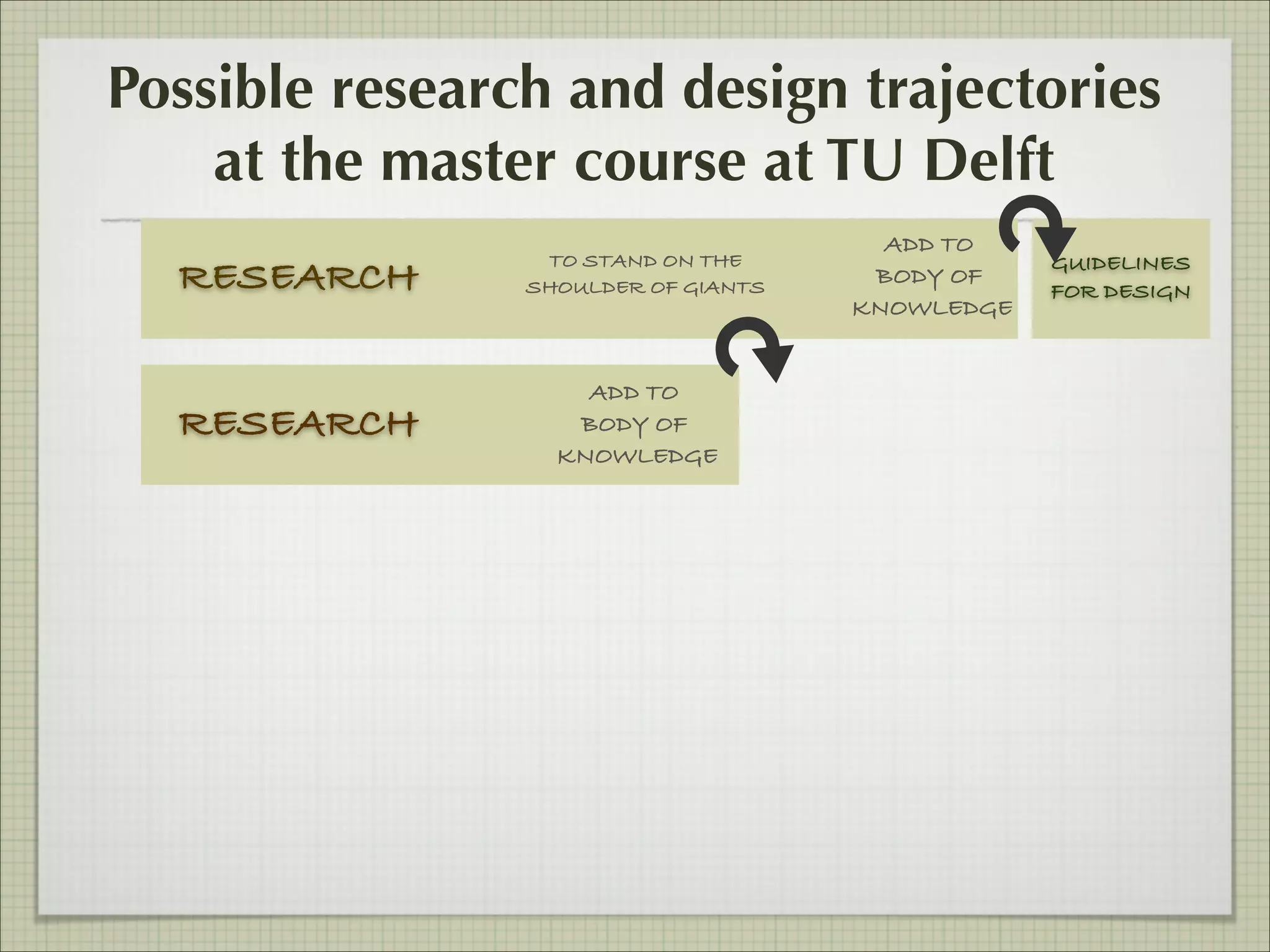
RESEARCH
RESEARCH

TO STAND ON THE
SHOULDER OF GIANTS

ADD TO
BODY OF
KNOWLEDGE

ADD TO
BODY OF
KNOWLEDGE

GUIDELINES
FOR DESIGN
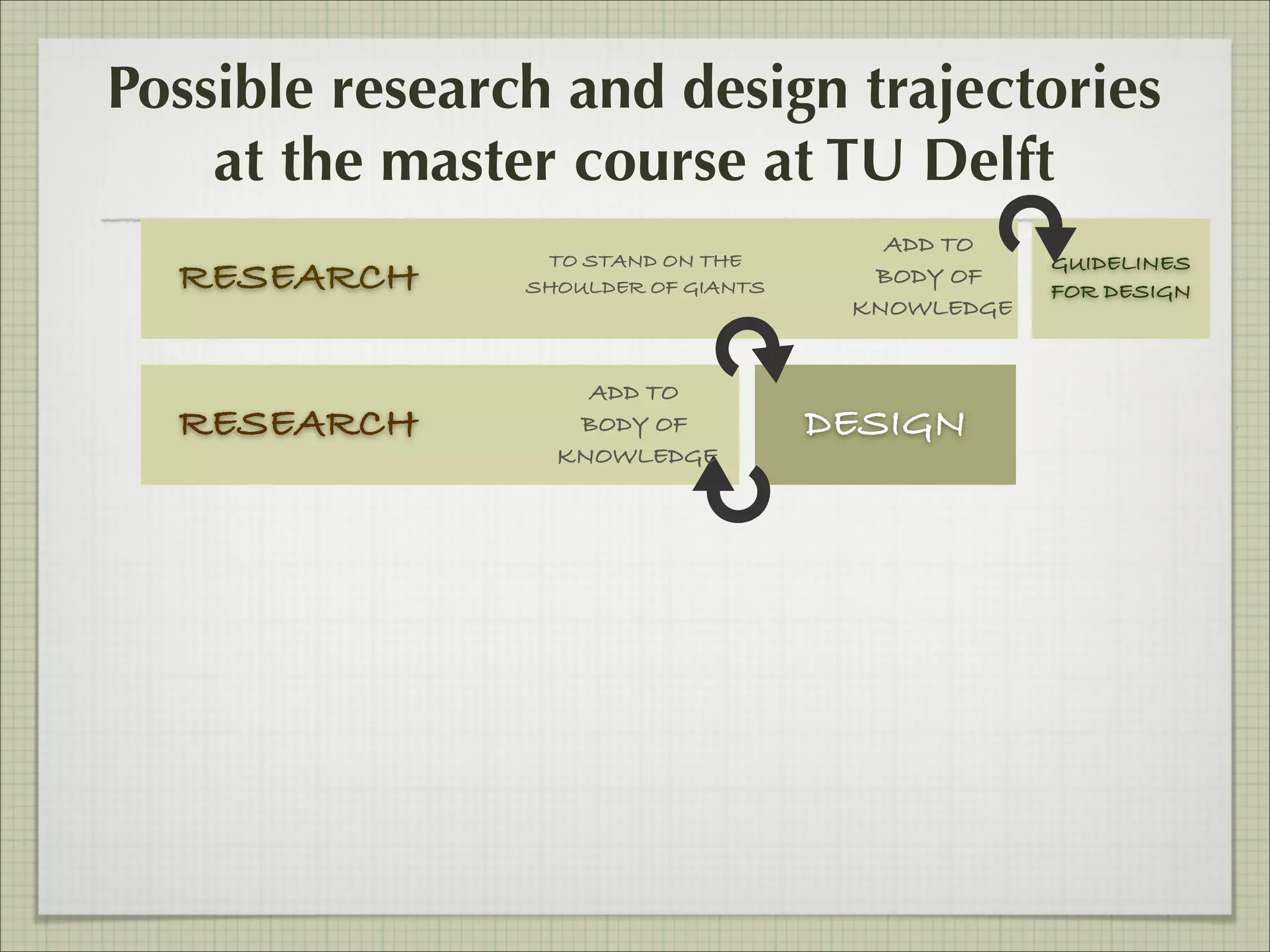
Possible research and design trajectories
at the master course at TU Delft
RESEARCH
RESEARCH

TO STAND ON THE
SHOULDER OF GIANTS

ADD TO
BODY OF
KNOWLEDGE

ADD TO
BODY OF
KNOWLEDGE

DESIGN

GUIDELINES
FOR DESIGN
Possible research and design trajectories
at the master course at TU Delft
RESEARCH
RESEARCH

TO STAND ON THE
SHOULDER OF GIANTS

ADD TO
BODY OF
KNOWLEDGE

ADD TO
BODY OF
KNOWLEDGE

DESIGN

GUIDELINES
FOR DESIGN
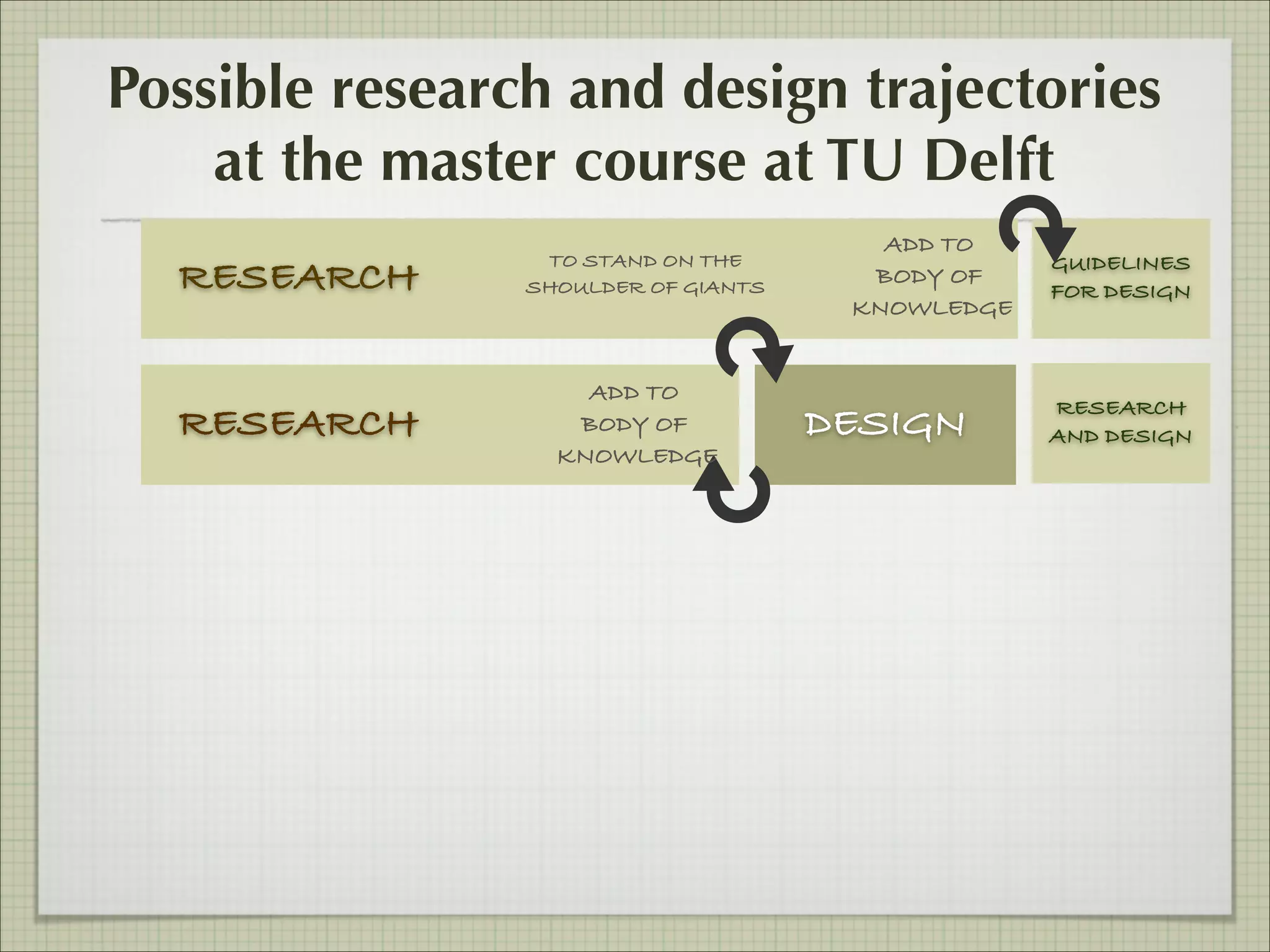
Possible research and design trajectories
at the master course at TU Delft
RESEARCH
RESEARCH

TO STAND ON THE
SHOULDER OF GIANTS

ADD TO
BODY OF
KNOWLEDGE

ADD TO
BODY OF
KNOWLEDGE

DESIGN

GUIDELINES
FOR DESIGN

RESEARCH
AND DESIGN
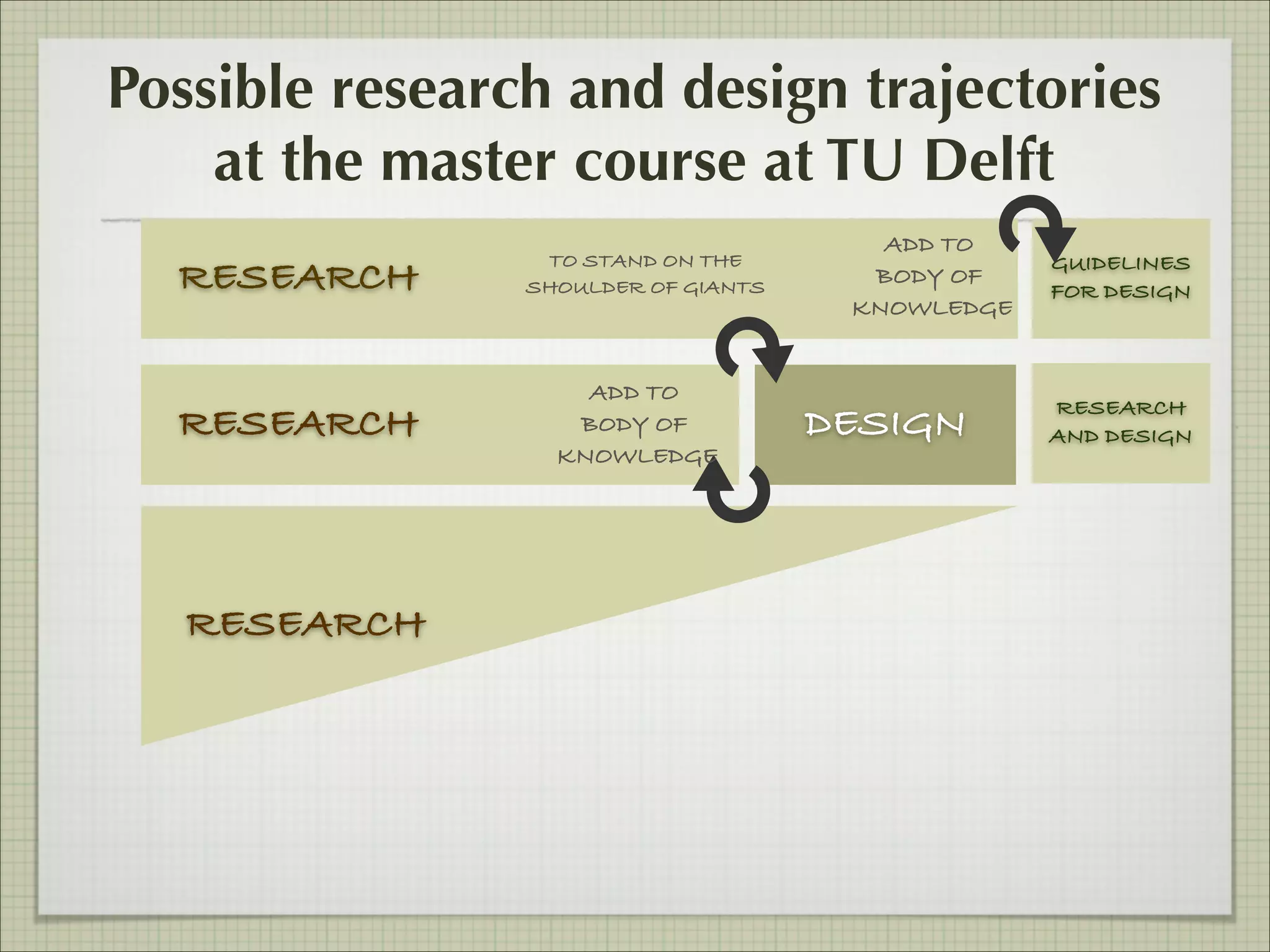
Possible research and design trajectories
at the master course at TU Delft
RESEARCH
RESEARCH

RESEARCH

TO STAND ON THE
SHOULDER OF GIANTS

ADD TO
BODY OF
KNOWLEDGE

ADD TO
BODY OF
KNOWLEDGE

DESIGN

GUIDELINES
FOR DESIGN

RESEARCH
AND DESIGN
Possible research and design trajectories
at the master course at TU Delft
RESEARCH
RESEARCH
ADD TO BODY OF
KNOWLEDGE

RESEARCH

TO STAND ON THE
SHOULDER OF GIANTS

ADD TO
BODY OF
KNOWLEDGE

ADD TO
BODY OF
KNOWLEDGE

DESIGN

GUIDELINES
FOR DESIGN

RESEARCH
AND DESIGN
Possible research and design trajectories
at the master course at TU Delft
RESEARCH
RESEARCH

TO STAND ON THE
SHOULDER OF GIANTS

ADD TO
BODY OF
KNOWLEDGE

ADD TO
BODY OF
KNOWLEDGE

DESIGN

ADD TO BODY OF
KNOWLEDGE

RESEARCH

DESIGN

GUIDELINES
FOR DESIGN

RESEARCH
AND DESIGN
Possible research and design trajectories
at the master course at TU Delft
RESEARCH
RESEARCH

TO STAND ON THE
SHOULDER OF GIANTS

ADD TO
BODY OF
KNOWLEDGE

ADD TO
BODY OF
KNOWLEDGE

DESIGN

ADD TO BODY OF
KNOWLEDGE

RESEARCH

DESIGN

GUIDELINES
FOR DESIGN

RESEARCH
AND DESIGN
Possible research and design trajectories
at the master course at TU Delft
RESEARCH
RESEARCH

TO STAND ON THE
SHOULDER OF GIANTS

ADD TO
BODY OF
KNOWLEDGE

ADD TO
BODY OF
KNOWLEDGE

DESIGN

ADD TO BODY OF
KNOWLEDGE

RESEARCH

DESIGN

GUIDELINES
FOR DESIGN

RESEARCH
AND DESIGN
Possible research and design trajectories
at the master course at TU Delft
RESEARCH
RESEARCH

TO STAND ON THE
SHOULDER OF GIANTS

ADD TO
BODY OF
KNOWLEDGE

ADD TO
BODY OF
KNOWLEDGE

DESIGN

ADD TO BODY OF
KNOWLEDGE

RESEARCH

DESIGN

GUIDELINES
FOR DESIGN

RESEARCH
AND DESIGN
Possible research and design trajectories
at the master course at TU Delft
RESEARCH
RESEARCH

TO STAND ON THE
SHOULDER OF GIANTS

ADD TO
BODY OF
KNOWLEDGE

ADD TO
BODY OF
KNOWLEDGE

DESIGN

ADD TO BODY OF
KNOWLEDGE

RESEARCH

DESIGN

GUIDELINES
FOR DESIGN

RESEARCH
AND DESIGN
Possible research and design trajectories
at the master course at TU Delft
RESEARCH
RESEARCH

TO STAND ON THE
SHOULDER OF GIANTS

ADD TO
BODY OF
KNOWLEDGE

ADD TO
BODY OF
KNOWLEDGE

DESIGN

ADD TO BODY OF
KNOWLEDGE

RESEARCH

DESIGN

GUIDELINES
FOR DESIGN

RESEARCH
AND DESIGN
Possible research and design trajectories
at the master course at TU Delft
RESEARCH
RESEARCH

TO STAND ON THE
SHOULDER OF GIANTS

ADD TO
BODY OF
KNOWLEDGE

ADD TO
BODY OF
KNOWLEDGE

DESIGN

ADD TO BODY OF
KNOWLEDGE

RESEARCH

DESIGN

GUIDELINES
FOR DESIGN

RESEARCH
AND DESIGN
Possible research and design trajectories
at the master course at TU Delft
RESEARCH
RESEARCH

TO STAND ON THE
SHOULDER OF GIANTS

ADD TO
BODY OF
KNOWLEDGE

ADD TO
BODY OF
KNOWLEDGE

DESIGN

ADD TO BODY OF
KNOWLEDGE

RESEARCH

DESIGN

GUIDELINES
FOR DESIGN

RESEARCH
AND DESIGN
Possible research and design trajectories
at the master course at TU Delft
RESEARCH
RESEARCH

TO STAND ON THE
SHOULDER OF GIANTS

ADD TO
BODY OF
KNOWLEDGE

ADD TO
BODY OF
KNOWLEDGE

DESIGN

ADD TO BODY OF
KNOWLEDGE

RESEARCH

DESIGN

GUIDELINES
FOR DESIGN

RESEARCH
AND DESIGN
Possible research and design trajectories
at the master course at TU Delft
RESEARCH
RESEARCH

TO STAND ON THE
SHOULDER OF GIANTS

ADD TO
BODY OF
KNOWLEDGE

ADD TO
BODY OF
KNOWLEDGE

DESIGN

ADD TO BODY OF
KNOWLEDGE

RESEARCH

DESIGN

GUIDELINES
FOR DESIGN

RESEARCH
AND DESIGN
Possible research and design trajectories
at the master course at TU Delft
RESEARCH
RESEARCH

TO STAND ON THE
SHOULDER OF GIANTS

ADD TO
BODY OF
KNOWLEDGE

ADD TO
BODY OF
KNOWLEDGE

DESIGN

ADD TO BODY OF
KNOWLEDGE

RESEARCH

DESIGN

GUIDELINES
FOR DESIGN

RESEARCH
AND DESIGN
Possible research and design trajectories
at the master course at TU Delft
RESEARCH
RESEARCH

TO STAND ON THE
SHOULDER OF GIANTS

ADD TO
BODY OF
KNOWLEDGE

ADD TO
BODY OF
KNOWLEDGE

DESIGN

ADD TO BODY OF
KNOWLEDGE

RESEARCH

DESIGN

GUIDELINES
FOR DESIGN

RESEARCH
AND DESIGN
Possible research and design trajectories
at the master course at TU Delft
RESEARCH
RESEARCH

TO STAND ON THE
SHOULDER OF GIANTS

ADD TO
BODY OF
KNOWLEDGE

ADD TO
BODY OF
KNOWLEDGE

DESIGN

ADD TO BODY OF
KNOWLEDGE

RESEARCH

DESIGN

GUIDELINES
FOR DESIGN

RESEARCH
AND DESIGN
Possible research and design trajectories
at the master course at TU Delft
RESEARCH
RESEARCH

TO STAND ON THE
SHOULDER OF GIANTS

ADD TO
BODY OF
KNOWLEDGE

ADD TO
BODY OF
KNOWLEDGE

DESIGN

ADD TO BODY OF
KNOWLEDGE

RESEARCH

DESIGN

GUIDELINES
FOR DESIGN

RESEARCH
AND DESIGN
Possible research and design trajectories
at the master course at TU Delft
RESEARCH
RESEARCH

TO STAND ON THE
SHOULDER OF GIANTS

ADD TO
BODY OF
KNOWLEDGE

ADD TO
BODY OF
KNOWLEDGE

DESIGN

ADD TO BODY OF
KNOWLEDGE

RESEARCH

DESIGN

GUIDELINES
FOR DESIGN

RESEARCH
AND DESIGN
Possible research and design trajectories
at the master course at TU Delft
RESEARCH
RESEARCH

TO STAND ON THE
SHOULDER OF GIANTS

ADD TO
BODY OF
KNOWLEDGE

ADD TO
BODY OF
KNOWLEDGE

DESIGN

GUIDELINES
FOR DESIGN

RESEARCH
AND DESIGN

ADD TO BODY OF
KNOWLEDGE

RESEARCH

DESIGN

RESEARCH BY
DESIGN
Possible research and design trajectories
at the master course at TU Delft
RESEARCH
RESEARCH

TO STAND ON THE
SHOULDER OF GIANTS

ADD TO
BODY OF
KNOWLEDGE

ADD TO
BODY OF
KNOWLEDGE

DESIGN

GUIDELINES
FOR DESIGN

RESEARCH
AND DESIGN

ADD TO BODY OF
KNOWLEDGE

RESEARCH

DESIGN
USE THE BODY OF
KNOWLEDGE

RESEARCH BY
DESIGN
Possible research and design trajectories
at the master course at TU Delft
RESEARCH
RESEARCH

TO STAND ON THE
SHOULDER OF GIANTS

ADD TO
BODY OF
KNOWLEDGE

ADD TO
BODY OF
KNOWLEDGE

DESIGN

GUIDELINES
FOR DESIGN

RESEARCH
AND DESIGN

ADD TO BODY OF
KNOWLEDGE

RESEARCH

DESIGN
USE THE BODY OF
KNOWLEDGE

DESIGN

RESEARCH BY
DESIGN
Possible research and design trajectories
at the master course at TU Delft
RESEARCH
RESEARCH

TO STAND ON THE
SHOULDER OF GIANTS

ADD TO
BODY OF
KNOWLEDGE

ADD TO
BODY OF
KNOWLEDGE

DESIGN

GUIDELINES
FOR DESIGN

RESEARCH
AND DESIGN

ADD TO BODY OF
KNOWLEDGE

RESEARCH

DESIGN

RESEARCH BY
DESIGN

USE THE BODY OF
KNOWLEDGE

DESIGN

MEANINGLESS
DESIGN
Possible research and design trajectories
at the master course at TU Delft
RESEARCH
RESEARCH

TO STAND ON THE
SHOULDER OF GIANTS

ADD TO
BODY OF
KNOWLEDGE

ADD TO
BODY OF
KNOWLEDGE

DESIGN

GUIDELINES
FOR DESIGN

RESEARCH
AND DESIGN

ADD TO BODY OF
KNOWLEDGE

RESEARCH

DESIGN

RESEARCH BY
DESIGN

USE THE BODY OF
KNOWLEDGE

DESIGN

MEANINGLESS
DESIGN
Possible research and design trajectories
at the master course at TU Delft
RESEARCH
RESEARCH

TO STAND ON THE
SHOULDER OF GIANTS

ADD TO
BODY OF
KNOWLEDGE

ADD TO
BODY OF
KNOWLEDGE

DESIGN

GUIDELINES
FOR DESIGN

RESEARCH
AND DESIGN

ADD TO BODY OF
KNOWLEDGE

RESEARCH

DESIGN

RESEARCH BY
DESIGN

USE THE BODY OF
KNOWLEDGE

DESIGN

MEANINGLESS
DESIGN
Possible research and design trajectories
at the master course at TU Delft
RESEARCH
RESEARCH

TO STAND ON THE
SHOULDER OF GIANTS

ADD TO
BODY OF
KNOWLEDGE

ADD TO
BODY OF
KNOWLEDGE

DESIGN

GUIDELINES
FOR DESIGN

RESEARCH
AND DESIGN

ADD TO BODY OF
KNOWLEDGE

RESEARCH

DESIGN

RESEARCH BY
DESIGN

USE THE BODY OF
KNOWLEDGE

DESIGN

MEANINGLESS
DESIGN
Possible research and design trajectories
at the master course at TU Delft
RESEARCH
RESEARCH

TO STAND ON THE
SHOULDER OF GIANTS

ADD TO
BODY OF
KNOWLEDGE

ADD TO
BODY OF
KNOWLEDGE

DESIGN

GUIDELINES
FOR DESIGN

RESEARCH
AND DESIGN

ADD TO BODY OF
KNOWLEDGE

RESEARCH

DESIGN

RESEARCH BY
DESIGN

USE THE BODY OF
KNOWLEDGE

MEANINGLESS
DESIGN
Possible research and design trajectories
at the master course at TU Delft
RESEARCH
RESEARCH

TO STAND ON THE
SHOULDER OF GIANTS

ADD TO
BODY OF
KNOWLEDGE

ADD TO
BODY OF
KNOWLEDGE

DESIGN

GUIDELINES
FOR DESIGN

RESEARCH
AND DESIGN

ADD TO BODY OF
KNOWLEDGE

RESEARCH

DESIGN
USE THE BODY OF
KNOWLEDGE

RESEARCH BY
DESIGN
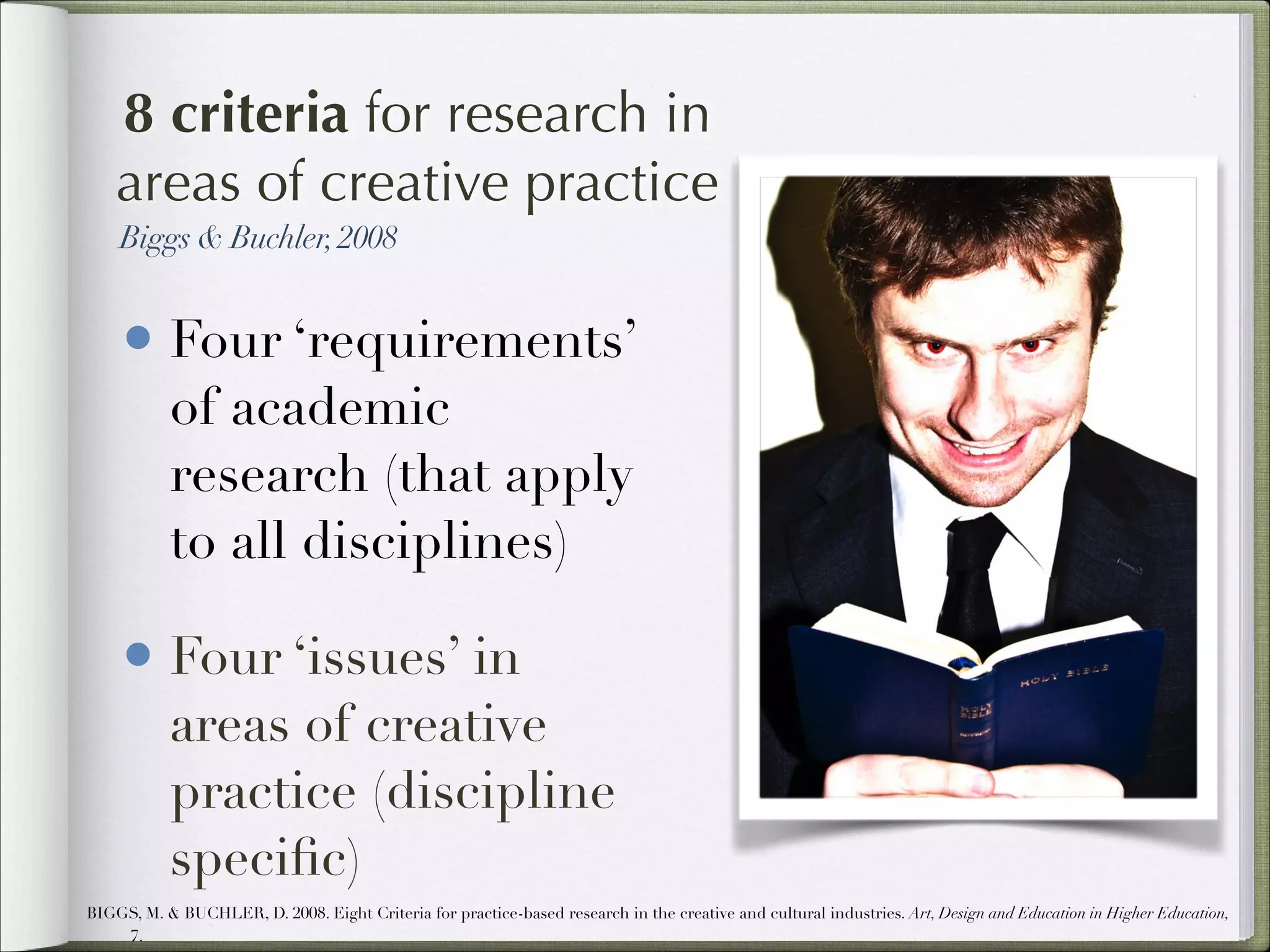
8 criteria for research in
areas of creative practice
Biggs & Buchler, 2008

• Four ‘requirements’
of academic
research (that apply
to all disciplines)

• Four ‘issues’ in

areas of creative
practice (discipline
specific)

BIGGS, M. & BUCHLER, D. 2008. Eight Criteria for practice-based research in the creative and cultural industries. Art, Design and Education in Higher Education,
7.
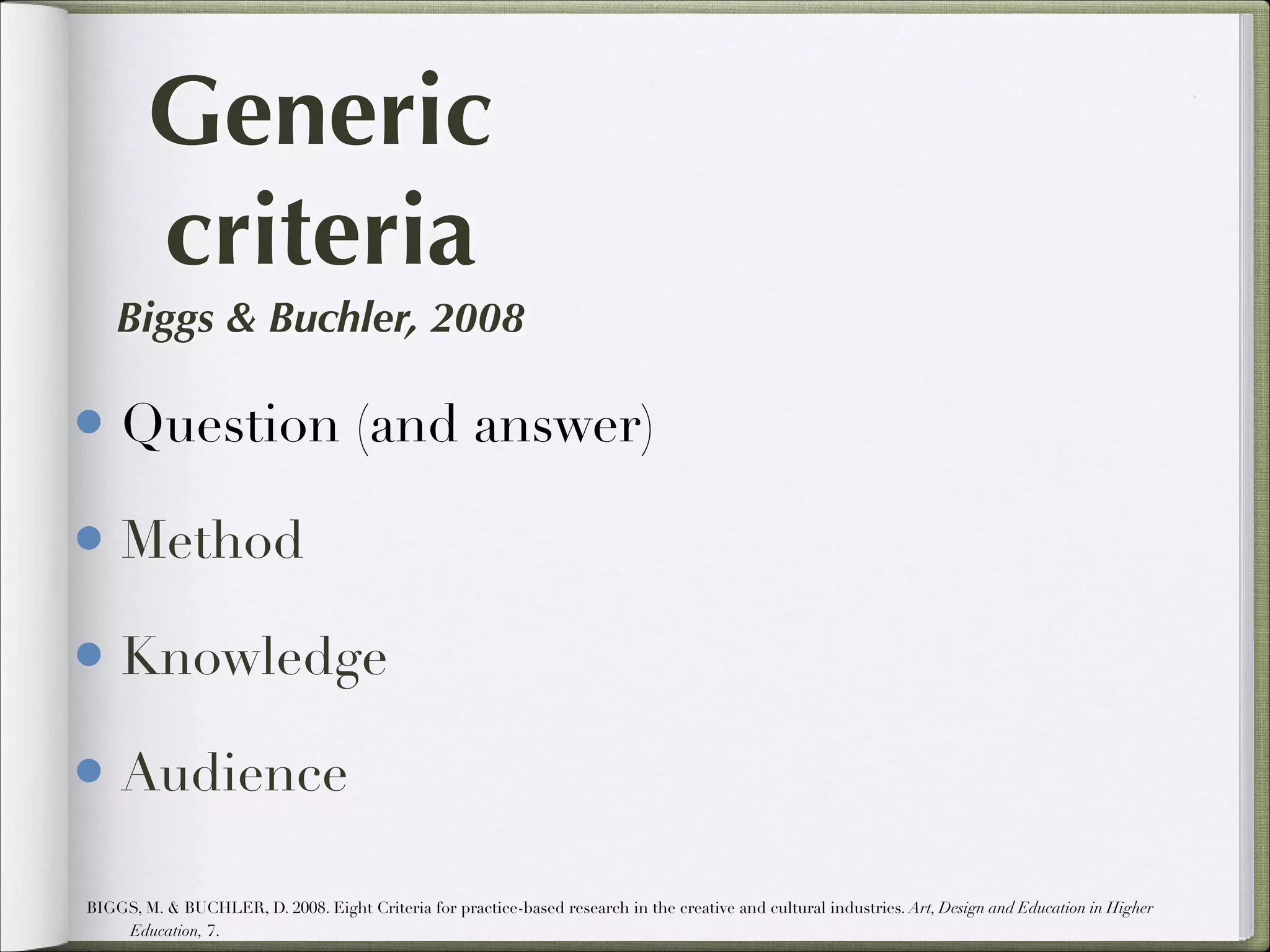
Generic
criteria
Biggs & Buchler, 2008

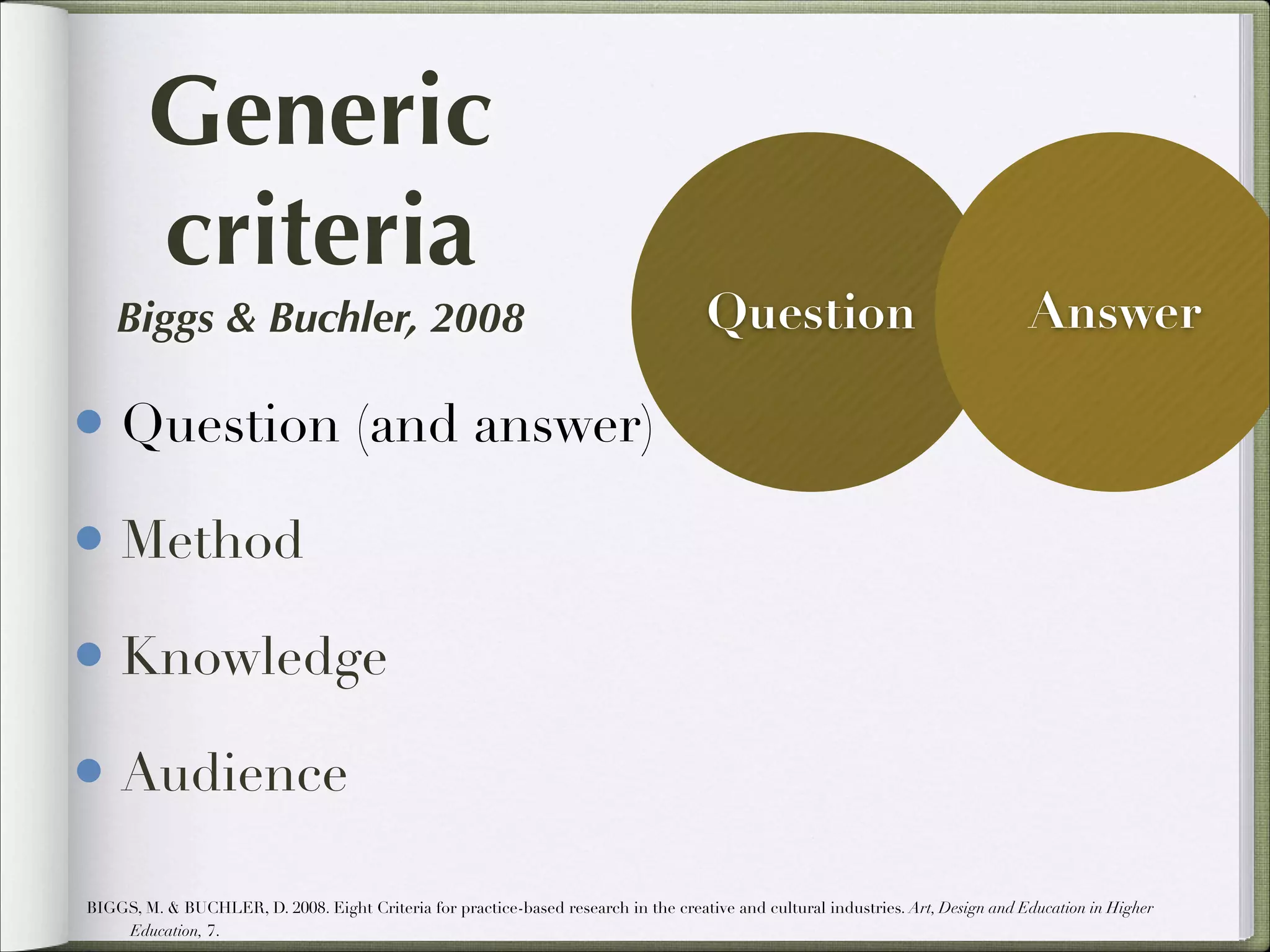
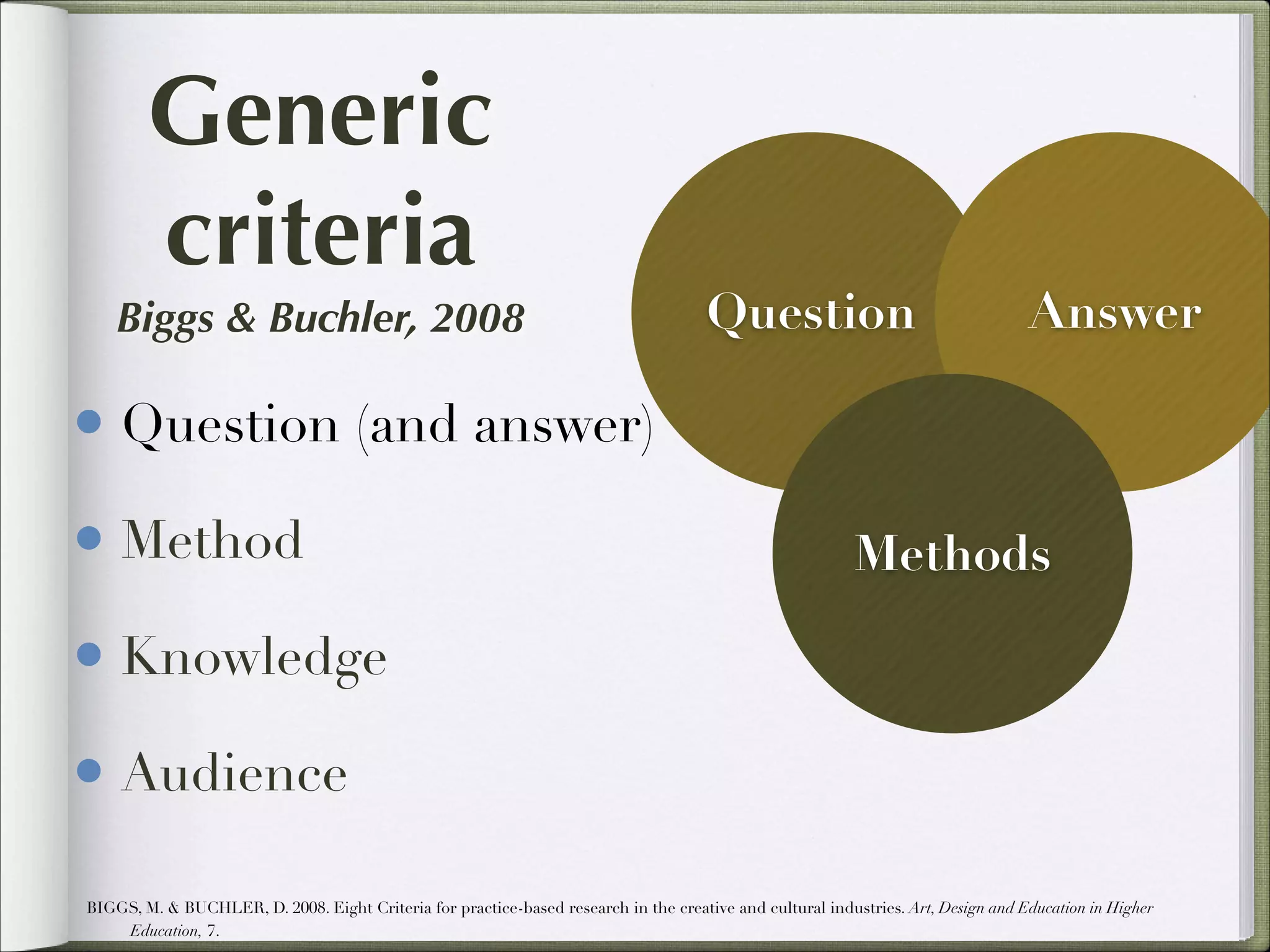
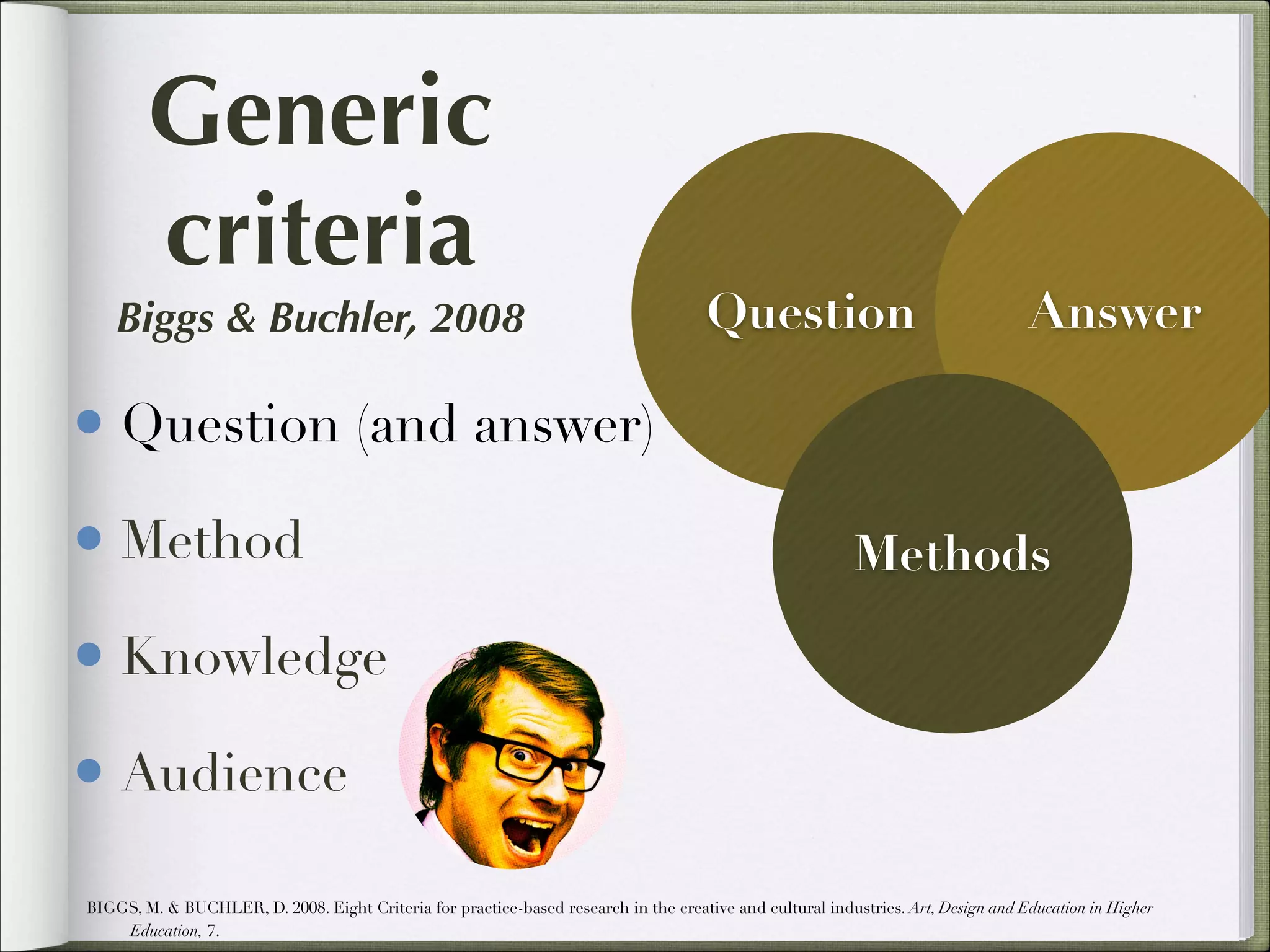
• Question (and answer)
• Method
• Knowledge
• Audience
BIGGS, M. & BUCHLER, D. 2008. Eight Criteria for practice-based research in the creative and cultural industries. Art, Design and Education in Higher
Education, 7.
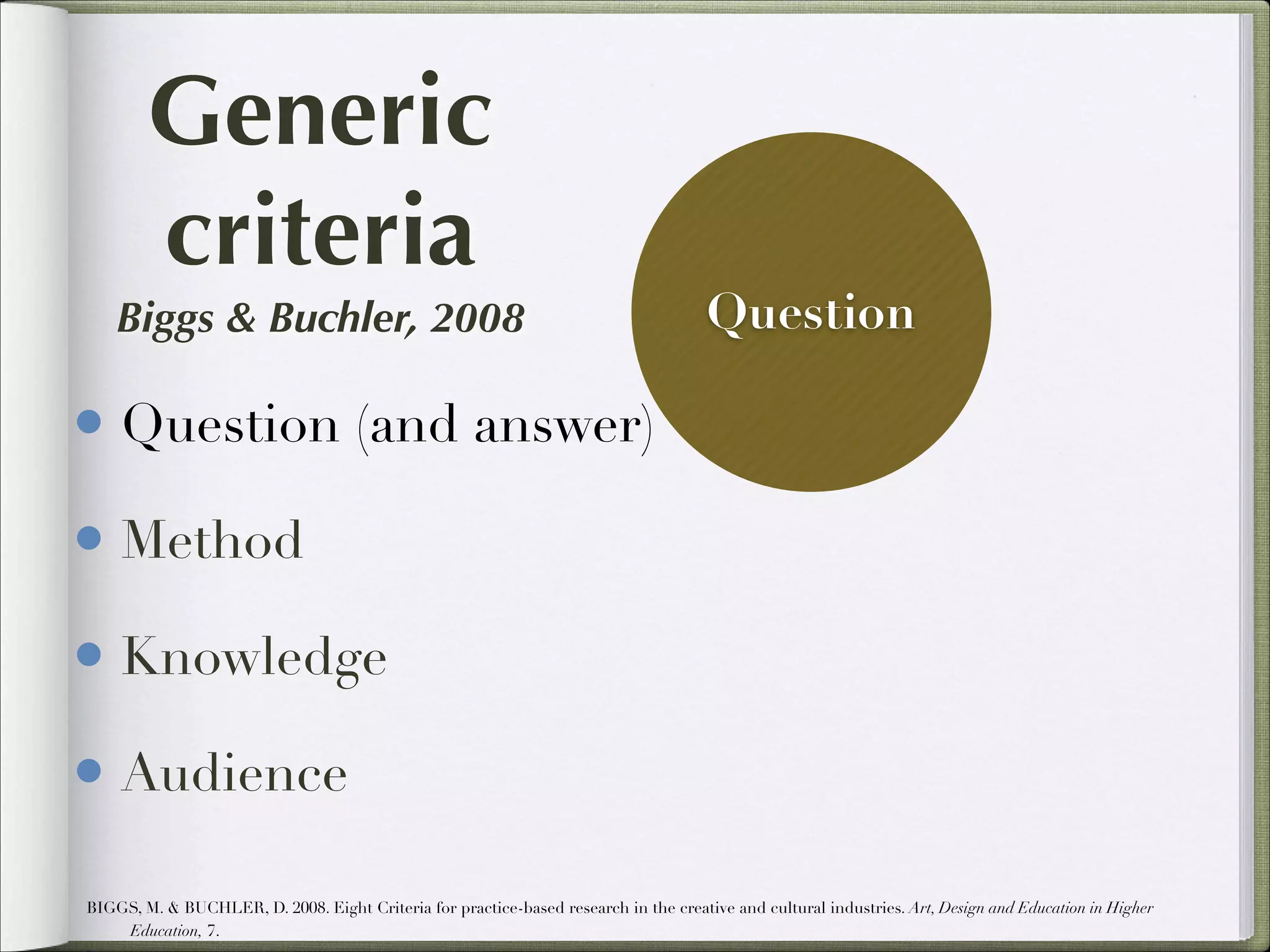
Generic
criteria
Biggs & Buchler, 2008

Question

• Question (and answer)
• Method
• Knowledge
• Audience
BIGGS, M. & BUCHLER, D. 2008. Eight Criteria for practice-based research in the creative and cultural industries. Art, Design and Education in Higher
Education, 7.
Generic
criteria
Biggs & Buchler, 2008

Question

Answer

• Question (and answer)
• Method
• Knowledge
• Audience
BIGGS, M. & BUCHLER, D. 2008. Eight Criteria for practice-based research in the creative and cultural industries. Art, Design and Education in Higher
Education, 7.
Generic
criteria
Biggs & Buchler, 2008

Question

Answer

• Question (and answer)
• Method

Methods

• Knowledge
• Audience
BIGGS, M. & BUCHLER, D. 2008. Eight Criteria for practice-based research in the creative and cultural industries. Art, Design and Education in Higher
Education, 7.
Generic
criteria
Biggs & Buchler, 2008

Question

Answer

• Question (and answer)
• Method

Methods

• Knowledge
• Audience
BIGGS, M. & BUCHLER, D. 2008. Eight Criteria for practice-based research in the creative and cultural industries. Art, Design and Education in Higher
Education, 7.
Generic
criteria
Biggs & Buchler, 2008

Question

Answer

• Question (and answer)
• Method

Methods

• Knowledge
• Audience

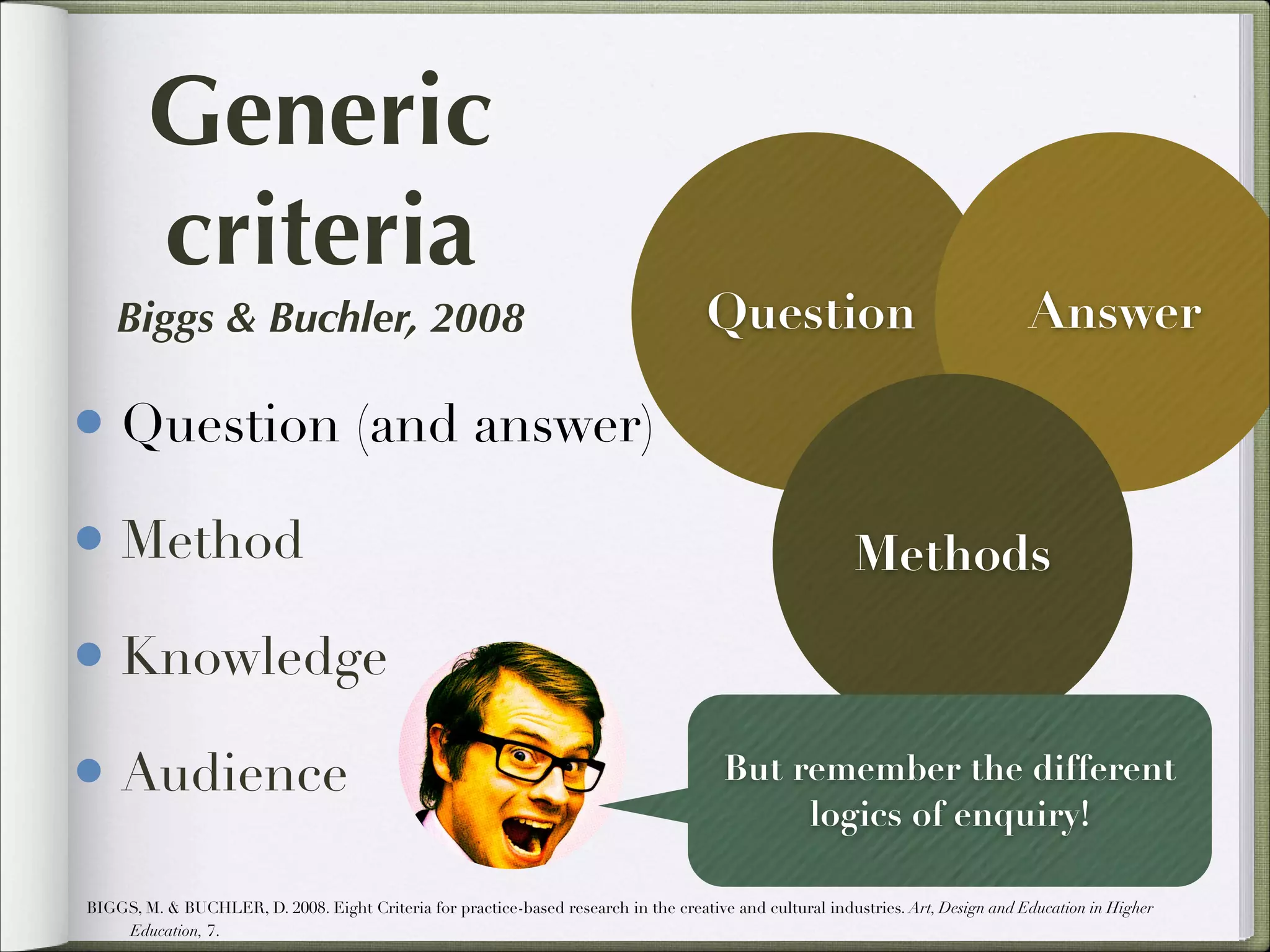
But remember the different
logics of enquiry!

BIGGS, M. & BUCHLER, D. 2008. Eight Criteria for practice-based research in the creative and cultural industries. Art, Design and Education in Higher
Education, 7.
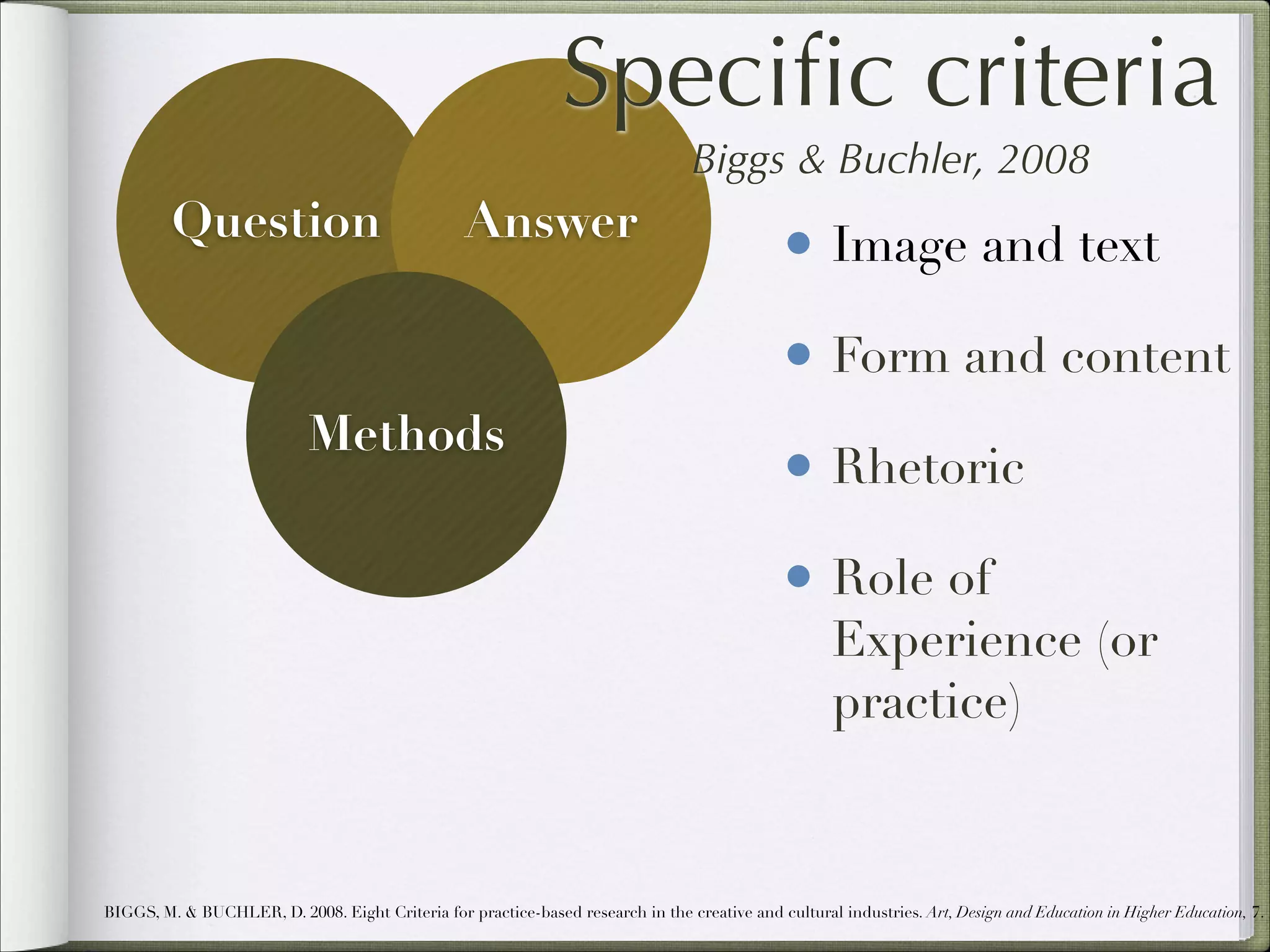
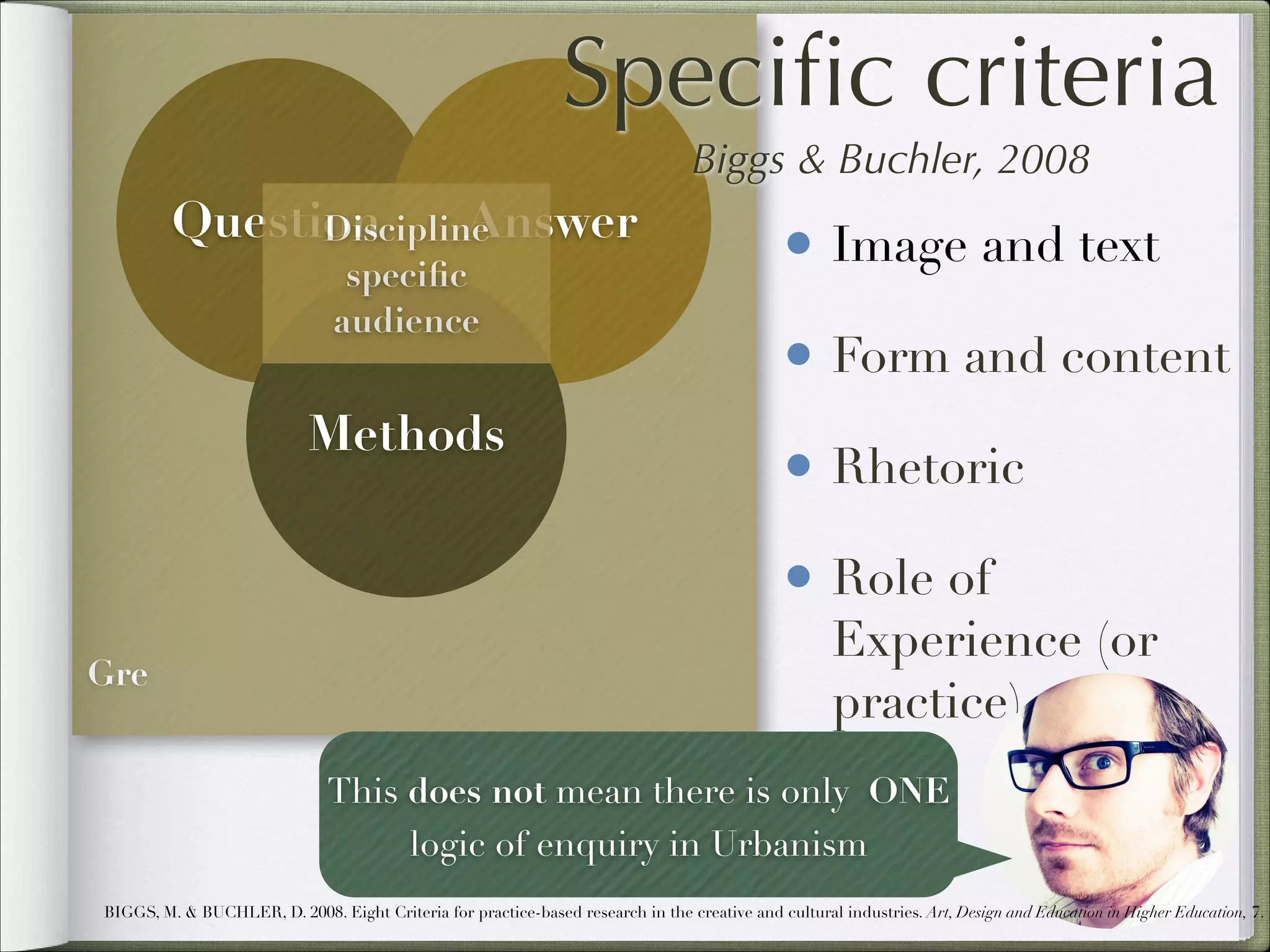
Specific criteria
Biggs & Buchler, 2008

Question

Answer

• Image and text
• Form and content

Methods

• Rhetoric
• Role of

Experience (or
practice)

BIGGS, M. & BUCHLER, D. 2008. Eight Criteria for practice-based research in the creative and cultural industries. Art, Design and Education in Higher Education, 7.
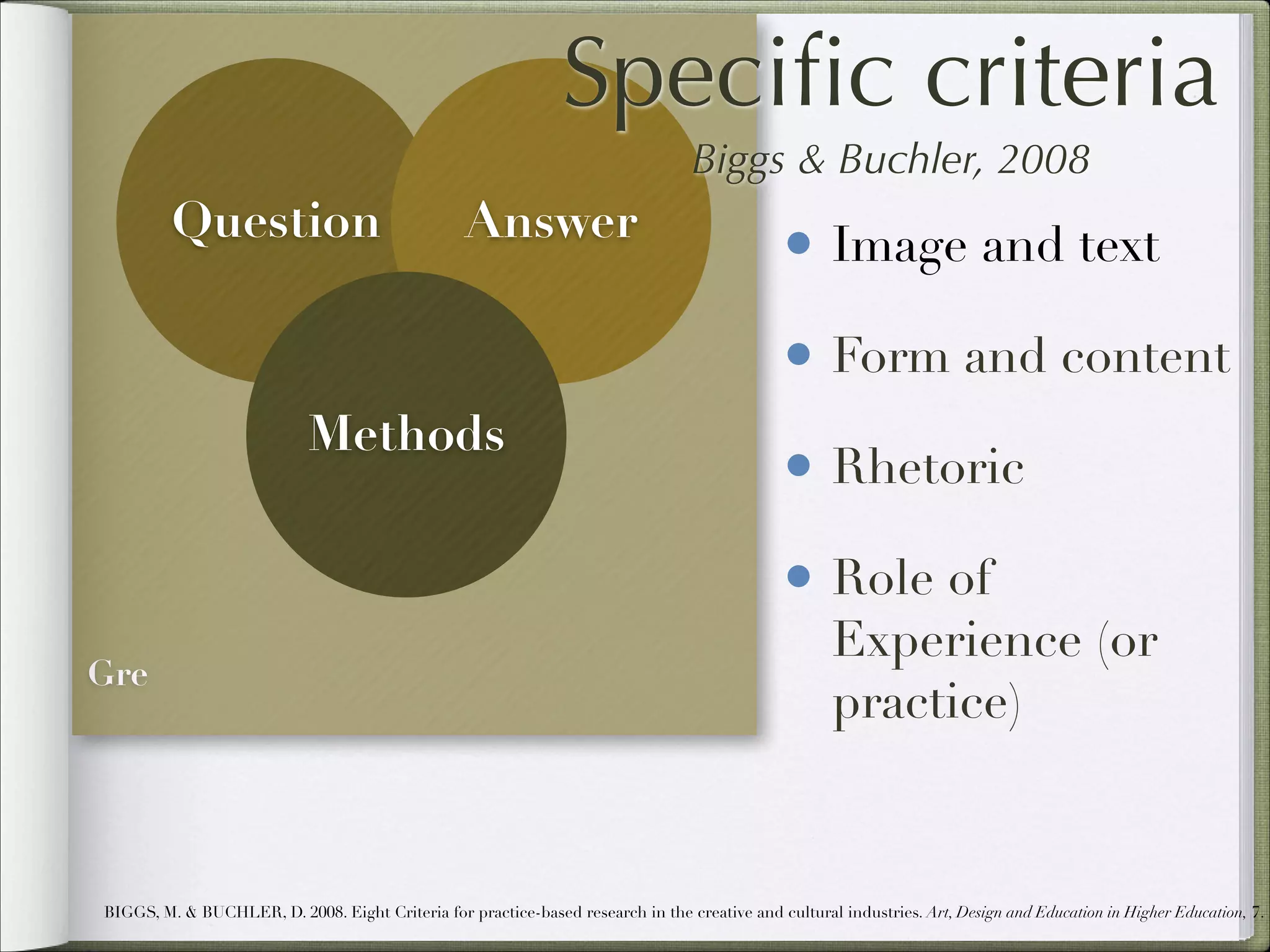
Specific criteria
Biggs & Buchler, 2008

Question

Answer

• Image and text
• Form and content

Methods

• Rhetoric
• Role of

Gre

Experience (or
practice)

BIGGS, M. & BUCHLER, D. 2008. Eight Criteria for practice-based research in the creative and cultural industries. Art, Design and Education in Higher Education, 7.
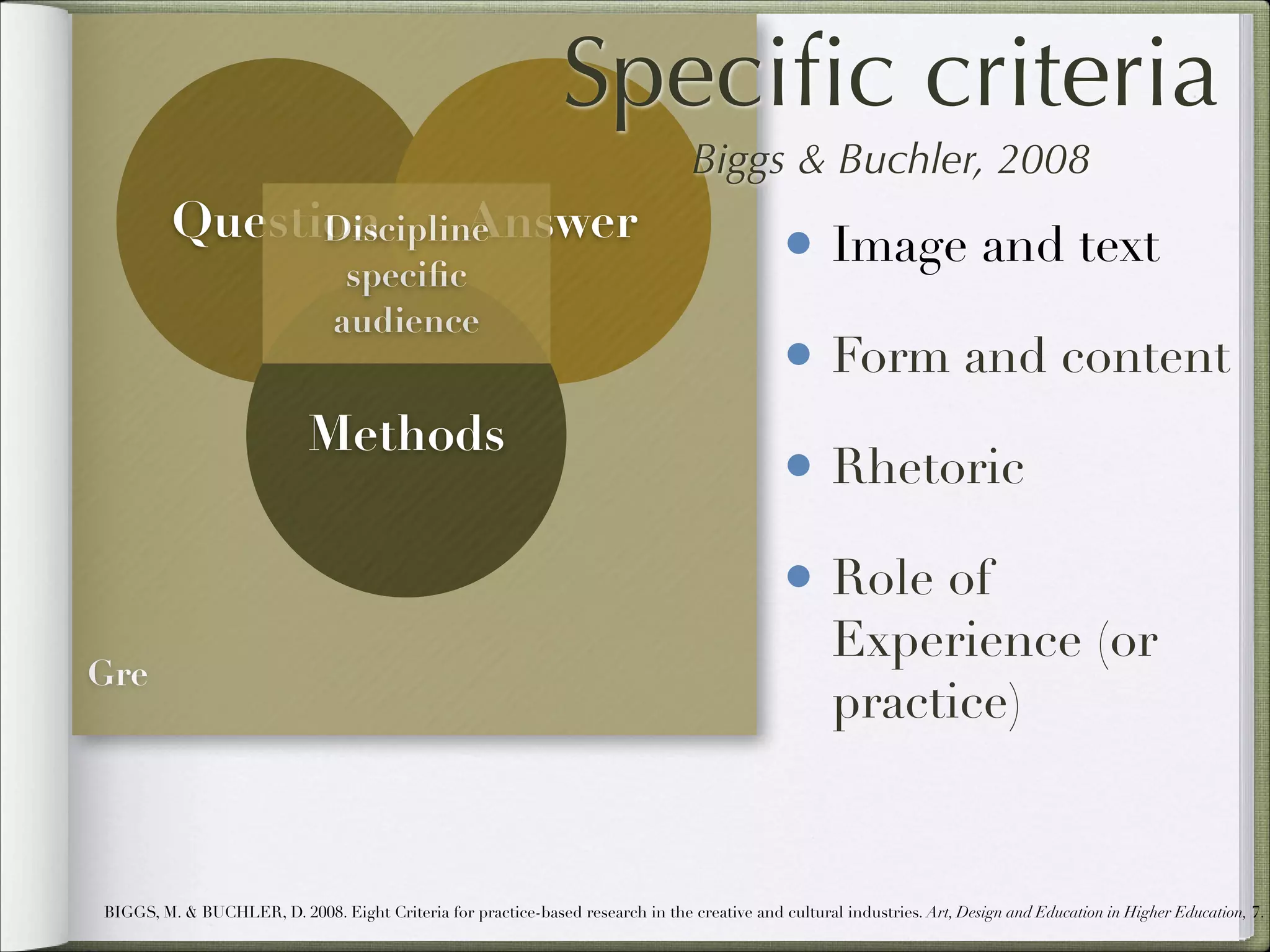
Specific criteria
Biggs & Buchler, 2008

Question
Answer
Discipline
specific
audience

Methods

• Image and text
• Form and content
• Rhetoric
• Role of

Gre

Experience (or
practice)

BIGGS, M. & BUCHLER, D. 2008. Eight Criteria for practice-based research in the creative and cultural industries. Art, Design and Education in Higher Education, 7.
Specific criteria
Biggs & Buchler, 2008

Question
Answer
Discipline
specific
audience

Methods

• Image and text
• Form and content
• Rhetoric
• Role of

Gre

Experience (or
practice)

BIGGS, M. & BUCHLER, D. 2008. Eight Criteria for practice-based research in the creative and cultural industries. Art, Design and Education in Higher Education, 7.
Specific criteria
Biggs & Buchler, 2008

Question
Answer
Discipline
specific
audience

Methods

• Image and text
• Form and content
• Rhetoric
• Role of

Gre

Experience (or
practice)

This does not mean there is only ONE
logic of enquiry in Urbanism
BIGGS, M. & BUCHLER, D. 2008. Eight Criteria for practice-based research in the creative and cultural industries. Art, Design and Education in Higher Education, 7.
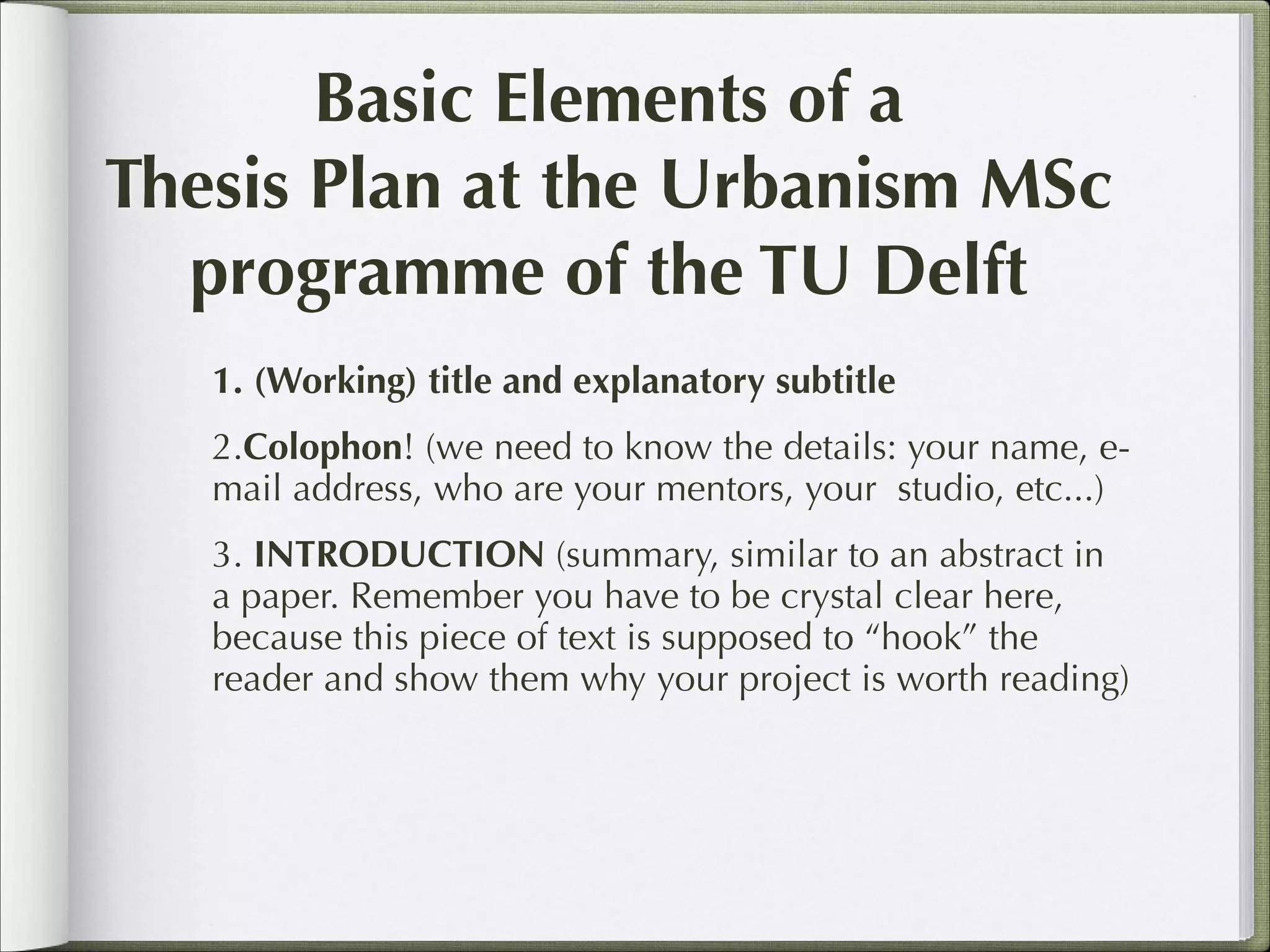
Basic Elements of a
Thesis Plan at the Urbanism MSc
programme of the TU Delft
Basic Elements of a
Thesis Plan at the Urbanism MSc
programme of the TU Delft
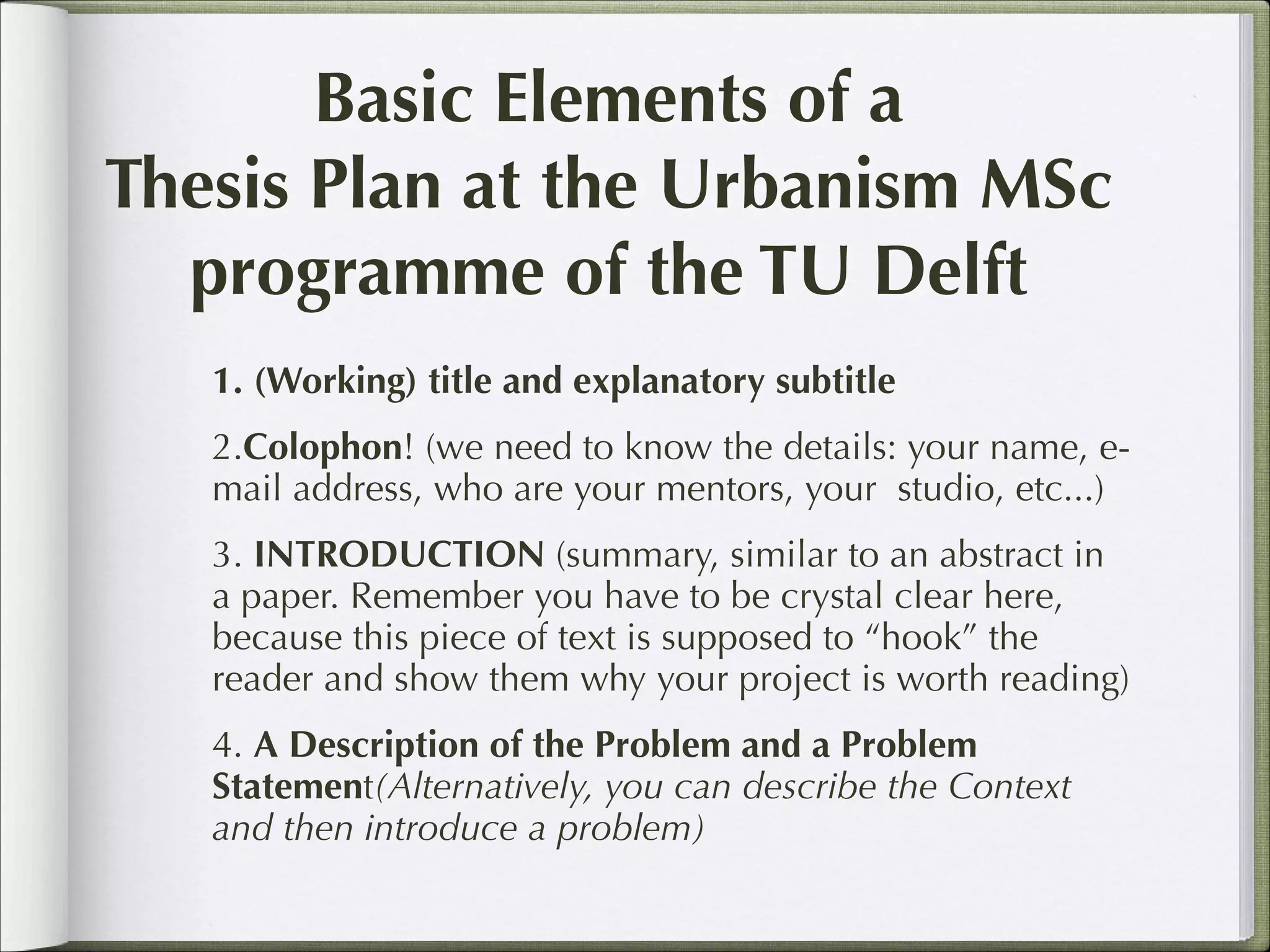
1. (Working) title and explanatory subtitle
Basic Elements of a
Thesis Plan at the Urbanism MSc
programme of the TU Delft
1. (Working) title and explanatory subtitle
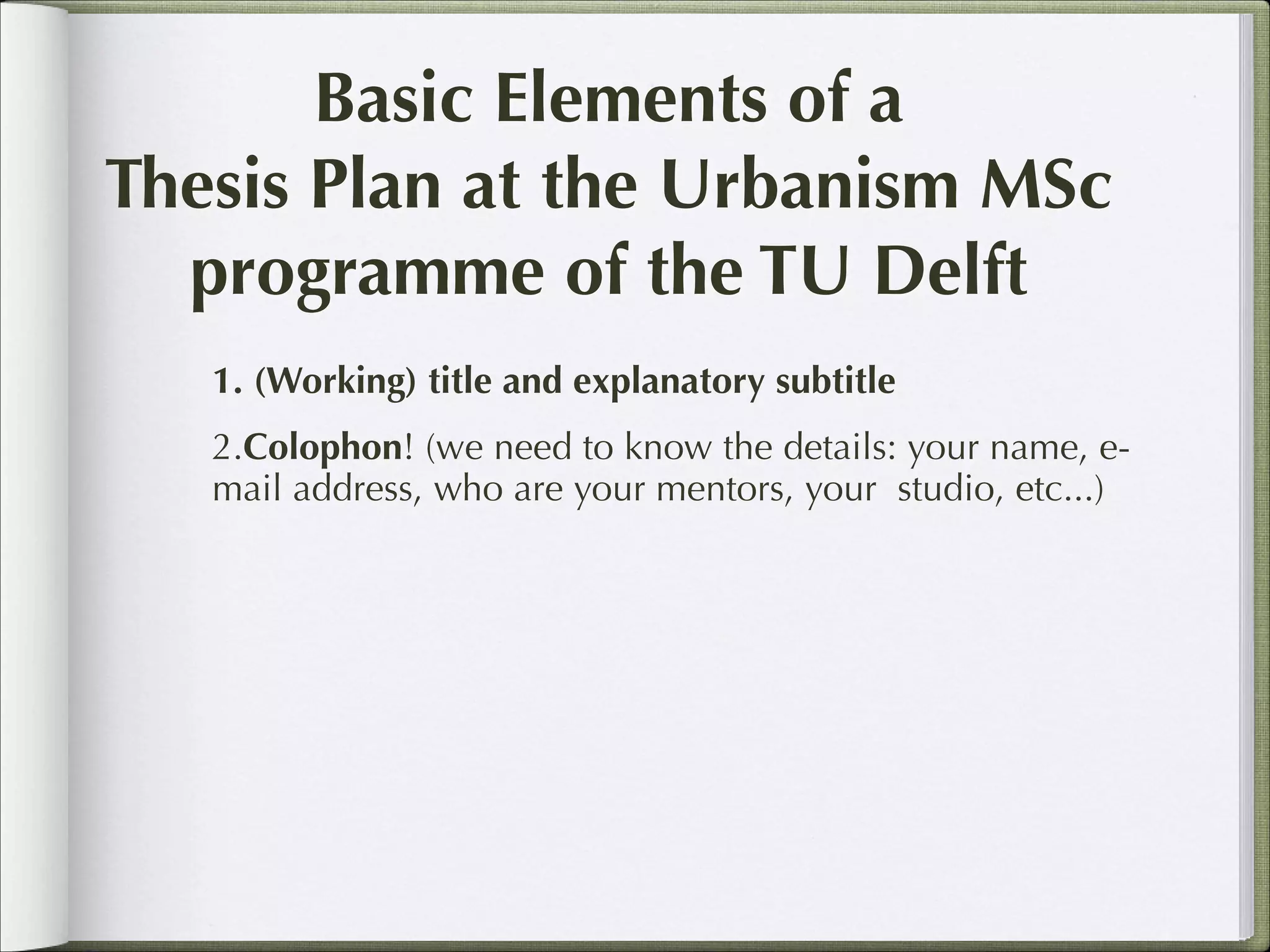
2.Colophon! (we need to know the details: your name, email address, who are your mentors, your studio, etc...)
Basic Elements of a
Thesis Plan at the Urbanism MSc
programme of the TU Delft
1. (Working) title and explanatory subtitle
2.Colophon! (we need to know the details: your name, email address, who are your mentors, your studio, etc...)
3. INTRODUCTION (summary, similar to an abstract in
a paper. Remember you have to be crystal clear here,
because this piece of text is supposed to “hook” the
reader and show them why your project is worth reading)
Basic Elements of a
Thesis Plan at the Urbanism MSc
programme of the TU Delft
1. (Working) title and explanatory subtitle
2.Colophon! (we need to know the details: your name, email address, who are your mentors, your studio, etc...)
3. INTRODUCTION (summary, similar to an abstract in
a paper. Remember you have to be crystal clear here,
because this piece of text is supposed to “hook” the
reader and show them why your project is worth reading)
4. A Description of the Problem and a Problem
Statement(Alternatively, you can describe the Context
and then introduce a problem)
Basic Elements of a
Thesis Plan
Basic Elements of a
Thesis Plan
5. Aims of the research and design project (what do you
want to achieve with this design and research project?)
Basic Elements of a
Thesis Plan
5. Aims of the research and design project (what do you
want to achieve with this design and research project?)
6. Research question(s): What do you have to answer in
order to achieve your aim IN A SPATIALLY RELATED
FRAMEWORK?
Basic Elements of a
Thesis Plan
5. Aims of the research and design project (what do you
want to achieve with this design and research project?)
6. Research question(s): What do you have to answer in
order to achieve your aim IN A SPATIALLY RELATED
FRAMEWORK?
7.AND/OR PROJECT OBJECTIVES! (the objectives you
want to achieve, with the information you have collected
preliminarily or was given to you by your studio)
Basic Elements of a
Thesis Plan
5. Aims of the research and design project (what do you
want to achieve with this design and research project?)
6. Research question(s): What do you have to answer in
order to achieve your aim IN A SPATIALLY RELATED
FRAMEWORK?
7.AND/OR PROJECT OBJECTIVES! (the objectives you
want to achieve, with the information you have collected
preliminarily or was given to you by your studio)
8. Sub-research questions (what questions do you have
to answer in order to clarify the underlying elements of
the main research question?)
Basic Elements of a
Thesis Plan
Basic Elements of a
Thesis Plan

9.Methodology
Basic Elements of a
Thesis Plan

9.Methodology
Yes, Methodology. Here, methodology refers to the critical and
structured description of the steps you are going to take in order
to answer your research questions WITHIN A THEORETICAL
FRAMEWORK (otherwise, we are talking loose methods)
Basic Elements of a
Thesis Plan

9.Methodology
Yes, Methodology. Here, methodology refers to the critical and
structured description of the steps you are going to take in order
to answer your research questions WITHIN A THEORETICAL
FRAMEWORK (otherwise, we are talking loose methods)
Tip: you almost always start with a literature review.
Basic Elements of a
Thesis Plan

9.Methodology
Yes, Methodology. Here, methodology refers to the critical and
structured description of the steps you are going to take in order
to answer your research questions WITHIN A THEORETICAL
FRAMEWORK (otherwise, we are talking loose methods)
Tip: you almost always start with a literature review.
10.Expected products and deliverables
Basic Elements of a
Thesis Plan

9.Methodology
Yes, Methodology. Here, methodology refers to the critical and
structured description of the steps you are going to take in order
to answer your research questions WITHIN A THEORETICAL
FRAMEWORK (otherwise, we are talking loose methods)
Tip: you almost always start with a literature review.
10.Expected products and deliverables
11.Societal and Scientific relevance
Basic Elements of a
Thesis Plan
Basic Elements of a
Thesis Plan
12.The ethical dimension (ethical problems
arising in your work)
Basic Elements of a
Thesis Plan
12.The ethical dimension (ethical problems
arising in your work)
13.Time-schedule
Basic Elements of a
Thesis Plan
12.The ethical dimension (ethical problems
arising in your work)
13.Time-schedule
14. Key words
Basic Elements of a
Thesis Plan
12.The ethical dimension (ethical problems
arising in your work)
13.Time-schedule
14. Key words
15.(Preliminary) Literature (in the CORRECT
format: HARVARD!)
Please, oh please!
DOWNLOAD
ENDNOTE FROM
BLACKBOARD
(and use it!)
But how do I start?
But how do I start?
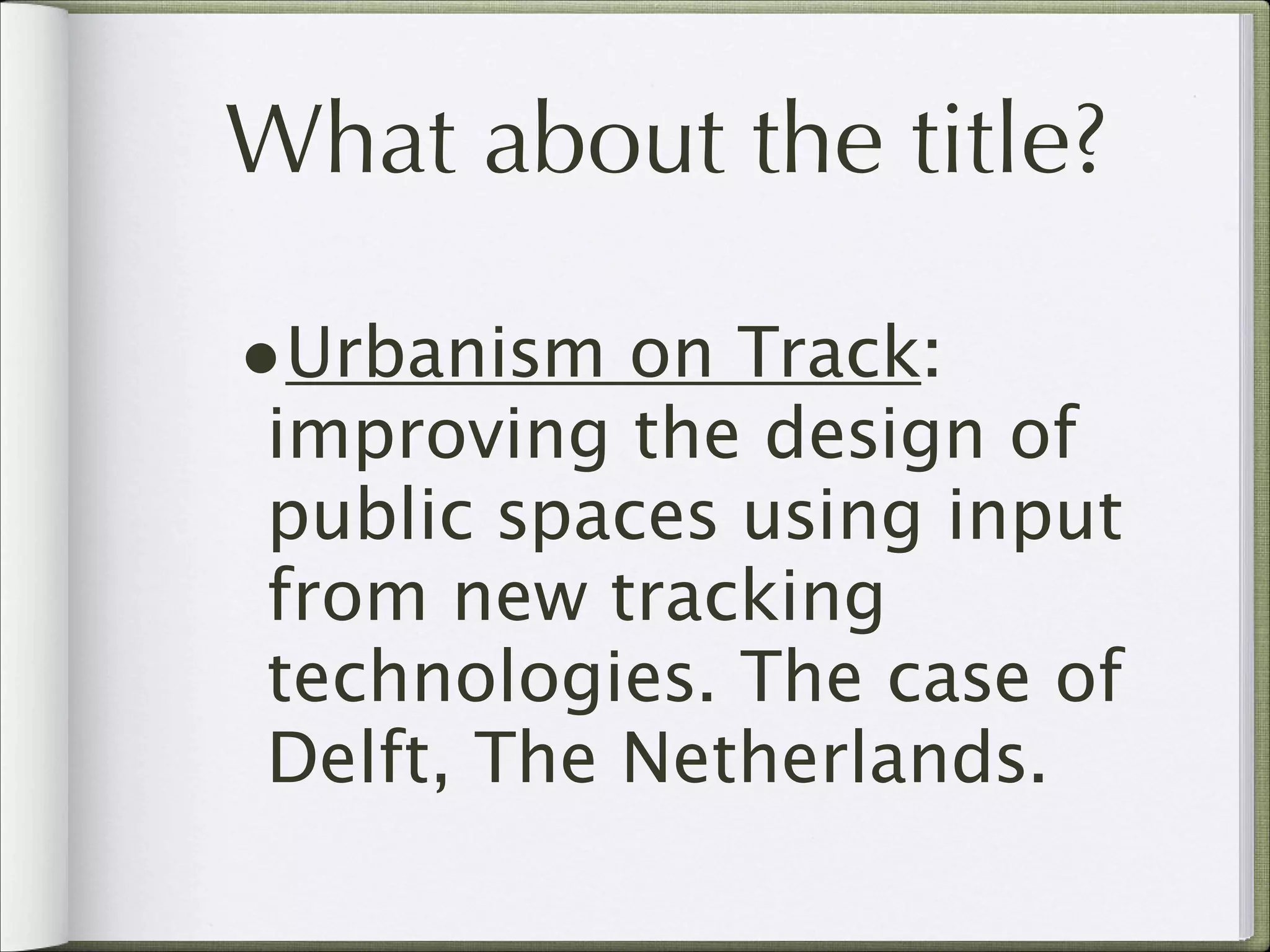
What about the title?
•Urbanism on Track:

improving the design of
public spaces using input
from new tracking
technologies. The case of
Delft, The Netherlands.
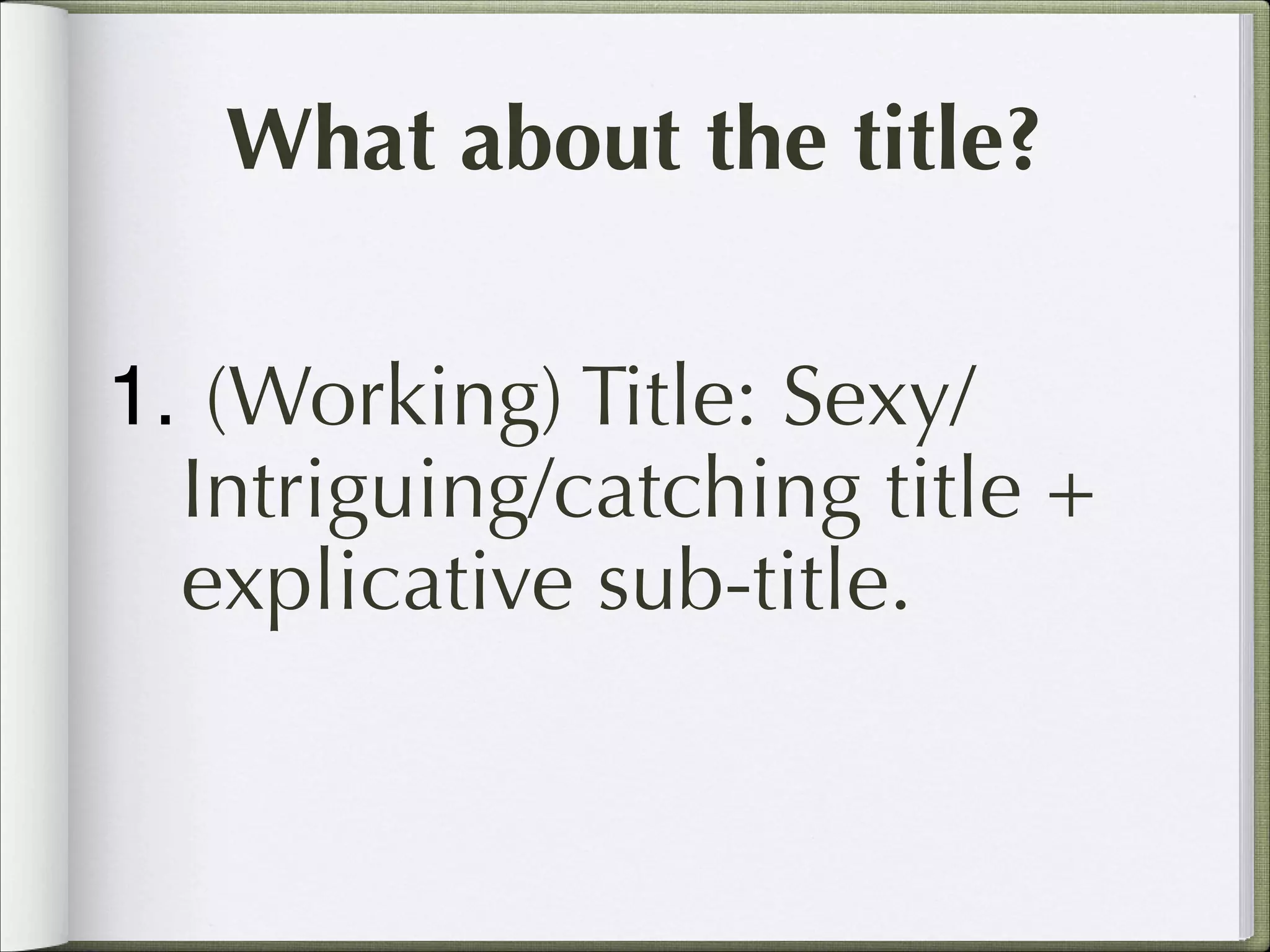
What about the title?
1. (Working) Title: Sexy/
Intriguing/catching title +
explicative sub-title.
A title should...
A title should...
•Hook the reader. You want the reader to be
intrigued and curious
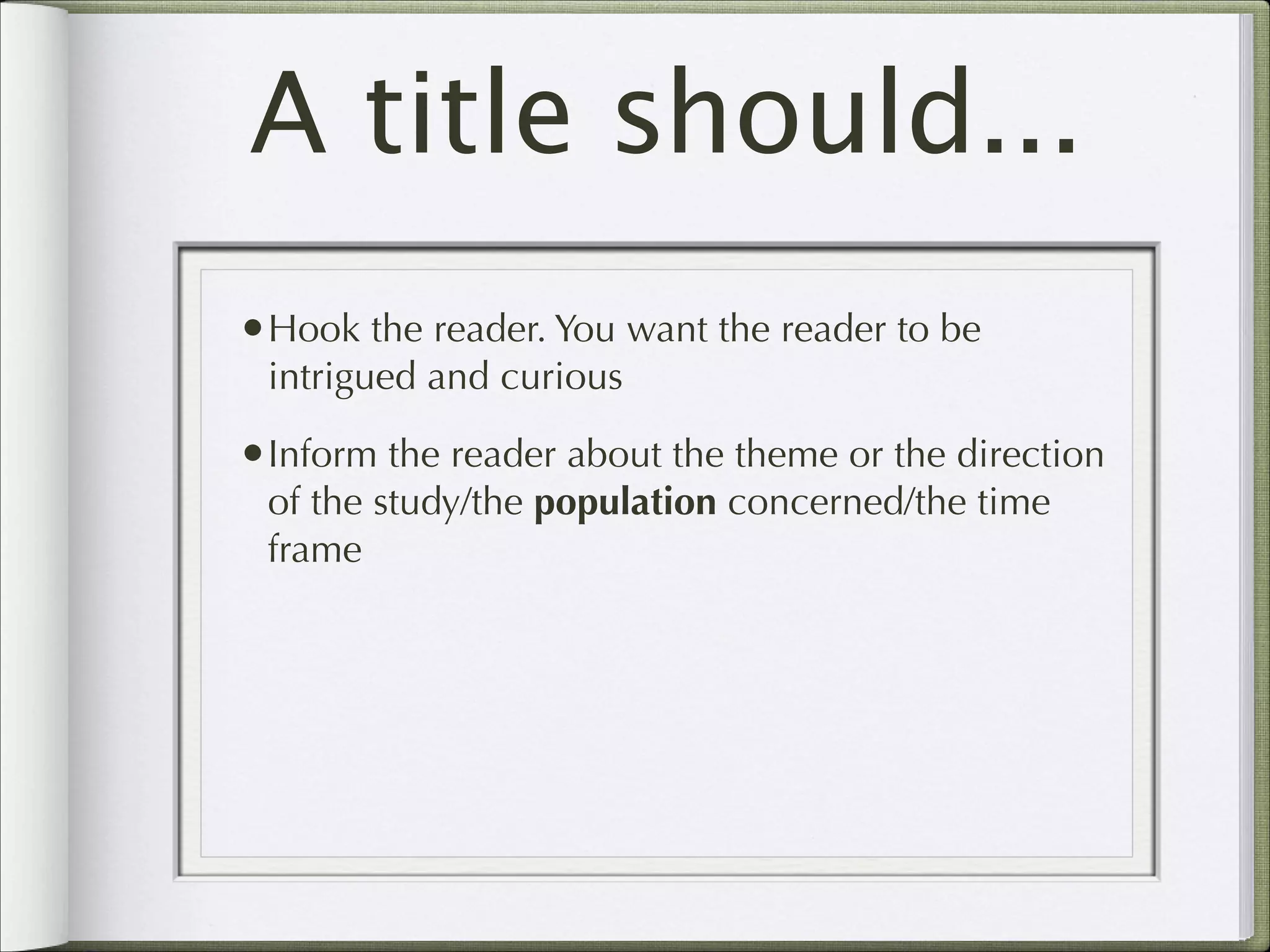
A title should...
•Hook the reader. You want the reader to be
intrigued and curious

•Inform the reader about the theme or the direction
of the study/the population concerned/the time
frame
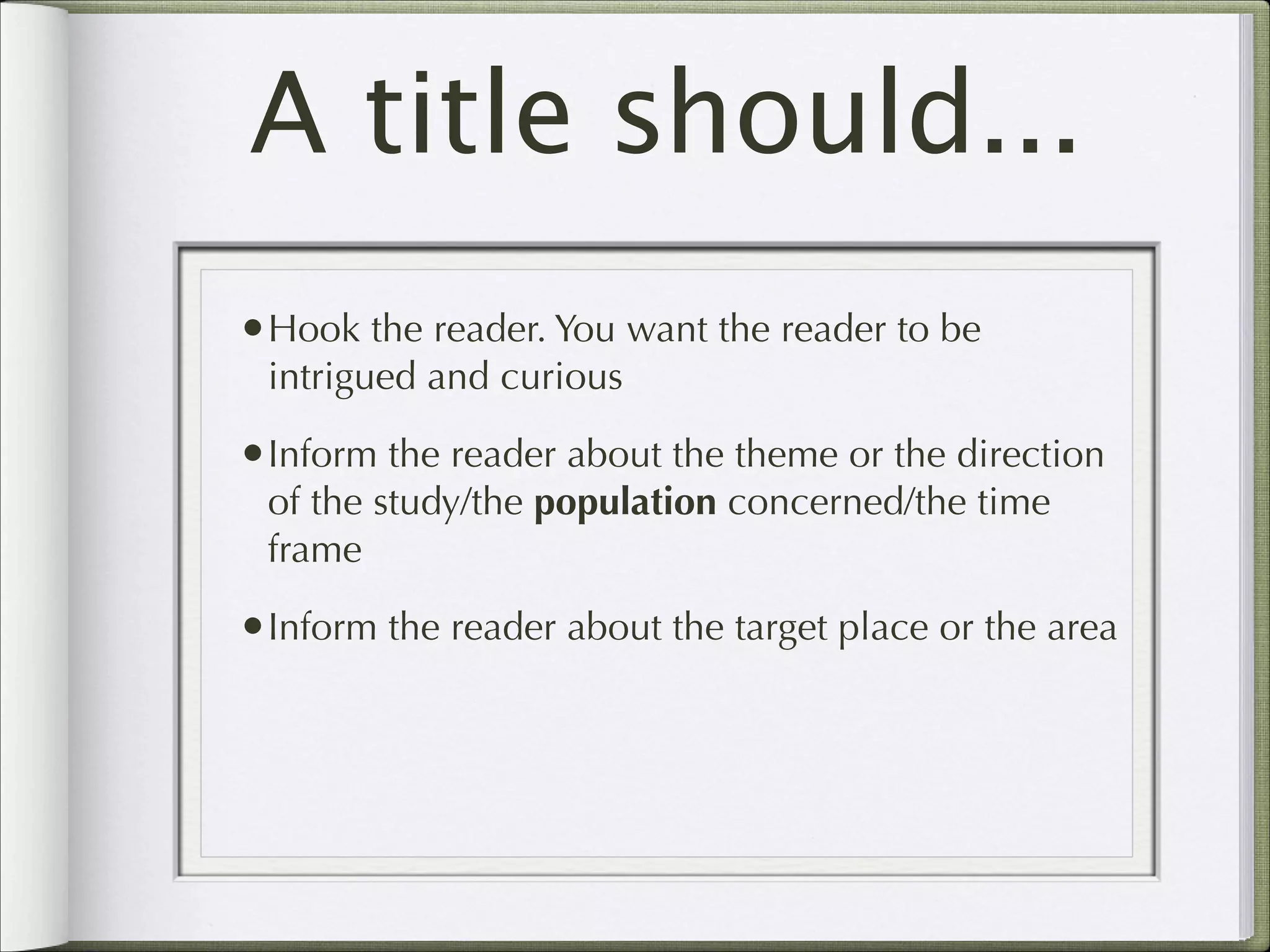
A title should...
•Hook the reader. You want the reader to be
intrigued and curious

•Inform the reader about the theme or the direction
of the study/the population concerned/the time
frame

•Inform the reader about the target place or the area
A title should...
•Hook the reader. You want the reader to be
intrigued and curious

•Inform the reader about the theme or the direction
of the study/the population concerned/the time
frame

•Inform the reader about the target place or the area
•Give some idea about possible results or solutions.
Alternatively, give an idea about the direction you
want to take.
The title
The title
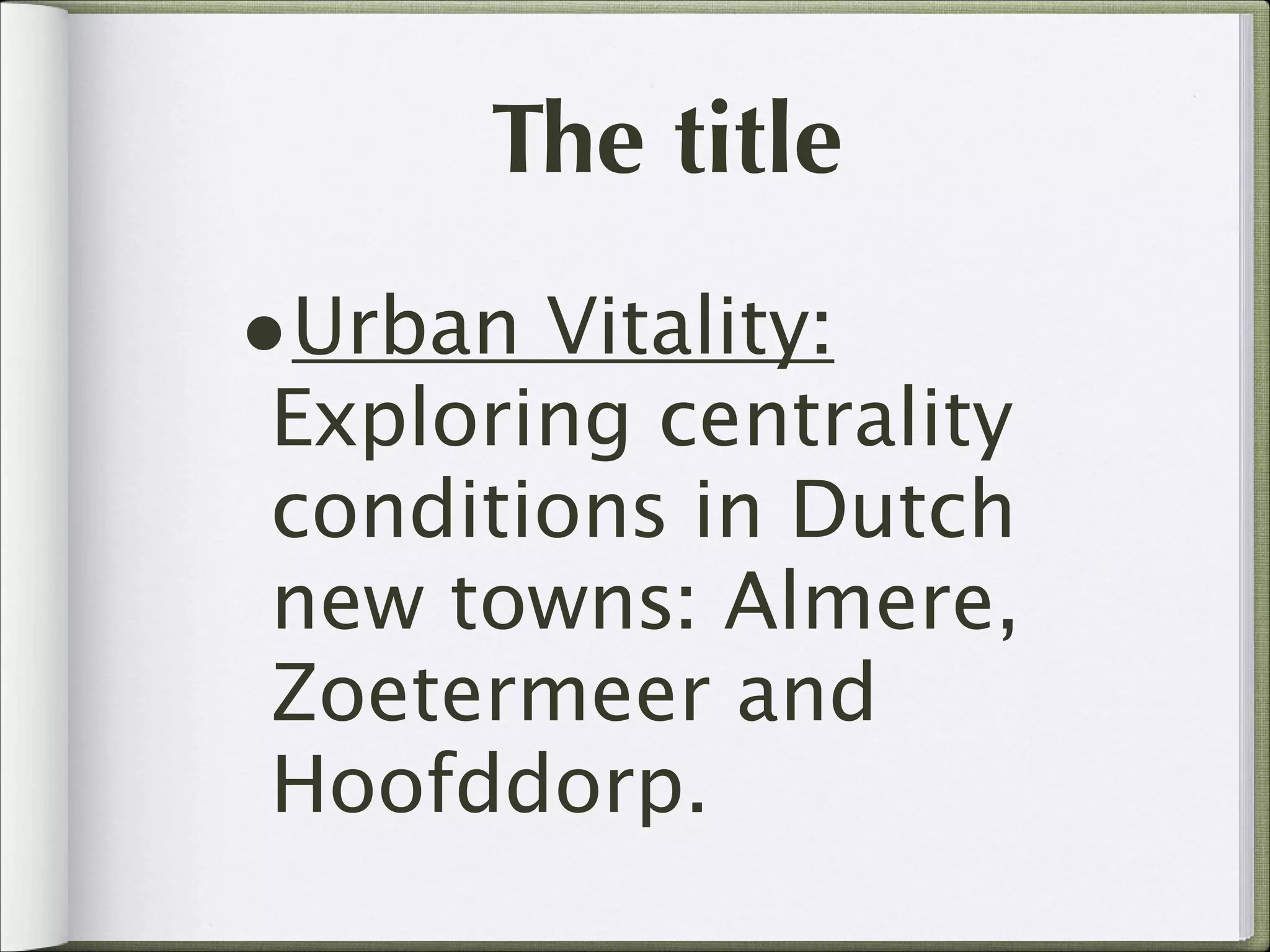
•Urban Vitality:

Exploring centrality
conditions in Dutch
new towns: Almere,
Zoetermeer and
Hoofddorp.
The title
The title
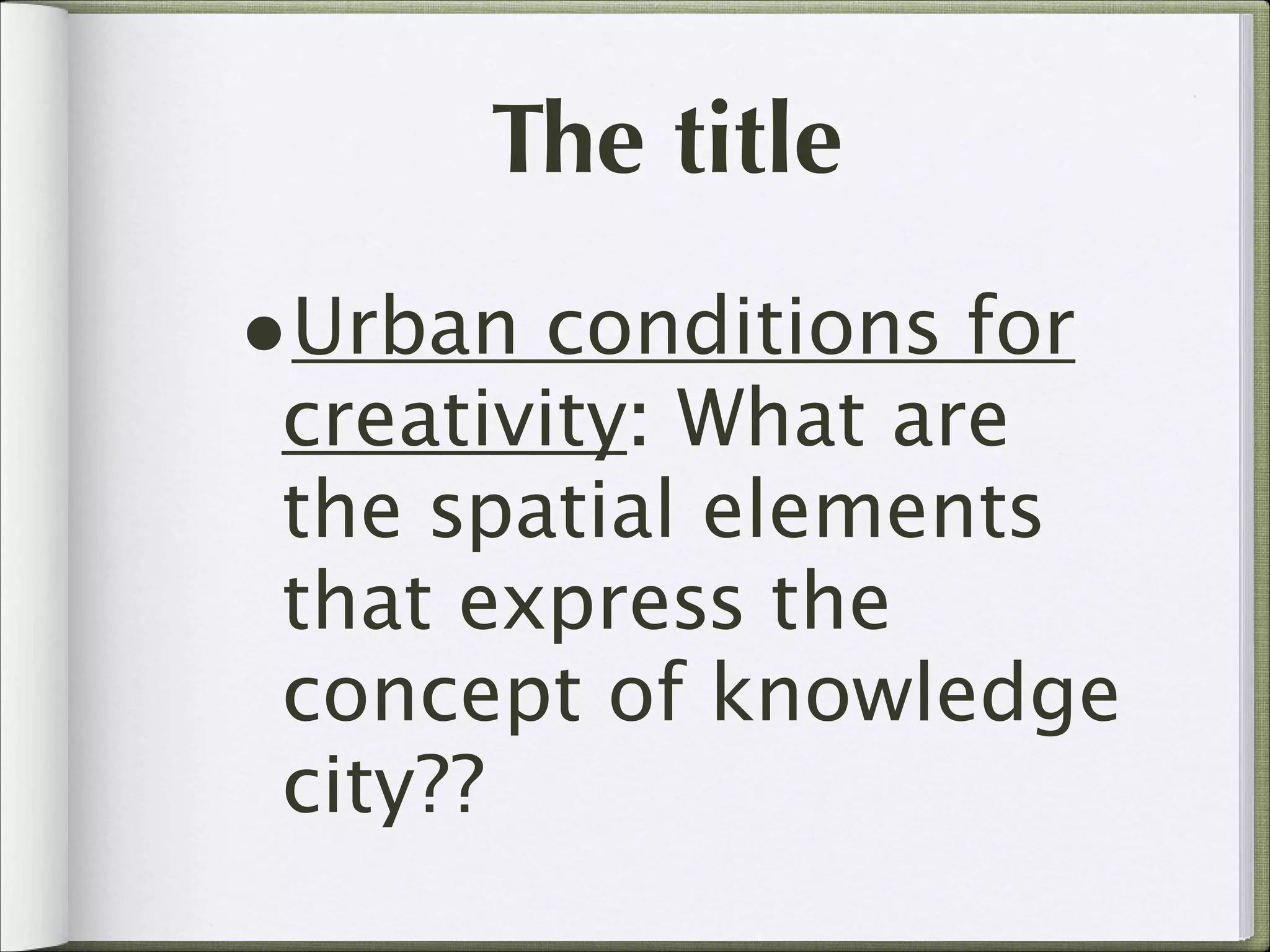
•Urban conditions for

creativity: What are
the spatial elements
that express the
concept of knowledge
city??
A title shouldn’t..
A title shouldn’t..
•Be too mystifying (mysterious)
A title shouldn’t..
•Be too mystifying (mysterious)
•Mislead the reader
A title shouldn’t..
•Be too mystifying (mysterious)
•Mislead the reader
•Be too long
A title shouldn’t..
•Be too mystifying (mysterious)
•Mislead the reader
•Be too long
•Consist only of sexy elements
without explanation
Playing in the garden of
good & evil: buildings,
gardens and streets as
elements for the
comprehension of the
sublimity of life in the urban
environment*
* This is a research and design project about redesign of modernist
neighbourhoods in North-western Europe, having Zoetermeer as main
case study
Reduce UHI effect by urban
geometry adjusting in
Beijing: search for
community scale design
principle in the topographic
and climatology context of
Beijing*
*This is a project about reducing urban heat effect, having Beijing as
the main case.
How to achieve integrated
urbanisation in the urban
periphery with the topdown project-based national
science park context, to
avoid fragmented and dual
development?
*This is a project about upgrading urbanisation in Chinese urban
peripheries
What about by creating a file with
all the headings?

Case study Nieuw-Dordrecht
improving local livability within the
perspective of regional transition

Thesis plan
20/07/11
Thomas Paul
1181181 | t.a.paul@gmail.com

1
The Problem Statement
The problem statement provides the context
for the research study and typically
generates QUESTIONS and OBJECTIVES
which the research hopes to answer
(objective of the research) and the design
hopes to solve (objective of the design)
In considering whether or not to move forward
with a research project, you will generally
spend some time considering the problem.
The Problem Statement
In your research project, the statement of
the problem is the first part of the
proposal to be read [apart from the title
and the abstract, if you decide to have
one]. The problem statement should
"hook" the reader and establish a
persuasive context for what follows.
The Problem Statement
You need to be able to clearly answer the
question: "what is the problem"? and "why
is this problem worth my attention"? (this
helps you define the RELEVANCE)
At the same time, the problem statement
limits scope by focusing on some
variables and not others. It also provides
an opportunity for you to demonstrate
why these variables are important.
Transferability
(in place of generalizability)
It is also important to be able to
make your problem ”transferable”.
Is it possible that the answers and
solutions you find can be used
somewhere else (even if variations?)
The Problem Statement
MOST IMPORTANT, your problem
must have some connection with
urban design, spatial planning or
landscape. This means that the
problem you want to analyse has
some connection with SPACE
(FGS*)! (*For God’s Sake!)
Pertinence
Pertinence
•Stating that China is industrialising

quickly is not a “pertinent” problem
(this is not a problem and anyway,
everybody knows that!).
Pertinence
•Stating that China is industrialising

quickly is not a “pertinent” problem
(this is not a problem and anyway,
everybody knows that!).

•Stating that the rapid industrialisation
of China is producing massive urban
growth and mass migration from
rural areas towards cities IS!
Pertinence
Pertinence
•Stating that the Delta Metropolis

needs to be defended from rising sea
levels is not as pertinent as...
Pertinence
•Stating that the Delta Metropolis

needs to be defended from rising sea
levels is not as pertinent as...

•Stating that the Delta Metropolis

needs to reconcile urbanisation with
the strengthening of its water defences
in order to create a more harmonic
living and productive environment.
The Problem Statement
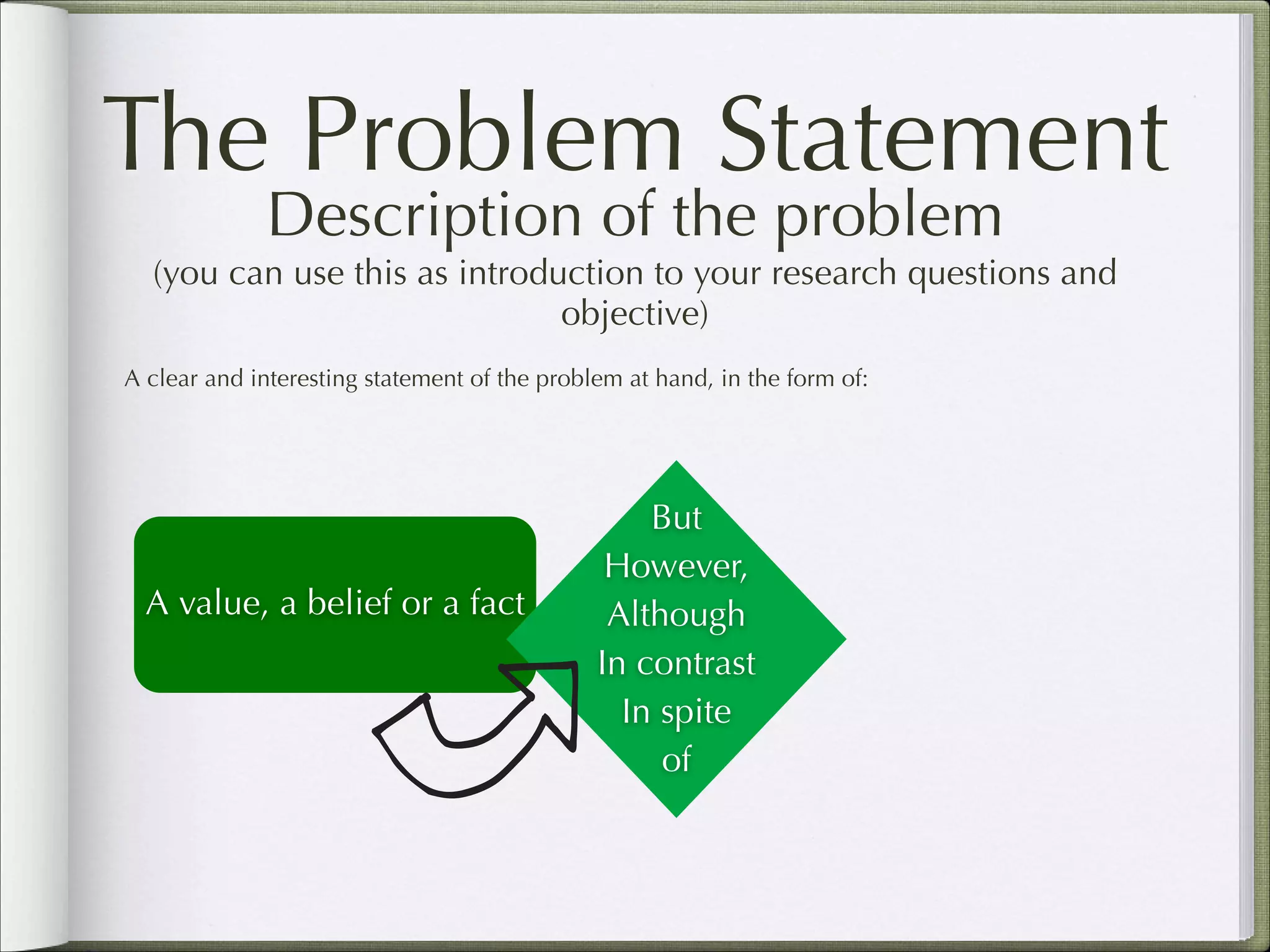
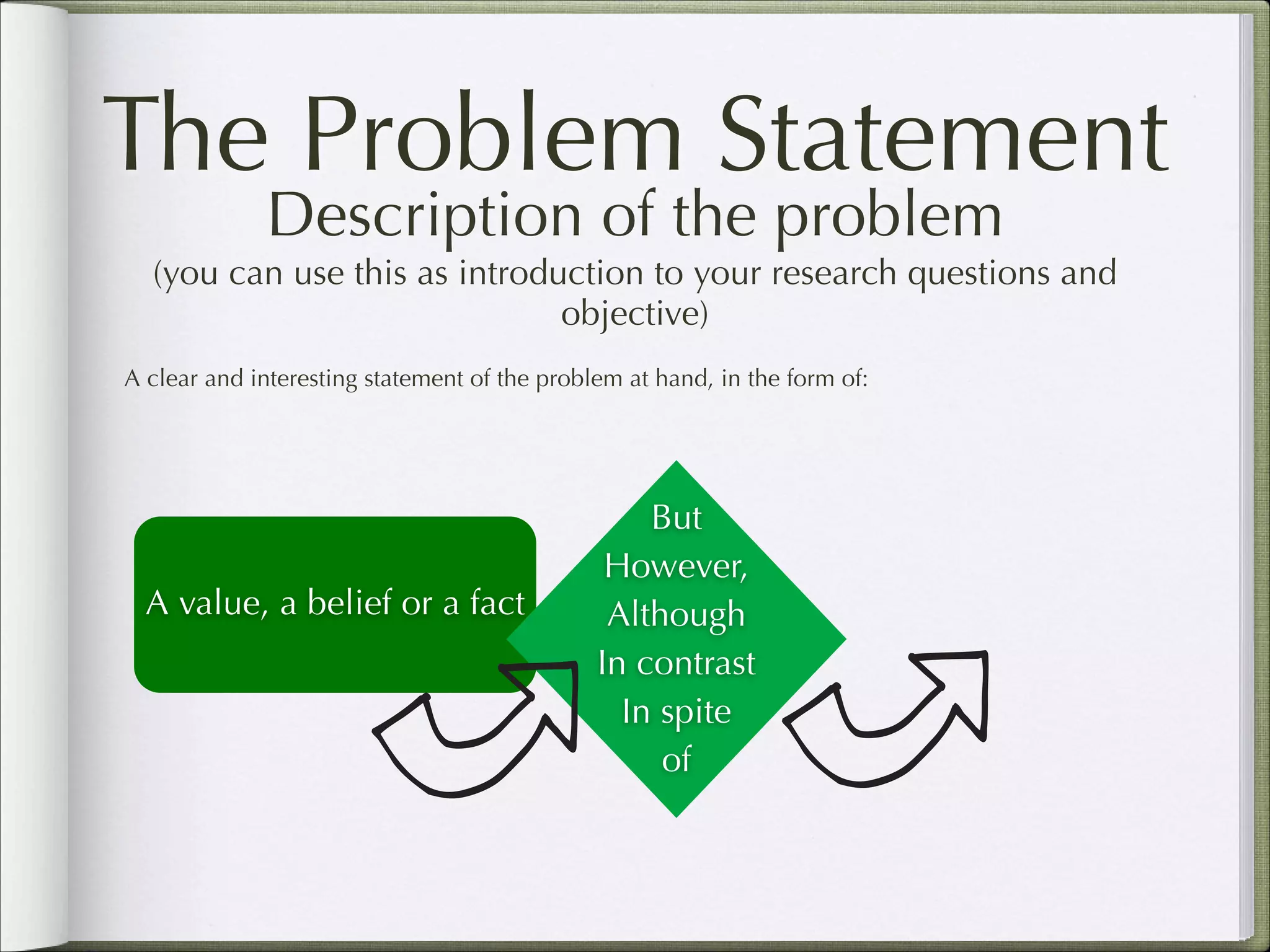
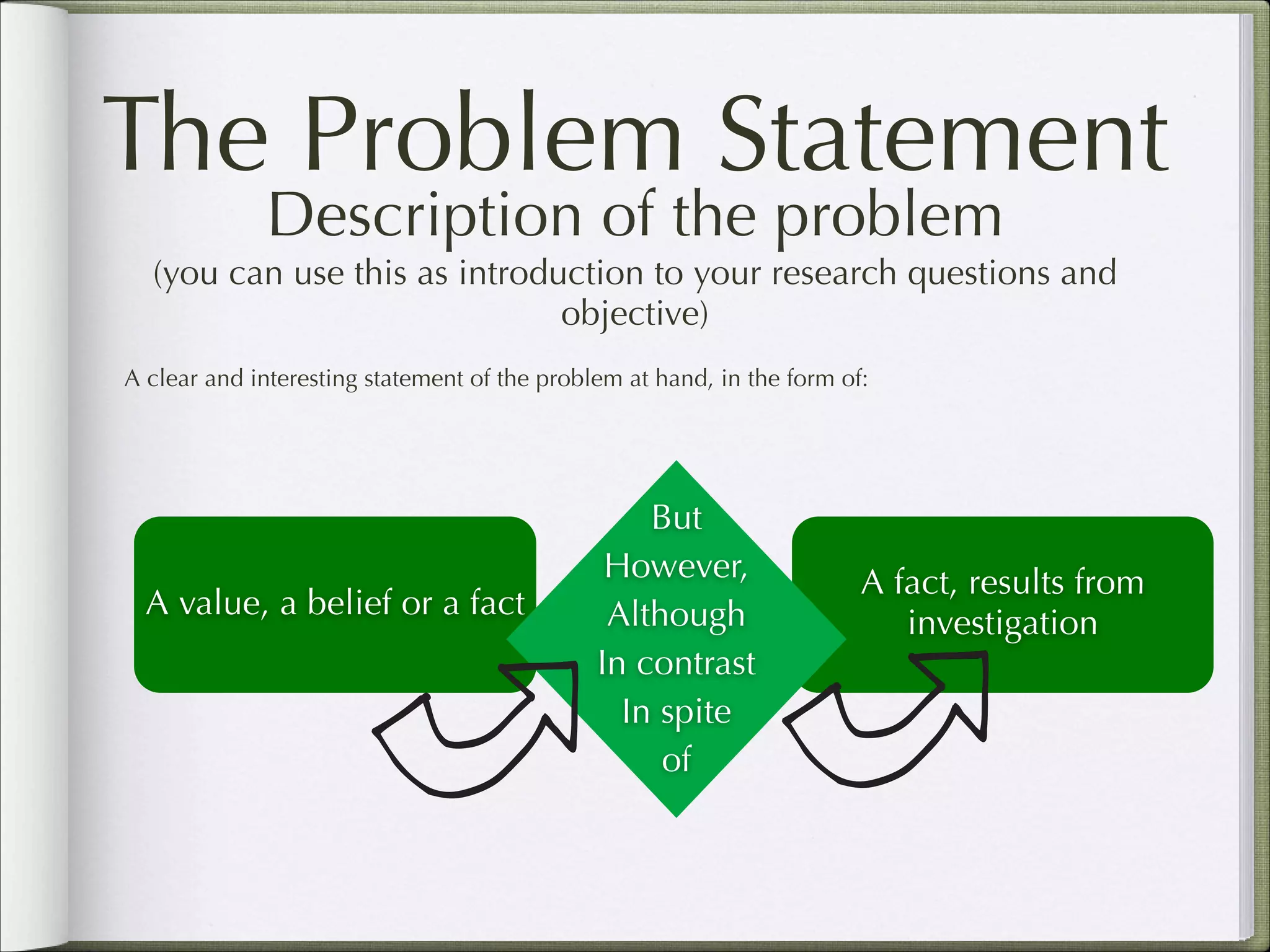
Description of the problem 


(you can use this as introduction to your research questions and
objective)
A clear and interesting statement of the problem at hand, in the form of:
The Problem Statement
Description of the problem 


(you can use this as introduction to your research questions and
objective)
A clear and interesting statement of the problem at hand, in the form of:

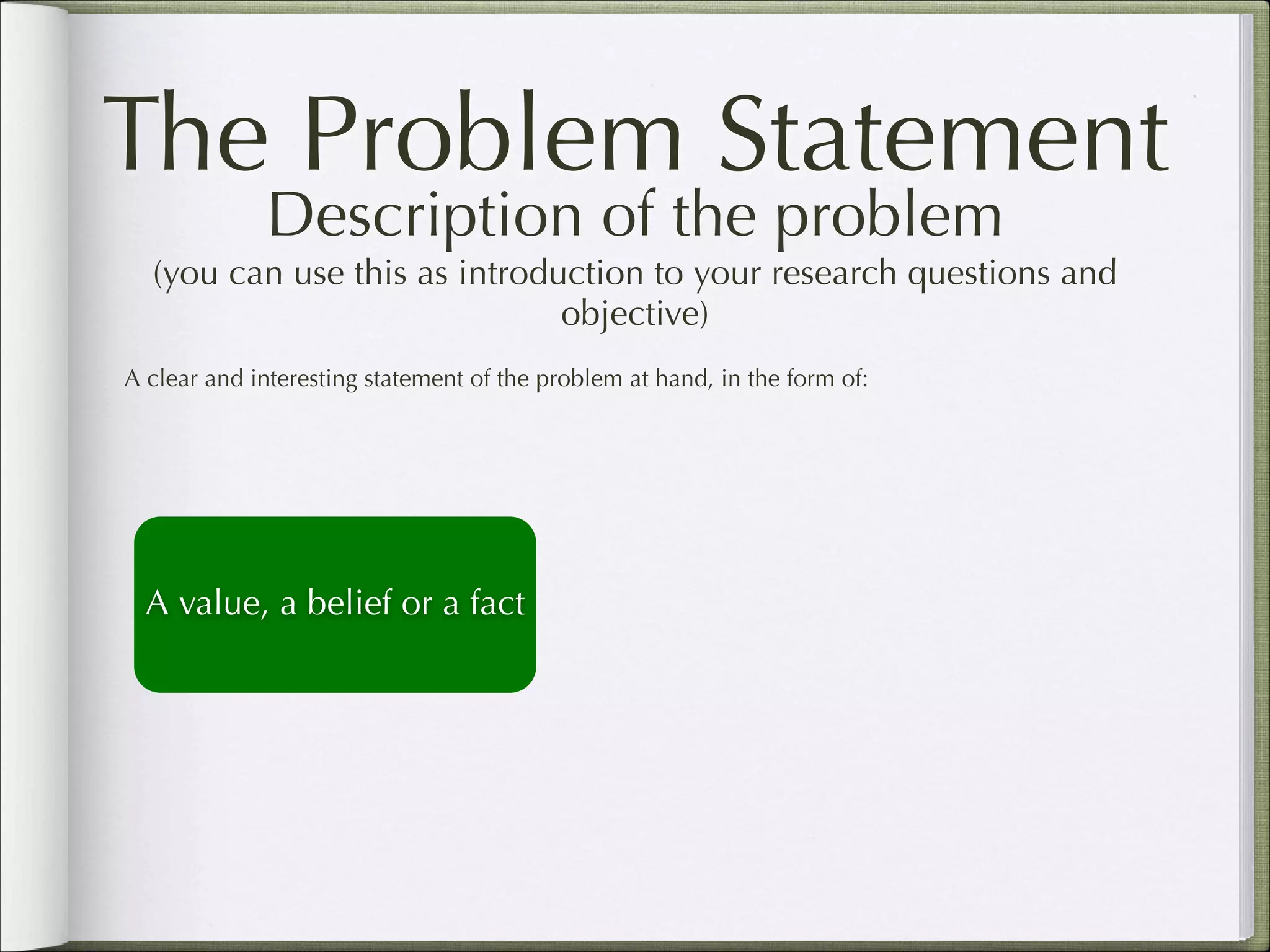
A value, a belief or a fact
The Problem Statement
Description of the problem 


(you can use this as introduction to your research questions and
objective)
A clear and interesting statement of the problem at hand, in the form of:

A value, a belief or a fact
The Problem Statement
Description of the problem 


(you can use this as introduction to your research questions and
objective)
A clear and interesting statement of the problem at hand, in the form of:

A value, a belief or a fact

But
However,
Although
In contrast
In spite
of
The Problem Statement
Description of the problem 


(you can use this as introduction to your research questions and
objective)
A clear and interesting statement of the problem at hand, in the form of:

A value, a belief or a fact

But
However,
Although
In contrast
In spite
of
The Problem Statement
Description of the problem 


(you can use this as introduction to your research questions and
objective)
A clear and interesting statement of the problem at hand, in the form of:

A value, a belief or a fact

But
However,
Although
In contrast
In spite
of

A fact, results from
investigation
Example
Example
Utrech city and municipality is the capital and most populous city of the Dutch
province of Utrecht. It is located in the eastern corner of the Randstad
conurbation, and is the fourth largest city of the Netherlands with a population
of 312,634 on 1 Jan 2011. It is a nodal location for many kinds of transportation
modes. The city also has a high pool of knowledge workers and a rich history,
which makes it a logical choice of large Dutch companies to locate.
Example
Utrech city and municipality is the capital and most populous city of the Dutch
province of Utrecht. It is located in the eastern corner of the Randstad
conurbation, and is the fourth largest city of the Netherlands with a population
of 312,634 on 1 Jan 2011. It is a nodal location for many kinds of transportation
modes. The city also has a high pool of knowledge workers and a rich history,
which makes it a logical choice of large Dutch companies to locate.

HOWEVER...
Example
According to Priemus (2008)*, Utrecht has lost most of its
competitiveness to Amsterdam and Rotterdam, because it
is not conveniently connected to global circuits. In
spatial terms, this means that international infrastructures
bypass the city. The inhabitants of Utrecht do not profit
from rapid train connections (the high speed line does
not stop in the city), the international airport of Schiphol
is relatively far away and the congestion of motor roads
makes it difficult for trucks coming from Germany or
Belgium to use the city as a exchange point.
* This is not an example drawn from real life.
The Problem Statement
Another question arises: is your problem
MANAGEABLE within the scope of spatial planning
and design?
The Problem Statement
Another question arises: is your problem
MANAGEABLE within the scope of spatial planning
and design?
Is your problem manageable within the scope of the
Masters Course of the TU Delft? (meaning: can you
research and find design solutions for that problem
within the framework given by the University)?
The Research Question
•

The MAIN research question (there might be more than one)
concerns the main elements of the problems statement that
you want to tackle in your research and design project
(therefore, we stick to spatial related features. Urban
regulations and planning laws are not spatial, but they are
certainly spatially related!):

•

Example: How to improve the competitiveness of Utrecht
using its unique geographical position and nodal functions as
leverage for development?
Sub-research questions
Sub research questions are questions that aim to answer
underlying elements of your main research question. They
might help you define your research strategy by highlighting
what are elements you need to know to answer your
research question.
Example:
1. How is city competitiveness related to physical
connectivity?
2. What are spatial/ geographical advantages of Utrecht?
3. How is the city of Utrecht performing in the Randstad?
Thank you for watching

Any questions?
This presentation was prepared by Roberto Rocco of the Chair
Spatial Planning and Strategy of the Department of Urbanism,
Tu Delft. For more information please write: r.c.rocco@tudelft.nl
SpatialPlanning
&Strategy

Elements of a research project

  • 1.
    Elements of a ResearchProject Directed to the Master of Urbanism of the TU !Delft ! ! Prepared by Roberto Rocco ! AR2U090 Methodology for Urbanism SpatialPlanning &Strategy Challenge the future
  • 2.
    A Masters degree Amaster's degree is an academic degree granted to individuals who have undergone study demonstrating a mastery or high-order overview of a specific field of study or area of professional practice. Within the area studied, graduates are posited to possess advanced knowledge of a specialised body of theoretical and applied topics; high order skills in analysis, critical evaluation and/or professional application; and the ability to solve complex problems and think rigorously and independently. Source: The Australian Qualification Framewrok http://www.aqf.edu.au/
  • 4.
    Possible research anddesign trajectories at the master course at TU Delft
  • 5.
    Possible research anddesign trajectories at the master course at TU Delft RESEARCH
  • 6.
    Possible research anddesign trajectories at the master course at TU Delft RESEARCH TO STAND ON THE SHOULDER OF GIANTS
  • 7.
    Possible research anddesign trajectories at the master course at TU Delft RESEARCH TO STAND ON THE SHOULDER OF GIANTS ADD TO BODY OF KNOWLEDGE
  • 8.
    Possible research anddesign trajectories at the master course at TU Delft RESEARCH TO STAND ON THE SHOULDER OF GIANTS ADD TO BODY OF KNOWLEDGE
  • 9.
    Possible research anddesign trajectories at the master course at TU Delft RESEARCH TO STAND ON THE SHOULDER OF GIANTS ADD TO BODY OF KNOWLEDGE GUIDELINES FOR DESIGN
  • 10.
    Possible research anddesign trajectories at the master course at TU Delft RESEARCH RESEARCH TO STAND ON THE SHOULDER OF GIANTS ADD TO BODY OF KNOWLEDGE GUIDELINES FOR DESIGN
  • 11.
    Possible research anddesign trajectories at the master course at TU Delft RESEARCH RESEARCH TO STAND ON THE SHOULDER OF GIANTS ADD TO BODY OF KNOWLEDGE ADD TO BODY OF KNOWLEDGE GUIDELINES FOR DESIGN
  • 12.
    Possible research anddesign trajectories at the master course at TU Delft RESEARCH RESEARCH TO STAND ON THE SHOULDER OF GIANTS ADD TO BODY OF KNOWLEDGE ADD TO BODY OF KNOWLEDGE GUIDELINES FOR DESIGN
  • 13.
    Possible research anddesign trajectories at the master course at TU Delft RESEARCH RESEARCH TO STAND ON THE SHOULDER OF GIANTS ADD TO BODY OF KNOWLEDGE ADD TO BODY OF KNOWLEDGE DESIGN GUIDELINES FOR DESIGN
  • 14.
    Possible research anddesign trajectories at the master course at TU Delft RESEARCH RESEARCH TO STAND ON THE SHOULDER OF GIANTS ADD TO BODY OF KNOWLEDGE ADD TO BODY OF KNOWLEDGE DESIGN GUIDELINES FOR DESIGN
  • 15.
    Possible research anddesign trajectories at the master course at TU Delft RESEARCH RESEARCH TO STAND ON THE SHOULDER OF GIANTS ADD TO BODY OF KNOWLEDGE ADD TO BODY OF KNOWLEDGE DESIGN GUIDELINES FOR DESIGN RESEARCH AND DESIGN
  • 16.
    Possible research anddesign trajectories at the master course at TU Delft RESEARCH RESEARCH RESEARCH TO STAND ON THE SHOULDER OF GIANTS ADD TO BODY OF KNOWLEDGE ADD TO BODY OF KNOWLEDGE DESIGN GUIDELINES FOR DESIGN RESEARCH AND DESIGN
  • 17.
    Possible research anddesign trajectories at the master course at TU Delft RESEARCH RESEARCH ADD TO BODY OF KNOWLEDGE RESEARCH TO STAND ON THE SHOULDER OF GIANTS ADD TO BODY OF KNOWLEDGE ADD TO BODY OF KNOWLEDGE DESIGN GUIDELINES FOR DESIGN RESEARCH AND DESIGN
  • 18.
    Possible research anddesign trajectories at the master course at TU Delft RESEARCH RESEARCH TO STAND ON THE SHOULDER OF GIANTS ADD TO BODY OF KNOWLEDGE ADD TO BODY OF KNOWLEDGE DESIGN ADD TO BODY OF KNOWLEDGE RESEARCH DESIGN GUIDELINES FOR DESIGN RESEARCH AND DESIGN
  • 19.
    Possible research anddesign trajectories at the master course at TU Delft RESEARCH RESEARCH TO STAND ON THE SHOULDER OF GIANTS ADD TO BODY OF KNOWLEDGE ADD TO BODY OF KNOWLEDGE DESIGN ADD TO BODY OF KNOWLEDGE RESEARCH DESIGN GUIDELINES FOR DESIGN RESEARCH AND DESIGN
  • 20.
    Possible research anddesign trajectories at the master course at TU Delft RESEARCH RESEARCH TO STAND ON THE SHOULDER OF GIANTS ADD TO BODY OF KNOWLEDGE ADD TO BODY OF KNOWLEDGE DESIGN ADD TO BODY OF KNOWLEDGE RESEARCH DESIGN GUIDELINES FOR DESIGN RESEARCH AND DESIGN
  • 21.
    Possible research anddesign trajectories at the master course at TU Delft RESEARCH RESEARCH TO STAND ON THE SHOULDER OF GIANTS ADD TO BODY OF KNOWLEDGE ADD TO BODY OF KNOWLEDGE DESIGN ADD TO BODY OF KNOWLEDGE RESEARCH DESIGN GUIDELINES FOR DESIGN RESEARCH AND DESIGN
  • 22.
    Possible research anddesign trajectories at the master course at TU Delft RESEARCH RESEARCH TO STAND ON THE SHOULDER OF GIANTS ADD TO BODY OF KNOWLEDGE ADD TO BODY OF KNOWLEDGE DESIGN ADD TO BODY OF KNOWLEDGE RESEARCH DESIGN GUIDELINES FOR DESIGN RESEARCH AND DESIGN
  • 23.
    Possible research anddesign trajectories at the master course at TU Delft RESEARCH RESEARCH TO STAND ON THE SHOULDER OF GIANTS ADD TO BODY OF KNOWLEDGE ADD TO BODY OF KNOWLEDGE DESIGN ADD TO BODY OF KNOWLEDGE RESEARCH DESIGN GUIDELINES FOR DESIGN RESEARCH AND DESIGN
  • 24.
    Possible research anddesign trajectories at the master course at TU Delft RESEARCH RESEARCH TO STAND ON THE SHOULDER OF GIANTS ADD TO BODY OF KNOWLEDGE ADD TO BODY OF KNOWLEDGE DESIGN ADD TO BODY OF KNOWLEDGE RESEARCH DESIGN GUIDELINES FOR DESIGN RESEARCH AND DESIGN
  • 25.
    Possible research anddesign trajectories at the master course at TU Delft RESEARCH RESEARCH TO STAND ON THE SHOULDER OF GIANTS ADD TO BODY OF KNOWLEDGE ADD TO BODY OF KNOWLEDGE DESIGN ADD TO BODY OF KNOWLEDGE RESEARCH DESIGN GUIDELINES FOR DESIGN RESEARCH AND DESIGN
  • 26.
    Possible research anddesign trajectories at the master course at TU Delft RESEARCH RESEARCH TO STAND ON THE SHOULDER OF GIANTS ADD TO BODY OF KNOWLEDGE ADD TO BODY OF KNOWLEDGE DESIGN ADD TO BODY OF KNOWLEDGE RESEARCH DESIGN GUIDELINES FOR DESIGN RESEARCH AND DESIGN
  • 27.
    Possible research anddesign trajectories at the master course at TU Delft RESEARCH RESEARCH TO STAND ON THE SHOULDER OF GIANTS ADD TO BODY OF KNOWLEDGE ADD TO BODY OF KNOWLEDGE DESIGN ADD TO BODY OF KNOWLEDGE RESEARCH DESIGN GUIDELINES FOR DESIGN RESEARCH AND DESIGN
  • 28.
    Possible research anddesign trajectories at the master course at TU Delft RESEARCH RESEARCH TO STAND ON THE SHOULDER OF GIANTS ADD TO BODY OF KNOWLEDGE ADD TO BODY OF KNOWLEDGE DESIGN ADD TO BODY OF KNOWLEDGE RESEARCH DESIGN GUIDELINES FOR DESIGN RESEARCH AND DESIGN
  • 29.
    Possible research anddesign trajectories at the master course at TU Delft RESEARCH RESEARCH TO STAND ON THE SHOULDER OF GIANTS ADD TO BODY OF KNOWLEDGE ADD TO BODY OF KNOWLEDGE DESIGN ADD TO BODY OF KNOWLEDGE RESEARCH DESIGN GUIDELINES FOR DESIGN RESEARCH AND DESIGN
  • 30.
    Possible research anddesign trajectories at the master course at TU Delft RESEARCH RESEARCH TO STAND ON THE SHOULDER OF GIANTS ADD TO BODY OF KNOWLEDGE ADD TO BODY OF KNOWLEDGE DESIGN ADD TO BODY OF KNOWLEDGE RESEARCH DESIGN GUIDELINES FOR DESIGN RESEARCH AND DESIGN
  • 31.
    Possible research anddesign trajectories at the master course at TU Delft RESEARCH RESEARCH TO STAND ON THE SHOULDER OF GIANTS ADD TO BODY OF KNOWLEDGE ADD TO BODY OF KNOWLEDGE DESIGN ADD TO BODY OF KNOWLEDGE RESEARCH DESIGN GUIDELINES FOR DESIGN RESEARCH AND DESIGN
  • 32.
    Possible research anddesign trajectories at the master course at TU Delft RESEARCH RESEARCH TO STAND ON THE SHOULDER OF GIANTS ADD TO BODY OF KNOWLEDGE ADD TO BODY OF KNOWLEDGE DESIGN ADD TO BODY OF KNOWLEDGE RESEARCH DESIGN GUIDELINES FOR DESIGN RESEARCH AND DESIGN
  • 33.
    Possible research anddesign trajectories at the master course at TU Delft RESEARCH RESEARCH TO STAND ON THE SHOULDER OF GIANTS ADD TO BODY OF KNOWLEDGE ADD TO BODY OF KNOWLEDGE DESIGN GUIDELINES FOR DESIGN RESEARCH AND DESIGN ADD TO BODY OF KNOWLEDGE RESEARCH DESIGN RESEARCH BY DESIGN
  • 34.
    Possible research anddesign trajectories at the master course at TU Delft RESEARCH RESEARCH TO STAND ON THE SHOULDER OF GIANTS ADD TO BODY OF KNOWLEDGE ADD TO BODY OF KNOWLEDGE DESIGN GUIDELINES FOR DESIGN RESEARCH AND DESIGN ADD TO BODY OF KNOWLEDGE RESEARCH DESIGN USE THE BODY OF KNOWLEDGE RESEARCH BY DESIGN
  • 35.
    Possible research anddesign trajectories at the master course at TU Delft RESEARCH RESEARCH TO STAND ON THE SHOULDER OF GIANTS ADD TO BODY OF KNOWLEDGE ADD TO BODY OF KNOWLEDGE DESIGN GUIDELINES FOR DESIGN RESEARCH AND DESIGN ADD TO BODY OF KNOWLEDGE RESEARCH DESIGN USE THE BODY OF KNOWLEDGE DESIGN RESEARCH BY DESIGN
  • 36.
    Possible research anddesign trajectories at the master course at TU Delft RESEARCH RESEARCH TO STAND ON THE SHOULDER OF GIANTS ADD TO BODY OF KNOWLEDGE ADD TO BODY OF KNOWLEDGE DESIGN GUIDELINES FOR DESIGN RESEARCH AND DESIGN ADD TO BODY OF KNOWLEDGE RESEARCH DESIGN RESEARCH BY DESIGN USE THE BODY OF KNOWLEDGE DESIGN MEANINGLESS DESIGN
  • 37.
    Possible research anddesign trajectories at the master course at TU Delft RESEARCH RESEARCH TO STAND ON THE SHOULDER OF GIANTS ADD TO BODY OF KNOWLEDGE ADD TO BODY OF KNOWLEDGE DESIGN GUIDELINES FOR DESIGN RESEARCH AND DESIGN ADD TO BODY OF KNOWLEDGE RESEARCH DESIGN RESEARCH BY DESIGN USE THE BODY OF KNOWLEDGE DESIGN MEANINGLESS DESIGN
  • 38.
    Possible research anddesign trajectories at the master course at TU Delft RESEARCH RESEARCH TO STAND ON THE SHOULDER OF GIANTS ADD TO BODY OF KNOWLEDGE ADD TO BODY OF KNOWLEDGE DESIGN GUIDELINES FOR DESIGN RESEARCH AND DESIGN ADD TO BODY OF KNOWLEDGE RESEARCH DESIGN RESEARCH BY DESIGN USE THE BODY OF KNOWLEDGE DESIGN MEANINGLESS DESIGN
  • 39.
    Possible research anddesign trajectories at the master course at TU Delft RESEARCH RESEARCH TO STAND ON THE SHOULDER OF GIANTS ADD TO BODY OF KNOWLEDGE ADD TO BODY OF KNOWLEDGE DESIGN GUIDELINES FOR DESIGN RESEARCH AND DESIGN ADD TO BODY OF KNOWLEDGE RESEARCH DESIGN RESEARCH BY DESIGN USE THE BODY OF KNOWLEDGE DESIGN MEANINGLESS DESIGN
  • 40.
    Possible research anddesign trajectories at the master course at TU Delft RESEARCH RESEARCH TO STAND ON THE SHOULDER OF GIANTS ADD TO BODY OF KNOWLEDGE ADD TO BODY OF KNOWLEDGE DESIGN GUIDELINES FOR DESIGN RESEARCH AND DESIGN ADD TO BODY OF KNOWLEDGE RESEARCH DESIGN RESEARCH BY DESIGN USE THE BODY OF KNOWLEDGE MEANINGLESS DESIGN
  • 41.
    Possible research anddesign trajectories at the master course at TU Delft RESEARCH RESEARCH TO STAND ON THE SHOULDER OF GIANTS ADD TO BODY OF KNOWLEDGE ADD TO BODY OF KNOWLEDGE DESIGN GUIDELINES FOR DESIGN RESEARCH AND DESIGN ADD TO BODY OF KNOWLEDGE RESEARCH DESIGN USE THE BODY OF KNOWLEDGE RESEARCH BY DESIGN
  • 42.
    8 criteria forresearch in areas of creative practice Biggs & Buchler, 2008 • Four ‘requirements’ of academic research (that apply to all disciplines) • Four ‘issues’ in areas of creative practice (discipline specific) BIGGS, M. & BUCHLER, D. 2008. Eight Criteria for practice-based research in the creative and cultural industries. Art, Design and Education in Higher Education, 7.
  • 43.
    Generic criteria Biggs & Buchler,2008 • Question (and answer) • Method • Knowledge • Audience BIGGS, M. & BUCHLER, D. 2008. Eight Criteria for practice-based research in the creative and cultural industries. Art, Design and Education in Higher Education, 7.
  • 44.
    Generic criteria Biggs & Buchler,2008 Question • Question (and answer) • Method • Knowledge • Audience BIGGS, M. & BUCHLER, D. 2008. Eight Criteria for practice-based research in the creative and cultural industries. Art, Design and Education in Higher Education, 7.
  • 45.
    Generic criteria Biggs & Buchler,2008 Question Answer • Question (and answer) • Method • Knowledge • Audience BIGGS, M. & BUCHLER, D. 2008. Eight Criteria for practice-based research in the creative and cultural industries. Art, Design and Education in Higher Education, 7.
  • 46.
    Generic criteria Biggs & Buchler,2008 Question Answer • Question (and answer) • Method Methods • Knowledge • Audience BIGGS, M. & BUCHLER, D. 2008. Eight Criteria for practice-based research in the creative and cultural industries. Art, Design and Education in Higher Education, 7.
  • 47.
    Generic criteria Biggs & Buchler,2008 Question Answer • Question (and answer) • Method Methods • Knowledge • Audience BIGGS, M. & BUCHLER, D. 2008. Eight Criteria for practice-based research in the creative and cultural industries. Art, Design and Education in Higher Education, 7.
  • 48.
    Generic criteria Biggs & Buchler,2008 Question Answer • Question (and answer) • Method Methods • Knowledge • Audience But remember the different logics of enquiry! BIGGS, M. & BUCHLER, D. 2008. Eight Criteria for practice-based research in the creative and cultural industries. Art, Design and Education in Higher Education, 7.
  • 49.
    Specific criteria Biggs &Buchler, 2008 Question Answer • Image and text • Form and content Methods • Rhetoric • Role of Experience (or practice) BIGGS, M. & BUCHLER, D. 2008. Eight Criteria for practice-based research in the creative and cultural industries. Art, Design and Education in Higher Education, 7.
  • 50.
    Specific criteria Biggs &Buchler, 2008 Question Answer • Image and text • Form and content Methods • Rhetoric • Role of Gre Experience (or practice) BIGGS, M. & BUCHLER, D. 2008. Eight Criteria for practice-based research in the creative and cultural industries. Art, Design and Education in Higher Education, 7.
  • 51.
    Specific criteria Biggs &Buchler, 2008 Question Answer Discipline specific audience Methods • Image and text • Form and content • Rhetoric • Role of Gre Experience (or practice) BIGGS, M. & BUCHLER, D. 2008. Eight Criteria for practice-based research in the creative and cultural industries. Art, Design and Education in Higher Education, 7.
  • 52.
    Specific criteria Biggs &Buchler, 2008 Question Answer Discipline specific audience Methods • Image and text • Form and content • Rhetoric • Role of Gre Experience (or practice) BIGGS, M. & BUCHLER, D. 2008. Eight Criteria for practice-based research in the creative and cultural industries. Art, Design and Education in Higher Education, 7.
  • 53.
    Specific criteria Biggs &Buchler, 2008 Question Answer Discipline specific audience Methods • Image and text • Form and content • Rhetoric • Role of Gre Experience (or practice) This does not mean there is only ONE logic of enquiry in Urbanism BIGGS, M. & BUCHLER, D. 2008. Eight Criteria for practice-based research in the creative and cultural industries. Art, Design and Education in Higher Education, 7.
  • 54.
    Basic Elements ofa Thesis Plan at the Urbanism MSc programme of the TU Delft
  • 55.
    Basic Elements ofa Thesis Plan at the Urbanism MSc programme of the TU Delft 1. (Working) title and explanatory subtitle
  • 56.
    Basic Elements ofa Thesis Plan at the Urbanism MSc programme of the TU Delft 1. (Working) title and explanatory subtitle 2.Colophon! (we need to know the details: your name, email address, who are your mentors, your studio, etc...)
  • 57.
    Basic Elements ofa Thesis Plan at the Urbanism MSc programme of the TU Delft 1. (Working) title and explanatory subtitle 2.Colophon! (we need to know the details: your name, email address, who are your mentors, your studio, etc...) 3. INTRODUCTION (summary, similar to an abstract in a paper. Remember you have to be crystal clear here, because this piece of text is supposed to “hook” the reader and show them why your project is worth reading)
  • 58.
    Basic Elements ofa Thesis Plan at the Urbanism MSc programme of the TU Delft 1. (Working) title and explanatory subtitle 2.Colophon! (we need to know the details: your name, email address, who are your mentors, your studio, etc...) 3. INTRODUCTION (summary, similar to an abstract in a paper. Remember you have to be crystal clear here, because this piece of text is supposed to “hook” the reader and show them why your project is worth reading) 4. A Description of the Problem and a Problem Statement(Alternatively, you can describe the Context and then introduce a problem)
  • 59.
    Basic Elements ofa Thesis Plan
  • 60.
    Basic Elements ofa Thesis Plan 5. Aims of the research and design project (what do you want to achieve with this design and research project?)
  • 61.
    Basic Elements ofa Thesis Plan 5. Aims of the research and design project (what do you want to achieve with this design and research project?) 6. Research question(s): What do you have to answer in order to achieve your aim IN A SPATIALLY RELATED FRAMEWORK?
  • 62.
    Basic Elements ofa Thesis Plan 5. Aims of the research and design project (what do you want to achieve with this design and research project?) 6. Research question(s): What do you have to answer in order to achieve your aim IN A SPATIALLY RELATED FRAMEWORK? 7.AND/OR PROJECT OBJECTIVES! (the objectives you want to achieve, with the information you have collected preliminarily or was given to you by your studio)
  • 63.
    Basic Elements ofa Thesis Plan 5. Aims of the research and design project (what do you want to achieve with this design and research project?) 6. Research question(s): What do you have to answer in order to achieve your aim IN A SPATIALLY RELATED FRAMEWORK? 7.AND/OR PROJECT OBJECTIVES! (the objectives you want to achieve, with the information you have collected preliminarily or was given to you by your studio) 8. Sub-research questions (what questions do you have to answer in order to clarify the underlying elements of the main research question?)
  • 64.
    Basic Elements ofa Thesis Plan
  • 65.
    Basic Elements ofa Thesis Plan 9.Methodology
  • 66.
    Basic Elements ofa Thesis Plan 9.Methodology Yes, Methodology. Here, methodology refers to the critical and structured description of the steps you are going to take in order to answer your research questions WITHIN A THEORETICAL FRAMEWORK (otherwise, we are talking loose methods)
  • 67.
    Basic Elements ofa Thesis Plan 9.Methodology Yes, Methodology. Here, methodology refers to the critical and structured description of the steps you are going to take in order to answer your research questions WITHIN A THEORETICAL FRAMEWORK (otherwise, we are talking loose methods) Tip: you almost always start with a literature review.
  • 68.
    Basic Elements ofa Thesis Plan 9.Methodology Yes, Methodology. Here, methodology refers to the critical and structured description of the steps you are going to take in order to answer your research questions WITHIN A THEORETICAL FRAMEWORK (otherwise, we are talking loose methods) Tip: you almost always start with a literature review. 10.Expected products and deliverables
  • 69.
    Basic Elements ofa Thesis Plan 9.Methodology Yes, Methodology. Here, methodology refers to the critical and structured description of the steps you are going to take in order to answer your research questions WITHIN A THEORETICAL FRAMEWORK (otherwise, we are talking loose methods) Tip: you almost always start with a literature review. 10.Expected products and deliverables 11.Societal and Scientific relevance
  • 70.
    Basic Elements ofa Thesis Plan
  • 71.
    Basic Elements ofa Thesis Plan 12.The ethical dimension (ethical problems arising in your work)
  • 72.
    Basic Elements ofa Thesis Plan 12.The ethical dimension (ethical problems arising in your work) 13.Time-schedule
  • 73.
    Basic Elements ofa Thesis Plan 12.The ethical dimension (ethical problems arising in your work) 13.Time-schedule 14. Key words
  • 74.
    Basic Elements ofa Thesis Plan 12.The ethical dimension (ethical problems arising in your work) 13.Time-schedule 14. Key words 15.(Preliminary) Literature (in the CORRECT format: HARVARD!)
  • 75.
    Please, oh please! DOWNLOAD ENDNOTEFROM BLACKBOARD (and use it!)
  • 76.
    But how doI start?
  • 77.
    But how doI start?
  • 78.
  • 79.
    What about thetitle? •Urbanism on Track: improving the design of public spaces using input from new tracking technologies. The case of Delft, The Netherlands.
  • 80.
  • 81.
    What about thetitle? 1. (Working) Title: Sexy/ Intriguing/catching title + explicative sub-title.
  • 82.
  • 83.
    A title should... •Hookthe reader. You want the reader to be intrigued and curious
  • 84.
    A title should... •Hookthe reader. You want the reader to be intrigued and curious •Inform the reader about the theme or the direction of the study/the population concerned/the time frame
  • 85.
    A title should... •Hookthe reader. You want the reader to be intrigued and curious •Inform the reader about the theme or the direction of the study/the population concerned/the time frame •Inform the reader about the target place or the area
  • 86.
    A title should... •Hookthe reader. You want the reader to be intrigued and curious •Inform the reader about the theme or the direction of the study/the population concerned/the time frame •Inform the reader about the target place or the area •Give some idea about possible results or solutions. Alternatively, give an idea about the direction you want to take.
  • 87.
  • 88.
    The title •Urban Vitality: Exploringcentrality conditions in Dutch new towns: Almere, Zoetermeer and Hoofddorp.
  • 89.
  • 90.
    The title •Urban conditionsfor creativity: What are the spatial elements that express the concept of knowledge city??
  • 91.
  • 92.
    A title shouldn’t.. •Betoo mystifying (mysterious)
  • 93.
    A title shouldn’t.. •Betoo mystifying (mysterious) •Mislead the reader
  • 94.
    A title shouldn’t.. •Betoo mystifying (mysterious) •Mislead the reader •Be too long
  • 95.
    A title shouldn’t.. •Betoo mystifying (mysterious) •Mislead the reader •Be too long •Consist only of sexy elements without explanation
  • 96.
    Playing in thegarden of good & evil: buildings, gardens and streets as elements for the comprehension of the sublimity of life in the urban environment* * This is a research and design project about redesign of modernist neighbourhoods in North-western Europe, having Zoetermeer as main case study
  • 97.
    Reduce UHI effectby urban geometry adjusting in Beijing: search for community scale design principle in the topographic and climatology context of Beijing* *This is a project about reducing urban heat effect, having Beijing as the main case.
  • 98.
    How to achieveintegrated urbanisation in the urban periphery with the topdown project-based national science park context, to avoid fragmented and dual development? *This is a project about upgrading urbanisation in Chinese urban peripheries
  • 99.
    What about bycreating a file with all the headings? Case study Nieuw-Dordrecht improving local livability within the perspective of regional transition Thesis plan 20/07/11 Thomas Paul 1181181 | t.a.paul@gmail.com 1
  • 100.
  • 101.
    The Problem Statement Theproblem statement provides the context for the research study and typically generates QUESTIONS and OBJECTIVES which the research hopes to answer (objective of the research) and the design hopes to solve (objective of the design) In considering whether or not to move forward with a research project, you will generally spend some time considering the problem.
  • 102.
    The Problem Statement Inyour research project, the statement of the problem is the first part of the proposal to be read [apart from the title and the abstract, if you decide to have one]. The problem statement should "hook" the reader and establish a persuasive context for what follows.
  • 103.
    The Problem Statement Youneed to be able to clearly answer the question: "what is the problem"? and "why is this problem worth my attention"? (this helps you define the RELEVANCE) At the same time, the problem statement limits scope by focusing on some variables and not others. It also provides an opportunity for you to demonstrate why these variables are important.
  • 104.
    Transferability (in place ofgeneralizability) It is also important to be able to make your problem ”transferable”. Is it possible that the answers and solutions you find can be used somewhere else (even if variations?)
  • 105.
  • 106.
    The Problem Statement MOSTIMPORTANT, your problem must have some connection with urban design, spatial planning or landscape. This means that the problem you want to analyse has some connection with SPACE (FGS*)! (*For God’s Sake!)
  • 107.
  • 108.
    Pertinence •Stating that Chinais industrialising quickly is not a “pertinent” problem (this is not a problem and anyway, everybody knows that!).
  • 109.
    Pertinence •Stating that Chinais industrialising quickly is not a “pertinent” problem (this is not a problem and anyway, everybody knows that!). •Stating that the rapid industrialisation of China is producing massive urban growth and mass migration from rural areas towards cities IS!
  • 110.
  • 111.
    Pertinence •Stating that theDelta Metropolis needs to be defended from rising sea levels is not as pertinent as...
  • 112.
    Pertinence •Stating that theDelta Metropolis needs to be defended from rising sea levels is not as pertinent as... •Stating that the Delta Metropolis needs to reconcile urbanisation with the strengthening of its water defences in order to create a more harmonic living and productive environment.
  • 113.
    The Problem Statement Descriptionof the problem 
 (you can use this as introduction to your research questions and objective) A clear and interesting statement of the problem at hand, in the form of:
  • 114.
    The Problem Statement Descriptionof the problem 
 (you can use this as introduction to your research questions and objective) A clear and interesting statement of the problem at hand, in the form of: A value, a belief or a fact
  • 115.
    The Problem Statement Descriptionof the problem 
 (you can use this as introduction to your research questions and objective) A clear and interesting statement of the problem at hand, in the form of: A value, a belief or a fact
  • 116.
    The Problem Statement Descriptionof the problem 
 (you can use this as introduction to your research questions and objective) A clear and interesting statement of the problem at hand, in the form of: A value, a belief or a fact But However, Although In contrast In spite of
  • 117.
    The Problem Statement Descriptionof the problem 
 (you can use this as introduction to your research questions and objective) A clear and interesting statement of the problem at hand, in the form of: A value, a belief or a fact But However, Although In contrast In spite of
  • 118.
    The Problem Statement Descriptionof the problem 
 (you can use this as introduction to your research questions and objective) A clear and interesting statement of the problem at hand, in the form of: A value, a belief or a fact But However, Although In contrast In spite of A fact, results from investigation
  • 119.
  • 120.
    Example Utrech city andmunicipality is the capital and most populous city of the Dutch province of Utrecht. It is located in the eastern corner of the Randstad conurbation, and is the fourth largest city of the Netherlands with a population of 312,634 on 1 Jan 2011. It is a nodal location for many kinds of transportation modes. The city also has a high pool of knowledge workers and a rich history, which makes it a logical choice of large Dutch companies to locate.
  • 121.
    Example Utrech city andmunicipality is the capital and most populous city of the Dutch province of Utrecht. It is located in the eastern corner of the Randstad conurbation, and is the fourth largest city of the Netherlands with a population of 312,634 on 1 Jan 2011. It is a nodal location for many kinds of transportation modes. The city also has a high pool of knowledge workers and a rich history, which makes it a logical choice of large Dutch companies to locate. HOWEVER...
  • 122.
    Example According to Priemus(2008)*, Utrecht has lost most of its competitiveness to Amsterdam and Rotterdam, because it is not conveniently connected to global circuits. In spatial terms, this means that international infrastructures bypass the city. The inhabitants of Utrecht do not profit from rapid train connections (the high speed line does not stop in the city), the international airport of Schiphol is relatively far away and the congestion of motor roads makes it difficult for trucks coming from Germany or Belgium to use the city as a exchange point. * This is not an example drawn from real life.
  • 123.
  • 124.
    The Problem Statement Anotherquestion arises: is your problem MANAGEABLE within the scope of spatial planning and design?
  • 125.
    The Problem Statement Anotherquestion arises: is your problem MANAGEABLE within the scope of spatial planning and design? Is your problem manageable within the scope of the Masters Course of the TU Delft? (meaning: can you research and find design solutions for that problem within the framework given by the University)?
  • 126.
    The Research Question • TheMAIN research question (there might be more than one) concerns the main elements of the problems statement that you want to tackle in your research and design project (therefore, we stick to spatial related features. Urban regulations and planning laws are not spatial, but they are certainly spatially related!): • Example: How to improve the competitiveness of Utrecht using its unique geographical position and nodal functions as leverage for development?
  • 127.
    Sub-research questions Sub researchquestions are questions that aim to answer underlying elements of your main research question. They might help you define your research strategy by highlighting what are elements you need to know to answer your research question. Example: 1. How is city competitiveness related to physical connectivity? 2. What are spatial/ geographical advantages of Utrecht? 3. How is the city of Utrecht performing in the Randstad?
  • 128.
    Thank you forwatching Any questions? This presentation was prepared by Roberto Rocco of the Chair Spatial Planning and Strategy of the Department of Urbanism, Tu Delft. For more information please write: r.c.rocco@tudelft.nl SpatialPlanning &Strategy