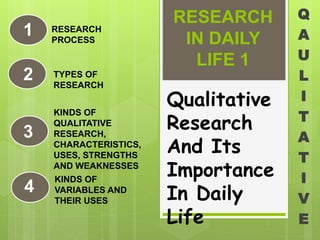
RESEARCH
IN DAILY
LIFE 1
Q
A
U
L
I
T
A
T
I
V
E
RESEARCH
PROCESS
KINDS OF
VARIABLES AND
THEIR USES
1
2
3
4
KINDS OF
QUALITATIVE
RESEARCH,
CHARACTERISTICS,
USES, STRENGTHS
AND WEAKNESSES
TYPES OF
RESEARCH
Qualitative
Research
And Its
Importance
In Daily
Life
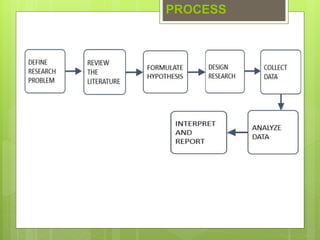
PROCESS
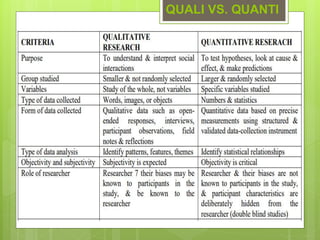
QUALI VS. QUANTI
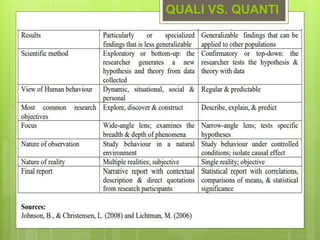
QUALI VS. QUANTI
RESEARCH
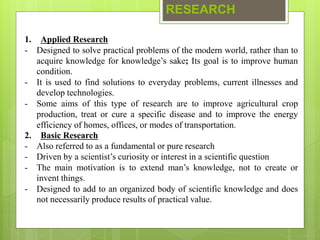
1. Applied Research
- Designed to solve practical problems of the modern world, rather than to
acquire knowledge for knowledge’s sake; Its goal is to improve human
condition.
- It is used to find solutions to everyday problems, current illnesses and
develop technologies.
- Some aims of this type of research are to improve agricultural crop
production, treat or cure a specific disease and to improve the energy
efficiency of homes, offices, or modes of transportation.
2. Basic Research
- Also referred to as a fundamental or pure research
- Driven by a scientist’s curiosity or interest in a scientific question
- The main motivation is to extend man’s knowledge, not to create or
invent things.
- Designed to add to an organized body of scientific knowledge and does
not necessarily produce results of practical value.
RESEARCH
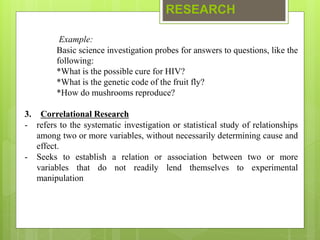
Example:
Basic science investigation probes for answers to questions, like the
following:
*What is the possible cure for HIV?
*What is the genetic code of the fruit fly?
*How do mushrooms reproduce?
3. Correlational Research
- refers to the systematic investigation or statistical study of relationships
among two or more variables, without necessarily determining cause and
effect.
- Seeks to establish a relation or association between two or more
variables that do not readily lend themselves to experimental
manipulation
RESEARCH
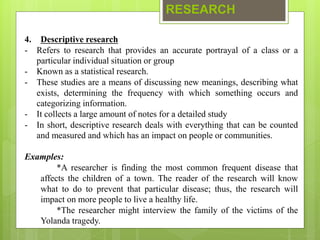
4. Descriptive research
- Refers to research that provides an accurate portrayal of a class or a
particular individual situation or group
- Known as a statistical research.
- These studies are a means of discussing new meanings, describing what
exists, determining the frequency with which something occurs and
categorizing information.
- It collects a large amount of notes for a detailed study
- In short, descriptive research deals with everything that can be counted
and measured and which has an impact on people or communities.
Examples:
*A researcher is finding the most common frequent disease that
affects the children of a town. The reader of the research will know
what to do to prevent that particular disease; thus, the research will
impact on more people to live a healthy life.
*The researcher might interview the family of the victims of the
Yolanda tragedy.
RESEARCH
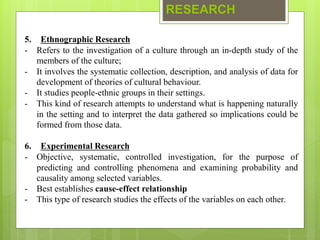
5. Ethnographic Research
- Refers to the investigation of a culture through an in-depth study of the
members of the culture;
- It involves the systematic collection, description, and analysis of data for
development of theories of cultural behaviour.
- It studies people-ethnic groups in their settings.
- This kind of research attempts to understand what is happening naturally
in the setting and to interpret the data gathered so implications could be
formed from those data.
6. Experimental Research
- Objective, systematic, controlled investigation, for the purpose of
predicting and controlling phenomena and examining probability and
causality among selected variables.
- Best establishes cause-effect relationship
- This type of research studies the effects of the variables on each other.
RESEARCH
7. Exploratory Research
- A type of research conducted for a problem that has not been clearly
defined
- It helps determine the best research design, data collection method and
selection of subjects.
- Can be informal, relying on secondary research such as review, available
literature and/or data
- Not typically generalizable to the population at large
8. Historical Research
- Is one involving analysis of events that occurred in the remote or recent
past
- It can show patterns that occurred in the past and over time which and
help to see where we came from and what kind of solutions we have
used in the past.
- Understanding this can add perspective on how we examine current
events and educational practices.
RESEARCH
9. Phenomenological Research
- An inductive descriptive research developed from phenomenological
philosophy.
- Its aim is to describe an experience as it is actually lived by the person.
- Concerned with the study of experience from the perspective of the
individual
- Emphasizes the importance of a personal perspective and interpretation
- This type of research is powerful for understanding subjective
experience, gaining insights into people’s motivation and actions.
- The researcher in this type of research attempts to understand one or
more individuals’ experiences of a phenomenon by one or more
individuals.
RESEARCH
10. Action Research
- Involves the application of the steps of the scientific method in the
classroom problems.
- This type of research is done on a very limited scope.
- The population to be studied is not so big.
- This type of research is helpful to beginning researchers.
- Such questions as “How did teachers feel about the new curriculum? Or
“What instructional strategies do students think are engaging and why?”
- Conducted primarily by Education students.
- This study might be answered through an interview of students at various
high school year levels about their experiences in the classroom. Or you
could video tape or conduct observations of high school classes to
answer this question.
- Basic studies use the two most common analysis techniques in
qualitative research which are coding and looking for more recurring
themes.
RESEARCH
Marshall and Rossman 91195) describe succinctly varied qualitative
research methods:
o Participant Observation – demands immersion in the natural
setting of the research participant/s. This way, the researcher
participant is able to hear, see, and experience reality as the research
participants perform activities and deal with one another during a
period of time.
o Observation – entails the systematic noting or recording of events,
behaviors and artifacts (objects) in the social setting chosen for
study. Through this method, the researcher learns about behaviors
and the meanings attached to those behaviors. The value here is that
the researcher is able to discover the recurring patterns of behaviour
and relationships. Likewise, she is able to note body language and
affect, in addition to the person’s words.
RESEARCH
o In-depth Interviewing – resembles conversations, but with pre-
determined response categories. A degree of systematization in
questioning may be necessary, especially in a multisite case study or
when many participants are interviewed. This way, large amounts of
data are gathered quickly and immediate follow-up and clarifications
are possible. Interviewers should have excellent listening skills, and
be equally skilful at personal interaction, question framing and
gentle probing for elaboration.
o Focus Group Interviewing – involves 7-10, at times 6-8 people, who
are unfamiliar with one another and have been selected because they
share certain characteristics that are relevant to the research inquiry
or problem. The interviewer creates a permissive environment, asks
focused questions, in order to encourage discussion and the expression
of differing opinions and points of view. These interviews are
conducted several times with different individuals so that the
researcher can identify trends in the perceptions and opinions
expressed, which are revealed through careful, systematic analysis.
(Krueger, 1988), as cited in Marshall and Rossman, 1995).
RESEARCH
This method also provides quick result; the discussion is free-
wheeling, not “stiff”, which can happen in a one-on-one
interview. The moderator or researcher must be an expert in
keeping the discussion focused on the research problem or
inquiry.
o Content Analysis – calls for systematic examination of forms of
communication to document patterns objectively-as shown in letters,
email, minutes of meetings, policy statements and a lot more.
o Narratology – can be applied to any spoken or written story. Narrative
inquiry requires a great deal of sensitivity between participant and
researcher. Ideally, a friendly atmosphere pervades during the story
telling, retelling and reliving of personal experiences. Needless to say,
the researcher must be an active listener and an adept feelings, views
and values as reflected in both oral and written stories.
o Films, Videos and Photographs – these provide visual records of
events, especially the films and videos which are capture the
perspective of the filmmaker or videographer. Pictures, on the other
hand, manifest the intent, interests and values of the photographer.
CHARACTERISTICS AND USES OF
QUALITATIVE RESEARCH
o The research takes place in a natural setting-a home, an office, an
institution, or a community where human behaviour and events
occur. This enables the researcher to be immersed in the actual
experiences of the research participants and to get as much detailed
data as s/he needs.
o The focus of qualitative research is on the participant’s perception
and experiences and the way they make sense of their lives
(Franenkel and Wallen, 1988 in Cresswell, 2013).
o The methods are interactive and humanistic, call for active
participation of research participants, and on the part of the
researcher, sensitivity to the needs of the participants.
o It uses various ways of collecting data: observations, structures or
semi-structured interviews, documents, and now, e-mails, blogs,
videos, stills, and a host of others.
CHARACTERISTICS AND USES OF
QUALITATIVE RESEARCH
o Qualitative research results being emergent, new discoveries during
the data gathering process can lead to a total revision of research
questions, among others.
o The theory or general pattern of understanding will emerge as it
begins with initial codes, develops into broad themes, and coalesces
into a ground theory or broad interpretation. (Cresswell, 2003).
o It is fundamentally interpretative. This includes a description of an
individual or setting, analysing data for themes or categories, and
finally, making an interpretation or drawing conclusions about its
meaning, personally and theoretically, stating lessons learned and
offering further questions to be asked. (Wolcott, 1994, as cited in
Cresswell, 2013).
o The researcher may filter the data through a personal lens that is
situated in specific socio-political and historical moments. One
cannot escape the personal interpretation brought to qualitative data
analysis. (Cresswell, 2013).
CHARACTERISTICS AND USES OF
QUALITATIVE RESEARCH
o The researcher is the primary instrument in data collection. S/he
views social phenomena holistically. The more complex, interactive
and encompassing the narrative, the better is the qualitative study.
The qualitative research systematically reflects on who he or
she is in the inquiry and is sensitive to his/her personal bias and
how it shapes the study. The persona-self becomes inseparable
from the researcher-self. (Mertens, 2003, as cited in Cresswell
2013)
STRENGTHS
o Qualitative research can offer the best light on or best
answers to certain phenomena-social, economic, political
or even psychological.
o Research results are exhaustive; even underlying
meanings surface.
o It offers several avenues to understand phenomena,
behaviour, human conditions and the like.
o It can build on, or even develop theories through
consistent themes, categories, relationships,
interrelationships that are crystallized during the data
gathering and data analysis process.
WEAKNESSES
The so-called weaknesses of qualitative research will not
affect the serious researcher who is willing to invest any
amount of time or resources in this endeavour.
o Total immersion in the natural setting of the research can
be time-consuming and tedious, and resource-draining,
as well.
o There comes a point when the personal-self and the
researcher-self are inseparable, so, subjectivity, on the
part of the researcher can happen. To prevent this, Locke
et al. (1987) stress that from the beginning of the study,
the researcher must identify his/her personal values,
assumptions and biases.
KINDS OF
VARIABLES
AND THEIR
USES
INDEPENDENT
VARIABLE
DEPENDENT
VARIABLE
VARIABLES
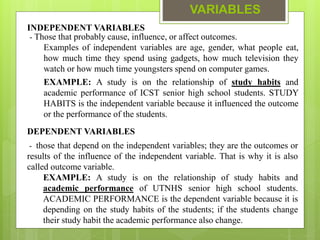
INDEPENDENT VARIABLES
- Those that probably cause, influence, or affect outcomes.
Examples of independent variables are age, gender, what people eat,
how much time they spend using gadgets, how much television they
watch or how much time youngsters spend on computer games.
EXAMPLE: A study is on the relationship of study habits and
academic performance of ICST senior high school students. STUDY
HABITS is the independent variable because it influenced the outcome
or the performance of the students.
DEPENDENT VARIABLES
- those that depend on the independent variables; they are the outcomes or
results of the influence of the independent variable. That is why it is also
called outcome variable.
EXAMPLE: A study is on the relationship of study habits and
academic performance of UTNHS senior high school students.
ACADEMIC PERFORMANCE is the dependent variable because it is
depending on the study habits of the students; if the students change
their study habit the academic performance also change.
VARIABLES
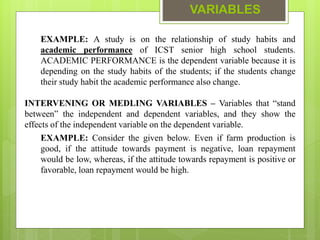
EXAMPLE: A study is on the relationship of study habits and
academic performance of ICST senior high school students.
ACADEMIC PERFORMANCE is the dependent variable because it is
depending on the study habits of the students; if the students change
their study habit the academic performance also change.
INTERVENING OR MEDLING VARIABLES – Variables that “stand
between” the independent and dependent variables, and they show the
effects of the independent variable on the dependent variable.
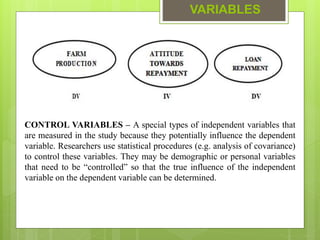
EXAMPLE: Consider the given below. Even if farm production is
good, if the attitude towards payment is negative, loan repayment
would be low, whereas, if the attitude towards repayment is positive or
favorable, loan repayment would be high.
VARIABLES
CONTROL VARIABLES – A special types of independent variables that
are measured in the study because they potentially influence the dependent
variable. Researchers use statistical procedures (e.g. analysis of covariance)
to control these variables. They may be demographic or personal variables
that need to be “controlled” so that the true influence of the independent
variable on the dependent variable can be determined.
VARIABLES
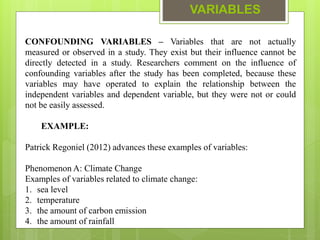
CONFOUNDING VARIABLES – Variables that are not actually
measured or observed in a study. They exist but their influence cannot be
directly detected in a study. Researchers comment on the influence of
confounding variables after the study has been completed, because these
variables may have operated to explain the relationship between the
independent variables and dependent variable, but they were not or could
not be easily assessed.
EXAMPLE:
Patrick Regoniel (2012) advances these examples of variables:
Phenomenon A: Climate Change
Examples of variables related to climate change:
1. sea level
2. temperature
3. the amount of carbon emission
4. the amount of rainfall
VARIABLES
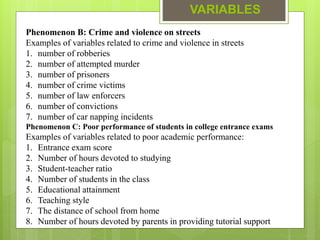
Phenomenon B: Crime and violence on streets
Examples of variables related to crime and violence in streets
1. number of robberies
2. number of attempted murder
3. number of prisoners
4. number of crime victims
5. number of law enforcers
6. number of convictions
7. number of car napping incidents
Phenomenon C: Poor performance of students in college entrance exams
Examples of variables related to poor academic performance:
1. Entrance exam score
2. Number of hours devoted to studying
3. Student-teacher ratio
4. Number of students in the class
5. Educational attainment
6. Teaching style
7. The distance of school from home
8. Number of hours devoted by parents in providing tutorial support

CHAPTER 2 RDL 1.pptx

  • 1.
    RESEARCH IN DAILY LIFE 1 Q A U L I T A T I V E RESEARCH PROCESS KINDSOF VARIABLES AND THEIR USES 1 2 3 4 KINDS OF QUALITATIVE RESEARCH, CHARACTERISTICS, USES, STRENGTHS AND WEAKNESSES TYPES OF RESEARCH Qualitative Research And Its Importance In Daily Life
  • 2.
  • 3.
  • 4.
  • 5.
    RESEARCH 1. Applied Research -Designed to solve practical problems of the modern world, rather than to acquire knowledge for knowledge’s sake; Its goal is to improve human condition. - It is used to find solutions to everyday problems, current illnesses and develop technologies. - Some aims of this type of research are to improve agricultural crop production, treat or cure a specific disease and to improve the energy efficiency of homes, offices, or modes of transportation. 2. Basic Research - Also referred to as a fundamental or pure research - Driven by a scientist’s curiosity or interest in a scientific question - The main motivation is to extend man’s knowledge, not to create or invent things. - Designed to add to an organized body of scientific knowledge and does not necessarily produce results of practical value.
  • 6.
    RESEARCH Example: Basic science investigationprobes for answers to questions, like the following: *What is the possible cure for HIV? *What is the genetic code of the fruit fly? *How do mushrooms reproduce? 3. Correlational Research - refers to the systematic investigation or statistical study of relationships among two or more variables, without necessarily determining cause and effect. - Seeks to establish a relation or association between two or more variables that do not readily lend themselves to experimental manipulation
  • 7.
    RESEARCH 4. Descriptive research -Refers to research that provides an accurate portrayal of a class or a particular individual situation or group - Known as a statistical research. - These studies are a means of discussing new meanings, describing what exists, determining the frequency with which something occurs and categorizing information. - It collects a large amount of notes for a detailed study - In short, descriptive research deals with everything that can be counted and measured and which has an impact on people or communities. Examples: *A researcher is finding the most common frequent disease that affects the children of a town. The reader of the research will know what to do to prevent that particular disease; thus, the research will impact on more people to live a healthy life. *The researcher might interview the family of the victims of the Yolanda tragedy.
  • 8.
    RESEARCH 5. Ethnographic Research -Refers to the investigation of a culture through an in-depth study of the members of the culture; - It involves the systematic collection, description, and analysis of data for development of theories of cultural behaviour. - It studies people-ethnic groups in their settings. - This kind of research attempts to understand what is happening naturally in the setting and to interpret the data gathered so implications could be formed from those data. 6. Experimental Research - Objective, systematic, controlled investigation, for the purpose of predicting and controlling phenomena and examining probability and causality among selected variables. - Best establishes cause-effect relationship - This type of research studies the effects of the variables on each other.
  • 9.
    RESEARCH 7. Exploratory Research -A type of research conducted for a problem that has not been clearly defined - It helps determine the best research design, data collection method and selection of subjects. - Can be informal, relying on secondary research such as review, available literature and/or data - Not typically generalizable to the population at large 8. Historical Research - Is one involving analysis of events that occurred in the remote or recent past - It can show patterns that occurred in the past and over time which and help to see where we came from and what kind of solutions we have used in the past. - Understanding this can add perspective on how we examine current events and educational practices.
  • 10.
    RESEARCH 9. Phenomenological Research -An inductive descriptive research developed from phenomenological philosophy. - Its aim is to describe an experience as it is actually lived by the person. - Concerned with the study of experience from the perspective of the individual - Emphasizes the importance of a personal perspective and interpretation - This type of research is powerful for understanding subjective experience, gaining insights into people’s motivation and actions. - The researcher in this type of research attempts to understand one or more individuals’ experiences of a phenomenon by one or more individuals.
  • 11.
    RESEARCH 10. Action Research -Involves the application of the steps of the scientific method in the classroom problems. - This type of research is done on a very limited scope. - The population to be studied is not so big. - This type of research is helpful to beginning researchers. - Such questions as “How did teachers feel about the new curriculum? Or “What instructional strategies do students think are engaging and why?” - Conducted primarily by Education students. - This study might be answered through an interview of students at various high school year levels about their experiences in the classroom. Or you could video tape or conduct observations of high school classes to answer this question. - Basic studies use the two most common analysis techniques in qualitative research which are coding and looking for more recurring themes.
  • 12.
    RESEARCH Marshall and Rossman91195) describe succinctly varied qualitative research methods: o Participant Observation – demands immersion in the natural setting of the research participant/s. This way, the researcher participant is able to hear, see, and experience reality as the research participants perform activities and deal with one another during a period of time. o Observation – entails the systematic noting or recording of events, behaviors and artifacts (objects) in the social setting chosen for study. Through this method, the researcher learns about behaviors and the meanings attached to those behaviors. The value here is that the researcher is able to discover the recurring patterns of behaviour and relationships. Likewise, she is able to note body language and affect, in addition to the person’s words.
  • 13.
    RESEARCH o In-depth Interviewing– resembles conversations, but with pre- determined response categories. A degree of systematization in questioning may be necessary, especially in a multisite case study or when many participants are interviewed. This way, large amounts of data are gathered quickly and immediate follow-up and clarifications are possible. Interviewers should have excellent listening skills, and be equally skilful at personal interaction, question framing and gentle probing for elaboration. o Focus Group Interviewing – involves 7-10, at times 6-8 people, who are unfamiliar with one another and have been selected because they share certain characteristics that are relevant to the research inquiry or problem. The interviewer creates a permissive environment, asks focused questions, in order to encourage discussion and the expression of differing opinions and points of view. These interviews are conducted several times with different individuals so that the researcher can identify trends in the perceptions and opinions expressed, which are revealed through careful, systematic analysis. (Krueger, 1988), as cited in Marshall and Rossman, 1995).
  • 14.
    RESEARCH This method alsoprovides quick result; the discussion is free- wheeling, not “stiff”, which can happen in a one-on-one interview. The moderator or researcher must be an expert in keeping the discussion focused on the research problem or inquiry. o Content Analysis – calls for systematic examination of forms of communication to document patterns objectively-as shown in letters, email, minutes of meetings, policy statements and a lot more. o Narratology – can be applied to any spoken or written story. Narrative inquiry requires a great deal of sensitivity between participant and researcher. Ideally, a friendly atmosphere pervades during the story telling, retelling and reliving of personal experiences. Needless to say, the researcher must be an active listener and an adept feelings, views and values as reflected in both oral and written stories. o Films, Videos and Photographs – these provide visual records of events, especially the films and videos which are capture the perspective of the filmmaker or videographer. Pictures, on the other hand, manifest the intent, interests and values of the photographer.
  • 15.
    CHARACTERISTICS AND USESOF QUALITATIVE RESEARCH o The research takes place in a natural setting-a home, an office, an institution, or a community where human behaviour and events occur. This enables the researcher to be immersed in the actual experiences of the research participants and to get as much detailed data as s/he needs. o The focus of qualitative research is on the participant’s perception and experiences and the way they make sense of their lives (Franenkel and Wallen, 1988 in Cresswell, 2013). o The methods are interactive and humanistic, call for active participation of research participants, and on the part of the researcher, sensitivity to the needs of the participants. o It uses various ways of collecting data: observations, structures or semi-structured interviews, documents, and now, e-mails, blogs, videos, stills, and a host of others.
  • 16.
    CHARACTERISTICS AND USESOF QUALITATIVE RESEARCH o Qualitative research results being emergent, new discoveries during the data gathering process can lead to a total revision of research questions, among others. o The theory or general pattern of understanding will emerge as it begins with initial codes, develops into broad themes, and coalesces into a ground theory or broad interpretation. (Cresswell, 2003). o It is fundamentally interpretative. This includes a description of an individual or setting, analysing data for themes or categories, and finally, making an interpretation or drawing conclusions about its meaning, personally and theoretically, stating lessons learned and offering further questions to be asked. (Wolcott, 1994, as cited in Cresswell, 2013). o The researcher may filter the data through a personal lens that is situated in specific socio-political and historical moments. One cannot escape the personal interpretation brought to qualitative data analysis. (Cresswell, 2013).
  • 17.
    CHARACTERISTICS AND USESOF QUALITATIVE RESEARCH o The researcher is the primary instrument in data collection. S/he views social phenomena holistically. The more complex, interactive and encompassing the narrative, the better is the qualitative study. The qualitative research systematically reflects on who he or she is in the inquiry and is sensitive to his/her personal bias and how it shapes the study. The persona-self becomes inseparable from the researcher-self. (Mertens, 2003, as cited in Cresswell 2013)
  • 18.
    STRENGTHS o Qualitative researchcan offer the best light on or best answers to certain phenomena-social, economic, political or even psychological. o Research results are exhaustive; even underlying meanings surface. o It offers several avenues to understand phenomena, behaviour, human conditions and the like. o It can build on, or even develop theories through consistent themes, categories, relationships, interrelationships that are crystallized during the data gathering and data analysis process.
  • 19.
    WEAKNESSES The so-called weaknessesof qualitative research will not affect the serious researcher who is willing to invest any amount of time or resources in this endeavour. o Total immersion in the natural setting of the research can be time-consuming and tedious, and resource-draining, as well. o There comes a point when the personal-self and the researcher-self are inseparable, so, subjectivity, on the part of the researcher can happen. To prevent this, Locke et al. (1987) stress that from the beginning of the study, the researcher must identify his/her personal values, assumptions and biases.
  • 20.
  • 21.
    VARIABLES INDEPENDENT VARIABLES - Thosethat probably cause, influence, or affect outcomes. Examples of independent variables are age, gender, what people eat, how much time they spend using gadgets, how much television they watch or how much time youngsters spend on computer games. EXAMPLE: A study is on the relationship of study habits and academic performance of ICST senior high school students. STUDY HABITS is the independent variable because it influenced the outcome or the performance of the students. DEPENDENT VARIABLES - those that depend on the independent variables; they are the outcomes or results of the influence of the independent variable. That is why it is also called outcome variable. EXAMPLE: A study is on the relationship of study habits and academic performance of UTNHS senior high school students. ACADEMIC PERFORMANCE is the dependent variable because it is depending on the study habits of the students; if the students change their study habit the academic performance also change.
  • 22.
    VARIABLES EXAMPLE: A studyis on the relationship of study habits and academic performance of ICST senior high school students. ACADEMIC PERFORMANCE is the dependent variable because it is depending on the study habits of the students; if the students change their study habit the academic performance also change. INTERVENING OR MEDLING VARIABLES – Variables that “stand between” the independent and dependent variables, and they show the effects of the independent variable on the dependent variable. EXAMPLE: Consider the given below. Even if farm production is good, if the attitude towards payment is negative, loan repayment would be low, whereas, if the attitude towards repayment is positive or favorable, loan repayment would be high.
  • 23.
    VARIABLES CONTROL VARIABLES –A special types of independent variables that are measured in the study because they potentially influence the dependent variable. Researchers use statistical procedures (e.g. analysis of covariance) to control these variables. They may be demographic or personal variables that need to be “controlled” so that the true influence of the independent variable on the dependent variable can be determined.
  • 24.
    VARIABLES CONFOUNDING VARIABLES –Variables that are not actually measured or observed in a study. They exist but their influence cannot be directly detected in a study. Researchers comment on the influence of confounding variables after the study has been completed, because these variables may have operated to explain the relationship between the independent variables and dependent variable, but they were not or could not be easily assessed. EXAMPLE: Patrick Regoniel (2012) advances these examples of variables: Phenomenon A: Climate Change Examples of variables related to climate change: 1. sea level 2. temperature 3. the amount of carbon emission 4. the amount of rainfall
  • 25.
    VARIABLES Phenomenon B: Crimeand violence on streets Examples of variables related to crime and violence in streets 1. number of robberies 2. number of attempted murder 3. number of prisoners 4. number of crime victims 5. number of law enforcers 6. number of convictions 7. number of car napping incidents Phenomenon C: Poor performance of students in college entrance exams Examples of variables related to poor academic performance: 1. Entrance exam score 2. Number of hours devoted to studying 3. Student-teacher ratio 4. Number of students in the class 5. Educational attainment 6. Teaching style 7. The distance of school from home 8. Number of hours devoted by parents in providing tutorial support