What is Research?
Research is an area that is
commonly misunderstood, but
an indispensable component of
academic and industry
practices.
Students must maximize all the
opportunities to be knowledgeable
on the research process while still
under schooling to create an
excellent knowledge base for future
career as a researcher on scientist.
Qualities of a Good Quantitative
Inquirer
TECHNICAL COMPETENCY- The
ability to use available technologies.
UTILITY COMPETENCY- The ability to
troubleshoot during unexpected
scenario.
PATIENCE- intra (within) and
extra ( outside) group
SERVICE- willingness of the
researcher to serve others, to do
good
EFFORT- time and skill
GUTS AND RISK- considering
options
CARE- distinct characteristics of a
researcher
PHILOSOPHICAL WORLDVIEWS IN
RESEARCH
Understanding research entails
understanding one’s philosophical
wold views.
I. Postpositivist
PHILOSOPHY
“We cannot be positive in our claims
of knowledge when studying
behavior and actions of humans”
MAIN CONCEPT
Researchers in this category subscribes
to the idea that everything should be
quantified to produce meaningful
concrete results.
EXAMPLE:
Satisfaction of students would be
expressed in percentage in relation
to the overall numbers.
II. Constructivist
PHILOSOPHY
“ Individuals develop subjective
meanings of their experiences”
MAIN CONCEPT
Researchers in this category group
believe that experience expressed
through words can paint a better
picture of a certain phenomena
EXAMPLE:
Analyzing the satisfaction of
students should consider their
verbatim comments and
experiences rather than numbers.
III. Transformative
PHILOSOPHY
“ Research inquiry should be
interwined with politics and
political change agenda”
MAIN CONCEPT
Researchers in this group supports
the idea that research should be
conducted to increase quality of life
and produce better societies
EXAMPLE:
A researcher conducts research on
waste segregation since he believe
that the results may help in the
development of valuable programs
and aid in policy-making.
IV. Pragmatic
PHILOSOPHY
“ We need to look to many
posibilities for collecting and
analyzing data”
MAIN CONCEPT
Researchers in this group promotes
the use of both quantitative and
qualitative data in expressing
research findings.
EXAMPLE:
A student reports the percentage of
smokers in the campus, as well as
the reasons for smoking in a study.
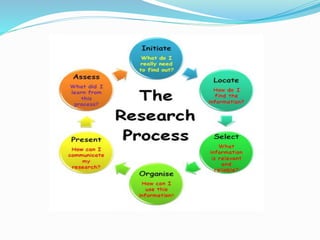
1. Conceptualization phase
Topic/Problem Identification
Review of Related Literature
[Objective Formulation]
2. DESIGN PHASE
[Research Plan Formulation]
3. Empirical Phase
[Data Gathering/Collection]
4. Analytical Phase
[Data Analysis/Interpretation]
5. Dissemination Phase
[Communicating/Utilizing]
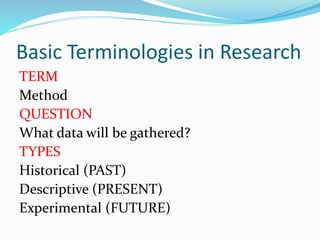
Basic Terminologies in Research
TERM
Method
QUESTION
What data will be gathered?
TYPES
Historical (PAST)
Descriptive (PRESENT)
Experimental (FUTURE)
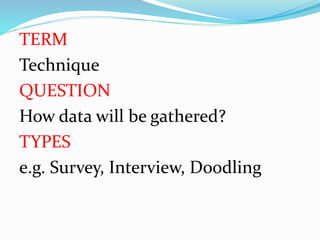
TERM
Technique
QUESTION
How data will be gathered?
TYPES
e.g. Survey, Interview, Doodling
TERM
Approach
QUESTION
How data will be processed?
TYPES
Quantitative, Qualitative or Mixed-
Method
Qualitative Research
An approach for exploring and
understanding the meaning
individuals or groups ascribe to
social or human problem.
Quantitative Research
An approach for testing objective
theories by examining the
relationship among variables.
Mixed Approach
Inquiry involving collecting
both quantitative and
qualitative data, and integrating
the two forms of data.
The Research Manuscript
Research manuscripts are the final
written output of a research study.
It is the product of the research
process in written and/or soft copy
file form.
Practical research 2 ppt #2

Practical research 2 ppt #2