Introduction to Project
Management
Information Technology Project
Management, Seventh Edition
Chapter 1
Introduction
 The world as a whole spends nearly $10 trillion of
its $40.7 trillion gross product on projects of all
kinds
 More than 16 million people regard project
management as their profession
 The overall information and communications
technology market grew by 6 percent to almost $3
trillion in 2010
2
Motivation for Studying Information
Technology (IT) Project Management
 IT Projects have a terrible track record, as described in the
“What Went Wrong?”
3
Advantages of Using Formal
Project Management
 Better control of financial, physical, and human
resources
 Improved customer relations
 Shorter development times
 Lower costs
 Higher quality and increased reliability
 Higher profit margins
 Improved productivity
 Better internal coordination
 Higher worker morale
Information Technology Project Management,
Seventh Edition
4
What Is a Project?
A project is “a temporary endeavor undertaken to create
a unique product, service, or result” (PMBOK® Guide, Fifth Edition, 2012)
Information Technology Project Management,
Seventh Edition
5
Project Attributes
 A project
 has a unique purpose
 is temporary
 is developed using progressive elaboration
 requires resources, often from various areas
 should have a primary customer or sponsor
 The project sponsor usually provides the
direction and funding for the project
 involves uncertainty
Information Technology Project Management,
Seventh Edition
6
Project and Program Managers
 Project managers work with project
sponsors, project team, and other people
involved in a project to meet project goals
 Program: group of related projects managed
in a coordinated way to obtain benefits and
control not available from managing them
individually (PMBOK® Guide, Fifth Edition,
2012)
7
Program and Project Portfolio
Management
A program is “a group of related projects
managed in a coordinated way to obtain
benefits and control not available from
managing them individually” (PMBOK®
Guide, Fifth Edition, 2012)
A program manager provides leadership and
direction for the project managers heading the
projects within the program
Information Technology Project Management,
Seventh Edition
8
PM Network: What’s in a Name?
9
 Programs vs. Projects
 Should there be a difference?
 What are the problems with labeling a
program as a large project?
 Are different skills needed to be a program
manager compared to a project manager?
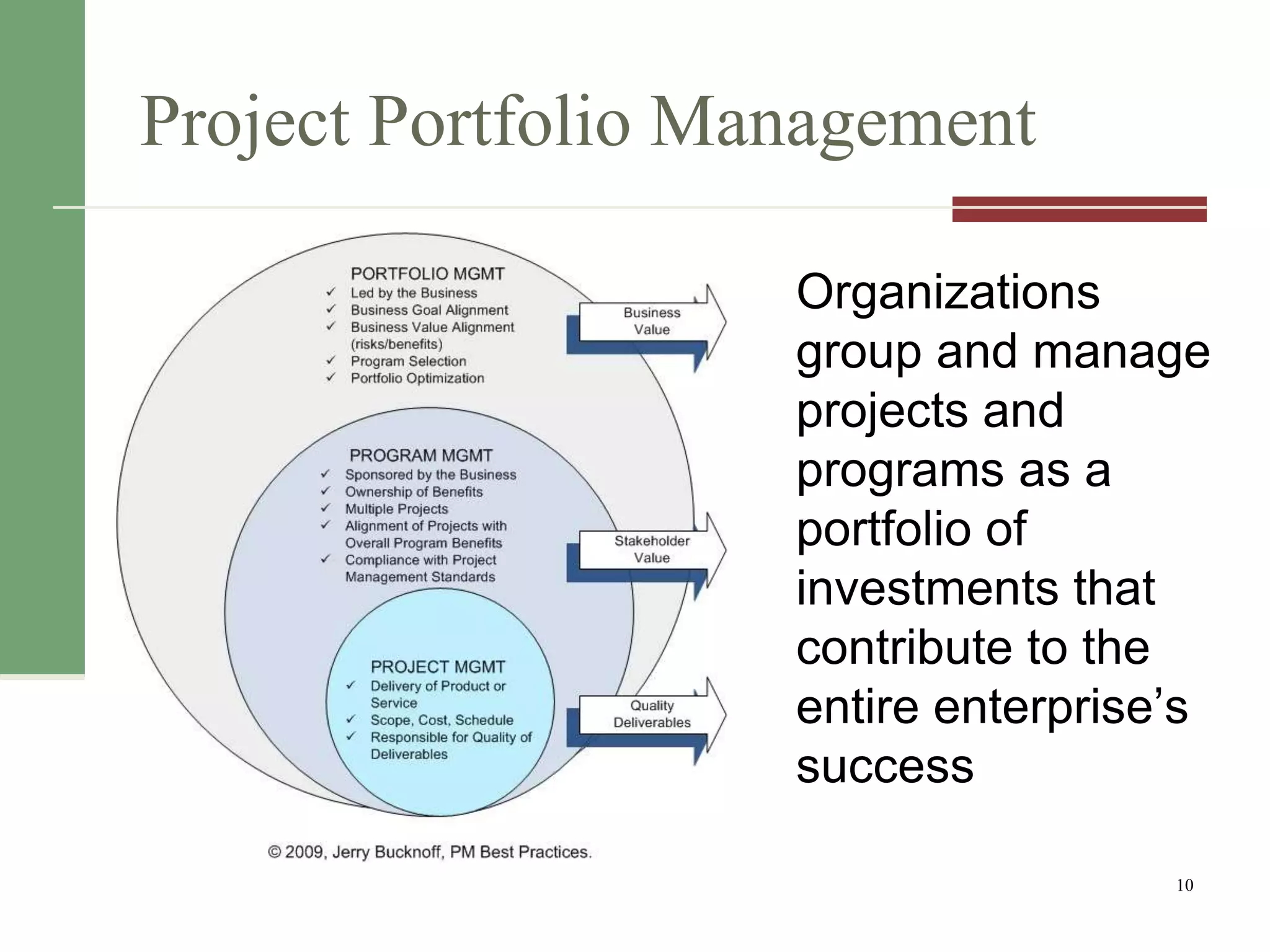
Project Portfolio Management
Organizations
group and manage
projects and
programs as a
portfolio of
investments that
contribute to the
entire enterprise’s
success
10
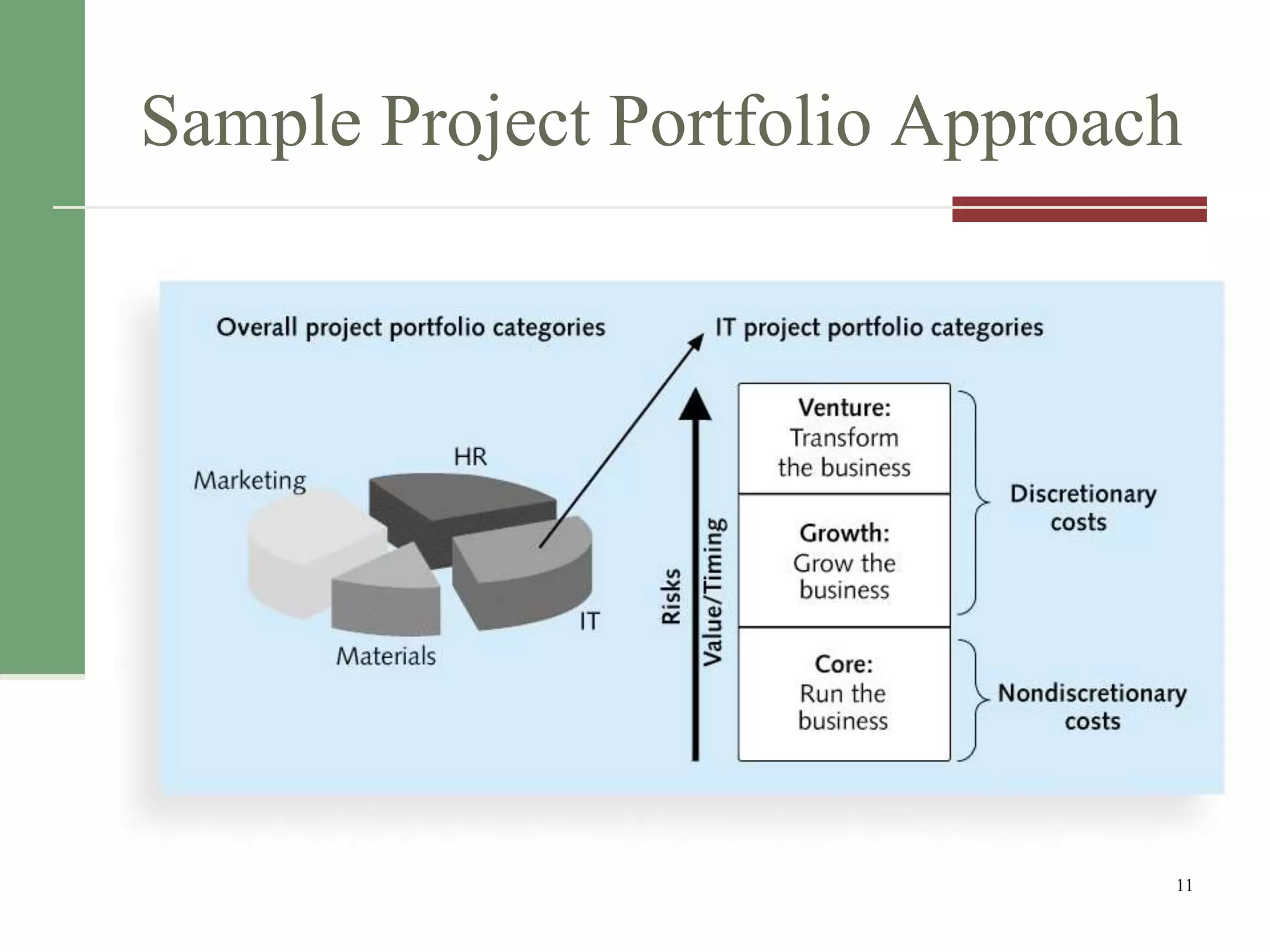
Sample Project Portfolio Approach
11
Figure 1-5. Sample Project Portfolio Management
Screen Showing Portfolio Optimization
Information Technology Project Management,
Seventh Edition
12
Project Management Offices
 A Project Management Office (PMO) is an
organizational group responsible for
coordinating the project management function
throughout an organization
13
PM Network - PMO 2.0
14
 Why do PMOs fail?
 What is the primary reason cited for failure?
 How do you resurrect a failed PMO?
 How do you ensure longevity of a PMO?
 When should a PMO just be closed?
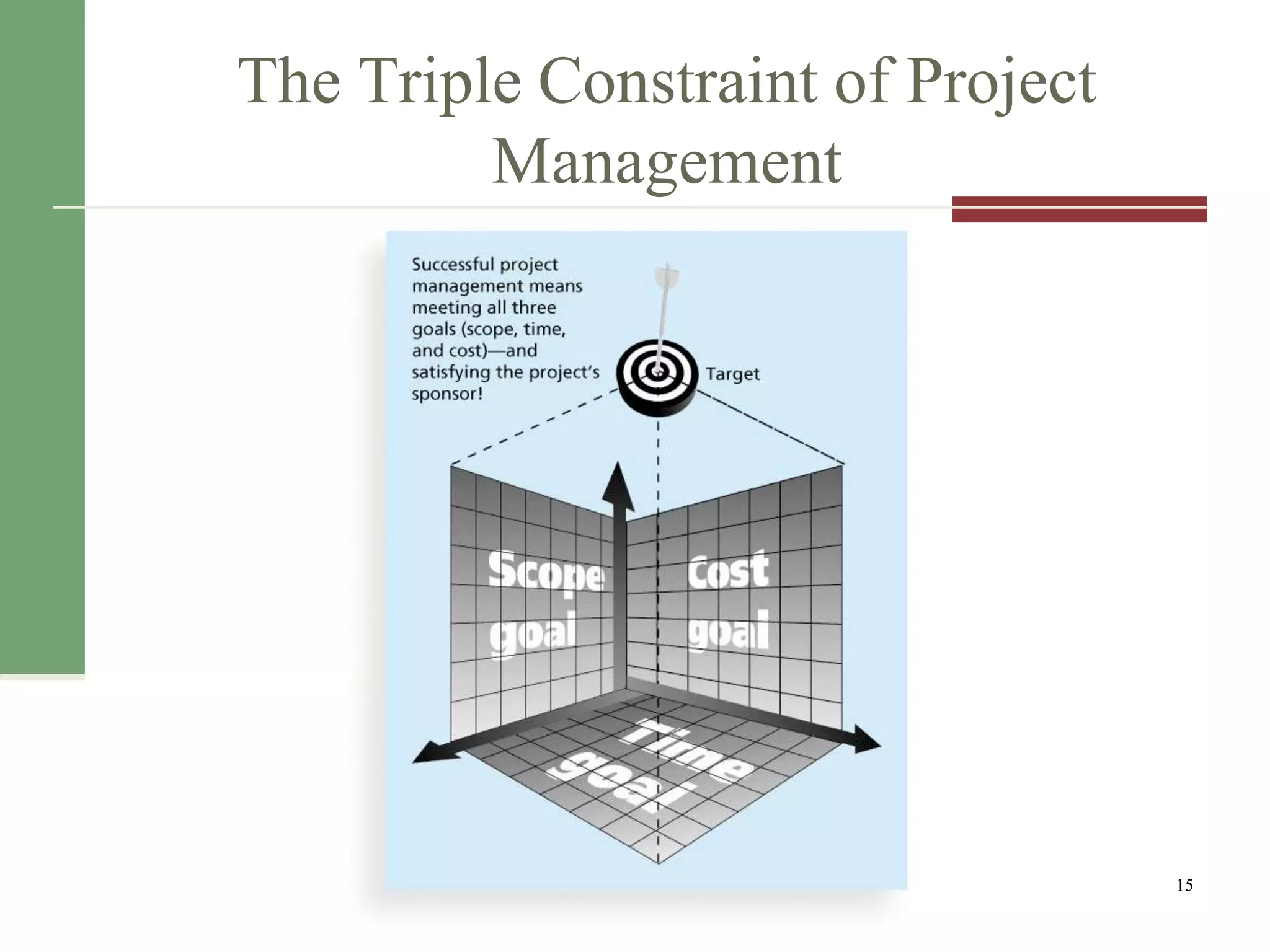
The Triple Constraint of Project
Management
15
What is Project Management?
“the application of knowledge, skills, tools and techniques
to project activities to meet project requirements” (PMBOK®
Guide, Fourth Edition, 2012)
Information Technology Project Management,
Seventh Edition
16
Stakeholders Core Functions
Facilitating
Functions
Project Management Knowledge Areas
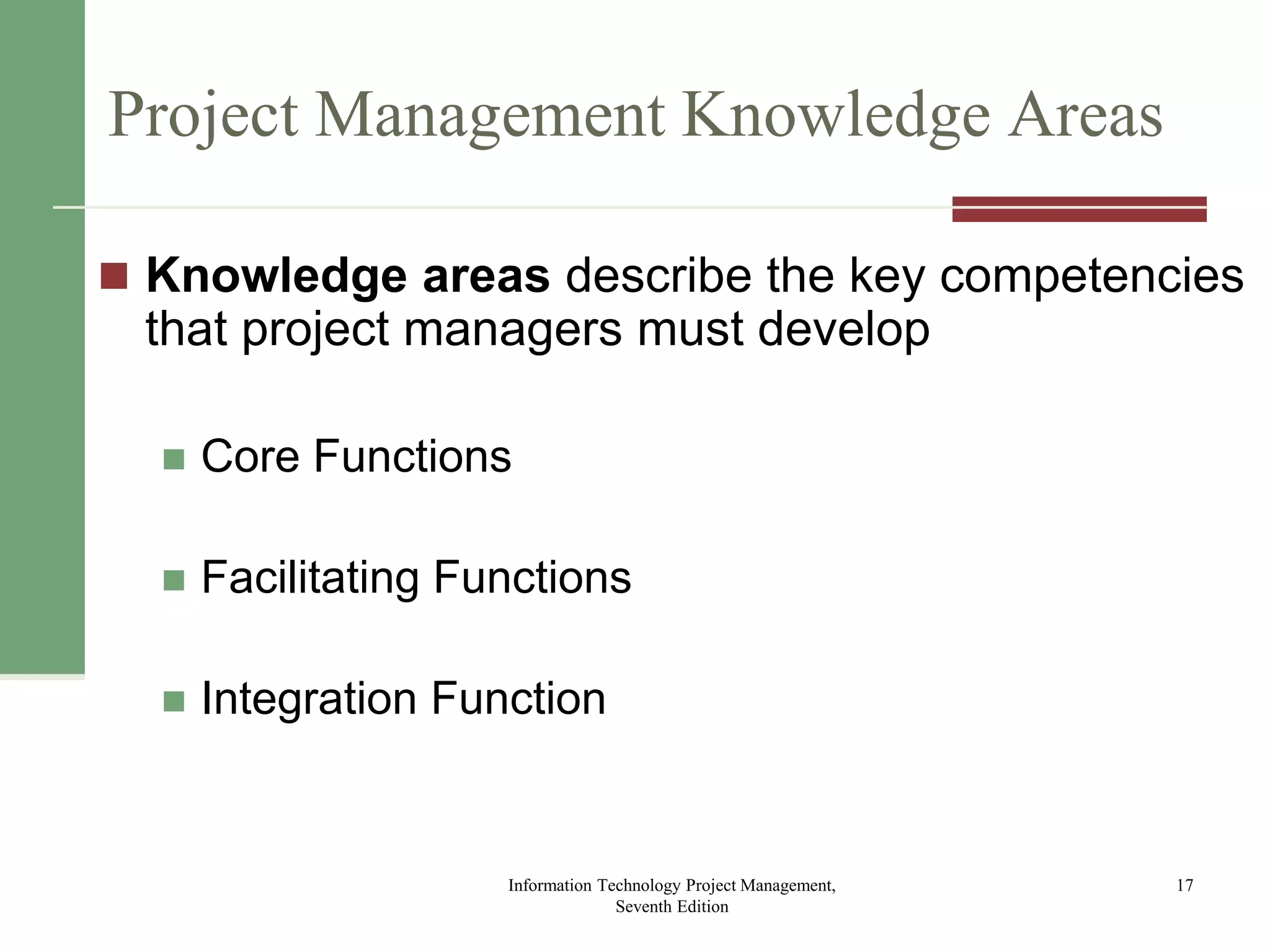
 Knowledge areas describe the key competencies
that project managers must develop
 Core Functions
 Facilitating Functions
 Integration Function
Information Technology Project Management,
Seventh Edition
17
Project Management Tools and
Techniques
 Project management tools and techniques
assist project managers and their teams in
various aspects of project management
18
Gantt chart
network diagram
Project Stakeholders
 Stakeholders are the people involved in or
affected by project activities
Who are the stakeholders in a project?
Information Technology Project Management,
Seventh Edition
19
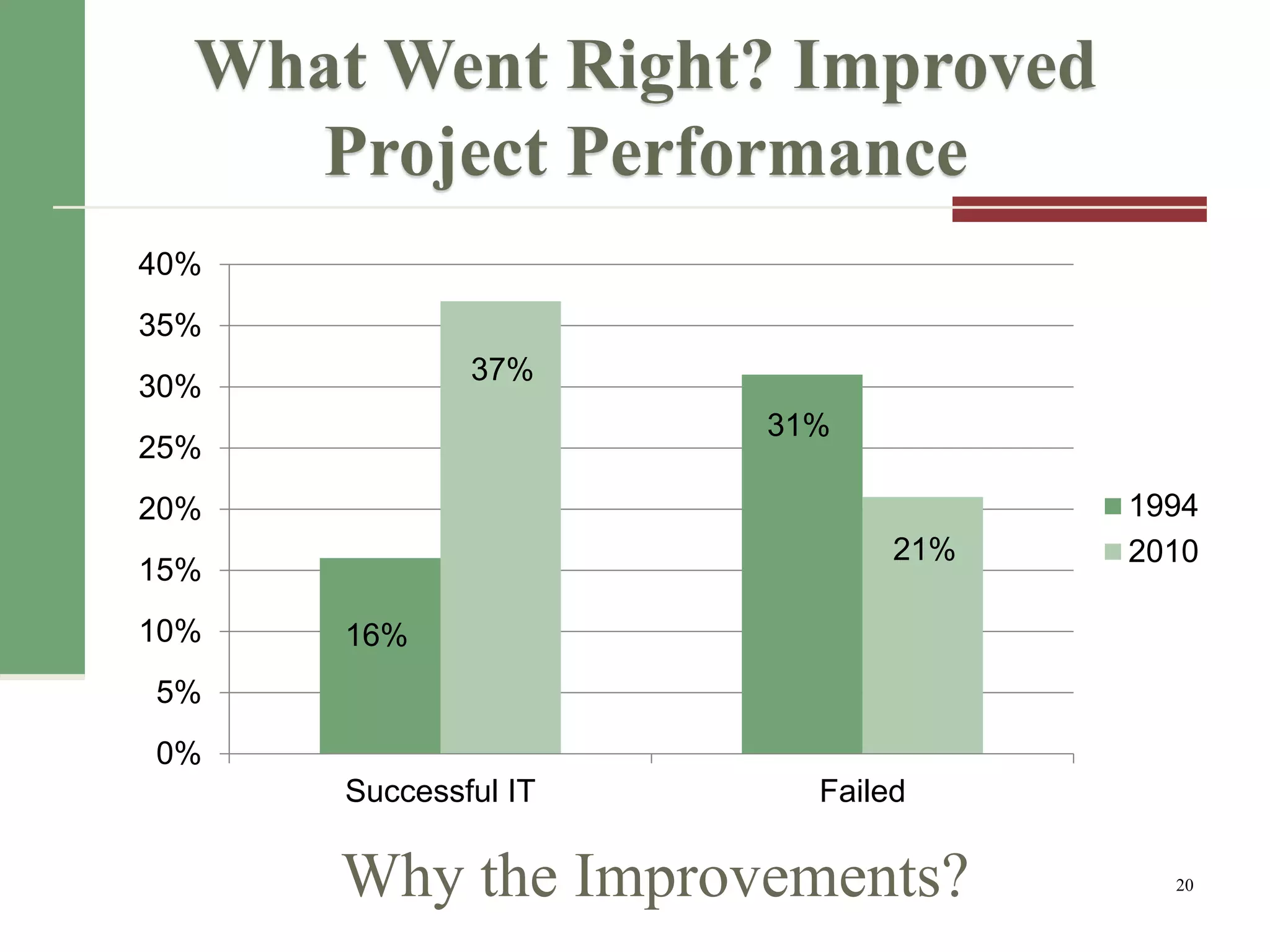
What Went Right? Improved
Project Performance
Why the Improvements?
16%
31%
37%
21%
0%
5%
10%
15%
20%
25%
30%
35%
40%
Successful IT Failed
1994
2010
20
Improved Project Performance
21
Growth in PMP Certification,
1993-2011
Coincidence?
Project Success
 There are several ways to define project
success:
 Triple Constraint
 Customer/Sponsor Satisfaction
 The results of the project met its main
objective
Information Technology Project Management,
Seventh Edition
22
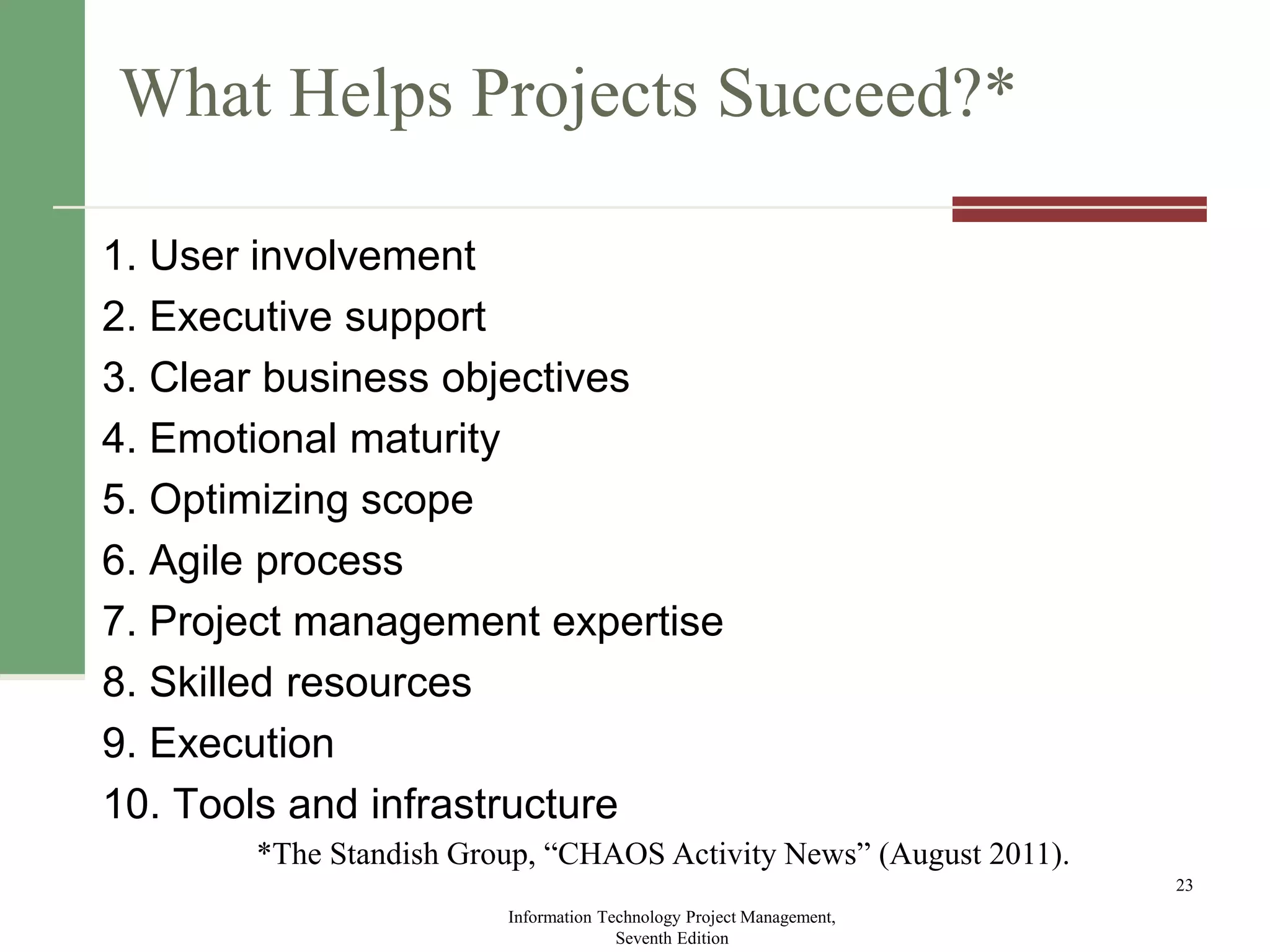
What Helps Projects Succeed?*
1. User involvement
2. Executive support
3. Clear business objectives
4. Emotional maturity
5. Optimizing scope
6. Agile process
7. Project management expertise
8. Skilled resources
9. Execution
10. Tools and infrastructure
Information Technology Project Management,
Seventh Edition
23
*The Standish Group, “CHAOS Activity News” (August 2011).
The Role of the Project Manager
 Job descriptions vary, but most include
responsibilities like planning, scheduling,
coordinating, and working with people to
achieve project goals
 Remember that 97% of successful projects
were led by experienced project managers,
who can often help influence success factors
Information Technology Project Management,
Seventh Edition
24
Suggested Skills for Project Managers
 The Project Management Body of Knowledge
 Application area knowledge, standards, and
regulations
 Project environment knowledge
 General management knowledge and skills
 Soft skills or human relations skills
Information Technology Project Management,
Seventh Edition
25
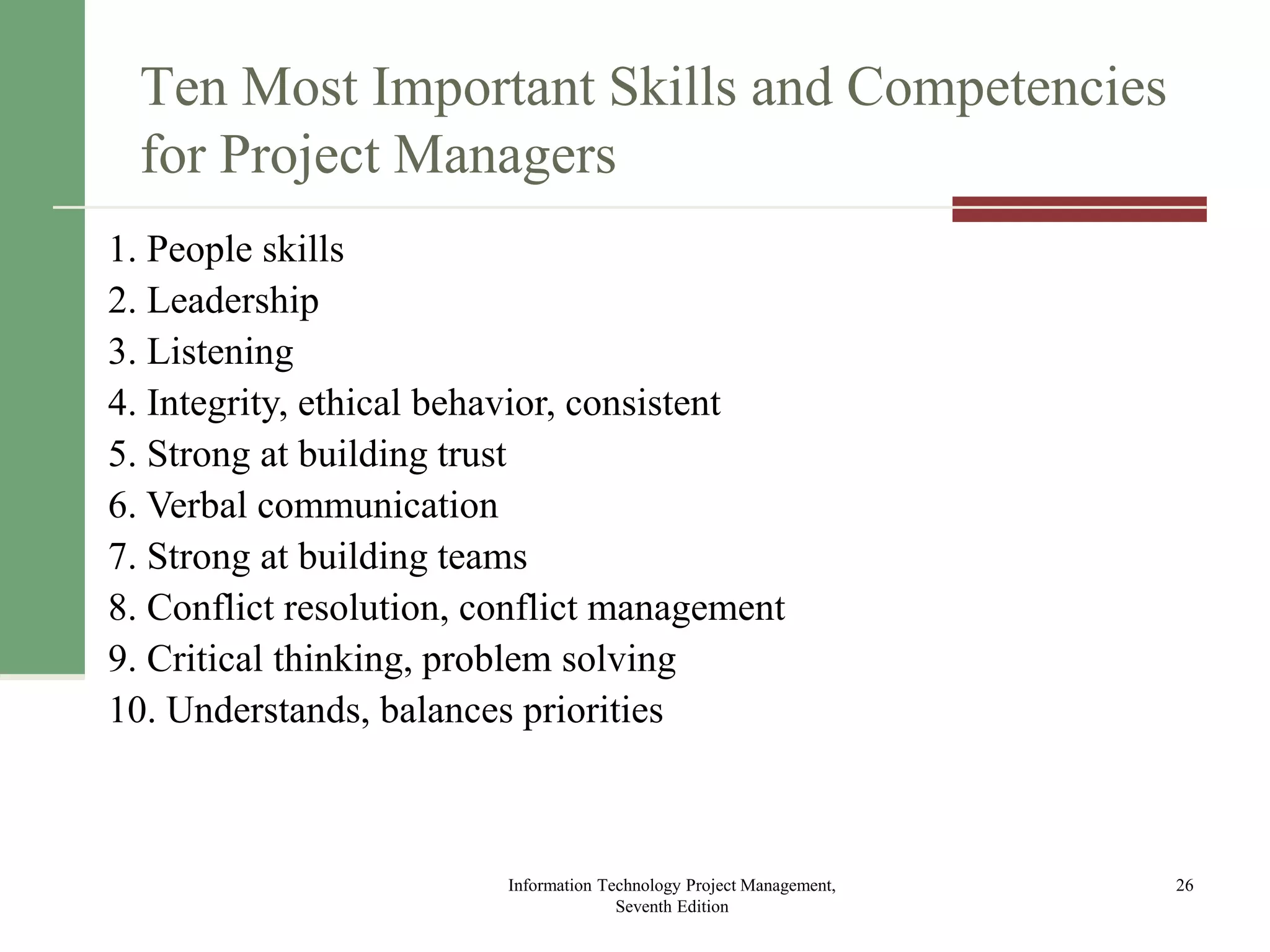
Ten Most Important Skills and Competencies
for Project Managers
Information Technology Project Management,
Seventh Edition
26
1. People skills
2. Leadership
3. Listening
4. Integrity, ethical behavior, consistent
5. Strong at building trust
6. Verbal communication
7. Strong at building teams
8. Conflict resolution, conflict management
9. Critical thinking, problem solving
10. Understands, balances priorities
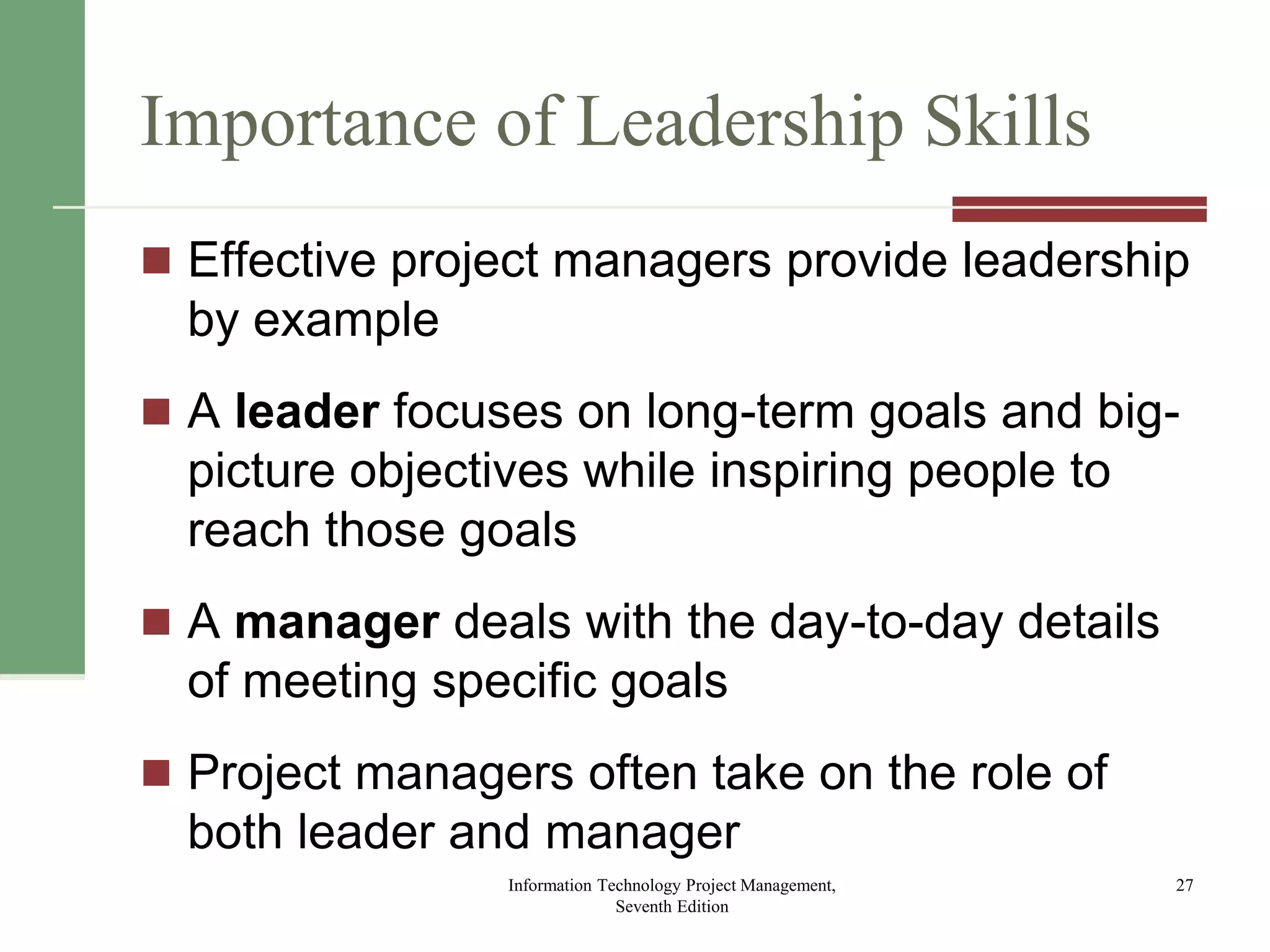
Importance of Leadership Skills
 Effective project managers provide leadership
by example
 A leader focuses on long-term goals and big-
picture objectives while inspiring people to
reach those goals
 A manager deals with the day-to-day details
of meeting specific goals
 Project managers often take on the role of
both leader and manager
Information Technology Project Management,
Seventh Edition
27
Different Skills Needed in Different
Situations
 Large projects
 High uncertainty projects
 Very novel projects
Information Technology Project Management,
Seventh Edition
28
Careers for IT Project Managers
 In a 2012 survey, IT
executives listed the “nine
hottest skills” they
planned to hire for in
2013
 Project management was
second only to
programming and
application development
Information Technology Project Management,
Seventh Edition
29
Job Categories TotalCurrent
EmployeesRank
GrowthRankBig Data / Analyst 6 1
Business/Systems
Analyst
3 3
(tie)
Database Admin /
Analyst
7 3 (tie)
Networks / Security
5 5
Project Management
4 2
Software Development
2 6
Other IT Skills(
Primarily Help Desk)
1 7
Nine Hottest Skills*
Skill Percentage of
Respondents
Programming and application development 60%
Project management 44%
Help desk/technical support 35%
Networking 35%
Business intelligence 23%
Data center 18%
Web 2.0 18%
Security 17%
Telecommunications 9%
30
*Source: Rick Saia, “9 Hot IT Skills for 2012,” Computerworld, September 26, 2011.
The Project Management Profession
 The profession of project management is
growing at a very rapid pace
 It is helpful to understand the history of the
field, the role of professional societies like
the Project Management Institute, and the
growth in project management software
Information Technology Project Management,
Seventh Edition
31
Global Issues
 Several global dynamics are forcing organizations
to rethink their practices:
 Talent development for project and program
managers is a top concern
 Good project portfolio management is crucial in
tight economic conditions
 Basic project management techniques are core
competencies
 Organizations want to use more agile approaches
to project management
 Benefits realization of projects is a key metric 32
Project Management Certification
 The Project Management Institute (PMI) is an international
professional society for project managers with 380,000
members worldwide in 2012
 Project Management Professional (PMP) has
documented sufficient project experience, agreed to follow a
code of ethics, and passed the PMP exam
 Certified Associate in PM (CAPM) is achievable with less
experience
 CompTIA offers another certification option
 CompTIA Project+ has less requirements but is not as well
recognized as PMP
33
Ethics in Project Management
 Ethics, loosely defined, is a set of principles that
guide our decision making based on personal values
of what is “right” and “wrong”
 Project managers often face ethical dilemmas
 In order to earn PMP certification, applicants must
agree to PMI’s Code of Ethics and Professional
Conduct
 Several questions on the PMP exam are related to
professional responsibility, including ethics
34
Project Management Software
There are hundreds of different products to assist
in performing project management
Three main categories of tools:
 Low-end tools
 Midrange tools
 High-end tools
35
Project Management Software
Various software includes:
 BaseCamp
 Clarizen
 Collabtive (open source)
 dotProject (open source)
 OneDesk
 Genius Inside
 PlanBox
36
Class Summary
Project Definition
Difference between project, program and portfolio
Project Management Office
Certification Opportunities
 PMI/PMP
 CompTIA
37

01 ch1

  • 1.
    Introduction to Project Management InformationTechnology Project Management, Seventh Edition Chapter 1
  • 2.
    Introduction  The worldas a whole spends nearly $10 trillion of its $40.7 trillion gross product on projects of all kinds  More than 16 million people regard project management as their profession  The overall information and communications technology market grew by 6 percent to almost $3 trillion in 2010 2
  • 3.
    Motivation for StudyingInformation Technology (IT) Project Management  IT Projects have a terrible track record, as described in the “What Went Wrong?” 3
  • 4.
    Advantages of UsingFormal Project Management  Better control of financial, physical, and human resources  Improved customer relations  Shorter development times  Lower costs  Higher quality and increased reliability  Higher profit margins  Improved productivity  Better internal coordination  Higher worker morale Information Technology Project Management, Seventh Edition 4
  • 5.
    What Is aProject? A project is “a temporary endeavor undertaken to create a unique product, service, or result” (PMBOK® Guide, Fifth Edition, 2012) Information Technology Project Management, Seventh Edition 5
  • 6.
    Project Attributes  Aproject  has a unique purpose  is temporary  is developed using progressive elaboration  requires resources, often from various areas  should have a primary customer or sponsor  The project sponsor usually provides the direction and funding for the project  involves uncertainty Information Technology Project Management, Seventh Edition 6
  • 7.
    Project and ProgramManagers  Project managers work with project sponsors, project team, and other people involved in a project to meet project goals  Program: group of related projects managed in a coordinated way to obtain benefits and control not available from managing them individually (PMBOK® Guide, Fifth Edition, 2012) 7
  • 8.
    Program and ProjectPortfolio Management A program is “a group of related projects managed in a coordinated way to obtain benefits and control not available from managing them individually” (PMBOK® Guide, Fifth Edition, 2012) A program manager provides leadership and direction for the project managers heading the projects within the program Information Technology Project Management, Seventh Edition 8
  • 9.
    PM Network: What’sin a Name? 9  Programs vs. Projects  Should there be a difference?  What are the problems with labeling a program as a large project?  Are different skills needed to be a program manager compared to a project manager?
  • 10.
    Project Portfolio Management Organizations groupand manage projects and programs as a portfolio of investments that contribute to the entire enterprise’s success 10
  • 11.
  • 12.
    Figure 1-5. SampleProject Portfolio Management Screen Showing Portfolio Optimization Information Technology Project Management, Seventh Edition 12
  • 13.
    Project Management Offices A Project Management Office (PMO) is an organizational group responsible for coordinating the project management function throughout an organization 13
  • 14.
    PM Network -PMO 2.0 14  Why do PMOs fail?  What is the primary reason cited for failure?  How do you resurrect a failed PMO?  How do you ensure longevity of a PMO?  When should a PMO just be closed?
  • 15.
    The Triple Constraintof Project Management 15
  • 16.
    What is ProjectManagement? “the application of knowledge, skills, tools and techniques to project activities to meet project requirements” (PMBOK® Guide, Fourth Edition, 2012) Information Technology Project Management, Seventh Edition 16 Stakeholders Core Functions Facilitating Functions
  • 17.
    Project Management KnowledgeAreas  Knowledge areas describe the key competencies that project managers must develop  Core Functions  Facilitating Functions  Integration Function Information Technology Project Management, Seventh Edition 17
  • 18.
    Project Management Toolsand Techniques  Project management tools and techniques assist project managers and their teams in various aspects of project management 18 Gantt chart network diagram
  • 19.
    Project Stakeholders  Stakeholdersare the people involved in or affected by project activities Who are the stakeholders in a project? Information Technology Project Management, Seventh Edition 19
  • 20.
    What Went Right?Improved Project Performance Why the Improvements? 16% 31% 37% 21% 0% 5% 10% 15% 20% 25% 30% 35% 40% Successful IT Failed 1994 2010 20
  • 21.
    Improved Project Performance 21 Growthin PMP Certification, 1993-2011 Coincidence?
  • 22.
    Project Success  Thereare several ways to define project success:  Triple Constraint  Customer/Sponsor Satisfaction  The results of the project met its main objective Information Technology Project Management, Seventh Edition 22
  • 23.
    What Helps ProjectsSucceed?* 1. User involvement 2. Executive support 3. Clear business objectives 4. Emotional maturity 5. Optimizing scope 6. Agile process 7. Project management expertise 8. Skilled resources 9. Execution 10. Tools and infrastructure Information Technology Project Management, Seventh Edition 23 *The Standish Group, “CHAOS Activity News” (August 2011).
  • 24.
    The Role ofthe Project Manager  Job descriptions vary, but most include responsibilities like planning, scheduling, coordinating, and working with people to achieve project goals  Remember that 97% of successful projects were led by experienced project managers, who can often help influence success factors Information Technology Project Management, Seventh Edition 24
  • 25.
    Suggested Skills forProject Managers  The Project Management Body of Knowledge  Application area knowledge, standards, and regulations  Project environment knowledge  General management knowledge and skills  Soft skills or human relations skills Information Technology Project Management, Seventh Edition 25
  • 26.
    Ten Most ImportantSkills and Competencies for Project Managers Information Technology Project Management, Seventh Edition 26 1. People skills 2. Leadership 3. Listening 4. Integrity, ethical behavior, consistent 5. Strong at building trust 6. Verbal communication 7. Strong at building teams 8. Conflict resolution, conflict management 9. Critical thinking, problem solving 10. Understands, balances priorities
  • 27.
    Importance of LeadershipSkills  Effective project managers provide leadership by example  A leader focuses on long-term goals and big- picture objectives while inspiring people to reach those goals  A manager deals with the day-to-day details of meeting specific goals  Project managers often take on the role of both leader and manager Information Technology Project Management, Seventh Edition 27
  • 28.
    Different Skills Neededin Different Situations  Large projects  High uncertainty projects  Very novel projects Information Technology Project Management, Seventh Edition 28
  • 29.
    Careers for ITProject Managers  In a 2012 survey, IT executives listed the “nine hottest skills” they planned to hire for in 2013  Project management was second only to programming and application development Information Technology Project Management, Seventh Edition 29 Job Categories TotalCurrent EmployeesRank GrowthRankBig Data / Analyst 6 1 Business/Systems Analyst 3 3 (tie) Database Admin / Analyst 7 3 (tie) Networks / Security 5 5 Project Management 4 2 Software Development 2 6 Other IT Skills( Primarily Help Desk) 1 7
  • 30.
    Nine Hottest Skills* SkillPercentage of Respondents Programming and application development 60% Project management 44% Help desk/technical support 35% Networking 35% Business intelligence 23% Data center 18% Web 2.0 18% Security 17% Telecommunications 9% 30 *Source: Rick Saia, “9 Hot IT Skills for 2012,” Computerworld, September 26, 2011.
  • 31.
    The Project ManagementProfession  The profession of project management is growing at a very rapid pace  It is helpful to understand the history of the field, the role of professional societies like the Project Management Institute, and the growth in project management software Information Technology Project Management, Seventh Edition 31
  • 32.
    Global Issues  Severalglobal dynamics are forcing organizations to rethink their practices:  Talent development for project and program managers is a top concern  Good project portfolio management is crucial in tight economic conditions  Basic project management techniques are core competencies  Organizations want to use more agile approaches to project management  Benefits realization of projects is a key metric 32
  • 33.
    Project Management Certification The Project Management Institute (PMI) is an international professional society for project managers with 380,000 members worldwide in 2012  Project Management Professional (PMP) has documented sufficient project experience, agreed to follow a code of ethics, and passed the PMP exam  Certified Associate in PM (CAPM) is achievable with less experience  CompTIA offers another certification option  CompTIA Project+ has less requirements but is not as well recognized as PMP 33
  • 34.
    Ethics in ProjectManagement  Ethics, loosely defined, is a set of principles that guide our decision making based on personal values of what is “right” and “wrong”  Project managers often face ethical dilemmas  In order to earn PMP certification, applicants must agree to PMI’s Code of Ethics and Professional Conduct  Several questions on the PMP exam are related to professional responsibility, including ethics 34
  • 35.
    Project Management Software Thereare hundreds of different products to assist in performing project management Three main categories of tools:  Low-end tools  Midrange tools  High-end tools 35
  • 36.
    Project Management Software Varioussoftware includes:  BaseCamp  Clarizen  Collabtive (open source)  dotProject (open source)  OneDesk  Genius Inside  PlanBox 36
  • 37.
    Class Summary Project Definition Differencebetween project, program and portfolio Project Management Office Certification Opportunities  PMI/PMP  CompTIA 37