Introduction to Phonetic Science HESP 403 Spring 2007
Our backgrounds ...
Syllabus Course / Instructor info www.bsos.umd.edu/hesp/mwinn  Office hours Book (yes, there’s a book) Syllabus/Grading Exams,  quizzes, prep work, homework, (=attendance)
Purpose of the course ASHA guidelines Communication between clinicians Understanding of the speech mechanism Physical and theoretical  properties of speech sounds
Goals of today’s class: Understand what the science of phonetics is.   Understand linguistic terms like “phoneme” “allophone” and “syllable” Understand Stress  Know why we use phonetic symbols
Phonetics Where does it fit in? What kinds of explanations does it offer? What comparisons and analogies can we make? To other fields of study,  within the study of language
Kinds of Phonetics Articulatory / Transcription Phonetics What is being said? How do we classify sounds that we make in speech? Acoustic Phonetics What are the physical properties of speech sounds? Auditory Phonetics How do we organize speech sounds in our brains? Clinical Phonetics How can we use this knowledge to solve problems?
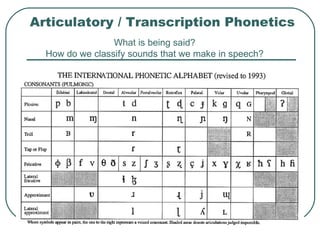
Articulatory / Transcription Phonetics What is being said? How do we classify sounds that we make in speech?
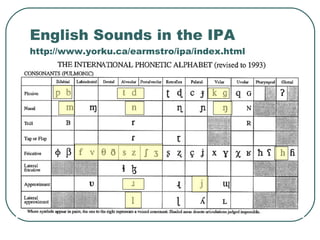
English Sounds in the IPA http://www.yorku.ca/earmstro/ipa/index.html
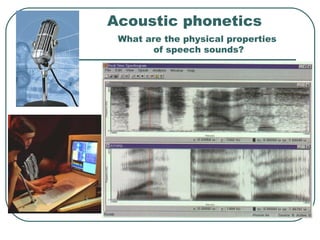
Acoustic phonetics What are the physical properties  of speech sounds?
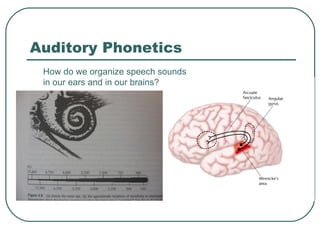
Auditory Phonetics How do we organize speech sounds  in our ears and in our brains?
Clinical Phonetics The application of the knowledge of phonetics to solving practical problems Phonological disorders Understanding dialects Accent reduction Language acquisition
The most important slide EVER Orthography (how a word is written) Does not  indicate  Pronunciation (how a word is spoken) Don’t be fooled by spelling! Phonetics is concerned with sounds, not letters Digraphs “th” “sh” “ch” “-ti”  etc. Represent one sound Vowels Are often not clearly reflected by spelling.
Spelling   Wood – would  Fly – high  Here – hear  Cough – scoff  Mission – ration – fishing Mission – fission
Helpful symbols to start off “ word ”     a normal, typewritten word in plain English /  word  /     the basic idea we have about how a word is pronounced [  word  ]     an actual pronunciation of a word (usually from an audio recording)
Terms:  Phoneme:  A sound in a language Smallest unit of  sound  that distinguishes meaning in a word/language “ cat”  has three sounds, each of which can distinguish its meaning from another word “ r at” “k i t” “ca b ” If you change any of the three sounds, the word no longer means the same thing.   Each phoneme is represented by one symbol in the IPA alphabet
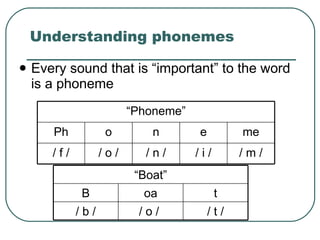
Understanding phonemes Every sound that is “important” to the word is a phoneme “ Phoneme” / m / / i / / n / / o / / f / me e n o Ph “ Boat” / t / / o /  / b / t oa B
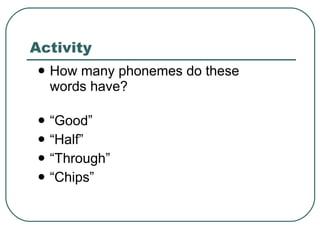
Activity How many phonemes do these  words have? “Good” “Half” “Through” “Chips”
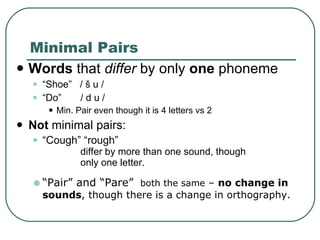
Minimal Pairs Words  that  differ  by only  one  phoneme “ Shoe”  /  š u /  “ Do”  / d u /  Min. Pair even though it is 4 letters vs 2 Not  minimal pairs: “ Cough” “rough”   differ by more than one sound, though only one letter.  “ Pair” and “Pare”   both the same  –  no change in sounds , though there is a change in orthography.
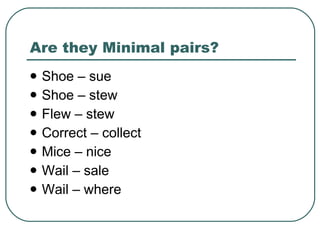
Are they Minimal pairs? Shoe – sue Shoe – stew  Flew – stew Correct – collect Mice – nice  Wail – sale  Wail – where
Phoneme    categorization Each speaker sounds a bit different.  Every time to  say  a word, it might sound a bit different.  Still, we can learn to put these physically different sounds into  categories .  The categories are phonemes
Allophones Variant pronunciations of a phoneme So… they are different  phones  (sounds) but the  same   phoneme (category) Any speech sound Because they don’t change the meaning of the word
Allophone examples Keep and Keep  (unreleased or released final sound) Light and Dark L sounds Little  vs  ball  Keel and cool  Front and back /k/
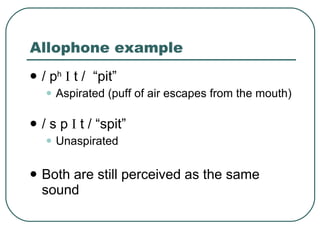
Allophone example / p h   I  t /  “pit” Aspirated (puff of air escapes from the mouth) / s p  I  t / “spit” Unaspirated Both are still perceived as the same sound
Allophones  Phonemes “ Allophone” is a  language-specific  designation.   Japanese [ r ] [ l ] p h o n e p h o n e / r / English [ r ] [ l ] p h o n e p h o n e / r / / l /
Allophones  Phonemes “ Allophone” is a  language-specific  designation.   “See” “ Sika” “ Siika” English [ i: ] [ i ] p h o n e p h o n e / i / Finnish [ i: ] [ i ] p h o n e p h o n e / i: / / i /
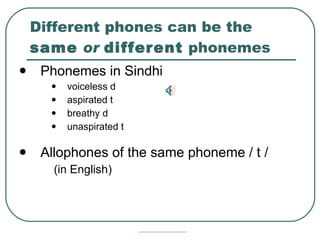
Different phones can be the  same   or   different  phonemes Phonemes in Sindhi voiceless d aspirated t breathy d  unaspirated t  Allophones of the same phoneme / t / (in English)
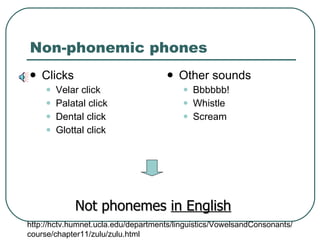
Non-phonemic phones Clicks Velar click Palatal click Dental click Glottal click Other sounds Bbbbbb! Whistle Scream  Not phonemes  in English http://hctv.humnet.ucla.edu/departments/linguistics/VowelsandConsonants/course/chapter11/zulu/zulu.html
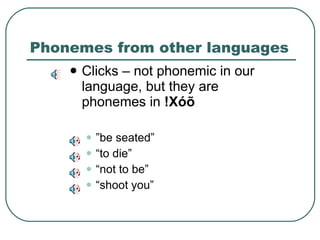
Phonemes from other languages Clicks – not phonemic in our language, but they are phonemes in  !Xóõ ” be seated” “ to die” “ not to be” “ shoot you”
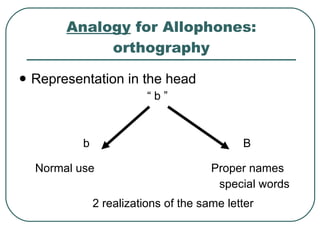
Analogy  for Allophones: orthography Representation in the head   “ b ” b B Normal use Proper names special words    2 realizations of the same letter
So far... Phonetics as a sound science Spelling is generally not useful for phonetics May not reflect sound contrasts May imply false contrasts Is not consistent Sounds  can  distinguish meaning This is language-specific
Kinds of  transcription If we use  Broad  Transcription, we just use the intended phoneme and disregard the slight variation All k’s are k’s.  All b’s are b’s If we use  Narrow  Transcription, we use the exact allophone being spoken Different sounds are written differently
The IPA The  International Phonetic Alphabet   Purpose Guiding principle:  one sound = one symbol  A different symbol for each distinctive sound  The same symbol should be used for that sound in every language which uses it  Simple symbols for major sounds    (from the roman alphabet where possible)   Diacritics are used for minor modifications
IPA symbols Familiarize yourself with the IPA chart (handout) It contains the characters used in broad transcription Extended IPA charts show markings (diacritics) to use for slight variations.
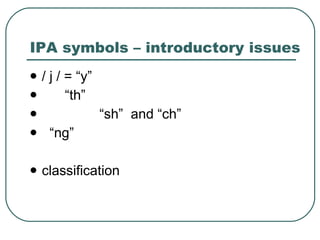
IPA symbols – introductory issues / j / = “y” “ th” “ sh”  and “ch” “ ng” classification
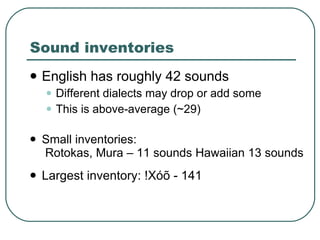
Sound inventories English has roughly 42 sounds Different dialects may drop or add some This is above-average (~29) Small inventories:   Rotokas, Mura – 11 sounds Hawaiian 13 sounds Largest inventory: !Xóõ - 141
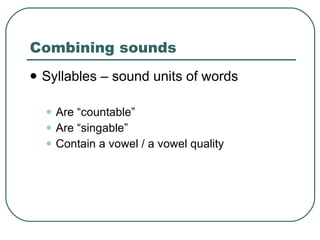
Combining sounds Syllables – sound units of words Are “countable” Are “singable”  Contain a vowel / a vowel quality
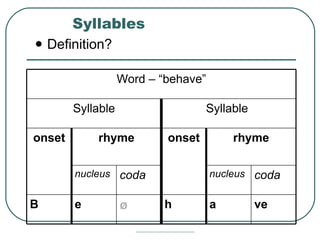
Syllables Definition? ve  coda a h ø e B nucleus coda nucleus rhyme onset rhyme onset Syllable  Syllable Word – “behave”
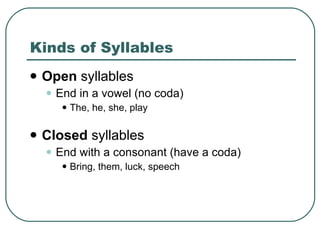
Kinds of Syllables Open  syllables End in a vowel (no coda) The, he, she, play Closed  syllables End with a consonant (have a coda) Bring, them, luck, speech
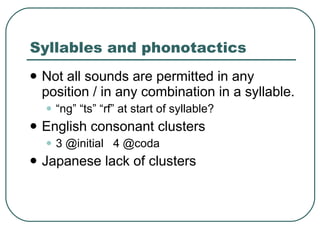
Syllables and phonotactics Not all sounds are permitted in any position / in any combination in a syllable. “ ng” “ts” “rf” at start of syllable? English consonant clusters 3 @initial  4 @coda Japanese lack of clusters
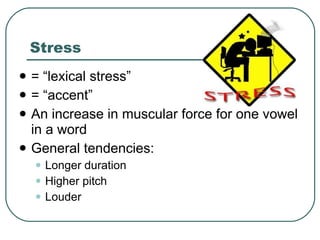
Stress = “lexical stress” = “accent” An increase in muscular force for one vowel in a word General tendencies: Longer duration Higher pitch Louder
Types of stress Trochaic (English)  vs.  Iambic (French) stress Photo Defense  Strategy
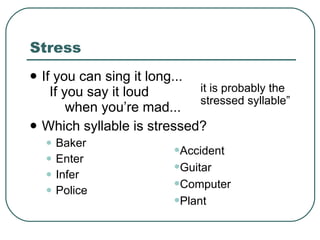
Stress If you can sing it long...    If you say it loud    when you’re mad... Which syllable is stressed? Baker  Enter  Infer  Police it is probably the stressed syllable” Accident  Guitar  Computer  Plant
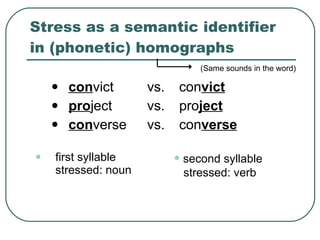
Stress as a semantic identifier in (phonetic) homographs con vict  vs.  con vict pro ject  vs.  pro ject con verse  vs.  con verse first syllable  stressed: noun (Same sounds in the word) second syllable    stressed: verb
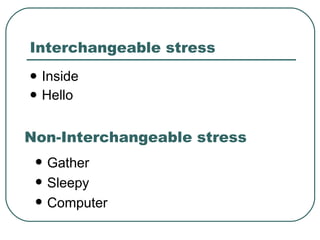
Interchangeable stress Inside Hello Non-Interchangeable stress Gather Sleepy  Computer
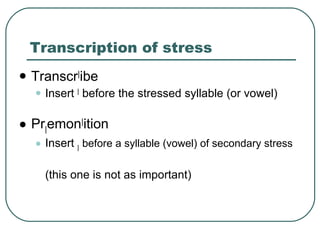
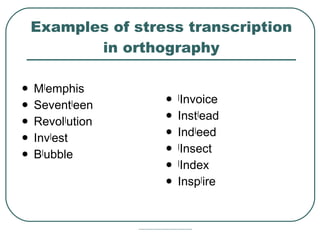
Transcription of stress Transcr | ibe Insert  |  before the stressed syllable (or vowel) Pr | emon | ition Insert  |   before a syllable (vowel) of secondary stress (this one is not as important)
Examples of stress transcription in orthography M | emphis Sevent | een Revol | ution  Inv | est B | ubble  | Invoice Inst | ead Ind | eed | Insect | Index Insp | ire
So far... We use IPA to transcribe sounds The IPA is governed by specific and simple principles Different languages vary greatly in their inventory of contrastive sounds Syllables Stress
Homework for next week ( Handout)  QUIZ next week: Basic linguistic terms that we discussed today The nature of phonetic transcription Identifying phonemes and stress in words Think about prep question

Introduction to Phonetic Science

  • 1.
    Introduction to PhoneticScience HESP 403 Spring 2007
  • 2.
  • 3.
    Syllabus Course /Instructor info www.bsos.umd.edu/hesp/mwinn Office hours Book (yes, there’s a book) Syllabus/Grading Exams, quizzes, prep work, homework, (=attendance)
  • 4.
    Purpose of thecourse ASHA guidelines Communication between clinicians Understanding of the speech mechanism Physical and theoretical properties of speech sounds
  • 5.
    Goals of today’sclass: Understand what the science of phonetics is. Understand linguistic terms like “phoneme” “allophone” and “syllable” Understand Stress Know why we use phonetic symbols
  • 6.
    Phonetics Where doesit fit in? What kinds of explanations does it offer? What comparisons and analogies can we make? To other fields of study, within the study of language
  • 7.
    Kinds of PhoneticsArticulatory / Transcription Phonetics What is being said? How do we classify sounds that we make in speech? Acoustic Phonetics What are the physical properties of speech sounds? Auditory Phonetics How do we organize speech sounds in our brains? Clinical Phonetics How can we use this knowledge to solve problems?
  • 8.
    Articulatory / TranscriptionPhonetics What is being said? How do we classify sounds that we make in speech?
  • 9.
    English Sounds inthe IPA http://www.yorku.ca/earmstro/ipa/index.html
  • 10.
    Acoustic phonetics Whatare the physical properties of speech sounds?
  • 11.
    Auditory Phonetics Howdo we organize speech sounds in our ears and in our brains?
  • 12.
    Clinical Phonetics Theapplication of the knowledge of phonetics to solving practical problems Phonological disorders Understanding dialects Accent reduction Language acquisition
  • 13.
    The most importantslide EVER Orthography (how a word is written) Does not indicate Pronunciation (how a word is spoken) Don’t be fooled by spelling! Phonetics is concerned with sounds, not letters Digraphs “th” “sh” “ch” “-ti” etc. Represent one sound Vowels Are often not clearly reflected by spelling.
  • 14.
    Spelling Wood – would Fly – high Here – hear Cough – scoff Mission – ration – fishing Mission – fission
  • 15.
    Helpful symbols tostart off “ word ”  a normal, typewritten word in plain English / word /  the basic idea we have about how a word is pronounced [ word ]  an actual pronunciation of a word (usually from an audio recording)
  • 16.
    Terms: Phoneme: A sound in a language Smallest unit of sound that distinguishes meaning in a word/language “ cat” has three sounds, each of which can distinguish its meaning from another word “ r at” “k i t” “ca b ” If you change any of the three sounds, the word no longer means the same thing. Each phoneme is represented by one symbol in the IPA alphabet
  • 17.
    Understanding phonemes Everysound that is “important” to the word is a phoneme “ Phoneme” / m / / i / / n / / o / / f / me e n o Ph “ Boat” / t / / o / / b / t oa B
  • 18.
    Activity How manyphonemes do these words have? “Good” “Half” “Through” “Chips”
  • 19.
    Minimal Pairs Words that differ by only one phoneme “ Shoe” / š u / “ Do” / d u / Min. Pair even though it is 4 letters vs 2 Not minimal pairs: “ Cough” “rough” differ by more than one sound, though only one letter. “ Pair” and “Pare” both the same – no change in sounds , though there is a change in orthography.
  • 20.
    Are they Minimalpairs? Shoe – sue Shoe – stew Flew – stew Correct – collect Mice – nice Wail – sale Wail – where
  • 21.
    Phoneme  categorization Each speaker sounds a bit different. Every time to say a word, it might sound a bit different. Still, we can learn to put these physically different sounds into categories . The categories are phonemes
  • 22.
    Allophones Variant pronunciationsof a phoneme So… they are different phones (sounds) but the same phoneme (category) Any speech sound Because they don’t change the meaning of the word
  • 23.
    Allophone examples Keepand Keep (unreleased or released final sound) Light and Dark L sounds Little vs ball Keel and cool Front and back /k/
  • 24.
    Allophone example /p h I t / “pit” Aspirated (puff of air escapes from the mouth) / s p I t / “spit” Unaspirated Both are still perceived as the same sound
  • 25.
    Allophones Phonemes“ Allophone” is a language-specific designation. Japanese [ r ] [ l ] p h o n e p h o n e / r / English [ r ] [ l ] p h o n e p h o n e / r / / l /
  • 26.
    Allophones Phonemes“ Allophone” is a language-specific designation. “See” “ Sika” “ Siika” English [ i: ] [ i ] p h o n e p h o n e / i / Finnish [ i: ] [ i ] p h o n e p h o n e / i: / / i /
  • 27.
    Different phones canbe the same or different phonemes Phonemes in Sindhi voiceless d aspirated t breathy d unaspirated t Allophones of the same phoneme / t / (in English)
  • 28.
    Non-phonemic phones ClicksVelar click Palatal click Dental click Glottal click Other sounds Bbbbbb! Whistle Scream Not phonemes in English http://hctv.humnet.ucla.edu/departments/linguistics/VowelsandConsonants/course/chapter11/zulu/zulu.html
  • 29.
    Phonemes from otherlanguages Clicks – not phonemic in our language, but they are phonemes in !Xóõ ” be seated” “ to die” “ not to be” “ shoot you”
  • 30.
    Analogy forAllophones: orthography Representation in the head “ b ” b B Normal use Proper names special words 2 realizations of the same letter
  • 31.
    So far... Phoneticsas a sound science Spelling is generally not useful for phonetics May not reflect sound contrasts May imply false contrasts Is not consistent Sounds can distinguish meaning This is language-specific
  • 32.
    Kinds of transcription If we use Broad Transcription, we just use the intended phoneme and disregard the slight variation All k’s are k’s. All b’s are b’s If we use Narrow Transcription, we use the exact allophone being spoken Different sounds are written differently
  • 33.
    The IPA The International Phonetic Alphabet Purpose Guiding principle: one sound = one symbol A different symbol for each distinctive sound The same symbol should be used for that sound in every language which uses it Simple symbols for major sounds (from the roman alphabet where possible) Diacritics are used for minor modifications
  • 34.
    IPA symbols Familiarizeyourself with the IPA chart (handout) It contains the characters used in broad transcription Extended IPA charts show markings (diacritics) to use for slight variations.
  • 35.
    IPA symbols –introductory issues / j / = “y” “ th” “ sh” and “ch” “ ng” classification
  • 36.
    Sound inventories Englishhas roughly 42 sounds Different dialects may drop or add some This is above-average (~29) Small inventories: Rotokas, Mura – 11 sounds Hawaiian 13 sounds Largest inventory: !Xóõ - 141
  • 37.
    Combining sounds Syllables– sound units of words Are “countable” Are “singable” Contain a vowel / a vowel quality
  • 38.
    Syllables Definition? ve coda a h ø e B nucleus coda nucleus rhyme onset rhyme onset Syllable Syllable Word – “behave”
  • 39.
    Kinds of SyllablesOpen syllables End in a vowel (no coda) The, he, she, play Closed syllables End with a consonant (have a coda) Bring, them, luck, speech
  • 40.
    Syllables and phonotacticsNot all sounds are permitted in any position / in any combination in a syllable. “ ng” “ts” “rf” at start of syllable? English consonant clusters 3 @initial 4 @coda Japanese lack of clusters
  • 41.
    Stress = “lexicalstress” = “accent” An increase in muscular force for one vowel in a word General tendencies: Longer duration Higher pitch Louder
  • 42.
    Types of stressTrochaic (English) vs. Iambic (French) stress Photo Defense Strategy
  • 43.
    Stress If youcan sing it long... If you say it loud when you’re mad... Which syllable is stressed? Baker Enter Infer Police it is probably the stressed syllable” Accident Guitar Computer Plant
  • 44.
    Stress as asemantic identifier in (phonetic) homographs con vict vs. con vict pro ject vs. pro ject con verse vs. con verse first syllable stressed: noun (Same sounds in the word) second syllable stressed: verb
  • 45.
    Interchangeable stress InsideHello Non-Interchangeable stress Gather Sleepy Computer
  • 46.
    Transcription of stressTranscr | ibe Insert | before the stressed syllable (or vowel) Pr | emon | ition Insert | before a syllable (vowel) of secondary stress (this one is not as important)
  • 47.
    Examples of stresstranscription in orthography M | emphis Sevent | een Revol | ution Inv | est B | ubble | Invoice Inst | ead Ind | eed | Insect | Index Insp | ire
  • 48.
    So far... Weuse IPA to transcribe sounds The IPA is governed by specific and simple principles Different languages vary greatly in their inventory of contrastive sounds Syllables Stress
  • 49.
    Homework for nextweek ( Handout) QUIZ next week: Basic linguistic terms that we discussed today The nature of phonetic transcription Identifying phonemes and stress in words Think about prep question

Editor's Notes

  • #8 When we say “phonetics,” we mean…
  • #25 Sometimes allophones are context-dependent
  • #27 Dog, whitefish
  • #31 Even though we’ve vowed to disregard spelling…
  • #37 Cite Maddieson book from 1984
  • #50 Make HW for this class