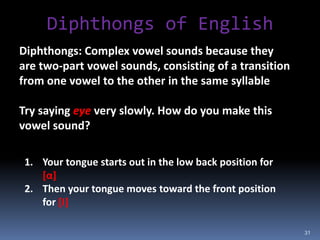
PhoneticsIntroduction to Language2011 FallRyan1
Objectives:Explore the relationship between sound and spelling
Become familiar with International Phonetic Alphabet (IPA )
Understand the nature of consonants and vowels
Learn where particular sounds occur (physical aspects of the human vocal tract)
How sounds change when different sounds surround them
Yule: Chapter 3, The Sounds of Language2
PhoneticsAcoustic phonetics – the physical properties of speech as sound waves in the airAuditory phonetics – the study of the perception of speech sounds, via the earArticulatory phonetics – the study of how speech sounds are made, or ‘articulated’3
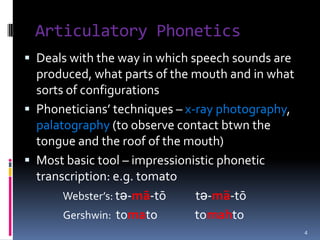
Articulatory PhoneticsDeals with the way in which speech sounds are produced, what parts of the mouth and in what sorts of configurationsPhoneticians’ techniques – x-ray photography, palatography (to observe contact btwn the tongue and the roof of the mouth)Most basic tool – impressionistic phonetic transcription: e.g. tomato           Webster’s: tə-mā-tōtə-mä-tō           Gershwin:  tomato              tomahto4
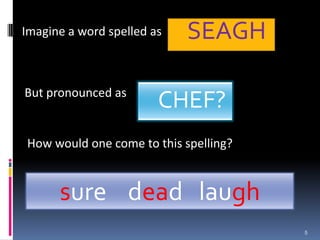
SEAGH5Imagine a word spelled asCHEF?But pronounced asHow would one come to this spelling?sure    dead   laugh
Describing Language SoundsThe sounds of spoken English often do not match up with the letters of written English.
 One solution to describe the sounds of a language is to produce a separate alphabet with symbols that represent sound  phonetic alphabet
These symbols represent both the consonant and vowel sounds of language6
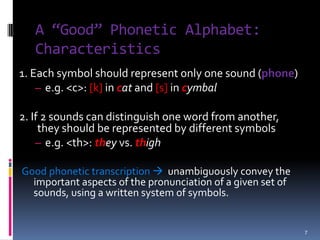
A “Good” Phonetic Alphabet: Characteristics1. Each symbol should represent only one sound (phone)e.g. <c>: [k] in cat and [s] in cymbal2. If 2 sounds can distinguish one word from another, they should be represented by different symbolse.g. <th>: they vs. thighGood phonetic transcription  unambiguously convey the important aspects of the pronunciation of a given set of sounds, using a written system of symbols.7
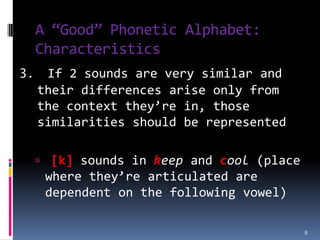
A “Good” Phonetic Alphabet: Characteristics3.  If 2 sounds are very similar and their differences arise only from the context they’re in, those similarities should be represented[k]sounds in keep and cool (place where they’re articulated are dependent on the following vowel)8
The English AlphabetThe English alphabet has 26 letters but there are over 40 different speech sounds:5 vowel and 21 consonant letters of the alphabetAbout 20 vowel sounds and 24 consonant sounds (depending on dialect)9
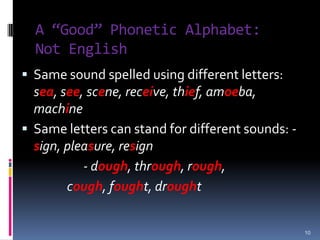
A “Good” Phonetic Alphabet: Not EnglishSame sound spelled using different letters: sea, see, scene, receive, thief, amoeba, machineSame letters can stand for different sounds: - sign, pleasure, resign			- dough, through, rough,                cough, fought, drought10
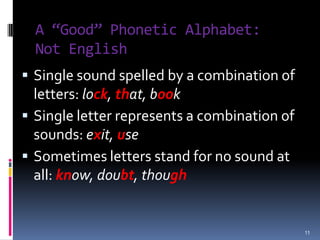
A “Good” Phonetic Alphabet: Not EnglishSingle sound spelled by a combination of letters: lock, that, bookSingle letter represents a combination of sounds: exit, useSometimes letters stand for no sound at all: know, doubt, though11
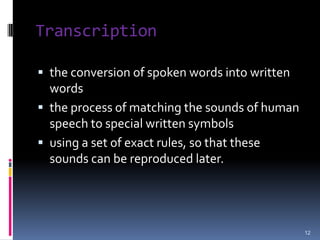
Transcriptionthe conversion of spoken words into written wordsthe process of matching the sounds of human speech to special written symbolsusing a set of exact rules, so that these sounds can be reproduced later.12
TranscriptionThere are two kinds of transcription
Narrow transcription:
seeks to document every possible detail of the segment
very often, these details are not discernible to the native speaker
Broad transcription:
specifies the segments that are contrastive in the language
far fewer sounds are documented13
TranscriptionA transcription system for these purposes must be different from traditional writing systems
Some features of a good phonetic transcription system:
Universal: no preference given to any existing spelling system
Interpretable: other linguists should be able to interpret it
Transparent: one-to-one correspondence between sounds and symbols
Comprehensive: symbols for all the sounds in human language
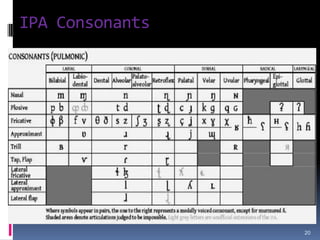
The International Phonetic Alphabet (IPA) is the best attempt so far (chart uploaded in Bb)14
The Organs of Speech (Yule, page 27)15
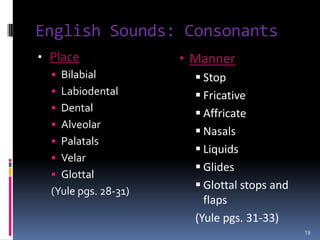
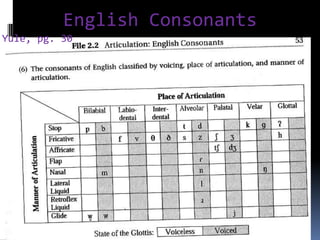
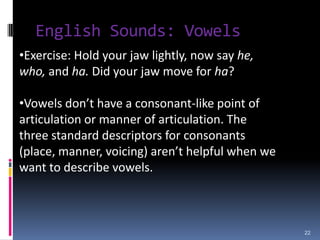
English Sounds16All English words are made from combinations of consonants and vowels

2 phonetics slides final