WTF is Penetration Testing
v.2
Who are we?
Eric Gruber
@egru
http://github.com/egru
http://github.com/netspi
http://netspi.com/blog
Karl Fosaaen
@kfosaaen

http://github.com/kfosaaen
http://slideshare.com/kfosaaen
Scott Sutherland
@_nullbind

http://github.com/nullbind
http://slideshare.com/nullbind
Demo
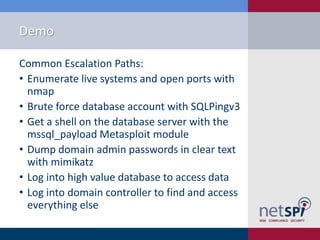
Common Escalation Paths:
• Enumerate live systems and open ports with
nmap
• Brute force database account with SQLPingv3
• Get a shell on the database server with the
mssql_payload Metasploit module
• Dump domain admin passwords in clear text
with mimikatz
• Log into high value database to access data
• Log into domain controller to find and access
everything else
Overview
•
•
•
•
•
•
•
•
•

What is a penetration test?
Why do companies pay for them?
Types of penetration testing
What are the rules of engagement?
Who does penetration testing?
What skills do they have?
What tools do they use?
Penetration testing as a Career
Questions
What is a Penetration Test?
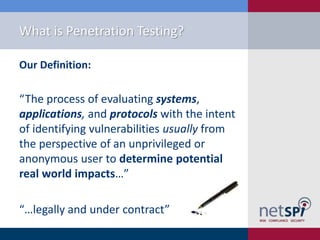
What is Penetration Testing?
Our Definition:

“The process of evaluating systems,
applications, and protocols with the intent
of identifying vulnerabilities usually from
the perspective of an unprivileged or
anonymous user to determine potential
real world impacts…”
“…legally and under contract”
What is Penetration Testing?

In short…
What is Penetration Testing?

…we try to break into stuff
before the bad guys do
Why do companies buy
Penetration Tests?
Why do companies buy pentests?
• Meet compliance requirements
• Evaluate risks associated with an acquisition
or partnership
• Validate preventative controls
• Validate detective controls
• Prioritize internal security initiatives
• Proactively prevent breaches
Why do Companies Pen Test?
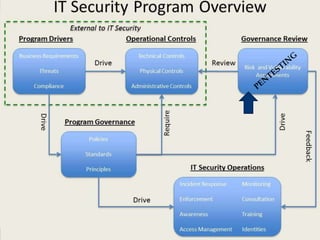
What types of Penetration Tests are there?
Hats and Boxes?
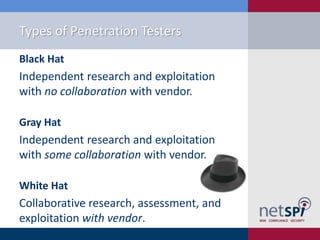
Types of Penetration Testers
Black Hat

Independent research and exploitation
with no collaboration with vendor.
Gray Hat

Independent research and exploitation
with some collaboration with vendor.
White Hat

Collaborative research, assessment, and
exploitation with vendor.
Types of Penetration Tests
Black Box

Zero knowledge of target.
Gray Box

User knowledge of target. Sometimes as
an anonymous user.
White Box

Administrative or development knowledge
of target.
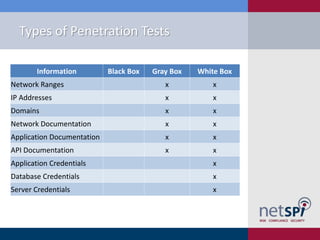
Types of Penetration Tests
Information

Black Box

Gray Box

White Box

Network Ranges

x

x

IP Addresses

x

x

Domains

x

x

Network Documentation

x

x

Application Documentation

x

x

API Documentation

x

x

Application Credentials

x

Database Credentials

x

Server Credentials

x
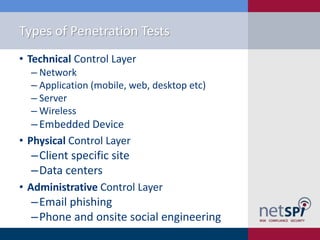
Types of Penetration Tests
• Technical Control Layer
‒ Network
‒ Application (mobile, web, desktop etc)
‒ Server
‒ Wireless

‒ Embedded Device
• Physical Control Layer

‒Client specific site
‒Data centers
• Administrative Control Layer

‒Email phishing
‒Phone and onsite social engineering
What are the
Rules of Engagement?
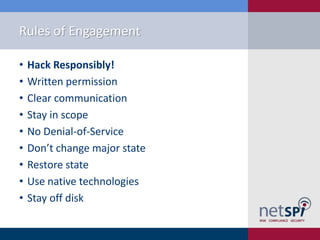
Rules of Engagement
•
•
•
•
•
•
•
•
•

Hack Responsibly!
Written permission
Clear communication
Stay in scope
No Denial-of-Service
Don’t change major state
Restore state
Use native technologies
Stay off disk
Are there any Penetration Testing
methodologies?
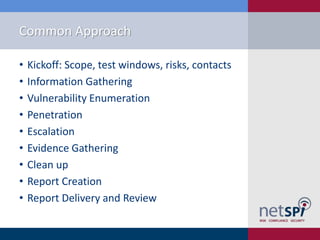
Common Approach
•
•
•
•
•
•
•
•
•

Kickoff: Scope, test windows, risks, contacts
Information Gathering
Vulnerability Enumeration
Penetration
Escalation
Evidence Gathering
Clean up
Report Creation
Report Delivery and Review
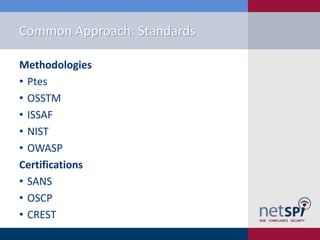
Common Approach: Standards
Methodologies
• Ptes
• OSSTM
• ISSAF
• NIST
• OWASP
Certifications
• SANS
• OSCP
• CREST
Penetration Test vs.
Vulnerability Assessment
Assessment VS. Penetration
What can both an assessment or pentest
answer?
•
•
•
•
•

What are my system layer vulnerabilities?
Where are my system layer vulnerabilities?
Will we know if we are being scanned?
How do I fix my vulnerabilities?
Are we fixing things over time?
Assessment VS. Penetration
What else can a pentest answer?

• What vulnerabilities represent the most risk?
• What are my high impact system, network,
and application layer issues?
• Can an attacker gain unauthorized access to
critical infrastructure, application
functionality, and sensitive data
• Can attackers bypass multiple layers of
detective and preventative controls?
• Can attackers pivot between environments?
• Are procedures being enforced
Who conducts Penetration Testing?
Who Conducts Penetration Testing?

People that can pass a background check
Who Conducts Penetration Testing?
• Internal Employees
‒ Security analysts
‒ Security consultants

• Third Parties
‒ Audit Firms
‒ Value-Added Reseller (VAR)
‒ Manage Services
‒ Software as a Service (SaaS)
‒ Software Vendors
‒ Security Consultants
What skills are required?
What Skills are Needed?
•
•
•
•

Non Technical
Basic Technical
Offensive
Defensive
Non Technical Skillsets
• Written and Verbal Communications
‒ Emails/phone calls
‒ Report development
‒ Small and large group presentations

• Professionalism
‒ Respecting others, setting, and
meeting expectations
Non Technical Skillsets
• Troubleshooting Mindset
‒ Never give up, never surrender!
‒ Where there is a will, there is a way

• Ethics
‒ Don’t do bad things
‒ Pros (career) vs. Cons (jail)
‒ Hack responsibly
Basic Technical Skillsets
•
•
•
•
•

Windows Desktop Administration
Windows Domain Administration
Linux and Unix Administration
Network Infrastructure Administration
Application Development
‒ Scripting (Ruby, Python, PHP, Bash, PS, Batch)
‒ Managed languages (.Net, Java, Davlik)
‒ Unmanaged languages (C, C++)
Offensive and Defensive Knowledge
• System enumeration and service
fingerprinting
• Linux system exploitation and escalation
• Windows system exploitation and escalation
• Network system exploitation and escalation
• Protocol exploitation
• Web application exploitation
• Reverse engineering
• Anti-virus Evasion
• Social engineering techniques
What are some of the
common tools?
Common Tools
There are hundreds of “hacker” tools.

Generally, you need to have enough
knowledge to know what tool or tool(s) is
right for the task at hand….

…and if one doesn’t exist, then create it.
Common Tools
That being said…
Common Tools
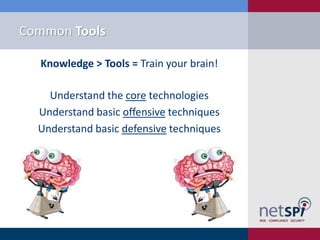
Knowledge > Tools = Train your brain!
Understand the core technologies
Understand basic offensive techniques
Understand basic defensive techniques
Common Tools: Info Gathering
Find online resources owned by target including:
• Subsidiaries (companies)
• Systems (live IP addresses)
• Services
• Domains
• Web applications
• Email addresses
Tool Examples:
• Public registries: IP, DNS, SEC Filings, etc.
• Nmap
• Recon-ng
• Google
• BackTrack / Kali tool sets (many discovery tools)
Common Tools: Identify Vulnerabilities
Find vulnerabilities:
• Missing patches
• Weak configurations
‒ system, application, network

• Application issues
Tool Examples:
• Patches/Configurations: OpenVAS, Nessus,
NeXpose, Qualys, IP360 etc
• Applications: Burp, Zap, w3af, Nikto, DirBuster,
SQLMap, Web Inspect, Appscan etc
Common Tools: Penetration
Common penetration methods:
• Buffer overflows
• Default and weak passwords
• SQL Injection
• Insecure Protocols
Tool Examples:
• Patches: Metasploit, Canvas, Core Impact
• Configurations: Native tools, Responder,
Metasploit, Yersinia, Cain, Loki, Medusa
• Applications: SQLMap, Metasploit, Burp, Zap etc
Common Tools: Privilege Escalation
Exploit trust relationships to access to everything!
Tool Examples:
• Local Exploits & Weak Configurations
‒ Metasploit, Core Impact, Canvas,
‒ exploit-db.com

• Password Hash Cracking
‒ John the ripper, Hashcat, Rainbow Tables

• Pass-the-Hash
‒ Metasploit, PTH toolkits, WCE

• Token stealing
‒ Metasploit and Incognito

• Credential dumping
‒ Mimikatz, LSA Secrets, Credential Manager,
groups.xml, unattend.xml etc
Common Tools

Tools output a TON of data!
How do people manage all that data?
Common Pentest CMS Options
Managing penetration test data:
• Storing files in organized folders
• Writing reports from word/excel templates
• Storing information in databases and XML
• Open source CMS projects
• Commercial CMS products
• Examples:
‒ Dradis
‒ Threadfix
‒ CorrelatedVM
‒ Risk IO
Penetration Testing as a Career?
Pen Testing as a Career: How to Start
• Read and learn! – There is no “end”
• Tap into the community!
• Research and development
‒ Contribute to/start open source projects
‒ Present research at conferences

• Training and Certifications
‒ Community: DC612, OWASP, Conferences, etc
‒ Professional ($): SANS, OffSec, CISSP, CREST, etc

• Volunteer
• Internships
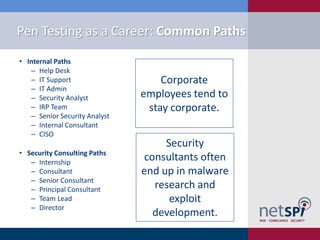
Pen Testing as a Career: Common Paths
• Internal Paths
‒ Help Desk
‒ IT Support
‒ IT Admin
‒ Security Analyst
‒ IRP Team
‒ Senior Security Analyst
‒ Internal Consultant
‒ CISO
• Security Consulting Paths
‒ Internship
‒ Consultant
‒ Senior Consultant
‒ Principal Consultant
‒ Team Lead
‒ Director

Corporate
employees tend to
stay corporate.
Security
consultants often
end up in malware
research and
exploit
development.
What we covered…
•
•
•
•
•
•
•
•
•

What is a penetration test?
Why do companies pay for them?
Types of penetration testing
What are the rules of engagement?
Who does penetration testing?
What skills do they have?
What tools do they use?
Penetration testing as a Career
Questions
Questions,
comments, curses?
BE SAFE and

HACK RESPONSIBLY

WTF is Penetration Testing v.2

  • 1.
    WTF is PenetrationTesting v.2
  • 2.
    Who are we? EricGruber @egru http://github.com/egru http://github.com/netspi http://netspi.com/blog Karl Fosaaen @kfosaaen http://github.com/kfosaaen http://slideshare.com/kfosaaen Scott Sutherland @_nullbind http://github.com/nullbind http://slideshare.com/nullbind
  • 3.
    Demo Common Escalation Paths: •Enumerate live systems and open ports with nmap • Brute force database account with SQLPingv3 • Get a shell on the database server with the mssql_payload Metasploit module • Dump domain admin passwords in clear text with mimikatz • Log into high value database to access data • Log into domain controller to find and access everything else
  • 4.
    Overview • • • • • • • • • What is apenetration test? Why do companies pay for them? Types of penetration testing What are the rules of engagement? Who does penetration testing? What skills do they have? What tools do they use? Penetration testing as a Career Questions
  • 5.
    What is aPenetration Test?
  • 6.
    What is PenetrationTesting? Our Definition: “The process of evaluating systems, applications, and protocols with the intent of identifying vulnerabilities usually from the perspective of an unprivileged or anonymous user to determine potential real world impacts…” “…legally and under contract”
  • 7.
    What is PenetrationTesting? In short…
  • 8.
    What is PenetrationTesting? …we try to break into stuff before the bad guys do
  • 9.
    Why do companiesbuy Penetration Tests?
  • 10.
    Why do companiesbuy pentests? • Meet compliance requirements • Evaluate risks associated with an acquisition or partnership • Validate preventative controls • Validate detective controls • Prioritize internal security initiatives • Proactively prevent breaches
  • 11.
  • 12.
  • 15.
    What types ofPenetration Tests are there?
  • 16.
  • 17.
    Types of PenetrationTesters Black Hat Independent research and exploitation with no collaboration with vendor. Gray Hat Independent research and exploitation with some collaboration with vendor. White Hat Collaborative research, assessment, and exploitation with vendor.
  • 18.
    Types of PenetrationTests Black Box Zero knowledge of target. Gray Box User knowledge of target. Sometimes as an anonymous user. White Box Administrative or development knowledge of target.
  • 19.
    Types of PenetrationTests Information Black Box Gray Box White Box Network Ranges x x IP Addresses x x Domains x x Network Documentation x x Application Documentation x x API Documentation x x Application Credentials x Database Credentials x Server Credentials x
  • 20.
    Types of PenetrationTests • Technical Control Layer ‒ Network ‒ Application (mobile, web, desktop etc) ‒ Server ‒ Wireless ‒ Embedded Device • Physical Control Layer ‒Client specific site ‒Data centers • Administrative Control Layer ‒Email phishing ‒Phone and onsite social engineering
  • 21.
    What are the Rulesof Engagement?
  • 22.
    Rules of Engagement • • • • • • • • • HackResponsibly! Written permission Clear communication Stay in scope No Denial-of-Service Don’t change major state Restore state Use native technologies Stay off disk
  • 23.
    Are there anyPenetration Testing methodologies?
  • 24.
    Common Approach • • • • • • • • • Kickoff: Scope,test windows, risks, contacts Information Gathering Vulnerability Enumeration Penetration Escalation Evidence Gathering Clean up Report Creation Report Delivery and Review
  • 25.
    Common Approach: Standards Methodologies •Ptes • OSSTM • ISSAF • NIST • OWASP Certifications • SANS • OSCP • CREST
  • 26.
  • 27.
    Assessment VS. Penetration Whatcan both an assessment or pentest answer? • • • • • What are my system layer vulnerabilities? Where are my system layer vulnerabilities? Will we know if we are being scanned? How do I fix my vulnerabilities? Are we fixing things over time?
  • 28.
    Assessment VS. Penetration Whatelse can a pentest answer? • What vulnerabilities represent the most risk? • What are my high impact system, network, and application layer issues? • Can an attacker gain unauthorized access to critical infrastructure, application functionality, and sensitive data • Can attackers bypass multiple layers of detective and preventative controls? • Can attackers pivot between environments? • Are procedures being enforced
  • 29.
  • 30.
    Who Conducts PenetrationTesting? People that can pass a background check
  • 31.
    Who Conducts PenetrationTesting? • Internal Employees ‒ Security analysts ‒ Security consultants • Third Parties ‒ Audit Firms ‒ Value-Added Reseller (VAR) ‒ Manage Services ‒ Software as a Service (SaaS) ‒ Software Vendors ‒ Security Consultants
  • 32.
    What skills arerequired?
  • 33.
    What Skills areNeeded? • • • • Non Technical Basic Technical Offensive Defensive
  • 34.
    Non Technical Skillsets •Written and Verbal Communications ‒ Emails/phone calls ‒ Report development ‒ Small and large group presentations • Professionalism ‒ Respecting others, setting, and meeting expectations
  • 35.
    Non Technical Skillsets •Troubleshooting Mindset ‒ Never give up, never surrender! ‒ Where there is a will, there is a way • Ethics ‒ Don’t do bad things ‒ Pros (career) vs. Cons (jail) ‒ Hack responsibly
  • 36.
    Basic Technical Skillsets • • • • • WindowsDesktop Administration Windows Domain Administration Linux and Unix Administration Network Infrastructure Administration Application Development ‒ Scripting (Ruby, Python, PHP, Bash, PS, Batch) ‒ Managed languages (.Net, Java, Davlik) ‒ Unmanaged languages (C, C++)
  • 37.
    Offensive and DefensiveKnowledge • System enumeration and service fingerprinting • Linux system exploitation and escalation • Windows system exploitation and escalation • Network system exploitation and escalation • Protocol exploitation • Web application exploitation • Reverse engineering • Anti-virus Evasion • Social engineering techniques
  • 38.
    What are someof the common tools?
  • 39.
    Common Tools There arehundreds of “hacker” tools. Generally, you need to have enough knowledge to know what tool or tool(s) is right for the task at hand…. …and if one doesn’t exist, then create it.
  • 40.
  • 41.
    Common Tools Knowledge >Tools = Train your brain! Understand the core technologies Understand basic offensive techniques Understand basic defensive techniques
  • 42.
    Common Tools: InfoGathering Find online resources owned by target including: • Subsidiaries (companies) • Systems (live IP addresses) • Services • Domains • Web applications • Email addresses Tool Examples: • Public registries: IP, DNS, SEC Filings, etc. • Nmap • Recon-ng • Google • BackTrack / Kali tool sets (many discovery tools)
  • 43.
    Common Tools: IdentifyVulnerabilities Find vulnerabilities: • Missing patches • Weak configurations ‒ system, application, network • Application issues Tool Examples: • Patches/Configurations: OpenVAS, Nessus, NeXpose, Qualys, IP360 etc • Applications: Burp, Zap, w3af, Nikto, DirBuster, SQLMap, Web Inspect, Appscan etc
  • 44.
    Common Tools: Penetration Commonpenetration methods: • Buffer overflows • Default and weak passwords • SQL Injection • Insecure Protocols Tool Examples: • Patches: Metasploit, Canvas, Core Impact • Configurations: Native tools, Responder, Metasploit, Yersinia, Cain, Loki, Medusa • Applications: SQLMap, Metasploit, Burp, Zap etc
  • 45.
    Common Tools: PrivilegeEscalation Exploit trust relationships to access to everything! Tool Examples: • Local Exploits & Weak Configurations ‒ Metasploit, Core Impact, Canvas, ‒ exploit-db.com • Password Hash Cracking ‒ John the ripper, Hashcat, Rainbow Tables • Pass-the-Hash ‒ Metasploit, PTH toolkits, WCE • Token stealing ‒ Metasploit and Incognito • Credential dumping ‒ Mimikatz, LSA Secrets, Credential Manager, groups.xml, unattend.xml etc
  • 46.
  • 47.
    How do peoplemanage all that data?
  • 48.
    Common Pentest CMSOptions Managing penetration test data: • Storing files in organized folders • Writing reports from word/excel templates • Storing information in databases and XML • Open source CMS projects • Commercial CMS products • Examples: ‒ Dradis ‒ Threadfix ‒ CorrelatedVM ‒ Risk IO
  • 49.
  • 50.
    Pen Testing asa Career: How to Start • Read and learn! – There is no “end” • Tap into the community! • Research and development ‒ Contribute to/start open source projects ‒ Present research at conferences • Training and Certifications ‒ Community: DC612, OWASP, Conferences, etc ‒ Professional ($): SANS, OffSec, CISSP, CREST, etc • Volunteer • Internships
  • 51.
    Pen Testing asa Career: Common Paths • Internal Paths ‒ Help Desk ‒ IT Support ‒ IT Admin ‒ Security Analyst ‒ IRP Team ‒ Senior Security Analyst ‒ Internal Consultant ‒ CISO • Security Consulting Paths ‒ Internship ‒ Consultant ‒ Senior Consultant ‒ Principal Consultant ‒ Team Lead ‒ Director Corporate employees tend to stay corporate. Security consultants often end up in malware research and exploit development.
  • 52.
    What we covered… • • • • • • • • • Whatis a penetration test? Why do companies pay for them? Types of penetration testing What are the rules of engagement? Who does penetration testing? What skills do they have? What tools do they use? Penetration testing as a Career Questions
  • 53.
  • 54.
    BE SAFE and HACKRESPONSIBLY

Editor's Notes

  • #29 Internal - wears many other hats or is a consultant on internal “Plan, build, deploy” teams – also help to maintain compliance status and deal with actual breaches when no response team existsExternal – brought because they don’t have the skillset on staff or a third party is required for legal, regulatory, or political reasonsNote: Touch briefly on crowd source of exploit development and the difference.Audit = often sold at loss as part of larger projects – example include deloit, larsonallen, and Value-Added Reseller – often part of goal to sell software, hardware, or applianceManaged services - Deploy appliances managed by third partySaas - Provide services through online application such as white hat, or qualysSoftware Vendors - Hp web inspect, cigitial with blah, rapid7 with metasploit, core with core impact – they makes, sell and use the product during the pentestSecurity consultants – focus just on services – often in advisory role
  • #30 Internal - wears many other hats or is a consultant on internal “Plan, build, deploy” teams – also help to maintain compliance status and deal with actual breaches when no response team existsExternal – brought because they don’t have the skillset on staff or a third party is required for legal, regulatory, or political reasonsNote: Touch briefly on crowd source of exploit development and the difference.Audit = often sold at loss as part of larger projects – example include deloit, larsonallen, and Value-Added Reseller – often part of goal to sell software, hardware, or applianceManaged services - Deploy appliances managed by third partySaas - Provide services through online application such as white hat, or qualysSoftware Vendors - Hp web inspect, cigitial with blah, rapid7 with metasploit, core with core impact – they makes, sell and use the product during the pentestSecurity consultants – focus just on services – often in advisory role
  • #32 Internal - wears many other hats or is a consultant on internal “Plan, build, deploy” teamsExternal – brought because they don’t have the skillset on staff or a third party is required for legal, regulatory, or political reasons
  • #37 Note: full blown reverse engineering using debugging techniques is often more of the focus of and malware analyst or exploit development. However, there is a cross over in toolsets.
  • #38 Note: full blown reverse engineering using debugging techniques is often more of the focus of and malware analyst or exploit development. However, there is a cross over in toolsets.
  • #39 Note: full blown reverse engineering using debugging techniques is often more of the focus of and malware analyst or exploit development. However, there is a cross over in toolsets.