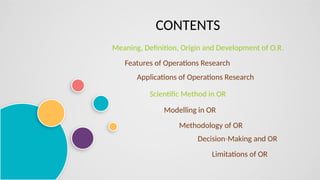
Meaning, Definition, Originand Development of O.R.
Features of Operations Research
CONTENTS
Applications of Operations Research
Scientific Method in OR
Modelling in OR
Methodology of OR
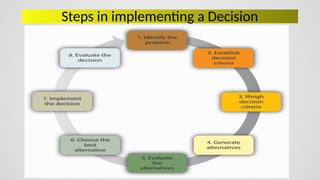
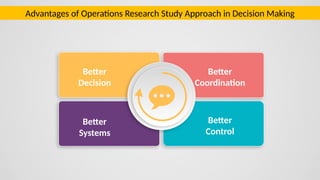
Decision-Making and OR
Limitations of OR
3.
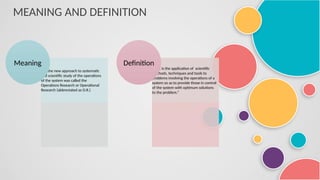
MEANING AND DEFINITION
Itis the new approach to systematic
and scientific study of the operations
of the system was called the
Operations Research or Operational
Research (abbreviated as O.R.)
Meaning
“O.R. is the application of scientific
methods, techniques and tools to
problems involving the operations of a
system so as to provide those in control
of the system with optimum solutions
to the problem.”
Definition
4.
Origin & Development
8
7
6
2
3
4
9
1
5
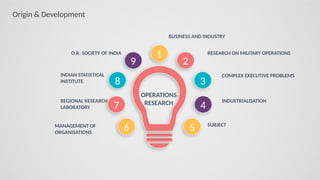
RESEARCHON MILITARY OPERATIONS
COMPLEX EXECUTIVE PROBLEMS
INDUSTRIALISATION
SUBJECT
O.R. SOCIETY OF INDIA
INDIAN STATISTICAL
INSTITUTE
REGIONAL RESEARCH
LABORATORY
MANAGEMENT OF
ORGANISATIONS
OPERATIONS
RESEARCH
BUSINESS AND INDUSTRY
5.
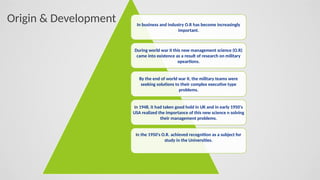
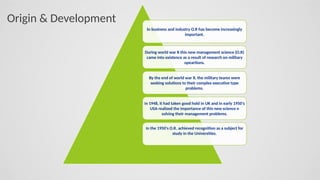
In business andindustry O.R has become increasingly
important.
During world war II this new management science (O.R)
came into existence as a result of research on military
opeartions.
By the end of world war II, the military teams were
seeking solutions to their complex executive type
problems.
In 1948, it had taken good hold in UK and in early 1950's
USA realized the importance of this new science n solving
their management problems.
In the 1950's O.R. achieved recognition as a subject for
study in the Universities.
Origin & Development
6.
In business andindustry O.R has become increasingly
important.
During world war II this new management science (O.R)
came into existence as a result of research on military
opeartions.
By the end of world war II, the military teams were
seeking solutions to their complex executive type
problems.
In 1948, it had taken good hold in UK and in early 1950's
USA realized the importance of this new science n
solving their management problems.
In the 1950's O.R. achieved recognition as a subject for
study in the Universities.
Origin & Development
7.
Nature and Featuresof O.R.
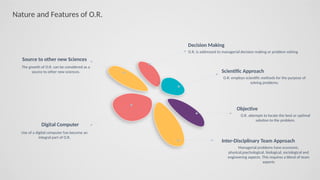
Source to other new Sciences
The growth of O.R. can be considered as a
source to other new sciences.
Digital Computer
Use of a digital computer has become an
integral part of O.R.
Decision Making
O.R. is addressed to managerial decision making or problem solving
Scientific Approach
O.R. employs scientific methods for the purpose of
solving problems.
Inter-Disciplinary Team Approach
Managerial problems have economic,
physical,psychological, biological, sociological and
engineering aspects. This requires a blend of team
experts
Objective
O.R. attempts to locate the best or optimal
solution to the problem.
Research Phase
formulation of
hypothesisand models
observations and data
collection
prediction of results
and generalization of
the results
analysis of the
available information
and verification of the
hypothesis
observations and
experimentation to
test the hypothesis
10.
Action Phase
Making recommendationsfor
decision process
Influencing the
operation in which the
problem occured
Anyone in a position to
make a decision
11.
Methodology of OperationsResearch
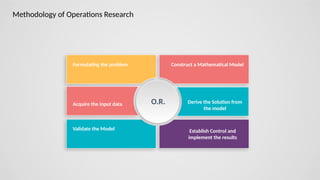
Formulating the problem
Acquire the input data
Validate the Model
Construct a Mathematical Model
Establish Control and
implement the results
O.R. Derive the Solution from
the model
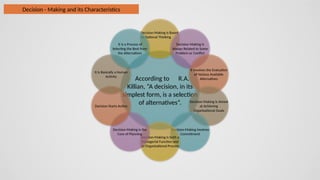
According to R.A.
Killian,“A decision, in its
simplest form, is a selection
of alternatives”.
Decision-Making is Based
on Rational Thinking
Decision-Making is
Always Related to Some
Problem or Conflict
It Involves the Evaluation
of Various Available
Alternatives
Decision-Making is Aimed
at Achieving
Organisational Goals
Decision-Making Involves
Commitment
Decision-Making is both a
Managerial Function and
an Organisational Process
Decision-Making is the
Core of Planning
Decision Starts Action
It is Basically a Human
Activity
It is a Process of
Selecting the Best from
the Alternatives
Decision - Making and its Characteristics
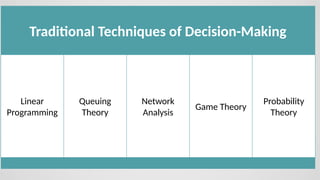
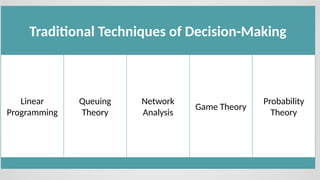
Traditional Techniques ofDecision-Making
Probability
Theory
Game Theory
Network
Analysis
Queuing
Theory
Linear
Programming
18.
Traditional Techniques ofDecision-Making
Probability
Theory
Game Theory
Network
Analysis
Queuing
Theory
Linear
Programming
19.
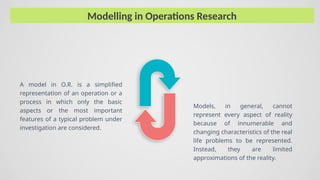
Modelling in OperationsResearch
Models, in general, cannot
represent every aspect of reality
because of innumerable and
changing characteristics of the real
life problems to be represented.
Instead, they are limited
approximations of the reality.
A model in O.R. is a simplified
representation of an operation or a
process in which only the basic
aspects or the most important
features of a typical problem under
investigation are considered.
20.
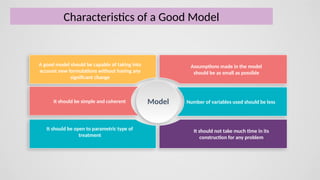
Characteristics of aGood Model
A good model should be capable of taking into
account new formulations without having any
significant change
It should be simple and coherent
It should be open to parametric type of
treatment
Assumptions made in the model
should be as small as possible
It should not take much time in its
construction for any problem
Model Number of variables used should be less
21.
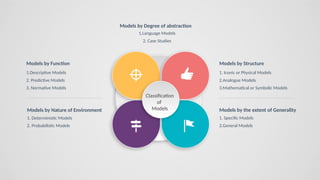
1.Descriptive Models
2. PredictiveModels
3. Normative Models
1. Deterministic Models
2. Probabilistic Models
Models by Function
Models by Nature of Environment
1. Iconic or Physical Models
2.Analogue Models
3.Mathematical or Symbolic Models
1. Specific Models
2.General Models
Models by Structure
Models by the extent of Generality
Models by Degree of abstraction
1.Language Models
2. Case Studies
Classification
of
Models
22.
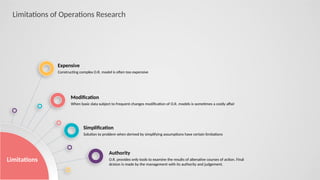
Limitations of OperationsResearch
Limitations
Expensive
Constructing complex O.R. model is often too expensive
Modification
When basic data subject to frequent changes modification of O.R. models is sometimes a costly affair
Simplification
Solution to problem when derived by simplifying assumptions have certain limitations
Authority
O.R. provides only tools to examine the results of altenative courses of action. Final
dcision is made by the management with its authority and judgement.