


INTRODUCTION
TO
OPERATIONS RESEARCH
Dr. V. THIRUVENI
ASSISTANT PROFESSOR
PG AND RESEARCH DEPARTMENT OF MATHEMATICS
SAIVA BHANU KSHATRIYA COLLEGE
ARUPPUKOTTAI 626 101
Class : III B.Sc Mathematics 2020-2021
Subject: Operations Research
TOPICS
 Introduction to Operational Research
 History of Operational Research
 Operational Research in India
 Definition of Operational Research
 Features of Operational Research
 Scope of Operational Research
 Methodology/Approaches of Operational
Research
 Tools/Techniques of Operational Research
 Operational Research and Management Decision-
Making
 Limitations of Operational Research
INTRODUCTION TO
OPERATIONAL RESEARCH
Operational Research is a systematic and analytical
approach to decision making and problem solving.
O.R. as termed in USA, Canada, Africa, Australia and
Operational Research as termed in Europe, is an Branch of
applied mathematics that uses techniques and statistics to
arrive at Optimal solutions to solve complex problems.
It is typically concerned with determining the
maximum profit, sale, output, crops yield and efficiency
And minimum losses, risks, cost, and time of some
objective function. It have also become an important part of
INDUSTRIAL ENGINEERING PROFESSION.
Some of the PRIMARY TOOLS used by operation
researchers are-
STATISTICS
GAME THEORY
PROBABILITY THEORY, etc.
HISTORY OF
OPERATIONAL RESEARCH
There is no clear history that marks the Birth if O.R., it is
generally accepted that the field originated in England
during the World War II. Some say that Charles Babbage
(1791-1871) is the Father of O.R because his research
into the cost of transportation and sorting of mail led to
England’s University Penny Post in 1840.
Modern Operations Research originated at the
Bowdsey Research Station in U.K. in 1937 to analyse
and improve the working of the UK’s Early Warning
Rador System.
During the Second World War about 1000 Men and
Women were engaged to work for British Army.
After World War II, Military Operational Research in
U.K. became Operational Analysis (OA) within the U.K.
Ministry of Defence with expanded techniques and
graving awareness.
OPERATIONAL RESEARCH
IN INDIA
The Operational Research Society of India was founded in 1957 to provide a
forum for the Operational Research Scientists as well as an avenue to widen
their horizon by exchange of knowledge and application of techniques from
outside the country. The Society is affiliated to the International Federation of
Operational Research Societies (IFORS).
The Headquarters of the Society is located in Kolkata at 39, Mahanirvan
Road, Kolkata 700029, India. At present the Society has 12 Operating Chapters
located in Agra, Ahmedabad, Ajmer, Bangalore, Chennai, Delhi, Durgapur,
Jamshedpur, Kolkata, Madurai, Mumbai and Tirupati.
The Objectives of the Society comprise advancement of, conducting of
research in, study of, promotion and propagation of knowledge in Operational
Research and Allied Techniques through exchange of information, as well as
establishment, improvement and maintenance of professional and academic
standards of work known as Operational Research.
Contribution to the Society towards attainment of these objectives is
eligible for exemption of income tax under Section 80(G)(5)(vi) of the Income Tax
Act 1961.
The Society Publishes a quarterly journal OPSEARCH, which brings out
high quality and state of the art papers in Operational Research.
In order to provide opportunity to professionals and students to equip
themselves with the knowledge and usage of the science of Operational
Research, the Society is conducting an examination on Graduate Diploma in
Operational Research since 1973.
DEFINITION OF
OPERATIONAL RESEARCH
It is an Act of winning wars without
actually fighting.
-Aurther Clark
It is a Scientific Approach to problem
solving for executive management.
-H.M. Wagner
It is Art of giving bad answers to
problem which otherwise have worse
answers.
-T.L. Saaty
FEATURES OF
OPERATIONAL RESEARCH
Decision-Making
Scientific Approach
Inter-Disciplinary Team Approach
System Approach
Use of Computers
Objectives
Human Factors
DECISION MAKING
Every industrial organisation faces
multifacet problems to identify best
possible solution to their problems.
OR aims to help the executives to
obtain optimal solution with the use of
OR techniques.
It also helps the decision maker to
improve his creative and judicious
capabilities, analyse and understand the
problem situation leading to better
control, better co-ordination, better
systems and finally better decisions.
SCIENTIFIC APPROACH
OR applies scientific methods,
techniques and tools for the purpose of
analysis and solution of the complex
problems.
In this approach there is no place
for guesswork and the person bias of
the decision maker.
INTER-DISCIPLINARY
TEAM APPROACH
Basically the industrial problems are of
complex nature and therefore require a
team effort to handle it.
This team comprises of scientist,
mathematician and technocrats. Who
jointly use the OR tools to obtain a
optimal solution of the problem.
They tries to analyse the cause and
effect relationship between various
parameters of the problem and
evaluates the outcome of various
alternative strategies.
SYSTEM APPROACH
The main aim of the system approach is
to trace out all significant and indirect
effects for each proposal on all sub-
system on a system and to evaluate
each action in terms of effects for the
system as a whole.
The inter-relationship and
interaction of each sub-system can be
handled with the help of
mathematical/analytical models of OR to
obtain acceptable solution.
USE OF COMPUTERS
The models of OR need lot of
computation and therefore, the use of
computers becomes necessary.
With the use of computers it is
possible to handle complex problems
requiring large amount of calculations.
The objective of the operations
research models is to attempt and to
locate Best or Optimal Solution.
OBJECTIVE
Operational Research always try to
find the best and optimal solution
to the problem.
For this purpose objectives of
the organisation are defined and
analysed. These objectives are
then used as the basis to compare
the alternative courses of action.
HUMAN FACTORS
In deriving, Quantitative Solutions
we do not consider human factors,
which doubtlessly play a great role
in the problems.
So, study of O.R. is incomplete
without study of human factors.
SCOPE OF
OPERATIONAL RESEARCH
The scope of OR is not only confined to any
specific agency like defence services but today
it is widely used in all industrial organisations.
It can be used to find the best solution to
any problem be it simple or complex. It is
useful in every field of human activities.
Thus, it attempts to resolve the conflicts of
interest among the components of
organization in a way that is best for the
organisation as a whole.
The main fields where OR is extensively
used are given in next slide.
FIELDS
National Planning and Budgeting
Defence Services
Industrial Establishment and
Private Sector Units
R & D and Engineering
NATIONAL PLANNING AND
BUDGETING
OR is used for the Preparation of-
 Five Year Plans
 Annual Budgets
 Forecasting of Income and Expenditure
 Scheduling of Major Projects of National
Importance
 Estimation of GNP
 GDP
 Population
 Employment and Generation of Agriculture
Yields, etc.
DEFENCE SERVICES
Basically formulation of OR started from USA Army, so it
has wide application in the areas such as:
 Development of New Technology
 Optimization of Cost and Time
 Tender Evaluation
 Setting and Layouts of Defence Projects
 Assessment of “Threat Analysis”
 Strategy of Battle
 Effective Maintenance and Replacement of Equipment
 Inventory Control,
 Transportation
 Supply Depots, etc.
INDUSTRIAL ESTABLISHMENTS
AND PRIVATE SECTOR UNITS
OR can be effectively used in-
Plant Location and Setting Finance
Planning
Product and Process Planning
Facility Planning and Construction
Production Planning and Control
Purchasing
Maintenance Management
Personnel Management, etc.
R&D AND ENGINEERING
Research and development being the
heart of technological growth, OR has
wide scope and can be applied in-
Technology Forecasting and Evaluation,
Technology and Project Management,
Preparation of Tender and Negotiation,
Value Engineering,
Work/Method Study and so on.
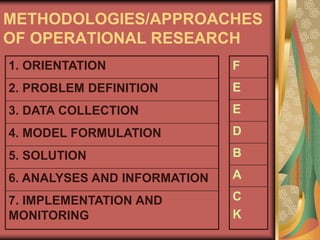
METHODOLOGIES/APPROACHES
OF OPERATIONAL RESEARCH
1. ORIENTATION
2. PROBLEM DEFINITION
3. DATA COLLECTION
4. MODEL FORMULATION
5. SOLUTION
6. ANALYSES AND INFORMATION
7. IMPLEMENTATION AND
MONITORING
F
E
E
D
B
A
C
K
TECHNIQUES/TOOLS OF
OPERATIONAL RESEARCH
Linear Programming
Queuing Theory
Sequencing
Transportation Problems
Integer Problems
Assignment Problems
Decision Theory and Games Theory
Replacement Problems
Symbolic Logic
LINEAR PROGRAMMING
This technique is used to find a solution
for optimising a given objective. Objective
may be maximizing profits or minimising
costs.
Objective function and Boundary conditions
are linear in nature. LPP techniques solve
Product-Mix and Distribution problems of
enterprise.
Its also used to allocate Scarce Resources in
optimum manner in problems of scheduling,
product mix, etc.
QUEUING THEORY
This theory deals with the situations in which
queue is formed, e.g. customers waiting for
services, machines waiting for repairmen, and
aircrafts waiting for landing strips, etc.
If the Queue will be long the cost will be high
due to long waiting hour.
This technique is used to analyse the
feasibility of adding facilities and to access the
amount and cost of waiting time.
This calculations can then be used to
determine the desirable number of service
facilities.
SEQUENCING
Models have been developed to find
a sequence for Processing Jobs so
that the total elapsed time for all the
jobs will be minimum.
The models also help to resolve
the conflict between the objectives
of maximizing machines utilization
and complying with predetermined
delivering rates.
TRANSPORTATION PROBLEMS
Transportation problems deals with
transportation of a product
 From a number of sources
 With limited supplies
 To number of destinations
 With specified demands
 At the total transportation cost.
The main objective of transportation
is to Schedule Shipment from sources
to destinations in such a way so as to
Minimize the Total Transportation Cost.
INTEGER PROGRAMMING
Integer means complete or whole
number. By using the Integer
Programming Algorithm a series of
continuous linear programming
problem are solved in such a way
that the solution containing un-
acceptable non-integer value are
ruled out and the best higher
programming solution is obtained.
ASSIGNMENT PROBLEMS
It is a special type of linear programming
problem. It deals in allocating the various
resources or items to various activities in
a one to one basis in such a way that the
time or cost involved in minimised and
the sale or profit is maximized.
E.g. Manager may like to know which
job should be assigned to which person
so that all jobs can be completed in the
shortest possible time.
DECISION THEORY AND
GAME THEORY
Decision Theory is primarily considered with
decision making under the conditions of:
 Risk
 Uncertainity
Game Theory is concerned with:
 Decision Making under Conflict
Hence, both Decision Theory and Game
Theory assist the Decision-Maker in Analysing
Problems with numerous alternative course of
action and consequences.
REPLACEMENT PROBLEMS
This Theory is concerned with situations that arise when
some items such as machines, men, etc. require
replacement due to their decreasing efficiency, failure or
break-down.
Sooner or later all the equipments are required to be
replaced because of:
 Obsolescence
 Discovery of New Technology
 Better Design of Equipment
In Replacement Decisions we consider:
 Cost of Equipment to be Installed
 Cost of Equipment Replaced, etc.
Hence, this theory helps to solve all Replacement
Problems.
SYMBOLIC LOGIC
Symbols are more meaningful and
accurate. Everything is Symbolic in this
world.
Words, classes of things, functional
systems and rules are substituted with
symbols.
The whole problem is converted into
algebraic equations and propositions.
Business Problems are not commonly
converted into symbols but calculations
are done on computers, that is why
symbols have extensive applications.
OPERATIONAL RESEARCH
AND MANAGEMENT
DECISION-MAKING
Operation Research increases the creative capabilities
of a decision maker.
It increases the effectiveness of mgt. decisions.
Management is most of the time making decisions. It is
thus a decision science which helps mgt. to take better
decisions.
Nowadays, business problems have become so
complex that it is almost impossible for a human being
to comprehend all important factors, OR Techniques can
be helpful in such situations.
It also helps in ascertaining best locations for
factories and warehouses, project scheduling as well as
most economic means of transportation.
OR study approach in business decisions leads to
better control, better co-ordination, better system and at
the end better decision.
LIMITATIONS OF
OPERATIONAL RESEARCH
Magnitude of Computation
Non-Quantifiable Factors
Distance between User and
Analyst
Time and Money Costs
Implementation
MAGNITUDE OF COMPUTATION
Operations research models try to find
out optimal solution taking into account
all the factors. But, these factors are
enormous
and,
expressing them in quantity,
and,
establishing relationships among these,
Require voluminous calculations which
can be handled only by computers.
NON-QUANTIFIABLE FACTORS
OR provides solution only when all
elements related to a problem can
be quantified. All relevant variables
do not lend themselves to
quantification. Factors which
cannot be quantified, find no place
in OR study. Models in OR do not
take into account qualititative
factors or emotional factors which
may be quite important.
DISTANCE BETWEEN USER
AND ANALYST
OR being specialist’s job requires
a mathematician or statistician,
who might not be aware of the
business problems.
Similarly, a manager fails to
understand the complex working of
OR. Thus there is a gap between
the two. Management itself may
offer a lot of resistance due to
conventional thinking.
TIME AND MONEY COST
When basic data are subjected to
frequent changes, incorporating them
into the OR models is a costly
proposition.
Moreover, a fairly good solution at
present may be,
More desirable than a perfect OR
solution available after sometime. The
computational time increases
depending upon the size of the problem
and accuracy of results desired.
IMPLEMENTATION
Implementation of any decision is a
delicate task. It must take into
account the complexities of human
relations and behaviour.
Sometimes, resistance is offered
due to psychological factors which
may not have any bearing on the
problem as well as its solution.
THANK YOU 

Introduction to OR.ppt

  • 1.
    INTRODUCTION TO OPERATIONS RESEARCH Dr. V.THIRUVENI ASSISTANT PROFESSOR PG AND RESEARCH DEPARTMENT OF MATHEMATICS SAIVA BHANU KSHATRIYA COLLEGE ARUPPUKOTTAI 626 101 Class : III B.Sc Mathematics 2020-2021 Subject: Operations Research
  • 2.
    TOPICS  Introduction toOperational Research  History of Operational Research  Operational Research in India  Definition of Operational Research  Features of Operational Research  Scope of Operational Research  Methodology/Approaches of Operational Research  Tools/Techniques of Operational Research  Operational Research and Management Decision- Making  Limitations of Operational Research
  • 3.
    INTRODUCTION TO OPERATIONAL RESEARCH OperationalResearch is a systematic and analytical approach to decision making and problem solving. O.R. as termed in USA, Canada, Africa, Australia and Operational Research as termed in Europe, is an Branch of applied mathematics that uses techniques and statistics to arrive at Optimal solutions to solve complex problems. It is typically concerned with determining the maximum profit, sale, output, crops yield and efficiency And minimum losses, risks, cost, and time of some objective function. It have also become an important part of INDUSTRIAL ENGINEERING PROFESSION. Some of the PRIMARY TOOLS used by operation researchers are- STATISTICS GAME THEORY PROBABILITY THEORY, etc.
  • 4.
    HISTORY OF OPERATIONAL RESEARCH Thereis no clear history that marks the Birth if O.R., it is generally accepted that the field originated in England during the World War II. Some say that Charles Babbage (1791-1871) is the Father of O.R because his research into the cost of transportation and sorting of mail led to England’s University Penny Post in 1840. Modern Operations Research originated at the Bowdsey Research Station in U.K. in 1937 to analyse and improve the working of the UK’s Early Warning Rador System. During the Second World War about 1000 Men and Women were engaged to work for British Army. After World War II, Military Operational Research in U.K. became Operational Analysis (OA) within the U.K. Ministry of Defence with expanded techniques and graving awareness.
  • 5.
    OPERATIONAL RESEARCH IN INDIA TheOperational Research Society of India was founded in 1957 to provide a forum for the Operational Research Scientists as well as an avenue to widen their horizon by exchange of knowledge and application of techniques from outside the country. The Society is affiliated to the International Federation of Operational Research Societies (IFORS). The Headquarters of the Society is located in Kolkata at 39, Mahanirvan Road, Kolkata 700029, India. At present the Society has 12 Operating Chapters located in Agra, Ahmedabad, Ajmer, Bangalore, Chennai, Delhi, Durgapur, Jamshedpur, Kolkata, Madurai, Mumbai and Tirupati. The Objectives of the Society comprise advancement of, conducting of research in, study of, promotion and propagation of knowledge in Operational Research and Allied Techniques through exchange of information, as well as establishment, improvement and maintenance of professional and academic standards of work known as Operational Research. Contribution to the Society towards attainment of these objectives is eligible for exemption of income tax under Section 80(G)(5)(vi) of the Income Tax Act 1961. The Society Publishes a quarterly journal OPSEARCH, which brings out high quality and state of the art papers in Operational Research. In order to provide opportunity to professionals and students to equip themselves with the knowledge and usage of the science of Operational Research, the Society is conducting an examination on Graduate Diploma in Operational Research since 1973.
  • 6.
    DEFINITION OF OPERATIONAL RESEARCH Itis an Act of winning wars without actually fighting. -Aurther Clark It is a Scientific Approach to problem solving for executive management. -H.M. Wagner It is Art of giving bad answers to problem which otherwise have worse answers. -T.L. Saaty
  • 7.
    FEATURES OF OPERATIONAL RESEARCH Decision-Making ScientificApproach Inter-Disciplinary Team Approach System Approach Use of Computers Objectives Human Factors
  • 8.
    DECISION MAKING Every industrialorganisation faces multifacet problems to identify best possible solution to their problems. OR aims to help the executives to obtain optimal solution with the use of OR techniques. It also helps the decision maker to improve his creative and judicious capabilities, analyse and understand the problem situation leading to better control, better co-ordination, better systems and finally better decisions.
  • 9.
    SCIENTIFIC APPROACH OR appliesscientific methods, techniques and tools for the purpose of analysis and solution of the complex problems. In this approach there is no place for guesswork and the person bias of the decision maker.
  • 10.
    INTER-DISCIPLINARY TEAM APPROACH Basically theindustrial problems are of complex nature and therefore require a team effort to handle it. This team comprises of scientist, mathematician and technocrats. Who jointly use the OR tools to obtain a optimal solution of the problem. They tries to analyse the cause and effect relationship between various parameters of the problem and evaluates the outcome of various alternative strategies.
  • 11.
    SYSTEM APPROACH The mainaim of the system approach is to trace out all significant and indirect effects for each proposal on all sub- system on a system and to evaluate each action in terms of effects for the system as a whole. The inter-relationship and interaction of each sub-system can be handled with the help of mathematical/analytical models of OR to obtain acceptable solution.
  • 12.
    USE OF COMPUTERS Themodels of OR need lot of computation and therefore, the use of computers becomes necessary. With the use of computers it is possible to handle complex problems requiring large amount of calculations. The objective of the operations research models is to attempt and to locate Best or Optimal Solution.
  • 13.
    OBJECTIVE Operational Research alwaystry to find the best and optimal solution to the problem. For this purpose objectives of the organisation are defined and analysed. These objectives are then used as the basis to compare the alternative courses of action.
  • 14.
    HUMAN FACTORS In deriving,Quantitative Solutions we do not consider human factors, which doubtlessly play a great role in the problems. So, study of O.R. is incomplete without study of human factors.
  • 15.
    SCOPE OF OPERATIONAL RESEARCH Thescope of OR is not only confined to any specific agency like defence services but today it is widely used in all industrial organisations. It can be used to find the best solution to any problem be it simple or complex. It is useful in every field of human activities. Thus, it attempts to resolve the conflicts of interest among the components of organization in a way that is best for the organisation as a whole. The main fields where OR is extensively used are given in next slide.
  • 16.
    FIELDS National Planning andBudgeting Defence Services Industrial Establishment and Private Sector Units R & D and Engineering
  • 17.
    NATIONAL PLANNING AND BUDGETING ORis used for the Preparation of-  Five Year Plans  Annual Budgets  Forecasting of Income and Expenditure  Scheduling of Major Projects of National Importance  Estimation of GNP  GDP  Population  Employment and Generation of Agriculture Yields, etc.
  • 18.
    DEFENCE SERVICES Basically formulationof OR started from USA Army, so it has wide application in the areas such as:  Development of New Technology  Optimization of Cost and Time  Tender Evaluation  Setting and Layouts of Defence Projects  Assessment of “Threat Analysis”  Strategy of Battle  Effective Maintenance and Replacement of Equipment  Inventory Control,  Transportation  Supply Depots, etc.
  • 19.
    INDUSTRIAL ESTABLISHMENTS AND PRIVATESECTOR UNITS OR can be effectively used in- Plant Location and Setting Finance Planning Product and Process Planning Facility Planning and Construction Production Planning and Control Purchasing Maintenance Management Personnel Management, etc.
  • 20.
    R&D AND ENGINEERING Researchand development being the heart of technological growth, OR has wide scope and can be applied in- Technology Forecasting and Evaluation, Technology and Project Management, Preparation of Tender and Negotiation, Value Engineering, Work/Method Study and so on.
  • 21.
    METHODOLOGIES/APPROACHES OF OPERATIONAL RESEARCH 1.ORIENTATION 2. PROBLEM DEFINITION 3. DATA COLLECTION 4. MODEL FORMULATION 5. SOLUTION 6. ANALYSES AND INFORMATION 7. IMPLEMENTATION AND MONITORING F E E D B A C K
  • 22.
    TECHNIQUES/TOOLS OF OPERATIONAL RESEARCH LinearProgramming Queuing Theory Sequencing Transportation Problems Integer Problems Assignment Problems Decision Theory and Games Theory Replacement Problems Symbolic Logic
  • 23.
    LINEAR PROGRAMMING This techniqueis used to find a solution for optimising a given objective. Objective may be maximizing profits or minimising costs. Objective function and Boundary conditions are linear in nature. LPP techniques solve Product-Mix and Distribution problems of enterprise. Its also used to allocate Scarce Resources in optimum manner in problems of scheduling, product mix, etc.
  • 24.
    QUEUING THEORY This theorydeals with the situations in which queue is formed, e.g. customers waiting for services, machines waiting for repairmen, and aircrafts waiting for landing strips, etc. If the Queue will be long the cost will be high due to long waiting hour. This technique is used to analyse the feasibility of adding facilities and to access the amount and cost of waiting time. This calculations can then be used to determine the desirable number of service facilities.
  • 25.
    SEQUENCING Models have beendeveloped to find a sequence for Processing Jobs so that the total elapsed time for all the jobs will be minimum. The models also help to resolve the conflict between the objectives of maximizing machines utilization and complying with predetermined delivering rates.
  • 26.
    TRANSPORTATION PROBLEMS Transportation problemsdeals with transportation of a product  From a number of sources  With limited supplies  To number of destinations  With specified demands  At the total transportation cost. The main objective of transportation is to Schedule Shipment from sources to destinations in such a way so as to Minimize the Total Transportation Cost.
  • 27.
    INTEGER PROGRAMMING Integer meanscomplete or whole number. By using the Integer Programming Algorithm a series of continuous linear programming problem are solved in such a way that the solution containing un- acceptable non-integer value are ruled out and the best higher programming solution is obtained.
  • 28.
    ASSIGNMENT PROBLEMS It isa special type of linear programming problem. It deals in allocating the various resources or items to various activities in a one to one basis in such a way that the time or cost involved in minimised and the sale or profit is maximized. E.g. Manager may like to know which job should be assigned to which person so that all jobs can be completed in the shortest possible time.
  • 29.
    DECISION THEORY AND GAMETHEORY Decision Theory is primarily considered with decision making under the conditions of:  Risk  Uncertainity Game Theory is concerned with:  Decision Making under Conflict Hence, both Decision Theory and Game Theory assist the Decision-Maker in Analysing Problems with numerous alternative course of action and consequences.
  • 30.
    REPLACEMENT PROBLEMS This Theoryis concerned with situations that arise when some items such as machines, men, etc. require replacement due to their decreasing efficiency, failure or break-down. Sooner or later all the equipments are required to be replaced because of:  Obsolescence  Discovery of New Technology  Better Design of Equipment In Replacement Decisions we consider:  Cost of Equipment to be Installed  Cost of Equipment Replaced, etc. Hence, this theory helps to solve all Replacement Problems.
  • 31.
    SYMBOLIC LOGIC Symbols aremore meaningful and accurate. Everything is Symbolic in this world. Words, classes of things, functional systems and rules are substituted with symbols. The whole problem is converted into algebraic equations and propositions. Business Problems are not commonly converted into symbols but calculations are done on computers, that is why symbols have extensive applications.
  • 32.
    OPERATIONAL RESEARCH AND MANAGEMENT DECISION-MAKING OperationResearch increases the creative capabilities of a decision maker. It increases the effectiveness of mgt. decisions. Management is most of the time making decisions. It is thus a decision science which helps mgt. to take better decisions. Nowadays, business problems have become so complex that it is almost impossible for a human being to comprehend all important factors, OR Techniques can be helpful in such situations. It also helps in ascertaining best locations for factories and warehouses, project scheduling as well as most economic means of transportation. OR study approach in business decisions leads to better control, better co-ordination, better system and at the end better decision.
  • 33.
    LIMITATIONS OF OPERATIONAL RESEARCH Magnitudeof Computation Non-Quantifiable Factors Distance between User and Analyst Time and Money Costs Implementation
  • 34.
    MAGNITUDE OF COMPUTATION Operationsresearch models try to find out optimal solution taking into account all the factors. But, these factors are enormous and, expressing them in quantity, and, establishing relationships among these, Require voluminous calculations which can be handled only by computers.
  • 35.
    NON-QUANTIFIABLE FACTORS OR providessolution only when all elements related to a problem can be quantified. All relevant variables do not lend themselves to quantification. Factors which cannot be quantified, find no place in OR study. Models in OR do not take into account qualititative factors or emotional factors which may be quite important.
  • 36.
    DISTANCE BETWEEN USER ANDANALYST OR being specialist’s job requires a mathematician or statistician, who might not be aware of the business problems. Similarly, a manager fails to understand the complex working of OR. Thus there is a gap between the two. Management itself may offer a lot of resistance due to conventional thinking.
  • 37.
    TIME AND MONEYCOST When basic data are subjected to frequent changes, incorporating them into the OR models is a costly proposition. Moreover, a fairly good solution at present may be, More desirable than a perfect OR solution available after sometime. The computational time increases depending upon the size of the problem and accuracy of results desired.
  • 38.
    IMPLEMENTATION Implementation of anydecision is a delicate task. It must take into account the complexities of human relations and behaviour. Sometimes, resistance is offered due to psychological factors which may not have any bearing on the problem as well as its solution.
  • 39.