Introduction to  Operations Management
Contents  I. The operations system  in Organizations  Example: The operations system for a Department store  Example : The operations system for a farm  II. Manufacturing operations Versus Service operations  III. Goods-service Continuum IV. Manufacturing vs Service V. Management-Process Management  VI. Operations  Management Defined
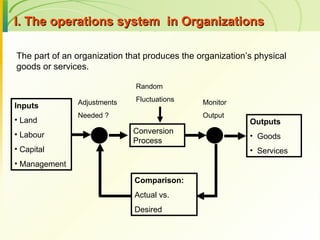
The part of an organization that produces the organization’s physical goods or services.  I. The operations system  in Organizations  Inputs  Land  Labour  Capital  Management  Conversion Process  Adjustments  Needed ? Random  Fluctuations  Comparison: Actual vs.  Desired  Outputs  Goods  Services  Monitor  Output
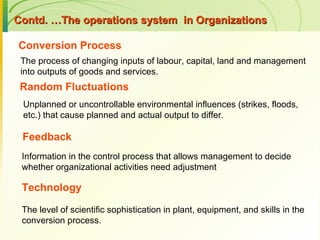
The process of changing inputs of labour, capital, land and management into outputs of goods and services. Conversion Process  Random Fluctuations  Unplanned or uncontrollable environmental influences (strikes, floods, etc.) that cause planned and actual output to differ.  Feedback  Information in the control process that allows management to decide whether organizational activities need adjustment  Technology  The level of scientific sophistication in plant, equipment, and skills in the conversion process.  Contd. …The operations system  in Organizations
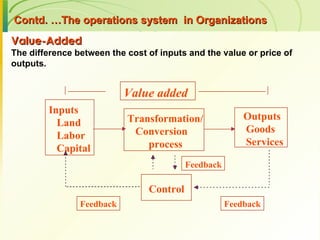
Value-Added The difference between the cost of inputs and the value or price of outputs. Contd. …The operations system  in Organizations  Inputs Land Labor Capital Transformation/ Conversion process Outputs Goods Services Control Feedback Feedback Feedback Value added
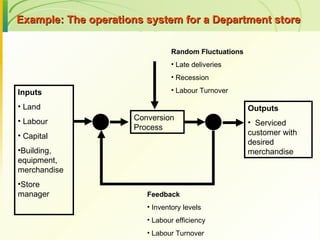
Example: The operations system for a Department store  Inputs  Land  Labour  Capital  Building, equipment, merchandise  Store manager  Conversion Process  Outputs  Serviced customer with desired merchandise  Random Fluctuations  Late deliveries  Recession Labour Turnover  Feedback  Inventory levels  Labour efficiency  Labour Turnover
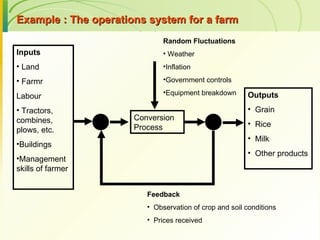
Example : The operations system for a farm  Inputs  Land  Farmr  Labour  Tractors, combines, plows, etc. Buildings Management skills of farmer  Conversion Process  Outputs  Grain  Rice  Milk  Other products  Random Fluctuations  Weather  Inflation  Government controls  Equipment breakdown  Feedback  Observation of crop and soil conditions  Prices received
II. Manufacturing operations Versus Service operations  A conversion process that includes manufacturing (or production) yields a  tangible  output: a product.  In contrast, a conversion process that includes service yields an  intangible  output: a deed, a performance, an effort.
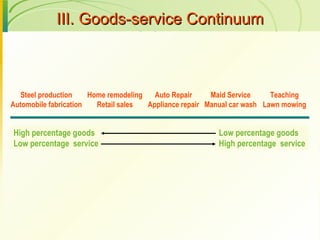
Steel production Automobile fabrication Home remodeling Retail sales Auto Repair Appliance repair Maid Service Manual car wash Teaching Lawn mowing High percentage goods Low percentage  service III. Goods-service Continuum Low percentage goods High percentage  service
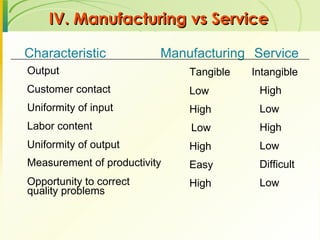
IV. Manufacturing vs Service Characteristic Manufacturing Service Output Customer contact Uniformity of input Labor content Uniformity of output Measurement of productivity Opportunity to correct Tangible Low High Low High Easy High Intangible High Low High Low Difficult Low quality problems High
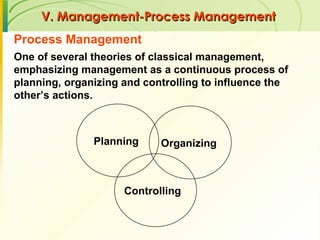
V. Management-Process Management  Process Management  One of several theories of classical management, emphasizing management as a continuous process of planning, organizing and controlling to influence the other’s actions.  Planning   Controlling   Organizing
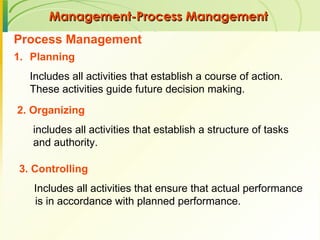
Management-Process Management  Process Management  Planning Includes all activities that establish a course of action. These activities guide future decision making.  2.   Organizing  includes all activities that establish a structure of tasks and authority.  3. Controlling   Includes all activities that ensure that actual performance is in accordance with planned performance.
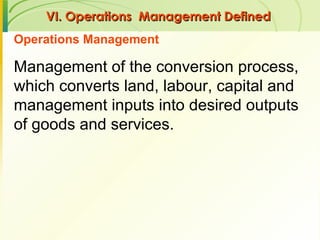
VI. Operations  Management Defined  Operations Management  Management of the conversion process, which converts land, labour, capital and management inputs into desired outputs of goods and services.
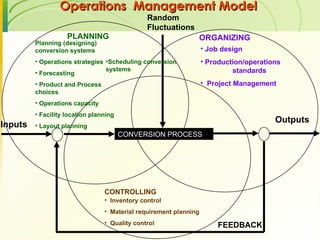
Operations  Management Model  Planning (designing) conversion systems  Operations strategies  Forecasting  Product and Process choices  Operations capacity  Facility location planning  Layout planning  Scheduling conversion  systems  PLANNING  ORGANIZING  CONTROLLING  Inventory control Material requirement planning  Quality control  Job design  Production/operations  standards Project Management  CONVERSION PROCESS Inputs Outputs FEEDBACK  Random Fluctuations

Introduction To Operation Management

  • 1.
    Introduction to Operations Management
  • 2.
    Contents I.The operations system in Organizations Example: The operations system for a Department store Example : The operations system for a farm II. Manufacturing operations Versus Service operations III. Goods-service Continuum IV. Manufacturing vs Service V. Management-Process Management VI. Operations Management Defined
  • 3.
    The part ofan organization that produces the organization’s physical goods or services. I. The operations system in Organizations Inputs Land Labour Capital Management Conversion Process Adjustments Needed ? Random Fluctuations Comparison: Actual vs. Desired Outputs Goods Services Monitor Output
  • 4.
    The process ofchanging inputs of labour, capital, land and management into outputs of goods and services. Conversion Process Random Fluctuations Unplanned or uncontrollable environmental influences (strikes, floods, etc.) that cause planned and actual output to differ. Feedback Information in the control process that allows management to decide whether organizational activities need adjustment Technology The level of scientific sophistication in plant, equipment, and skills in the conversion process. Contd. …The operations system in Organizations
  • 5.
    Value-Added The differencebetween the cost of inputs and the value or price of outputs. Contd. …The operations system in Organizations Inputs Land Labor Capital Transformation/ Conversion process Outputs Goods Services Control Feedback Feedback Feedback Value added
  • 6.
    Example: The operationssystem for a Department store Inputs Land Labour Capital Building, equipment, merchandise Store manager Conversion Process Outputs Serviced customer with desired merchandise Random Fluctuations Late deliveries Recession Labour Turnover Feedback Inventory levels Labour efficiency Labour Turnover
  • 7.
    Example : Theoperations system for a farm Inputs Land Farmr Labour Tractors, combines, plows, etc. Buildings Management skills of farmer Conversion Process Outputs Grain Rice Milk Other products Random Fluctuations Weather Inflation Government controls Equipment breakdown Feedback Observation of crop and soil conditions Prices received
  • 8.
    II. Manufacturing operationsVersus Service operations A conversion process that includes manufacturing (or production) yields a tangible output: a product. In contrast, a conversion process that includes service yields an intangible output: a deed, a performance, an effort.
  • 9.
    Steel production Automobilefabrication Home remodeling Retail sales Auto Repair Appliance repair Maid Service Manual car wash Teaching Lawn mowing High percentage goods Low percentage service III. Goods-service Continuum Low percentage goods High percentage service
  • 10.
    IV. Manufacturing vsService Characteristic Manufacturing Service Output Customer contact Uniformity of input Labor content Uniformity of output Measurement of productivity Opportunity to correct Tangible Low High Low High Easy High Intangible High Low High Low Difficult Low quality problems High
  • 11.
    V. Management-Process Management Process Management One of several theories of classical management, emphasizing management as a continuous process of planning, organizing and controlling to influence the other’s actions. Planning Controlling Organizing
  • 12.
    Management-Process Management Process Management Planning Includes all activities that establish a course of action. These activities guide future decision making. 2. Organizing includes all activities that establish a structure of tasks and authority. 3. Controlling Includes all activities that ensure that actual performance is in accordance with planned performance.
  • 13.
    VI. Operations Management Defined Operations Management Management of the conversion process, which converts land, labour, capital and management inputs into desired outputs of goods and services.
  • 14.
    Operations ManagementModel Planning (designing) conversion systems Operations strategies Forecasting Product and Process choices Operations capacity Facility location planning Layout planning Scheduling conversion systems PLANNING ORGANIZING CONTROLLING Inventory control Material requirement planning Quality control Job design Production/operations standards Project Management CONVERSION PROCESS Inputs Outputs FEEDBACK Random Fluctuations