
Mathematical Models for FLUID MECHANICS


                   P M V Subbarao
                  Associate Professor
           Mechanical Engineering Department
                       IIT Delhi


Convert Ideas into A Precise Blue Print before
             feeling the same....
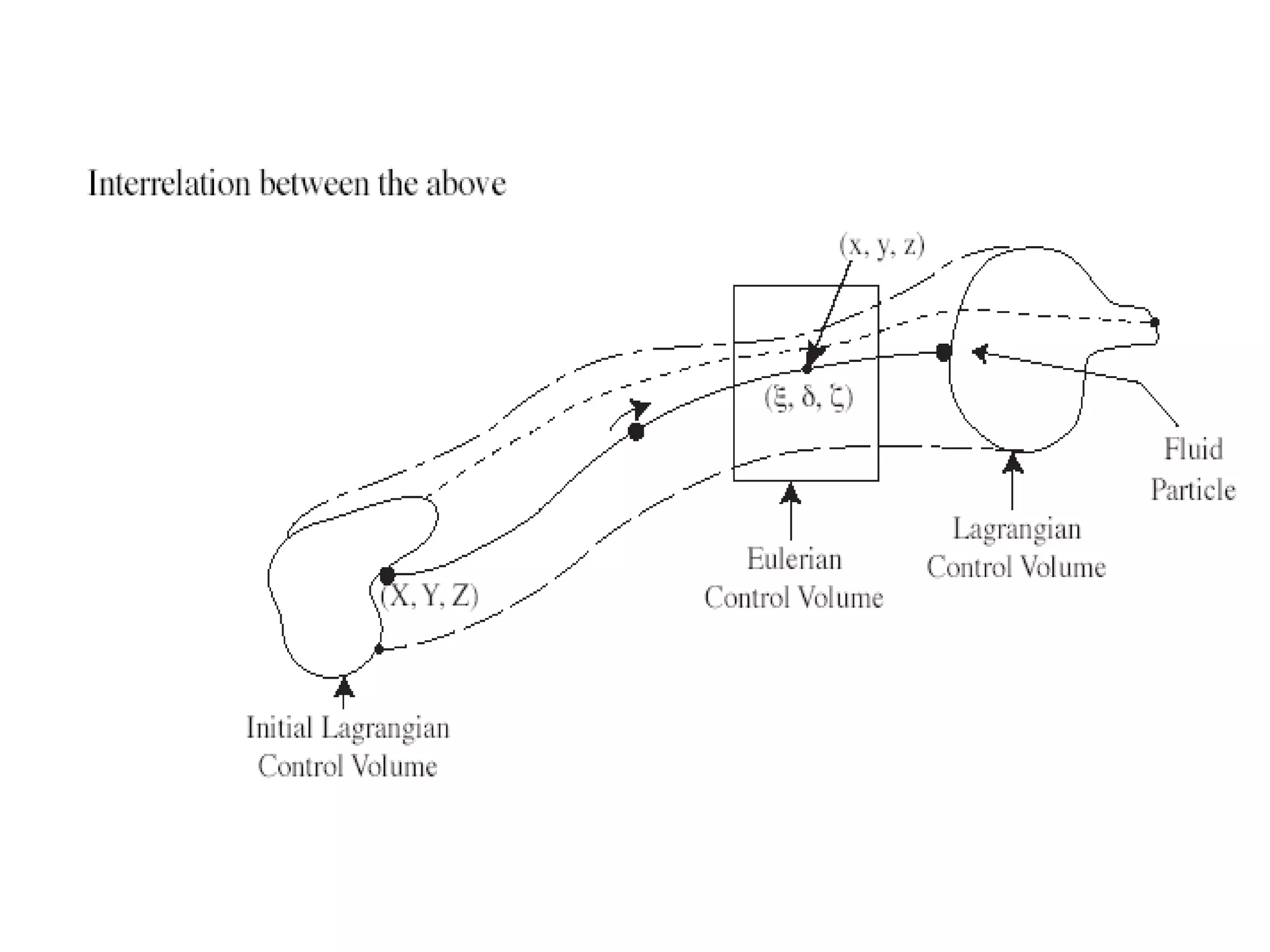
A path line is the trace of the path followed by a selected fluid particle
Few things to know about streamlines
• At all points the direction of the streamline is the direction of the
  fluid velocity: this is how they are defined.
• Close to the wall the velocity is parallel to the wall so the
  streamline is also parallel to the wall.
• It is also important to recognize that the position of streamlines
  can change with time - this is the case in unsteady flow.
• In steady flow, the position of streamlines does not change
• Because the fluid is moving in the same direction as the
  streamlines, fluid can not cross a streamline.
• Streamlines can not cross each other.
• If they were to cross this would indicate two different velocities at
  the same point.
• This is not physically possible.
• The above point implies that any particles of fluid starting on one
  streamline will stay on that same streamline throughout the fluid.
A useful technique in fluid flow analysis is to consider only a part of the
total fluid in isolation from the rest. This can be done by imagining a
tubular surface formed by streamlines along which the fluid flows. This
tubular surface is known as a streamtube.


                                                        A Streamtube

    A two dimensional version of the streamtube
  The "walls" of a streamtube are made of streamlines.
  As we have seen above, fluid cannot flow across a streamline, so
  fluid cannot cross a streamtube wall. The streamtube can often be
  viewed as a solid walled pipe.
  A streamtube is not a pipe - it differs in unsteady flow as the walls
  will move with time. And it differs because the "wall" is moving
  with the fluid
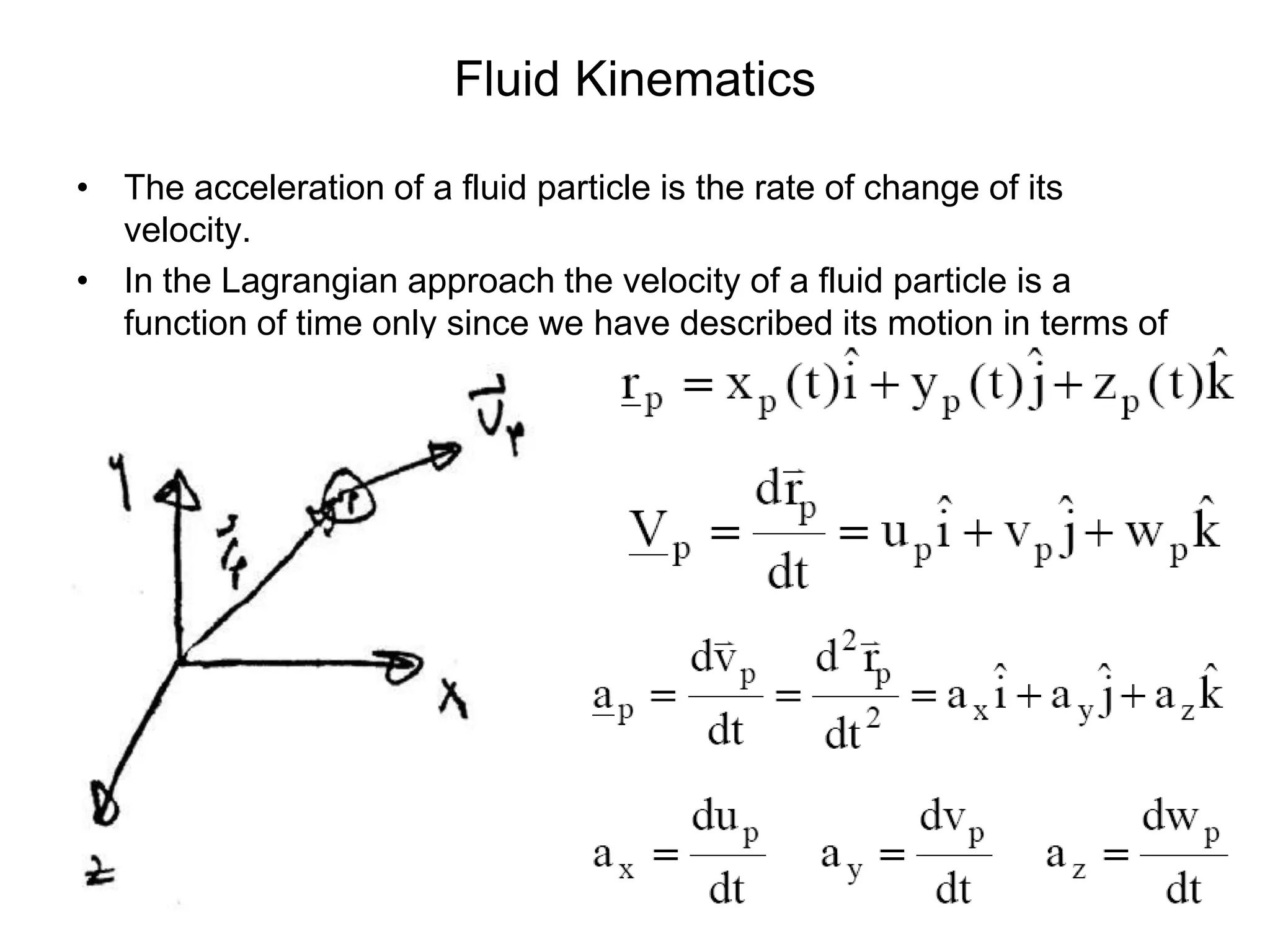
Fluid Kinematics

• The acceleration of a fluid particle is the rate of change of its
  velocity.
• In the Lagrangian approach the velocity of a fluid particle is a
  function of time only since we have described its motion in terms of
  its position vector.
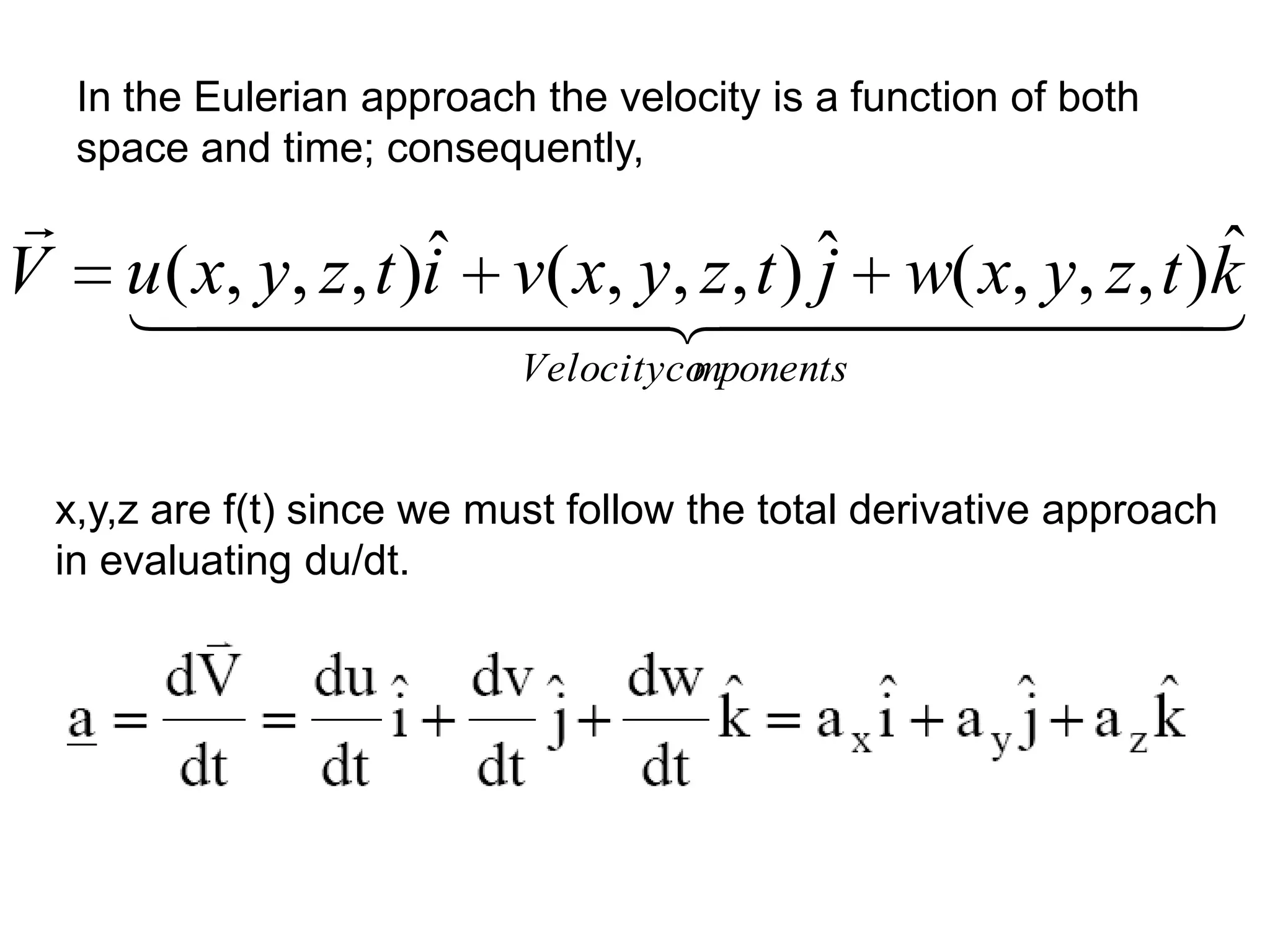
In the Eulerian approach the velocity is a function of both
     space and time; consequently,

V                      ˆ                 j                ˆ
       u ( x, y, z, t )i v( x, y, z, t ) ˆ w( x, y, z, t )k
                                        
                             Velocityco
                                      mponents


    x,y,z are f(t) since we must follow the total derivative approach
    in evaluating du/dt.
Similarly for ay & az,


In vector notation this can be written concisely
x


Conservation laws can be applied to an infinitesimal element or
cube, or may be integrated over a large control volume.
Basic Control-Volume Approach
Control Volume
• In fluid mechanics we are usually interested in a region of space, i.e,
  control volume and not particular systems.
• Therefore, we need to transform GDE’s from a system to a control
  volume.
• This is accomplished through the use of Reynolds Transport
  Theorem.
• Actually derived in thermodynamics for CV forms of continuity and
  1st and 2nd laws.
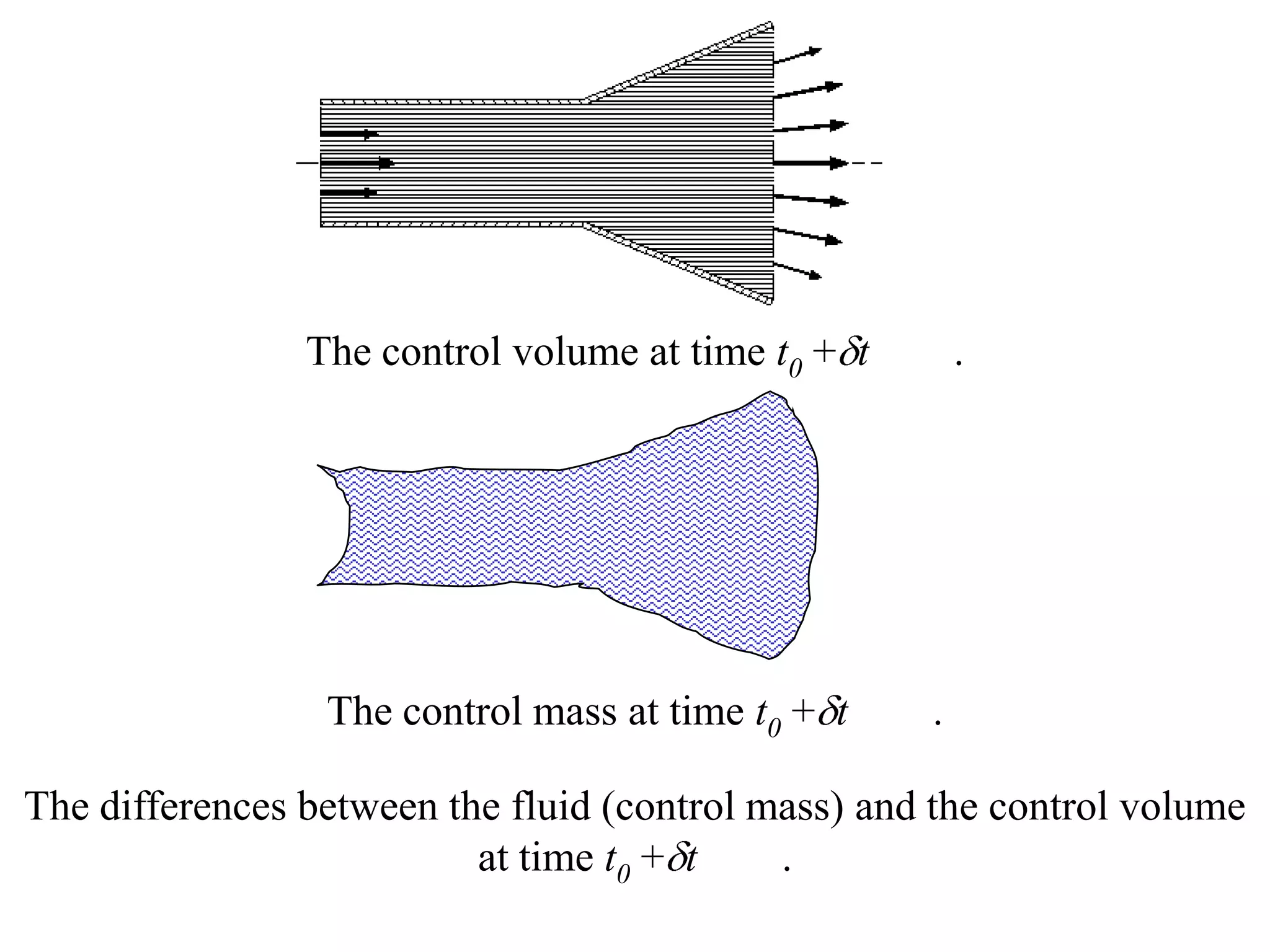
Flowing Fluid Through A CV


• A typical control volume for flow
  in an funnel-shaped pipe is
  bounded by the pipe wall and the
  broken lines.
• At time t0, all the fluid (control
  mass) is inside the control
  volume.
The fluid that was in the control volume at time t0 will be seen at
  time t0 + t as:       .
The control volume at time t0 + t       .


                 The control mass at time t0 + t    .

The differences between the fluid (control mass) and the control volume
                          at time t0 + t    .
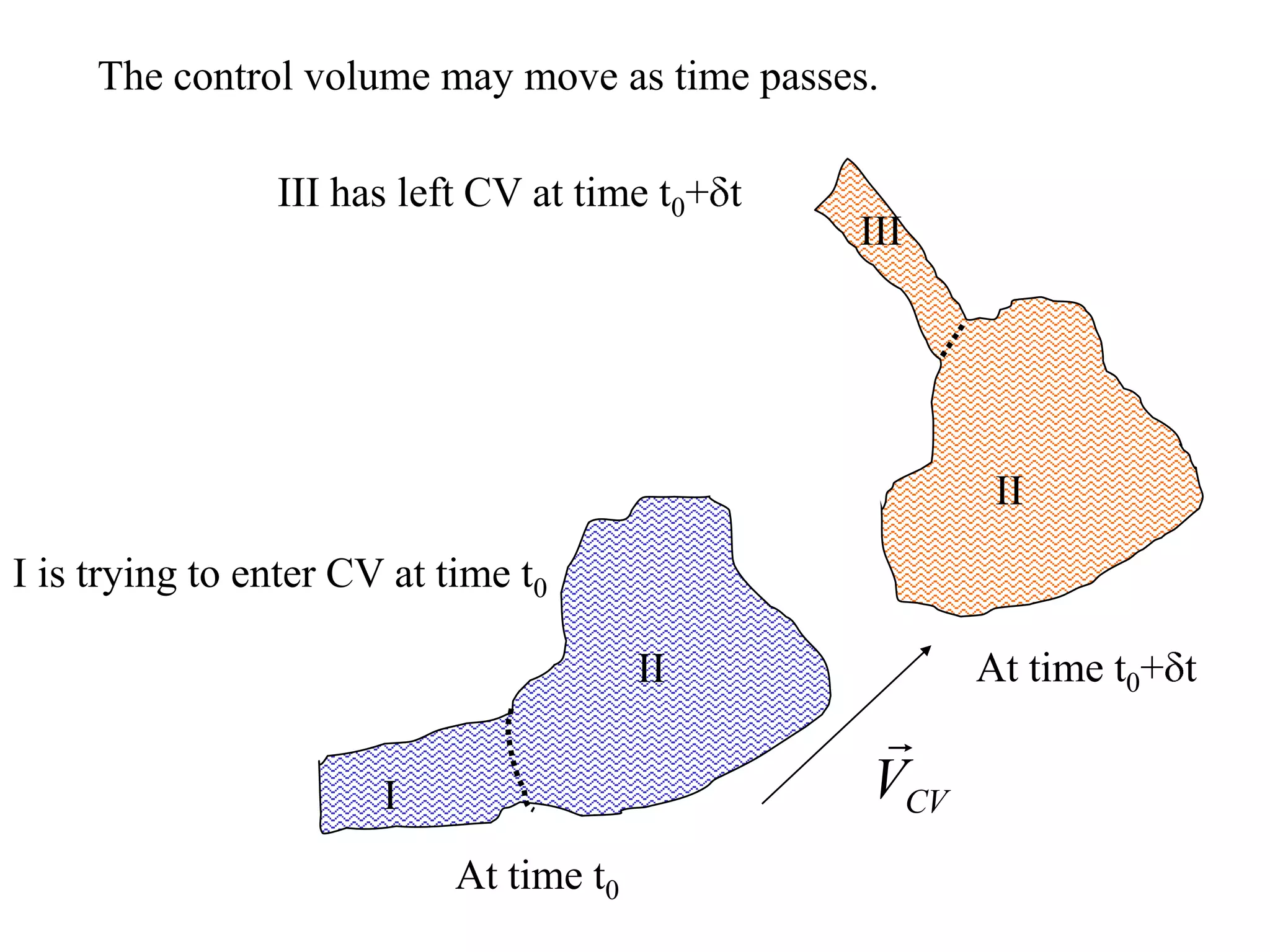
• Consider a system and a control volume (C.V.) as follows:
• the system occupies region I and C.V. (region II) at time t0.
• Fluid particles of region – I are trying to enter C.V. (II) at time t0.


                             III


                                     II
                        I
  • the same system occupies regions (II+III) at t0 + t
  • Fluid particles of I will enter CV-II in a time t.
  •Few more fluid particles which belong to CV – II at t0 will occupy
  III at time t0 + t.
The control volume may move as time passes.

                III has left CV at time t0+ t
                                                III


                                                       II
I is trying to enter CV at time t0

                                         II           At time t0+ t
                                                 
                       I                        VCV
                            At time t0
Reynolds' Transport Theorem


• Consider a fluid scalar property b which is the amount of this property
  per unit mass of fluid.
• For example, b might be a thermodynamic property, such as the
  internal energy unit mass, or the electric charge per unit mass of fluid.
• The laws of physics are expressed as applying to a fixed mass of
  material.
• But most of the real devices are control volumes.
• The total amount of the property b inside the material volume M ,
  designated by B, may be found by integrating the property per unit
  volume, M ,over the material volume :
Conservation of B
• total rate of change of any extensive property B of a
  system(C.M.) occupying a control volume C.V. at time t is
  equal to the sum of
• a) the temporal rate of change of B within the C.V.
• b) the net flux of B through the control surface C.S. that
  surrounds the C.V.
• The change of property B of system (C.M.) during Dt is


      BCM      Bt          t
                               Bt
                       0               0


BCM     BII   t0   t
                           BIII   t0           t
                                                   BI   t0
                                                             BII   t0


add and subtract B t                       t
                                  0
BCM    BII   t0   t
                        BIII          t0       t
                                                     BI        t0
                                                                         BII    t0
                                                                                                BI    t0        t
                                                                                                                         BI   t0   t


BCM         BI        BII        t0       t
                                                   BIII    t0       t
                                                                               BI               BII        t0
                                                                                                                     BI       t0   t


       BCM         BCV           t0        t
                                                   BCV         t0
                                                                         BIII      t0       t
                                                                                                     BI         t0   t


  The above mentioned change has occurred over a time t, therefore
  Time averaged change in BCM is

      BCM         BCV       t0        t
                                               BCV        t0
                                                                        BIII    t0      t
                                                                                                     BI     t0       t

       t                                  t                                    t                                t
For and infinitesimal time duration
     BCM             BCV   t0   t
                                        BCV   t0
                                                            BIII   t0   t
                                                                                    BI   t0   t
lim         lim                                    lim                      lim
 t o  t      t   o                  t               t   o          t        t   o        t

• The rate of change of property B of the system.

                 dBCM       dBCV                  
                                          BIII     BI
                  dt         dt
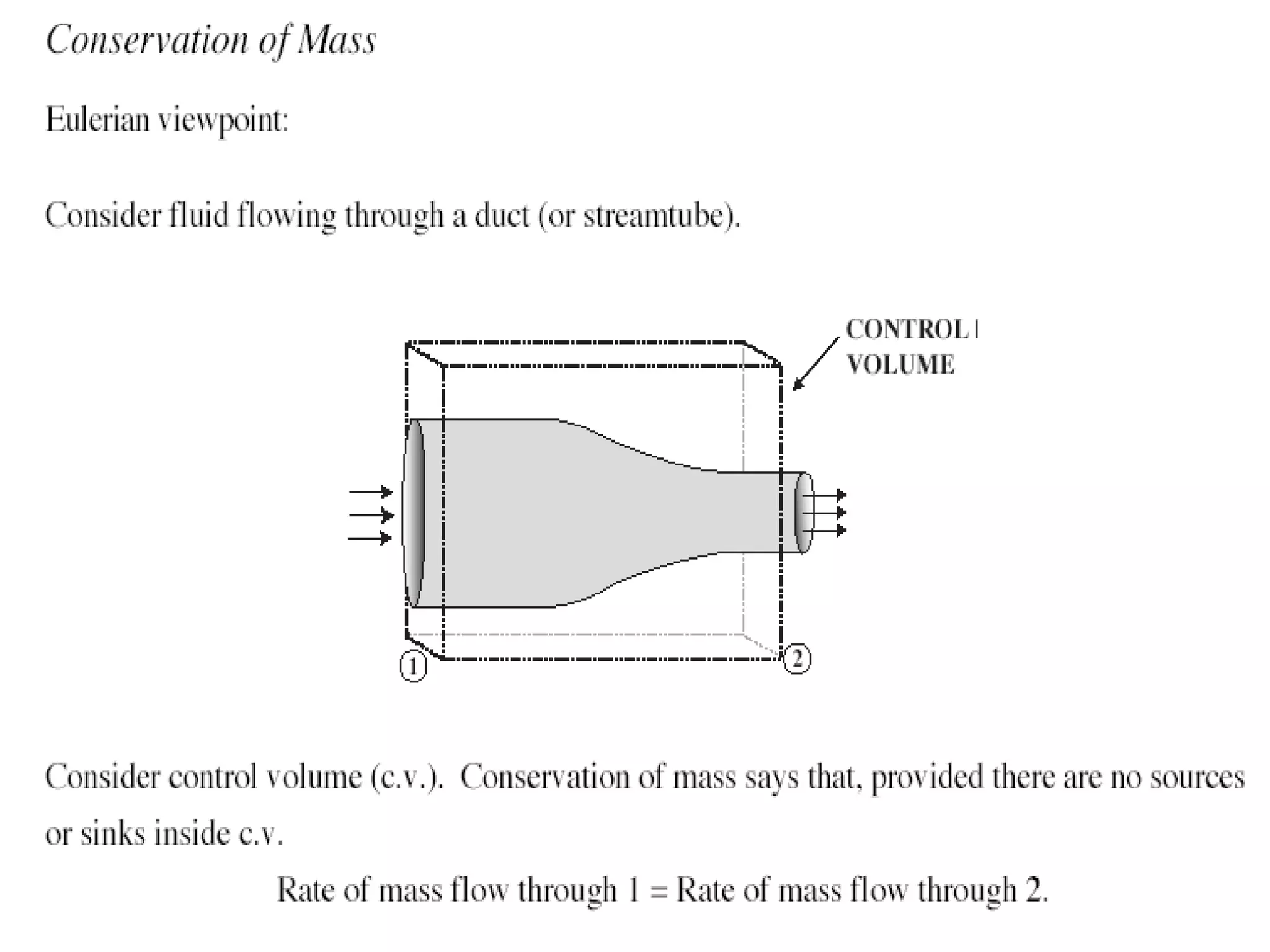
Conservation of Mass

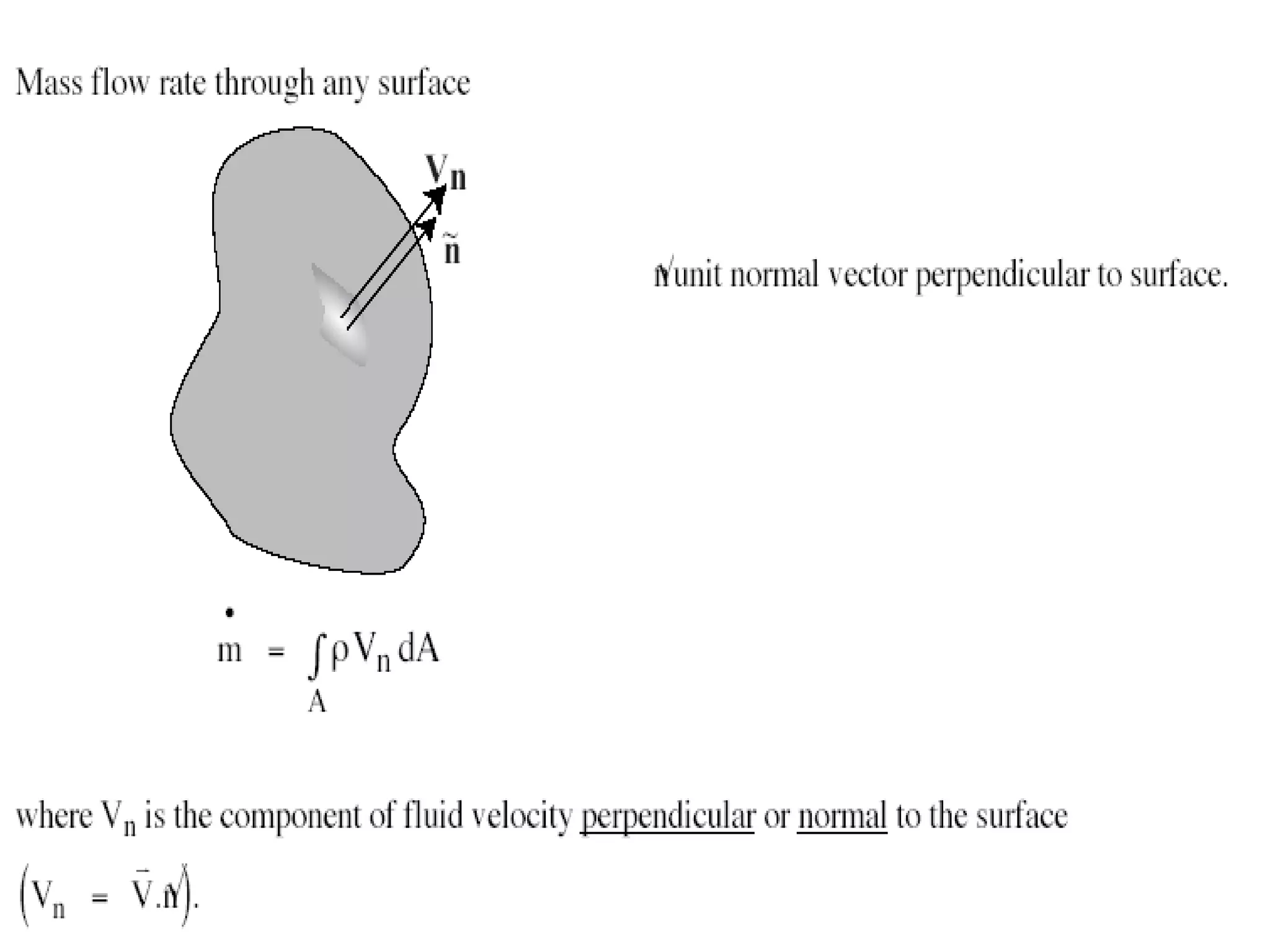
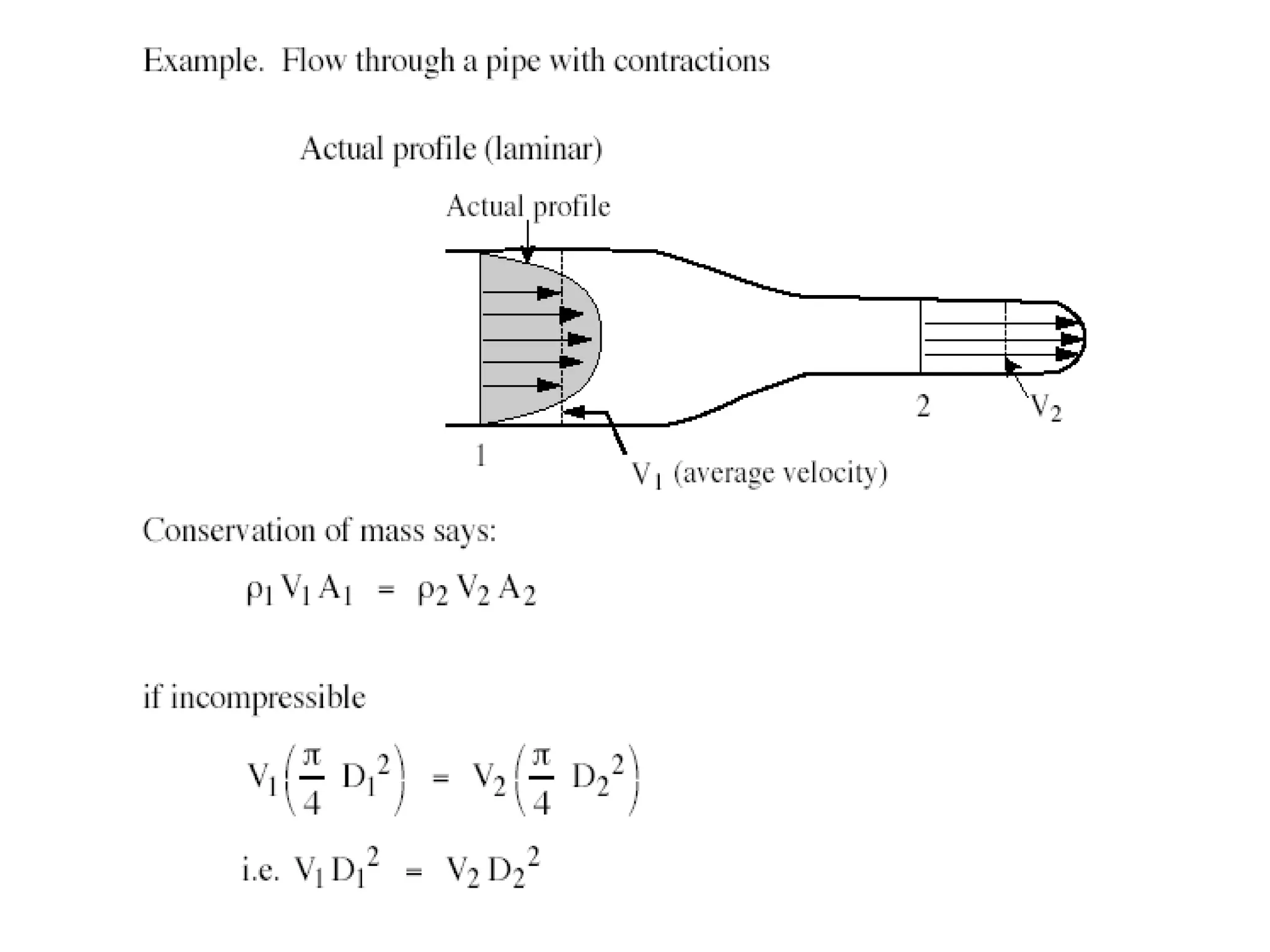
 • Let b=1, the B = mass of the system, m.


        dmCM     dmCV
                         
                         mout      
                                   min
         dt       dt

The rate of change of mass in a control mass should be zero.


             dmCV
                      
                      mout   
                             min     0
              dt
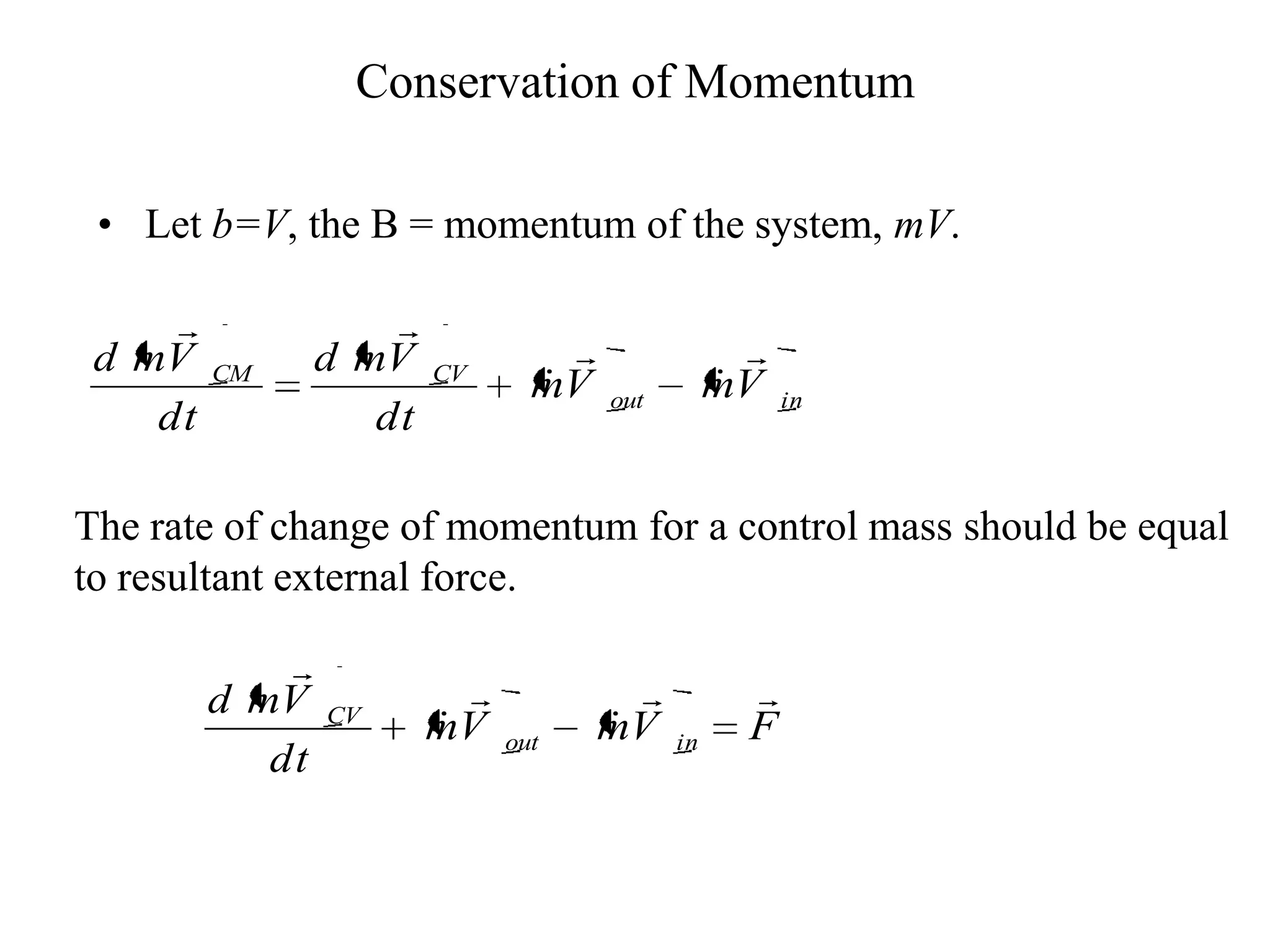
Conservation of Momentum

 • Let b=V, the B = momentum of the system, mV.

                    
 d mV            d mV                              
         CM              CV
                                 
                                 mV    out
                                                  
                                                  mV    in
    dt              dt

The rate of change of momentum for a control mass should be equal
to resultant external force.

             
         d mV                                     
                 CV
                         
                         mV    out
                                       
                                       mV    in     F
            dt
Conservation of Energy

 • Let b=e, the B = Energy of the system, mV.


  d me              d me
          CM                CV
                                   
                                   me   out
                                              
                                              me   in
     dt                dt

The rate of change of energy of a control mass should be equal
to difference of work and heat transfers.

      d me                                     
               CV
                       
                       me    out
                                   
                                   me    in   Q W
         dt
Applications of Momentum Analysis

                                                                 

M out    
         M in             Vn A Vout             Vn A Vin           F
                    out                  in


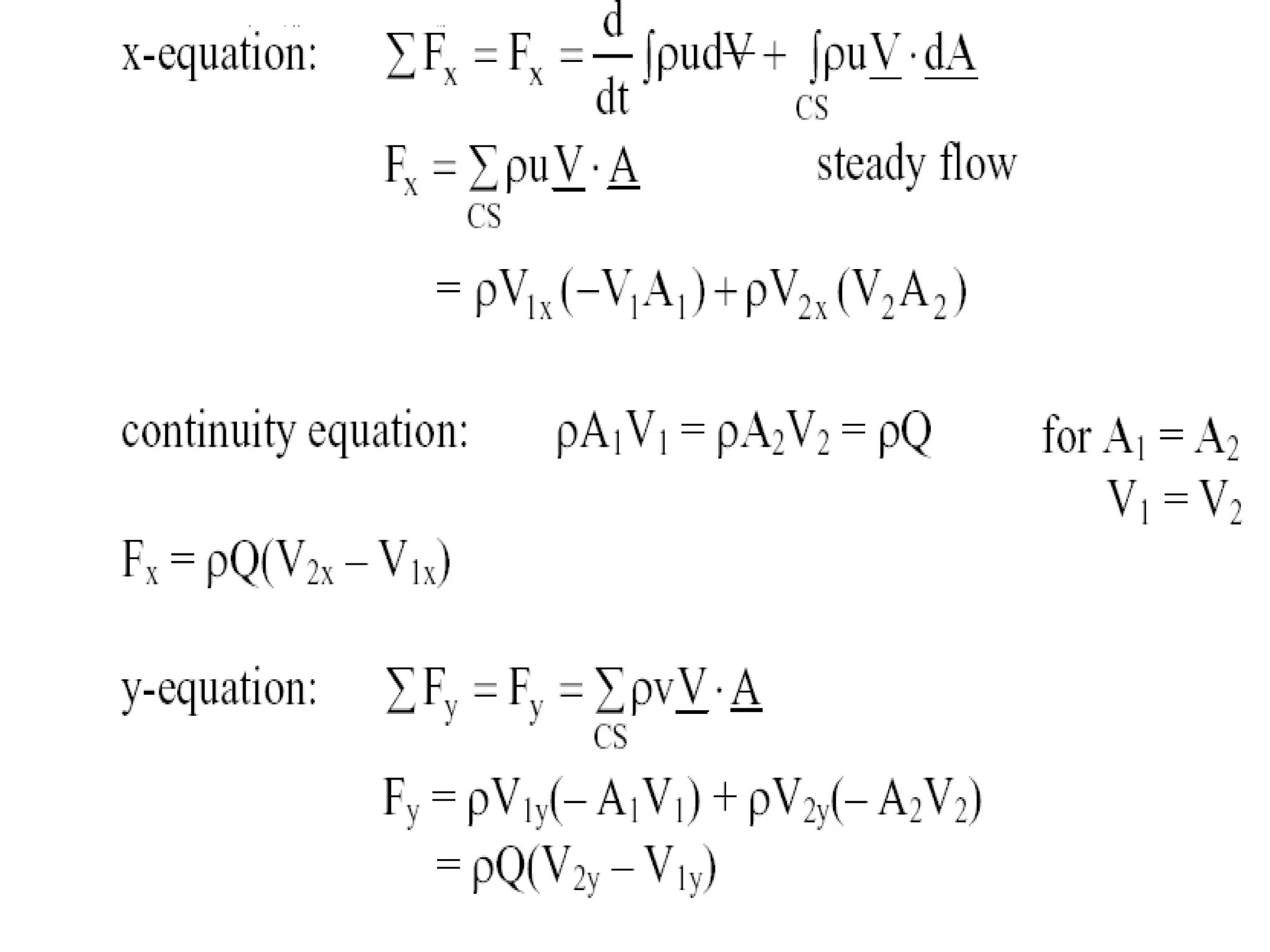
 This is a vector equation and will have three components in x, y and z
 Directions.
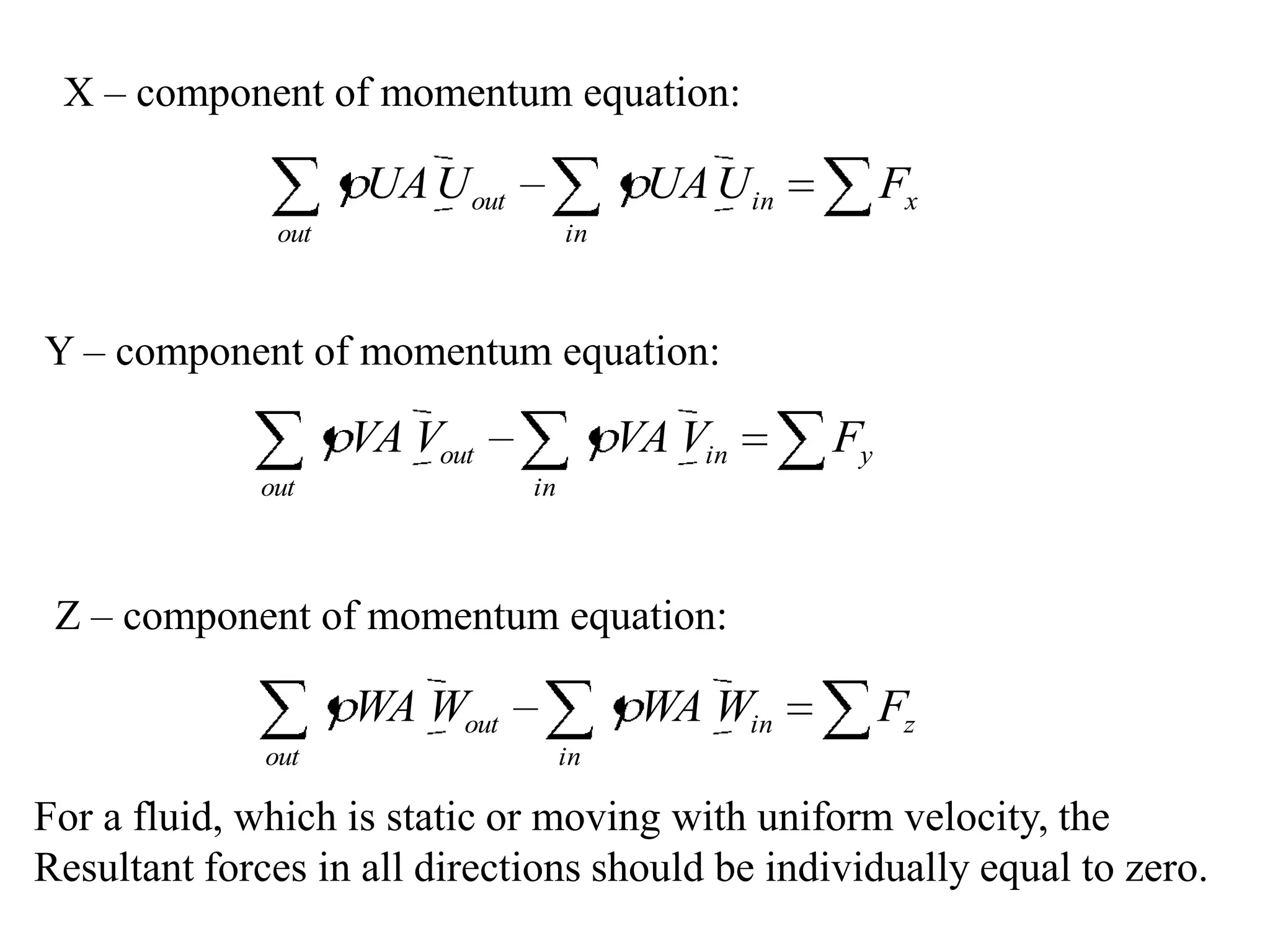
 X – component of momentum equation:

                    UA U out        UA U in      Fx
              out              in
X – component of momentum equation:

                     UA U out              UA U in        Fx
               out                   in


Y – component of momentum equation:

                     VA Vout              VA Vin     Fy
             out                in


 Z – component of momentum equation:

                     WA Wout               WA Win         Fz
              out                    in

For a fluid, which is static or moving with uniform velocity, the
Resultant forces in all directions should be individually equal to zero.
X – component of momentum equation:

                     UA U out              UA U in        Fx
               out                   in


Y – component of momentum equation:

                     VA Vout              VA Vin     Fy
             out                in


 Z – component of momentum equation:

                     WA Wout                WA Win         Fz
              out                    in

For a fluid, which is static or moving with uniform velocity, the
Resultant forces in all directions should be individually equal to zero.
X – component of momentum equation:

                    Max           Fx      FB, x      FS , x


Y – component of momentum equation:


                  May        Fy        FB, y      FS , y

 Z – component of momentum equation:

                   Maz        Fz       FB, z       FS , z
For a fluid, which is static or moving with uniform velocity, the
Resultant forces in all directions should be individually equal to zero.
Vector equation for momentum:
                                        
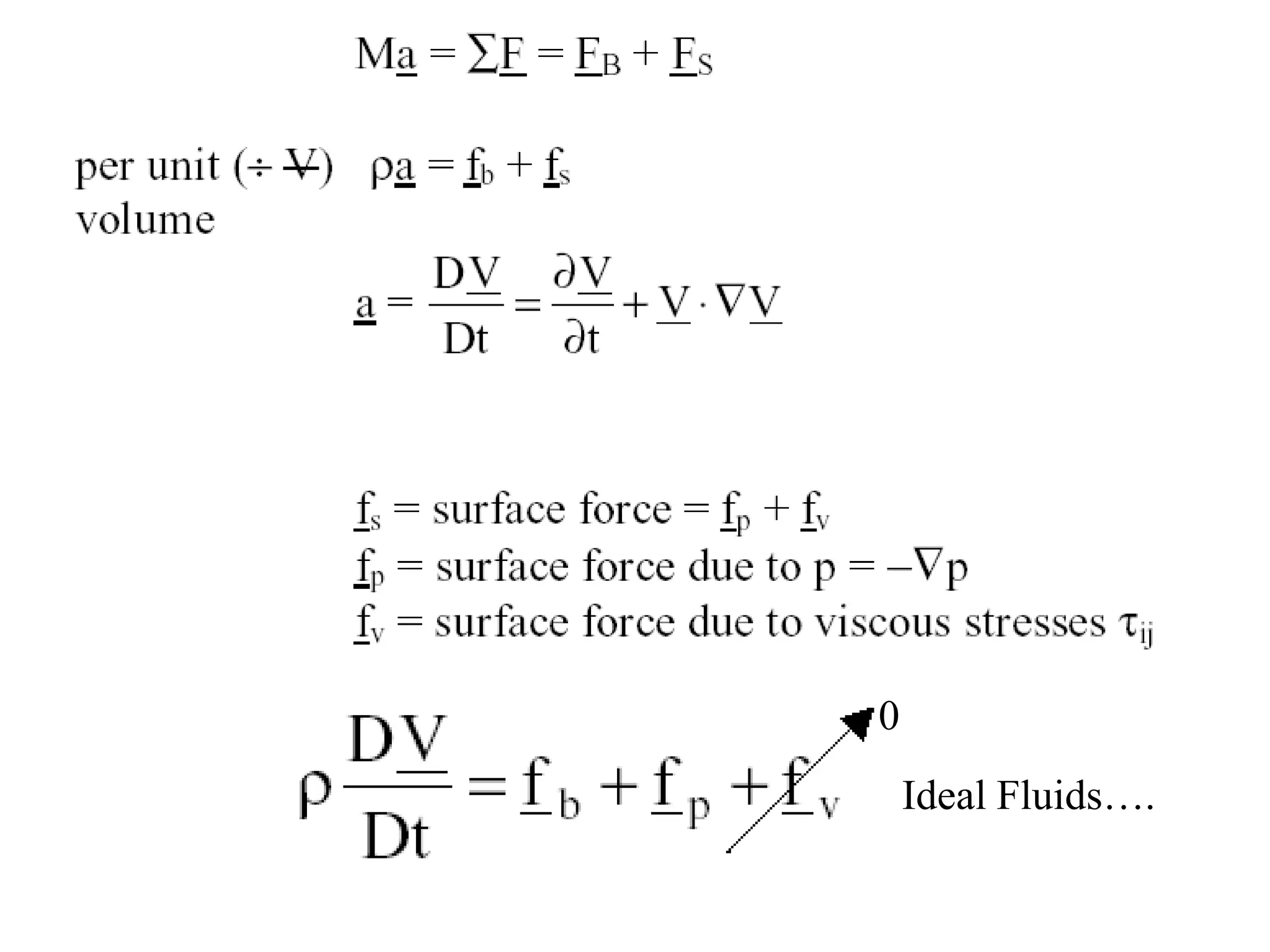
                   Ma           F    FB    FS

Vector momentum equation per unit volume:
                                       
                    a       f       fB    fS

                           
                           f
 Body force per unit volume:B

                          
     Gravitational force: f B       oi 0 ˆ
                                     ˆ   j       ˆ
                                                gk
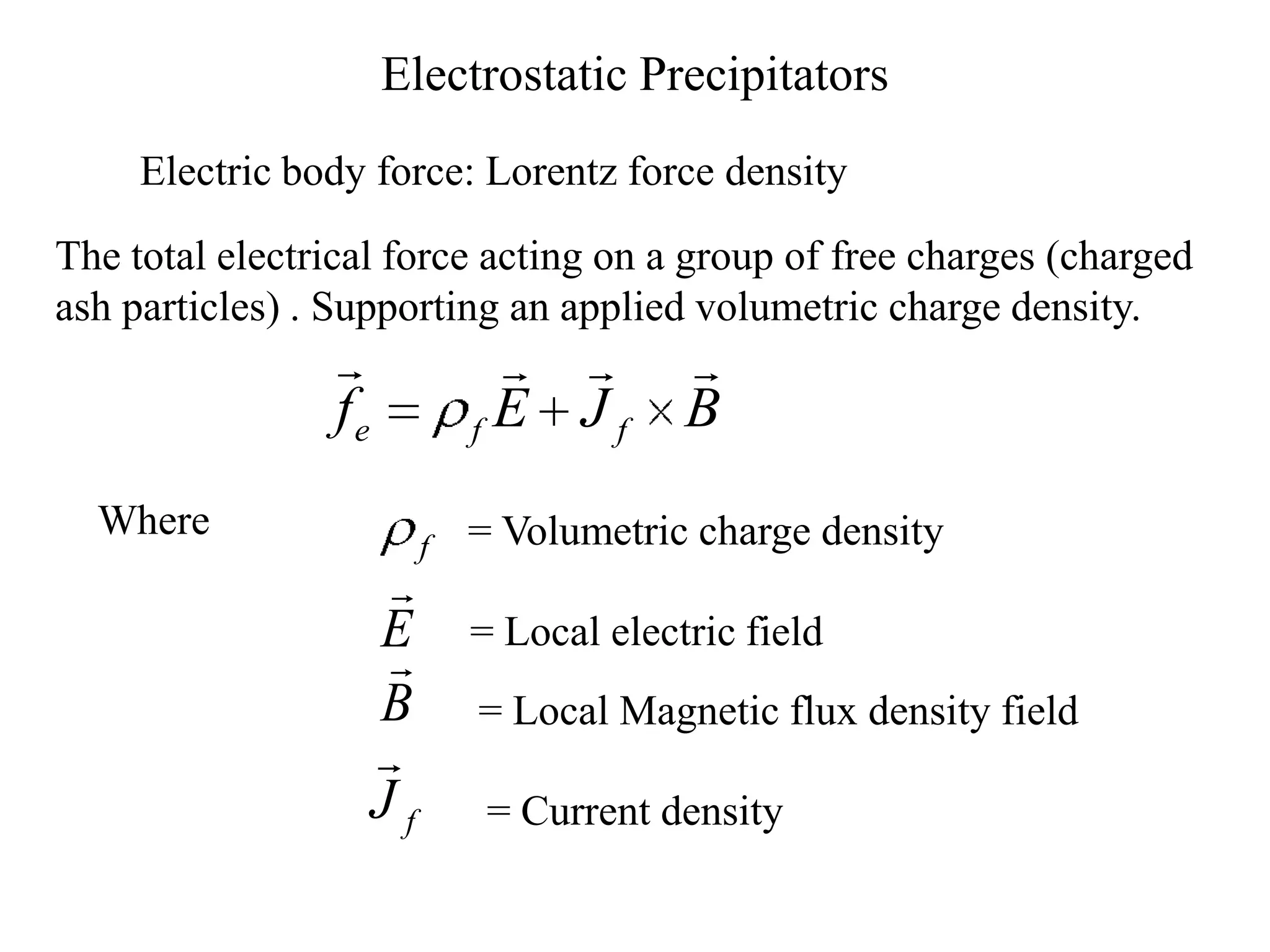
Electrostatic Precipitators
     Electric body force: Lorentz force density

The total electrical force acting on a group of free charges (charged
ash particles) . Supporting an applied volumetric charge density.
                                         
                 fe            fE Jf        B
  Where                        = Volumetric charge density
                           f
                       
                      E       = Local electric field
                      B        = Local Magnetic flux density field
                      
                      Jf        = Current density
Electric Body Force

• This is also called electrical force density.
• This represents the body force density on a ponderable
  medium.
• The Coulomb force on the ions becomes an electrical body
  force on gaseous medium.
• This ion-drag effect on the fluid is called as
  electrohydrodynamic body force.
0
    Ideal Fluids….
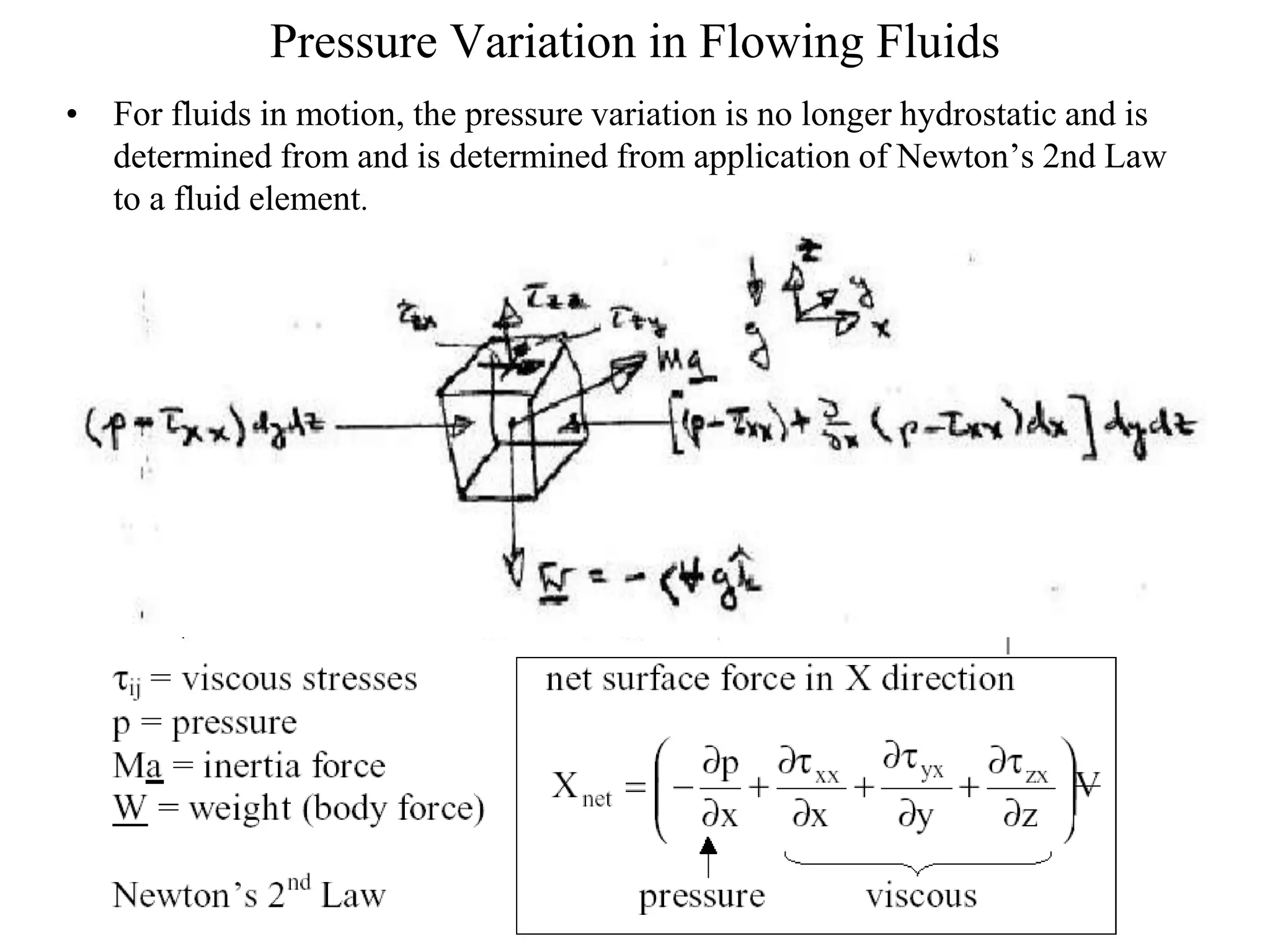
Pressure Variation in Flowing Fluids
• For fluids in motion, the pressure variation is no longer hydrostatic and is
  determined from and is determined from application of Newton’s 2nd Law
  to a fluid element.
Various Forces in A Flow field


• For fluids in motion, various forces are important:
                                                        
• Inertia Force per unit volume :      finertia          a
                    
 • Body Force:      f body       ˆ
                                gk
                                     
 • Hydrostatic Surface Force:        f surface, pressure         p

                                                                
                                                                 
• Viscous Surface Force:            f surface ,viscous       .

• Relative magnitudes of Inertial Forces and Viscous Surface
  Force are very important in design of basic fluid devices.
Comparison of Magnitudes of Inertia Force and Viscous Force

• Internal vs. External Flows
• Internal flows = completely wall bounded;
• Both viscous and Inertial Forces are important.
• External flows = unbounded; i.e., at some distance from body
  or wall flow is uniform.
• External Flow exhibits flow-field regions such that both
  inviscid and viscous analysis can be used depending on the
  body shape.
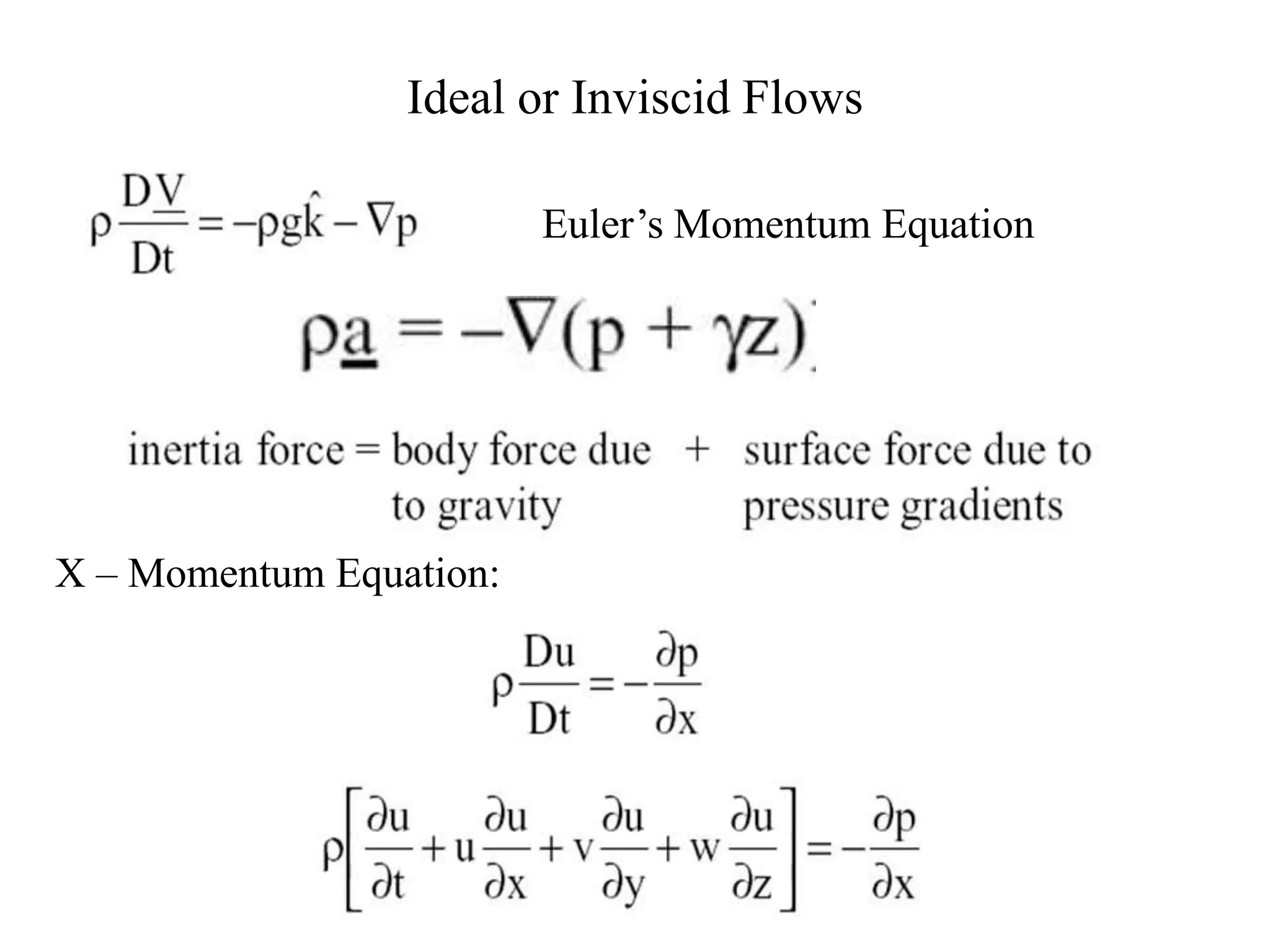
Ideal or Inviscid Flows

                         Euler’s Momentum Equation


X – Momentum Equation:
Euler’s Equation for One Dimensional Flow

Define an exclusive direction along the
axis of the pipe and corresponding unit
                  ˆ
direction vector el


                                 Along a path of zero acceleration the
                                 pressure variation is hydrostatic
Pressure Variation Due to Acceleration


                     V       V         p        z
                         V
                     t       l              l

For steady flow along l – direction (stream line)
                      V          P      z
                    V
                      l          l     l
Integration of above equation yields
Momentum Transfer in A Pump


    • Shaft power            Disc Power              Fluid Power.

       2 TN
P                    Td         Td           m vdp        or        m pdv
        60

    • Flow Machines & Non Flow Machines.
    • Compressible fluids & Incompressible Fluids.
    • Rotary Machines & Reciprocating Machines.
Pump

• Rotate a cylinder containing
  fluid at constant speed.
• Supply continuously fluid
  from bottom.
• See What happens?

                                        Flow in


   •Any More Ideas?
Momentum Principle
                  P M V Subbarao
                 Associate Professor
          Mechanical Engineering Department
                      IIT Delhi


A primary basis for the design of flow devices ..
Momentum Equation
Applications of of the Momentum Equation


Initial Setup and Signs
• 1. Jet deflected by a plate or a vane
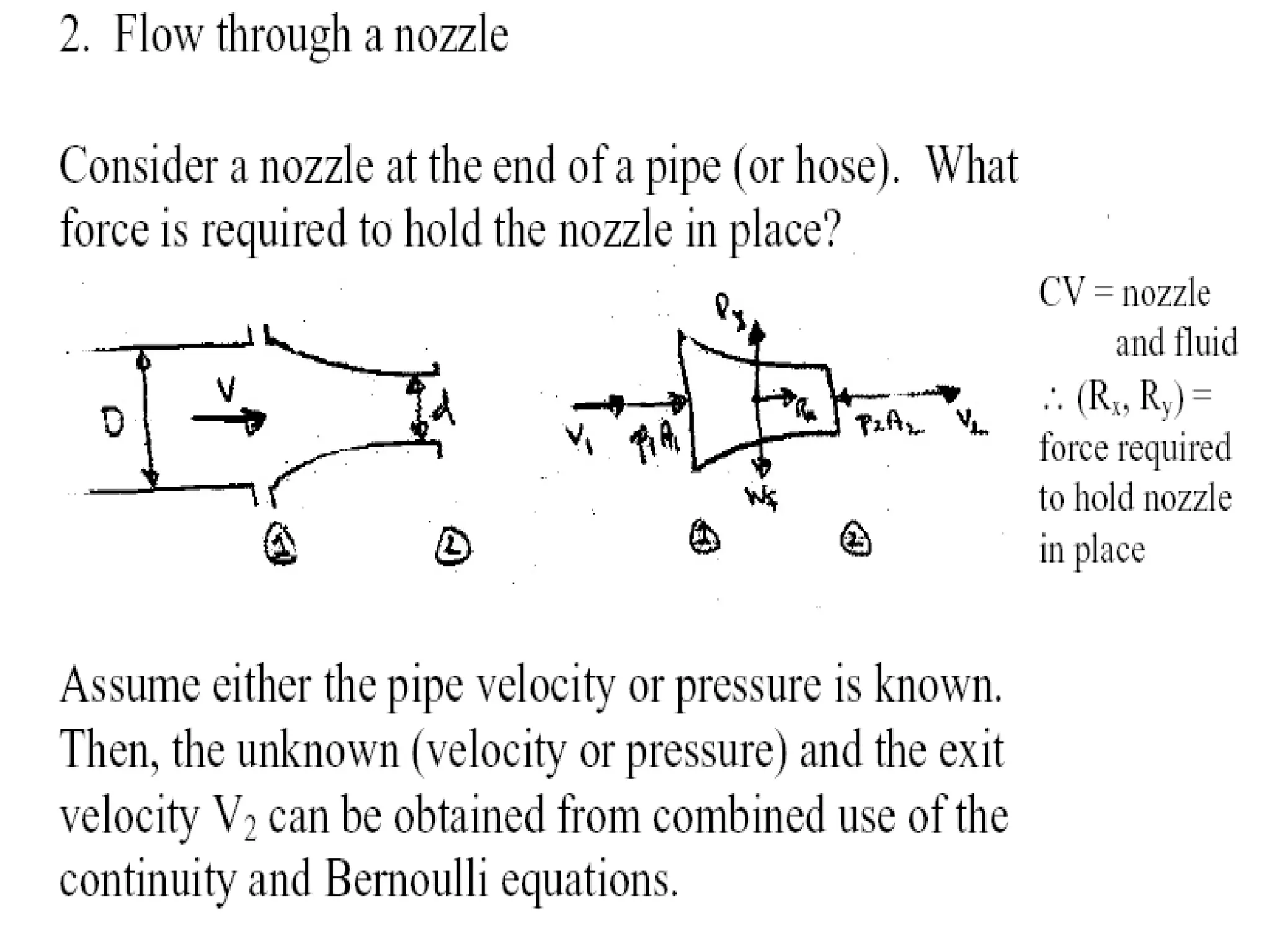
• 2. Flow through a nozzle
• 3. Forces on bends
• 4. Problems involving non-uniform velocity distribution
• 5. Motion of a rocket
• 6. Force on rectangular sluice gate
• 7. Water hammer
Navier-Stokes Equations
        Differential form of momentum equation


X-component:
                                         2    2    2
   u   u   u       u       (p       z)    u    u    u
     u   v       w
   t   x   y       z            x        x2   y2   z2


Y-component:
                                         2    2    2
   v   v   v   v           (p       z)    v    v       v
     u   v   w
   t   x   y   z                y        x2   y2   z2
z-component:
                                2    2    2
  w   w   w   w   (p       z)    w    w    w
    u   v   w
  t   x   y   z        z        x2   y2   z2
Applications of Momentum Equation
Generation of Motive Power Through
       Newton’s Second Law
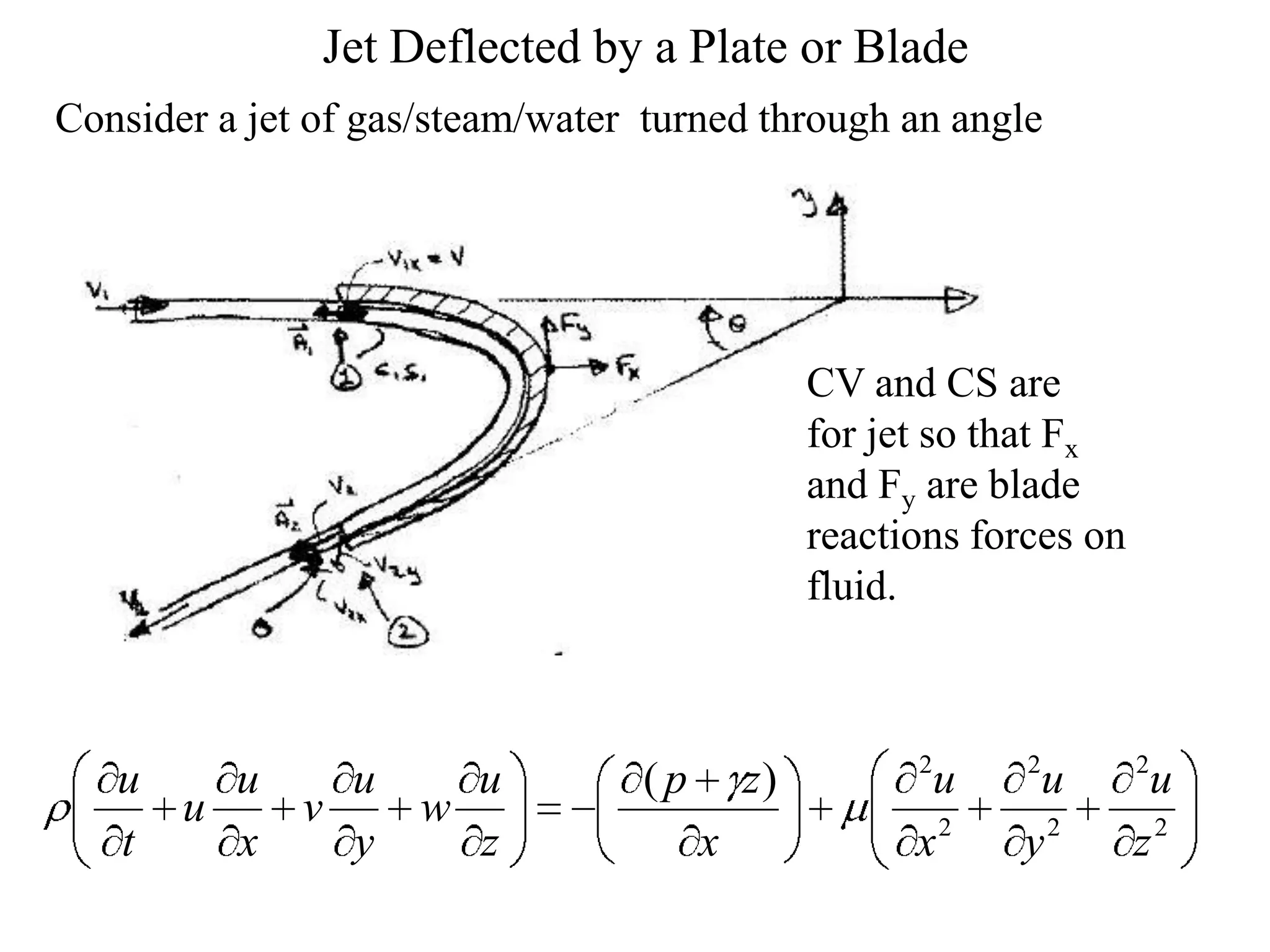
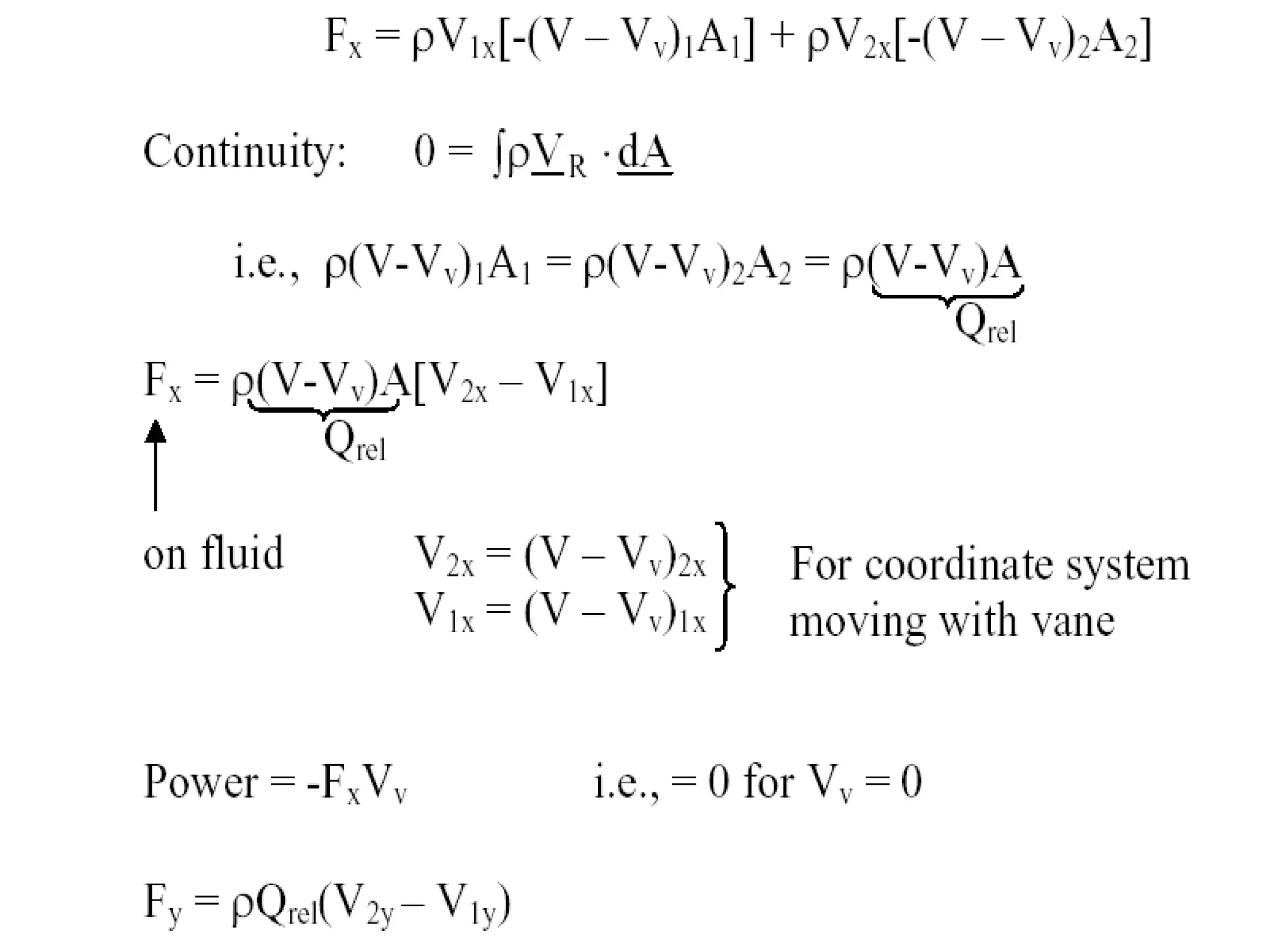
Jet Deflected by a Plate or Blade
Consider a jet of gas/steam/water turned through an angle


                                               CV and CS are
                                               for jet so that Fx
                                               and Fy are blade
                                               reactions forces on
                                               fluid.


                                                     2      2        2
   u   u   u           u         (p       z)          u     u         u
     u   v           w
   t   x   y           z              x              x2    y2        z2
Steady 2 Dimensional Flow

X-component:


                                                       2            2
            u   u                (p       z)            u        u
          u   v
            x   y                     x                x2       y2


 Y-component:
                                                           2            2
                 v   v            (p          z)            v            v
               u   v
                 x   y                    y                x2           y2
   Continuity equation:
                      u      v                     u   v
                                      0                         0
                      x      y                     x   y
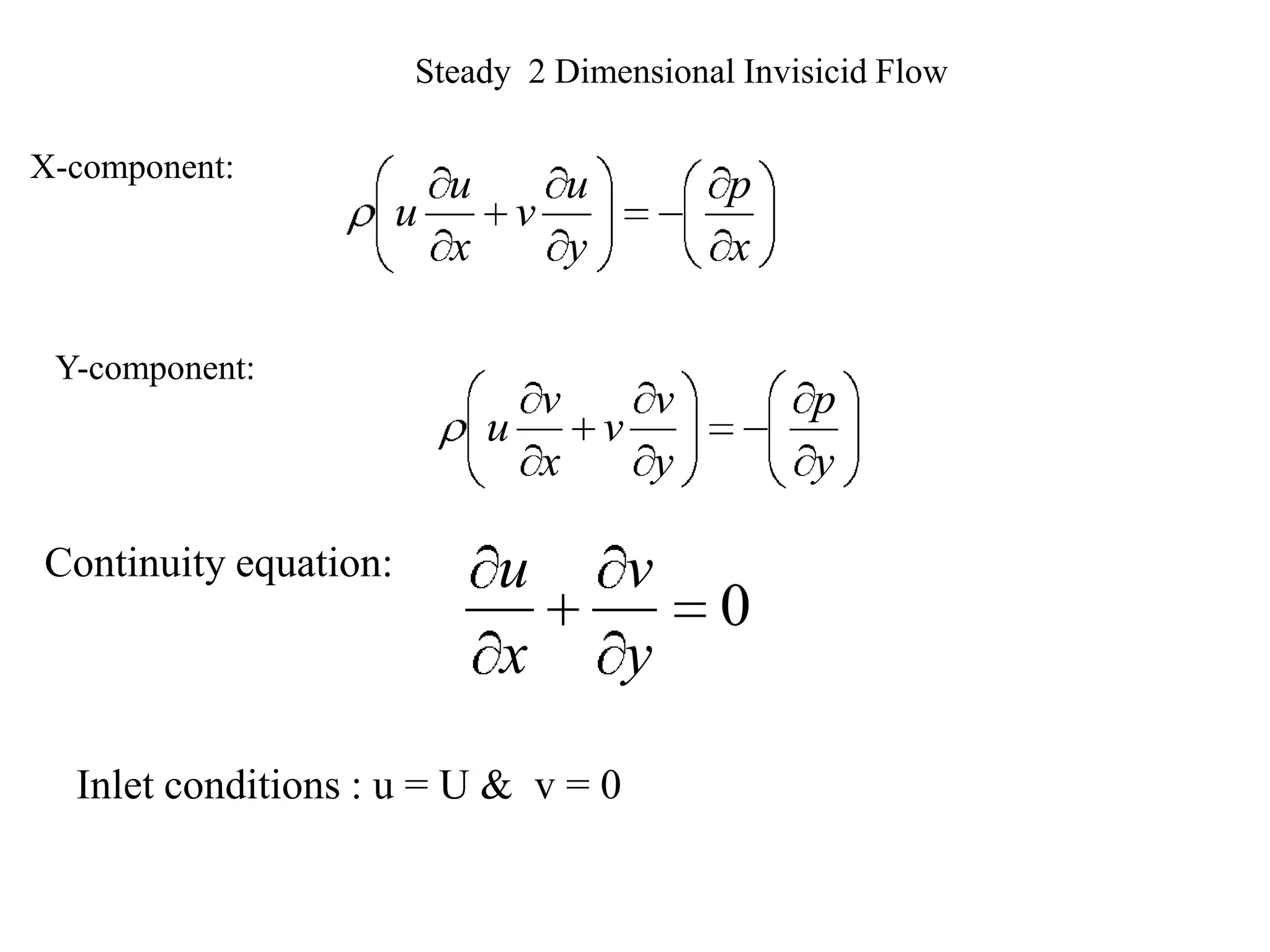
Steady 2 Dimensional Invisicid Flow

X-component:
                           u   u           p
                       u     v
                           x   y           x

 Y-component:
                              v   v              p
                            u   v
                              x   y              y

Continuity equation:        u        v
                                           0
                            x        y

  Inlet conditions : u = U & v = 0
Pure Impulse Blade

  Pressure remains constant along the entire jet.

                            u   u
X-component:            u     v         o
                            x   y


 Y-component:                     v   v
                                u   v        0
                                  x   y


Continuity equation:        u     v              u   v
                                       0
                            x     y              x   y
Fm 5
Fm 5
Fm 5
Fm 5
Fm 5
Fm 5
Fm 5

Fm 5

  • 1.
    Mathematical Models forFLUID MECHANICS P M V Subbarao Associate Professor Mechanical Engineering Department IIT Delhi Convert Ideas into A Precise Blue Print before feeling the same....
  • 4.
    A path lineis the trace of the path followed by a selected fluid particle
  • 5.
    Few things toknow about streamlines • At all points the direction of the streamline is the direction of the fluid velocity: this is how they are defined. • Close to the wall the velocity is parallel to the wall so the streamline is also parallel to the wall. • It is also important to recognize that the position of streamlines can change with time - this is the case in unsteady flow. • In steady flow, the position of streamlines does not change • Because the fluid is moving in the same direction as the streamlines, fluid can not cross a streamline. • Streamlines can not cross each other. • If they were to cross this would indicate two different velocities at the same point. • This is not physically possible. • The above point implies that any particles of fluid starting on one streamline will stay on that same streamline throughout the fluid.
  • 6.
    A useful techniquein fluid flow analysis is to consider only a part of the total fluid in isolation from the rest. This can be done by imagining a tubular surface formed by streamlines along which the fluid flows. This tubular surface is known as a streamtube. A Streamtube A two dimensional version of the streamtube The "walls" of a streamtube are made of streamlines. As we have seen above, fluid cannot flow across a streamline, so fluid cannot cross a streamtube wall. The streamtube can often be viewed as a solid walled pipe. A streamtube is not a pipe - it differs in unsteady flow as the walls will move with time. And it differs because the "wall" is moving with the fluid
  • 7.
    Fluid Kinematics • Theacceleration of a fluid particle is the rate of change of its velocity. • In the Lagrangian approach the velocity of a fluid particle is a function of time only since we have described its motion in terms of its position vector.
  • 8.
    In the Eulerianapproach the velocity is a function of both space and time; consequently,  V ˆ j ˆ u ( x, y, z, t )i v( x, y, z, t ) ˆ w( x, y, z, t )k     Velocityco mponents x,y,z are f(t) since we must follow the total derivative approach in evaluating du/dt.
  • 10.
    Similarly for ay& az, In vector notation this can be written concisely
  • 13.
    x Conservation laws canbe applied to an infinitesimal element or cube, or may be integrated over a large control volume.
  • 14.
  • 15.
    Control Volume • Influid mechanics we are usually interested in a region of space, i.e, control volume and not particular systems. • Therefore, we need to transform GDE’s from a system to a control volume. • This is accomplished through the use of Reynolds Transport Theorem. • Actually derived in thermodynamics for CV forms of continuity and 1st and 2nd laws.
  • 16.
    Flowing Fluid ThroughA CV • A typical control volume for flow in an funnel-shaped pipe is bounded by the pipe wall and the broken lines. • At time t0, all the fluid (control mass) is inside the control volume.
  • 17.
    The fluid thatwas in the control volume at time t0 will be seen at time t0 + t as: .
  • 18.
    The control volumeat time t0 + t . The control mass at time t0 + t . The differences between the fluid (control mass) and the control volume at time t0 + t .
  • 19.
    • Consider asystem and a control volume (C.V.) as follows: • the system occupies region I and C.V. (region II) at time t0. • Fluid particles of region – I are trying to enter C.V. (II) at time t0. III II I • the same system occupies regions (II+III) at t0 + t • Fluid particles of I will enter CV-II in a time t. •Few more fluid particles which belong to CV – II at t0 will occupy III at time t0 + t.
  • 20.
    The control volumemay move as time passes. III has left CV at time t0+ t III II I is trying to enter CV at time t0 II At time t0+ t  I VCV At time t0
  • 21.
    Reynolds' Transport Theorem •Consider a fluid scalar property b which is the amount of this property per unit mass of fluid. • For example, b might be a thermodynamic property, such as the internal energy unit mass, or the electric charge per unit mass of fluid. • The laws of physics are expressed as applying to a fixed mass of material. • But most of the real devices are control volumes. • The total amount of the property b inside the material volume M , designated by B, may be found by integrating the property per unit volume, M ,over the material volume :
  • 22.
    Conservation of B •total rate of change of any extensive property B of a system(C.M.) occupying a control volume C.V. at time t is equal to the sum of • a) the temporal rate of change of B within the C.V. • b) the net flux of B through the control surface C.S. that surrounds the C.V. • The change of property B of system (C.M.) during Dt is BCM Bt t Bt 0 0 BCM BII t0 t BIII t0 t BI t0 BII t0 add and subtract B t t 0
  • 23.
    BCM BII t0 t BIII t0 t BI t0 BII t0 BI t0 t BI t0 t BCM BI BII t0 t BIII t0 t BI BII t0 BI t0 t BCM BCV t0 t BCV t0 BIII t0 t BI t0 t The above mentioned change has occurred over a time t, therefore Time averaged change in BCM is BCM BCV t0 t BCV t0 BIII t0 t BI t0 t t t t t
  • 24.
    For and infinitesimaltime duration BCM BCV t0 t BCV t0 BIII t0 t BI t0 t lim lim lim lim t o t t o t t o t t o t • The rate of change of property B of the system. dBCM dBCV   BIII BI dt dt
  • 25.
    Conservation of Mass • Let b=1, the B = mass of the system, m. dmCM dmCV  mout  min dt dt The rate of change of mass in a control mass should be zero. dmCV  mout  min 0 dt
  • 26.
    Conservation of Momentum • Let b=V, the B = momentum of the system, mV.   d mV d mV   CM CV  mV out  mV in dt dt The rate of change of momentum for a control mass should be equal to resultant external force.  d mV    CV  mV out  mV in F dt
  • 27.
    Conservation of Energy • Let b=e, the B = Energy of the system, mV. d me d me CM CV  me out  me in dt dt The rate of change of energy of a control mass should be equal to difference of work and heat transfers. d me   CV  me out  me in Q W dt
  • 35.
    Applications of MomentumAnalysis     M out  M in Vn A Vout Vn A Vin F out in This is a vector equation and will have three components in x, y and z Directions. X – component of momentum equation: UA U out UA U in Fx out in
  • 36.
    X – componentof momentum equation: UA U out UA U in Fx out in Y – component of momentum equation: VA Vout VA Vin Fy out in Z – component of momentum equation: WA Wout WA Win Fz out in For a fluid, which is static or moving with uniform velocity, the Resultant forces in all directions should be individually equal to zero.
  • 37.
    X – componentof momentum equation: UA U out UA U in Fx out in Y – component of momentum equation: VA Vout VA Vin Fy out in Z – component of momentum equation: WA Wout WA Win Fz out in For a fluid, which is static or moving with uniform velocity, the Resultant forces in all directions should be individually equal to zero.
  • 38.
    X – componentof momentum equation: Max Fx FB, x FS , x Y – component of momentum equation: May Fy FB, y FS , y Z – component of momentum equation: Maz Fz FB, z FS , z For a fluid, which is static or moving with uniform velocity, the Resultant forces in all directions should be individually equal to zero.
  • 39.
    Vector equation formomentum:     Ma F FB FS Vector momentum equation per unit volume:     a f fB fS  f Body force per unit volume:B  Gravitational force: f B oi 0 ˆ ˆ j ˆ gk
  • 40.
    Electrostatic Precipitators Electric body force: Lorentz force density The total electrical force acting on a group of free charges (charged ash particles) . Supporting an applied volumetric charge density.     fe fE Jf B Where = Volumetric charge density f  E = Local electric field B = Local Magnetic flux density field  Jf = Current density
  • 41.
    Electric Body Force •This is also called electrical force density. • This represents the body force density on a ponderable medium. • The Coulomb force on the ions becomes an electrical body force on gaseous medium. • This ion-drag effect on the fluid is called as electrohydrodynamic body force.
  • 42.
    0 Ideal Fluids….
  • 43.
    Pressure Variation inFlowing Fluids • For fluids in motion, the pressure variation is no longer hydrostatic and is determined from and is determined from application of Newton’s 2nd Law to a fluid element.
  • 44.
    Various Forces inA Flow field • For fluids in motion, various forces are important:   • Inertia Force per unit volume : finertia a  • Body Force: f body ˆ gk  • Hydrostatic Surface Force: f surface, pressure p    • Viscous Surface Force: f surface ,viscous . • Relative magnitudes of Inertial Forces and Viscous Surface Force are very important in design of basic fluid devices.
  • 45.
    Comparison of Magnitudesof Inertia Force and Viscous Force • Internal vs. External Flows • Internal flows = completely wall bounded; • Both viscous and Inertial Forces are important. • External flows = unbounded; i.e., at some distance from body or wall flow is uniform. • External Flow exhibits flow-field regions such that both inviscid and viscous analysis can be used depending on the body shape.
  • 46.
    Ideal or InviscidFlows Euler’s Momentum Equation X – Momentum Equation:
  • 48.
    Euler’s Equation forOne Dimensional Flow Define an exclusive direction along the axis of the pipe and corresponding unit ˆ direction vector el Along a path of zero acceleration the pressure variation is hydrostatic
  • 49.
    Pressure Variation Dueto Acceleration V V p z V t l l For steady flow along l – direction (stream line) V P z V l l l Integration of above equation yields
  • 50.
    Momentum Transfer inA Pump • Shaft power Disc Power Fluid Power. 2 TN P Td Td m vdp or m pdv 60 • Flow Machines & Non Flow Machines. • Compressible fluids & Incompressible Fluids. • Rotary Machines & Reciprocating Machines.
  • 51.
    Pump • Rotate acylinder containing fluid at constant speed. • Supply continuously fluid from bottom. • See What happens? Flow in •Any More Ideas?
  • 55.
    Momentum Principle P M V Subbarao Associate Professor Mechanical Engineering Department IIT Delhi A primary basis for the design of flow devices ..
  • 56.
  • 57.
    Applications of ofthe Momentum Equation Initial Setup and Signs • 1. Jet deflected by a plate or a vane • 2. Flow through a nozzle • 3. Forces on bends • 4. Problems involving non-uniform velocity distribution • 5. Motion of a rocket • 6. Force on rectangular sluice gate • 7. Water hammer
  • 58.
    Navier-Stokes Equations Differential form of momentum equation X-component: 2 2 2 u u u u (p z) u u u u v w t x y z x x2 y2 z2 Y-component: 2 2 2 v v v v (p z) v v v u v w t x y z y x2 y2 z2
  • 59.
    z-component: 2 2 2 w w w w (p z) w w w u v w t x y z z x2 y2 z2
  • 60.
  • 61.
    Generation of MotivePower Through Newton’s Second Law
  • 62.
    Jet Deflected bya Plate or Blade Consider a jet of gas/steam/water turned through an angle CV and CS are for jet so that Fx and Fy are blade reactions forces on fluid. 2 2 2 u u u u (p z) u u u u v w t x y z x x2 y2 z2
  • 63.
    Steady 2 DimensionalFlow X-component: 2 2 u u (p z) u u u v x y x x2 y2 Y-component: 2 2 v v (p z) v v u v x y y x2 y2 Continuity equation: u v u v 0 0 x y x y
  • 64.
    Steady 2 DimensionalInvisicid Flow X-component: u u p u v x y x Y-component: v v p u v x y y Continuity equation: u v 0 x y Inlet conditions : u = U & v = 0
  • 65.
    Pure Impulse Blade Pressure remains constant along the entire jet. u u X-component: u v o x y Y-component: v v u v 0 x y Continuity equation: u v u v 0 x y x y