1 Ikiriza Antony
OCCUPATIONAL HAZARDS
2
By the end of this lectures students
should be able;
• Differentiate between hazard and
risks
• Describe the Classifications of
occupational health and safety
hazards
• To Identify the occupational health
and safety hazards in various
workplaces
• Discuss the range of hazards in
LEARNING OBJECTIVES
3
 Hazard: is a condition or set of circumstances that has a
potential of causing harm or contributing to injury or
death.
 Safety hazards: hazards that can cause accidents, injuries,
and sometimes even death
 Heath hazards: those hazards that can cause occupational
disease or illness
 Risk: A combination of likelihood that injury or damage
to people’s health, or property will occur and the severity
OCCUPATIONAL HAZARDS
4
Planning and Design (people involved in
planning and design activities may create
hazards)
Production and Distribution (production,
process, distribution can result in hazards)
Maintenance and Repair (hazards may come
from insufficient, delayed and improper
maintenance)
Communication (poor communication or
failures in communications can introduce
hazards)
SOURCES OF HAZARDS
5
Chemical hazards
Physical hazards
Biological hazards
Ergonomic hazards
Psycho-social hazards
TYPES OF OCCUPATIONAL HAZARDS
6
Classification of dangerous chemicals
 Carcinogens
 Corrosion
 Oxidizing
 Harmful
 Very toxic and toxic
 Irritant
 Highly flammable
 Explosive
CHEMICAL HAZARDS
7
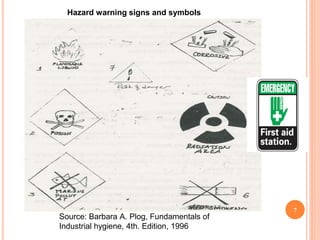
Hazard warning signs and symbols
Source: Barbara A. Plog, Fundamentals of
Industrial hygiene, 4th. Edition, 1996
8
These are agents that cause cancer
These can be identified in epidemiological
studies
They include: Asbestos, Benzene, Rubber
Manufacture, Coke Oven Emissions, Lead,
Chromium, Wood Dusts, Vinyl Chloride,
Chloroform, DDT, Beryllium, Asbestos,Cadmi
CARCINOGENS
9
1. Asphyxiation
2. Systemic intoxication
3. Pneumoconiosis (occupational lung disease
due to inhalation of dust usually in mines)
4. Cancers
5. Irritation
6. Mutagenicity
7.Teratogenicity
EFFECTS OF CHEMICALS
10
• Extremes of temperature
• Ionizing radiation
• Non ionizing radiation
• Excessive noise
• Vibrations
PHYSICAL HAZARDS
11
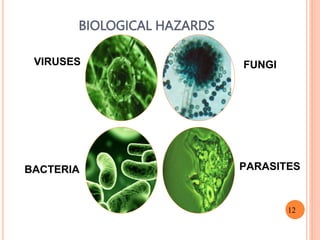
Any living organism with potential to caus
e harm to humans
They can be transmitted via inhalation, co
ntact, ingestion and Injection
They include:
 Bacteria
 Viruses
 Fungi
 Mold
 Protozoa
 Animals and insects
BIO HAZARDS (BIOLOGICAL HAZARDS)
BIOLOGICAL HAZARDS
VIRUSES FUNGI
BACTERIA PARASITES
12
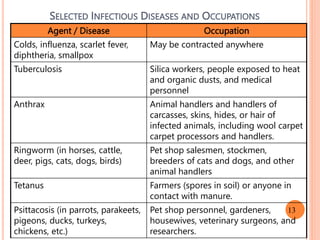
SELECTED INFECTIOUS DISEASES AND OCCUPATIONS
Agent / Disease Occupation
Colds, influenza, scarlet fever,
diphtheria, smallpox
May be contracted anywhere
Tuberculosis Silica workers, people exposed to heat
and organic dusts, and medical
personnel
Anthrax Animal handlers and handlers of
carcasses, skins, hides, or hair of
infected animals, including wool carpet
carpet processors and handlers.
Ringworm (in horses, cattle,
deer, pigs, cats, dogs, birds)
Pet shop salesmen, stockmen,
breeders of cats and dogs, and other
animal handlers
Tetanus Farmers (spores in soil) or anyone in
contact with manure.
Psittacosis (in parrots, parakeets,
pigeons, ducks, turkeys,
chickens, etc.)
Pet shop personnel, gardeners,
housewives, veterinary surgeons, and
researchers.
13
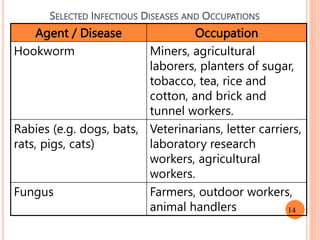
SELECTED INFECTIOUS DISEASES AND OCCUPATIONS
Agent / Disease Occupation
Hookworm Miners, agricultural
laborers, planters of sugar,
tobacco, tea, rice and
cotton, and brick and
tunnel workers.
Rabies (e.g. dogs, bats,
rats, pigs, cats)
Veterinarians, letter carriers,
laboratory research
workers, agricultural
workers.
Fungus Farmers, outdoor workers,
animal handlers 14
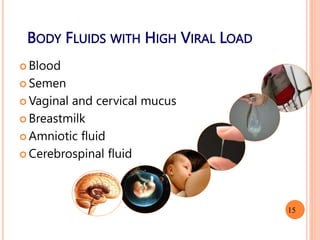
BODY FLUIDS WITH HIGH VIRAL LOAD
 Blood
 Semen
 Vaginal and cervical mucus
 Breastmilk
 Amniotic fluid
 Cerebrospinal fluid
15
16
In summary exposure to Biohazards can be thro
ugh;
 Laboratory research
 Hospitals
 Laundry
 Housekeeping
 Health care
 Diet
 Contact with the skin
EXPOSURES TO BIO HAZARDS
17
 There are numerous psychosocial factors, which
operate at workplace.
 These are the human relationships among
workers themselves and those in authorities over
them.
 Examples of psychosocial factors include:-
The type and rhythm of work.
Work stability.
Sexual and other forms of harassment
Job satisfaction.
Leadership style.
 Security.
 Workers` participation and communication.
Motivation and incentives.
PSYCHOSOCIAL HAZARDS
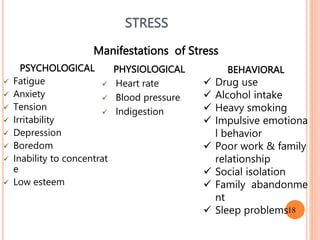
STRESS
Manifestations of Stress
PHYSIOLOGICAL
 Heart rate
 Blood pressure
 Indigestion
BEHAVIORAL
 Drug use
 Alcohol intake
 Heavy smoking
 Impulsive emotiona
l behavior
 Poor work & family
relationship
 Social isolation
 Family abandonme
nt
 Sleep problems
PSYCHOLOGICAL
 Fatigue
 Anxiety
 Tension
 Irritability
 Depression
 Boredom
 Inability to concentrat
e
 Low esteem
18
• Ergonomics, also known as human
engineering or human factors
engineering.
• The science of designing machines,
products, and systems to maximize the
safety, comfort, and efficiency of the
people who use them.
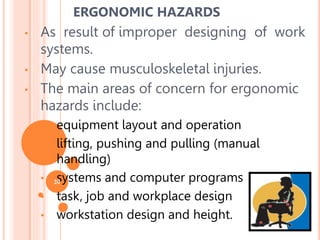
ERGONOMIC HAZARDS
19
• As result of improper designing of work
systems.
• May cause musculoskeletal injuries.
• The main areas of concern for ergonomic
hazards include:
• equipment layout and operation
• lifting, pushing and pulling (manual
handling)
• systems and computer programs
• task, job and workplace design
• workstation design and height.
ERGONOMIC HAZARDS
20
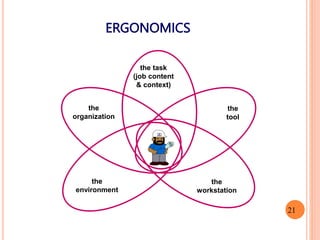
ERGONOMICS
the
tool
the
workstation
the task
(job content
& context)
the
organization
the
environment
21
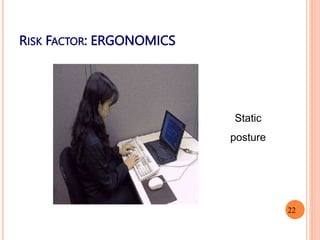
RISK FACTOR: ERGONOMICS
Static
posture
22
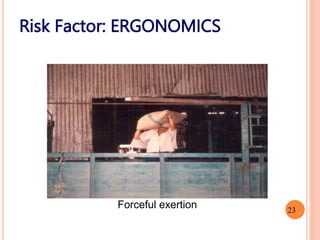
Forceful exertion
Risk Factor: ERGONOMICS
23
RISK FACTOR: ERGONOMICS
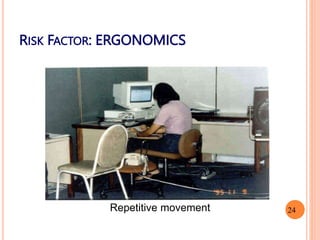
Repetitive movement 24
RISK FACTOR: ERGONOMICS
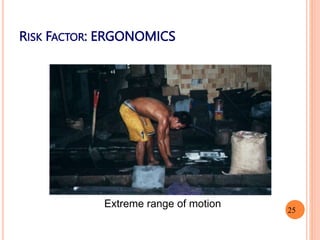
Extreme range of motion
25
RISK FACTOR: ERGONOMICS
Awkward posture
26
OCCUPATIONAL DISEASES
 Occupational diseases are adverse health conditions in the
human being, the occurrence or severity of which is
related to exposure to factors on the job or in the work
environment.
 Such factors can be:
Physical: e.g. heat, noise, radiation
Chemical: e.g. solvents, pesticides, heavy metals, dust
Biological: e.g. tuberculosis, hepatitis B virus, HIV
Ergonomic: e.g. improperly designed tools or work areas,
repetitive motions
Psychosocial stressors: e.g. lack of control over work,
inadequate personal support
Mechanical: these mainly cause work accidents and
injuries rather than occupational diseases.
27
OCCUPATIONAL DISEASES
Occupational diseases are slow to
develop, less dramatic and even less
obvious.
Due to their gradual effects they do
not receive publicity.
Losses attributable to occupational
diseases over time are more difficult
to describe compared to injuries.
28
MOST COMMON OCC DISEASES
 Noise-induced hearing loss (NIHL)
 Pneumoconioses (mining operations)
 Respiratory eg. Occupational asthma (paints)
 Occupational dermatoses (skin disorders)
 MSDs (lack of ergonomics)
 Psychiatric disorders (post-traumatic stress), drug
abuse
 Hepatitis B and C, TB, HIV, anthrax, etc (health
care, vet)
 Occupational cancer (chemical, pesticides, dyes)
 Cardiovascular disorders
 Gasto-intestinal disorders
 Visual disorders
 Neurological disorders
 Reproductive disorders 29
SUMMARY
There is an unlimited number of hazards that
can be found in almost every workplace.
These include both obvious unsafe working
conditions and insidious, less obvious hazards.
Hazards often are built into the workplace.
Therefore, workplace managers must ensure
that hazards are removed, rather than trying
to get workers to adapt to unsafe conditions.
The most effective accident and disease
prevention begins when work processes are
still in the design stage, when safe conditions
can be built into the work process.
30
ACTIVITY
Read and make notes about identification
of occupational health and safety hazards
Discuss the different occupational hazards
in your workplace.

31

OCCUPATIONAL HAZARDS.pptx

  • 1.
  • 2.
    2 By the endof this lectures students should be able; • Differentiate between hazard and risks • Describe the Classifications of occupational health and safety hazards • To Identify the occupational health and safety hazards in various workplaces • Discuss the range of hazards in LEARNING OBJECTIVES
  • 3.
    3  Hazard: isa condition or set of circumstances that has a potential of causing harm or contributing to injury or death.  Safety hazards: hazards that can cause accidents, injuries, and sometimes even death  Heath hazards: those hazards that can cause occupational disease or illness  Risk: A combination of likelihood that injury or damage to people’s health, or property will occur and the severity OCCUPATIONAL HAZARDS
  • 4.
    4 Planning and Design(people involved in planning and design activities may create hazards) Production and Distribution (production, process, distribution can result in hazards) Maintenance and Repair (hazards may come from insufficient, delayed and improper maintenance) Communication (poor communication or failures in communications can introduce hazards) SOURCES OF HAZARDS
  • 5.
    5 Chemical hazards Physical hazards Biologicalhazards Ergonomic hazards Psycho-social hazards TYPES OF OCCUPATIONAL HAZARDS
  • 6.
    6 Classification of dangerouschemicals  Carcinogens  Corrosion  Oxidizing  Harmful  Very toxic and toxic  Irritant  Highly flammable  Explosive CHEMICAL HAZARDS
  • 7.
    7 Hazard warning signsand symbols Source: Barbara A. Plog, Fundamentals of Industrial hygiene, 4th. Edition, 1996
  • 8.
    8 These are agentsthat cause cancer These can be identified in epidemiological studies They include: Asbestos, Benzene, Rubber Manufacture, Coke Oven Emissions, Lead, Chromium, Wood Dusts, Vinyl Chloride, Chloroform, DDT, Beryllium, Asbestos,Cadmi CARCINOGENS
  • 9.
    9 1. Asphyxiation 2. Systemicintoxication 3. Pneumoconiosis (occupational lung disease due to inhalation of dust usually in mines) 4. Cancers 5. Irritation 6. Mutagenicity 7.Teratogenicity EFFECTS OF CHEMICALS
  • 10.
    10 • Extremes oftemperature • Ionizing radiation • Non ionizing radiation • Excessive noise • Vibrations PHYSICAL HAZARDS
  • 11.
    11 Any living organismwith potential to caus e harm to humans They can be transmitted via inhalation, co ntact, ingestion and Injection They include:  Bacteria  Viruses  Fungi  Mold  Protozoa  Animals and insects BIO HAZARDS (BIOLOGICAL HAZARDS)
  • 12.
  • 13.
    SELECTED INFECTIOUS DISEASESAND OCCUPATIONS Agent / Disease Occupation Colds, influenza, scarlet fever, diphtheria, smallpox May be contracted anywhere Tuberculosis Silica workers, people exposed to heat and organic dusts, and medical personnel Anthrax Animal handlers and handlers of carcasses, skins, hides, or hair of infected animals, including wool carpet carpet processors and handlers. Ringworm (in horses, cattle, deer, pigs, cats, dogs, birds) Pet shop salesmen, stockmen, breeders of cats and dogs, and other animal handlers Tetanus Farmers (spores in soil) or anyone in contact with manure. Psittacosis (in parrots, parakeets, pigeons, ducks, turkeys, chickens, etc.) Pet shop personnel, gardeners, housewives, veterinary surgeons, and researchers. 13
  • 14.
    SELECTED INFECTIOUS DISEASESAND OCCUPATIONS Agent / Disease Occupation Hookworm Miners, agricultural laborers, planters of sugar, tobacco, tea, rice and cotton, and brick and tunnel workers. Rabies (e.g. dogs, bats, rats, pigs, cats) Veterinarians, letter carriers, laboratory research workers, agricultural workers. Fungus Farmers, outdoor workers, animal handlers 14
  • 15.
    BODY FLUIDS WITHHIGH VIRAL LOAD  Blood  Semen  Vaginal and cervical mucus  Breastmilk  Amniotic fluid  Cerebrospinal fluid 15
  • 16.
    16 In summary exposureto Biohazards can be thro ugh;  Laboratory research  Hospitals  Laundry  Housekeeping  Health care  Diet  Contact with the skin EXPOSURES TO BIO HAZARDS
  • 17.
    17  There arenumerous psychosocial factors, which operate at workplace.  These are the human relationships among workers themselves and those in authorities over them.  Examples of psychosocial factors include:- The type and rhythm of work. Work stability. Sexual and other forms of harassment Job satisfaction. Leadership style.  Security.  Workers` participation and communication. Motivation and incentives. PSYCHOSOCIAL HAZARDS
  • 18.
    STRESS Manifestations of Stress PHYSIOLOGICAL Heart rate  Blood pressure  Indigestion BEHAVIORAL  Drug use  Alcohol intake  Heavy smoking  Impulsive emotiona l behavior  Poor work & family relationship  Social isolation  Family abandonme nt  Sleep problems PSYCHOLOGICAL  Fatigue  Anxiety  Tension  Irritability  Depression  Boredom  Inability to concentrat e  Low esteem 18
  • 19.
    • Ergonomics, alsoknown as human engineering or human factors engineering. • The science of designing machines, products, and systems to maximize the safety, comfort, and efficiency of the people who use them. ERGONOMIC HAZARDS 19
  • 20.
    • As resultof improper designing of work systems. • May cause musculoskeletal injuries. • The main areas of concern for ergonomic hazards include: • equipment layout and operation • lifting, pushing and pulling (manual handling) • systems and computer programs • task, job and workplace design • workstation design and height. ERGONOMIC HAZARDS 20
  • 21.
    ERGONOMICS the tool the workstation the task (job content &context) the organization the environment 21
  • 22.
  • 23.
  • 24.
  • 25.
  • 26.
  • 27.
    OCCUPATIONAL DISEASES  Occupationaldiseases are adverse health conditions in the human being, the occurrence or severity of which is related to exposure to factors on the job or in the work environment.  Such factors can be: Physical: e.g. heat, noise, radiation Chemical: e.g. solvents, pesticides, heavy metals, dust Biological: e.g. tuberculosis, hepatitis B virus, HIV Ergonomic: e.g. improperly designed tools or work areas, repetitive motions Psychosocial stressors: e.g. lack of control over work, inadequate personal support Mechanical: these mainly cause work accidents and injuries rather than occupational diseases. 27
  • 28.
    OCCUPATIONAL DISEASES Occupational diseasesare slow to develop, less dramatic and even less obvious. Due to their gradual effects they do not receive publicity. Losses attributable to occupational diseases over time are more difficult to describe compared to injuries. 28
  • 29.
    MOST COMMON OCCDISEASES  Noise-induced hearing loss (NIHL)  Pneumoconioses (mining operations)  Respiratory eg. Occupational asthma (paints)  Occupational dermatoses (skin disorders)  MSDs (lack of ergonomics)  Psychiatric disorders (post-traumatic stress), drug abuse  Hepatitis B and C, TB, HIV, anthrax, etc (health care, vet)  Occupational cancer (chemical, pesticides, dyes)  Cardiovascular disorders  Gasto-intestinal disorders  Visual disorders  Neurological disorders  Reproductive disorders 29
  • 30.
    SUMMARY There is anunlimited number of hazards that can be found in almost every workplace. These include both obvious unsafe working conditions and insidious, less obvious hazards. Hazards often are built into the workplace. Therefore, workplace managers must ensure that hazards are removed, rather than trying to get workers to adapt to unsafe conditions. The most effective accident and disease prevention begins when work processes are still in the design stage, when safe conditions can be built into the work process. 30
  • 31.
    ACTIVITY Read and makenotes about identification of occupational health and safety hazards Discuss the different occupational hazards in your workplace.  31

Editor's Notes

  • #4 Risk- chance that harm (illness, injury, disorder, impairment) will arises due to exposure to an occupation hazard