HOSPITAL- ITS FUNCTIONS AND
DEPARTMENTS
Hospital
Definition:
A hospital is a health care institution with
an organized medical and professional staff,
and with permanent facilities that include in-
patient beds. Provide medical, nursing and
other health related services to patients.
Hospital
Functions of the hospital:
1) Preventive function
2) Curative function
3) Training function
4) Research function
Hospital
1) Preventive function:
o it is an emerging secondary function for
the hospital and concerned with health
promotion
o It is geared toward providing the
preventive services through a community
health center
o It takes an active role to improve the
health of the population
Hospital
2) Curative function:
o it is the primary function of the hospital and
concerned with providing patient care
o It refers to any type of care given to the
patients by the health team members e.g.
physicians, nurses, dietitians……
o Also includes health education to patients
Hospital
3) Training function:
o It is a secondary function and concerned
with providing training and educational
courses for the professional and technical
personnel who provides health services
(e.g. physicians, nurses, dentists,
therapist………
Hospital
4) Research function:
o It is a secondary function and concerned with
conducting the health related researches that
focus on the improvement of the health and/or
prevention of diseases.
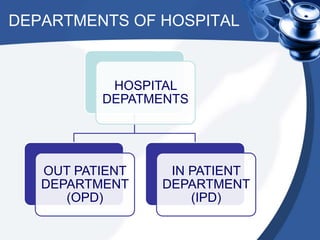
DEPARTMENTS OF HOSPITAL
HOSPITAL
DEPATMENTS
OUT PATIENT
DEPARTMENT
(OPD)
IN PATIENT
DEPARTMENT
(IPD)
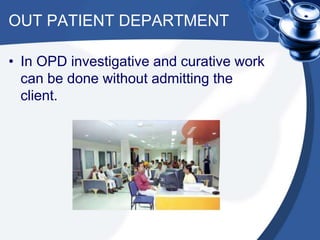
OUT PATIENT DEPARTMENT
• In OPD investigative and curative work
can be done without admitting the
client.
SCOPE
• Consultation, investigation, procedures,
speciality services
• Preventive and promotive health care
• Rehabilitation services
• Health education
• Counselling
INPATIENT DEPARTMENT
• “Inpatient" means that the procedure
requires the patient to be admitted to
the hospital, primarily so that he or she
can be closely monitored during the
procedure and afterwards, during
recovery.
OTHER DEPARTMENTS
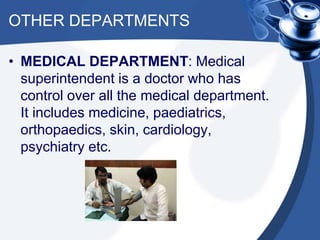
• MEDICAL DEPARTMENT: Medical
superintendent is a doctor who has
control over all the medical department.
It includes medicine, paediatrics,
orthopaedics, skin, cardiology,
psychiatry etc.
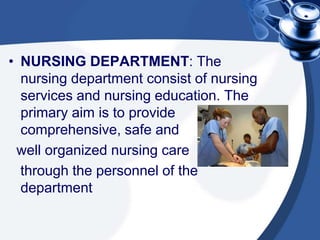
• NURSING DEPARTMENT: The
nursing department consist of nursing
services and nursing education. The
primary aim is to provide
comprehensive, safe and
well organized nursing care
through the personnel of the
department
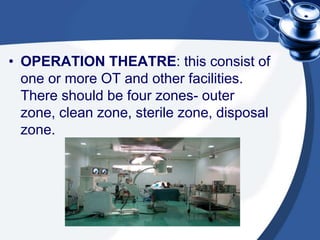
• OPERATION THEATRE: this consist of
one or more OT and other facilities.
There should be four zones- outer
zone, clean zone, sterile zone, disposal
zone.
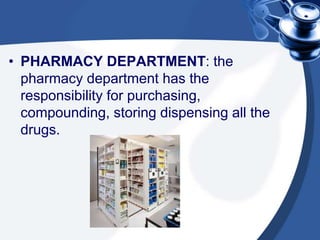
• PHARMACY DEPARTMENT: the
pharmacy department has the
responsibility for purchasing,
compounding, storing dispensing all the
drugs.
• REHABLIATION UNIT: This
department deals with clients who have
functional disabilities resulting from
disease condition/injuries.
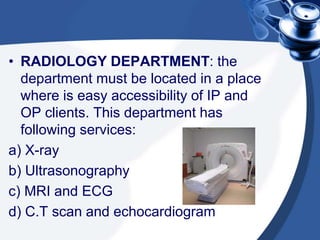
• RADIOLOGY DEPARTMENT: the
department must be located in a place
where is easy accessibility of IP and
OP clients. This department has
following services:
a) X-ray
b) Ultrasonography
c) MRI and ECG
d) C.T scan and echocardiogram
• PARAMEDICAL DEPARTMENT: it
include the laboratory services and
blood bank facilities.
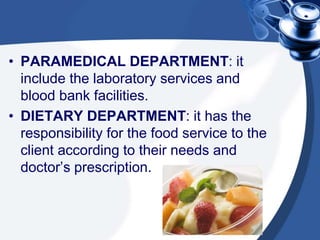
• DIETARY DEPARTMENT: it has the
responsibility for the food service to the
client according to their needs and
doctor’s prescription.
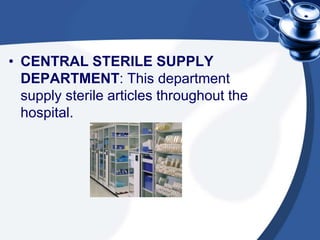
• CENTRAL STERILE SUPPLY
DEPARTMENT: This department
supply sterile articles throughout the
hospital.
Hospital
Hospital
Hospital

Hospital

  • 1.
    HOSPITAL- ITS FUNCTIONSAND DEPARTMENTS
  • 2.
    Hospital Definition: A hospital isa health care institution with an organized medical and professional staff, and with permanent facilities that include in- patient beds. Provide medical, nursing and other health related services to patients.
  • 3.
    Hospital Functions of thehospital: 1) Preventive function 2) Curative function 3) Training function 4) Research function
  • 4.
    Hospital 1) Preventive function: oit is an emerging secondary function for the hospital and concerned with health promotion o It is geared toward providing the preventive services through a community health center o It takes an active role to improve the health of the population
  • 5.
    Hospital 2) Curative function: oit is the primary function of the hospital and concerned with providing patient care o It refers to any type of care given to the patients by the health team members e.g. physicians, nurses, dietitians…… o Also includes health education to patients
  • 6.
    Hospital 3) Training function: oIt is a secondary function and concerned with providing training and educational courses for the professional and technical personnel who provides health services (e.g. physicians, nurses, dentists, therapist………
  • 7.
    Hospital 4) Research function: oIt is a secondary function and concerned with conducting the health related researches that focus on the improvement of the health and/or prevention of diseases.
  • 8.
    DEPARTMENTS OF HOSPITAL HOSPITAL DEPATMENTS OUTPATIENT DEPARTMENT (OPD) IN PATIENT DEPARTMENT (IPD)
  • 9.
    OUT PATIENT DEPARTMENT •In OPD investigative and curative work can be done without admitting the client.
  • 10.
    SCOPE • Consultation, investigation,procedures, speciality services • Preventive and promotive health care • Rehabilitation services • Health education • Counselling
  • 11.
    INPATIENT DEPARTMENT • “Inpatient"means that the procedure requires the patient to be admitted to the hospital, primarily so that he or she can be closely monitored during the procedure and afterwards, during recovery.
  • 12.
    OTHER DEPARTMENTS • MEDICALDEPARTMENT: Medical superintendent is a doctor who has control over all the medical department. It includes medicine, paediatrics, orthopaedics, skin, cardiology, psychiatry etc.
  • 13.
    • NURSING DEPARTMENT:The nursing department consist of nursing services and nursing education. The primary aim is to provide comprehensive, safe and well organized nursing care through the personnel of the department
  • 14.
    • OPERATION THEATRE:this consist of one or more OT and other facilities. There should be four zones- outer zone, clean zone, sterile zone, disposal zone.
  • 15.
    • PHARMACY DEPARTMENT:the pharmacy department has the responsibility for purchasing, compounding, storing dispensing all the drugs.
  • 16.
    • REHABLIATION UNIT:This department deals with clients who have functional disabilities resulting from disease condition/injuries.
  • 17.
    • RADIOLOGY DEPARTMENT:the department must be located in a place where is easy accessibility of IP and OP clients. This department has following services: a) X-ray b) Ultrasonography c) MRI and ECG d) C.T scan and echocardiogram
  • 18.
    • PARAMEDICAL DEPARTMENT:it include the laboratory services and blood bank facilities. • DIETARY DEPARTMENT: it has the responsibility for the food service to the client according to their needs and doctor’s prescription.
  • 19.
    • CENTRAL STERILESUPPLY DEPARTMENT: This department supply sterile articles throughout the hospital.