Class Presentation on Occupational
Health
Introduction
The health and efficiency of workers working in any
organization get influenced in large measures by
conditions prevailing work environment. The
prevailing conditions related to physical,
biological, chemical and social their agents . A
worker usually exposed to these agents for out 6-8
hours daily. It is, therefore, essential that this
environment should be wholesome and free from
any kind of harmful agents as far as possible. So
the occupational health is to provide a safe
occupational environment to promote and
preserve the health of workers and to step up their
efficiency and productivity.
Definition
Occupational health should aim at the promotion
and maintenance of the highest degree of
physical, mental and social well-being of workers
in all occupations; the prevention among workers
of departures from health caused by their working
conditions; the protection o workers in their
employment from risks resulting from actors
adverse to health; the placing and maintenance of
the worker in an occupational environment
adapted his physiological and psychological
equipment, an summarize, the adaptation of work
to man and of each man to his job'.
Occupational Health Nursing
The application of nursing principles in
conserving the health of worker in all
occupations. It involve preventions,
recognition and treatment of illness an injury,
and requires special skills and knowledge in
the field of health, education and counseling
environment health, rehabilitation and human
relations'. -(American Association of
Occupational Health Nurse )
Aims of Occupational Health
The joint ILO/WHO Committee on Occupational Health, in
1950, gave the following general aims:
• Promotion and maintenance of the highest degree of physical,
mental and social well-being of workers in all occupations.
• Prevention among workers, of departures from health, caused
by their working conditions.
• Protection of workers in their employment from risks
resulting from factors adverse to health.
• Placing and maintenance of the worker in an occupational
environment adapted to his physiological and psychological
equipment, and to summarize, the adaptation of work to man
and of each man to his job.
Objectives of Occupational Health
• Identify all the hazardous conditions which might be there in work place.
• Plan and implement protective and control measures to deal with identified
hazardous conditions in work place.
• Ensure that the physical and psychological demands imposed on workers
by their respective jobs are properly matched with their individual
anatomical, physical and psychological needs, capabilities and limitations.
• Provide effective services to protect those who are especially vulnerable to
adverse working conditions.
• Provide effective services to workers who are incapacitated for any reason
to rehabilitate them as soon as possible.
• Using resources effectively and efficiently and protecting the natural
environment and creating health supportive environment.
• Improving societal communication and literacy on health, environment and
social cohesion.
Basic Principles of Occupational Health
WHO has identified three basic principles for the development of
an occupational health service
1. It must be ensured that occupational health services are
provided through the existing national health services by a
process of integration.
2. The service must provide for the total health of the workers
and if necessary their families. The primary health care
approach must be the chosen system for the delivery of such
services.
3. The occupational health problems of working women,
especially those in the unorganized sector are a matter of
urgent concern .
Occupational environment
By Occupational environment is meant the sum
of external conditions and which prevail at the
place of work and which have a bearing on the
health of the working population. Basically,
there are three types of interaction in a
working environment.
• Man and physical, chemical and biological
agents
• Man and machine
• Man and man
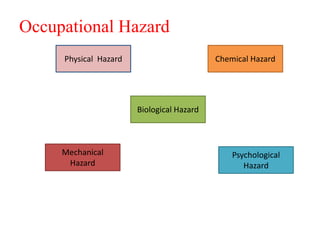
Occupational Hazard
Physical Hazard
Biological Hazard
Psychological
Hazard
Mechanical
Hazard
Chemical Hazard
Physical hazard
• Heat and cold
• Light
• Noise
• Vibration
• Ultraviolet radiation
• Ionizing radiation
Heat and Cold
Direct effect of heat
Burn, heat exhaustion, heat cramps.
Indirect effect of heat
Decreased efficiency, increased fatigue,
enhanced accident rates.
Cold effect
Chilblains, erythrocyanosis,frost bite
Light
• Poor illumination of eye
• Headache
• Eye pain
• Lachrymation
Noise
• Auditory effect
Temporary or permanent hearing loss.
• Non auditory effect
Nervousness, fatigue, interference with
communication by speech.
Vibration
• Spasm of blood vessels
• Injuries to joint elbow ,shoulder
and hand
Ultraviolet radiation
• Effects on eye
• Intense conjunctivitis
• Eye pain
• Redness
Ionizing radiation
• Genetic changes
• Leukemia
• Cancer
• Sterility
• Death
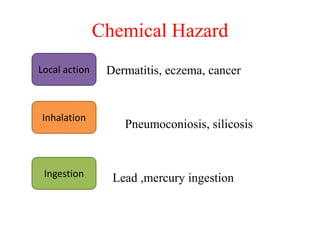
Chemical Hazard
Dermatitis, eczema, cancer
Pneumoconiosis, silicosis
Lead ,mercury ingestion
Local action
Inhalation
Ingestion
Biological hazards:
Brucellosis, leptospirosis, anthrax, hydatidosis,
psittacosis, tetanus, encephalitis, fungal infection,
Mechanical hazards:
The mechanical hazards industry center round
machinery, protruding moving parts and the like.
About 10 percent of accidents in industry are said to
be due to mechanical causes.
Psychosocial hazards
Frustration, lack of job satisfaction, insecurity, poor human
relationships, emotional tension
The health effects can be classified in two main categories:
1. Psychological and behavioral changes: Including hostility,
aggressiveness, anxiety, depression, tardiness, alcoholism,
drug abuse, sickness, absenteeism .
2. Psychosomatic ill health: Including fatigue, head- ache, pain
in the shoulders, neck and back; propensity to peptic ulcer,
hypertension, heart disease and rapid aging.
Occupational Diseases
Pneumoconiosis
Dust within the size range of 0.5 to 3 micron, is a
health hazard producing, after a variable period of
exposure, a lung disease known as pneumoconiosis,
which may gradually cripple a man by reducing his
working capacity due to lung fibrosis and other
complications. The important dust diseases are
silicosis, anthracosis, byssinosis, bagassosis,
asbestosis and farmer's lung.
Silicosis
Among the occupational diseases, silicosis is the major
cause of permanent disability and mortality. It is
caused by inhalation of dust containing free silica or
silicon dioxide 50). It was first reported in India from
the Kolar Gold Mines (Mysore) in 1947. Ever since,
its occurrence has been uncovered in various other
industries, e.g., mining industry al, mica, gold, silver,
lead, zinc, manganese and other metals), pottery and
ceramic industry, sand blasting, metal grinding,
building and construction work, rock mining, iron
and steel industry and several others.
Anthracosis
Previously it was thought that pulmonary "anthracosis"
was inert. Studies indicate that there are two general
phases in coal miners pneumoconiosis (1) the first
phase is 's labeled simple pneumoconiosis which is
associated with little ventilatory impairment. This
phase may require about 12 years of work exposure
for its development (2) the second phase is
characterized by progressive massive fibrosis (PMF):
this causes severe respiratory disability and
frequently results in premature death.
Byssinosis
Byssinosis is due to inhalation of cotton fiber dust over a long
periods of time. The symptoms are chronic cough and
progressive dyspnoea, ending in chronic bronchitis and
emphysema. India has a large textile industry employing
nearly 35 per cent of the factory workers.
Bagassosis
Bagassosis is the given to an occupational disease of the lung
caused by inhalation of bagasse or sugarcane dust. It was first
reported in India by Ganguli and Pal in 1955 in a cardboard
manufacturing firm near Kolkata India has a large cane sugar
industry.
Asbestosis
Asbestos enters the body by inhalation, and fine dust
may be deposited in the alveoli. The fibers are
insoluble The dust deposited in the lungs causes
pulmonary fibrosis leading to respiratory
insufficiency and death: carcinoma of the bronchus;
mesothelioma of the pleura or peritoneum; and cancer
of the gastro-intestinal tract.
Farmer's lung
Farmer's lung is due to the inhalation of mouldy hay or
grain dust .
Lead poisoning
More industrial workers are exposed to lead
than to any other toxic metal. Lead is used
widely in a variety of industries because of its
properties: (1) low boiling point (2) mixes with
other metals easily to form alloys (3) easily
oxidized and (4) anticorrosive. All lead
compounds are toxic-lead arsenate, lead oxide
and lead carbonate are the most dangerous;
lead sulphide is the least toxic.
Clinical feature
Loss of appetite
Abdominal colic
Obstinate constipation
Occupational cancer
• Skin cancer
• Lung cancer
• Bladder cancer
• Leukemia
Occupational Dermatitis
Occupational dermatitis is a big health problem
in many industries. The causes may be:
Physical heat, cold ,moisture, friction,
pressure, X-rays and other rays: Chemical
acids, alkalis, dyes, solvents, grease, tar, pitch,
chlorinated phenols etc. Biological living
agents such as viruses, bacteria, fungi and
other parasites. Plant products- leaves,
vegetables, fruits, flowers, vegetable dust.
Radiation hazards
A number of industries use radium and other
radioactive substances, e.g., painting of luminous
dials for watches and other instruments,
manufacture of radio-active paints. Exposure to
radium also occurs in mining of radio-active ores,
monazite sand workers and handling of their
products. X-rays are used both in medicine and
industry. Exposure to ultraviolet rays occurs in
electric welding processes, Infrared rays are
produced in welding blowing, foundry work and
other processes where metal and glass are heated
to the molten state, and in heating drying of
painted and lacquered objects.
Occupational hazard of agricultural worker
• Zoonotic disease
• Accidents
• Physical hazard
• Respiratory disease
Sickness absenteeism
Sickness absence is an important health problem
in industry. It may seriously impede
production with serious cost repercussions,
both direct as well as indirect. Absenteeism is
a useful index in industry to assess the state of
health of workers, and their physical, mental
and social well-being.
Health problem due to industrialization
• Environmental sanitation
• Communicable diseases
• Food sanitation
• Mental health
• Accidents
Measures for health protection of worker
• Nutrition
• Communicable disease control
• Environmental sanitation
• Mental health
• Measures for women and children
• Health education
• Family planning
Occupational health team
• Occupational health nurse
• Physiotherapist
• Specialist doctor
• Industrial manager
• Supervisor
• Shift in charge
• Rehabilitation specialist
• Labor welfare officer
• Labor union representative
• Representative of voluntary organization
• Other invited member as per the need
Prevention of occupational disease
Medical measures
• Pre Placement examination
• Periodical check up
• Medical and health care services
• Notification
• Supervision of working environment
• Maintenance and analysis of records
• Health education and counseling
Engineering measures
• Design and building
• Good house keeping
• General ventilation
• Mechanization
• Substitution
• Dusts
• Enclosure
• Isolation
Cont…
• Local exhaust ventilation
• Protective devices
• Environmental monitoring
• Statistical monitoring
• Research
Legislation
The society has an obligation to protect the health of the
worker engaged in diverse occupations. It has grown
out of the realization that the worker is more important
than the machine which he operates. The worker cannot
be permitted to endanger his life and limb in an
occupation, while the employer makes a fortune.
Factory laws, therefore, have been framed in every
country to govern the conditions in industry and to
safeguard the health and welfare of the worker. The
most important factory laws in India today are
• (1) The Factories Act, 1948
• (2) The Employees' State Insurance Act
Factories Act, 1948
The first Indian Factories Act dates as far back
as 1881. The Act was revised and amended
several times, the latest being the Factories
(Amendment) Act, 1987.
1948 Factory act
• Scope
• Health ,safety and welfare
• Employment of young persons
• Hours of work
• Leave with wages
• Occupational diseases
• Employment in hazardous processes.
The Employees State Insurance Act. 1948
The ESI Act passed in 1948 (amended in 1975, 1984, 2010 and
2019) is an important measure of social county and health
insurance in this country, It provides for certain cash and
medical benefits to industrial employees in case of sickness,
maternity and employment injury.
SCOPE The Act extends to the whole of India. The ESI Act of 95
covered all power-using factories other than seasonal cones
wherein 10 or more persons were employed including mines
railways and defense establishments) The provisions of ESI
(Amendment) Act of 1975 were extended to the following
new classes of establishments
Benefits to employees
The Act has made provision for the following benefits to
insured persons or, to other dependants as the case may
be
• Medical benefit
• Sickness benefit.
• Maternity benefit
• Disablement benefit
• Dependant's benefit
• Funeral expenses
• Rehabilitation allowance.
Benefits to employers
• Exemption from the applicability of Workmen's
Compensation Act 1923.
• Exemption from Maternity Benefit Act 1961.
• Exemption from payment of Medical allowance to
employees and their dependants or arranging for their
medical care.
• Rebate under the Income Tax Act on contribution
deposited in the ESI Account.
• Healthy work-force.
RAJIB GANDHI SHRAMIK KALYAN YOJNA
The ESI Corporation has launched a new Yojna for the
employees covered under the ESI scheme. This
scheme provides an unemployment allowance for the
employees covered under ESI scheme who are
rendered unemployed involuntarily due to
retrenchment closure of factory etc. her fulfilling
certain eligibility conditions. The scheme came into
effect from 1st April, 2005.
Occupational health in India
The trend in India is towards industrialization. As industries develop
both in size and complexity occupational health will pose new and
more difficult problems. The National Government have recognized
the need for protecting the health of the workers. The Directive
Principles of State Policy, in the Indian Constitution are important in
this context. The relevant portions are:
(a) The State shall, in particular, direct its policy towards securing that
the health and strength of the workers man, woman, and the sender
age of the children are not abused, and that citizens are not forced by
economic necessity to enter avocations unsuited to their strength
(b) The State shall make provisions for securing just and humane
conditions of work,
Role of occupational health nurse
• Work place surveillance
• Comprehensive intervention
• Health surveillance
• Reduction of work place injury
• Health promotion and protection
• Enhancement of employee wellbeing
• Primary care
• Appropriate treatment
• Counseling
• Rehabilitation
Thank You

Class Presentation on Occupational Health ppt.pptx

  • 1.
    Class Presentation onOccupational Health
  • 2.
    Introduction The health andefficiency of workers working in any organization get influenced in large measures by conditions prevailing work environment. The prevailing conditions related to physical, biological, chemical and social their agents . A worker usually exposed to these agents for out 6-8 hours daily. It is, therefore, essential that this environment should be wholesome and free from any kind of harmful agents as far as possible. So the occupational health is to provide a safe occupational environment to promote and preserve the health of workers and to step up their efficiency and productivity.
  • 3.
    Definition Occupational health shouldaim at the promotion and maintenance of the highest degree of physical, mental and social well-being of workers in all occupations; the prevention among workers of departures from health caused by their working conditions; the protection o workers in their employment from risks resulting from actors adverse to health; the placing and maintenance of the worker in an occupational environment adapted his physiological and psychological equipment, an summarize, the adaptation of work to man and of each man to his job'.
  • 4.
    Occupational Health Nursing Theapplication of nursing principles in conserving the health of worker in all occupations. It involve preventions, recognition and treatment of illness an injury, and requires special skills and knowledge in the field of health, education and counseling environment health, rehabilitation and human relations'. -(American Association of Occupational Health Nurse )
  • 5.
    Aims of OccupationalHealth The joint ILO/WHO Committee on Occupational Health, in 1950, gave the following general aims: • Promotion and maintenance of the highest degree of physical, mental and social well-being of workers in all occupations. • Prevention among workers, of departures from health, caused by their working conditions. • Protection of workers in their employment from risks resulting from factors adverse to health. • Placing and maintenance of the worker in an occupational environment adapted to his physiological and psychological equipment, and to summarize, the adaptation of work to man and of each man to his job.
  • 6.
    Objectives of OccupationalHealth • Identify all the hazardous conditions which might be there in work place. • Plan and implement protective and control measures to deal with identified hazardous conditions in work place. • Ensure that the physical and psychological demands imposed on workers by their respective jobs are properly matched with their individual anatomical, physical and psychological needs, capabilities and limitations. • Provide effective services to protect those who are especially vulnerable to adverse working conditions. • Provide effective services to workers who are incapacitated for any reason to rehabilitate them as soon as possible. • Using resources effectively and efficiently and protecting the natural environment and creating health supportive environment. • Improving societal communication and literacy on health, environment and social cohesion.
  • 7.
    Basic Principles ofOccupational Health WHO has identified three basic principles for the development of an occupational health service 1. It must be ensured that occupational health services are provided through the existing national health services by a process of integration. 2. The service must provide for the total health of the workers and if necessary their families. The primary health care approach must be the chosen system for the delivery of such services. 3. The occupational health problems of working women, especially those in the unorganized sector are a matter of urgent concern .
  • 8.
    Occupational environment By Occupationalenvironment is meant the sum of external conditions and which prevail at the place of work and which have a bearing on the health of the working population. Basically, there are three types of interaction in a working environment. • Man and physical, chemical and biological agents • Man and machine • Man and man
  • 9.
    Occupational Hazard Physical Hazard BiologicalHazard Psychological Hazard Mechanical Hazard Chemical Hazard
  • 10.
    Physical hazard • Heatand cold • Light • Noise • Vibration • Ultraviolet radiation • Ionizing radiation
  • 11.
    Heat and Cold Directeffect of heat Burn, heat exhaustion, heat cramps. Indirect effect of heat Decreased efficiency, increased fatigue, enhanced accident rates. Cold effect Chilblains, erythrocyanosis,frost bite
  • 12.
    Light • Poor illuminationof eye • Headache • Eye pain • Lachrymation
  • 13.
    Noise • Auditory effect Temporaryor permanent hearing loss. • Non auditory effect Nervousness, fatigue, interference with communication by speech.
  • 14.
    Vibration • Spasm ofblood vessels • Injuries to joint elbow ,shoulder and hand
  • 15.
    Ultraviolet radiation • Effectson eye • Intense conjunctivitis • Eye pain • Redness
  • 16.
    Ionizing radiation • Geneticchanges • Leukemia • Cancer • Sterility • Death
  • 17.
    Chemical Hazard Dermatitis, eczema,cancer Pneumoconiosis, silicosis Lead ,mercury ingestion Local action Inhalation Ingestion
  • 18.
    Biological hazards: Brucellosis, leptospirosis,anthrax, hydatidosis, psittacosis, tetanus, encephalitis, fungal infection, Mechanical hazards: The mechanical hazards industry center round machinery, protruding moving parts and the like. About 10 percent of accidents in industry are said to be due to mechanical causes.
  • 19.
    Psychosocial hazards Frustration, lackof job satisfaction, insecurity, poor human relationships, emotional tension The health effects can be classified in two main categories: 1. Psychological and behavioral changes: Including hostility, aggressiveness, anxiety, depression, tardiness, alcoholism, drug abuse, sickness, absenteeism . 2. Psychosomatic ill health: Including fatigue, head- ache, pain in the shoulders, neck and back; propensity to peptic ulcer, hypertension, heart disease and rapid aging.
  • 20.
    Occupational Diseases Pneumoconiosis Dust withinthe size range of 0.5 to 3 micron, is a health hazard producing, after a variable period of exposure, a lung disease known as pneumoconiosis, which may gradually cripple a man by reducing his working capacity due to lung fibrosis and other complications. The important dust diseases are silicosis, anthracosis, byssinosis, bagassosis, asbestosis and farmer's lung.
  • 21.
    Silicosis Among the occupationaldiseases, silicosis is the major cause of permanent disability and mortality. It is caused by inhalation of dust containing free silica or silicon dioxide 50). It was first reported in India from the Kolar Gold Mines (Mysore) in 1947. Ever since, its occurrence has been uncovered in various other industries, e.g., mining industry al, mica, gold, silver, lead, zinc, manganese and other metals), pottery and ceramic industry, sand blasting, metal grinding, building and construction work, rock mining, iron and steel industry and several others.
  • 22.
    Anthracosis Previously it wasthought that pulmonary "anthracosis" was inert. Studies indicate that there are two general phases in coal miners pneumoconiosis (1) the first phase is 's labeled simple pneumoconiosis which is associated with little ventilatory impairment. This phase may require about 12 years of work exposure for its development (2) the second phase is characterized by progressive massive fibrosis (PMF): this causes severe respiratory disability and frequently results in premature death.
  • 23.
    Byssinosis Byssinosis is dueto inhalation of cotton fiber dust over a long periods of time. The symptoms are chronic cough and progressive dyspnoea, ending in chronic bronchitis and emphysema. India has a large textile industry employing nearly 35 per cent of the factory workers. Bagassosis Bagassosis is the given to an occupational disease of the lung caused by inhalation of bagasse or sugarcane dust. It was first reported in India by Ganguli and Pal in 1955 in a cardboard manufacturing firm near Kolkata India has a large cane sugar industry.
  • 24.
    Asbestosis Asbestos enters thebody by inhalation, and fine dust may be deposited in the alveoli. The fibers are insoluble The dust deposited in the lungs causes pulmonary fibrosis leading to respiratory insufficiency and death: carcinoma of the bronchus; mesothelioma of the pleura or peritoneum; and cancer of the gastro-intestinal tract. Farmer's lung Farmer's lung is due to the inhalation of mouldy hay or grain dust .
  • 25.
    Lead poisoning More industrialworkers are exposed to lead than to any other toxic metal. Lead is used widely in a variety of industries because of its properties: (1) low boiling point (2) mixes with other metals easily to form alloys (3) easily oxidized and (4) anticorrosive. All lead compounds are toxic-lead arsenate, lead oxide and lead carbonate are the most dangerous; lead sulphide is the least toxic.
  • 26.
    Clinical feature Loss ofappetite Abdominal colic Obstinate constipation
  • 27.
    Occupational cancer • Skincancer • Lung cancer • Bladder cancer • Leukemia
  • 28.
    Occupational Dermatitis Occupational dermatitisis a big health problem in many industries. The causes may be: Physical heat, cold ,moisture, friction, pressure, X-rays and other rays: Chemical acids, alkalis, dyes, solvents, grease, tar, pitch, chlorinated phenols etc. Biological living agents such as viruses, bacteria, fungi and other parasites. Plant products- leaves, vegetables, fruits, flowers, vegetable dust.
  • 29.
    Radiation hazards A numberof industries use radium and other radioactive substances, e.g., painting of luminous dials for watches and other instruments, manufacture of radio-active paints. Exposure to radium also occurs in mining of radio-active ores, monazite sand workers and handling of their products. X-rays are used both in medicine and industry. Exposure to ultraviolet rays occurs in electric welding processes, Infrared rays are produced in welding blowing, foundry work and other processes where metal and glass are heated to the molten state, and in heating drying of painted and lacquered objects.
  • 30.
    Occupational hazard ofagricultural worker • Zoonotic disease • Accidents • Physical hazard • Respiratory disease
  • 31.
    Sickness absenteeism Sickness absenceis an important health problem in industry. It may seriously impede production with serious cost repercussions, both direct as well as indirect. Absenteeism is a useful index in industry to assess the state of health of workers, and their physical, mental and social well-being.
  • 32.
    Health problem dueto industrialization • Environmental sanitation • Communicable diseases • Food sanitation • Mental health • Accidents
  • 33.
    Measures for healthprotection of worker • Nutrition • Communicable disease control • Environmental sanitation • Mental health • Measures for women and children • Health education • Family planning
  • 34.
    Occupational health team •Occupational health nurse • Physiotherapist • Specialist doctor • Industrial manager • Supervisor • Shift in charge • Rehabilitation specialist • Labor welfare officer • Labor union representative • Representative of voluntary organization • Other invited member as per the need
  • 35.
    Prevention of occupationaldisease Medical measures • Pre Placement examination • Periodical check up • Medical and health care services • Notification • Supervision of working environment • Maintenance and analysis of records • Health education and counseling
  • 36.
    Engineering measures • Designand building • Good house keeping • General ventilation • Mechanization • Substitution • Dusts • Enclosure • Isolation
  • 37.
    Cont… • Local exhaustventilation • Protective devices • Environmental monitoring • Statistical monitoring • Research
  • 38.
    Legislation The society hasan obligation to protect the health of the worker engaged in diverse occupations. It has grown out of the realization that the worker is more important than the machine which he operates. The worker cannot be permitted to endanger his life and limb in an occupation, while the employer makes a fortune. Factory laws, therefore, have been framed in every country to govern the conditions in industry and to safeguard the health and welfare of the worker. The most important factory laws in India today are • (1) The Factories Act, 1948 • (2) The Employees' State Insurance Act
  • 39.
    Factories Act, 1948 Thefirst Indian Factories Act dates as far back as 1881. The Act was revised and amended several times, the latest being the Factories (Amendment) Act, 1987.
  • 40.
    1948 Factory act •Scope • Health ,safety and welfare • Employment of young persons • Hours of work • Leave with wages • Occupational diseases • Employment in hazardous processes.
  • 41.
    The Employees StateInsurance Act. 1948 The ESI Act passed in 1948 (amended in 1975, 1984, 2010 and 2019) is an important measure of social county and health insurance in this country, It provides for certain cash and medical benefits to industrial employees in case of sickness, maternity and employment injury. SCOPE The Act extends to the whole of India. The ESI Act of 95 covered all power-using factories other than seasonal cones wherein 10 or more persons were employed including mines railways and defense establishments) The provisions of ESI (Amendment) Act of 1975 were extended to the following new classes of establishments
  • 42.
    Benefits to employees TheAct has made provision for the following benefits to insured persons or, to other dependants as the case may be • Medical benefit • Sickness benefit. • Maternity benefit • Disablement benefit • Dependant's benefit • Funeral expenses • Rehabilitation allowance.
  • 43.
    Benefits to employers •Exemption from the applicability of Workmen's Compensation Act 1923. • Exemption from Maternity Benefit Act 1961. • Exemption from payment of Medical allowance to employees and their dependants or arranging for their medical care. • Rebate under the Income Tax Act on contribution deposited in the ESI Account. • Healthy work-force.
  • 44.
    RAJIB GANDHI SHRAMIKKALYAN YOJNA The ESI Corporation has launched a new Yojna for the employees covered under the ESI scheme. This scheme provides an unemployment allowance for the employees covered under ESI scheme who are rendered unemployed involuntarily due to retrenchment closure of factory etc. her fulfilling certain eligibility conditions. The scheme came into effect from 1st April, 2005.
  • 45.
    Occupational health inIndia The trend in India is towards industrialization. As industries develop both in size and complexity occupational health will pose new and more difficult problems. The National Government have recognized the need for protecting the health of the workers. The Directive Principles of State Policy, in the Indian Constitution are important in this context. The relevant portions are: (a) The State shall, in particular, direct its policy towards securing that the health and strength of the workers man, woman, and the sender age of the children are not abused, and that citizens are not forced by economic necessity to enter avocations unsuited to their strength (b) The State shall make provisions for securing just and humane conditions of work,
  • 46.
    Role of occupationalhealth nurse • Work place surveillance • Comprehensive intervention • Health surveillance • Reduction of work place injury • Health promotion and protection • Enhancement of employee wellbeing • Primary care • Appropriate treatment • Counseling • Rehabilitation
  • 47.