Presented By:-
Girdhar Ratne
B.Sc.(I.T.) IIIrd sem.
Outlines
 Accounting
Classification of Accounting
 Double Entry Rule
 Journal
 Journal Entry
 Journalizing
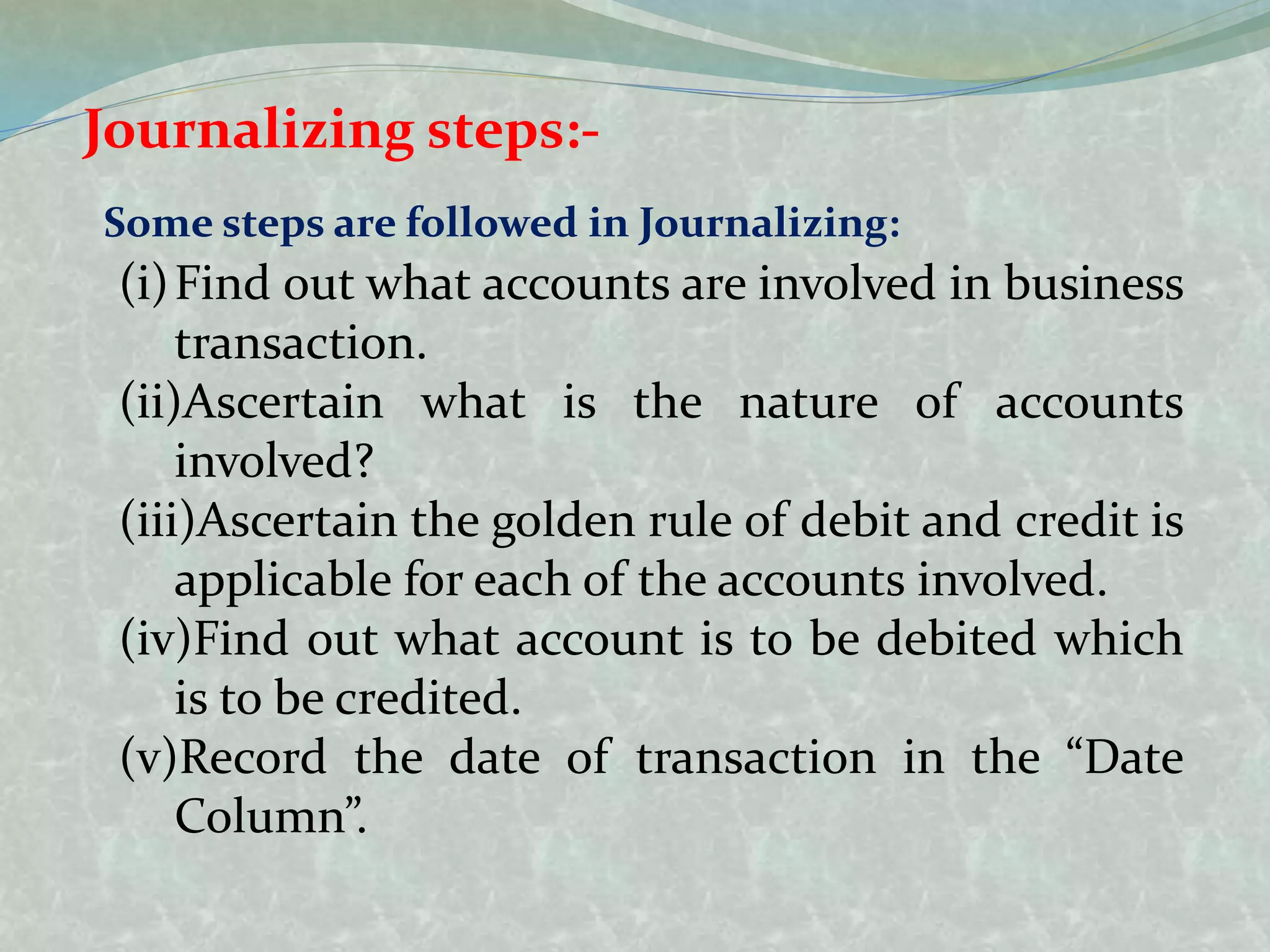
 Journalizing steps
 Illustration
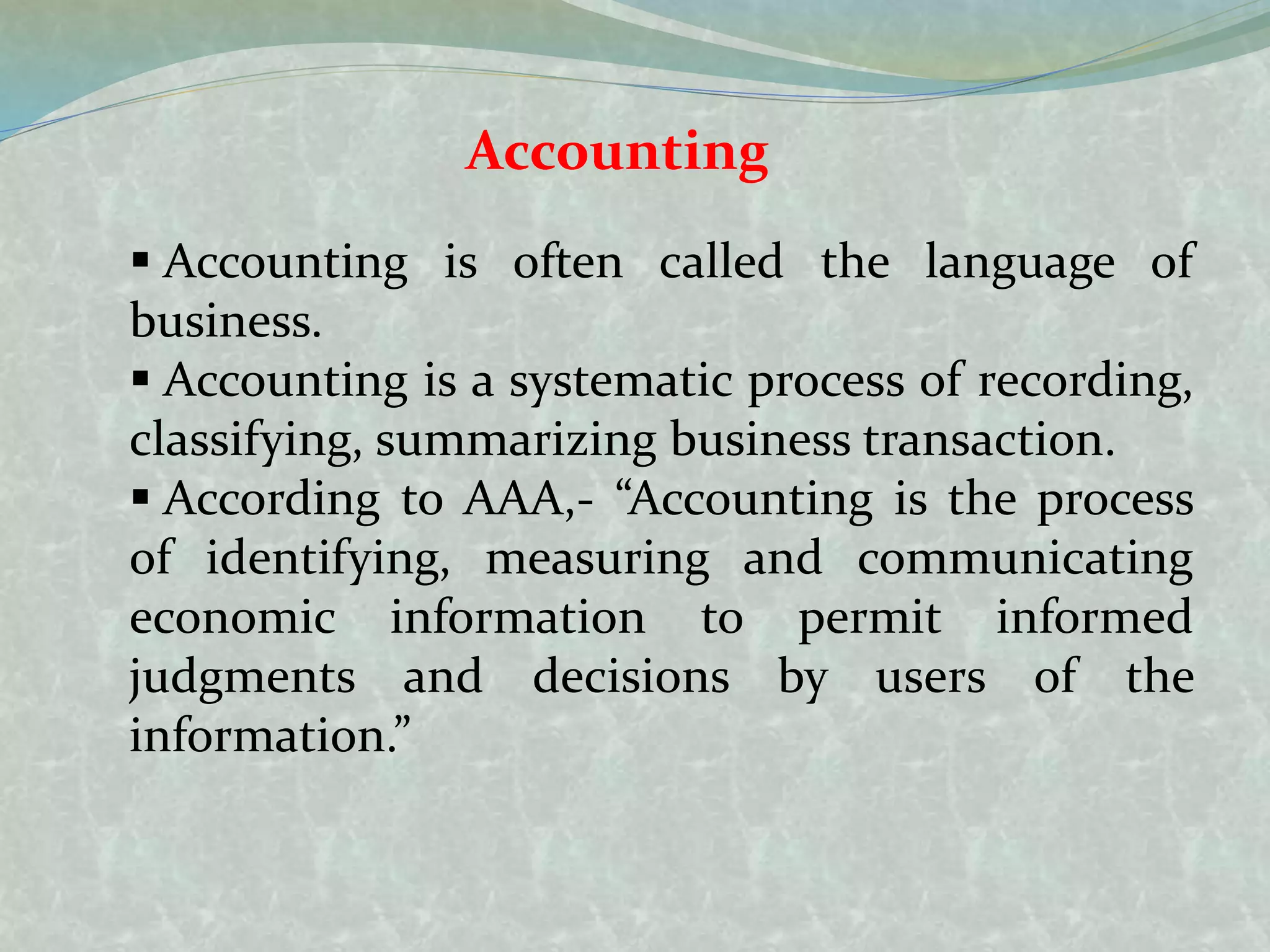
Accounting
 Accounting is often called the language of
business.
 Accounting is a systematic process of recording,
classifying, summarizing business transaction.
 According to AAA,- “Accounting is the process
of identifying, measuring and communicating
economic information to permit informed
judgments and decisions by users of the
information.”
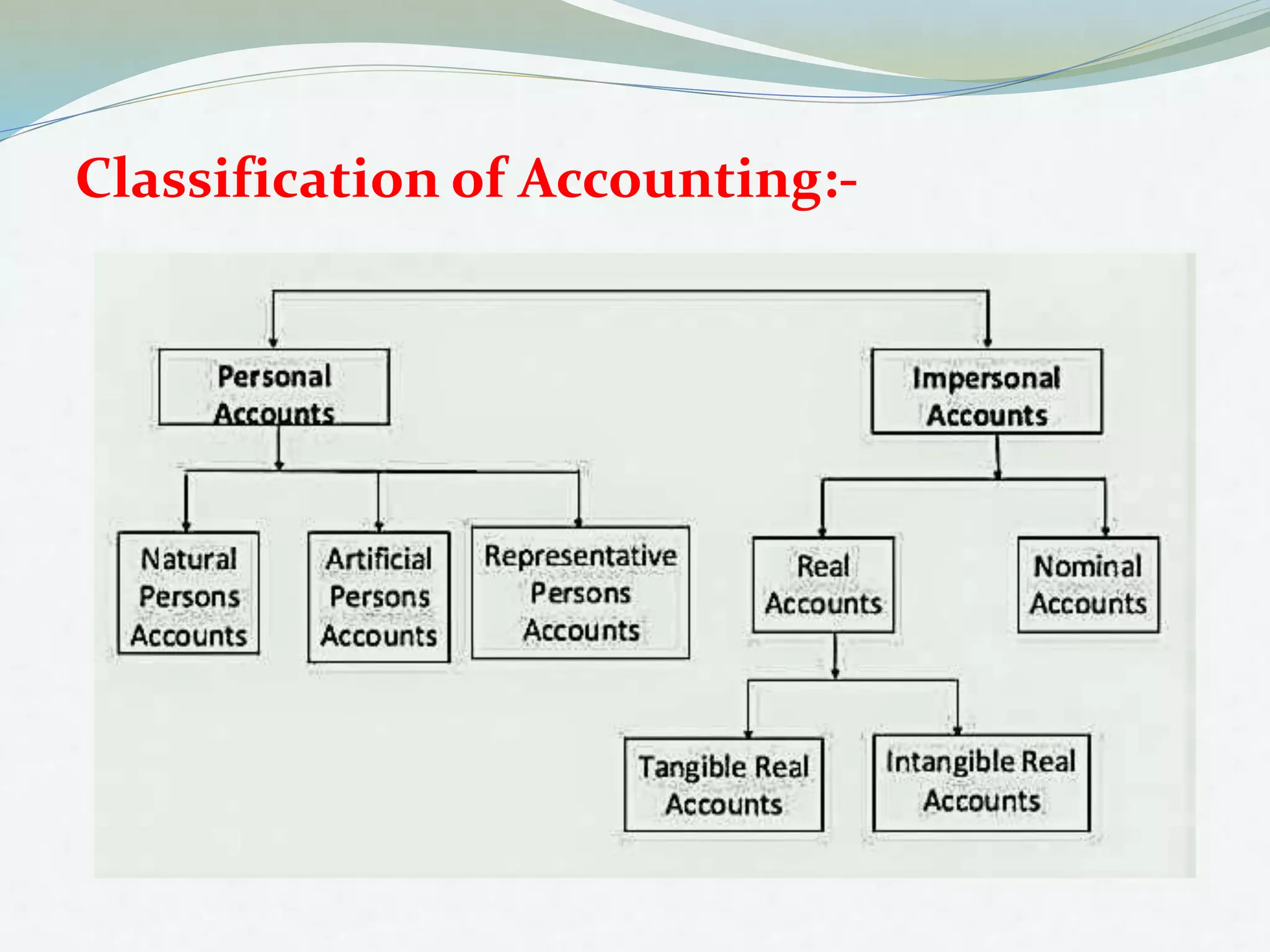
Classification of Accounting:-
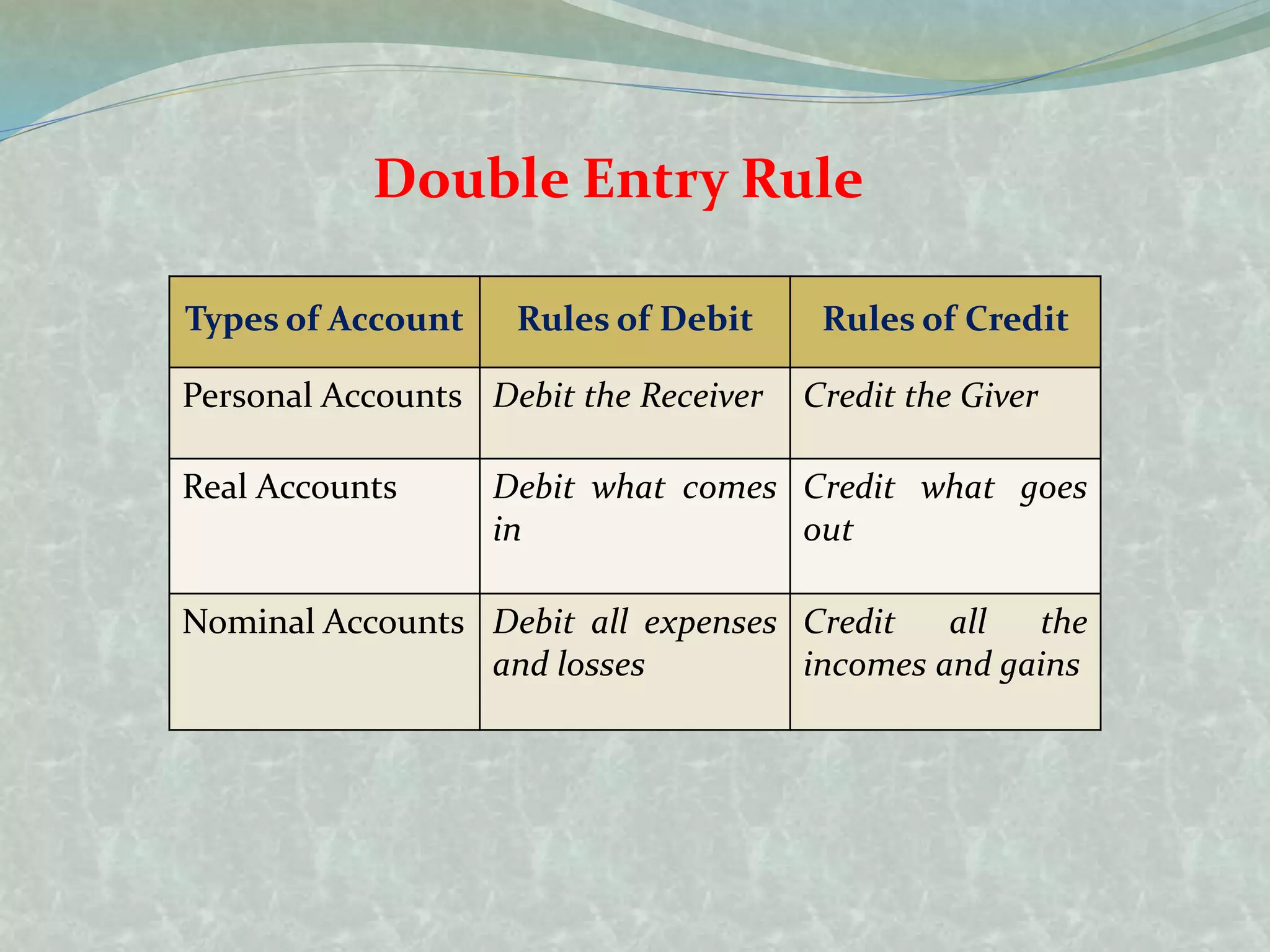
Double Entry Rule
Types of Account Rules of Debit Rules of Credit
Personal Accounts Debit the Receiver Credit the Giver
Real Accounts Debit what comes
in
Credit what goes
out
Nominal Accounts Debit all expenses
and losses
Credit all the
incomes and gains
Journal:-
o Journal is a historical record of business
transaction or events.
o Journal is a primary book for recording the
day to day transactions in a chronological order
i.e. the order in which they occur.
o This is called the book of first entry.
Journal Entry
• Journal entry means recording the business
transactions in the journal.
• The transaction is analyzed to determine which
account is to be debited and which account is to
be credited.
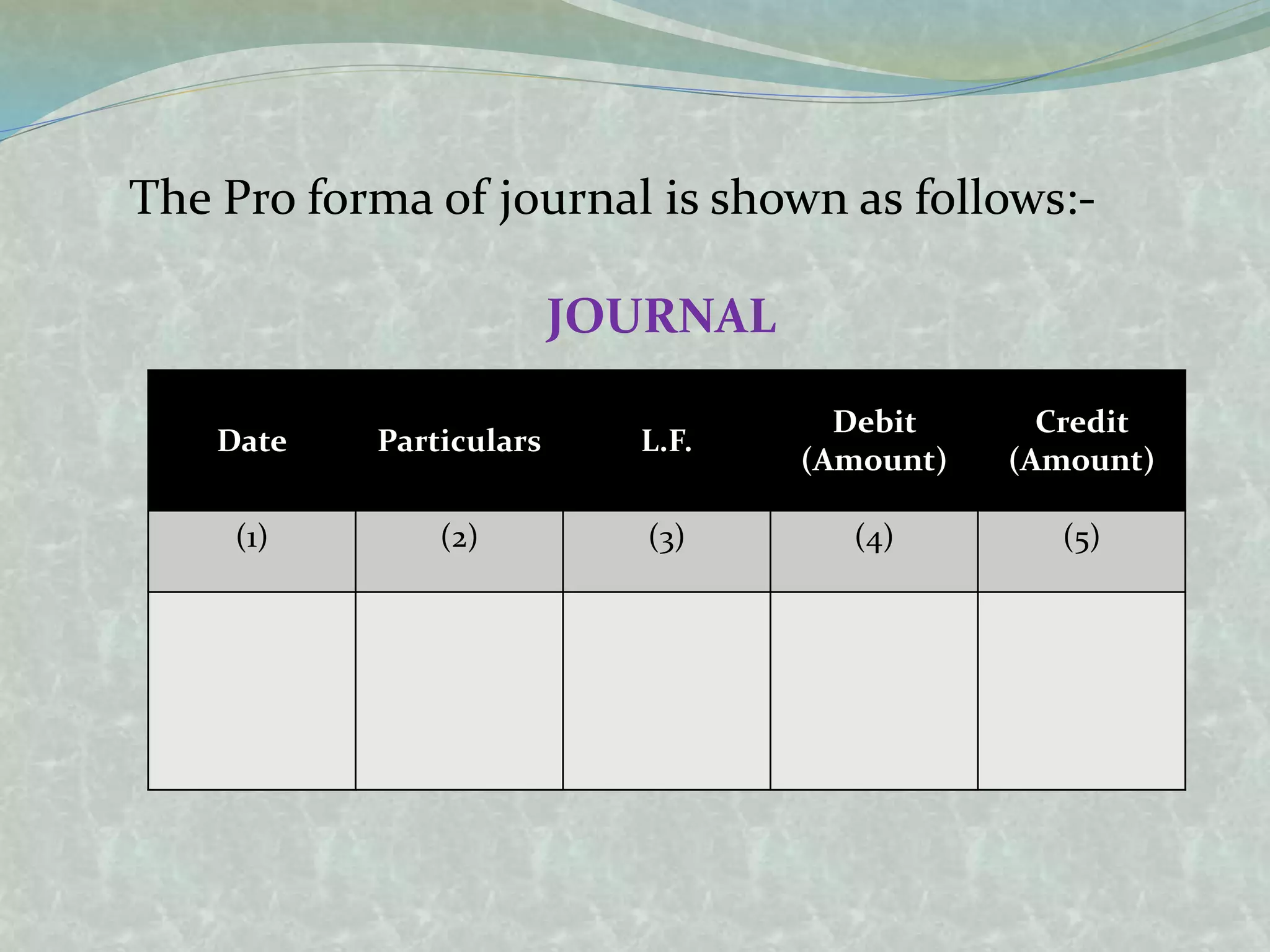
The Pro forma of journal is shown as follows:-
JOURNAL
Date Particulars L.F.
Debit
(Amount)
Credit
(Amount)
(1) (2) (3) (4) (5)
Date:- The date of the transaction on which it takes place.
Particulars:- The name of the accounts to the debited is
written first, then the names of the accounts to be credited,
and lastly the narration are entered.
L.F.(Ledger Folio):- In it entered the page numbers on
which the various accounts appear in the ledger.
Debit (Amount):- The amount to be debited against the
‘Dr.’ Account is written along with the nature of currency.
Credit (Amount):- The amount to be credited against the
‘Cr.’ Account is written along with the nature of currency.
Journalizing
Journalism is the process of recording journal
entries in the Journal.
It is a systematic act of entering the transaction
in a day book in order of their occurrence i.e.,
date-wise or event-wise.
At the time of Journalizing of the transactions,
when an account is debited it is denoted by ‘Dr.’
and crediting of an account by ‘To’.
(i)Find out what accounts are involved in business
transaction.
(ii)Ascertain what is the nature of accounts
involved?
(iii)Ascertain the golden rule of debit and credit is
applicable for each of the accounts involved.
(iv)Find out what account is to be debited which
is to be credited.
(v)Record the date of transaction in the “Date
Column”.
Some steps are followed in Journalizing:
Journalizing steps:-
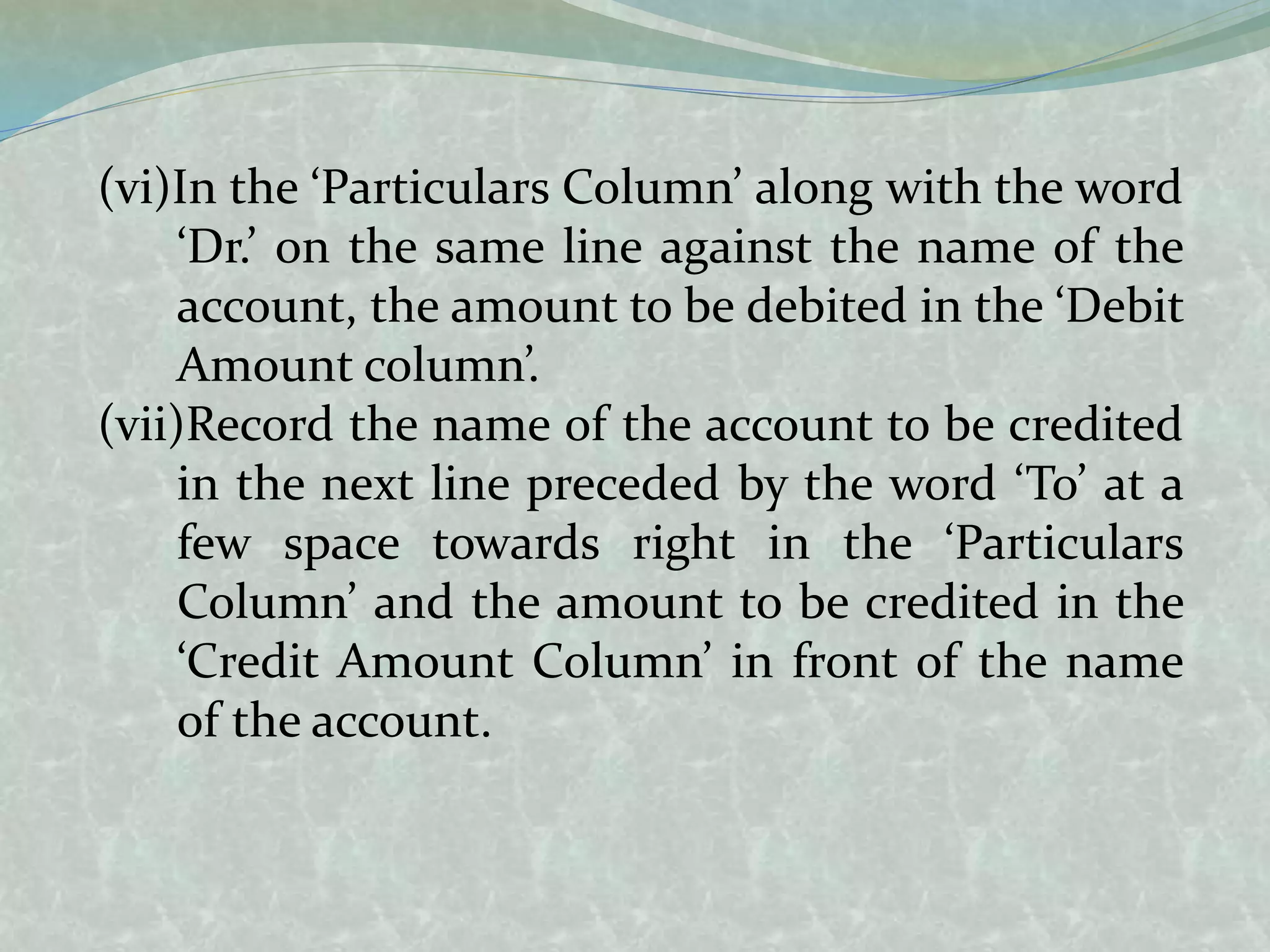
(vi)In the ‘Particulars Column’ along with the word
‘Dr.’ on the same line against the name of the
account, the amount to be debited in the ‘Debit
Amount column’.
(vii)Record the name of the account to be credited
in the next line preceded by the word ‘To’ at a
few space towards right in the ‘Particulars
Column’ and the amount to be credited in the
‘Credit Amount Column’ in front of the name
of the account.
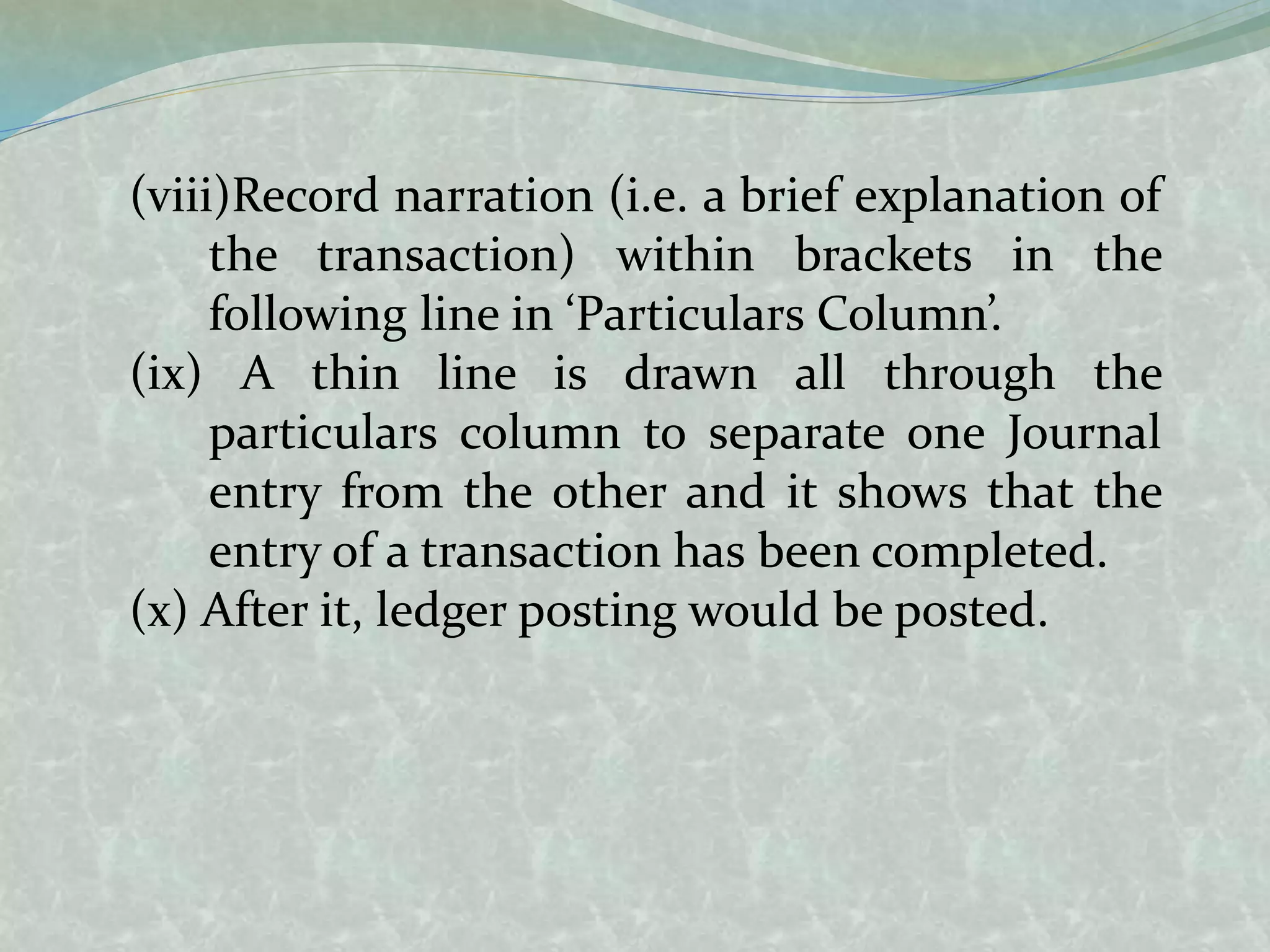
(viii)Record narration (i.e. a brief explanation of
the transaction) within brackets in the
following line in ‘Particulars Column’.
(ix) A thin line is drawn all through the
particulars column to separate one Journal
entry from the other and it shows that the
entry of a transaction has been completed.
(x) After it, ledger posting would be posted.
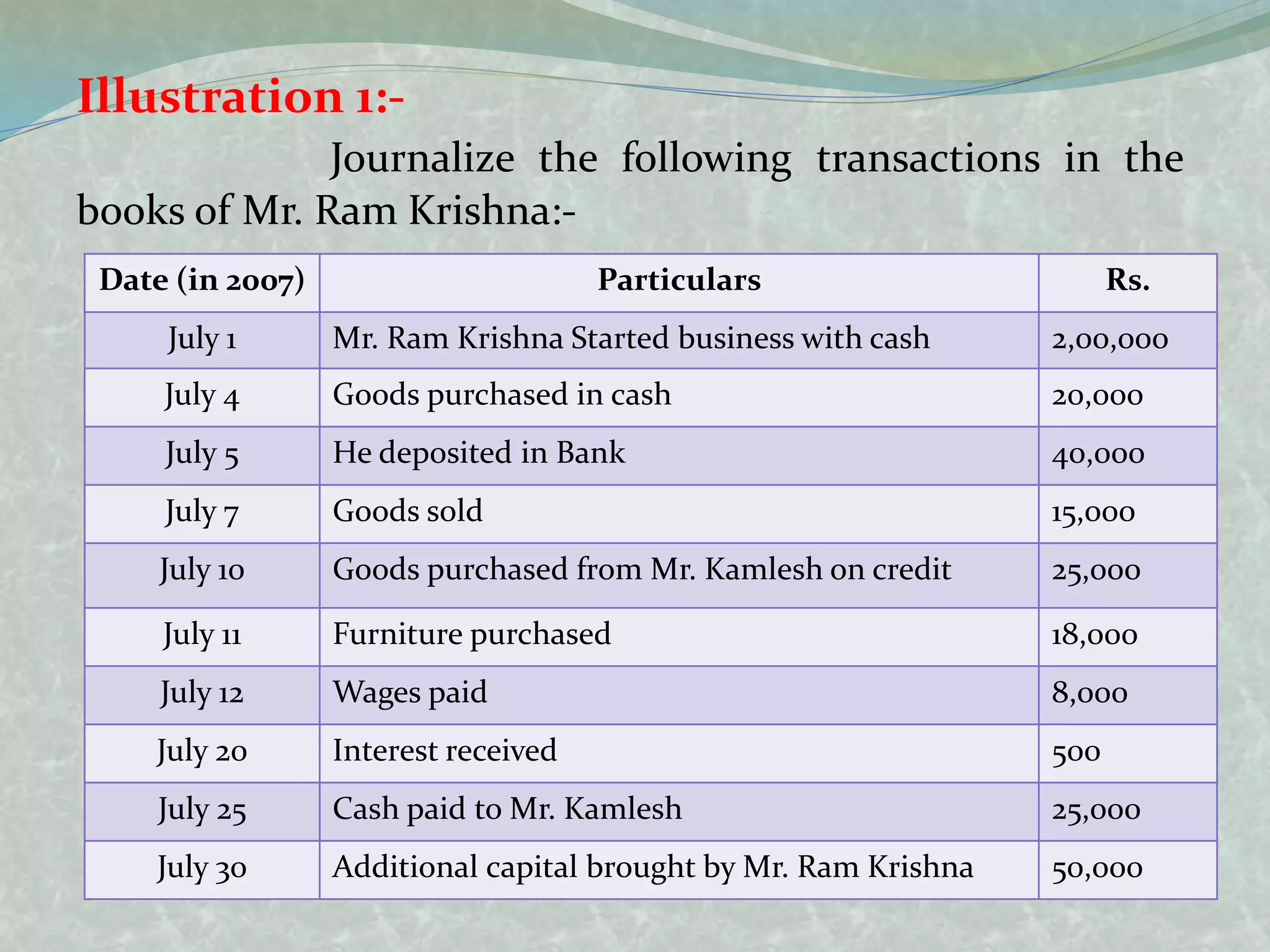
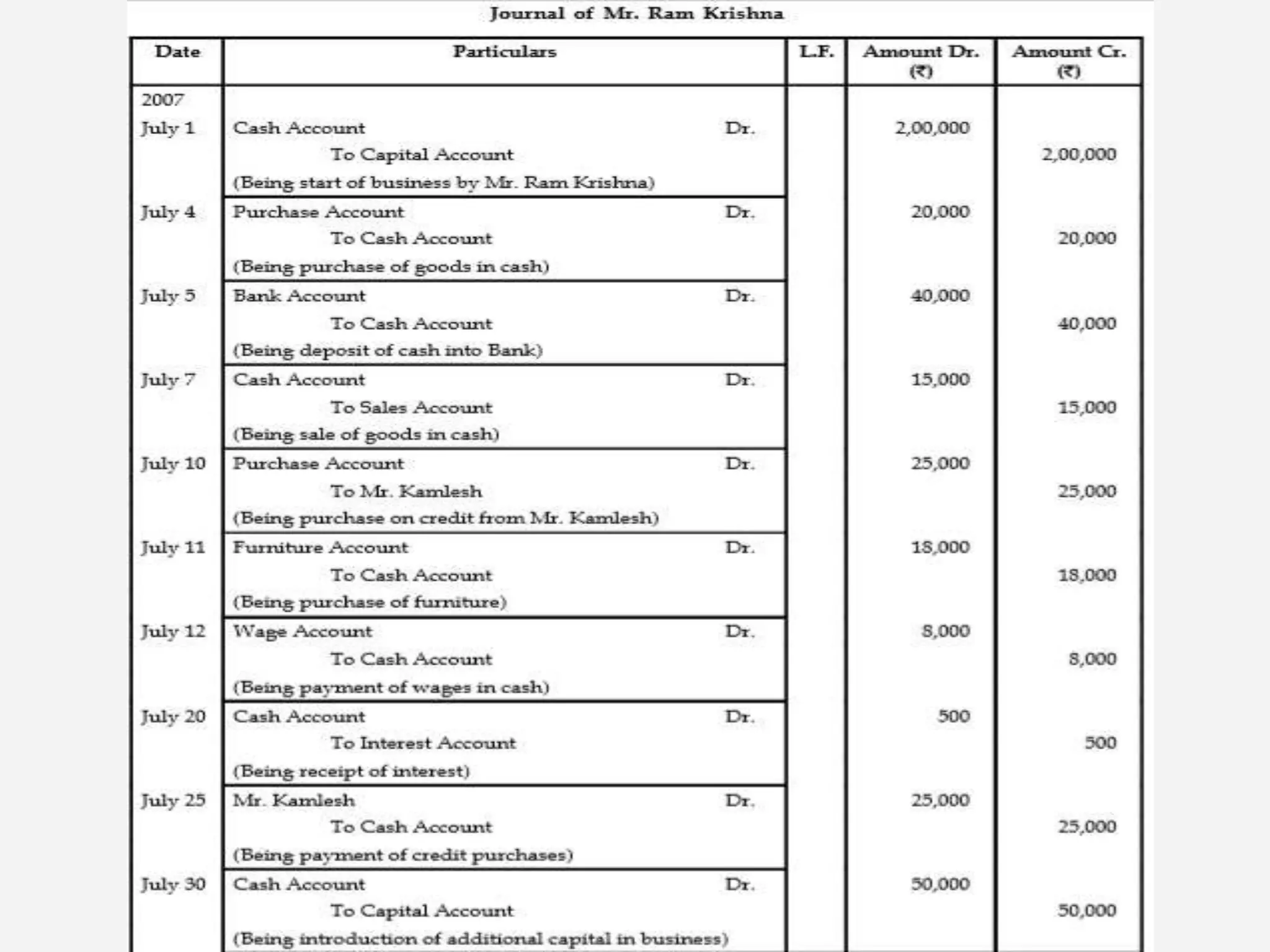
Date (in 2007) Particulars Rs.
July 1 Mr. Ram Krishna Started business with cash 2,00,000
July 4 Goods purchased in cash 20,000
July 5 He deposited in Bank 40,000
July 7 Goods sold 15,000
July 10 Goods purchased from Mr. Kamlesh on credit 25,000
July 11 Furniture purchased 18,000
July 12 Wages paid 8,000
July 20 Interest received 500
July 25 Cash paid to Mr. Kamlesh 25,000
July 30 Additional capital brought by Mr. Ram Krishna 50,000
Illustration 1:-
Journalize the following transactions in the
books of Mr. Ram Krishna:-
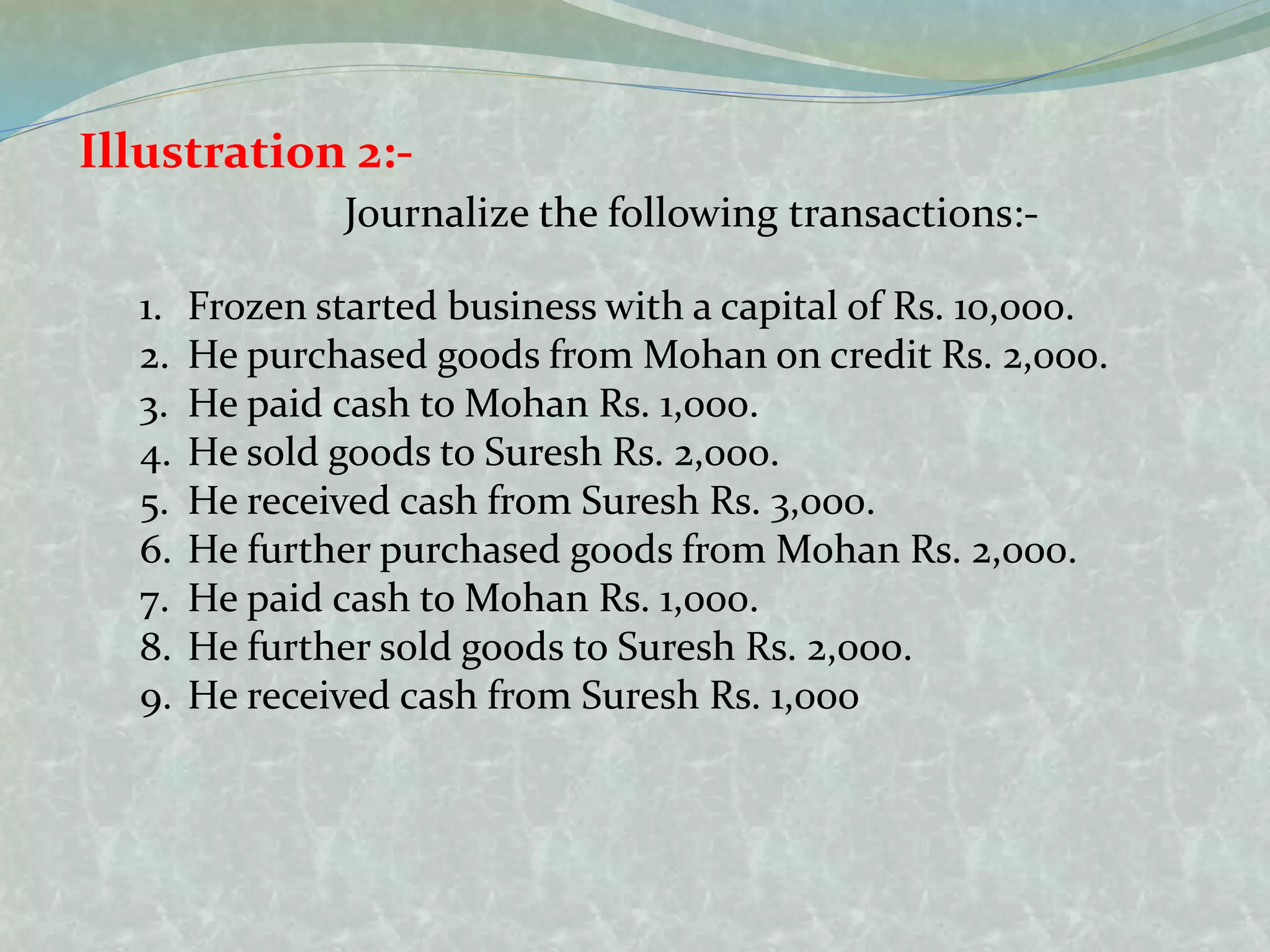
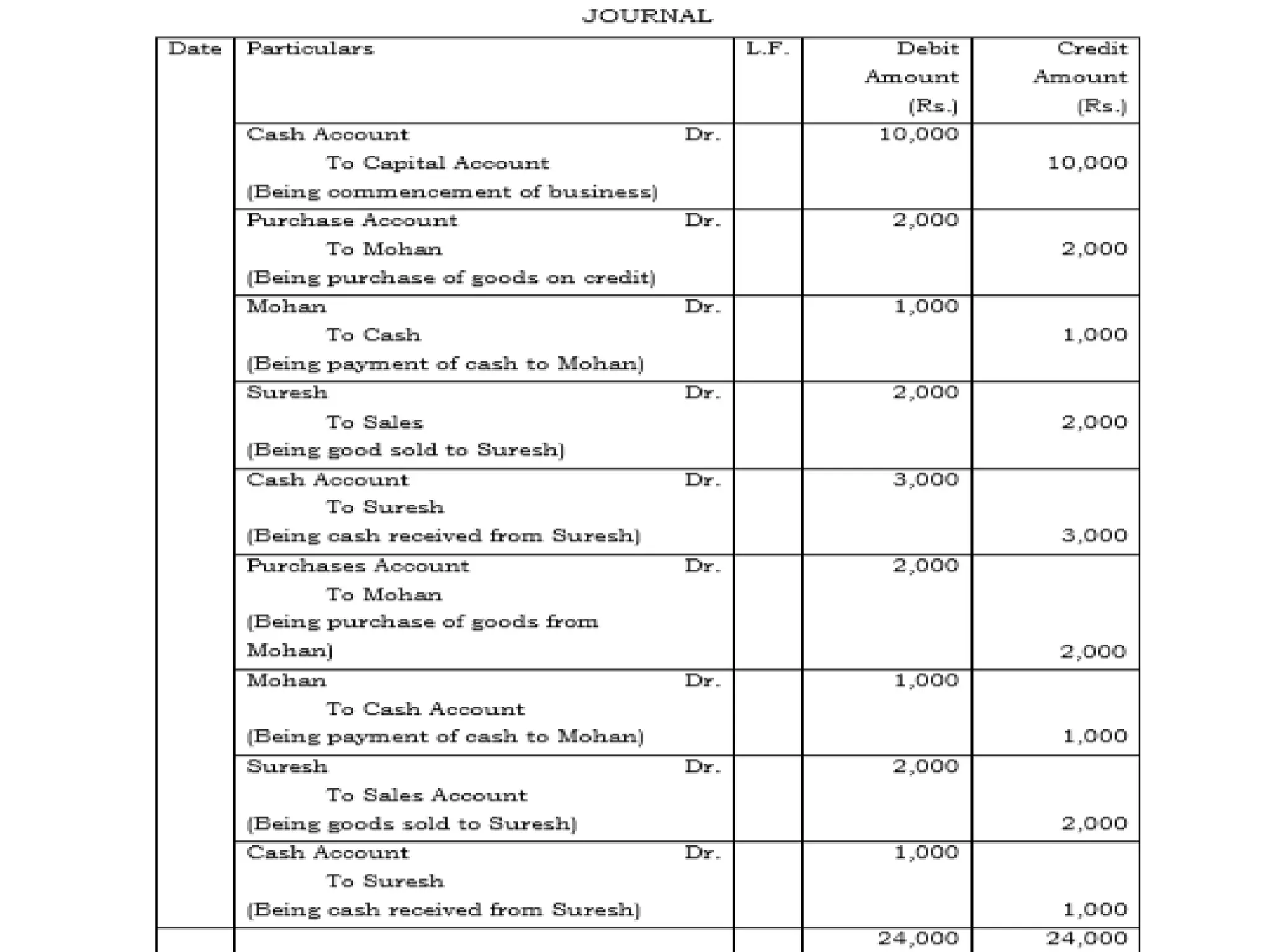
Illustration 2:-
Journalize the following transactions:-
1. Frozen started business with a capital of Rs. 10,000.
2. He purchased goods from Mohan on credit Rs. 2,000.
3. He paid cash to Mohan Rs. 1,000.
4. He sold goods to Suresh Rs. 2,000.
5. He received cash from Suresh Rs. 3,000.
6. He further purchased goods from Mohan Rs. 2,000.
7. He paid cash to Mohan Rs. 1,000.
8. He further sold goods to Suresh Rs. 2,000.
9. He received cash from Suresh Rs. 1,000
Reference:-
 Accounting for Management
-S N & S K Maheshwari
 Management Accounting
-Khan & Jain
 Financial Accounting
- By Dr. M.C. Garg
 Internet
owww.slideplayer.com
owww.shobhituniversity.ac.in
Thank you

Introduction to journal entry

  • 1.
  • 2.
    Outlines  Accounting Classification ofAccounting  Double Entry Rule  Journal  Journal Entry  Journalizing  Journalizing steps  Illustration
  • 3.
    Accounting  Accounting isoften called the language of business.  Accounting is a systematic process of recording, classifying, summarizing business transaction.  According to AAA,- “Accounting is the process of identifying, measuring and communicating economic information to permit informed judgments and decisions by users of the information.”
  • 4.
  • 5.
    Double Entry Rule Typesof Account Rules of Debit Rules of Credit Personal Accounts Debit the Receiver Credit the Giver Real Accounts Debit what comes in Credit what goes out Nominal Accounts Debit all expenses and losses Credit all the incomes and gains
  • 6.
    Journal:- o Journal isa historical record of business transaction or events. o Journal is a primary book for recording the day to day transactions in a chronological order i.e. the order in which they occur. o This is called the book of first entry.
  • 7.
    Journal Entry • Journalentry means recording the business transactions in the journal. • The transaction is analyzed to determine which account is to be debited and which account is to be credited.
  • 8.
    The Pro formaof journal is shown as follows:- JOURNAL Date Particulars L.F. Debit (Amount) Credit (Amount) (1) (2) (3) (4) (5)
  • 9.
    Date:- The dateof the transaction on which it takes place. Particulars:- The name of the accounts to the debited is written first, then the names of the accounts to be credited, and lastly the narration are entered. L.F.(Ledger Folio):- In it entered the page numbers on which the various accounts appear in the ledger. Debit (Amount):- The amount to be debited against the ‘Dr.’ Account is written along with the nature of currency. Credit (Amount):- The amount to be credited against the ‘Cr.’ Account is written along with the nature of currency.
  • 10.
    Journalizing Journalism is theprocess of recording journal entries in the Journal. It is a systematic act of entering the transaction in a day book in order of their occurrence i.e., date-wise or event-wise. At the time of Journalizing of the transactions, when an account is debited it is denoted by ‘Dr.’ and crediting of an account by ‘To’.
  • 11.
    (i)Find out whataccounts are involved in business transaction. (ii)Ascertain what is the nature of accounts involved? (iii)Ascertain the golden rule of debit and credit is applicable for each of the accounts involved. (iv)Find out what account is to be debited which is to be credited. (v)Record the date of transaction in the “Date Column”. Some steps are followed in Journalizing: Journalizing steps:-
  • 12.
    (vi)In the ‘ParticularsColumn’ along with the word ‘Dr.’ on the same line against the name of the account, the amount to be debited in the ‘Debit Amount column’. (vii)Record the name of the account to be credited in the next line preceded by the word ‘To’ at a few space towards right in the ‘Particulars Column’ and the amount to be credited in the ‘Credit Amount Column’ in front of the name of the account.
  • 13.
    (viii)Record narration (i.e.a brief explanation of the transaction) within brackets in the following line in ‘Particulars Column’. (ix) A thin line is drawn all through the particulars column to separate one Journal entry from the other and it shows that the entry of a transaction has been completed. (x) After it, ledger posting would be posted.
  • 14.
    Date (in 2007)Particulars Rs. July 1 Mr. Ram Krishna Started business with cash 2,00,000 July 4 Goods purchased in cash 20,000 July 5 He deposited in Bank 40,000 July 7 Goods sold 15,000 July 10 Goods purchased from Mr. Kamlesh on credit 25,000 July 11 Furniture purchased 18,000 July 12 Wages paid 8,000 July 20 Interest received 500 July 25 Cash paid to Mr. Kamlesh 25,000 July 30 Additional capital brought by Mr. Ram Krishna 50,000 Illustration 1:- Journalize the following transactions in the books of Mr. Ram Krishna:-
  • 16.
    Illustration 2:- Journalize thefollowing transactions:- 1. Frozen started business with a capital of Rs. 10,000. 2. He purchased goods from Mohan on credit Rs. 2,000. 3. He paid cash to Mohan Rs. 1,000. 4. He sold goods to Suresh Rs. 2,000. 5. He received cash from Suresh Rs. 3,000. 6. He further purchased goods from Mohan Rs. 2,000. 7. He paid cash to Mohan Rs. 1,000. 8. He further sold goods to Suresh Rs. 2,000. 9. He received cash from Suresh Rs. 1,000
  • 18.
    Reference:-  Accounting forManagement -S N & S K Maheshwari  Management Accounting -Khan & Jain  Financial Accounting - By Dr. M.C. Garg  Internet owww.slideplayer.com owww.shobhituniversity.ac.in
  • 19.