Accounting Basics
Prepared for First Year MBA 
Overview
S No Particulars
01 Introduction to Accounting
02 Accounting Equation
03 Types of Transactions
04 Purchase and Sales
05 Types of Accounts
06 Golden Rules of Accounting
07 Journal ; Step by Step Procedure of Writing a Journal
08 Ledger ; Procedure for Posting a Ledger
09 Trail Balance along with illustration
10 Introduction to Trading account, P&L A/C and Balance Sheets
11 References
1. Introduction to Accounting
1.1 Definition
“The process of identifying, measuring and communicating economic information to
permit informed judgment and decision by users of the information”.
‐ American Accounting Association
1.2 Objectives of Accounting
i. to maintain accounting records.
ii. to calculate the result of operations.
iii. to ascertain the financial position.
iv. to communicate the information to users.
1. Introduction to Accounting
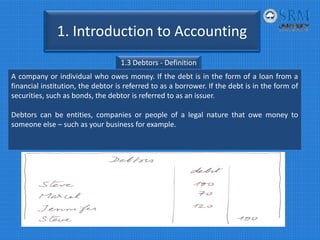
1.3 Debtors ‐ Definition
A company or individual who owes money. If the debt is in the form of a loan from a
financial institution, the debtor is referred to as a borrower. If the debt is in the form of
securities, such as bonds, the debtor is referred to as an issuer.
Debtors can be entities, companies or people of a legal nature that owe money to
someone else – such as your business for example.
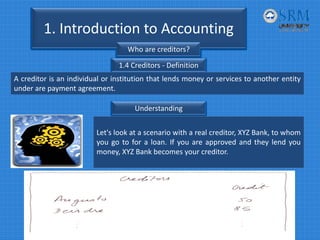
1.4 Creditors ‐ Definition
A creditor is an individual or institution that lends money or services to another entity
under are payment agreement.
1. Introduction to Accounting
Who are creditors?
Let's look at a scenario with a real creditor, XYZ Bank, to whom
you go to for a loan. If you are approved and they lend you
money, XYZ Bank becomes your creditor.
Understanding
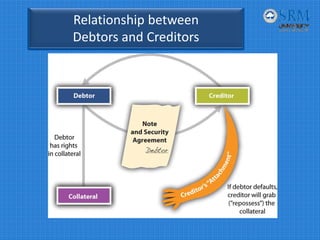
Relationship between 
Debtors and Creditors
2. Accounting Equation 
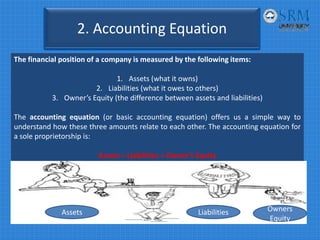
The financial position of a company is measured by the following items:
1. Assets (what it owns)
2. Liabilities (what it owes to others)
3. Owner’s Equity (the difference between assets and liabilities)
The accounting equation (or basic accounting equation) offers us a simple way to
understand how these three amounts relate to each other. The accounting equation for
a sole proprietorship is:
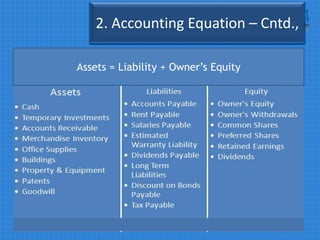
Assets = Liabilities + Owner’s Equity
Assets Liabilities Owners 
Equity
2. Accounting Equation 
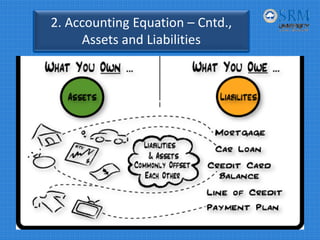
2.1 Assets : Assets are a company’s resources—things the company owns. Examples of 
assets include cash, accounts receivable, inventory, prepaid insurance, investments, 
land, buildings, equipment, and goodwill. From the accounting equation, we see that 
the amount of assets must equal the combined amount of liabilities plus owner’s (or 
stockholders’) equity.
2.2 Liability : Liabilities are a company’s obligations—amounts the company owes.
Examples of liabilities include notes or loans payable, accounts payable, salaries and
wages payable, interest payable, and income taxes payable (if the company is a regular
corporation). Liabilities can be viewed in two ways:
(1) as claims by creditors against the company’s assets, and
(2) a source—along with owner or stockholder equity—of the company’s assets.
2.3 Owners Equity : Owner’s equity or stockholders’ equity is the amount left over after 
liabilities are deducted from assets:
Assets – Liabilities = Owner’s (or Stockholders’) Equity.
Owner’s or stockholders’ equity also reports the amounts invested into the company by
the owners plus the cumulative net income of the company that has not been
withdrawn or distributed to the owners.
2. Accounting Equation – Cntd.,
Assets and Liabilities
2. Accounting Equation – Cntd.,
Terms
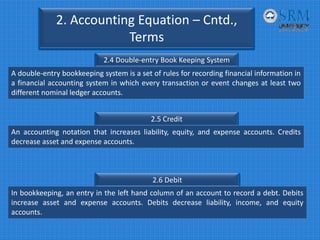
2.4 Double‐entry Book Keeping System
A double‐entry bookkeeping system is a set of rules for recording financial information in
a financial accounting system in which every transaction or event changes at least two
different nominal ledger accounts.
2.5 Credit
An accounting notation that increases liability, equity, and expense accounts. Credits
decrease asset and expense accounts.
2.6 Debit
In bookkeeping, an entry in the left hand column of an account to record a debt. Debits
increase asset and expense accounts. Debits decrease liability, income, and equity
accounts.
2. Accounting Equation – Cntd.,
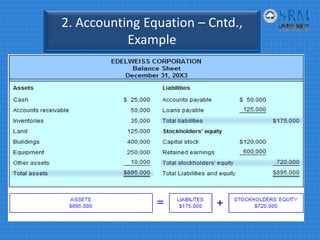
Assets = Liability + Owner’s Equity
2. Accounting Equation – Cntd.,
Example 1
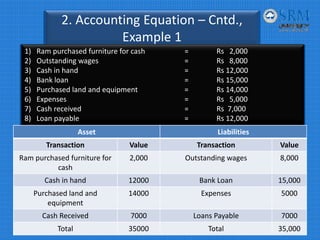
1) Ram purchased furniture for cash = Rs   2,000
2) Outstanding wages  = Rs   8,000
3) Cash in hand  = Rs 12,000
4) Bank loan = Rs 15,000
5) Purchased land and equipment = Rs 14,000
6) Expenses = Rs   5,000
7) Cash received = Rs  7,000
8) Loan payable =     Rs 12,000
Asset Liabilities
Transaction Value Transaction Value
Ram purchased furniture for 
cash
2,000 Outstanding wages 8,000
Cash in hand 12000 Bank Loan 15,000
Purchased land and
equipment
14000 Expenses 5000
Cash Received 7000 Loans Payable 7000
Total 35000 Total 35,000
2. Accounting Equation – Cntd.,
Example
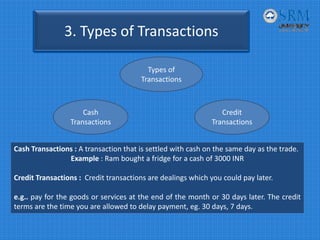
3. Types of Transactions
Types of 
Transactions
Cash 
Transactions
Credit 
Transactions
Cash Transactions : A transaction that is settled with cash on the same day as the trade.
Example : Ram bought a fridge for a cash of 3000 INR
Credit Transactions : Credit transactions are dealings which you could pay later.
e.g.. pay for the goods or services at the end of the month or 30 days later. The credit
terms are the time you are allowed to delay payment, eg. 30 days, 7 days.
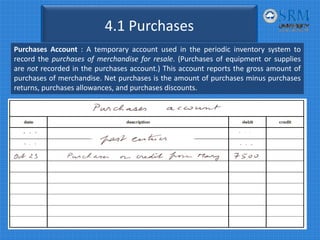
4.1 Purchases
Purchases Account : A temporary account used in the periodic inventory system to
record the purchases of merchandise for resale. (Purchases of equipment or supplies
are not recorded in the purchases account.) This account reports the gross amount of
purchases of merchandise. Net purchases is the amount of purchases minus purchases
returns, purchases allowances, and purchases discounts.
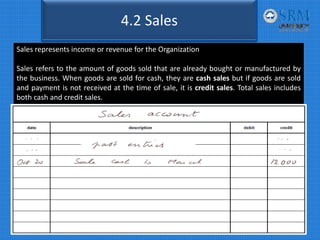
Sales represents income or revenue for the Organization
Sales refers to the amount of goods sold that are already bought or manufactured by
the business. When goods are sold for cash, they are cash sales but if goods are sold
and payment is not received at the time of sale, it is credit sales. Total sales includes
both cash and credit sales.
4.2 Sales
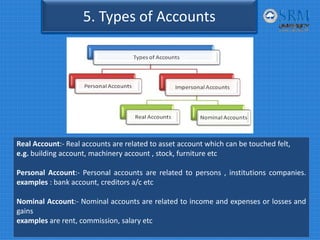
5. Types of Accounts
Real Account:‐ Real accounts are related to asset account which can be touched felt,
e.g. building account, machinery account , stock, furniture etc
Personal Account:‐ Personal accounts are related to persons , institutions companies.
examples : bank account, creditors a/c etc
Nominal Account:‐ Nominal accounts are related to income and expenses or losses and
gains
examples are rent, commission, salary etc
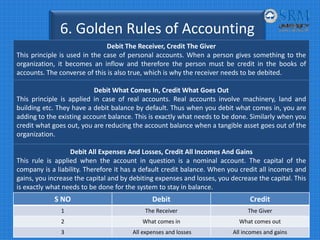
6. Golden Rules of Accounting
Debit The Receiver, Credit The Giver
This principle is used in the case of personal accounts. When a person gives something to the
organization, it becomes an inflow and therefore the person must be credit in the books of
accounts. The converse of this is also true, which is why the receiver needs to be debited.
Debit What Comes In, Credit What Goes Out
This principle is applied in case of real accounts. Real accounts involve machinery, land and
building etc. They have a debit balance by default. Thus when you debit what comes in, you are
adding to the existing account balance. This is exactly what needs to be done. Similarly when you
credit what goes out, you are reducing the account balance when a tangible asset goes out of the
organization.
Debit All Expenses And Losses, Credit All Incomes And Gains
This rule is applied when the account in question is a nominal account. The capital of the
company is a liability. Therefore it has a default credit balance. When you credit all incomes and
gains, you increase the capital and by debiting expenses and losses, you decrease the capital. This
is exactly what needs to be done for the system to stay in balance.
S NO Debit Credit
1 The Receiver The Giver
2 What comes in  What comes out
3 All expenses and losses All incomes and gains
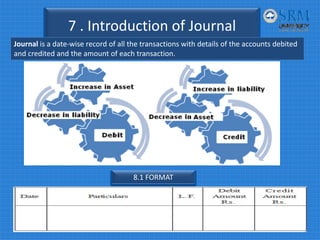
7 . Introduction of Journal
Journal is a date‐wise record of all the transactions with details of the accounts debited 
and credited and the amount of each transaction.
8.1 FORMAT
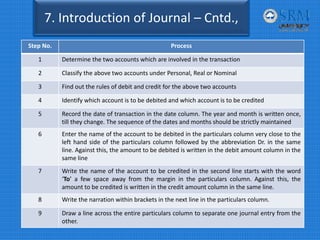
7. Introduction of Journal – Cntd.,
Step No. Process
1 Determine the two accounts which are involved in the transaction
2 Classify the above two accounts under Personal, Real or Nominal
3 Find out the rules of debit and credit for the above two accounts
4 Identify which account is to be debited and which account is to be credited
5 Record the date of transaction in the date column. The year and month is written once,
till they change. The sequence of the dates and months should be strictly maintained
6 Enter the name of the account to be debited in the particulars column very close to the
left hand side of the particulars column followed by the abbreviation Dr. in the same
line. Against this, the amount to be debited is written in the debit amount column in the
same line
7 Write the name of the account to be credited in the second line starts with the word
‘To’ a few space away from the margin in the particulars column. Against this, the
amount to be credited is written in the credit amount column in the same line.
8 Write the narration within brackets in the next line in the particulars column.
9 Draw a line across the entire particulars column to separate one journal entry from the
other.
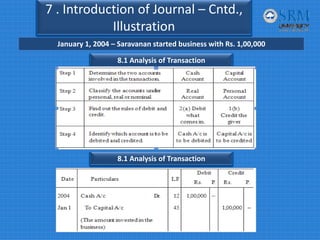
7 . Introduction of Journal – Cntd.,
Illustration
January 1, 2004 – Saravanan started business with Rs. 1,00,000
8.1 Analysis of Transaction
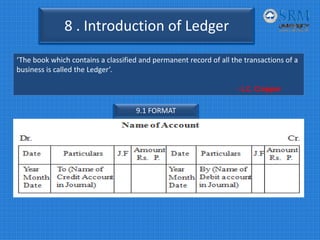
8 . Introduction of Ledger
‘The book which contains a classified and permanent record of all the transactions of a 
business is called the Ledger’.
‐ L.C. Cropper
9.1 FORMAT
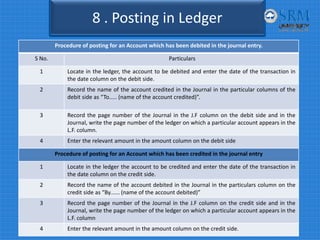
8 . Posting in Ledger
Procedure of posting for an Account which has been debited in the journal entry.
S No. Particulars
1 Locate in the ledger, the account to be debited and enter the date of the transaction in
the date column on the debit side.
2 Record the name of the account credited in the Journal in the particular columns of the
debit side as “To..... (name of the account credited)”.
3 Record the page number of the Journal in the J.F column on the debit side and in the
Journal, write the page number of the ledger on which a particular account appears in the
L.F. column.
4 Enter the relevant amount in the amount column on the debit side
Procedure of posting for an Account which has been credited in the journal entry
1 Locate in the ledger the account to be credited and enter the date of the transaction in
the date column on the credit side.
2 Record the name of the account debited in the Journal in the particulars column on the
credit side as “By...... (name of the account debited)”
3 Record the page number of the Journal in the J.F column on the credit side and in the
Journal, write the page number of the ledger on which a particular account appears in the
L.F. column
4 Enter the relevant amount in the amount column on the credit side.
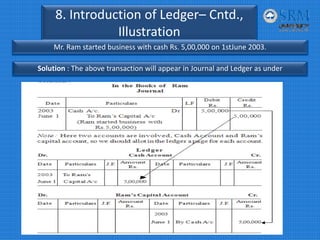
8. Introduction of Ledger– Cntd.,
Illustration
Mr. Ram started business with cash Rs. 5,00,000 on 1stJune 2003.
Solution : The above transaction will appear in Journal and Ledger as under
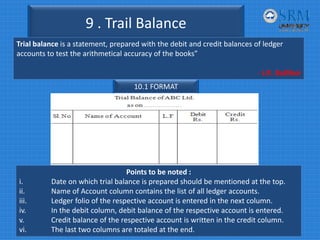
9 . Trail Balance
Trial balance is a statement, prepared with the debit and credit balances of ledger 
accounts to test the arithmetical accuracy of the books”
‐ J.R. Batliboi    
10.1 FORMAT
Points to be noted :
i. Date on which trial balance is prepared should be mentioned at the top.
ii. Name of Account column contains the list of all ledger accounts.
iii. Ledger folio of the respective account is entered in the next column.
iv. In the debit column, debit balance of the respective account is entered.
v. Credit balance of the respective account is written in the credit column.
vi.    The last two columns are totaled at the end.
9 Trail Balance ‐ Illustration
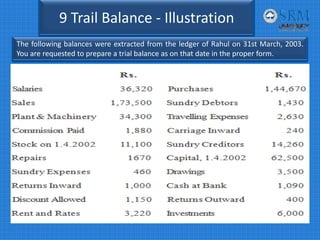
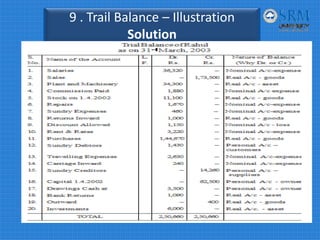
The following balances were extracted from the ledger of Rahul on 31st March, 2003.
You are requested to prepare a trial balance as on that date in the proper form.
9 . Trail Balance – Illustration
Solution
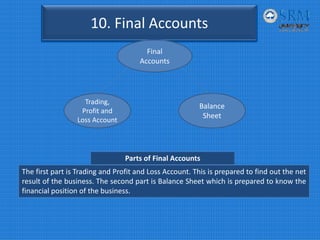
10. Final Accounts
Final 
Accounts
Trading, 
Profit and 
Loss Account
Balance 
Sheet
Parts of Final Accounts
The first part is Trading and Profit and Loss Account. This is prepared to find out the net
result of the business. The second part is Balance Sheet which is prepared to know the
financial position of the business.
10.1 Trading Account
Trading means buying and selling. The trading account shows the result of buying and
selling of goods.
9.1 FORMAT 9.2 ILLUSTRATION
Prepare a Trading Account from the following
information of a trader.
Total purchases made during the year 2003
Rs.2,00,000.
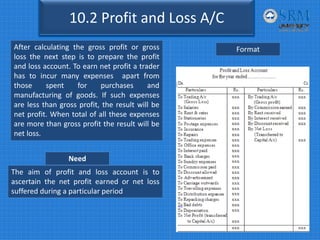
10.2 Profit and Loss A/C
After calculating the gross profit or gross
loss the next step is to prepare the profit
and loss account. To earn net profit a trader
has to incur many expenses apart from
those spent for purchases and
manufacturing of goods. If such expenses
are less than gross profit, the result will be
net profit. When total of all these expenses
are more than gross profit the result will be
net loss.
Need
Format
The aim of profit and loss account is to
ascertain the net profit earned or net loss
suffered during a particular period
10.2 Profit and Loss A/C
Illustration
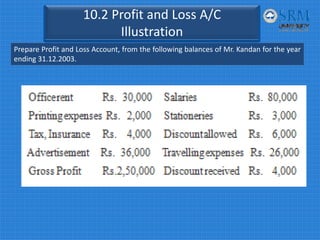
Prepare Profit and Loss Account, from the following balances of Mr. Kandan for the year
ending 31.12.2003.
10.2 Profit and Loss A/C
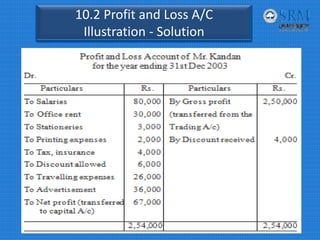
Illustration ‐ Solution
10.3 Balance Sheet
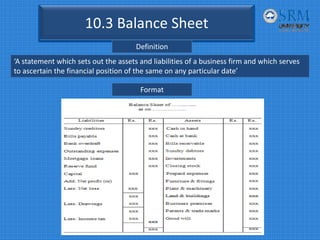
Definition
‘A statement which sets out the assets and liabilities of a business firm and which serves 
to ascertain the financial position of the same on any particular date’
Format
10.3 Balance Sheet 
Illustration
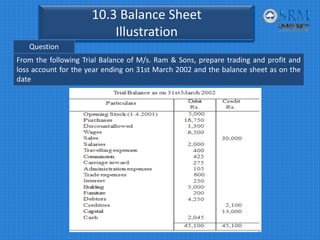
Question
From the following Trial Balance of M/s. Ram & Sons, prepare trading and profit and
loss account for the year ending on 31st March 2002 and the balance sheet as on the
date
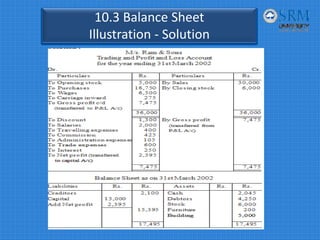
10.3 Balance Sheet 
Illustration ‐ Solution
11.References
1. Higher Secondary Accountancy book published by Tamil Nadu Text Book 
Corporation
2. T.S.Grewal – Double Entry Book Keeping.
3. R.L.Gupta, Radha Swamy – Financial Accounting.
4. Institute of Company Secretaries of India – Principle  of Accountancy.
5. P.C.Tulsian, S.D.Tulsian – ISC Accountancy for Class XI
6. Accounting Text and Cases – Robert Anthony, Tata McGraw‐Hill Publications
7. www.icai.org
8. Education.svtution.org
9. www.investpedia.com
10. www.lapasserelle.com

Accounting basics study_material_0