Introduction to Interpretable
Machine Learning
Presented by Giang Nguyen
KAIST, Nov 2019
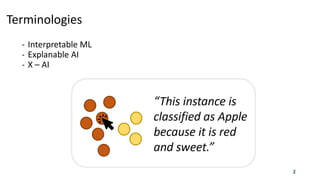
Terminologies
- Interpretable ML
- Explanable AI
- X – AI
2
BIRD VIEW OVER EXPLAINABLE AI
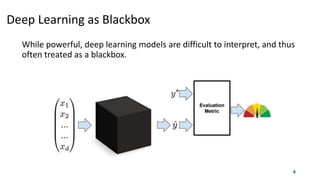
Deep Learning as Blackbox
While powerful, deep learning models are difficult to interpret, and thus
often treated as a blackbox.
4
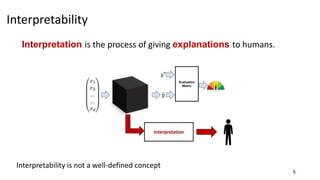
Interpretability
Interpretation is the process of giving explanations to humans.
Interpretability is not a well-defined concept
5
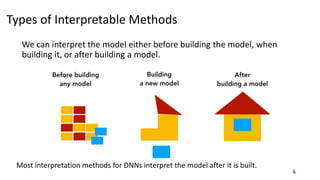
Types of Interpretable Methods
We can interpret the model either before building the model, when
building it, or after building a model.
Most interpretation methods for DNNs interpret the model after it is built.
6
Interpretation When Building a Model
7
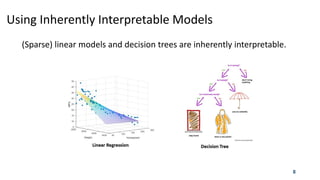
Using Inherently Interpretable Models
(Sparse) linear models and decision trees are inherently interpretable.
8
Attention Mechanisms
Attention mechanisms guide deep neural networks to focus on
relevant input features, which allows to interpret how the model made
certain predictions.
9
[Bahdanau et al. 15] Neural Machine Translation by Jointly Learning to Align and Translate, ICLR 2015
Limitation of Conventional Attention Mechanisms
Conventional attention models may allocate attention inaccurately since
they are trained in a weakly-supervised manner.
The problem becomes more prominent when a task has no one-to-one
mapping from inputs to the final predictions.
10
Limitation of Conventional Attention Mechanisms
This is because the conventional attention mechanisms do not consider
uncertainties in the model and the input, which often leads to
overconfident attention allocations.
Such unreliability may lead to incorrect predictions and/or interpretations
which can result in fatal consequences for safety-critical applications.
11
Uncertainty Aware Attention (UA)
12
Uncertainty Aware Attention (UA)
13
Multi-class classification performance on the three health records datasets
Info-GAN
14
There are structures in the noise vectors that have meaningful and
consistent effects on the output of the generator.
However, there’s no systematic way to find these structures. The only
thing affecting to the generator output is the noise input, so we have no
idea how to modify the noise to generate expected images.
Info-GAN
15
The idea is to provide a latent code, which has meaningful and consistent
effects on the output - disentangled representation
The hope is that if you keep the code the same and randomly change the
noise, you get variations of the same digit.
Info-GAN
16
c1 ∼ Cat(K = 10, p = 0.1)
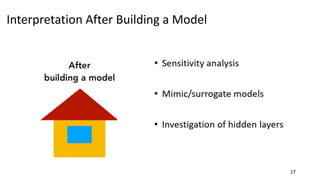
Interpretation After Building a Model
17
Understanding Black-Box Predictions
Given a high-accuracy blackbox model and a prediction from it, can we
answer why the model made a certain prediction?
[Koh and Liang 17] tackles this question by training a model’s prediction through its learning algorithm
and back to the training data.
To formalize the impact of a training point on a prediction, they ask the counterfactual:
What would happen if we did not have this training point or if its value were slightly changed?
18
[Koh and Liang 17] Understanding Black-box Predictions via Influence Functions, ICML 2017
Interpretable Mimic Learning
This framework is mainly based on knowledge distillation from Neural
Networks.
However, they use Gradient Boosting Trees (GBT) instead of another neural
network as the student model since GBT satisfies our requirements for
both learning capacity and interpretability.
19[Che et al. 2016] Z. Che, S. Purushotham, R. Khemani, and Y. Liu. Interpretable Deep Models for
ICU outcome prediction, AMIA 2016.
Knowledge distillation
G. Hinton et al. 15
Interpretable Mimic Learning
The resulting simple model works even better than the best deep learning
model – perhaps due to suppression of the overfitting.
20[Che et al. 2016] Z. Che, S. Purushotham, R. Khemani, and Y. Liu. Interpretable Deep Models for
ICU outcome prediction, AMIA 2016.
Visualizing Convolutional Neural Networks
Propose Deconvolution Network (deconvnet) to inversely map the feature
activations to pixel space and provide a sensitivity analysis to point out
which regions of an image affect to decision making process the most.
21
[Zeiler and Fergus 14] Visualizing and Understanding Convolutional Networks, ECCV 2014
Prediction difference analysis
22
The visualization method shows which pixels of a specific input image are
evidence for or against a prediction
[Zintgraf et al. 2017] Visualizing Deep Neural Network Decisions: Prediction Difference Analysis, ICLR 2017
Shown is the evidence for (red) and against (blue) the prediction.
We see that the facial features of the cockatoo are most supportive for the decision, and
parts of the body seem to constitute evidence against it.
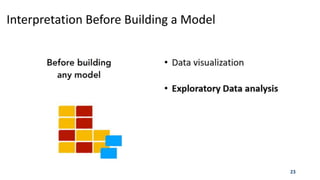
Interpretation Before Building a Model
23
Understanding Data Through Examples
[Kim et al. 16] propose to interpret the given data by providing examples
that can show the full picture – majorities + minorities
[Kim et al. 16] Examples are not Enough, Learn to Criticize! Criticism for Interpretability 24
INTRODUCTION
AI is data-driven, what we get is what we have
26
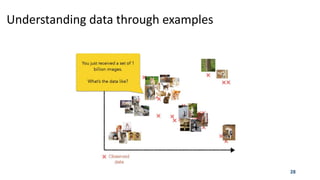
Understanding data through examples
27
Understanding data through examples
28
Understanding data through examples
29
Understanding data through examples
30
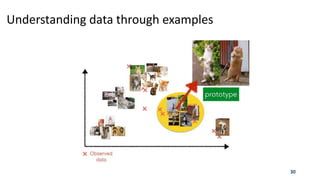
Understanding data through examples
31
Understanding data through examples
33
Understanding data through examples
34
Ideas of paper
35
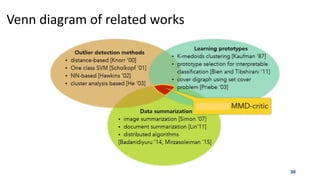
Related Work
37
Over-generalization
Over-generalization is consistent with evolutionary
theory [Zebrowitz ‘10, Schaller’ 06]
algorithms can help against over-generalization
38
Venn diagram of related works
MMD-critic
40
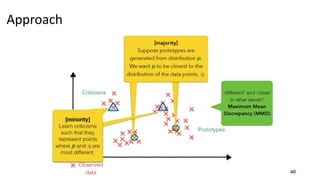
Approach
41
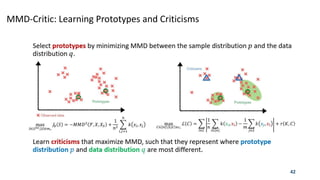
Maximum Mean Discrepancy (MMD)
42
MMD-Critic: Learning Prototypes and Criticisms
Experiments
44
Results
45
Prototype-based classification
• Use the learned prototypes for classification (nearest-neighbor)
46
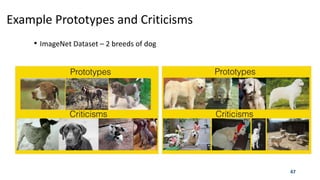
Example Prototypes and Criticisms
• USPS Digits Dataset
Unrecognizable
47
Example Prototypes and Criticisms
• ImageNet Dataset – 2 breeds of dog
48
Pilot study with human subjects
Definition of interpretability: A method is interpretable if a user can
correctly and efficiently predict the method’s results.
Task: Assign a new data point to one of the groups using 1) all images
2) prototypes 3) prototypes and criticisms 4) small set of randomly
selected images
49
Pilot study with human subjects
Conclusion
Take-home messages
51
• There are three types of Interpretable Methods, but mostly after building
models
• Criticism and prototypes are equally important and are a step towards
improving interpretability of complex data distributions
• MMD-critic learns prototypes + criticisms that highlight aspects of
data that are overlooked by prototypes.
Discussion
52
• If we have the insight into a dataset, can we really build a better model?
Human intuition is biased and not realiable!
Gap in Interpretable ML research
53
• Limited work to explain the operation of RNNs, only CNN. Attention
mechanism is not enough. Especially in multimodal network (CNN +
RNN), this kind of research is more necessary
Thank you for your attention!

Introduction to Interpretable Machine Learning

  • 1.
    Introduction to Interpretable MachineLearning Presented by Giang Nguyen KAIST, Nov 2019
  • 2.
    Terminologies - Interpretable ML -Explanable AI - X – AI 2
  • 3.
    BIRD VIEW OVEREXPLAINABLE AI
  • 4.
    Deep Learning asBlackbox While powerful, deep learning models are difficult to interpret, and thus often treated as a blackbox. 4
  • 5.
    Interpretability Interpretation is theprocess of giving explanations to humans. Interpretability is not a well-defined concept 5
  • 6.
    Types of InterpretableMethods We can interpret the model either before building the model, when building it, or after building a model. Most interpretation methods for DNNs interpret the model after it is built. 6
  • 7.
  • 8.
    Using Inherently InterpretableModels (Sparse) linear models and decision trees are inherently interpretable. 8
  • 9.
    Attention Mechanisms Attention mechanismsguide deep neural networks to focus on relevant input features, which allows to interpret how the model made certain predictions. 9 [Bahdanau et al. 15] Neural Machine Translation by Jointly Learning to Align and Translate, ICLR 2015
  • 10.
    Limitation of ConventionalAttention Mechanisms Conventional attention models may allocate attention inaccurately since they are trained in a weakly-supervised manner. The problem becomes more prominent when a task has no one-to-one mapping from inputs to the final predictions. 10
  • 11.
    Limitation of ConventionalAttention Mechanisms This is because the conventional attention mechanisms do not consider uncertainties in the model and the input, which often leads to overconfident attention allocations. Such unreliability may lead to incorrect predictions and/or interpretations which can result in fatal consequences for safety-critical applications. 11
  • 12.
  • 13.
    Uncertainty Aware Attention(UA) 13 Multi-class classification performance on the three health records datasets
  • 14.
    Info-GAN 14 There are structuresin the noise vectors that have meaningful and consistent effects on the output of the generator. However, there’s no systematic way to find these structures. The only thing affecting to the generator output is the noise input, so we have no idea how to modify the noise to generate expected images.
  • 15.
    Info-GAN 15 The idea isto provide a latent code, which has meaningful and consistent effects on the output - disentangled representation The hope is that if you keep the code the same and randomly change the noise, you get variations of the same digit.
  • 16.
  • 17.
  • 18.
    Understanding Black-Box Predictions Givena high-accuracy blackbox model and a prediction from it, can we answer why the model made a certain prediction? [Koh and Liang 17] tackles this question by training a model’s prediction through its learning algorithm and back to the training data. To formalize the impact of a training point on a prediction, they ask the counterfactual: What would happen if we did not have this training point or if its value were slightly changed? 18 [Koh and Liang 17] Understanding Black-box Predictions via Influence Functions, ICML 2017
  • 19.
    Interpretable Mimic Learning Thisframework is mainly based on knowledge distillation from Neural Networks. However, they use Gradient Boosting Trees (GBT) instead of another neural network as the student model since GBT satisfies our requirements for both learning capacity and interpretability. 19[Che et al. 2016] Z. Che, S. Purushotham, R. Khemani, and Y. Liu. Interpretable Deep Models for ICU outcome prediction, AMIA 2016. Knowledge distillation G. Hinton et al. 15
  • 20.
    Interpretable Mimic Learning Theresulting simple model works even better than the best deep learning model – perhaps due to suppression of the overfitting. 20[Che et al. 2016] Z. Che, S. Purushotham, R. Khemani, and Y. Liu. Interpretable Deep Models for ICU outcome prediction, AMIA 2016.
  • 21.
    Visualizing Convolutional NeuralNetworks Propose Deconvolution Network (deconvnet) to inversely map the feature activations to pixel space and provide a sensitivity analysis to point out which regions of an image affect to decision making process the most. 21 [Zeiler and Fergus 14] Visualizing and Understanding Convolutional Networks, ECCV 2014
  • 22.
    Prediction difference analysis 22 Thevisualization method shows which pixels of a specific input image are evidence for or against a prediction [Zintgraf et al. 2017] Visualizing Deep Neural Network Decisions: Prediction Difference Analysis, ICLR 2017 Shown is the evidence for (red) and against (blue) the prediction. We see that the facial features of the cockatoo are most supportive for the decision, and parts of the body seem to constitute evidence against it.
  • 23.
  • 24.
    Understanding Data ThroughExamples [Kim et al. 16] propose to interpret the given data by providing examples that can show the full picture – majorities + minorities [Kim et al. 16] Examples are not Enough, Learn to Criticize! Criticism for Interpretability 24
  • 25.
  • 26.
    AI is data-driven,what we get is what we have 26
  • 27.
  • 28.
  • 29.
  • 30.
  • 31.
  • 32.
  • 33.
  • 34.
  • 35.
  • 36.
    37 Over-generalization Over-generalization is consistentwith evolutionary theory [Zebrowitz ‘10, Schaller’ 06] algorithms can help against over-generalization
  • 37.
    38 Venn diagram ofrelated works
  • 38.
  • 39.
  • 40.
  • 41.
  • 42.
  • 43.
  • 44.
    45 Prototype-based classification • Usethe learned prototypes for classification (nearest-neighbor)
  • 45.
    46 Example Prototypes andCriticisms • USPS Digits Dataset Unrecognizable
  • 46.
    47 Example Prototypes andCriticisms • ImageNet Dataset – 2 breeds of dog
  • 47.
    48 Pilot study withhuman subjects Definition of interpretability: A method is interpretable if a user can correctly and efficiently predict the method’s results. Task: Assign a new data point to one of the groups using 1) all images 2) prototypes 3) prototypes and criticisms 4) small set of randomly selected images
  • 48.
    49 Pilot study withhuman subjects
  • 49.
  • 50.
    Take-home messages 51 • Thereare three types of Interpretable Methods, but mostly after building models • Criticism and prototypes are equally important and are a step towards improving interpretability of complex data distributions • MMD-critic learns prototypes + criticisms that highlight aspects of data that are overlooked by prototypes.
  • 51.
    Discussion 52 • If wehave the insight into a dataset, can we really build a better model? Human intuition is biased and not realiable!
  • 52.
    Gap in InterpretableML research 53 • Limited work to explain the operation of RNNs, only CNN. Attention mechanism is not enough. Especially in multimodal network (CNN + RNN), this kind of research is more necessary
  • 53.
    Thank you foryour attention!

Editor's Notes

  • #3 As a result of the success of deep learning over the past decade, many model success and even surpass human performance on classification tasks. However, it still remains secrect how deep learning models actually works. DL models are usually considered as black-box
  • #4 First and foremost, I would like to provide a bird view over X-ai
  • #5 As a result of the success of deep learning over the past decade, many model success and even surpass human performance on classification tasks. However, it still remains secrect how deep learning models actually works. DL models are usually considered as black-box
  • #6 To deal with this, interpretation should be given to support the operation of DL models. However, Interpretability is not a well-defined concept
  • #7 Generally speaking, interpretable methods are now divided into three categories: before building the model, when building it, or after building a model. However, Most interpretation methods for DNNs interpret the model after it is built.
  • #8 First, when building a new model, we can use/
  • #9 An intuitive example is to use a sparse models, which is easy to understand. In addition, decision tree support human intuition as we can know the decision at each stage.
  • #10 Another solution is to use attention mechanism as at each time step, we can adjust the focal point in input
  • #18 The next category, interpretation after building a mode, which covers almost all papers in this course.
  • #19 In a paper, Understanding Black-box Predictions via Influence Functions, Koh and Liang address the question: why the model made a certain prediction By training a model’s prediction through its learning algorithm and back to the training data. To formalize the impact of a training point on a prediction, they ask the counterfactual: What would happen if we did not have this training point or if its value were slightly changed?
  • #22 In paper Visualizing and Understanding Convolutional Networks, authors proposed to visualize learned representations in convolutional neural networks using deconvolution and maximally activating images.
  • #23 Another paper, mostly you know, Visualizing Deep Neural Network Decisions: Prediction Difference Analysis, they highlights areas in a given input image that provide evidence for or against a certain class.
  • #24 The paper I am gonna present today falls into this type of category, Interpretation Before Building a Model
  • #25 This paper explore data analysis through examples
  • #26 Now I will introduce the paper: Examples are not Enough, Learn to Criticize! Criticism for Interpretability
  • #27 AI community invents million of different DL models, but essentially, AI is data-driven, what we get is what we have. Its mean the model will behave based on the data we provide
  • #28 So, it would be nice if we know what we are having before building any models
  • #29 Imagine you are given a giant dataset, that contains one billion of data points. Before modeling, you wanna get a sense of what the data looks like. Of couse you don’t have time to look at all one billion images so you might do sampling from this group
  • #30 A lot of images look like this
  • #31 Another group shows that this kind of image is popular.
  • #32 But the problem is that protoptyes images don’t give you the full picture. There are also groups like this, and we need to look at them to get the full picture. Then the question is which group should we look? We want to look at important minorities. Others you can ignore.
  • #33 Like this one, animal laying on keyboard. These are small but noy ignorable
  • #34 Or this one. They are different from prototypes we have seen so far
  • #35 So you finally want to come up with an algorithm to efficiently select majorities and important minorities
  • #36 So this paper is about an algorithm of that kind. The idea is not only select prototypes but also important minorities. This helps human get better insights into a complex high dimensional dataset
  • #37 Now coming to related work of this paper
  • #38 Human tends to over-generalize and this cartoon suggest overgeneralization. This algorthim in this paper help us to minimiza the over-generalization via prototypes + criticisms However, examples are not enough. Relying only on examples to explain the models’ behavior can lead over-generalization and misunderstanding. Examples alone may be sufficient when the distribution of data points are ‘clean’ – in the sense that there exists a set of prototypical examples which sufficiently represent the data. However, this is rarely the case in real world data. For instance, fitting models to complex datasets often requires the use of regularization Here fitting models to complex datasets often requires the use of regularization means when training, we add regularization to generalize both prototype and criticism then we can not see the real distribution of data.
  • #39 There are number of methods to select prototypes but non of them focus on minorities. There are outlier detection methods that consider minorities however mostly focus on detecting abnormalities rather than representing the whole distribution.
  • #40 Now, we will explore how MMD-critic works
  • #41 So, technically speaking, this work will select prototypes generated from distribution p, and criticism from … Here, how can we measure the distance between the distribution, the authors propose to use MMD
  • #42 MMD is used to calculate the discrepancy between two distribution P and Q, by this witness function. However, this function is intractable; as a result, we need to approximate this function by sampling like this function. To further measure this function, authors use Bayesian model criticism and two-sample tests.
  • #43 Prototypes: min vi cac representative la se dung gan nhau Criticisms: max boi vi 2 distribution se la xa nhau
  • #44 Now jumping to experiments
  • #45 This paper conducts three experiments, both qualitatively and quantitatively
  • #46 Competitive performance with PS, thuat toan classifier su dung nearest neighbor de classify (clustering)
  • #50 Measure how well they did and how quickly they give back the response. Talking about speed first, people work fastest using prototypes (make sense vi so sample trong prototypes la it nhat)… Conclusion: When criticism is given together with prototypes, a human pilot study suggests that humans are better able to perform a predictive task that requires the data-distributions to be well-explained. This suggests that criticism and prototypes are a step towards improving interpretability of complex data distributions. (Nhom thu 3 perform tot nhat boi vi da biet nhom so 2 la prototype roi). Prototypes + criticisms works best suggest that human intuition works best if the dataset only have prototypes + criticisms => we can filter data to get only prototype+criticism, khi do human da co insight tot => co the build model tot hon
  • #51 The final part is conclusion