Explainable AI (XAI) – A Perspective
Author – Saurabh Kaushik
Twitter - @saurabhkaushik
2
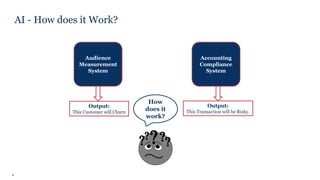
AI - How does it Work?
Audience
Measurement
System
Accounting
Compliance
System
Output:
This Customer will Churn
Output:
This Transaction will be Risky.
How
does it
work?
3
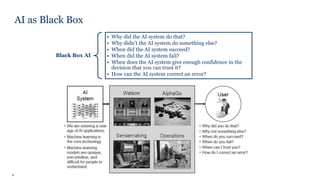
AI as Black Box
Black Box AI
• Why did the AI system do that?
• Why didn’t the AI system do something else?
• When did the AI system succeed?
• When did the AI system fail?
• When does the AI system give enough confidence in the
decision that you can trust it?
• How can the AI system correct an error?
4
XAI – Full Circle of Life
World
Data
Black Box Model
Explainable
Technique
Captures
Trains
Interprets
Augment
5
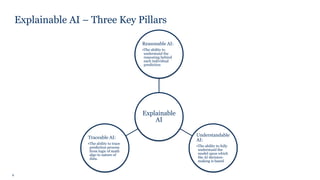
Explainable AI – Three Key Pillars
Explainable
AI
Reasonable AI:
•The ability to
understand the
reasoning behind
each individual
prediction
Understandable
AI:
•The ability to fully
understand the
model upon which
the AI decision-
making is based
Traceable AI:
•The ability to trace
prediction process
from logic of math
algo to nature of
data.
6
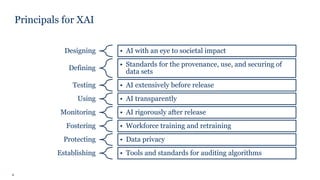
Principals for XAI
Designing • AI with an eye to societal impact
Defining
• Standards for the provenance, use, and securing of
data sets
Testing • AI extensively before release
Using • AI transparently
Monitoring • AI rigorously after release
Fostering • Workforce training and retraining
Protecting • Data privacy
Establishing • Tools and standards for auditing algorithms
7
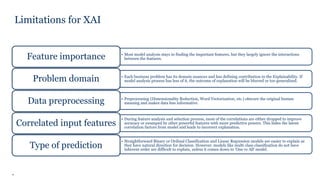
Limitations for XAI
• Most model analysis stays in finding the important features, but they largely ignore the interactions
between the features.Feature importance
• Each business problem has its domain nuances and has defining contribution to the Explainability. If
model analysis process has less of it, the outcome of explanation will be blurred or too generalized.Problem domain
• Preprocessing (Dimensionality Reduction, Word Vectorization, etc.) obscure the original human
meaning and makes data less informative.Data preprocessing
• During feature analysis and selection process, most of the correlations are either dropped to improve
accuracy or swamped by other powerful features with more predictive powers. This hides the latent
correlation factors from model and leads to incorrect explanation.
Correlated input features
• Straightforward Binary or Ordinal Classification and Linear Regression models are easier to explain as
they have natural direction for decision. However, models like multi class classification do not have
inherent order are difficult to explain, unless it comes down to ‘One vs All’ model.
Type of prediction
8
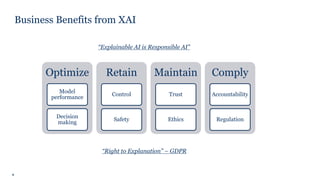
Business Benefits from XAI
Optimize
Model
performance
Decision
making
Retain
Control
Safety
Maintain
Trust
Ethics
Comply
Accountability
Regulation
“Explainable AI is Responsible AI”
“Right to Explanation” – GDPR
9
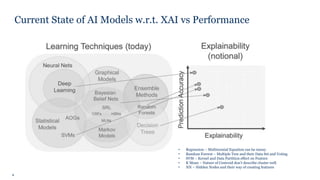
Current State of AI Models w.r.t. XAI vs Performance
• Regression – Multinomial Equation can be messy
• Random Forrest – Multiple Tree and their Data Set and Voting
• SVM – Kernel and Data Partition effect on Feature
• K Mean – Nature of Centroid don’t describe cluster well.
• NN – Hidden Nodes and their way of creating features
10
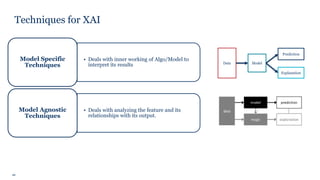
Techniques for XAI
• Deals with inner working of Algo/Model to
interpret its results
Model Specific
Techniques
• Deals with analyzing the feature and its
relationships with its output.
Model Agnostic
Techniques
Data Model
Explanation
Prediction
11
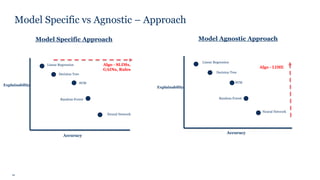
Model Specific vs Agnostic – Approach
Linear Regression
Decision Tree
SVM
Random Forest
Neural Network
Linear Regression
Decision Tree
SVM
Random Forest
Neural Network
Accuracy
Explainability
Explainability
Accuracy
Algo - SLIMs,
GAINs, Rules
Algo - LIME
Model Specific Approach Model Agnostic Approach
12
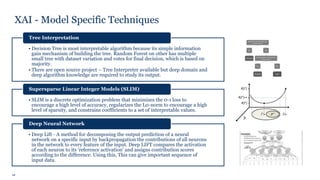
XAI - Model Specific Techniques
• Decision Tree is most interpretable algorithm because its simple information
gain mechanism of building the tree. Random Forest on other has multiple
small tree with dataset variation and votes for final decision, which is based on
majority.
• There are open source project – Tree Interpreter available but deep domain and
deep algorithm knowledge are required to study its output.
Tree Interpretation
• SLIM is a discrete optimization problem that minimizes the 0-1 loss to
encourage a high level of accuracy, regularizes the L0-norm to encourage a high
level of sparsity, and constrains coefficients to a set of interpretable values.
Supersparse Linear Integer Models (SLIM)
• Deep Lift - A method for decomposing the output prediction of a neural
network on a specific input by backpropagation the contributions of all neurons
in the network to every feature of the input. Deep LIFT compares the activation
of each neuron to its 'reference activation' and assigns contribution scores
according to the difference. Using this, This can give important sequence of
input data.
Deep Neural Network
13
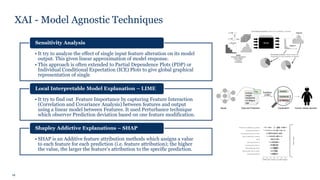
XAI - Model Agnostic Techniques
• It try to analyze the effect of single input feature alteration on its model
output. This given linear approximation of model response.
• This approach is often extended to Partial Dependence Plots (PDP) or
Individual Conditional Expectation (ICE) Plots to give global graphical
representation of single
Sensitivity Analysis
• It try to find out Feature Importance by capturing Feature Interaction
(Correlation and Covariance Analysis) between features and output
using a linear model between Features. It used Perturbance technique
which observer Prediction deviation based on one feature modification.
Local Interpretable Model Explanation – LIME
• SHAP is an Additive feature attribution methods which assigns a value
to each feature for each prediction (i.e. feature attribution); the higher
the value, the larger the feature’s attribution to the specific prediction.
Shapley Addictive Explanations – SHAP
14
Future Status of XAI Systems
Thank You
Author – Saurabh Kaushik
Twitter - @saurabhkaushik
16
References
• https://www.darpa.mil/program/explainable-artificial-intelligence
• https://ai.intel.com/the-challenges-and-opportunities-of-explainable-ai/
• https://arxiv.org/pdf/1708.08296.pdf
• https://bons.ai/blog/explainable-ai-machine-learning-systems
• https://medium.com/@BonsaiAI/explainable-ai-3-deep-explanations-approaches-to-xai-1807e251e537
• https://www.pwc.com/us/en/services/consulting/library/artificial-intelligence-predictions/explainable-
ai.html
• https://aibusiness.com/explainable-algorithms-rainbird-ai/
• https://www.accenture.com/us-en/blogs/blogs-why-explainable-ai-must-central-responsible-ai
• https://www.accenture.com/us-en/blogs/blogs-responsible-ai

Explainable AI (XAI) - A Perspective

  • 1.
    Explainable AI (XAI)– A Perspective Author – Saurabh Kaushik Twitter - @saurabhkaushik
  • 2.
    2 AI - Howdoes it Work? Audience Measurement System Accounting Compliance System Output: This Customer will Churn Output: This Transaction will be Risky. How does it work?
  • 3.
    3 AI as BlackBox Black Box AI • Why did the AI system do that? • Why didn’t the AI system do something else? • When did the AI system succeed? • When did the AI system fail? • When does the AI system give enough confidence in the decision that you can trust it? • How can the AI system correct an error?
  • 4.
    4 XAI – FullCircle of Life World Data Black Box Model Explainable Technique Captures Trains Interprets Augment
  • 5.
    5 Explainable AI –Three Key Pillars Explainable AI Reasonable AI: •The ability to understand the reasoning behind each individual prediction Understandable AI: •The ability to fully understand the model upon which the AI decision- making is based Traceable AI: •The ability to trace prediction process from logic of math algo to nature of data.
  • 6.
    6 Principals for XAI Designing• AI with an eye to societal impact Defining • Standards for the provenance, use, and securing of data sets Testing • AI extensively before release Using • AI transparently Monitoring • AI rigorously after release Fostering • Workforce training and retraining Protecting • Data privacy Establishing • Tools and standards for auditing algorithms
  • 7.
    7 Limitations for XAI •Most model analysis stays in finding the important features, but they largely ignore the interactions between the features.Feature importance • Each business problem has its domain nuances and has defining contribution to the Explainability. If model analysis process has less of it, the outcome of explanation will be blurred or too generalized.Problem domain • Preprocessing (Dimensionality Reduction, Word Vectorization, etc.) obscure the original human meaning and makes data less informative.Data preprocessing • During feature analysis and selection process, most of the correlations are either dropped to improve accuracy or swamped by other powerful features with more predictive powers. This hides the latent correlation factors from model and leads to incorrect explanation. Correlated input features • Straightforward Binary or Ordinal Classification and Linear Regression models are easier to explain as they have natural direction for decision. However, models like multi class classification do not have inherent order are difficult to explain, unless it comes down to ‘One vs All’ model. Type of prediction
  • 8.
    8 Business Benefits fromXAI Optimize Model performance Decision making Retain Control Safety Maintain Trust Ethics Comply Accountability Regulation “Explainable AI is Responsible AI” “Right to Explanation” – GDPR
  • 9.
    9 Current State ofAI Models w.r.t. XAI vs Performance • Regression – Multinomial Equation can be messy • Random Forrest – Multiple Tree and their Data Set and Voting • SVM – Kernel and Data Partition effect on Feature • K Mean – Nature of Centroid don’t describe cluster well. • NN – Hidden Nodes and their way of creating features
  • 10.
    10 Techniques for XAI •Deals with inner working of Algo/Model to interpret its results Model Specific Techniques • Deals with analyzing the feature and its relationships with its output. Model Agnostic Techniques Data Model Explanation Prediction
  • 11.
    11 Model Specific vsAgnostic – Approach Linear Regression Decision Tree SVM Random Forest Neural Network Linear Regression Decision Tree SVM Random Forest Neural Network Accuracy Explainability Explainability Accuracy Algo - SLIMs, GAINs, Rules Algo - LIME Model Specific Approach Model Agnostic Approach
  • 12.
    12 XAI - ModelSpecific Techniques • Decision Tree is most interpretable algorithm because its simple information gain mechanism of building the tree. Random Forest on other has multiple small tree with dataset variation and votes for final decision, which is based on majority. • There are open source project – Tree Interpreter available but deep domain and deep algorithm knowledge are required to study its output. Tree Interpretation • SLIM is a discrete optimization problem that minimizes the 0-1 loss to encourage a high level of accuracy, regularizes the L0-norm to encourage a high level of sparsity, and constrains coefficients to a set of interpretable values. Supersparse Linear Integer Models (SLIM) • Deep Lift - A method for decomposing the output prediction of a neural network on a specific input by backpropagation the contributions of all neurons in the network to every feature of the input. Deep LIFT compares the activation of each neuron to its 'reference activation' and assigns contribution scores according to the difference. Using this, This can give important sequence of input data. Deep Neural Network
  • 13.
    13 XAI - ModelAgnostic Techniques • It try to analyze the effect of single input feature alteration on its model output. This given linear approximation of model response. • This approach is often extended to Partial Dependence Plots (PDP) or Individual Conditional Expectation (ICE) Plots to give global graphical representation of single Sensitivity Analysis • It try to find out Feature Importance by capturing Feature Interaction (Correlation and Covariance Analysis) between features and output using a linear model between Features. It used Perturbance technique which observer Prediction deviation based on one feature modification. Local Interpretable Model Explanation – LIME • SHAP is an Additive feature attribution methods which assigns a value to each feature for each prediction (i.e. feature attribution); the higher the value, the larger the feature’s attribution to the specific prediction. Shapley Addictive Explanations – SHAP
  • 14.
  • 15.
    Thank You Author –Saurabh Kaushik Twitter - @saurabhkaushik
  • 16.
    16 References • https://www.darpa.mil/program/explainable-artificial-intelligence • https://ai.intel.com/the-challenges-and-opportunities-of-explainable-ai/ •https://arxiv.org/pdf/1708.08296.pdf • https://bons.ai/blog/explainable-ai-machine-learning-systems • https://medium.com/@BonsaiAI/explainable-ai-3-deep-explanations-approaches-to-xai-1807e251e537 • https://www.pwc.com/us/en/services/consulting/library/artificial-intelligence-predictions/explainable- ai.html • https://aibusiness.com/explainable-algorithms-rainbird-ai/ • https://www.accenture.com/us-en/blogs/blogs-why-explainable-ai-must-central-responsible-ai • https://www.accenture.com/us-en/blogs/blogs-responsible-ai