Van Thuy Hoang
Network Science Lab
Dept. of Artificial Intelligence
The Catholic University of Korea
E-mail: hoangvanthuy90@gmail.com
240302
Kaveh Hassani et.al., PMLR 2020
2
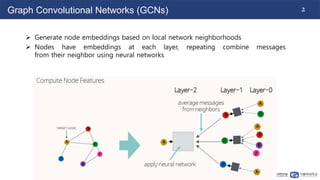
Graph Convolutional Networks (GCNs)
 Generate node embeddings based on local network neighborhoods
 Nodes have embeddings at each layer, repeating combine messages
from their neighbor using neural networks
3
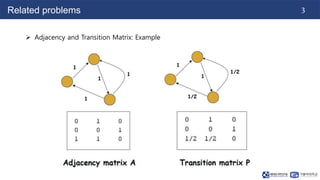
Related problems
 Adjacency and Transition Matrix: Example
4
Key ideas
 A self-supervised approach for learning node and graph level representations by
contrasting structural views of graphs..
 Increasing the number of views to more than two or contrasting multi-scale
encodings do not improve performance , and the best performance is achieved
by contrasting encodings from first-order neighbors and a graph diffusion.
5
Contrastive Multi-View Representation Learning on Graphs
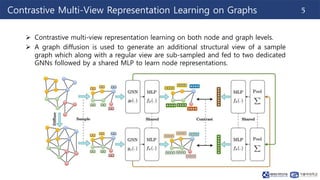
 Contrastive multi-view representation learning on both node and graph levels.
 A graph diffusion is used to generate an additional structural view of a sample
graph which along with a regular view are sub-sampled and fed to two dedicated
GNNs followed by a shared MLP to learn node representations.
6
Augmentations
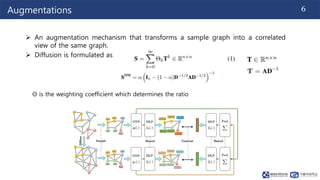
 An augmentation mechanism that transforms a sample graph into a correlated
view of the same graph.
 Diffusion is formulated as
Θ is the weighting coefficient which determines the ratio
7
Encoder
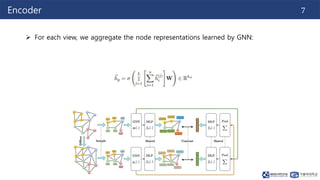
 For each view, we aggregate the node representations learned by GNN:
8
Training
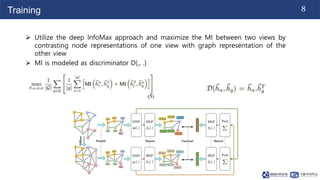
 Utilize the deep InfoMax approach and maximize the MI between two views by
contrasting node representations of one view with graph representation of the
other view
 MI is modeled as discriminator D(., .)
9
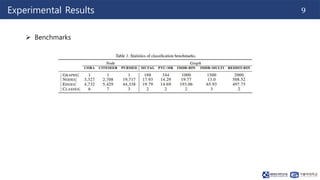
Experimental Results
 Benchmarks
10
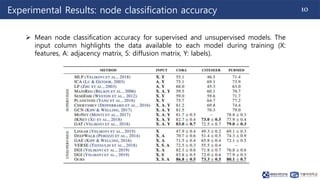
Experimental Results: node classification accuracy
 Mean node classification accuracy for supervised and unsupervised models. The
input column highlights the data available to each model during training (X:
features, A: adjacency matrix, S: diffusion matrix, Y: labels).
11
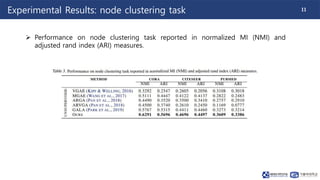
Experimental Results: node clustering task
 Performance on node clustering task reported in normalized MI (NMI) and
adjusted rand index (ARI) measures.
12
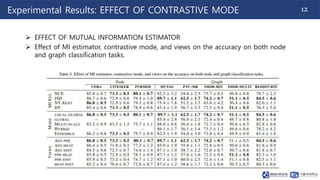
Experimental Results: EFFECT OF CONTRASTIVE MODE
 EFFECT OF MUTUAL INFORMATION ESTIMATOR
 Effect of MI estimator, contrastive mode, and views on the accuracy on both node
and graph classification tasks.
13
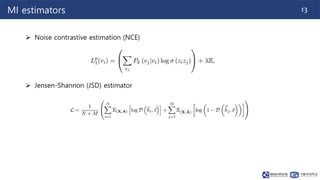
MI estimators
 Noise contrastive estimation (NCE)
 Jensen-Shannon (JSD) estimator
14
Conclusion
 a self-supervised approach for learning node and graph level
representations by contrasting encodings from two structural views
of graphs including first-order neighbors and a graph diffusion.
 The paper showed that unlike visual representation learning,
increasing the number of views or contrasting multi-scale encodings
do not improve the performance.
240311_Thuy_Labseminar[Contrastive Multi-View Representation Learning on Graphs].pptx

240311_Thuy_Labseminar[Contrastive Multi-View Representation Learning on Graphs].pptx

  • 1.
    Van Thuy Hoang NetworkScience Lab Dept. of Artificial Intelligence The Catholic University of Korea E-mail: hoangvanthuy90@gmail.com 240302 Kaveh Hassani et.al., PMLR 2020
  • 2.
    2 Graph Convolutional Networks(GCNs)  Generate node embeddings based on local network neighborhoods  Nodes have embeddings at each layer, repeating combine messages from their neighbor using neural networks
  • 3.
    3 Related problems  Adjacencyand Transition Matrix: Example
  • 4.
    4 Key ideas  Aself-supervised approach for learning node and graph level representations by contrasting structural views of graphs..  Increasing the number of views to more than two or contrasting multi-scale encodings do not improve performance , and the best performance is achieved by contrasting encodings from first-order neighbors and a graph diffusion.
  • 5.
    5 Contrastive Multi-View RepresentationLearning on Graphs  Contrastive multi-view representation learning on both node and graph levels.  A graph diffusion is used to generate an additional structural view of a sample graph which along with a regular view are sub-sampled and fed to two dedicated GNNs followed by a shared MLP to learn node representations.
  • 6.
    6 Augmentations  An augmentationmechanism that transforms a sample graph into a correlated view of the same graph.  Diffusion is formulated as Θ is the weighting coefficient which determines the ratio
  • 7.
    7 Encoder  For eachview, we aggregate the node representations learned by GNN:
  • 8.
    8 Training  Utilize thedeep InfoMax approach and maximize the MI between two views by contrasting node representations of one view with graph representation of the other view  MI is modeled as discriminator D(., .)
  • 9.
  • 10.
    10 Experimental Results: nodeclassification accuracy  Mean node classification accuracy for supervised and unsupervised models. The input column highlights the data available to each model during training (X: features, A: adjacency matrix, S: diffusion matrix, Y: labels).
  • 11.
    11 Experimental Results: nodeclustering task  Performance on node clustering task reported in normalized MI (NMI) and adjusted rand index (ARI) measures.
  • 12.
    12 Experimental Results: EFFECTOF CONTRASTIVE MODE  EFFECT OF MUTUAL INFORMATION ESTIMATOR  Effect of MI estimator, contrastive mode, and views on the accuracy on both node and graph classification tasks.
  • 13.
    13 MI estimators  Noisecontrastive estimation (NCE)  Jensen-Shannon (JSD) estimator
  • 14.
    14 Conclusion  a self-supervisedapproach for learning node and graph level representations by contrasting encodings from two structural views of graphs including first-order neighbors and a graph diffusion.  The paper showed that unlike visual representation learning, increasing the number of views or contrasting multi-scale encodings do not improve the performance.