Embed presentation
Downloaded 17 times


This document discusses machine learning interpretability and explainability. It begins with introducing the problem of making black box machine learning models more interpretable and defining key concepts. Next, it reviews popular interpretability methods like LIME, LRP, DeepLIFT and SHAP. It then describes the authors' proposed model CAMEL, which uses clustering to learn local interpretable models without sampling. The document concludes by discussing evaluation of interpretability models and important considerations like the tradeoff between performance and interpretability.


Introduces the topic, outlines key sections including definitions, state of the art, and model specifics.
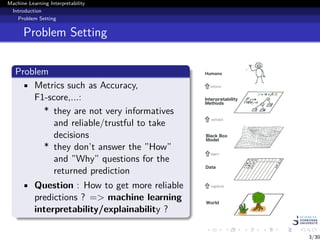
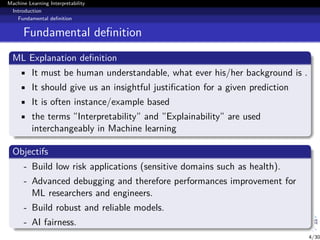
Discusses problems with traditional metrics of model performance and offers a fundamental definition of interpretability.
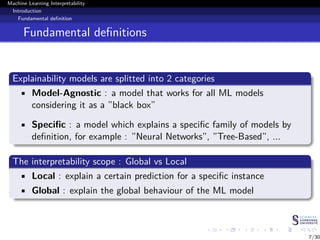
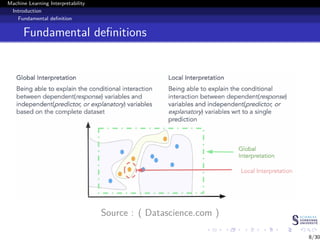
Explains various interpretability models such as model-agnostic and specific models, and discusses local versus global interpretability.
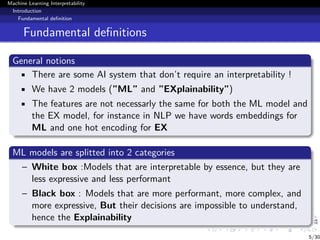
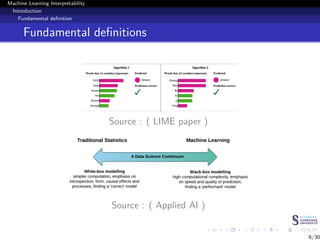
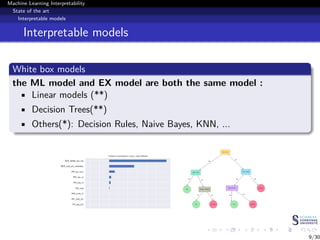
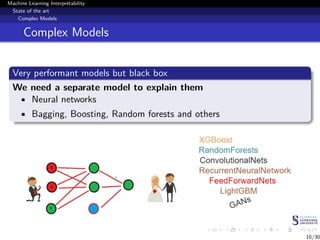
Discusses white-box models that are inherently interpretable and complex black-box models that necessitate separate explanations.
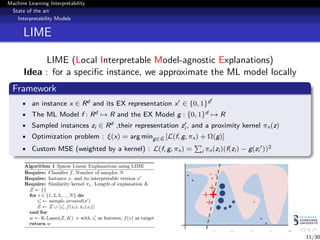
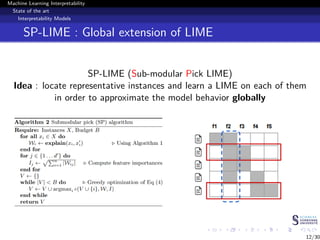
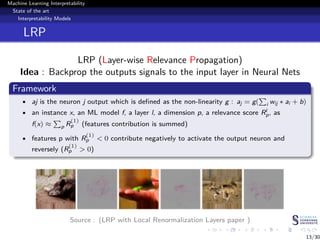
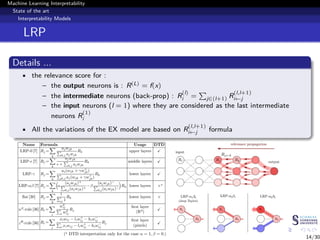
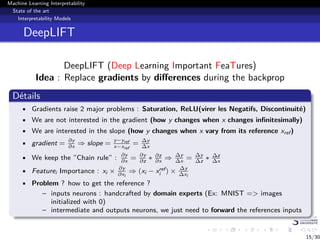
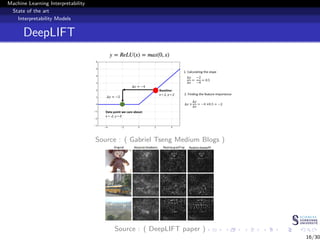
Details on various interpretability models including LIME, Layer-wise Relevance Propagation, and DeepLIFT with their frameworks.
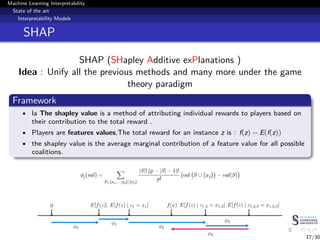
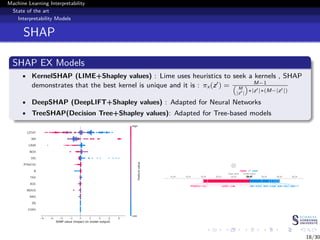
Introduces SHAP as a unifying explanation model and discusses examples like saliency maps and adversarial attacks.
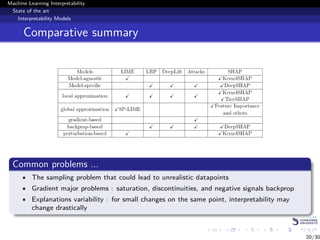
Identifies common problems faced by interpretability models including sampling issues and gradients.
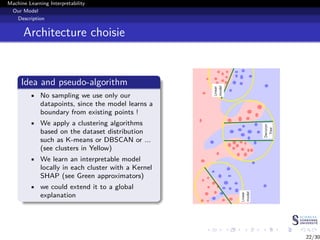
Describes the proposed model CAMEL, which is based on clustering and aims for model-agnostic explanations.
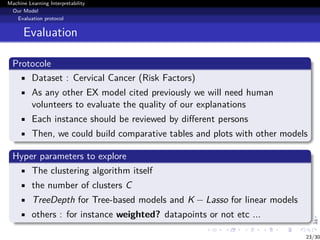
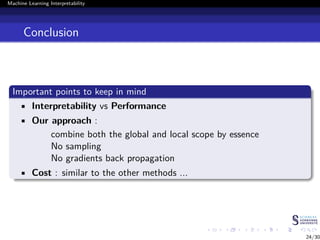
Outlines evaluation protocol for model effectiveness using a cervical cancer dataset, and summarizes key points.
Lists extensive references used throughout the presentation for further exploration of machine learning interpretability.