Introduction to HRM
First Chapter 1
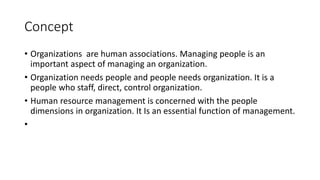
Concept
• Organizations are human associations. Managing people is an
important aspect of managing an organization.
• Organization needs people and people needs organization. It is a
people who staff, direct, control organization.
• Human resource management is concerned with the people
dimensions in organization. It Is an essential function of management.
•
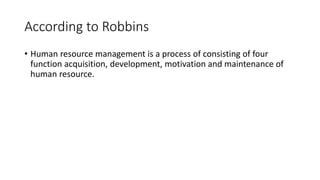
According to Robbins
• Human resource management is a process of consisting of four
function acquisition, development, motivation and maintenance of
human resource.
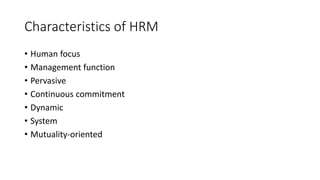
Characteristics of HRM
• Human focus
• Management function
• Pervasive
• Continuous commitment
• Dynamic
• System
• Mutuality-oriented
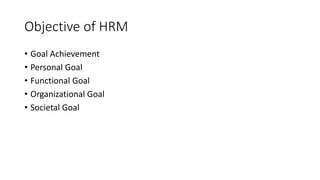
Objective of HRM
• Goal Achievement
• Personal Goal
• Functional Goal
• Organizational Goal
• Societal Goal
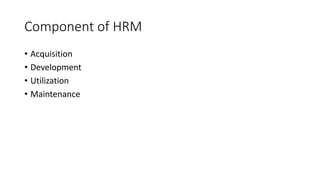
Component of HRM
• Acquisition
• Development
• Utilization
• Maintenance
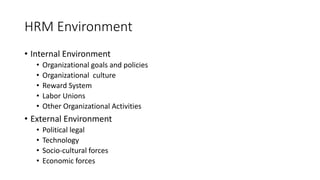
HRM Environment
• Internal Environment
• Organizational goals and policies
• Organizational culture
• Reward System
• Labor Unions
• Other Organizational Activities
• External Environment
• Political legal
• Technology
• Socio-cultural forces
• Economic forces
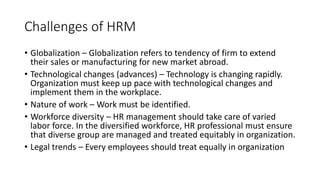
Challenges of HRM
• Globalization – Globalization refers to tendency of firm to extend
their sales or manufacturing for new market abroad.
• Technological changes (advances) – Technology is changing rapidly.
Organization must keep up pace with technological changes and
implement them in the workplace.
• Nature of work – Work must be identified.
• Workforce diversity – HR management should take care of varied
labor force. In the diversified workforce, HR professional must ensure
that diverse group are managed and treated equitably in organization.
• Legal trends – Every employees should treat equally in organization
Role of HR Manager
• Line function role
• Staff function role
• Representative role
• Coordinative role
• Mediator role
• Strategic role
• Integrative Role

Introduction to human resource management

  • 1.
  • 2.
    Concept • Organizations arehuman associations. Managing people is an important aspect of managing an organization. • Organization needs people and people needs organization. It is a people who staff, direct, control organization. • Human resource management is concerned with the people dimensions in organization. It Is an essential function of management. •
  • 3.
    According to Robbins •Human resource management is a process of consisting of four function acquisition, development, motivation and maintenance of human resource.
  • 4.
    Characteristics of HRM •Human focus • Management function • Pervasive • Continuous commitment • Dynamic • System • Mutuality-oriented
  • 5.
    Objective of HRM •Goal Achievement • Personal Goal • Functional Goal • Organizational Goal • Societal Goal
  • 6.
    Component of HRM •Acquisition • Development • Utilization • Maintenance
  • 7.
    HRM Environment • InternalEnvironment • Organizational goals and policies • Organizational culture • Reward System • Labor Unions • Other Organizational Activities • External Environment • Political legal • Technology • Socio-cultural forces • Economic forces
  • 8.
    Challenges of HRM •Globalization – Globalization refers to tendency of firm to extend their sales or manufacturing for new market abroad. • Technological changes (advances) – Technology is changing rapidly. Organization must keep up pace with technological changes and implement them in the workplace. • Nature of work – Work must be identified. • Workforce diversity – HR management should take care of varied labor force. In the diversified workforce, HR professional must ensure that diverse group are managed and treated equitably in organization. • Legal trends – Every employees should treat equally in organization
  • 9.
    Role of HRManager • Line function role • Staff function role • Representative role • Coordinative role • Mediator role • Strategic role • Integrative Role