Human resource managementis to
make the most productive use of
human resource to the greatest
benefits of the organization and
individuals.
4.
Human Resources
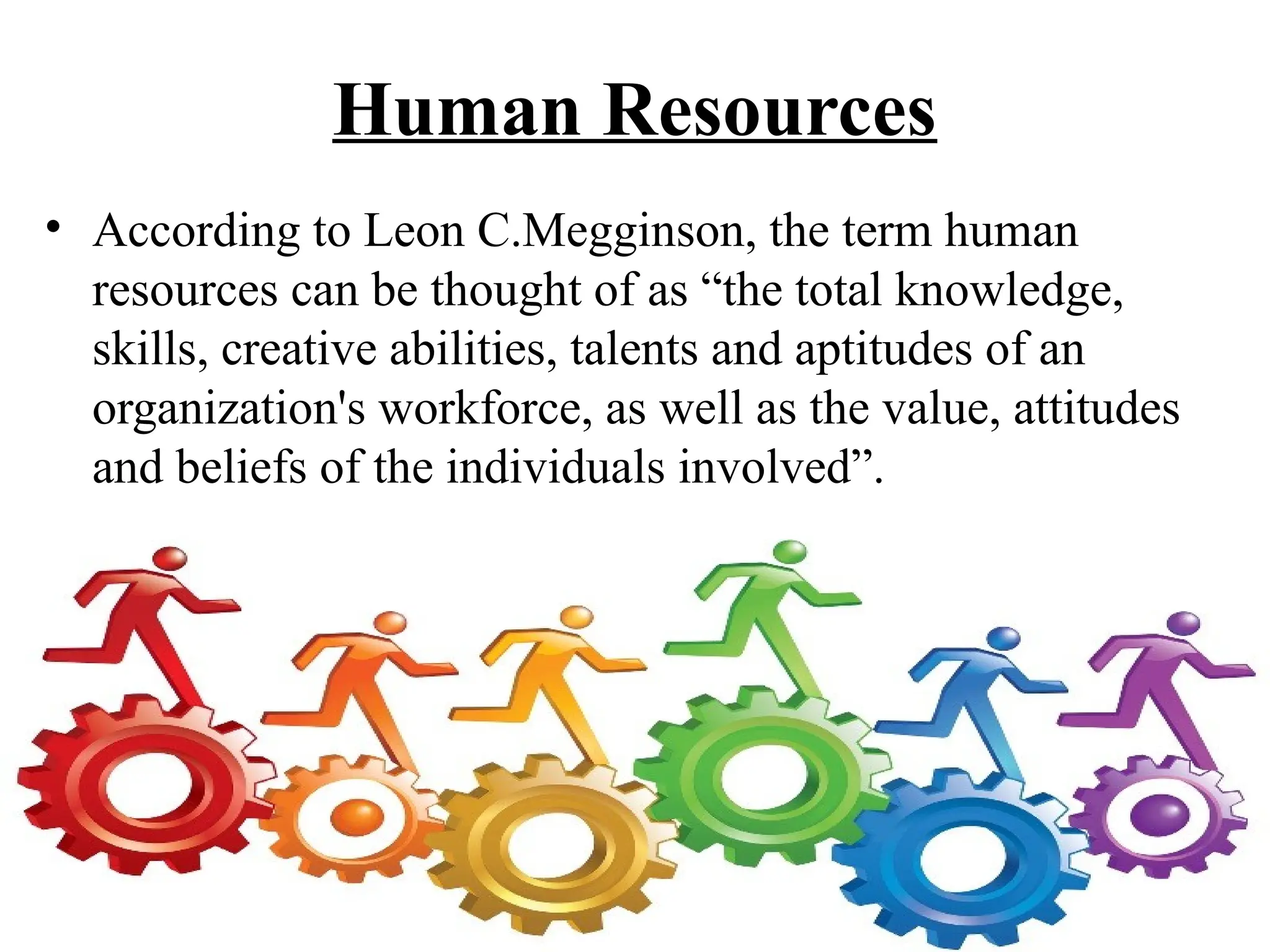
• Accordingto Leon C.Megginson, the term human
resources can be thought of as “the total knowledge,
skills, creative abilities, talents and aptitudes of an
organization's workforce, as well as the value, attitudes
and beliefs of the individuals involved”.
5.
Personnel management
Michael J.Jucius defined Personnel Management
as “the field of management which has to do with
planning, organizing, directing & controlling the
functions of procuring, developing, maintaining
and utilizing a labor force, such that the-
• Objectives of the company is met
• Objective of all levels of personnel are served
• Objectives of society are duly considered and
served
8.
Meaning of HRM
•HRM can be defined as managing the
functions of employing, developing and
compensating human resources
• resulting in the creation and development of
human relations with a view to contribute
proportionately to the organizational,
individual and social goals.
9.
Evolution of HRM
•The commodity concept
• The factor of production concept
• The good will concept
• The paternalistic/ Paternalism concept
• The humanitarian concept
• The human resources concept
• The emerging concept
10.
Nature of HRM
•Pervasive force
• Action oriented
• Individually oriented
• People oriented
• Future oriented
• Development oriented
11.
• Integrating mechanism
•Comprehensive function
• Auxiliary service
• Inter- disciplinary function
• Continuous function
12.
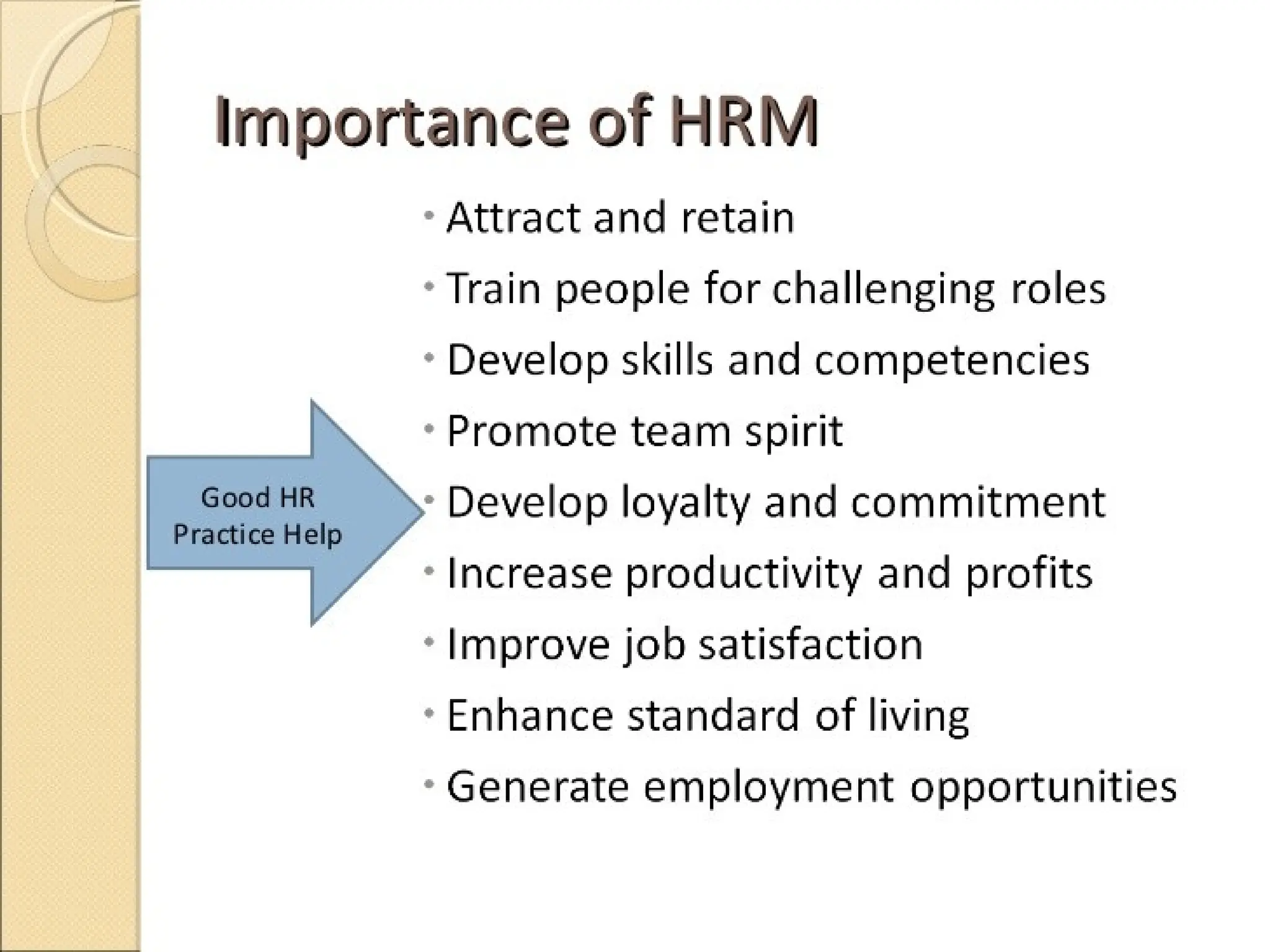
Importance of HRM
IndividualLevel:
• Man v/s Machine
• Team work
• Growth
opportunities
• Commitment
towards work
13.
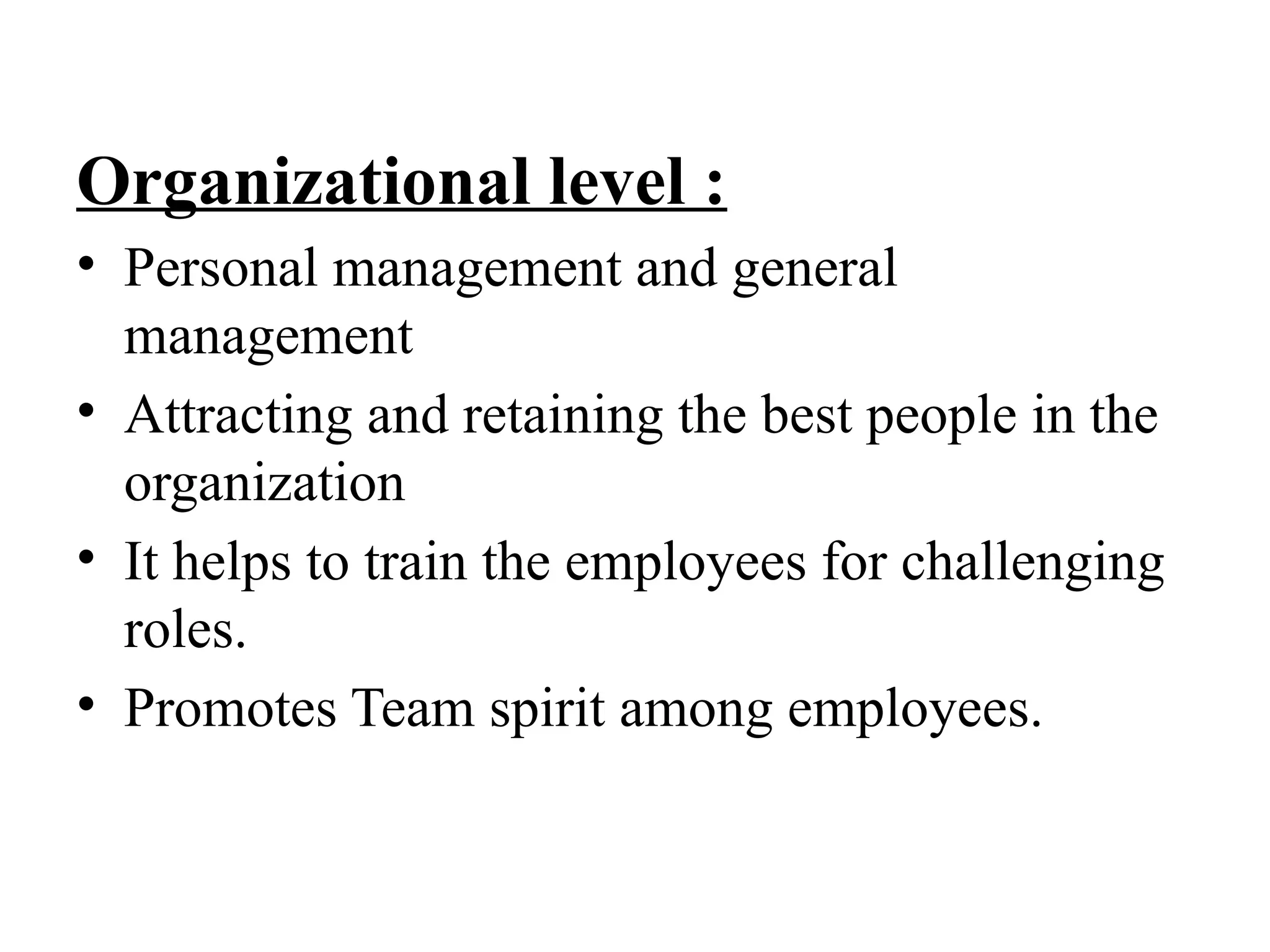
Organizational level :
•Personal management and general
management
• Attracting and retaining the best people in the
organization
• It helps to train the employees for challenging
roles.
• Promotes Team spirit among employees.
14.
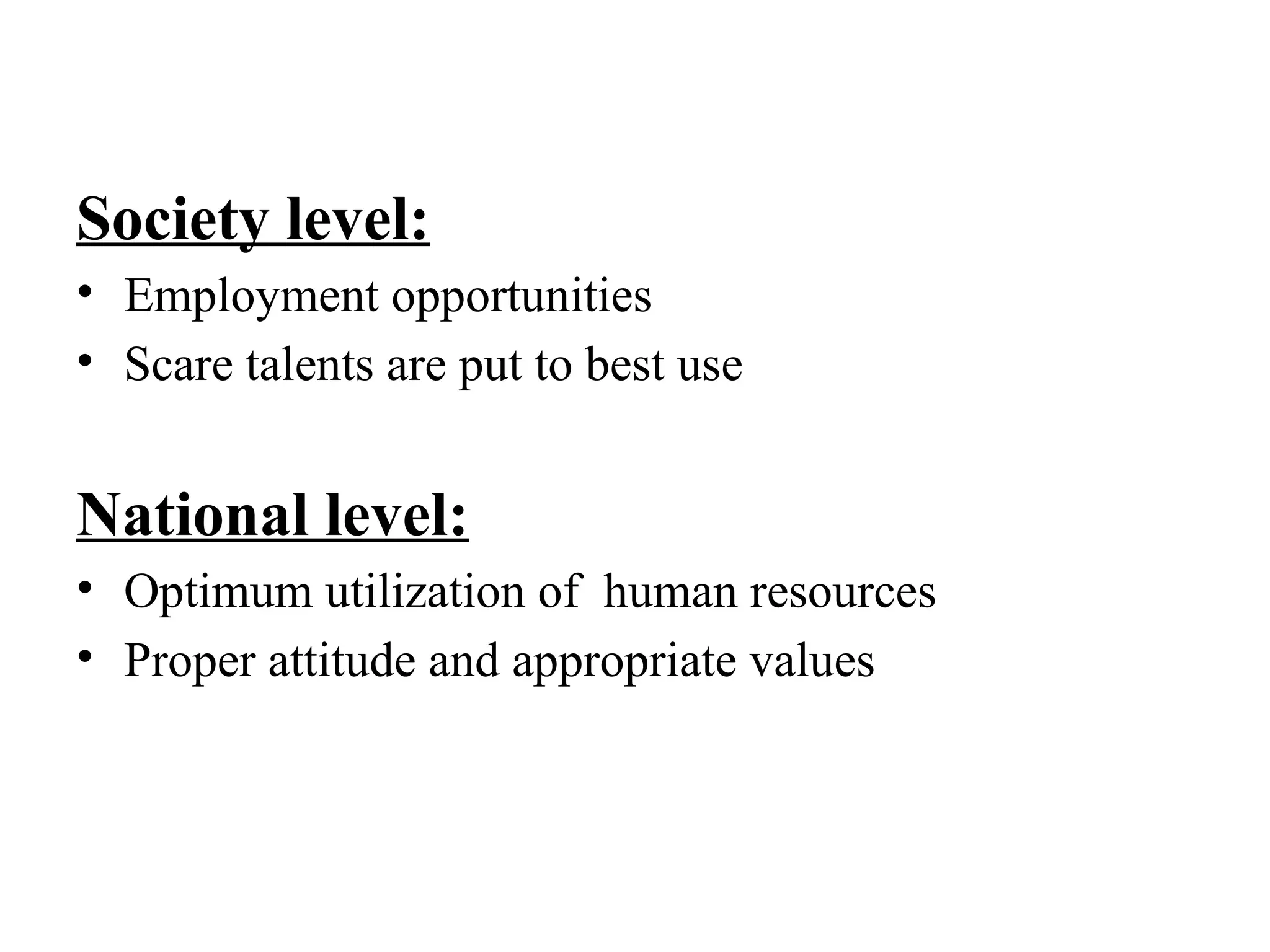
Society level:
• Employmentopportunities
• Scare talents are put to best use
National level:
• Optimum utilization of human resources
• Proper attitude and appropriate values
16.
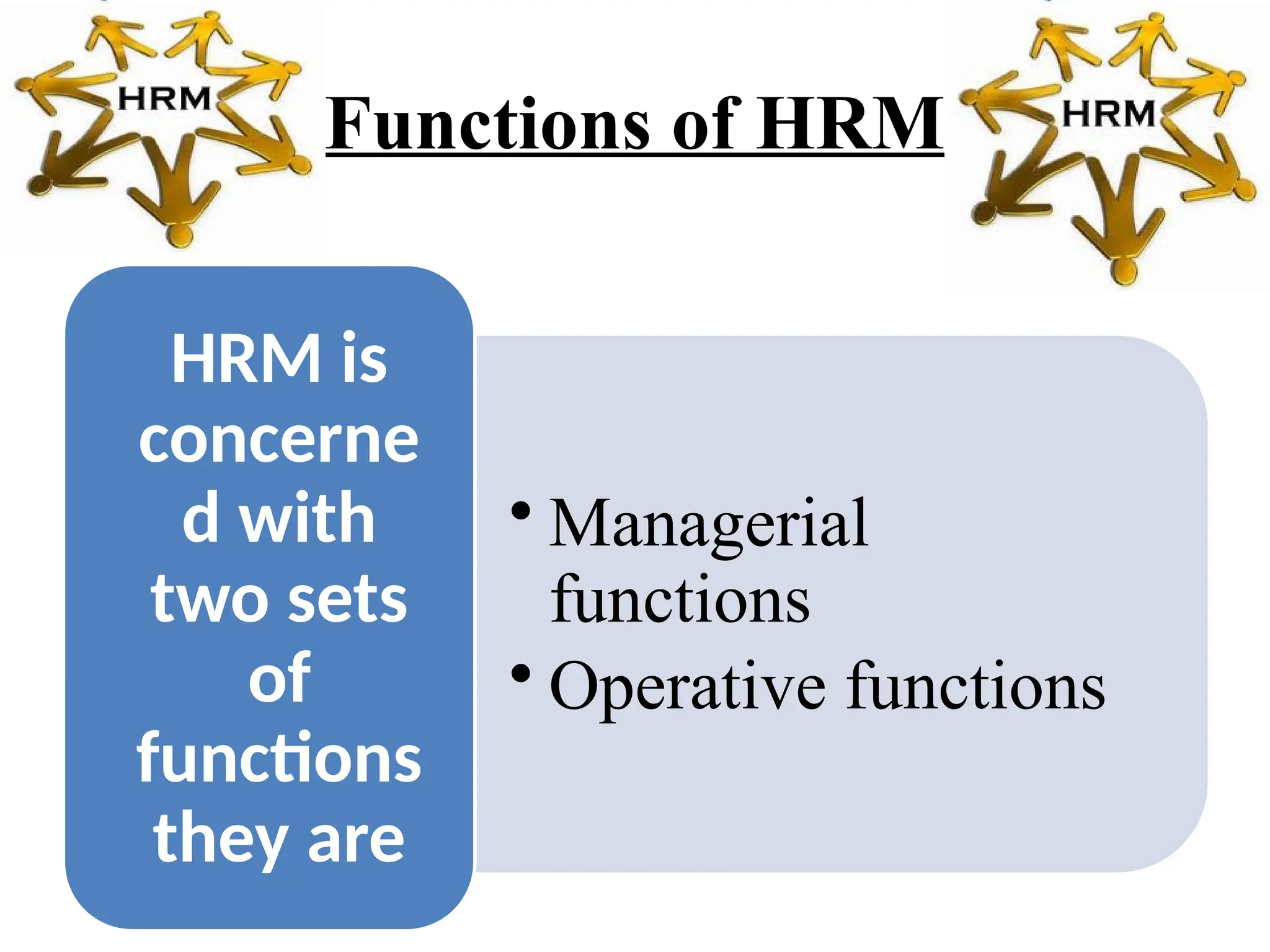
Functions of HRM
•Managerial
functions
• Operative functions
HRM is
concerne
d with
two sets
of
functions
they are
17.
Managerial functions
• Planning:It deals with the determination of the future course of
action to achieve desired results.
• Organizing: it is concerned with proper grouping of personnel
activities, assigning of different groups of activities to different
individuals and delegation of authority.
• Directing: it involves supervising and guiding the personnel. To
execute plans, direction is essential without direction there is no
destination. Direction consists of motivation and leadership.
18.
• Controlling: itis measuring the employee’s
performance, correcting negative deviations and
industrial assuring an efficient accomplishment
of plans.
– Individual becomes aware of his/her performance
through review reports, records and personnel audit
programmes.
19.
Operative functions
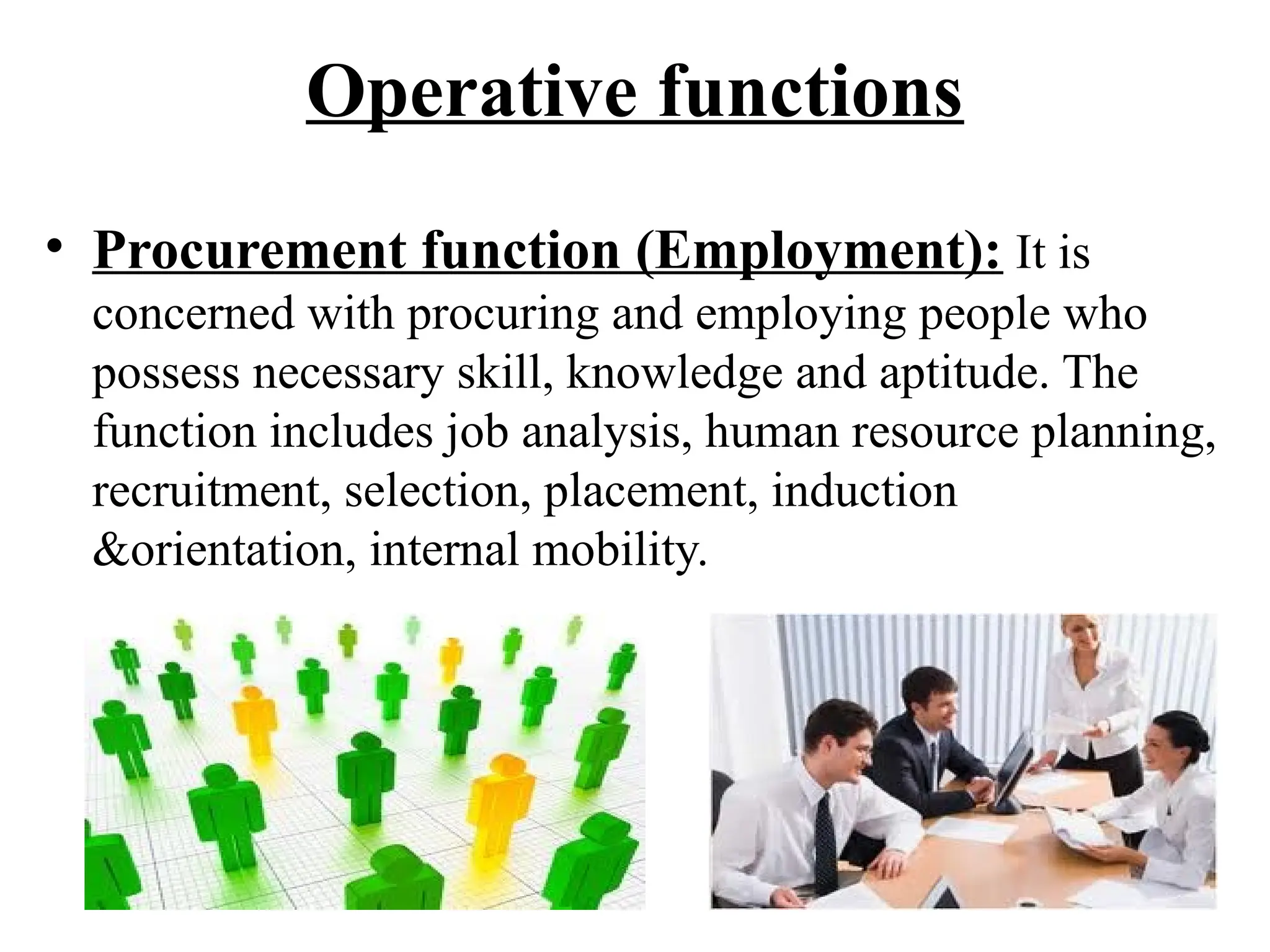
• Procurementfunction (Employment): It is
concerned with procuring and employing people who
possess necessary skill, knowledge and aptitude. The
function includes job analysis, human resource planning,
recruitment, selection, placement, induction
&orientation, internal mobility.
20.
• Human ResourceDevelopment: It is the process
of improving, moulding, changing and developing the
skills, knowledge etc. The development of employees is
done by providing them with,
proper training,
executive development,
career planning and development,
human resource development which aims at developing the
total organization.
21.
• Motivation andcompensation: It is the process
which inspires people to give their best to the
organization through the intrinsic and extrinsic rewards.
This function includes job design, work scheduling,
motivation, job evaluation, performance appraisal,
compensation administration, incentives and benefits.
• Maintenance: It aims at protecting and preserving the
physical and psychological health of employees through
various welfare measures.
This function includes health and safety, employee welfare,
and social security measures.
22.
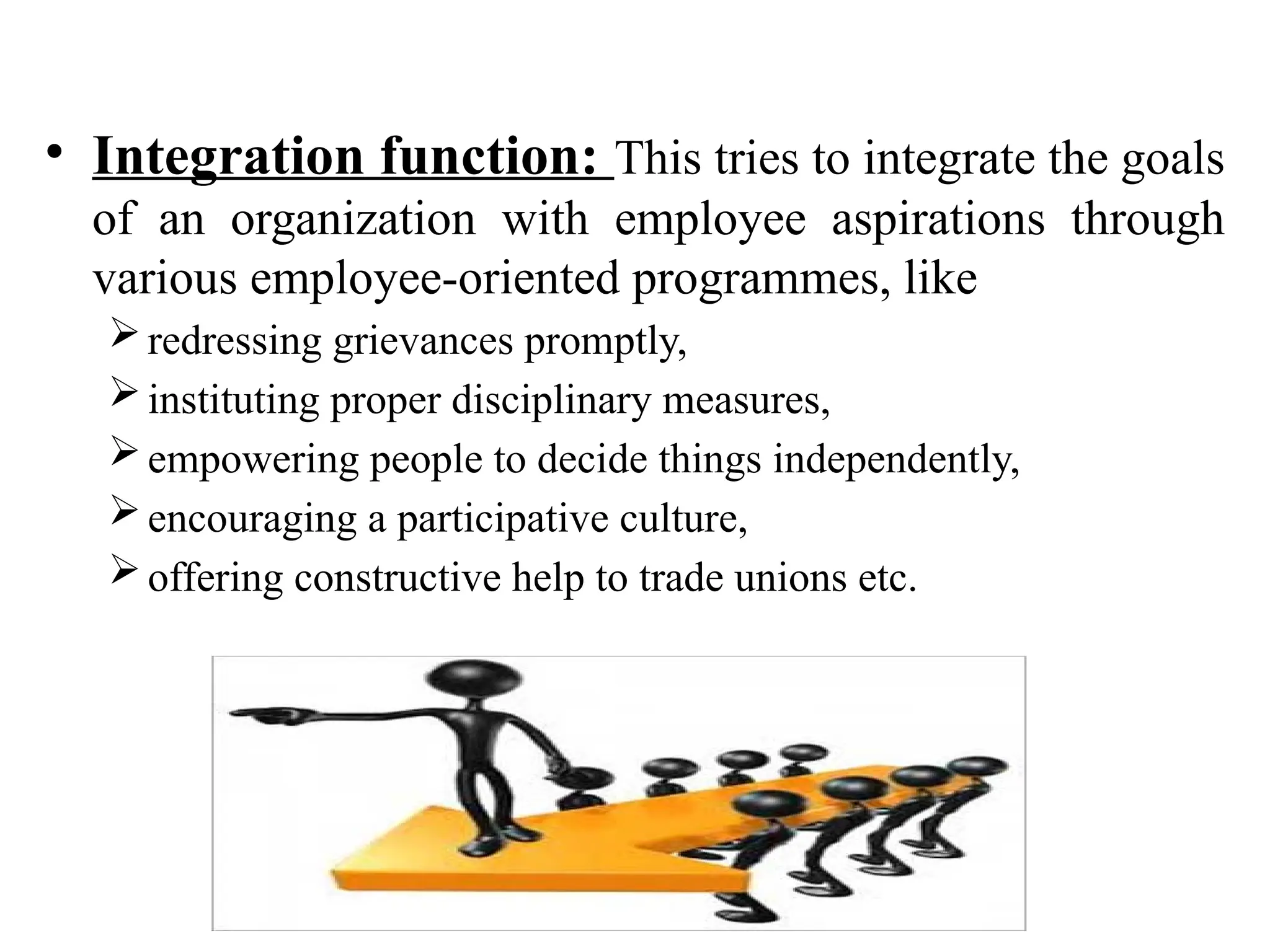
• Integration function:This tries to integrate the goals
of an organization with employee aspirations through
various employee-oriented programmes, like
redressing grievances promptly,
instituting proper disciplinary measures,
empowering people to decide things independently,
encouraging a participative culture,
offering constructive help to trade unions etc.
23.
• Emerging issues:Effective management of human
resources depends on refining HRM practices to
changing conditions.
• Hence there is a need to look at other important issues that can
motivate people to give their best in a dynamic and ever-
changing environment.
24.
Principles of HRM
Principlesof HRM have been well summarized in 10c’s :
Comprehensiveness
Cost effective
Control
Coherence
Communication
Creativity
Competence
Credibility
Change
Commitment
25.
Comprehensiveness
proper management ofall aspect of the people
This means that the financial, health, transportation,
tools and anything employees need to work should be
well taken care of.
Cost effective
Company should ensure that they remunerate their
employees accordingly. The employees reward system
should be able to sustain the organization
26.
Control
Firm shouldensure that productivity and quality are
achieved and maintained though employees.
Control should be exercised carefully so that it does not
seem like tyranny
Coherence
Every organization should have mission and vision.
They should focus on company needs and employees
abilities.
27.
Communication
Communication is veryimportant in every
organization through communication further can
there is a flow of information that is necessary for
efficiency.
Creativity
It is key, if a firm is to be efficient in human
resources management firm should adopt new
ways of human resources management as long as
it fits their companies.
28.
Competence
Proper training shouldbe given to the
employees to compete in the market.
Credibility
Company should have a credibility and we
should direct employees to a common goal.
29.
Change
Change is inevitablefor business.
Change is necessary it produce better results.
Commitment
It is the duty of HRM to keep employees
committed to the organization.
30.
Role of HRmanager
The Human Resources Manager is responsible for
oversight of all human resources systems and
procedures,
including recruitment and selection, training and
development, performance management (evaluations),
conflict resolution, and compensation/rewards
management and ensuring compliance with governing
regulations.
and he/she will be responsible for the development and
implementation of HR policies and procedures.
31.
The three importantrole of HR manager
are as follows:
1) Administrative roles
2) Operational roles
3) Strategic roles
32.
Administrative roles
The administrativeroles of HR manager include policy
formulation and implementation, housekeeping,
records maintenance, welfare administration legal
compliance etc.
Policy maker
Administrative expert
Advisor
Housekeeper
Counselor
Legal consultant
33.
Policy maker
Formationof policies & implementation, governing
talent acquisition and retention, wage and salary
administration, welfare activities, personnel records
etc.
Administrative expert
Record keeping, maintaining employees file,& HR
related database processing employee benefit claims,
answering queries regarding leave, transport &
medical facilities etc.
Advisor
Advising, suggesting, conflict resolution,
34.
Housekeeper
Time keeping,pre employment testing. Reference
checking, wellness programs, maintenance records
etc
Counselor
Problems of the employees are tackled and resolved
Legal consultant
Grievance handling, settling disputes, handling
disciplinary cases etc
35.
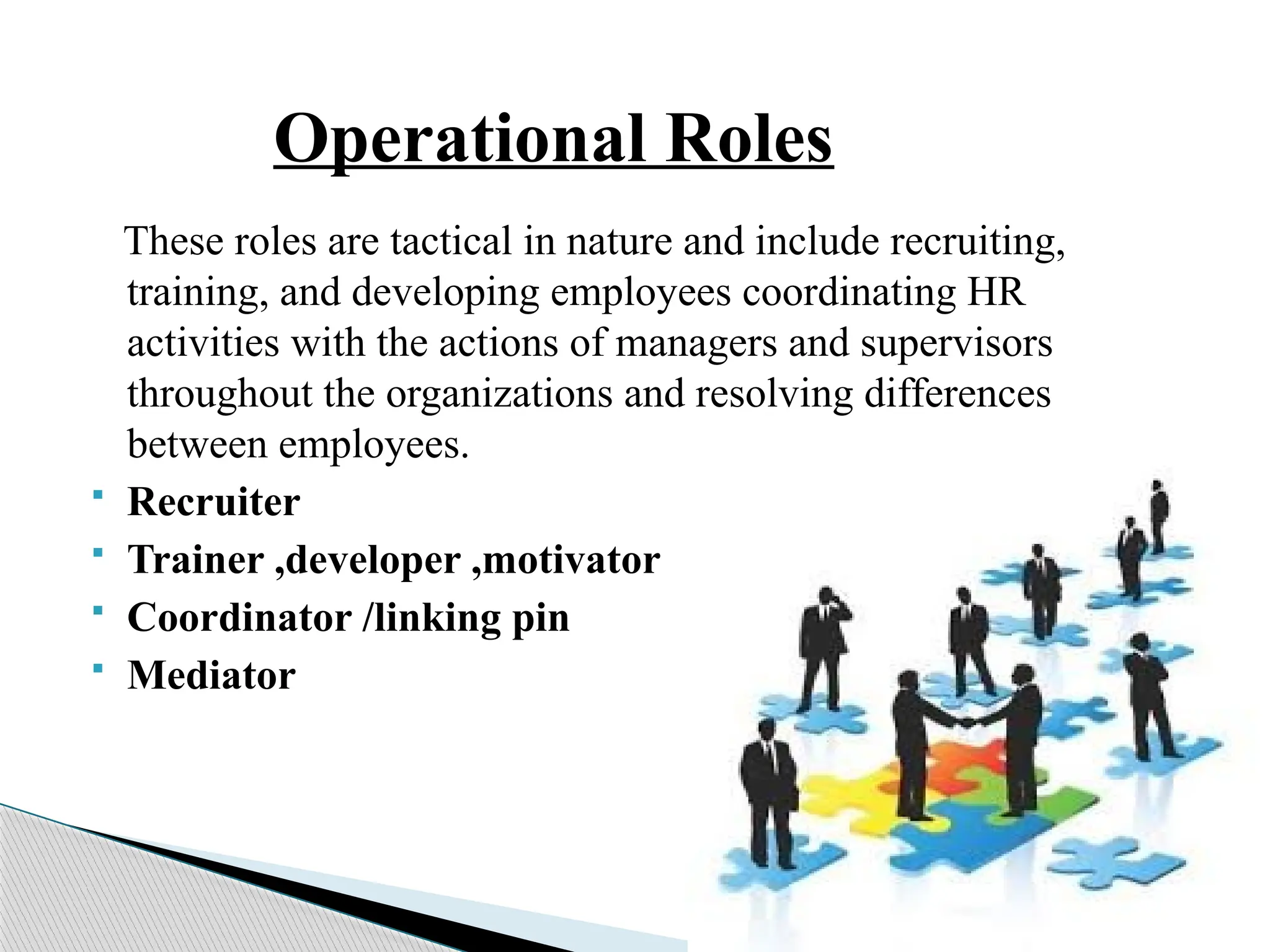
Operational Roles
These rolesare tactical in nature and include recruiting,
training, and developing employees coordinating HR
activities with the actions of managers and supervisors
throughout the organizations and resolving differences
between employees.
Recruiter
Trainer ,developer ,motivator
Coordinator /linking pin
Mediator
36.
Recruiter
to recruitsuitable candidate for the
organization.
Trainer developer motivator
Responsible for all the organization
staff Training and Development
37.
Coordinator /linkingpin
act as a linking pin between various departments
of an organization.
Mediator
The HR manager acts as a mediator in case of
friction between two employees, groups of
employees, superiors, and subordinates and
employees and management with the sole objective
of maintaining industrial harmony.
38.
Strategic roles
StrategicPartner.
HR must ensure that its practices, processes, and policies
complement the overall organizational strategy. It needs to
develop a capacity to execute that strategy. HR must minimize
the time it takes to implement the strategy.
Change Agent.
The HR role is to facilitate that change in organizations. This
includes modelling change to other departments, advocating
change across the entire organization, resolving issues that
arise from change, and institutionalizing change by
implementing efficient and flexible processes.
The internalstructure of personnel development depends on
various factors such as nature and size of the organization,
managerial preferences to structure operations clearly, external
forces etc.
Small firms have only a single section headed by a personnel
officer taking care of everything .
medium sized firms may create a separate personnel department
having expert in the personnel field supported by administrative
staff.
In large firms the structure of a personnel department may take
various shapes depending on a organizational resources,
competitive pressures and total employee strength.
Designing organisational structure
41.
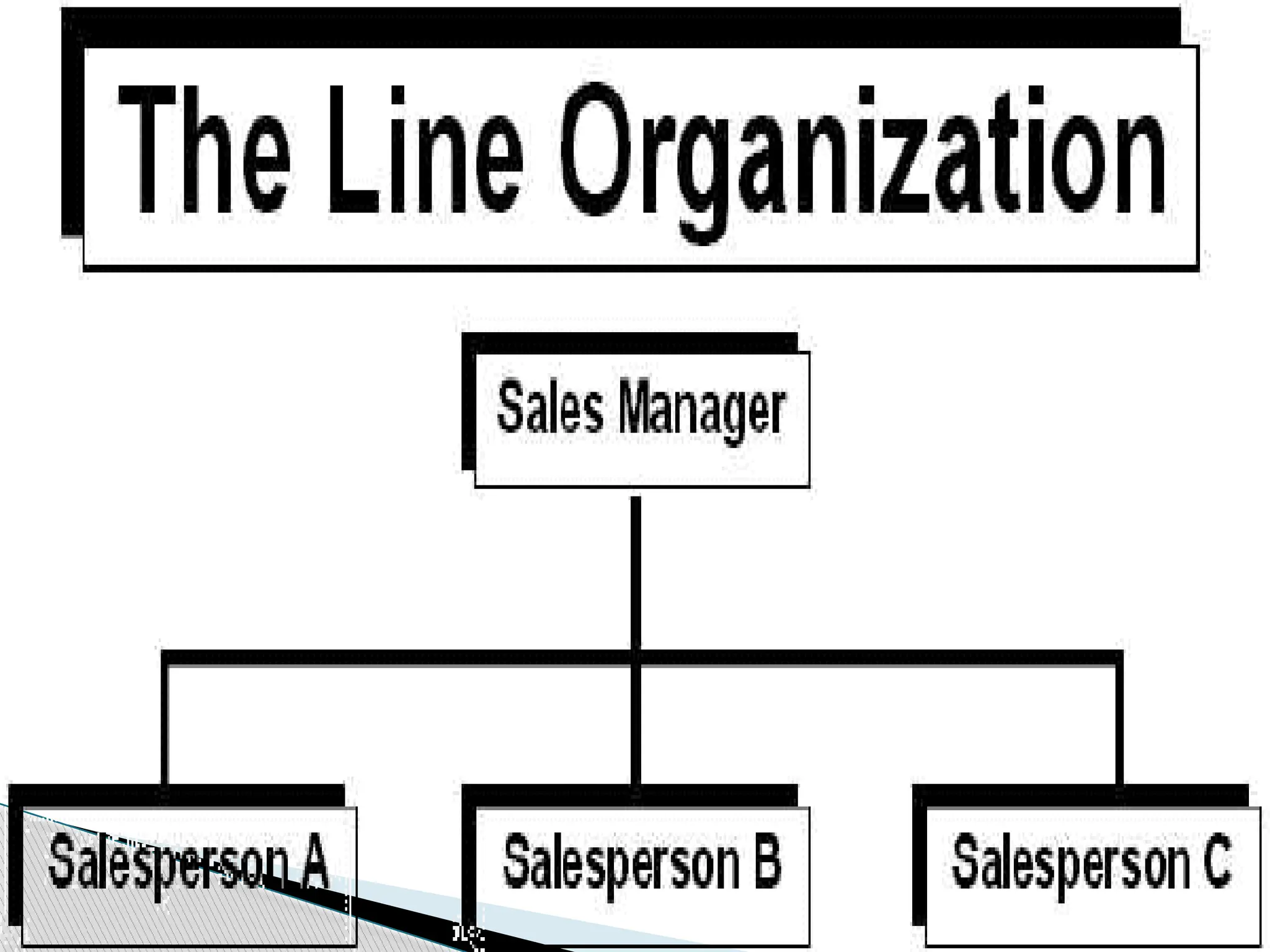
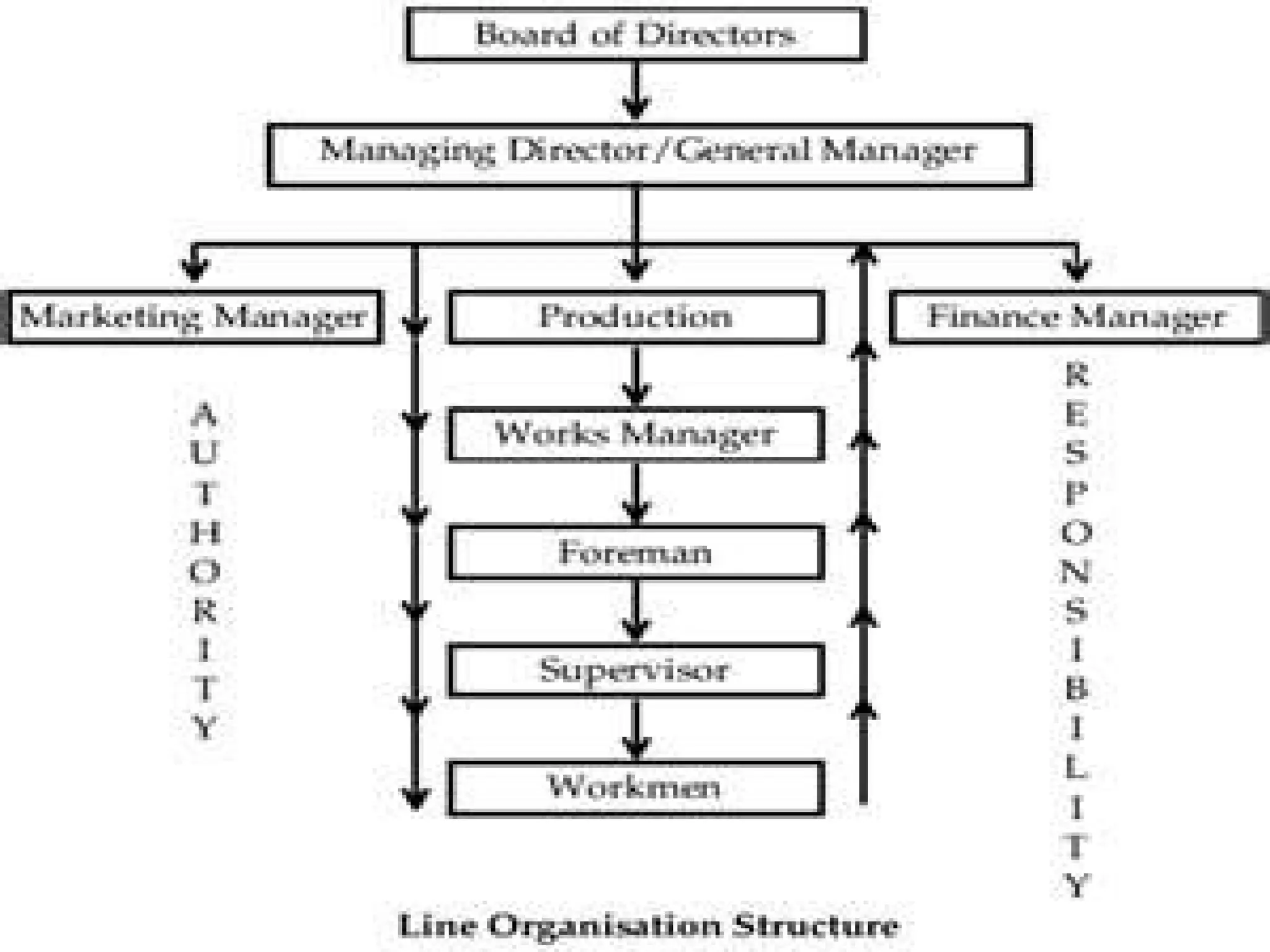
Line organization
Line structureis more common in small firms this structure
authority flows in a direct line from supervisors to subordinates.
Each employee knows who his superior is and who has authority
to issue orders managers have full authority in their areas of
operation and are responsible for final result.
Line authority implies the right to give orders and to have
decision implemented.
42.
The “one-man-oneboss” principle is observed
strictly.
authority are clear and there is strict discipline as
persons working at lower levels can have access to
higher level officers only through their immediate
bosses
45.
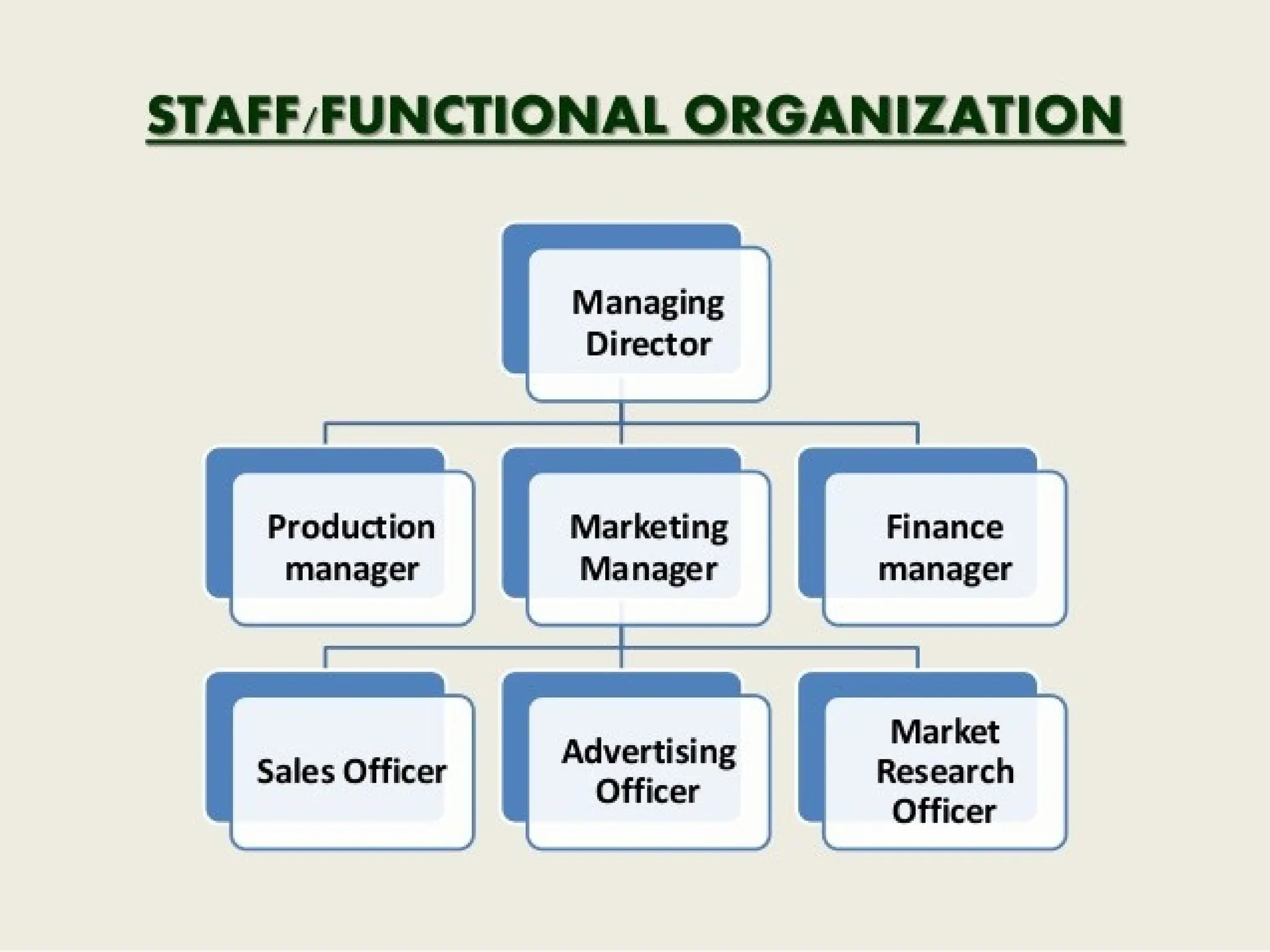
Functional (Staff) organization
Inany functional organization, all activates of an
organization are divided into various functions such as
production, marketing, finance etc.
each functional area is headed by a especially who
directs specialist who direct the activities of that area for
the entire organization.
Every, employee, therefore, is required to report to
various functional heads.
46.
The functionalhead has line authority over
subordinates in his own area. Additionally, he has
functional authority over activities in there functional
areas.
The term “functional authority” thus is a limited form
of line authority given to functional experts in an area
where certain specialized activities are carried out
under the normal supervision of managers belonging
to other department .
48.
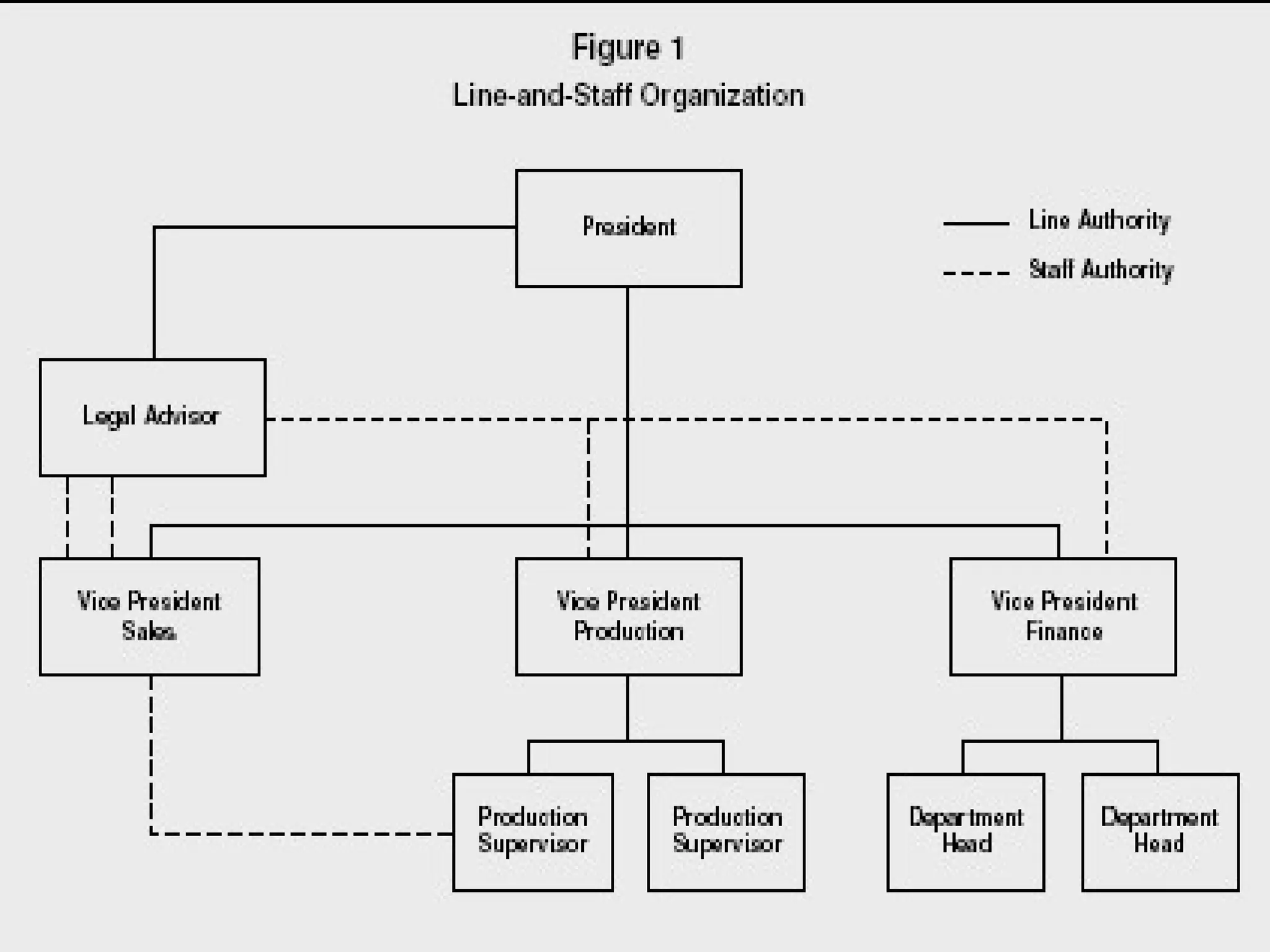
Line and stafforganization
The line and staff structure combines the benefits of
both line organization and functional organization.
Staff positions are created to assist line manager .
Thus the personnel department offers and advices on
personal issues to all departments without violating one
unity of command principle.
50.
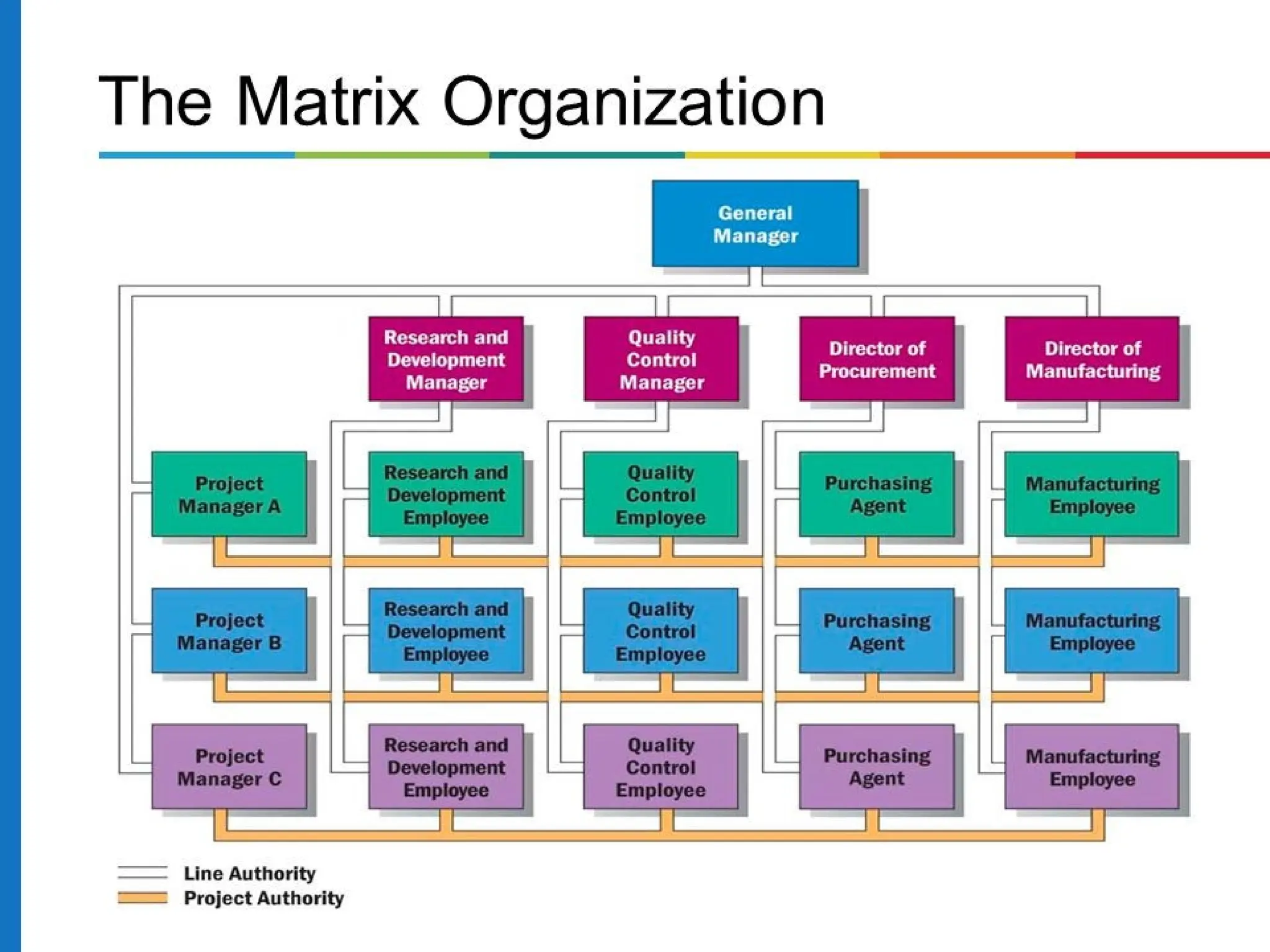
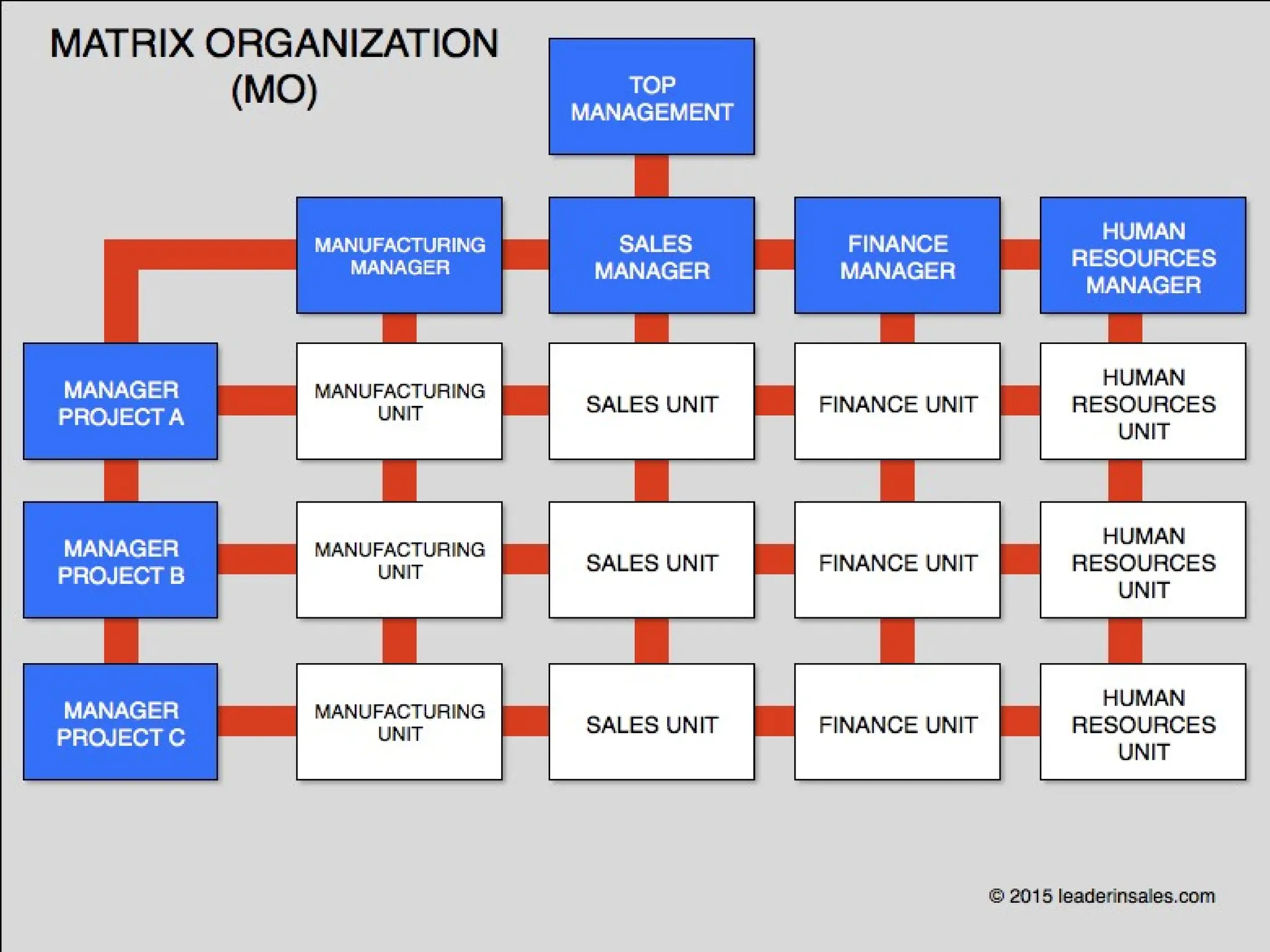
Matrix Organization
AMatrix Organizational structure is a company
structure in which the reporting relationships are set up
as a grid, or Matrix, rather than in the traditional
hierarchy.
In other words, employees have dual reporting
relationships - generally to both a functional manager
and a product manager