HUMAN RESOURCES
MANAGEMENT
1
By: SARA BABIKER _ May,2014
► Preface
► The Importance of HRM
► From Traditional to Modern HRM
► Human Resources Management HRM
► The Benefits and Goals of HRM
► HRM Landscape
► Characteristics of HRM (4 Ps)
► Challenges in HRM
Outlines:
2
Preface
Human Resources Management is a management of work
and people towards desired ends, is a fundamental
activity in any organization in which human beings are
employed. It is not something whose existence needs to
be elaborately justified; HRM is a certain consequence of
starting and growing an organization. While there are
many of variations in the ideologies, styles, and
managerial resources engaged, HRM happens in some
form or other.
3
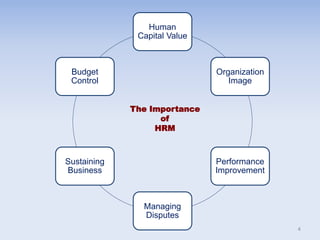
Human
Capital Value
Organization
Image
Performance
Improvement
Managing
Disputes
Sustaining
Business
Budget
Control
The Importance
of
HRM
4
►Human Capital Value
 Having human resources function is important. An internal
human resources staff or expert can increase the
understanding of how important human capital is to the
organization’s bottom line.
 In particular, human capital is critical because so many
organizations have employees who perform cross-functional
duties.
 With a smaller workforce, if just one person leaves, it
leaves the organization with a huge gap to fill and a potential
threats.
The Importance of HRM
5
►Budget Control
 Human resources curbs excessive spending through
developing methods for trimming workforce management
costs, which includes negotiating better rates for benefits
such as health care coverage.
 In addition, human resources ensures competitive and
realistic wage-setting based on studying the labor market,
employment trends and salary analysis based on job
functions. As some organization have budget constraints,
this human resources function is especially helpful.
The Importance of HRM
6
► Organization Image(Brand)
 Organizations want to be known as the "employer of
choice." Employers of choice are the organizations that
receive recognition for the way they treat employees;
they are the organization for whom people want to work.
 Becoming an employer of choice means human
resources balances attracting and acquiring the most
qualified applicants, selecting the most suitable
candidates and retaining the most talented employees.
The Importance of HRM
7
► Sustaining Business
 Through succession planning that human resources
develops, the organization identifies employees with the
promise and requisite capabilities to eventually transition
into leadership roles.
 This is an important function as it can guarantee the
organization's stability and future success.
The Importance of HRM
8
The Importance of HRM
► Performance Improvement
 HRM develops performance management systems in the
organization, a cornerstone of the management and appraisal of
an employee’s performance is the inculcation of a desire for
continuous improvement.
 The ongoing coaching is an integral aspect of performance
management, while performance appraisal is the time period in
which to summarize the overall progress that an employee has
made as a result of being coached, and to agree on the new goals
that should be set.
 Without a human resources specialist to construct a plan that
measures performance, employees can wind in jobs that aren't
suitable for their skills and expertise. 9
The Importance of HRM
►Managing Disputes
 In an organization, disputes are almost unavoidable, given the
diversity of personalities, work styles, backgrounds and levels of
experience among employees.
 It is the human resource HR department which acts as a
consultant and mediator to sort out those issues in an effective
manner.
 They first hear the complaints of the employees, then they come
up with suitable solutions to sort them out. In other words, they
take timely action, prevent things from going out of hands and
restore positive working relationships.
10
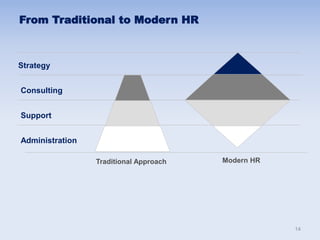
From Traditional to Modern HR
 Traditional Approach-Personnel: was basically an
administrative function focused on direction and
coordination of human relations of the organization with
view to getting the maximum necessary production with
minimum of effort
 It’s an administration routine distinctly human matters like
hiring, firing, maintaining personal records, decision upon
terms of employment contract with an eye to the
organization’s benefits.
11
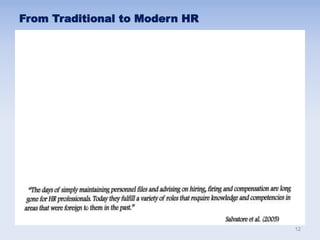
From Traditional to Modern HR
12
 At the beginning of the twenty-first century, the situation is
transformed. Not only has the idea of HRM spread across the
world, it is now recognized and practiced as a fundamental
part of any organization
 The purpose of modern HRM practices is to develop or
acquire this human capital and influence the relationships and
behaviors of the employees so that they can contribute to the
strategic goals of the organization. HRM practices must be
strategically aligned so as to contribute directly to
competitive advantage.
From Traditional to Modern HR
13
From Traditional to Modern HR
Administration
Support
Consulting
Strategy
Traditional Approach Modern HR
14
► All planned and controlled activities of an
organization to build and maintain the relation
between employees and the organization in order to
meet both business objectives and employee
expectations
Human Resources Management HRM
15
The Benefits and Goals of HRM
16
The Benefits and Goals of HRM
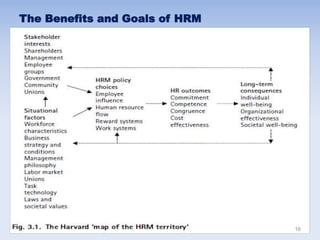
► In this framework, specialists set their own priorities in
HRM based on the interplay of stakeholder interests and
situational factors.
► HR outcomes, in turn, are seen as having longer-term
impacts on organizational effectiveness and on societal
and individual well-being
► At the most basic level, the mission of HRM is to support
the viability of the firm through stabilizing a cost-effective
and socially legitimate system of labor management
17
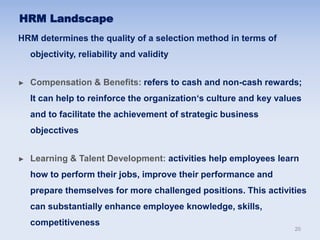
HRM Landscape
HR
Controlling
HR
Organization
HR-IT
Policy &
Procedure
Talent
Acquisition
Compensation &
Benefits Retention
Change
Management
Candidate
Selection
HR-
Strategy &
Planning
Learning &
Talent
Development
HR
Infrastructure
HR Activities
18
► Talent Acquisition: is the process of seeking and attracting
a pool of talent applicants from which the qualified
candidates for job vacancies within orgnization can be
selected. HRM includes the tranditional approch (Job Ad.)
, and guides organizations to position and present itself as
an attractive place to work through building an employer
brand
► Candidate Selection: involves choosing from the available
candidates the individual predicted to be most likely to
perform successfully in the job. HRM applies variety of
selection criteria and methods
HRM Landscape
19
HRM determines the quality of a selection method in terms of
objectivity, reliability and validity
► Compensation & Benefits: refers to cash and non-cash rewards;
It can help to reinforce the organization‘s culture and key values
and to facilitate the achievement of strategic business
objecctives
► Learning & Talent Development: activities help employees learn
how to perform their jobs, improve their performance and
prepare themselves for more challenged positions. This activities
can substantially enhance employee knowledge, skills,
competitiveness
HRM Landscape
20
► Change Management: HRM has been transfromed to deal
creatively and practically with emerging challenges. By
accomplishing talented roles and acquiring new
competencies
► Retention: refers to ability of an organization to retain the
most talent employees.
HRM Landscape
21
HRM Landscape
22
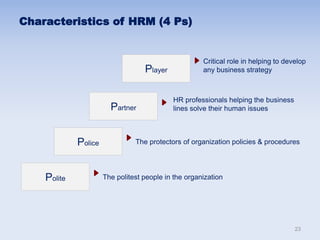
Characteristics of HRM (4 Ps)
Polite The politest people in the organization
Police The protectors of organization policies & procedures
Partner
HR professionals helping the business
lines solve their human issues
Player
Critical role in helping to develop
any business strategy
23
Innovation
?
24
Innovation
?
25
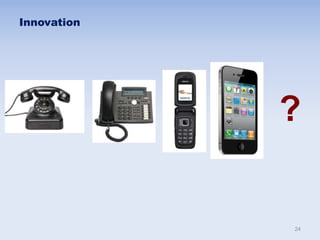
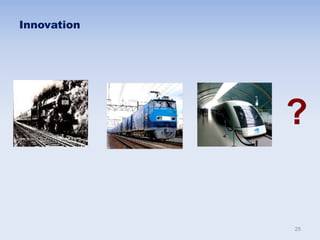
► World is always changing and advancing!
► iPhone is not the last product invented by Apple in coming
years, surely it will produce more and more modern and
sophisticated products.
► The development witnessed in train structure and railway
networks will not stop at Shanghai train.
► Many organizations survive in the market because of
producing an innovative idea/product/service created by
talent, skilled, competent human recourses as recently
called (Human Capital)
Innovation
26
From Hand Work to Knowledge Work
17
30
49
62
75
83
70
51
38
25
0% 20% 40% 60% 80% 100%
1900
1930
1970
2000
2020
knowledge work manual work
27
From Hand Work to Knowledge Work
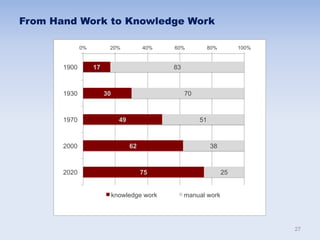
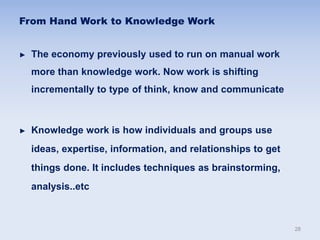
► The economy previously used to run on manual work
more than knowledge work. Now work is shifting
incrementally to type of think, know and communicate
► Knowledge work is how individuals and groups use
ideas, expertise, information, and relationships to get
things done. It includes techniques as brainstorming,
analysis..etc
28
Web 2.0 – User-generated Content
Web 1.0 Web 2.0
29
Web 2.0 – User-generated Content
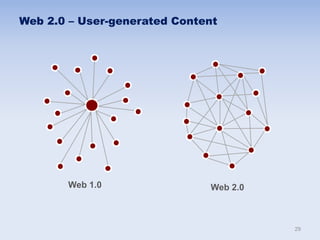
►Web 1.0 did not allow Web users to add or modify
information contained in Web sites. Users only had the
ability to use Web sites to gather information
►The Web 2.0 environment allows Web site visitors to
make contributions and changes to existing Web
content and to interact with other members of those
Web site
►This development caused significant change in the
way of hiring “qualified” employees as well as the way
that used by organizations to share or exchange ideas
or information
30

Human resources management sara babiker

  • 1.
  • 2.
    ► Preface ► TheImportance of HRM ► From Traditional to Modern HRM ► Human Resources Management HRM ► The Benefits and Goals of HRM ► HRM Landscape ► Characteristics of HRM (4 Ps) ► Challenges in HRM Outlines: 2
  • 3.
    Preface Human Resources Managementis a management of work and people towards desired ends, is a fundamental activity in any organization in which human beings are employed. It is not something whose existence needs to be elaborately justified; HRM is a certain consequence of starting and growing an organization. While there are many of variations in the ideologies, styles, and managerial resources engaged, HRM happens in some form or other. 3
  • 4.
  • 5.
    ►Human Capital Value Having human resources function is important. An internal human resources staff or expert can increase the understanding of how important human capital is to the organization’s bottom line.  In particular, human capital is critical because so many organizations have employees who perform cross-functional duties.  With a smaller workforce, if just one person leaves, it leaves the organization with a huge gap to fill and a potential threats. The Importance of HRM 5
  • 6.
    ►Budget Control  Humanresources curbs excessive spending through developing methods for trimming workforce management costs, which includes negotiating better rates for benefits such as health care coverage.  In addition, human resources ensures competitive and realistic wage-setting based on studying the labor market, employment trends and salary analysis based on job functions. As some organization have budget constraints, this human resources function is especially helpful. The Importance of HRM 6
  • 7.
    ► Organization Image(Brand) Organizations want to be known as the "employer of choice." Employers of choice are the organizations that receive recognition for the way they treat employees; they are the organization for whom people want to work.  Becoming an employer of choice means human resources balances attracting and acquiring the most qualified applicants, selecting the most suitable candidates and retaining the most talented employees. The Importance of HRM 7
  • 8.
    ► Sustaining Business Through succession planning that human resources develops, the organization identifies employees with the promise and requisite capabilities to eventually transition into leadership roles.  This is an important function as it can guarantee the organization's stability and future success. The Importance of HRM 8
  • 9.
    The Importance ofHRM ► Performance Improvement  HRM develops performance management systems in the organization, a cornerstone of the management and appraisal of an employee’s performance is the inculcation of a desire for continuous improvement.  The ongoing coaching is an integral aspect of performance management, while performance appraisal is the time period in which to summarize the overall progress that an employee has made as a result of being coached, and to agree on the new goals that should be set.  Without a human resources specialist to construct a plan that measures performance, employees can wind in jobs that aren't suitable for their skills and expertise. 9
  • 10.
    The Importance ofHRM ►Managing Disputes  In an organization, disputes are almost unavoidable, given the diversity of personalities, work styles, backgrounds and levels of experience among employees.  It is the human resource HR department which acts as a consultant and mediator to sort out those issues in an effective manner.  They first hear the complaints of the employees, then they come up with suitable solutions to sort them out. In other words, they take timely action, prevent things from going out of hands and restore positive working relationships. 10
  • 11.
    From Traditional toModern HR  Traditional Approach-Personnel: was basically an administrative function focused on direction and coordination of human relations of the organization with view to getting the maximum necessary production with minimum of effort  It’s an administration routine distinctly human matters like hiring, firing, maintaining personal records, decision upon terms of employment contract with an eye to the organization’s benefits. 11
  • 12.
    From Traditional toModern HR 12
  • 13.
     At thebeginning of the twenty-first century, the situation is transformed. Not only has the idea of HRM spread across the world, it is now recognized and practiced as a fundamental part of any organization  The purpose of modern HRM practices is to develop or acquire this human capital and influence the relationships and behaviors of the employees so that they can contribute to the strategic goals of the organization. HRM practices must be strategically aligned so as to contribute directly to competitive advantage. From Traditional to Modern HR 13
  • 14.
    From Traditional toModern HR Administration Support Consulting Strategy Traditional Approach Modern HR 14
  • 15.
    ► All plannedand controlled activities of an organization to build and maintain the relation between employees and the organization in order to meet both business objectives and employee expectations Human Resources Management HRM 15
  • 16.
    The Benefits andGoals of HRM 16
  • 17.
    The Benefits andGoals of HRM ► In this framework, specialists set their own priorities in HRM based on the interplay of stakeholder interests and situational factors. ► HR outcomes, in turn, are seen as having longer-term impacts on organizational effectiveness and on societal and individual well-being ► At the most basic level, the mission of HRM is to support the viability of the firm through stabilizing a cost-effective and socially legitimate system of labor management 17
  • 18.
    HRM Landscape HR Controlling HR Organization HR-IT Policy & Procedure Talent Acquisition Compensation& Benefits Retention Change Management Candidate Selection HR- Strategy & Planning Learning & Talent Development HR Infrastructure HR Activities 18
  • 19.
    ► Talent Acquisition:is the process of seeking and attracting a pool of talent applicants from which the qualified candidates for job vacancies within orgnization can be selected. HRM includes the tranditional approch (Job Ad.) , and guides organizations to position and present itself as an attractive place to work through building an employer brand ► Candidate Selection: involves choosing from the available candidates the individual predicted to be most likely to perform successfully in the job. HRM applies variety of selection criteria and methods HRM Landscape 19
  • 20.
    HRM determines thequality of a selection method in terms of objectivity, reliability and validity ► Compensation & Benefits: refers to cash and non-cash rewards; It can help to reinforce the organization‘s culture and key values and to facilitate the achievement of strategic business objecctives ► Learning & Talent Development: activities help employees learn how to perform their jobs, improve their performance and prepare themselves for more challenged positions. This activities can substantially enhance employee knowledge, skills, competitiveness HRM Landscape 20
  • 21.
    ► Change Management:HRM has been transfromed to deal creatively and practically with emerging challenges. By accomplishing talented roles and acquiring new competencies ► Retention: refers to ability of an organization to retain the most talent employees. HRM Landscape 21
  • 22.
  • 23.
    Characteristics of HRM(4 Ps) Polite The politest people in the organization Police The protectors of organization policies & procedures Partner HR professionals helping the business lines solve their human issues Player Critical role in helping to develop any business strategy 23
  • 24.
  • 25.
  • 26.
    ► World isalways changing and advancing! ► iPhone is not the last product invented by Apple in coming years, surely it will produce more and more modern and sophisticated products. ► The development witnessed in train structure and railway networks will not stop at Shanghai train. ► Many organizations survive in the market because of producing an innovative idea/product/service created by talent, skilled, competent human recourses as recently called (Human Capital) Innovation 26
  • 27.
    From Hand Workto Knowledge Work 17 30 49 62 75 83 70 51 38 25 0% 20% 40% 60% 80% 100% 1900 1930 1970 2000 2020 knowledge work manual work 27
  • 28.
    From Hand Workto Knowledge Work ► The economy previously used to run on manual work more than knowledge work. Now work is shifting incrementally to type of think, know and communicate ► Knowledge work is how individuals and groups use ideas, expertise, information, and relationships to get things done. It includes techniques as brainstorming, analysis..etc 28
  • 29.
    Web 2.0 –User-generated Content Web 1.0 Web 2.0 29
  • 30.
    Web 2.0 –User-generated Content ►Web 1.0 did not allow Web users to add or modify information contained in Web sites. Users only had the ability to use Web sites to gather information ►The Web 2.0 environment allows Web site visitors to make contributions and changes to existing Web content and to interact with other members of those Web site ►This development caused significant change in the way of hiring “qualified” employees as well as the way that used by organizations to share or exchange ideas or information 30