HUMAN RESOURCE
MANAGEMENT
Introduction
• HRM is a management function concerned with
hiring, motivating & maintaining people in an
organization.     It focuses on people in
organization.

• In other words, HRM is concerned with getting
better results with the collaboration of people. It
is an integral but distinctive part of management,
concerned with people at work and their
relationships within the enterprise.
Features:
   Managing people.
   People oriented process.
   Develops employee’s potentialities.
   Integral part of organizations.
   Continuous activity.
   Securing employee co-operation.
   Future oriented.
   Challenging activity.
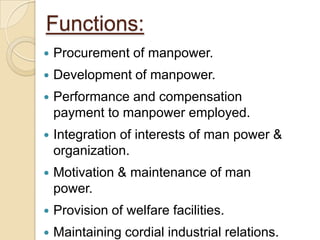
Functions:
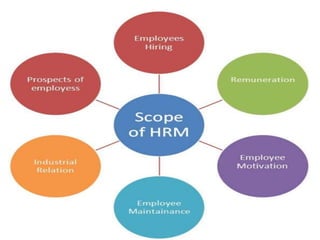
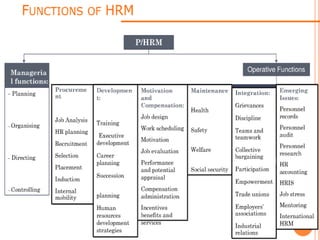
   Procurement of manpower.
   Development of manpower.
   Performance and compensation
    payment to manpower employed.
   Integration of interests of man power &
    organization.
   Motivation & maintenance of man
    power.
   Provision of welfare facilities.
   Maintaining cordial industrial relations.
Objectives:
   To attain maximum individual development
   To mold effectively the human resources
   To establish desirable working relations
   To ensure satisfactions to the workers
   To help organizations to achieve its goals
   Ensure competent & willing work force.
   Improve service rendered by the enterprise
    to the society.
   Maintain high morale & good human
DEFINITION OF PERSONNEL;
MANAGEMENT ??
 It can be defined as obtaining, using
  and maintaining a satisfied work-force.
 It is significant part of management
  concerned with employees at work
  and with their relationship within the
  organization.
EVOLUTION OF HRM !!!
 Evolution of HRM started in 19th
  century.
 HRM emerged from personnel mgmt
  and personnel mgmt emerged from
  manpower-planning.
 Human resource gained attention as
  the work-force considered to be an
  important resource to gain competitive
  advantage of organizations and also
  the resources of the organization.
 As HRM evolved it considered
  employees as the assets of the
  organization.
 The consideration of changes taking
  place in managing human resource
  led to the formation of STRATEGIC
  HUMAN RESOURCE PLANNING .
 It is crucial for achieving a
  corporation’s long-term goal.
 “There is no magic in the
 success of the companies
 ,The secret of their success
 is simply the way that they
 treat their employees.

             ‘AKIO MORITA’
           FOUNDER, “SONY”
CHALLENGES FACED BY HR
MANAGERS
Challenges faced by HR
Managers
  Managing the Vision
 Internal Environment
 Changing Industrial Relations
 Building Organizational Capability
 Job Design and Organizational
  Structure
Cont..
 Managing Large Workforce
 Psycho Social Environment
 Employee Satisfaction
 Modern technology
 Computerized Information System
 Legal Environment
 Managing Human Relations
CONCLUSION

 In spite of all the problems HR
 Managers are able to overcome all
 these problems with the support of
 management and employees. In the
 current business world managing
 employees are becoming complex
 task and this can be handled
 effectively only by our great HR
 Leaders.
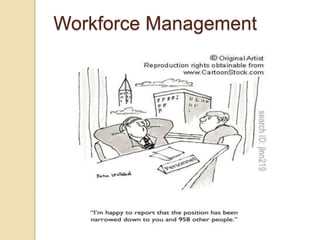
Workforce Management
Defination:-
              encompasses all the
 activities needed to maintain a
 productive workforce, under the
 umbrella of human resource
 management, WFM is sometimes

 referred to as HRMS systems, or even
 part of ERP systems.
Characteristic
 Composition of workforce
 Women at work
 Changes in employees value
 Level of Education
 Dual career couples
 Size of workforce
 Employee expectation
 Life –style changes
Personnel Philosophy
 It revolves around beliefs and
  assumption about people.
 These determines how people should
  be treated.
 Its abt knowing their nature, needs,
  value and their approach towards
  work.
Function
 Style of mangement.
 Creates and redefines operational
  goals.
Approaches for treating people:-
1. Commodity approach.
2. machine approach.
3. humanistic approach.
Based on following beliefs.
 Consider them as an ASSET.
 Can be developed
 Committed to work if develop
  belongingness
 Care aout their needs.
 Contribute to maximum if they get
  opportunity.
 Create healthy and motivating work
  climate
Personnel manual
 •A document which contains the details of
 personnel policy of an organization .

 •Copies  of personnel manual must be
 distributed to managerial employees by top
 management.

 •Manual   is mainly used for decision-making.
Purpose
 Systematic approach
 Providing a fundamental
  communication tool
 Avoiding difficulties due to
  misunderstandings
 Providing fair opportunities.
 Written policies.
 Enables managers to maintain cordial
  relations.
Benefits
 Gives clear explanation
 Useful in supervisory training
 Document of company ‘s faith
 Act as a ready made guide
 Training manual for staff
 Avoids indecision
 Avoids unfair employment practices
 Acts as communicating devices
Case
Study.
PEOPLE MANAGEMENT

• All about Managing People i.e. H.R of company.


• Low employee turn over at Infosys.


• Rigorous selection process and Proactive HRD practice.


INFOSYS’S HRM STRATEGY
   Get the big picture
   Develop a Mission Statement or Statement of Intent
   Conduct a SWOT analysis of the organization
   Conduct a detailed human resources analysis
   Determine critical people issues
   Develop consequences and solutions
   Implementation and evaluation of the action plans
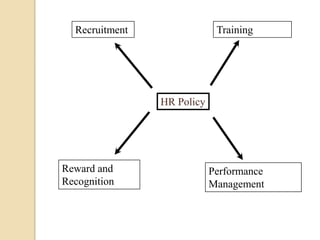
Recruitment                Training


                HR Policy


Reward and                  Performance
Recognition                 Management
FACILITIES FOR EMPLOYEES

•   Employee training
•   Recreation facilities.
•   Events.
•   Insurance and security facilities.
•   Transport facilities.
•   Maternal leaves.
•   Creche facilities.
•   ESOP.
•   Reward system.
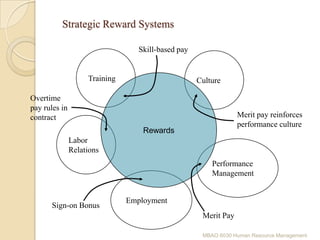
Strategic Reward Systems

                                  Skill-based pay


                    Training                        Culture

Overtime
pay rules in
contract                                                         Merit pay reinforces
                                                                 performance culture
                                   Rewards
               Labor
               Relations
                                                        Performance
                                                        Management


                               Employment
      Sign-on Bonus
                                                     Merit Pay

                                                     MBAO 6030 Human Resource Management
TYPES OF BENEFITS
• MONETARY           • NON –
 Increments           MONETARY
                      Promotions
 Compensation
                      Housing Facilities
 Overtime
                      Conveyance
 Performance -        Facilities
  pay
                      Fringe Benefits
EMPLOYEE STOCK OPTION PLAN (ESOP)


 •Highly profitable reward system.

 •Offers emotional and financial ownership to the employees.

 •Performance management tool for attracting and retaining
 talent.

 •Win loyalty, accountability of employees as their own
 interest is vested into it.
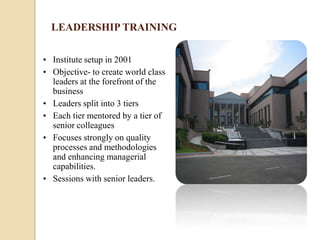
LEADERSHIP TRAINING

• Institute setup in 2001
• Objective- to create world class
  leaders at the forefront of the
  business
• Leaders split into 3 tiers
• Each tier mentored by a tier of
  senior colleagues
• Focuses strongly on quality
  processes and methodologies
  and enhancing managerial
  capabilities.
• Sessions with senior leaders.
Introduction to human resource management

Introduction to human resource management

  • 1.
  • 2.
    Introduction • HRM isa management function concerned with hiring, motivating & maintaining people in an organization. It focuses on people in organization. • In other words, HRM is concerned with getting better results with the collaboration of people. It is an integral but distinctive part of management, concerned with people at work and their relationships within the enterprise.
  • 3.
    Features:  Managing people.  People oriented process.  Develops employee’s potentialities.  Integral part of organizations.  Continuous activity.  Securing employee co-operation.  Future oriented.  Challenging activity.
  • 6.
    Functions:  Procurement of manpower.  Development of manpower.  Performance and compensation payment to manpower employed.  Integration of interests of man power & organization.  Motivation & maintenance of man power.  Provision of welfare facilities.  Maintaining cordial industrial relations.
  • 8.
    Objectives:  To attain maximum individual development  To mold effectively the human resources  To establish desirable working relations  To ensure satisfactions to the workers  To help organizations to achieve its goals  Ensure competent & willing work force.  Improve service rendered by the enterprise to the society.  Maintain high morale & good human
  • 9.
    DEFINITION OF PERSONNEL; MANAGEMENT??  It can be defined as obtaining, using and maintaining a satisfied work-force.  It is significant part of management concerned with employees at work and with their relationship within the organization.
  • 10.
    EVOLUTION OF HRM!!!  Evolution of HRM started in 19th century.  HRM emerged from personnel mgmt and personnel mgmt emerged from manpower-planning.  Human resource gained attention as the work-force considered to be an important resource to gain competitive advantage of organizations and also the resources of the organization.
  • 11.
     As HRMevolved it considered employees as the assets of the organization.  The consideration of changes taking place in managing human resource led to the formation of STRATEGIC HUMAN RESOURCE PLANNING .  It is crucial for achieving a corporation’s long-term goal.
  • 12.
     “There isno magic in the success of the companies ,The secret of their success is simply the way that they treat their employees. ‘AKIO MORITA’ FOUNDER, “SONY”
  • 13.
  • 14.
    Challenges faced byHR Managers  Managing the Vision  Internal Environment  Changing Industrial Relations  Building Organizational Capability  Job Design and Organizational Structure
  • 15.
    Cont..  Managing LargeWorkforce  Psycho Social Environment  Employee Satisfaction  Modern technology  Computerized Information System  Legal Environment  Managing Human Relations
  • 16.
    CONCLUSION In spiteof all the problems HR Managers are able to overcome all these problems with the support of management and employees. In the current business world managing employees are becoming complex task and this can be handled effectively only by our great HR Leaders.
  • 17.
  • 18.
    Workforce Management Defination:- encompasses all the activities needed to maintain a productive workforce, under the umbrella of human resource management, WFM is sometimes referred to as HRMS systems, or even part of ERP systems.
  • 19.
    Characteristic  Composition ofworkforce  Women at work  Changes in employees value  Level of Education  Dual career couples  Size of workforce  Employee expectation  Life –style changes
  • 20.
    Personnel Philosophy  Itrevolves around beliefs and assumption about people.  These determines how people should be treated.  Its abt knowing their nature, needs, value and their approach towards work.
  • 21.
    Function  Style ofmangement.  Creates and redefines operational goals. Approaches for treating people:- 1. Commodity approach. 2. machine approach. 3. humanistic approach.
  • 22.
    Based on followingbeliefs.  Consider them as an ASSET.  Can be developed  Committed to work if develop belongingness  Care aout their needs.  Contribute to maximum if they get opportunity.  Create healthy and motivating work climate
  • 23.
    Personnel manual •Adocument which contains the details of personnel policy of an organization . •Copies of personnel manual must be distributed to managerial employees by top management. •Manual is mainly used for decision-making.
  • 24.
    Purpose  Systematic approach Providing a fundamental communication tool  Avoiding difficulties due to misunderstandings  Providing fair opportunities.  Written policies.  Enables managers to maintain cordial relations.
  • 25.
    Benefits  Gives clearexplanation  Useful in supervisory training  Document of company ‘s faith  Act as a ready made guide  Training manual for staff  Avoids indecision  Avoids unfair employment practices  Acts as communicating devices
  • 26.
  • 27.
    PEOPLE MANAGEMENT • Allabout Managing People i.e. H.R of company. • Low employee turn over at Infosys. • Rigorous selection process and Proactive HRD practice. INFOSYS’S HRM STRATEGY  Get the big picture  Develop a Mission Statement or Statement of Intent  Conduct a SWOT analysis of the organization  Conduct a detailed human resources analysis  Determine critical people issues  Develop consequences and solutions  Implementation and evaluation of the action plans
  • 28.
    Recruitment Training HR Policy Reward and Performance Recognition Management
  • 29.
    FACILITIES FOR EMPLOYEES • Employee training • Recreation facilities. • Events. • Insurance and security facilities. • Transport facilities. • Maternal leaves. • Creche facilities. • ESOP. • Reward system.
  • 30.
    Strategic Reward Systems Skill-based pay Training Culture Overtime pay rules in contract Merit pay reinforces performance culture Rewards Labor Relations Performance Management Employment Sign-on Bonus Merit Pay MBAO 6030 Human Resource Management
  • 31.
    TYPES OF BENEFITS •MONETARY • NON –  Increments MONETARY  Promotions  Compensation  Housing Facilities  Overtime  Conveyance  Performance - Facilities pay  Fringe Benefits
  • 32.
    EMPLOYEE STOCK OPTIONPLAN (ESOP) •Highly profitable reward system. •Offers emotional and financial ownership to the employees. •Performance management tool for attracting and retaining talent. •Win loyalty, accountability of employees as their own interest is vested into it.
  • 33.
    LEADERSHIP TRAINING • Institutesetup in 2001 • Objective- to create world class leaders at the forefront of the business • Leaders split into 3 tiers • Each tier mentored by a tier of senior colleagues • Focuses strongly on quality processes and methodologies and enhancing managerial capabilities. • Sessions with senior leaders.