HUMAN RESOURCE
MANAGEMENT
Semester VI
Subject code: SET6B
UNIT 1 - Syllabus
Introduction to HRM
• Definition and Scope of HRM
• Functions of HRM
• Role of HRM in the organisation
• Changing trends and Challenges in HRM
MEANING
• HRM is a an aspect and process which aims to
optimize the human resources i.e. the employees
of the organization to achieve goals and
individual goals
• Emphasis on – people are the asset to the
business
• Aim – organizational success
• Employee’s aim – apt compensation for the
service rendered and ensure career growth,
satisfaction
• Human resource includes all the experience,
skills, knowledge, judgment and creativity
belonging to the organisation along with the
means of organising, structuring and rewarding
these capabilities.
• Human resource management involves all
management decisions and practices that directly
affect or influence the people or the ‘human
resource’ who works for the organisation and this
resource in particular needs to be nurtured.
DEFINITION
• Edwin Flippo defines HRM as- “planning, organizing,
directing, controlling of procurement, development,
compensation, integration, maintenance and
separation of human resources to the end that
individual, organizational and social objectives are
accomplished”.
• Ivancevich and Glueck – “Human resource
management is the function performed in
organizations’ that facilitate the most effective use of
people (employees) to achieve organizational and
individual goals”.
• The National Institute of Personal Management (NIPM)
of India defined human resources – personal
management as
• “that part of management which is concerned with
people at work and with their relationship within an
enterprise. Its aim is to bring together and develop into
an effective organization of the men and women who
make up enterprise and having regard for the well –
being of the individuals and of working groups, to
enable them to make their best contribution to its
success”.
Nature of HRM
• People related functions – hiring, training, performance
review etc
• Building of human capital – skills, capabilities, knowledge
etc.
• Alignment of HR policies and practices with organization's
strategies
• Formulate business strategies
• Administrative to strategic role of HRM
• Focus – people make difference
• Rationale – “machines wont replace us, they will force us to
evolve
• Universal
• Dynamic
• Comprehensive
• Integrating mechanism
• Strategic function
• Development oriented
Personnel management
• PM – labour as a tool whose behaviour could
be manipulated for organization’s benefit;
limited scope
• HRM – view people as asset ad promote
mutuality – mutual goals, mutual respect,
mutual rewards and mutual responsibilities
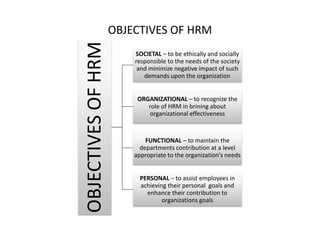
OBJECTIVES OF HRM
OBJECTIVES
OF
HRM
SOCIETAL – to be ethically and socially
responsible to the needs of the society
and minimize negative impact of such
demands upon the organization
ORGANIZATIONAL – to recognize the
role of HRM in brining about
organizational effectiveness
FUNCTIONAL – to maintain the
departments contribution at a level
appropriate to the organization's needs
PERSONAL – to assist employees in
achieving their personal goals and
enhance their contribution to
organizations goals
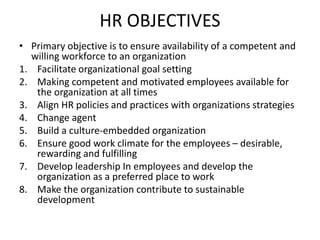
HR OBJECTIVES
• Primary objective is to ensure availability of a competent and
willing workforce to an organization
1. Facilitate organizational goal setting
2. Making competent and motivated employees available for
the organization at all times
3. Align HR policies and practices with organizations strategies
4. Change agent
5. Build a culture-embedded organization
6. Ensure good work climate for the employees – desirable,
rewarding and fulfilling
7. Develop leadership In employees and develop the
organization as a preferred place to work
8. Make the organization contribute to sustainable
development
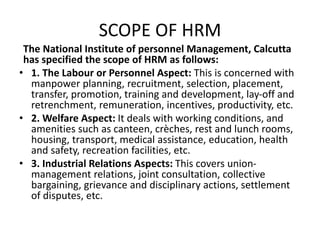
SCOPE OF HRM
The National Institute of personnel Management, Calcutta
has specified the scope of HRM as follows:
• 1. The Labour or Personnel Aspect: This is concerned with
manpower planning, recruitment, selection, placement,
transfer, promotion, training and development, lay-off and
retrenchment, remuneration, incentives, productivity, etc.
• 2. Welfare Aspect: It deals with working conditions, and
amenities such as canteen, crèches, rest and lunch rooms,
housing, transport, medical assistance, education, health
and safety, recreation facilities, etc.
• 3. Industrial Relations Aspects: This covers union-
management relations, joint consultation, collective
bargaining, grievance and disciplinary actions, settlement
of disputes, etc.
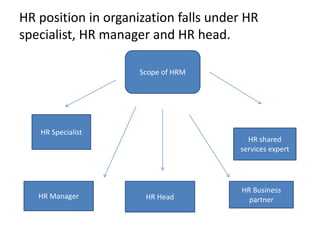
HR position in organization falls under HR
specialist, HR manager and HR head.
Scope of HRM
HR Specialist
HR Manager HR Head
HR shared
services expert
HR Business
partner
● HR Specialist: entry level for HRM, roles such as
interviewer, compensation analyst, benefits, co-ordinator,
job analyst and trainer.
● HR Manager: administers and co-ordinates programs. Top
ranking personnel. Head functional personnel at a
corporate level and formulate policies
● HR Head: Top level executive, usually the vice president,
linking corporate policy to HR strategy.
● HR business partner: they engage in discussions with top executives on
how the organization can evolve or change to realise a strategy. They
garner support to realise goals. They help to:
○ Evolve an organizational culture to convert strategy into action
○ Learn to diagnose organizational problems
○ Identify and prioritize the initiatives and ensure implementation.
● HR Shared services expert: is a process expert and is able to leverage
operational knowledge to optimise HR functioning. Required services are
delivered electronically to any location. A help desk system.
FUNCTIONS OF HRM
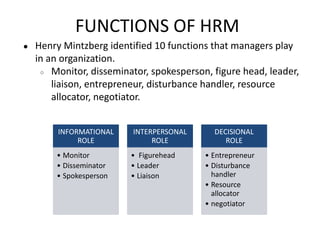
● Henry Mintzberg identified 10 functions that managers play
in an organization.
○ Monitor, disseminator, spokesperson, figure head, leader,
liaison, entrepreneur, disturbance handler, resource
allocator, negotiator.
INFORMATIONAL
ROLE
• Monitor
• Disseminator
• Spokesperson
INTERPERSONAL
ROLE
• Figurehead
• Leader
• Liaison
DECISIONAL
ROLE
• Entrepreneur
• Disturbance
handler
• Resource
allocator
• negotiator
Functions of HR:
○ Planning – future employee forecast in light of
mission, identify strength and weakness, culture,
leadership etc.
○ Staffing – recruit people with appropriate skills, job
analysis, interviewing (psychologist) etc.
○ Developing – analyse specific and general learning
requirements, identify key skills and competencies
○ Monitoring – reward system design and
administration
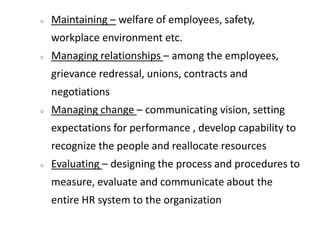
○ Maintaining – welfare of employees, safety,
workplace environment etc.
○ Managing relationships – among the employees,
grievance redressal, unions, contracts and
negotiations
○ Managing change – communicating vision, setting
expectations for performance , develop capability to
recognize the people and reallocate resources
○ Evaluating – designing the process and procedures to
measure, evaluate and communicate about the
entire HR system to the organization
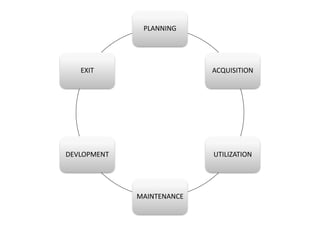
PLANNING
ACQUISITION
UTILIZATION
MAINTENANCE
DEVLOPMENT
EXIT
Human resource functions
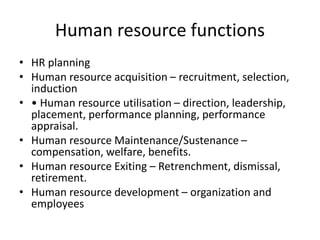
• HR planning
• Human resource acquisition – recruitment, selection,
induction
• • Human resource utilisation – direction, leadership,
placement, performance planning, performance
appraisal.
• Human resource Maintenance/Sustenance –
compensation, welfare, benefits.
• Human resource Exiting – Retrenchment, dismissal,
retirement.
• Human resource development – organization and
employees
New age functions
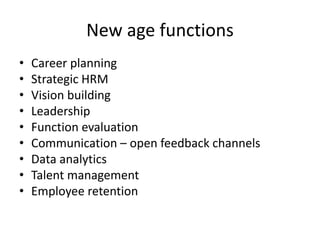
• Career planning
• Strategic HRM
• Vision building
• Leadership
• Function evaluation
• Communication – open feedback channels
• Data analytics
• Talent management
• Employee retention
Changing trends in HRM
• Strategic HRM
• Job enrichment and job enlargement
• Centralization Vs. Decentralization
• Human capital management
• Achievement orientation
• Innovation and creativity
• Management of change
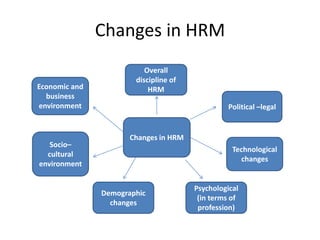
Changes in HRM
Changes in HRM
Economic and
business
environment
Socio–
cultural
environment
Overall
discipline of
HRM
Political –legal
Technological
changes
Psychological
(in terms of
profession)
Demographic
changes
• Economic and business environment
1. Globalization
2. Venturing into new business
3. Increasing complexities of work
4. Higher competition
5. Customer orientation
6. Specialization and niche creation Vs. profit
making
7. Organizational restructuring – merger,
downsizing
• Socio-cultural
1. Diversity
2. Multiculturalism
3. Work Ethics
• Psycho-social
1. Openness to experience
2. Flexibility and adaptability
3. Cultural consciousness and sensitivity
4. Paternity leave
• Psychological and work aptitude
1. Focus on career development
2. Internal motivation of work vs. external motivation
3. Self-actualization needs
4. Autonomy
5. Merit over hierarchy
6. Focus on diversifying and widening the skill set
7. Work-life balance
8. Reward expectations changes – leisure, gift
cards/memberships etc
• Demographic changes
1. Younger population
2. Increase in women population
3. Employees entering the work from varied
disciplines
4. Mixed population
Technological
1. Automation
2. Artificial intelligence
3. Data analytics
4. Performance management system is more
vibrant
5. Digital communication
6. Remote working
• Political – legal
1. Corporate laws
2. Conducive business environment
3. Regional balance
4. Corporate social responsibility
5. Diplomacy
Challenges in HRM
• Managing workforce diversity
• Empowerment of employees
• Employee motivation and relationship management
• Leadership
• Quality of work life - A sensible integration of job
career and family life and leisure time.
• Training needs
• Outsourcing
• Retention
• Difficulty in integrating HR policies with business
strategy.
● Inability of HR to think strategically in a business perspective
● Lack appreciation for value of HR
● Line managers think they’re HR but focus more on technical issues
● Problem quantifying HR programs, HR functions can be abstract
● Human assets are not owned by organizations
● Non-availability of HR staffs, failure to integrate
● Failure to understand sustainable needs, inadequate assessments
● Disconnect between HR and employees.
● Inadequate allotment of resources for optimum functioning

Unit 1 - Introduction to HRM.pptx Semester 6

  • 1.
  • 2.
    UNIT 1 -Syllabus Introduction to HRM • Definition and Scope of HRM • Functions of HRM • Role of HRM in the organisation • Changing trends and Challenges in HRM
  • 3.
    MEANING • HRM isa an aspect and process which aims to optimize the human resources i.e. the employees of the organization to achieve goals and individual goals • Emphasis on – people are the asset to the business • Aim – organizational success • Employee’s aim – apt compensation for the service rendered and ensure career growth, satisfaction
  • 4.
    • Human resourceincludes all the experience, skills, knowledge, judgment and creativity belonging to the organisation along with the means of organising, structuring and rewarding these capabilities. • Human resource management involves all management decisions and practices that directly affect or influence the people or the ‘human resource’ who works for the organisation and this resource in particular needs to be nurtured.
  • 5.
    DEFINITION • Edwin Flippodefines HRM as- “planning, organizing, directing, controlling of procurement, development, compensation, integration, maintenance and separation of human resources to the end that individual, organizational and social objectives are accomplished”. • Ivancevich and Glueck – “Human resource management is the function performed in organizations’ that facilitate the most effective use of people (employees) to achieve organizational and individual goals”.
  • 6.
    • The NationalInstitute of Personal Management (NIPM) of India defined human resources – personal management as • “that part of management which is concerned with people at work and with their relationship within an enterprise. Its aim is to bring together and develop into an effective organization of the men and women who make up enterprise and having regard for the well – being of the individuals and of working groups, to enable them to make their best contribution to its success”.
  • 7.
    Nature of HRM •People related functions – hiring, training, performance review etc • Building of human capital – skills, capabilities, knowledge etc. • Alignment of HR policies and practices with organization's strategies • Formulate business strategies • Administrative to strategic role of HRM • Focus – people make difference • Rationale – “machines wont replace us, they will force us to evolve
  • 8.
    • Universal • Dynamic •Comprehensive • Integrating mechanism • Strategic function • Development oriented
  • 9.
    Personnel management • PM– labour as a tool whose behaviour could be manipulated for organization’s benefit; limited scope • HRM – view people as asset ad promote mutuality – mutual goals, mutual respect, mutual rewards and mutual responsibilities
  • 10.
    OBJECTIVES OF HRM OBJECTIVES OF HRM SOCIETAL– to be ethically and socially responsible to the needs of the society and minimize negative impact of such demands upon the organization ORGANIZATIONAL – to recognize the role of HRM in brining about organizational effectiveness FUNCTIONAL – to maintain the departments contribution at a level appropriate to the organization's needs PERSONAL – to assist employees in achieving their personal goals and enhance their contribution to organizations goals
  • 11.
    HR OBJECTIVES • Primaryobjective is to ensure availability of a competent and willing workforce to an organization 1. Facilitate organizational goal setting 2. Making competent and motivated employees available for the organization at all times 3. Align HR policies and practices with organizations strategies 4. Change agent 5. Build a culture-embedded organization 6. Ensure good work climate for the employees – desirable, rewarding and fulfilling 7. Develop leadership In employees and develop the organization as a preferred place to work 8. Make the organization contribute to sustainable development
  • 12.
    SCOPE OF HRM TheNational Institute of personnel Management, Calcutta has specified the scope of HRM as follows: • 1. The Labour or Personnel Aspect: This is concerned with manpower planning, recruitment, selection, placement, transfer, promotion, training and development, lay-off and retrenchment, remuneration, incentives, productivity, etc. • 2. Welfare Aspect: It deals with working conditions, and amenities such as canteen, crèches, rest and lunch rooms, housing, transport, medical assistance, education, health and safety, recreation facilities, etc. • 3. Industrial Relations Aspects: This covers union- management relations, joint consultation, collective bargaining, grievance and disciplinary actions, settlement of disputes, etc.
  • 13.
    HR position inorganization falls under HR specialist, HR manager and HR head. Scope of HRM HR Specialist HR Manager HR Head HR shared services expert HR Business partner
  • 14.
    ● HR Specialist:entry level for HRM, roles such as interviewer, compensation analyst, benefits, co-ordinator, job analyst and trainer. ● HR Manager: administers and co-ordinates programs. Top ranking personnel. Head functional personnel at a corporate level and formulate policies ● HR Head: Top level executive, usually the vice president, linking corporate policy to HR strategy.
  • 15.
    ● HR businesspartner: they engage in discussions with top executives on how the organization can evolve or change to realise a strategy. They garner support to realise goals. They help to: ○ Evolve an organizational culture to convert strategy into action ○ Learn to diagnose organizational problems ○ Identify and prioritize the initiatives and ensure implementation. ● HR Shared services expert: is a process expert and is able to leverage operational knowledge to optimise HR functioning. Required services are delivered electronically to any location. A help desk system.
  • 16.
    FUNCTIONS OF HRM ●Henry Mintzberg identified 10 functions that managers play in an organization. ○ Monitor, disseminator, spokesperson, figure head, leader, liaison, entrepreneur, disturbance handler, resource allocator, negotiator. INFORMATIONAL ROLE • Monitor • Disseminator • Spokesperson INTERPERSONAL ROLE • Figurehead • Leader • Liaison DECISIONAL ROLE • Entrepreneur • Disturbance handler • Resource allocator • negotiator
  • 17.
    Functions of HR: ○Planning – future employee forecast in light of mission, identify strength and weakness, culture, leadership etc. ○ Staffing – recruit people with appropriate skills, job analysis, interviewing (psychologist) etc. ○ Developing – analyse specific and general learning requirements, identify key skills and competencies ○ Monitoring – reward system design and administration
  • 18.
    ○ Maintaining –welfare of employees, safety, workplace environment etc. ○ Managing relationships – among the employees, grievance redressal, unions, contracts and negotiations ○ Managing change – communicating vision, setting expectations for performance , develop capability to recognize the people and reallocate resources ○ Evaluating – designing the process and procedures to measure, evaluate and communicate about the entire HR system to the organization
  • 19.
  • 20.
    Human resource functions •HR planning • Human resource acquisition – recruitment, selection, induction • • Human resource utilisation – direction, leadership, placement, performance planning, performance appraisal. • Human resource Maintenance/Sustenance – compensation, welfare, benefits. • Human resource Exiting – Retrenchment, dismissal, retirement. • Human resource development – organization and employees
  • 21.
    New age functions •Career planning • Strategic HRM • Vision building • Leadership • Function evaluation • Communication – open feedback channels • Data analytics • Talent management • Employee retention
  • 22.
    Changing trends inHRM • Strategic HRM • Job enrichment and job enlargement • Centralization Vs. Decentralization • Human capital management • Achievement orientation • Innovation and creativity • Management of change
  • 23.
    Changes in HRM Changesin HRM Economic and business environment Socio– cultural environment Overall discipline of HRM Political –legal Technological changes Psychological (in terms of profession) Demographic changes
  • 24.
    • Economic andbusiness environment 1. Globalization 2. Venturing into new business 3. Increasing complexities of work 4. Higher competition 5. Customer orientation 6. Specialization and niche creation Vs. profit making 7. Organizational restructuring – merger, downsizing
  • 25.
    • Socio-cultural 1. Diversity 2.Multiculturalism 3. Work Ethics • Psycho-social 1. Openness to experience 2. Flexibility and adaptability 3. Cultural consciousness and sensitivity 4. Paternity leave
  • 26.
    • Psychological andwork aptitude 1. Focus on career development 2. Internal motivation of work vs. external motivation 3. Self-actualization needs 4. Autonomy 5. Merit over hierarchy 6. Focus on diversifying and widening the skill set 7. Work-life balance 8. Reward expectations changes – leisure, gift cards/memberships etc
  • 27.
    • Demographic changes 1.Younger population 2. Increase in women population 3. Employees entering the work from varied disciplines 4. Mixed population
  • 28.
    Technological 1. Automation 2. Artificialintelligence 3. Data analytics 4. Performance management system is more vibrant 5. Digital communication 6. Remote working
  • 29.
    • Political –legal 1. Corporate laws 2. Conducive business environment 3. Regional balance 4. Corporate social responsibility 5. Diplomacy
  • 30.
    Challenges in HRM •Managing workforce diversity • Empowerment of employees • Employee motivation and relationship management • Leadership • Quality of work life - A sensible integration of job career and family life and leisure time. • Training needs • Outsourcing • Retention • Difficulty in integrating HR policies with business strategy.
  • 31.
    ● Inability ofHR to think strategically in a business perspective ● Lack appreciation for value of HR ● Line managers think they’re HR but focus more on technical issues ● Problem quantifying HR programs, HR functions can be abstract ● Human assets are not owned by organizations ● Non-availability of HR staffs, failure to integrate ● Failure to understand sustainable needs, inadequate assessments ● Disconnect between HR and employees. ● Inadequate allotment of resources for optimum functioning