MODULE
HUMAN RESOURCE MANAGEMENT
(HRM)
University of Rwanda
1
CHAP 1
Introduction: the HRM Concept
2
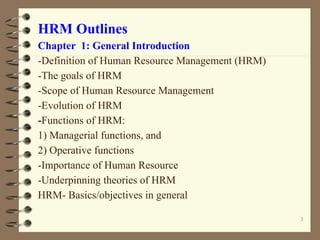
HRM Outlines
Chapter 1: General Introduction
-Definition of Human Resource Management (HRM)
-The goals of HRM
-Scope of Human Resource Management
-Evolution of HRM
-Functions of HRM:
1) Managerial functions, and
2) Operative functions
-Importance of Human Resource
-Underpinning theories of HRM
HRM- Basics/objectives in general
3
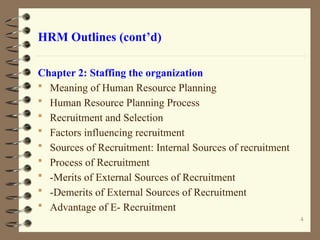
HRM Outlines (cont’d)
Chapter 2: Staffing the organization
 Meaning of Human Resource Planning
 Human Resource Planning Process
 Recruitment and Selection
 Factors influencing recruitment
 Sources of Recruitment: Internal Sources of recruitment
 Process of Recruitment
 -Merits of External Sources of Recruitment
 -Demerits of External Sources of Recruitment
 Advantage of E- Recruitment
4
HRM Outlines (cont’d)
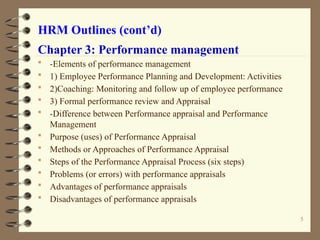
Chapter 3: Performance management
 -Elements of performance management
 1) Employee Performance Planning and Development: Activities
 2)Coaching: Monitoring and follow up of employee performance
 3) Formal performance review and Appraisal
 -Difference between Performance appraisal and Performance
Management
 Purpose (uses) of Performance Appraisal
 Methods or Approaches of Performance Appraisal
 Steps of the Performance Appraisal Process (six steps)
 Problems (or errors) with performance appraisals
 Advantages of performance appraisals
 Disadvantages of performance appraisals
5
HRM Outlines (cont’d)
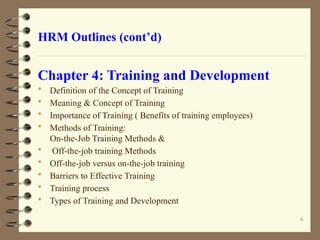
Chapter 4: Training and Development
 Definition of the Concept of Training
 Meaning & Concept of Training
 Importance of Training ( Benefits of training employees)
 Methods of Training:
On-the-Job Training Methods &
 Off-the-job training Methods
 Off-the-job versus on-the-job training
 Barriers to Effective Training
 Training process
 Types of Training and Development
6
HRM Outlines (cont’d)
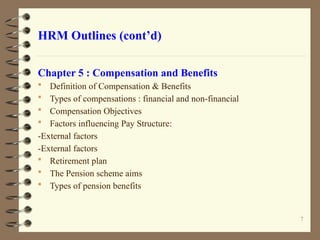
Chapter 5 : Compensation and Benefits
 Definition of Compensation & Benefits
 Types of compensations : financial and non-financial
 Compensation Objectives
 Factors influencing Pay Structure:
-External factors
-External factors
 Retirement plan
 The Pension scheme aims
 Types of pension benefits
7
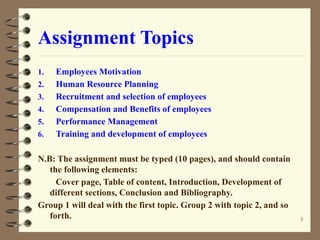
Assignment Topics
1. Employees Motivation
2. Human Resource Planning
3. Recruitment and selection of employees
4. Compensation and Benefits of employees
5. Performance Management
6. Training and development of employees
N.B: The assignment must be typed (10 pages), and should contain
the following elements:
Cover page, Table of content, Introduction, Development of
different sections, Conclusion and Bibliography.
Group 1 will deal with the first topic. Group 2 with topic 2, and so
forth. 8
Introduction
Human resource management (HRM) is concerned with
all aspects of how people are employed and managed in
organizations. It covers the activities of strategic HRM,
human capital management, knowledge management,
corporate social responsibility, organization development,
resourcing (workforce planning, recruitment and selection
and talent management), learning and development,
performance and reward management, employee
relations, employee well-being and the provision of
employee services.
9
Definition of HRM
Human resource management can be defined as a
strategic, integrated and coherent approach to the
employment, development and well-being of the people
working in organizations.
HRM is the managerial utilization of the efforts,
knowledge, capabilities and committed behaviours which
people contribute to an authoritatively coordinated
human enterprise as part of an employment exchange (or
more temporary contractual arrangement) to carry out
work tasks in a way which enables the enterprise to
continue into the future.
Human resource management is concerned with policies and
practices that ensure the best use of the human resources
for fulfilling the organizational and individual goals.
10
Definition of HRM (cont’d)
(HRM) concerns the recruitment, selection,
development, compensation, retention, evaluation,
and promotion of personnel within an
organization.” (Bernardin and Russell, 1993:2).
 HRM is to ensure that the employees of an
organization are used in such a way that the
employer obtains the greatest possible benefits
from their abilities and the employees obtain both
materials and psychological rewards from their
work ( Graham 1978); 11
Definition of HRM (cont’d)
 It is the process of acquiring, training, appraising and
compensating employees and attending to their labour
relations, health and safety, and fairness concerns.
 Includes All decisions that affect the workforce
 HR Decisions must influence effectiveness of the
organization leading to better service to customer and high
quality product and services at reasonable price.
 It is not confined to business establishment only, HRM is
applicable also to the non business organization, like
government department, education, health care, etc
12
The goals of HRM
The goals of HRM are to:
 support the organization in achieving its objectives by
developing and implementing human resource (HR)
strategies that are integrated with the business strategy
(strategic HRM);
 contribute to the development of a high-performance
culture;
 ensure that the organization has the talented, skilled and
engaged people it needs;
 create a positive and ethical employment relationship
between management and employees and a climate of
mutual trust; 13
Scope of Human Resource Management
The scope of HRM is, indeed, very vast and wide. It
includes all activities starting from manpower planning till
employee leaves the organisation. The scope of HRM
consists of acquisition, development,
maintenance/retention, and control of human resources in
the organisation.
The Labour or Personnel Aspect:
This is concerned with manpower planning, recruitment,
selection, placement, transfer, promotion, training and
development, retrenchment, remuneration, incentives,
productivity, etc.
Contt.
Welfare Aspect:
It deals with working conditions, and amenities such as
canteen, crèches, rest and lunch rooms, housing,
transport, medical assistance, education, health and
safety, recreation facilities, etc.
Industrial Relations Aspects:
This covers union-management relations, joint
consultation, collective bargaining, grievance and
disciplinary actions, settlement of disputes, etc.
Evolution of HRM
Modern HRM has emerged from 4 interrelated sources:
1)Rapid technological change that came with discovery of
machines, creation of factories and increased division of
labour leading to specialization associated with the
industrial revolution in 1750s
2)Scientific Management movement of Frederick Taylor of
1900s which emphasized proper job design, employee
selection based on mental and physical fitness, training
and job re-design if necessary
3)The Human relations movement of Elton Mayo in the
1930s which argued employee productivity was not only
affected by job design but also by rewards, psychological
factors, relationships, leadership styles and management
support.
16
Evolution of HRM (Cont’d)
4)The behavioural sciences movement after HR movement which
demanded further study of people, of organizations, of society and
social institutions, all influencing employee behaviour and
productivity.
 These developments created the need for more effective HRM
17
Functions of HRM
We have already defined HRM. The definition of HRM is
based on what managers do. The functions performed by
managers are common to all organizations.
For the convenience of study, the function performed by
the Human resource management can broadly be
classified into following categories:
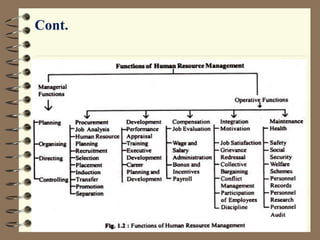
1. Managerial functions, and
2. Operative functions
Cont.
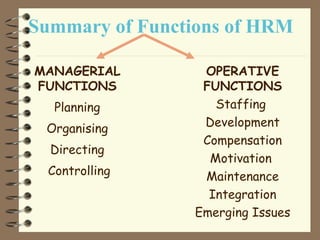
Summary of Functions of HRM
MANAGERIAL
FUNCTIONS
Planning
Organising
Directing
Controlling
OPERATIVE
FUNCTIONS
Staffing
Development
Compensation
Motivation
Maintenance
Integration
Emerging Issues
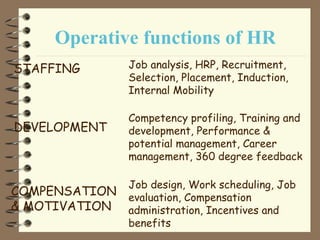
Operative functions of HR
STAFFING Job analysis, HRP, Recruitment,
Selection, Placement, Induction,
Internal Mobility
DEVELOPMENT
Competency profiling, Training and
development, Performance &
potential management, Career
management, 360 degree feedback
COMPENSATION
& MOTIVATION
Job design, Work scheduling, Job
evaluation, Compensation
administration, Incentives and
benefits
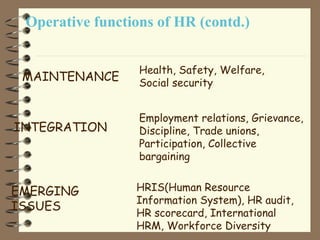
Operative functions of HR (contd.)
MAINTENANCE
Health, Safety, Welfare,
Social security
INTEGRATION
Employment relations, Grievance,
Discipline, Trade unions,
Participation, Collective
bargaining
EMERGING
ISSUES
HRIS(Human Resource
Information System), HR audit,
HR scorecard, International
HRM, Workforce Diversity
Contt.
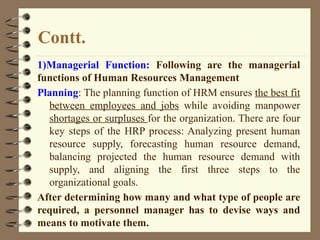
1)Managerial Function: Following are the managerial
functions of Human Resources Management
Planning: The planning function of HRM ensures the best fit
between employees and jobs while avoiding manpower
shortages or surpluses for the organization. There are four
key steps of the HRP process: Analyzing present human
resource supply, forecasting human resource demand,
balancing projected the human resource demand with
supply, and aligning the first three steps to the
organizational goals.
After determining how many and what type of people are
required, a personnel manager has to devise ways and
means to motivate them.
Cont.
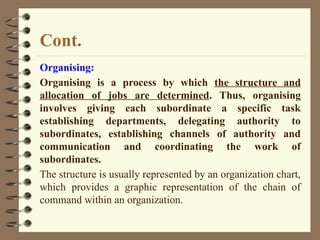
Organising:
Organising is a process by which the structure and
allocation of jobs are determined. Thus, organising
involves giving each subordinate a specific task
establishing departments, delegating authority to
subordinates, establishing channels of authority and
communication and coordinating the work of
subordinates.
The structure is usually represented by an organization chart,
which provides a graphic representation of the chain of
command within an organization.
Contt.
Staffing:
This is a process by which managers select, train,
promote and retire their subordinates. This involves
deciding what type of people should be hired, recruiting
prospective employees, selecting employees, setting
performance standard, compensating employees,
evaluating performance, counselling employees, training
and developing employees.
Contt.
Directing/Leading:
Directing is the process of activating group efforts to achieve the
desired goals. It includes activities like getting subordinates the job
done, maintaining morale or motivating subordinates etc. for
achieving the goals of the organisation.Tapping maximum
potentialities of an employee via constant motivation and command is
a prime focus for this function of HRM.
Controlling:
It is the process of setting standards for performance,
checking to see how actual performance compares with these
set standards, and taking corrective actions as needed. Here
the performance of an employee is to be evaluated, verified
and compared with organizational goals. If performance is
found to be deviating from the plan, corrective measures are
to be taken.
Contt.
2) Operative Functions:
The operative, also called, service functions are those
which are relevant to specific department.
These functions vary from department to department
depending on the nature of the department. Viewed from
this standpoint, the operative functions of HRM relate to
ensuring right people for right jobs at right times.
These functions include procurement, development,
compensation, and maintenance functions of HRM.
Contt.
 Procurement: It involves procuring the right kind of
people in appropriate number to be placed in the
organisation. It consists of activities such as manpower
planning, recruitment, selection placement and
induction or orientation of new employees
 Development: This function involves activities to
improve the knowledge, skills aptitudes and values of
employees so as to enable them to perform their jobs in
a better manner in future. These functions may
comprise training to employees, executive training to
develop managers, organisation development to strike
a better fit between organisational climate/culture.
Contt.
 Compensation:
Compensation function involves determination of wages and salaries
matching with contribution made by employees to organisational
goals. In other words, this function ensures equitable and fair
remuneration for employees in the organisation. It consists of
activities such as job evaluation, wage and salary administration,
bonus, incentives, etc.
Maintenance:
It is concerned with protecting and promoting employees while at
work. For this purpose various benefits such as housing, medical,
educational, transport facilities, etc. are provided to the employees.
Several social security measures such as provident fund, pension,
gratuity, group insurance, etc. are also arranged.
It is important to note that the managerial and operative functions of
HRM are performed in conjunction with each other in an
organisation,
Importance of Human Resource
 It helps management in the preparation, adoption and
continuing evolution of personnel programmes and
policies.
 It supplies skilled workers through scientific selection
process.
 It ensures maximum benefit out of the expenditure on
training and development and appreciates the human
assets.
 It prepares workers according to the changing needs of
industry and environment.
Importance of Human Resource (Cont’d)
 It motivates workers and upgrades them so as to
enable them to accomplish the organisation goals.
 Through innovation and experimentation in the fields
of personnel, it helps in reducing costs and helps in
increasing productivity.
 It contributes a lot in restoring the industrial harmony
and healthy employer-employee relations.
 It establishes mechanism for the administration of
personnel services that are delegated to the personnel
department.
Underpinning theories of HRM
Human Resource theory is a general term for the strategies, tactics
and objectives used by business owners and managers to administer
policies and procedures related to employees.
Human resource theories explain how management practices and
structures can influence employee behaviour in a favorable or bad
way. Small business owners can optimize staff productivity and
creativity while reducing employee turnover by having a basic
understanding of organizational behavior and HR theories and acting
on it.
Guest (1987: 505) commented that: ‘Human resource management
appears to lean heavily on theories of commitment and motivation
and other ideas derived from the field of organizational behaviour.’ A
number of other theories, especially the resource-based view, have
contributed to the understanding of purpose and meaning of HRM.
These theories are summarized below.
32
Underpinning theories of HRM (Cont’d)
Commitment Theories
Walton (1985: 77) Workers respond best and most
creatively not when they are tightly controlled by
management, placed in narrowly defined jobs and treated
as an unwelcome necessity, but, instead, when they are
given broader responsibilities, encouraged to contribute
and helped to take satisfaction in their work.
It should come as no surprise that eliciting commitment
and providing the environment in which it can flourish
pays tangible dividends for the individual and for the
company. 33
Underpinning theories of HRM (Cont’d)
Motivation theory
Motivation is a way to create a high amount of passion in order to achieve
organizational goals, and this condition is addressed by fulfilling certain
individual needs.
Motivation theory explains the factors that affect goal-directed
behaviour and therefore influences the approaches used in HRM to
enhance engagement (the situation in which people are committed to
their work and the organization and are motivated to achieve high
levels of performance).
To optimize the productivity of the employees, the employee needs to be
motivated enough. At this level, one must understand human nature better
understand how motivation can impact on the performance of the
employee.
34
Underpinning theories of HRM (Cont’d)
Successful work output may therefore emerge from a variety
of motives. It provides an ambiguity in the discussion as
performance and motivation varies from individual to
individual and from industry to industry.
The resource-based view
Resource-based theory expressed as ‘the resource-based
view’ states that competitive advantage is achieved if a
firm’s resources are valuable, rare and costly to imitate. It
is claimed that HRM can play a major part in ensuring
that the firm’s human resources meet these criteria.
35
Underpinning theories of HRM (Cont’d)
Organizational behaviour theory
Organizational behaviour theory describes how people
within their organizations act individually or in groups
and how organizations function in terms of their
structure, processes and culture. It therefore influences
HRM approaches to organization design and development
and enhancing organizational capability
The study of organizational behavior (OB) is applied to HRM
functions and its related subjects help us understand what
people in organizational environments think, feel and do. This
knowledge helps to anticipate, recognize and monitor
organizational events for HR and, realistically all employees.
36
Underpinning theories of HRM (Cont’d)
Organizational behaviour theory (Cont’d)
Organizational behavior study includes research areas
dedicated to improving performance at work, increasing job
stability, fostering creativity, and fostering leadership. A
focus on organizational behavior helps to explain why certain
different behaviors impact workers’ efficiency and
discretionary effort, as well as how to consider and forecast
the effects of different policies on managing human resources
(Pfeffer, 2007, p.126-127). EXAMPLE of organizational
behavior: Organizational behavior is the resulting behavior of
the people within the organization based on the culture
they're immersed in. If the company culture is one that
promotes customer service, then the employees are likely to
display behaviors such as friendliness and helpfulness when
dealing with customers
37
Underpinning theories of HRM (Cont’d)
Contingency theory
Contingency theory states that HRM practices are
dependent on the organization’s environment and
circumstances. This means that, as Paauwe (2004: 36)
explained: ‘The relationship between the relevant
independent variables (eg HRM policies and practices)
and the dependent variable (performance) will vary
according to the influences such as company size, age and
technology, capital intensity, degree of unionization,
industry/sector ownership and location.’ Contingency
theory is associated with the need to achieve congruence
between an organization’s HR policies and practices and
its business strategies within the context of its external
and internal environment. 38
Underpinning theories of HRM (Cont’d)
Institutional theory
Organizations conform to internal and external
environmental pressures in order to gain legitimacy and
acceptance.
Human capital theory
Human capital theory is concerned with how people in an
organization contribute their knowledge, skills and
abilities to enhancing organizational capability and the
significance of that contribution.
Resource dependence theory
Resource dependence theory states that groups and
organizations gain power over each other by controlling
valued resources.
39
Underpinning theories of HRM (Cont’d)
Ability, Motivation and Opportunity (AMO) theory
The ‘AMO’ formula as set out by Boxall and Purcell
(2003) states that performance is a function of Ability +
Motivation + Opportunity to Participate. HRM practices
therefore impact on individual performance if they
encourage discretionary effort, develop skills and provide
people with the opportunity to perform. The formula
provides the basis for developing HR systems that attend
to employees’ interests, namely their skill requirements,
motivations and the quality of their job.
40
Organizational Lifecycle theory
Organizations at any stage of the lifecycle are impacted by
external environmental circumstances as well as internal
factors. The rise and fall of organizations and entire industries
have been witnessed. Products also have life cycles, a fact
that has been long recognized by marketing and sales experts.
It seemed reasonable, for academicians, to conclude that
organizations also have life cycles. They are born (established
or formed), they grow and develop, they reach maturity, they
begin to decline and age, and finally, in many cases, they die.
41
Underpinning theories of HRM (Cont’d)
Social exchange theory
Employees will reciprocate their contribution to the
organization if they perceive that the organization has
treated them well.
Transaction costs theory
Transaction costs theory (TCT) considers the transaction
as the most basic unity of measure and focuses on how
much effort, resources, or cost necessary for two parties
to complete an exchange ( Williamson, 1981). The theory
assumes that businesses develop in organizational
structures and systems that economize the costs of the
transactions (interrelated exchange activities) that take
place during the course of their operations.
42
Underpinning theories of HRM (Cont’d)
Agency theory
Agency theory states that the role of the managers of a
business is to act on behalf of the owners of the business
as their agents. But there is a separation between the
owners (the principals) and the agents (the managers) and
the principals may not have complete control over their
agents. The latter may therefore act in ways that are
against the interests of those principals. Agency theory
encourages looking at how the interest of the agent and
principal diverse and how their attitudes may differ. It
indicates that it is desirable to operate a system of
incentives for agents( i.e directors or managers) to
motivate and reward acceptable behavior.
43
HRM- Basics/objectives in general
1. Matching the workforce to the needs of the business......
2. Making full use of the workforce’s potential……
3. Minimising labour costs…….
4. Maintaining good employee/employer relations……..
A. Matching the workforce to the needs of the business
 Workforce planning to ensure business has the right
number of staff in the right locations with the right
skills
 Effective recruitment to match workforce needs
 Training programmes to cover skills gaps or respond
to changes in technology, processes & market
 Consider outsourcing activities
 Get the right number and mix of staff at each location
where the business operates in multiple sites and
countries
44
HRM- Basics/objectives in general (cont’d)
B. Making full use of the workforce’s potential
 Regular appraisals and skills audits
 Internal promotion
 Development opportunities
 Ensure jobs have suitable, achievable workloads
 Avoid too many under-utilised or over-stretched staff
Make best use of employees skills
C. Minimising labour costs
 Reduced labour turnover to keep recruitment costs low
 Pay rates should be competitive but not excessive
 Achieve acceptable staff utilisation
 Minimise staff turnover
 Measure returns on investment in training
45
HRM- Basics/objectives in general (cont’d)
D. Maintaining good employee/employer relations…
 Importance of employees relation:
- There are several issues on which individual cannot take decision alone;
-Work becomes easy if it is shared among all employees;
-The organization becomes a happy place to work if the employees work
together as a family;
-A healthy employee relation reduces the problem of absenteeism at the
workplace;
- It is wise to share a warm relation with your fellow workers, because
you never know when you need them.
 The quality of the relationship that exists between employers and
employees determines the quality of industrial relations between the
parties and can improve staff moral therefore production.
 the implementation of the various health, safety and welfare
regulations in the workplace together with interest in, and support for,
the social and recreational needs of employees, e.g. sport and social
clubs, have a very positive effect on employee morale.
46
Maintaining good employee/employer relations (cont’d)…
How to achieve high moral/ improving employer/employee relations?
1) Open communication: holding regular face to face meetings informing staff of
the performance of the business can improve staff morale and relations
between staff and management
2)Valuing employees/Training
If management value their employees, give them a say in matters that are relevant
to them and provide training for them to continuously up-skill, moral/
relations will be improved
3) Teamwork
-By encouraging teamwork between staff and management, divides that could
exist can be broken down
- There is less of a ‘them and us’ attitude and a more harmonious work
environment.
4) Grievance and procedure
-Clear procedures to deal with industrial disputes can help resolve issue that may
occur between staff and management
This can increase confidence amongst staff as if they have an issue, they are aware
of the procedure available to resolve it.
47
What are the best practices for improving employee relations?
 Good employee relations are important as they contribute to increasing
employees’ motivation and productivity at work. Employee relations
are not only limited to communication but also involves organisational
policies and any interactions between employer and employees.
There are a few best practices that businesses can follow to achieve
good employee relations. These are:
 Putting in place policies that will identify and have a solution to
arguments or issues that may occur between employer and employees.
 Providing suitable working conditions for employees
 Giving reasonable working hours to employees, so that the work-life
balance is achieved
 Providing employees with reasonable pay and benefits
 Putting in place practices that will allow for employees to give
feedback regarding their work satisfaction and suggestions of
improvements that could be implemented.
 Rewarding and recognizing employees for their achievements at work.
48
Benefits of good Employer/Employee
relationships:
-Employees are more motivated to work to the best
of their ability;
-All personnel are working towards the same goals;
-Flexibility is increased;
- Lines of communication are open and clear
49
References
1. Armstrong. M. (2001) A Handbook of Human Resource
Management practice (8 th edn) Kogan Page Ltd. London
2. Cole G.A. Management: Theory and Practice. TJ International UK,
1995
3. Cole, G.A (2002) Personnel and Human resource Management (5th
edn): ELT. London
4. Dwivedi R.S (2002) Human Resource and Organization Behaviour:
A Global Perspective (5th edn) : Macmillan. New Delhi
5. Gary Dessier, Human Resource Management, Prentice Hall.
Available at http://www.amazon.com/Framework -Human-
Resource-Management
6. Gosh. B. (2000) Entrepreneurship Development in India: National
Publishing House. Jaipur & New Delhi
7. Greer Charles. Strategic Human Resource Management: A General
Managerial Approach, 2nd
ed.India, Pearson Education Inc. 2001
50
References (cont’d)
8. Heinz Weihrich & Koontz Harold (2005) Management: A Global
Perspective (11th edn) McGraw Hill. New Delhi
9. Long, P and Armstrong. The Reality of Strategic Human Resource
Management. 1994
10. Michael Armstrong. Strategic Human Resource Management, a Guide
to Action. 2000
11. Muller and Dess. Strategic Management. 2nd edition 1996
12. Pfeffer, J. (2007). Human Resources from an Organizational Behavior
Perspective: Some Paradoxes Explained. Journal of Economic
Perspectives, 21(4), 115- 134.
13.. Susan Jackson & Randal Schuler. Managing Human Resource: A
partnership Perspective, South-Western College Publishing
14. Tri Palti .P.C. & Reddy .P.N.( 2006) Principles of Management(3rd
edn) : Tata McGraw Hill Company Ltd. New Delhi 51

CHAP 1 Human Resource Management UR.pptx

  • 1.
  • 2.
  • 3.
    HRM Outlines Chapter 1:General Introduction -Definition of Human Resource Management (HRM) -The goals of HRM -Scope of Human Resource Management -Evolution of HRM -Functions of HRM: 1) Managerial functions, and 2) Operative functions -Importance of Human Resource -Underpinning theories of HRM HRM- Basics/objectives in general 3
  • 4.
    HRM Outlines (cont’d) Chapter2: Staffing the organization  Meaning of Human Resource Planning  Human Resource Planning Process  Recruitment and Selection  Factors influencing recruitment  Sources of Recruitment: Internal Sources of recruitment  Process of Recruitment  -Merits of External Sources of Recruitment  -Demerits of External Sources of Recruitment  Advantage of E- Recruitment 4
  • 5.
    HRM Outlines (cont’d) Chapter3: Performance management  -Elements of performance management  1) Employee Performance Planning and Development: Activities  2)Coaching: Monitoring and follow up of employee performance  3) Formal performance review and Appraisal  -Difference between Performance appraisal and Performance Management  Purpose (uses) of Performance Appraisal  Methods or Approaches of Performance Appraisal  Steps of the Performance Appraisal Process (six steps)  Problems (or errors) with performance appraisals  Advantages of performance appraisals  Disadvantages of performance appraisals 5
  • 6.
    HRM Outlines (cont’d) Chapter4: Training and Development  Definition of the Concept of Training  Meaning & Concept of Training  Importance of Training ( Benefits of training employees)  Methods of Training: On-the-Job Training Methods &  Off-the-job training Methods  Off-the-job versus on-the-job training  Barriers to Effective Training  Training process  Types of Training and Development 6
  • 7.
    HRM Outlines (cont’d) Chapter5 : Compensation and Benefits  Definition of Compensation & Benefits  Types of compensations : financial and non-financial  Compensation Objectives  Factors influencing Pay Structure: -External factors -External factors  Retirement plan  The Pension scheme aims  Types of pension benefits 7
  • 8.
    Assignment Topics 1. EmployeesMotivation 2. Human Resource Planning 3. Recruitment and selection of employees 4. Compensation and Benefits of employees 5. Performance Management 6. Training and development of employees N.B: The assignment must be typed (10 pages), and should contain the following elements: Cover page, Table of content, Introduction, Development of different sections, Conclusion and Bibliography. Group 1 will deal with the first topic. Group 2 with topic 2, and so forth. 8
  • 9.
    Introduction Human resource management(HRM) is concerned with all aspects of how people are employed and managed in organizations. It covers the activities of strategic HRM, human capital management, knowledge management, corporate social responsibility, organization development, resourcing (workforce planning, recruitment and selection and talent management), learning and development, performance and reward management, employee relations, employee well-being and the provision of employee services. 9
  • 10.
    Definition of HRM Humanresource management can be defined as a strategic, integrated and coherent approach to the employment, development and well-being of the people working in organizations. HRM is the managerial utilization of the efforts, knowledge, capabilities and committed behaviours which people contribute to an authoritatively coordinated human enterprise as part of an employment exchange (or more temporary contractual arrangement) to carry out work tasks in a way which enables the enterprise to continue into the future. Human resource management is concerned with policies and practices that ensure the best use of the human resources for fulfilling the organizational and individual goals. 10
  • 11.
    Definition of HRM(cont’d) (HRM) concerns the recruitment, selection, development, compensation, retention, evaluation, and promotion of personnel within an organization.” (Bernardin and Russell, 1993:2).  HRM is to ensure that the employees of an organization are used in such a way that the employer obtains the greatest possible benefits from their abilities and the employees obtain both materials and psychological rewards from their work ( Graham 1978); 11
  • 12.
    Definition of HRM(cont’d)  It is the process of acquiring, training, appraising and compensating employees and attending to their labour relations, health and safety, and fairness concerns.  Includes All decisions that affect the workforce  HR Decisions must influence effectiveness of the organization leading to better service to customer and high quality product and services at reasonable price.  It is not confined to business establishment only, HRM is applicable also to the non business organization, like government department, education, health care, etc 12
  • 13.
    The goals ofHRM The goals of HRM are to:  support the organization in achieving its objectives by developing and implementing human resource (HR) strategies that are integrated with the business strategy (strategic HRM);  contribute to the development of a high-performance culture;  ensure that the organization has the talented, skilled and engaged people it needs;  create a positive and ethical employment relationship between management and employees and a climate of mutual trust; 13
  • 14.
    Scope of HumanResource Management The scope of HRM is, indeed, very vast and wide. It includes all activities starting from manpower planning till employee leaves the organisation. The scope of HRM consists of acquisition, development, maintenance/retention, and control of human resources in the organisation. The Labour or Personnel Aspect: This is concerned with manpower planning, recruitment, selection, placement, transfer, promotion, training and development, retrenchment, remuneration, incentives, productivity, etc.
  • 15.
    Contt. Welfare Aspect: It dealswith working conditions, and amenities such as canteen, crèches, rest and lunch rooms, housing, transport, medical assistance, education, health and safety, recreation facilities, etc. Industrial Relations Aspects: This covers union-management relations, joint consultation, collective bargaining, grievance and disciplinary actions, settlement of disputes, etc.
  • 16.
    Evolution of HRM ModernHRM has emerged from 4 interrelated sources: 1)Rapid technological change that came with discovery of machines, creation of factories and increased division of labour leading to specialization associated with the industrial revolution in 1750s 2)Scientific Management movement of Frederick Taylor of 1900s which emphasized proper job design, employee selection based on mental and physical fitness, training and job re-design if necessary 3)The Human relations movement of Elton Mayo in the 1930s which argued employee productivity was not only affected by job design but also by rewards, psychological factors, relationships, leadership styles and management support. 16
  • 17.
    Evolution of HRM(Cont’d) 4)The behavioural sciences movement after HR movement which demanded further study of people, of organizations, of society and social institutions, all influencing employee behaviour and productivity.  These developments created the need for more effective HRM 17
  • 18.
    Functions of HRM Wehave already defined HRM. The definition of HRM is based on what managers do. The functions performed by managers are common to all organizations. For the convenience of study, the function performed by the Human resource management can broadly be classified into following categories: 1. Managerial functions, and 2. Operative functions
  • 19.
  • 20.
    Summary of Functionsof HRM MANAGERIAL FUNCTIONS Planning Organising Directing Controlling OPERATIVE FUNCTIONS Staffing Development Compensation Motivation Maintenance Integration Emerging Issues
  • 21.
    Operative functions ofHR STAFFING Job analysis, HRP, Recruitment, Selection, Placement, Induction, Internal Mobility DEVELOPMENT Competency profiling, Training and development, Performance & potential management, Career management, 360 degree feedback COMPENSATION & MOTIVATION Job design, Work scheduling, Job evaluation, Compensation administration, Incentives and benefits
  • 22.
    Operative functions ofHR (contd.) MAINTENANCE Health, Safety, Welfare, Social security INTEGRATION Employment relations, Grievance, Discipline, Trade unions, Participation, Collective bargaining EMERGING ISSUES HRIS(Human Resource Information System), HR audit, HR scorecard, International HRM, Workforce Diversity
  • 23.
    Contt. 1)Managerial Function: Followingare the managerial functions of Human Resources Management Planning: The planning function of HRM ensures the best fit between employees and jobs while avoiding manpower shortages or surpluses for the organization. There are four key steps of the HRP process: Analyzing present human resource supply, forecasting human resource demand, balancing projected the human resource demand with supply, and aligning the first three steps to the organizational goals. After determining how many and what type of people are required, a personnel manager has to devise ways and means to motivate them.
  • 24.
    Cont. Organising: Organising is aprocess by which the structure and allocation of jobs are determined. Thus, organising involves giving each subordinate a specific task establishing departments, delegating authority to subordinates, establishing channels of authority and communication and coordinating the work of subordinates. The structure is usually represented by an organization chart, which provides a graphic representation of the chain of command within an organization.
  • 25.
    Contt. Staffing: This is aprocess by which managers select, train, promote and retire their subordinates. This involves deciding what type of people should be hired, recruiting prospective employees, selecting employees, setting performance standard, compensating employees, evaluating performance, counselling employees, training and developing employees.
  • 26.
    Contt. Directing/Leading: Directing is theprocess of activating group efforts to achieve the desired goals. It includes activities like getting subordinates the job done, maintaining morale or motivating subordinates etc. for achieving the goals of the organisation.Tapping maximum potentialities of an employee via constant motivation and command is a prime focus for this function of HRM. Controlling: It is the process of setting standards for performance, checking to see how actual performance compares with these set standards, and taking corrective actions as needed. Here the performance of an employee is to be evaluated, verified and compared with organizational goals. If performance is found to be deviating from the plan, corrective measures are to be taken.
  • 27.
    Contt. 2) Operative Functions: Theoperative, also called, service functions are those which are relevant to specific department. These functions vary from department to department depending on the nature of the department. Viewed from this standpoint, the operative functions of HRM relate to ensuring right people for right jobs at right times. These functions include procurement, development, compensation, and maintenance functions of HRM.
  • 28.
    Contt.  Procurement: Itinvolves procuring the right kind of people in appropriate number to be placed in the organisation. It consists of activities such as manpower planning, recruitment, selection placement and induction or orientation of new employees  Development: This function involves activities to improve the knowledge, skills aptitudes and values of employees so as to enable them to perform their jobs in a better manner in future. These functions may comprise training to employees, executive training to develop managers, organisation development to strike a better fit between organisational climate/culture.
  • 29.
    Contt.  Compensation: Compensation functioninvolves determination of wages and salaries matching with contribution made by employees to organisational goals. In other words, this function ensures equitable and fair remuneration for employees in the organisation. It consists of activities such as job evaluation, wage and salary administration, bonus, incentives, etc. Maintenance: It is concerned with protecting and promoting employees while at work. For this purpose various benefits such as housing, medical, educational, transport facilities, etc. are provided to the employees. Several social security measures such as provident fund, pension, gratuity, group insurance, etc. are also arranged. It is important to note that the managerial and operative functions of HRM are performed in conjunction with each other in an organisation,
  • 30.
    Importance of HumanResource  It helps management in the preparation, adoption and continuing evolution of personnel programmes and policies.  It supplies skilled workers through scientific selection process.  It ensures maximum benefit out of the expenditure on training and development and appreciates the human assets.  It prepares workers according to the changing needs of industry and environment.
  • 31.
    Importance of HumanResource (Cont’d)  It motivates workers and upgrades them so as to enable them to accomplish the organisation goals.  Through innovation and experimentation in the fields of personnel, it helps in reducing costs and helps in increasing productivity.  It contributes a lot in restoring the industrial harmony and healthy employer-employee relations.  It establishes mechanism for the administration of personnel services that are delegated to the personnel department.
  • 32.
    Underpinning theories ofHRM Human Resource theory is a general term for the strategies, tactics and objectives used by business owners and managers to administer policies and procedures related to employees. Human resource theories explain how management practices and structures can influence employee behaviour in a favorable or bad way. Small business owners can optimize staff productivity and creativity while reducing employee turnover by having a basic understanding of organizational behavior and HR theories and acting on it. Guest (1987: 505) commented that: ‘Human resource management appears to lean heavily on theories of commitment and motivation and other ideas derived from the field of organizational behaviour.’ A number of other theories, especially the resource-based view, have contributed to the understanding of purpose and meaning of HRM. These theories are summarized below. 32
  • 33.
    Underpinning theories ofHRM (Cont’d) Commitment Theories Walton (1985: 77) Workers respond best and most creatively not when they are tightly controlled by management, placed in narrowly defined jobs and treated as an unwelcome necessity, but, instead, when they are given broader responsibilities, encouraged to contribute and helped to take satisfaction in their work. It should come as no surprise that eliciting commitment and providing the environment in which it can flourish pays tangible dividends for the individual and for the company. 33
  • 34.
    Underpinning theories ofHRM (Cont’d) Motivation theory Motivation is a way to create a high amount of passion in order to achieve organizational goals, and this condition is addressed by fulfilling certain individual needs. Motivation theory explains the factors that affect goal-directed behaviour and therefore influences the approaches used in HRM to enhance engagement (the situation in which people are committed to their work and the organization and are motivated to achieve high levels of performance). To optimize the productivity of the employees, the employee needs to be motivated enough. At this level, one must understand human nature better understand how motivation can impact on the performance of the employee. 34
  • 35.
    Underpinning theories ofHRM (Cont’d) Successful work output may therefore emerge from a variety of motives. It provides an ambiguity in the discussion as performance and motivation varies from individual to individual and from industry to industry. The resource-based view Resource-based theory expressed as ‘the resource-based view’ states that competitive advantage is achieved if a firm’s resources are valuable, rare and costly to imitate. It is claimed that HRM can play a major part in ensuring that the firm’s human resources meet these criteria. 35
  • 36.
    Underpinning theories ofHRM (Cont’d) Organizational behaviour theory Organizational behaviour theory describes how people within their organizations act individually or in groups and how organizations function in terms of their structure, processes and culture. It therefore influences HRM approaches to organization design and development and enhancing organizational capability The study of organizational behavior (OB) is applied to HRM functions and its related subjects help us understand what people in organizational environments think, feel and do. This knowledge helps to anticipate, recognize and monitor organizational events for HR and, realistically all employees. 36
  • 37.
    Underpinning theories ofHRM (Cont’d) Organizational behaviour theory (Cont’d) Organizational behavior study includes research areas dedicated to improving performance at work, increasing job stability, fostering creativity, and fostering leadership. A focus on organizational behavior helps to explain why certain different behaviors impact workers’ efficiency and discretionary effort, as well as how to consider and forecast the effects of different policies on managing human resources (Pfeffer, 2007, p.126-127). EXAMPLE of organizational behavior: Organizational behavior is the resulting behavior of the people within the organization based on the culture they're immersed in. If the company culture is one that promotes customer service, then the employees are likely to display behaviors such as friendliness and helpfulness when dealing with customers 37
  • 38.
    Underpinning theories ofHRM (Cont’d) Contingency theory Contingency theory states that HRM practices are dependent on the organization’s environment and circumstances. This means that, as Paauwe (2004: 36) explained: ‘The relationship between the relevant independent variables (eg HRM policies and practices) and the dependent variable (performance) will vary according to the influences such as company size, age and technology, capital intensity, degree of unionization, industry/sector ownership and location.’ Contingency theory is associated with the need to achieve congruence between an organization’s HR policies and practices and its business strategies within the context of its external and internal environment. 38
  • 39.
    Underpinning theories ofHRM (Cont’d) Institutional theory Organizations conform to internal and external environmental pressures in order to gain legitimacy and acceptance. Human capital theory Human capital theory is concerned with how people in an organization contribute their knowledge, skills and abilities to enhancing organizational capability and the significance of that contribution. Resource dependence theory Resource dependence theory states that groups and organizations gain power over each other by controlling valued resources. 39
  • 40.
    Underpinning theories ofHRM (Cont’d) Ability, Motivation and Opportunity (AMO) theory The ‘AMO’ formula as set out by Boxall and Purcell (2003) states that performance is a function of Ability + Motivation + Opportunity to Participate. HRM practices therefore impact on individual performance if they encourage discretionary effort, develop skills and provide people with the opportunity to perform. The formula provides the basis for developing HR systems that attend to employees’ interests, namely their skill requirements, motivations and the quality of their job. 40
  • 41.
    Organizational Lifecycle theory Organizationsat any stage of the lifecycle are impacted by external environmental circumstances as well as internal factors. The rise and fall of organizations and entire industries have been witnessed. Products also have life cycles, a fact that has been long recognized by marketing and sales experts. It seemed reasonable, for academicians, to conclude that organizations also have life cycles. They are born (established or formed), they grow and develop, they reach maturity, they begin to decline and age, and finally, in many cases, they die. 41
  • 42.
    Underpinning theories ofHRM (Cont’d) Social exchange theory Employees will reciprocate their contribution to the organization if they perceive that the organization has treated them well. Transaction costs theory Transaction costs theory (TCT) considers the transaction as the most basic unity of measure and focuses on how much effort, resources, or cost necessary for two parties to complete an exchange ( Williamson, 1981). The theory assumes that businesses develop in organizational structures and systems that economize the costs of the transactions (interrelated exchange activities) that take place during the course of their operations. 42
  • 43.
    Underpinning theories ofHRM (Cont’d) Agency theory Agency theory states that the role of the managers of a business is to act on behalf of the owners of the business as their agents. But there is a separation between the owners (the principals) and the agents (the managers) and the principals may not have complete control over their agents. The latter may therefore act in ways that are against the interests of those principals. Agency theory encourages looking at how the interest of the agent and principal diverse and how their attitudes may differ. It indicates that it is desirable to operate a system of incentives for agents( i.e directors or managers) to motivate and reward acceptable behavior. 43
  • 44.
    HRM- Basics/objectives ingeneral 1. Matching the workforce to the needs of the business...... 2. Making full use of the workforce’s potential…… 3. Minimising labour costs……. 4. Maintaining good employee/employer relations…….. A. Matching the workforce to the needs of the business  Workforce planning to ensure business has the right number of staff in the right locations with the right skills  Effective recruitment to match workforce needs  Training programmes to cover skills gaps or respond to changes in technology, processes & market  Consider outsourcing activities  Get the right number and mix of staff at each location where the business operates in multiple sites and countries 44
  • 45.
    HRM- Basics/objectives ingeneral (cont’d) B. Making full use of the workforce’s potential  Regular appraisals and skills audits  Internal promotion  Development opportunities  Ensure jobs have suitable, achievable workloads  Avoid too many under-utilised or over-stretched staff Make best use of employees skills C. Minimising labour costs  Reduced labour turnover to keep recruitment costs low  Pay rates should be competitive but not excessive  Achieve acceptable staff utilisation  Minimise staff turnover  Measure returns on investment in training 45
  • 46.
    HRM- Basics/objectives ingeneral (cont’d) D. Maintaining good employee/employer relations…  Importance of employees relation: - There are several issues on which individual cannot take decision alone; -Work becomes easy if it is shared among all employees; -The organization becomes a happy place to work if the employees work together as a family; -A healthy employee relation reduces the problem of absenteeism at the workplace; - It is wise to share a warm relation with your fellow workers, because you never know when you need them.  The quality of the relationship that exists between employers and employees determines the quality of industrial relations between the parties and can improve staff moral therefore production.  the implementation of the various health, safety and welfare regulations in the workplace together with interest in, and support for, the social and recreational needs of employees, e.g. sport and social clubs, have a very positive effect on employee morale. 46
  • 47.
    Maintaining good employee/employerrelations (cont’d)… How to achieve high moral/ improving employer/employee relations? 1) Open communication: holding regular face to face meetings informing staff of the performance of the business can improve staff morale and relations between staff and management 2)Valuing employees/Training If management value their employees, give them a say in matters that are relevant to them and provide training for them to continuously up-skill, moral/ relations will be improved 3) Teamwork -By encouraging teamwork between staff and management, divides that could exist can be broken down - There is less of a ‘them and us’ attitude and a more harmonious work environment. 4) Grievance and procedure -Clear procedures to deal with industrial disputes can help resolve issue that may occur between staff and management This can increase confidence amongst staff as if they have an issue, they are aware of the procedure available to resolve it. 47
  • 48.
    What are thebest practices for improving employee relations?  Good employee relations are important as they contribute to increasing employees’ motivation and productivity at work. Employee relations are not only limited to communication but also involves organisational policies and any interactions between employer and employees. There are a few best practices that businesses can follow to achieve good employee relations. These are:  Putting in place policies that will identify and have a solution to arguments or issues that may occur between employer and employees.  Providing suitable working conditions for employees  Giving reasonable working hours to employees, so that the work-life balance is achieved  Providing employees with reasonable pay and benefits  Putting in place practices that will allow for employees to give feedback regarding their work satisfaction and suggestions of improvements that could be implemented.  Rewarding and recognizing employees for their achievements at work. 48
  • 49.
    Benefits of goodEmployer/Employee relationships: -Employees are more motivated to work to the best of their ability; -All personnel are working towards the same goals; -Flexibility is increased; - Lines of communication are open and clear 49
  • 50.
    References 1. Armstrong. M.(2001) A Handbook of Human Resource Management practice (8 th edn) Kogan Page Ltd. London 2. Cole G.A. Management: Theory and Practice. TJ International UK, 1995 3. Cole, G.A (2002) Personnel and Human resource Management (5th edn): ELT. London 4. Dwivedi R.S (2002) Human Resource and Organization Behaviour: A Global Perspective (5th edn) : Macmillan. New Delhi 5. Gary Dessier, Human Resource Management, Prentice Hall. Available at http://www.amazon.com/Framework -Human- Resource-Management 6. Gosh. B. (2000) Entrepreneurship Development in India: National Publishing House. Jaipur & New Delhi 7. Greer Charles. Strategic Human Resource Management: A General Managerial Approach, 2nd ed.India, Pearson Education Inc. 2001 50
  • 51.
    References (cont’d) 8. HeinzWeihrich & Koontz Harold (2005) Management: A Global Perspective (11th edn) McGraw Hill. New Delhi 9. Long, P and Armstrong. The Reality of Strategic Human Resource Management. 1994 10. Michael Armstrong. Strategic Human Resource Management, a Guide to Action. 2000 11. Muller and Dess. Strategic Management. 2nd edition 1996 12. Pfeffer, J. (2007). Human Resources from an Organizational Behavior Perspective: Some Paradoxes Explained. Journal of Economic Perspectives, 21(4), 115- 134. 13.. Susan Jackson & Randal Schuler. Managing Human Resource: A partnership Perspective, South-Western College Publishing 14. Tri Palti .P.C. & Reddy .P.N.( 2006) Principles of Management(3rd edn) : Tata McGraw Hill Company Ltd. New Delhi 51