Module:1
Introduction to Human Resource
Management
Dr. Bijal Shah
Learning Objectives
• Meaning of HRM
• Nature of HRM
• Scope of HRM
• Importance of HRM
• HRM Functions
• HRM Models
HUMAN RESOURCE MANAGEMENT
• “Human” represents the dimension of HRM which relates to the
soft aspect such as commitment through participation and the
most important aspect being the employees.
• “Resource "represent the hard aspects such as strategy link of
HRM and the importance of efficient utilization of employees.
• “Management” represent the role of HRM as part of management
that implies that it is not only an administrative function that
carries out the formulated policies but also a managerial function
that contribute to strategy formulation.
Human
Resources…
 Are the greatest assets of an Org.
 All other resources get connected through
person
 To make them deliver they need to be –
 Properly selected
 Properly trained
 Properly motivated
HUMAN RESOURCE MANAGEMENT
• HRM is the part of the organization that is concerned with the ‘people’
dimension.
• HRM deals with human relations of an organization starting from recruitment
to labor relation. It is a process of acquisition , development, motivation
and maintenance of human resource of an organization.
• Human resource management may be defined as a set of policies,
practices, and principles designed to maximize both personal and
organizational objectives.
• It is a process by which the people and the organizations are bound
together in such a way that both of them are able to achieve their
objectives.
HRM is
“ The management of human resources is viewed
as a system in which participants seeks to
attain both individual & group goals.”
- Dale Yoder
 “HRM is the function performed in
organizations that facilitates the most
effective use of people to achieve
organizational and individual goals.” ----
-Ivancevich and Glueck
DEFINITION
According to Flippo ,
“Human resource management is the
planning, organizing, directing and controlling of
the procurement, development , compensation ,
integration , maintenance , and reproduction of human
resources to the end so that individual, organizational
and societal objectives are accomplished.”
Nature / Features OF HRM
1. A part of Management Discipline
2. Universal Existence
3. Concerned with People
4. Action oriented
5. Directed towards Achievement of Objectives
6. Integrating Mechanism
7. Development Oriented
8. Continuous Process
9. Comprehensive Function
Contd.
1. A part of Management Discipline:
HRM is a part of management discipline. It is not a discipline in itself
but is only a field of study. HRM, being a part of management
process, draws heavily from management concepts, principles and
techniques and apply these in the management of human
resources.
2. Universal Existence:
HRM is pervasive in nature. It is present in all enterprises. It
permeates all levels of management in an organisation.
3. Concerned with People:
HRM is all about people at work, both as individuals and groups. It
tries to put people on assigned job in order to produce goods
results. The resultant gains are used to reward people and motivate
them towards further improvement is productivity.
Contd.
4. Action oriented:
HRM focuses attention on action, rather than on record keeping,
written procedures or rules. The problems of employees are
solved through rational policies.
5. Directed towards Achievement of Objectives:
HRM is directed towards achievement of organisational
objectives by providing tools and techniques of managing people
in the organisation effectively.
6. Integrating Mechanism:
HRM tries to build and maintain cordial relation between people
working at different levels in the organisation. It tries to integrate
human assets in the best possible manner for achieving
organisational goals.
Contd.
7. Development Oriented:
HRM intends to develop the full potential of employees. The reward
structure is turned to the needs of employees. Training is provided to
improve the skill of employees. Every attempt is made to use their
talents fully in the service of organisational goals.
8. Continuous Process:
HRM is not a one short deal. It cannot be practiced only one hour
each day or one day a week. It requires constant alertness and
awareness of human relations and their importance in every day
operations.
9. Comprehensive Function:
HRM is concerned with managing people at work. It covers all types
of people at all levels in the organisation. It applies to workers,
supervisors, officers, manager and other types of personnel.
SCOPE OF HRM
The scope of HRM is very wide:
• Personnel aspect-This is concerned with manpower
planning, recruitment, selection, placement, transfer, promotion, training
and development, layoff and retrenchment, remuneration, incentives,
productivity etc.
• Welfare aspect-It deals with working conditions and amenities such as
canteens, creches, rest and lunch
rooms, housing, transport, medical assistance, education, health and
safety, recreation facilities, etc.
• Industrial relations aspect-This covers union-management relations,
joint consultation, collective bargaining, grievance and disciplinary
procedures, settlement of disputes, etc.
IMPORTANCE OF HRM
 Good human resource practices help in attracting and retaining
the best people in the organizations.
 In order to make use of latest technology the appointment of right
persons is essential and this happens only when management
performs its HR function satisfactorily.
 The performance of the company depends upon the qualities of
the people employed . this has further increased the importance of
HRM.
 Human resource development is essential for meeting the
challenges of future
Importance for Employees
• Effective management of human resource
promotes team work and team spirit.
• It encourages people to work with diligence and
commitment.
• HRM stresses on the motivation of employees by
providing them various financial and non financial
incentives.
OBJECTIVES OF HRM
There are four clearly defined objectives that you would
have to follow.
1. Societal Objectives: Society here includes legal obligations, union-
management relations that an HR manager needs to fulfill. Operative functions
of HR management find more cognizance here.
2. Organizational Objectives: As an HRM professional you would be required to
ensure organizational effectiveness by assisting the company to meet its primary
goals.
3. Functional Objectives: The HR department should function in tandem with the
organizational goals. Keeping up to date with your core competencies is the
mantra here.
4. Personal Objectives: HR manager assess individual employee’s skill sets and
designs ‘learning and development’ pathways, aligning it with organizational
goals simultaneously. At its forefront it involves helping individual employee in
achieving his/her personal goals and envisioning a career path in the
organization in a way it adds value to the company.
Functions of HRM
Functions of HRM may be broadly divided into
two categories:
•Managerial functions
•Operative functions
Managerial functions
The basic managerial functions are:
•Planning
•Organizing
•Directing
•controlling
Operative Functions
1. Procurement :
 Job analysis
 Human resource planning
 Recruitment
 Selection
 Placement
 Induction and orientation
 Internal mobility
2. Development
• Training
• Executive development.
• Career planning and development.
• Human resource development.
HRM vs. HRD
• HRM is a management function and HRD is a
subset of it.
• Basically HRM is concerned with making best
use of human resource or employees with
best working conditions. whereas, HRD is a
wing of HRM which focus on development of
employees for better performance by
enhancing skills, knowledge or competency.
3. Motivation and compensation
•Job design.
•Work scheduling
•Motivation
•Job evaluation
•Performance appraisal
•Compensation administration
•Incentives and benefits
• Job design (also referred to as work design or task design) is a core function of human
resource management and it is related to the specification of contents, methods and
relationship of jobs in order to satisfy technological and organizational requirements as well
as the social and personal requirements of the job .
• A work schedule is a list of employees, and associated information e.g. location,
working times, responsibilities for a given time period e.g. week, month
• Motivation: It is the inner drive that directs a person's behavior toward. In HRM the term
refers to person's desire to do the best possible job or to exert the maximum effort to
perform assigned tasks.
• Job evaluation: It is a systematic way of determining the value/worth of a job in relation to
other jobs in an organization. It tries to make a systematic comparison between jobs to
assess their relative worth for the purpose of establishing a rational pay structure.
• Performance appraisal: It is a systematic, general and periodic process that assesses an
individual employee's job performance and productivity in relation to certain pre-
established criteria and organizational objectives.
• Compensation administration: It is a segment of management or human resource
management focusing on planning, organizing, and controlling the direct and indirect
payments employees receive for the work they perform.
• Benefits :These perks, also known as “benefits in kind” can include bonuses, profit sharing,
medical, disability, and life insurance, paid vacations, free meals, use of a company car,
pensions, stock options, childcare, gratuity, company holidays, personal days, sick leave,
other time off from work, retirement and pension plan.
• Incentives refer to rewards given to employees in monetary on non-monetary form in order
to motivate them to work more efficiently. It is also known as payment by results (PBR) as
they are paid in lieu of outstanding performance by an employee.
4. Maintenance:
• Health and safety
• Employee welfare
• Social security measures
• Health and safety : All workers are entitled to work in environments
where risks to their health and safety are properly controlled.
Under health and safety law, the primary responsibility for this is down
to employers.
• Employee welfare : Welfare includes anything that is done for the
comfort and improvement of employees and is provided over and
above the wages. Labor welfare entails all those activities of employer
which are directed towards providing the employees with certain
facilities and services in addition to wages or salaries.
• Social security measures : Under Social Security activities function of
HRM, a range of programs are included to afford employee a basic level
of benefits in the event of their retirement, death, or disability.
Line functions &Staff functions
• The departments or employees of a firm that perform the core
activities and contribute to its business directly are called
line function example manufacturing and marketing.
• On the other hand the departments or employees that perform
the support function and contribute indirectly to the
business of a firm are termed as staff function example Human
Resource Management .
• A staff function is a secondary business activity that
supports the line functions of a business to achieve the
objectives. In business management, staff functions are usually
defined as all functions that are not line functions. The nature of
this function is advisory. The people belonging to this function
investigate, research, and give advice to their line
managers.
A Line Function:
An HR manager possesses a line authority over his own
department to accomplish the task and roles assigned to
each employee of the department. His suggestions also are
taken as orders.
A Staff Function:
This is basically an advisory role played by the manager
whereby he only assists line managers, but that does not
mean his advice shall be taken finally. It all depends on the
discretion of the line manager. Such a function involves
assisting on areas such as training, evaluating, rewarding,
counseling, promoting, and firing of employees, etc. Many a
times, HR managers also update the line managers as
well as top management regarding the current
trends and new methods of solving problems.
Line functions &Staff functions in HRM
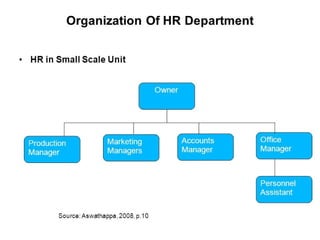
Organisation for HR department
• Size of the firm
• Nature of the business
• Senior Management Philosophy
• Multinational/ Global Presence
HRM in Large-scale Unit
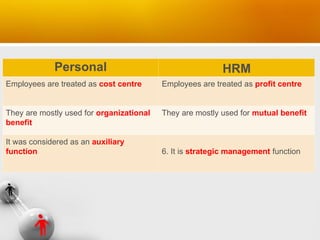
Personnel versus HRM
Personnel HRM
It is the management of people
employed
It is the management of employees
skills knowledge, abilities, talents,
aptitudes etc..
Employee is treated as economic man
as his services are exchanged for wage or
salary
Employees are not only treated as
economic man but social and
psychological man too
Employee is viewed as a commodity or
tool which can be purchased and used
3. Employees are treated as resource.
Personal HRM
Employees are treated as cost centre Employees are treated as profit centre
They are mostly used for organizational
benefit
They are mostly used for mutual benefit
It was considered as an auxiliary
function 6. It is strategic management function
HRM Models
•The Harvard
•The Guest
•The Warwick
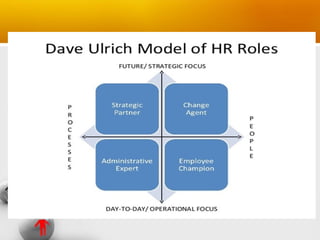
•Dave Ulrich
David Guest 1997
Hendry and Pettigrew of university of Warwick
HR Business Partner: The HR business partner is the HR point-of-contact for
these individuals and is therefore the channel that most internal members of
an organization will use to communicate with a Human Resources department.
Among other things, the HR business partner gives feedback to internal
customers about the quality of their experience, identifies top talents within
the organization, helps fill job vacancies, shares HR goals with employees to
ensure they are implemented across the organization, and helps promote
overall productivity and harmony in the workplace.
Change Agent: When an organization is required to expand, evolve, or
otherwise alter its goals or objectives, the change agent is the Human
Resources role that communicates those organizational changes internally.
Essentially, the change agent helps adapt the organization for its next stage of
growth or evolution.
Administration Expert: This administration role within HR is responsible for
numerous different types of tasks. On one end of the spectrum, the
administration expert follows changes in legislation, regulation, occupational
health and safety rules, and other types of labor or trade law and helps the
organization adapt in order to stay compliant with those laws. On the other
end of the spectrum, the administration expert is responsible for organizing
personal employee information and making sure that it is up to date.
Employee Advocate/Employee Champion: At all times, any Human Resources
department is responsible for staying aware of employee interests and
making sure they are protected. The employee advocate (also known as the
“employee champion”) is the role in charge of gauging employee morale and
satisfaction and using that information to create a positive company where
people will want to work.
Human Resource
Planning
INTRODUCTION
•Planning for human resources is
more important than planning for any
other resources because the demand
of latter depends on size and
structure of the former whether it is in
country or in an Industry.
Management of human resource
hardly begins from human resource
planning.
DEFINITION
• HRP is a process of forecasting a firm’s future demand
for, and supply of , the right type of people in the
right number.
- K. Aswathappa
• HRP is a process by which manager ensure that they have
the right number and kind of capable people in the right
places and at the right times.
- Robbins & Coulter
“A process by which an organization should move
from its current manpower position to desired
manpower position. Through planning the
management strives to have the right number,
right kind of people at right place and at right
time, doing things which results both organization
and individual receiving maximum long run
benefits.”
- E.W. Vetter
Contd.
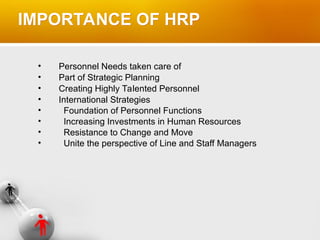
IMPORTANCE OF HRP
• Personnel Needs taken care of
• Part of Strategic Planning
• Creating Highly Talented Personnel
• International Strategies
• Foundation of Personnel Functions
• Increasing Investments in Human Resources
• Resistance to Change and Move
• Unite the perspective of Line and Staff Managers
Environment
Organizational
Objectives and Policies
Shortage
Recruitment
Selection, etc
HR Needs Forecasts
HR Programming
HRP
Implementation
HR Supply Forecasts
Control and Evaluation
of Programming
Surplus
Restricted Hiring
Reduced Hours VRS,
Lay off, etc.
The HRP Process
Rrequisites For Eeffective HRP
1. HRP should be integral part of corporate planning
2. Top management backing is essential.
3. HRP responsibilities should be centralized.
4. Personnel records must be complete , up-to-date and readily available
5. The Time horizon of the plan must be long enough to permit any
remedial action
6. Plan should be prepared by Skill Levels rather than by aggregates
Rrequisites For Eeffective HRP
1. HRP should be integral part of corporate planning
2. Top management backing is essential.
3. HRP responsibilities should be centralized.
4. Personnel records must be complete , up-to-date and readily available
5. The Time horizon of the plan must be long enough to permit any
remedial action
6. Impact of technological changes should be considerred.
1. Inexpert in managing business.
2. Only experts in handling personnel
matters
3. Time consuming
4. Financial forecasting precedes HRP
5. Qualitative vs. Quantitative
6. Non-involvement of operations
managers
BARRIERS TO HRP
Job Description
Job Specification
Job Analysis process
1) Strategic Choices
– employee Involvement
– Level of details
– When and how often
– Past oriented versus future oriented
– Source of job data
2) Information gathering
3) Information Processing
4) Job Analysis
TQM
• Total quality management consists of
organization-wide efforts to install and make
permanent climate where employees
continuously improve their ability to provide
on demand products and services that
customers will find of particular value.
• Management approach to Long-term
satisfaction through customer satisfaction
Problems with Job Analysis
• Support from top management
• Single means and source
• No training or motivation
• Activities may be distorted
Requisites for job analysis
• Job description and specification becomes
easy.
• Managers can easily communicates the
info.
• When changes required.
• Purpose is employee involvement with type of
information required & level of details
specified.
Issues in Job Design
piece
Definition of Recruitment
According to Edwin Flippo, "Recruitment is the
process of searching for prospective
employees and stimulating them to apply for
jobs in the Organisation."
•Head Hunting
•Cold Calling
•Poaching
Recruiting Yield Pyramid
Barriers to effective selection
• Perception
• Fairness
• Validity
• Reliability
• Pressure
Evolution of selection Process
• Cost per Hire
• Time to Hire
• Quality of Hire
• Selecting Programme Audit
human resource management module one pptx

human resource management module one pptx

  • 1.
    Module:1 Introduction to HumanResource Management Dr. Bijal Shah
  • 2.
    Learning Objectives • Meaningof HRM • Nature of HRM • Scope of HRM • Importance of HRM • HRM Functions • HRM Models
  • 3.
    HUMAN RESOURCE MANAGEMENT •“Human” represents the dimension of HRM which relates to the soft aspect such as commitment through participation and the most important aspect being the employees. • “Resource "represent the hard aspects such as strategy link of HRM and the importance of efficient utilization of employees. • “Management” represent the role of HRM as part of management that implies that it is not only an administrative function that carries out the formulated policies but also a managerial function that contribute to strategy formulation.
  • 4.
    Human Resources…  Are thegreatest assets of an Org.  All other resources get connected through person  To make them deliver they need to be –  Properly selected  Properly trained  Properly motivated
  • 5.
    HUMAN RESOURCE MANAGEMENT •HRM is the part of the organization that is concerned with the ‘people’ dimension. • HRM deals with human relations of an organization starting from recruitment to labor relation. It is a process of acquisition , development, motivation and maintenance of human resource of an organization. • Human resource management may be defined as a set of policies, practices, and principles designed to maximize both personal and organizational objectives. • It is a process by which the people and the organizations are bound together in such a way that both of them are able to achieve their objectives.
  • 6.
    HRM is “ Themanagement of human resources is viewed as a system in which participants seeks to attain both individual & group goals.” - Dale Yoder  “HRM is the function performed in organizations that facilitates the most effective use of people to achieve organizational and individual goals.” ---- -Ivancevich and Glueck
  • 7.
    DEFINITION According to Flippo, “Human resource management is the planning, organizing, directing and controlling of the procurement, development , compensation , integration , maintenance , and reproduction of human resources to the end so that individual, organizational and societal objectives are accomplished.”
  • 8.
    Nature / FeaturesOF HRM 1. A part of Management Discipline 2. Universal Existence 3. Concerned with People 4. Action oriented 5. Directed towards Achievement of Objectives 6. Integrating Mechanism 7. Development Oriented 8. Continuous Process 9. Comprehensive Function
  • 9.
    Contd. 1. A partof Management Discipline: HRM is a part of management discipline. It is not a discipline in itself but is only a field of study. HRM, being a part of management process, draws heavily from management concepts, principles and techniques and apply these in the management of human resources. 2. Universal Existence: HRM is pervasive in nature. It is present in all enterprises. It permeates all levels of management in an organisation. 3. Concerned with People: HRM is all about people at work, both as individuals and groups. It tries to put people on assigned job in order to produce goods results. The resultant gains are used to reward people and motivate them towards further improvement is productivity.
  • 10.
    Contd. 4. Action oriented: HRMfocuses attention on action, rather than on record keeping, written procedures or rules. The problems of employees are solved through rational policies. 5. Directed towards Achievement of Objectives: HRM is directed towards achievement of organisational objectives by providing tools and techniques of managing people in the organisation effectively. 6. Integrating Mechanism: HRM tries to build and maintain cordial relation between people working at different levels in the organisation. It tries to integrate human assets in the best possible manner for achieving organisational goals.
  • 11.
    Contd. 7. Development Oriented: HRMintends to develop the full potential of employees. The reward structure is turned to the needs of employees. Training is provided to improve the skill of employees. Every attempt is made to use their talents fully in the service of organisational goals. 8. Continuous Process: HRM is not a one short deal. It cannot be practiced only one hour each day or one day a week. It requires constant alertness and awareness of human relations and their importance in every day operations. 9. Comprehensive Function: HRM is concerned with managing people at work. It covers all types of people at all levels in the organisation. It applies to workers, supervisors, officers, manager and other types of personnel.
  • 12.
  • 13.
    The scope ofHRM is very wide: • Personnel aspect-This is concerned with manpower planning, recruitment, selection, placement, transfer, promotion, training and development, layoff and retrenchment, remuneration, incentives, productivity etc. • Welfare aspect-It deals with working conditions and amenities such as canteens, creches, rest and lunch rooms, housing, transport, medical assistance, education, health and safety, recreation facilities, etc. • Industrial relations aspect-This covers union-management relations, joint consultation, collective bargaining, grievance and disciplinary procedures, settlement of disputes, etc.
  • 14.
    IMPORTANCE OF HRM Good human resource practices help in attracting and retaining the best people in the organizations.  In order to make use of latest technology the appointment of right persons is essential and this happens only when management performs its HR function satisfactorily.  The performance of the company depends upon the qualities of the people employed . this has further increased the importance of HRM.  Human resource development is essential for meeting the challenges of future
  • 15.
    Importance for Employees •Effective management of human resource promotes team work and team spirit. • It encourages people to work with diligence and commitment. • HRM stresses on the motivation of employees by providing them various financial and non financial incentives.
  • 16.
  • 17.
    There are fourclearly defined objectives that you would have to follow. 1. Societal Objectives: Society here includes legal obligations, union- management relations that an HR manager needs to fulfill. Operative functions of HR management find more cognizance here. 2. Organizational Objectives: As an HRM professional you would be required to ensure organizational effectiveness by assisting the company to meet its primary goals. 3. Functional Objectives: The HR department should function in tandem with the organizational goals. Keeping up to date with your core competencies is the mantra here. 4. Personal Objectives: HR manager assess individual employee’s skill sets and designs ‘learning and development’ pathways, aligning it with organizational goals simultaneously. At its forefront it involves helping individual employee in achieving his/her personal goals and envisioning a career path in the organization in a way it adds value to the company.
  • 19.
    Functions of HRM Functionsof HRM may be broadly divided into two categories: •Managerial functions •Operative functions
  • 20.
    Managerial functions The basicmanagerial functions are: •Planning •Organizing •Directing •controlling
  • 21.
    Operative Functions 1. Procurement:  Job analysis  Human resource planning  Recruitment  Selection  Placement  Induction and orientation  Internal mobility
  • 24.
    2. Development • Training •Executive development. • Career planning and development. • Human resource development.
  • 26.
    HRM vs. HRD •HRM is a management function and HRD is a subset of it. • Basically HRM is concerned with making best use of human resource or employees with best working conditions. whereas, HRD is a wing of HRM which focus on development of employees for better performance by enhancing skills, knowledge or competency.
  • 27.
    3. Motivation andcompensation •Job design. •Work scheduling •Motivation •Job evaluation •Performance appraisal •Compensation administration •Incentives and benefits
  • 28.
    • Job design(also referred to as work design or task design) is a core function of human resource management and it is related to the specification of contents, methods and relationship of jobs in order to satisfy technological and organizational requirements as well as the social and personal requirements of the job . • A work schedule is a list of employees, and associated information e.g. location, working times, responsibilities for a given time period e.g. week, month • Motivation: It is the inner drive that directs a person's behavior toward. In HRM the term refers to person's desire to do the best possible job or to exert the maximum effort to perform assigned tasks. • Job evaluation: It is a systematic way of determining the value/worth of a job in relation to other jobs in an organization. It tries to make a systematic comparison between jobs to assess their relative worth for the purpose of establishing a rational pay structure.
  • 29.
    • Performance appraisal:It is a systematic, general and periodic process that assesses an individual employee's job performance and productivity in relation to certain pre- established criteria and organizational objectives. • Compensation administration: It is a segment of management or human resource management focusing on planning, organizing, and controlling the direct and indirect payments employees receive for the work they perform. • Benefits :These perks, also known as “benefits in kind” can include bonuses, profit sharing, medical, disability, and life insurance, paid vacations, free meals, use of a company car, pensions, stock options, childcare, gratuity, company holidays, personal days, sick leave, other time off from work, retirement and pension plan. • Incentives refer to rewards given to employees in monetary on non-monetary form in order to motivate them to work more efficiently. It is also known as payment by results (PBR) as they are paid in lieu of outstanding performance by an employee.
  • 30.
    4. Maintenance: • Healthand safety • Employee welfare • Social security measures
  • 31.
    • Health andsafety : All workers are entitled to work in environments where risks to their health and safety are properly controlled. Under health and safety law, the primary responsibility for this is down to employers. • Employee welfare : Welfare includes anything that is done for the comfort and improvement of employees and is provided over and above the wages. Labor welfare entails all those activities of employer which are directed towards providing the employees with certain facilities and services in addition to wages or salaries. • Social security measures : Under Social Security activities function of HRM, a range of programs are included to afford employee a basic level of benefits in the event of their retirement, death, or disability.
  • 32.
    Line functions &Stafffunctions • The departments or employees of a firm that perform the core activities and contribute to its business directly are called line function example manufacturing and marketing. • On the other hand the departments or employees that perform the support function and contribute indirectly to the business of a firm are termed as staff function example Human Resource Management . • A staff function is a secondary business activity that supports the line functions of a business to achieve the objectives. In business management, staff functions are usually defined as all functions that are not line functions. The nature of this function is advisory. The people belonging to this function investigate, research, and give advice to their line managers.
  • 33.
    A Line Function: AnHR manager possesses a line authority over his own department to accomplish the task and roles assigned to each employee of the department. His suggestions also are taken as orders. A Staff Function: This is basically an advisory role played by the manager whereby he only assists line managers, but that does not mean his advice shall be taken finally. It all depends on the discretion of the line manager. Such a function involves assisting on areas such as training, evaluating, rewarding, counseling, promoting, and firing of employees, etc. Many a times, HR managers also update the line managers as well as top management regarding the current trends and new methods of solving problems. Line functions &Staff functions in HRM
  • 34.
    Organisation for HRdepartment • Size of the firm • Nature of the business • Senior Management Philosophy • Multinational/ Global Presence
  • 36.
  • 38.
  • 39.
    Personnel versus HRM PersonnelHRM It is the management of people employed It is the management of employees skills knowledge, abilities, talents, aptitudes etc.. Employee is treated as economic man as his services are exchanged for wage or salary Employees are not only treated as economic man but social and psychological man too Employee is viewed as a commodity or tool which can be purchased and used 3. Employees are treated as resource.
  • 40.
    Personal HRM Employees aretreated as cost centre Employees are treated as profit centre They are mostly used for organizational benefit They are mostly used for mutual benefit It was considered as an auxiliary function 6. It is strategic management function
  • 41.
    HRM Models •The Harvard •TheGuest •The Warwick •Dave Ulrich
  • 43.
  • 44.
    Hendry and Pettigrewof university of Warwick
  • 46.
    HR Business Partner:The HR business partner is the HR point-of-contact for these individuals and is therefore the channel that most internal members of an organization will use to communicate with a Human Resources department. Among other things, the HR business partner gives feedback to internal customers about the quality of their experience, identifies top talents within the organization, helps fill job vacancies, shares HR goals with employees to ensure they are implemented across the organization, and helps promote overall productivity and harmony in the workplace. Change Agent: When an organization is required to expand, evolve, or otherwise alter its goals or objectives, the change agent is the Human Resources role that communicates those organizational changes internally. Essentially, the change agent helps adapt the organization for its next stage of growth or evolution.
  • 47.
    Administration Expert: Thisadministration role within HR is responsible for numerous different types of tasks. On one end of the spectrum, the administration expert follows changes in legislation, regulation, occupational health and safety rules, and other types of labor or trade law and helps the organization adapt in order to stay compliant with those laws. On the other end of the spectrum, the administration expert is responsible for organizing personal employee information and making sure that it is up to date. Employee Advocate/Employee Champion: At all times, any Human Resources department is responsible for staying aware of employee interests and making sure they are protected. The employee advocate (also known as the “employee champion”) is the role in charge of gauging employee morale and satisfaction and using that information to create a positive company where people will want to work.
  • 48.
  • 49.
    INTRODUCTION •Planning for humanresources is more important than planning for any other resources because the demand of latter depends on size and structure of the former whether it is in country or in an Industry. Management of human resource hardly begins from human resource planning.
  • 51.
    DEFINITION • HRP isa process of forecasting a firm’s future demand for, and supply of , the right type of people in the right number. - K. Aswathappa • HRP is a process by which manager ensure that they have the right number and kind of capable people in the right places and at the right times. - Robbins & Coulter
  • 52.
    “A process bywhich an organization should move from its current manpower position to desired manpower position. Through planning the management strives to have the right number, right kind of people at right place and at right time, doing things which results both organization and individual receiving maximum long run benefits.” - E.W. Vetter Contd.
  • 53.
    IMPORTANCE OF HRP •Personnel Needs taken care of • Part of Strategic Planning • Creating Highly Talented Personnel • International Strategies • Foundation of Personnel Functions • Increasing Investments in Human Resources • Resistance to Change and Move • Unite the perspective of Line and Staff Managers
  • 54.
    Environment Organizational Objectives and Policies Shortage Recruitment Selection,etc HR Needs Forecasts HR Programming HRP Implementation HR Supply Forecasts Control and Evaluation of Programming Surplus Restricted Hiring Reduced Hours VRS, Lay off, etc. The HRP Process
  • 56.
    Rrequisites For EeffectiveHRP 1. HRP should be integral part of corporate planning 2. Top management backing is essential. 3. HRP responsibilities should be centralized. 4. Personnel records must be complete , up-to-date and readily available 5. The Time horizon of the plan must be long enough to permit any remedial action 6. Plan should be prepared by Skill Levels rather than by aggregates
  • 57.
    Rrequisites For EeffectiveHRP 1. HRP should be integral part of corporate planning 2. Top management backing is essential. 3. HRP responsibilities should be centralized. 4. Personnel records must be complete , up-to-date and readily available 5. The Time horizon of the plan must be long enough to permit any remedial action 6. Impact of technological changes should be considerred.
  • 58.
    1. Inexpert inmanaging business. 2. Only experts in handling personnel matters 3. Time consuming 4. Financial forecasting precedes HRP 5. Qualitative vs. Quantitative 6. Non-involvement of operations managers BARRIERS TO HRP
  • 62.
  • 65.
    Job Analysis process 1)Strategic Choices – employee Involvement – Level of details – When and how often – Past oriented versus future oriented – Source of job data 2) Information gathering 3) Information Processing 4) Job Analysis
  • 67.
    TQM • Total qualitymanagement consists of organization-wide efforts to install and make permanent climate where employees continuously improve their ability to provide on demand products and services that customers will find of particular value. • Management approach to Long-term satisfaction through customer satisfaction
  • 68.
    Problems with JobAnalysis • Support from top management • Single means and source • No training or motivation • Activities may be distorted
  • 69.
    Requisites for jobanalysis • Job description and specification becomes easy. • Managers can easily communicates the info. • When changes required. • Purpose is employee involvement with type of information required & level of details specified.
  • 76.
  • 79.
  • 85.
    Definition of Recruitment Accordingto Edwin Flippo, "Recruitment is the process of searching for prospective employees and stimulating them to apply for jobs in the Organisation."
  • 89.
  • 90.
  • 103.
    Barriers to effectiveselection • Perception • Fairness • Validity • Reliability • Pressure
  • 104.
    Evolution of selectionProcess • Cost per Hire • Time to Hire • Quality of Hire • Selecting Programme Audit