Toc-H INSTITUTE OF SCIENCE & TECHNOLOGY 1
Introduction to
Genetic Algorithms
BY
PREMSANKAR.C
CS S7
ROLL NO :25
Toc-H INSTITUTE OF SCIENCE &
TECHNOLOGY 2
Genetic Algorithms (GA) Overview
 Originally developed by John Holland (1975)
 A class of optimization algorithms
 Inspired by the biological evolution process
 Uses concepts of “Natural Selection” and
“Genetic Inheritance” (Darwin 1859)
 Particularly well suited for hard problems where
little is known about the underlying
search space
 Widely-used in business, science and
engineering
 GA’s are a subclass of Evolutionary Algorithm
Toc-H INSTITUTE OF SCIENCE &
TECHNOLOGY 3
History of GA’s
Evolutionary computing developed in
the 1960’s.
GA’s were created by John Holland in
the mid-70’s.
 The computer model introduces
simplifications (relative to the real
biological mechanisms)
General Introduction to GA’s
Toc-H INSTITUTE OF SCIENCE &
TECHNOLOGY 4
INTRODUCTION
 genetic algorithms are best for
searching for new solutions
 making use of solutions that have
worked well in the past
 It works on large population of
solutions that are repeatedly
subjected to selection pressure
(survival of the fittest)
Toc-H INSTITUTE OF SCIENCE &
TECHNOLOGY 5
 Each solution is encoded as a
chromosome (string) also called a
genotype
 chromosome is given a measure of
fitness via a fitness function.
Possible information encoding
 Bit strings (0101 ... 1100)
 Real numbers (43.2 -33.1 ... 89.2)
 Permutations of element (E11 E3 E7 ... E1 E15)
 Lists of rules (R1 R2 R3 ... R22 R23)
 Program elements (genetic programming)
Toc-H INSTITUTE OF SCIENCE &
TECHNOLOGY 6
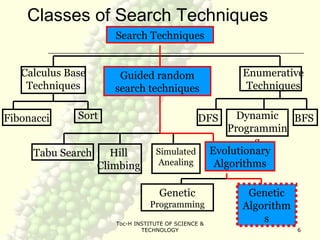
Classes of Search Techniques
Search Techniques
Calculus Base
Techniques
Guided random
search techniques
Enumerative
Techniques
BFSDFS Dynamic
Programmin
g
Tabu Search Hill
Climbing
Simulated
Anealing
Evolutionary
Algorithms
Genetic
Programming
Genetic
Algorithm
s
Fibonacci Sort
Toc-H INSTITUTE OF SCIENCE &
TECHNOLOGY 7
Genetic Algorithms vs Traditional
Algorithm
1.GA’s work with a coding of parameter set,
not the parameter themselves.
2.GA’s search from a population of points,
not a single point.
3. Application of GA operators causes
information from the previous
generation to be carried over to the next.
4.GA’s use probabilistic rules, not
deterministic rules.
Toc-H INSTITUTE OF SCIENCE &
TECHNOLOGY 8
BASIC Components of a GA
A problem definition as input, and
 Encoding principles (gene, chromosome)
 Initialization procedure (creation)
 Selection of parents (reproduction)
 Genetic operators (mutation, recombination)
 Evaluation function (environment)
 Termination condition
Toc-H INSTITUTE OF SCIENCE &
TECHNOLOGY 9
Initialization
Start with a population of randomly generated
individuals, or use
- A previously saved population
- A set of solutions provided by a human expert
- A set of solutions provided by another heuristic
algorithm
Toc-H INSTITUTE OF SCIENCE &
TECHNOLOGY 10
ENCODING
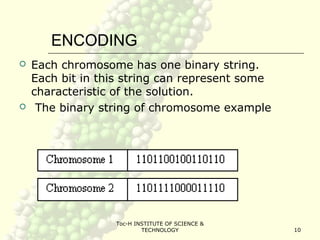
 Each chromosome has one binary string.
Each bit in this string can represent some
characteristic of the solution.
 The binary string of chromosome example
Toc-H INSTITUTE OF SCIENCE &
TECHNOLOGY 11
FITTNESS FUNCTION
 Determine the fitness of each
member of the population
 Perform the objective function on
each population member
 . FitnessScaling adjusts down the
fitness values of the super-
performers and adjusts up the lower
performers.
Toc-H INSTITUTE OF SCIENCE &
TECHNOLOGY 12
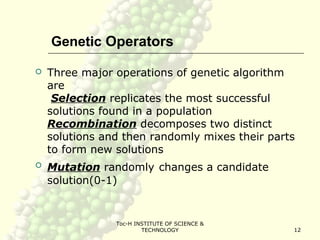
Genetic Operators
 Three major operations of genetic algorithm
are
Selection replicates the most successful
solutions found in a population
Recombination decomposes two distinct
solutions and then randomly mixes their parts
to form new solutions
 Mutation randomly changes a candidate
solution(0-1)
Toc-H INSTITUTE OF SCIENCE &
TECHNOLOGY 13
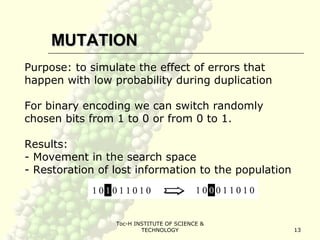
MUTATIONMUTATION
Purpose: to simulate the effect of errors that
happen with low probability during duplication
For binary encoding we can switch randomly
chosen bits from 1 to 0 or from 0 to 1.
Results:
- Movement in the search space
- Restoration of lost information to the population
Toc-H INSTITUTE OF SCIENCE &
TECHNOLOGY 14
SELECTION(reproduction)
 Purpose: to focus the search in
promising regions of the space
 Inspiration: Darwin’s “survival of
the fittest” .
 Example: the probability of
selecting a string with a fitness
value of f is f/ft, ft is the sum of all
of the fitness values in the
population
Toc-H INSTITUTE OF SCIENCE &
TECHNOLOGY 15
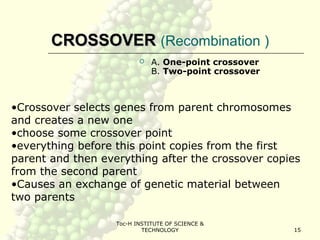
CROSSOVERCROSSOVER (Recombination )
 A. One-point crossover
B. Two-point crossover
•Crossover selects genes from parent chromosomes
and creates a new one
•choose some crossover point
•everything before this point copies from the first
parent and then everything after the crossover copies
from the second parent
•Causes an exchange of genetic material between
two parents
Toc-H INSTITUTE OF SCIENCE &
TECHNOLOGY 16
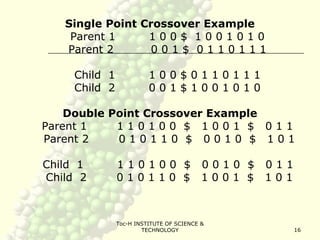
Single Point Crossover Example
Parent 1 1 0 0 $ 1 0 0 1 0 1 0
Parent 2 0 0 1 $ 0 1 1 0 1 1 1
Child 1 1 0 0 $ 0 1 1 0 1 1 1
Child 2 0 0 1 $ 1 0 0 1 0 1 0
Double Point Crossover Example
Parent 1 1 1 0 1 0 0 $ 1 0 0 1 $ 0 1 1
Parent 2 0 1 0 1 1 0 $ 0 0 1 0 $ 1 0 1
Child 1 1 1 0 1 0 0 $ 0 0 1 0 $ 0 1 1
Child 2 0 1 0 1 1 0 $ 1 0 0 1 $ 1 0 1
Toc-H INSTITUTE OF SCIENCE &
TECHNOLOGY 17
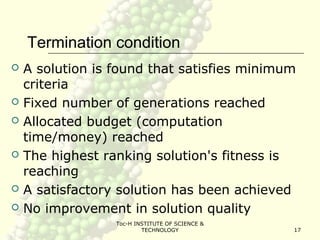
Termination condition
 A solution is found that satisfies minimum
criteria
 Fixed number of generations reached
 Allocated budget (computation
time/money) reached
 The highest ranking solution's fitness is
reaching
 A satisfactory solution has been achieved
 No improvement in solution quality
Toc-H INSTITUTE OF SCIENCE &
TECHNOLOGY 18
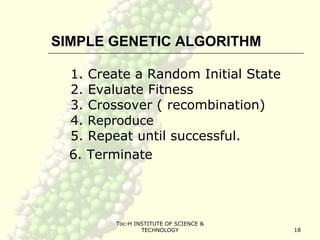
SIMPLE GENETIC ALGORITHM
1. Create a Random Initial State
2. Evaluate Fitness
3. Crossover ( recombination)
4. Reproduce
5. Repeat until successful.
6. Terminate
Toc-H INSTITUTE OF SCIENCE &
TECHNOLOGY 19
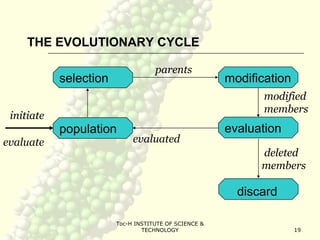
THE EVOLUTIONARY CYCLE
selection
population evaluation
modification
discard
deleted
members
parents
modified
members
evaluated
initiate
evaluate
Toc-H INSTITUTE OF SCIENCE &
TECHNOLOGY 20
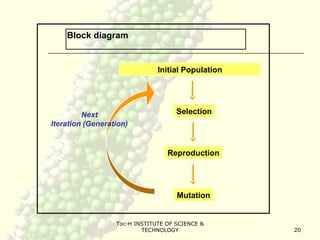
Initial Population
Selection
Reproduction
Mutation
Next
Iteration (Generation)
Block diagram
Toc-H INSTITUTE OF SCIENCE &
TECHNOLOGY 21
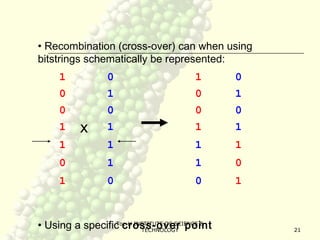
• Recombination (cross-over) can when using
bitstrings schematically be represented:
• Using a specific cross-over point
1
0
0
1
1
0
1
0
1
0
1
1
1
0
X
1
0
0
1
1
1
0
0
1
0
1
1
0
1
Toc-H INSTITUTE OF SCIENCE &
TECHNOLOGY 22
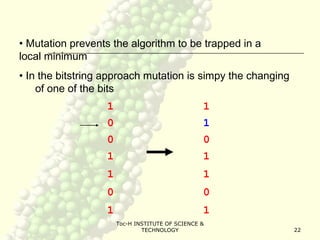
• Mutation prevents the algorithm to be trapped in a
local minimum
• In the bitstring approach mutation is simpy the changing
of one of the bits
1
0
0
1
1
0
1
1
1
0
1
1
0
1
Toc-H INSTITUTE OF SCIENCE &
TECHNOLOGY 23
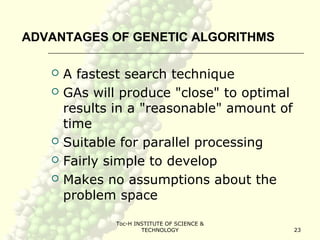
ADVANTAGES OF GENETIC ALGORITHMS
 A fastest search technique
 GAs will produce "close" to optimal
results in a "reasonable" amount of
time
 Suitable for parallel processing
 Fairly simple to develop
 Makes no assumptions about the
problem space
Toc-H INSTITUTE OF SCIENCE &
TECHNOLOGY 24
DRAWBACKS
 Number of permutations of functions and
variables. The search space is vast.
 Most GPs are limited in the available
operators and terminals they can use.
 It requires a lot of computer work, even
when a good set of operations, terminals
and controlling algorithm are chosen
Toc-H INSTITUTE OF SCIENCE &
TECHNOLOGY 25
APPLICATIONS OF GENETIC ALGORITHMS
 genetic programming
 Scheduling: Facility, Production, Job, and
Transportation Scheduling
 Design: Circuit board layout, Communication
Network design, keyboard layout, Parametric
design in aircraft
 Machine Learning: Designing Neural
Networks, Classifier Systems, Learning rules
 Image Processing: Pattern recognition
Toc-H INSTITUTE OF SCIENCE &
TECHNOLOGY 26
CONCLUSION
 GAs are a powerful tool for global
search
 GA are best for searching for new
solutions and making use of
solutions that have worked well in
the past
Toc-H INSTITUTE OF SCIENCE &
TECHNOLOGY 27
ANY OUESTIONS ?
Toc-H INSTITUTE OF SCIENCE &
TECHNOLOGY 28

Introduction to Genetic Algorithms

  • 1.
    Toc-H INSTITUTE OFSCIENCE & TECHNOLOGY 1 Introduction to Genetic Algorithms BY PREMSANKAR.C CS S7 ROLL NO :25
  • 2.
    Toc-H INSTITUTE OFSCIENCE & TECHNOLOGY 2 Genetic Algorithms (GA) Overview  Originally developed by John Holland (1975)  A class of optimization algorithms  Inspired by the biological evolution process  Uses concepts of “Natural Selection” and “Genetic Inheritance” (Darwin 1859)  Particularly well suited for hard problems where little is known about the underlying search space  Widely-used in business, science and engineering  GA’s are a subclass of Evolutionary Algorithm
  • 3.
    Toc-H INSTITUTE OFSCIENCE & TECHNOLOGY 3 History of GA’s Evolutionary computing developed in the 1960’s. GA’s were created by John Holland in the mid-70’s.  The computer model introduces simplifications (relative to the real biological mechanisms) General Introduction to GA’s
  • 4.
    Toc-H INSTITUTE OFSCIENCE & TECHNOLOGY 4 INTRODUCTION  genetic algorithms are best for searching for new solutions  making use of solutions that have worked well in the past  It works on large population of solutions that are repeatedly subjected to selection pressure (survival of the fittest)
  • 5.
    Toc-H INSTITUTE OFSCIENCE & TECHNOLOGY 5  Each solution is encoded as a chromosome (string) also called a genotype  chromosome is given a measure of fitness via a fitness function. Possible information encoding  Bit strings (0101 ... 1100)  Real numbers (43.2 -33.1 ... 89.2)  Permutations of element (E11 E3 E7 ... E1 E15)  Lists of rules (R1 R2 R3 ... R22 R23)  Program elements (genetic programming)
  • 6.
    Toc-H INSTITUTE OFSCIENCE & TECHNOLOGY 6 Classes of Search Techniques Search Techniques Calculus Base Techniques Guided random search techniques Enumerative Techniques BFSDFS Dynamic Programmin g Tabu Search Hill Climbing Simulated Anealing Evolutionary Algorithms Genetic Programming Genetic Algorithm s Fibonacci Sort
  • 7.
    Toc-H INSTITUTE OFSCIENCE & TECHNOLOGY 7 Genetic Algorithms vs Traditional Algorithm 1.GA’s work with a coding of parameter set, not the parameter themselves. 2.GA’s search from a population of points, not a single point. 3. Application of GA operators causes information from the previous generation to be carried over to the next. 4.GA’s use probabilistic rules, not deterministic rules.
  • 8.
    Toc-H INSTITUTE OFSCIENCE & TECHNOLOGY 8 BASIC Components of a GA A problem definition as input, and  Encoding principles (gene, chromosome)  Initialization procedure (creation)  Selection of parents (reproduction)  Genetic operators (mutation, recombination)  Evaluation function (environment)  Termination condition
  • 9.
    Toc-H INSTITUTE OFSCIENCE & TECHNOLOGY 9 Initialization Start with a population of randomly generated individuals, or use - A previously saved population - A set of solutions provided by a human expert - A set of solutions provided by another heuristic algorithm
  • 10.
    Toc-H INSTITUTE OFSCIENCE & TECHNOLOGY 10 ENCODING  Each chromosome has one binary string. Each bit in this string can represent some characteristic of the solution.  The binary string of chromosome example
  • 11.
    Toc-H INSTITUTE OFSCIENCE & TECHNOLOGY 11 FITTNESS FUNCTION  Determine the fitness of each member of the population  Perform the objective function on each population member  . FitnessScaling adjusts down the fitness values of the super- performers and adjusts up the lower performers.
  • 12.
    Toc-H INSTITUTE OFSCIENCE & TECHNOLOGY 12 Genetic Operators  Three major operations of genetic algorithm are Selection replicates the most successful solutions found in a population Recombination decomposes two distinct solutions and then randomly mixes their parts to form new solutions  Mutation randomly changes a candidate solution(0-1)
  • 13.
    Toc-H INSTITUTE OFSCIENCE & TECHNOLOGY 13 MUTATIONMUTATION Purpose: to simulate the effect of errors that happen with low probability during duplication For binary encoding we can switch randomly chosen bits from 1 to 0 or from 0 to 1. Results: - Movement in the search space - Restoration of lost information to the population
  • 14.
    Toc-H INSTITUTE OFSCIENCE & TECHNOLOGY 14 SELECTION(reproduction)  Purpose: to focus the search in promising regions of the space  Inspiration: Darwin’s “survival of the fittest” .  Example: the probability of selecting a string with a fitness value of f is f/ft, ft is the sum of all of the fitness values in the population
  • 15.
    Toc-H INSTITUTE OFSCIENCE & TECHNOLOGY 15 CROSSOVERCROSSOVER (Recombination )  A. One-point crossover B. Two-point crossover •Crossover selects genes from parent chromosomes and creates a new one •choose some crossover point •everything before this point copies from the first parent and then everything after the crossover copies from the second parent •Causes an exchange of genetic material between two parents
  • 16.
    Toc-H INSTITUTE OFSCIENCE & TECHNOLOGY 16 Single Point Crossover Example Parent 1 1 0 0 $ 1 0 0 1 0 1 0 Parent 2 0 0 1 $ 0 1 1 0 1 1 1 Child 1 1 0 0 $ 0 1 1 0 1 1 1 Child 2 0 0 1 $ 1 0 0 1 0 1 0 Double Point Crossover Example Parent 1 1 1 0 1 0 0 $ 1 0 0 1 $ 0 1 1 Parent 2 0 1 0 1 1 0 $ 0 0 1 0 $ 1 0 1 Child 1 1 1 0 1 0 0 $ 0 0 1 0 $ 0 1 1 Child 2 0 1 0 1 1 0 $ 1 0 0 1 $ 1 0 1
  • 17.
    Toc-H INSTITUTE OFSCIENCE & TECHNOLOGY 17 Termination condition  A solution is found that satisfies minimum criteria  Fixed number of generations reached  Allocated budget (computation time/money) reached  The highest ranking solution's fitness is reaching  A satisfactory solution has been achieved  No improvement in solution quality
  • 18.
    Toc-H INSTITUTE OFSCIENCE & TECHNOLOGY 18 SIMPLE GENETIC ALGORITHM 1. Create a Random Initial State 2. Evaluate Fitness 3. Crossover ( recombination) 4. Reproduce 5. Repeat until successful. 6. Terminate
  • 19.
    Toc-H INSTITUTE OFSCIENCE & TECHNOLOGY 19 THE EVOLUTIONARY CYCLE selection population evaluation modification discard deleted members parents modified members evaluated initiate evaluate
  • 20.
    Toc-H INSTITUTE OFSCIENCE & TECHNOLOGY 20 Initial Population Selection Reproduction Mutation Next Iteration (Generation) Block diagram
  • 21.
    Toc-H INSTITUTE OFSCIENCE & TECHNOLOGY 21 • Recombination (cross-over) can when using bitstrings schematically be represented: • Using a specific cross-over point 1 0 0 1 1 0 1 0 1 0 1 1 1 0 X 1 0 0 1 1 1 0 0 1 0 1 1 0 1
  • 22.
    Toc-H INSTITUTE OFSCIENCE & TECHNOLOGY 22 • Mutation prevents the algorithm to be trapped in a local minimum • In the bitstring approach mutation is simpy the changing of one of the bits 1 0 0 1 1 0 1 1 1 0 1 1 0 1
  • 23.
    Toc-H INSTITUTE OFSCIENCE & TECHNOLOGY 23 ADVANTAGES OF GENETIC ALGORITHMS  A fastest search technique  GAs will produce "close" to optimal results in a "reasonable" amount of time  Suitable for parallel processing  Fairly simple to develop  Makes no assumptions about the problem space
  • 24.
    Toc-H INSTITUTE OFSCIENCE & TECHNOLOGY 24 DRAWBACKS  Number of permutations of functions and variables. The search space is vast.  Most GPs are limited in the available operators and terminals they can use.  It requires a lot of computer work, even when a good set of operations, terminals and controlling algorithm are chosen
  • 25.
    Toc-H INSTITUTE OFSCIENCE & TECHNOLOGY 25 APPLICATIONS OF GENETIC ALGORITHMS  genetic programming  Scheduling: Facility, Production, Job, and Transportation Scheduling  Design: Circuit board layout, Communication Network design, keyboard layout, Parametric design in aircraft  Machine Learning: Designing Neural Networks, Classifier Systems, Learning rules  Image Processing: Pattern recognition
  • 26.
    Toc-H INSTITUTE OFSCIENCE & TECHNOLOGY 26 CONCLUSION  GAs are a powerful tool for global search  GA are best for searching for new solutions and making use of solutions that have worked well in the past
  • 27.
    Toc-H INSTITUTE OFSCIENCE & TECHNOLOGY 27 ANY OUESTIONS ?
  • 28.
    Toc-H INSTITUTE OFSCIENCE & TECHNOLOGY 28

Editor's Notes

  • #2 GENETIC ALGORITHMS CS S7