Genetic Algorithms Presentation By: Divya Rani R, Fazeelath Naziya
Presentation Outline Introduction History Search Techniques Basic concepts Biological Background Search Space Fitness Function Simple Genetic Algorithm Encoding GA Operators Reproduction Crossover Mutation Parameters of GA Example Benefits Applications Conclusion  Bibliography
Introduction Introduction Computerized search and  optimization algorithms  based on  Darwin’s Principle of Natural Selection Part of  Evolutionary Algorithms Basic concept  - to simulate processes in natural system necessary for evolution Structural Engineering Problems, Biology, Computer Science, Image processing and Pattern Recognition, physical science, social sciences and Neural Networks  Provide efficient, effective techniques for optimization
History Evolutionary Computing – 1960 by  Rechenberg Developed by  John Holland , University of Michigan - 1970 Got popular in the late 1980’s Based on ideas from  Darwinian Evolution theory   “Survival of the fittest” 1986 – Optimization of a Ten Member Plane
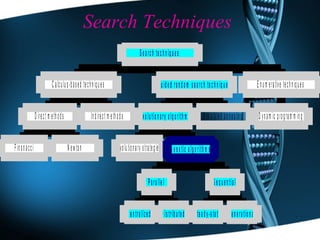
Search Techniques
GA converts design space into genetic space Works with a coding variables Traditional optimization techniques are deterministic in nature, but GA uses randomized operators Three important aspects:  Definition of objective function Definition and implementation of genetic representation Definition and implementation of genetic operators Basic Concepts
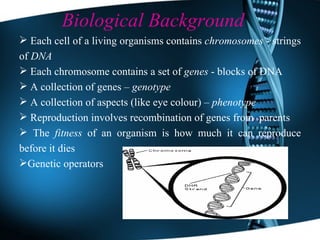
Biological Background Each cell of a living organisms contains  chromosomes  - strings of  DNA Each chromosome contains a set of  genes  - blocks of DNA A collection of genes –  genotype A collection of aspects (like eye colour) –  phenotype Reproduction involves recombination of genes from  parents The  fitness  of an organism is how much it can reproduce before it dies Genetic operators Biological Background
Search Space The space for all possible feasible solutions Each feasible solution can be "marked" by its value of the fitness of the problem GA is started with a set of solutions called  populations Used to form a  new population More suitable, more chances to select This is repeated until best population is obtained
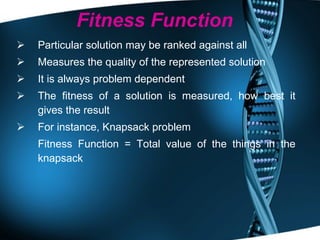
Fitness Function Particular solution may be ranked against all  Measures the quality of the represented solution It is always problem dependent The fitness of a solution is measured, how best it gives the result For instance, Knapsack problem Fitness Function = Total value of the things in the knapsack
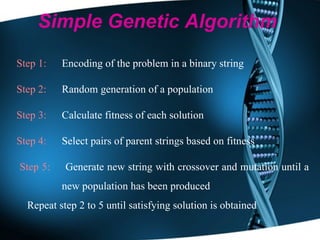
Simple Genetic Algorithm Step 1: Encoding of the problem in a binary string Step 2: Random generation of a population Step 3: Calculate fitness of each solution Step 4: S elect pairs of parent strings based on fitness Step 5: Generate new string with crossover and mutation until a  new population has been produced Repeat step 2 to 5 until satisfying solution is obtained
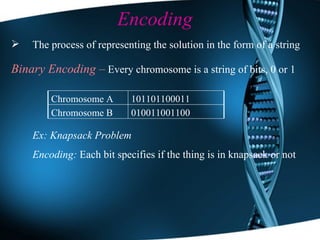
Encoding  The process of representing the solution in the form of a string  Binary Encoding –   E very chromosome is a string of bits, 0 or 1 Ex: Knapsack Problem Encoding:  Each bit specifies if the thing is in knapsack or not 010011001100 Chromosome B 101101100011 Chromosome A
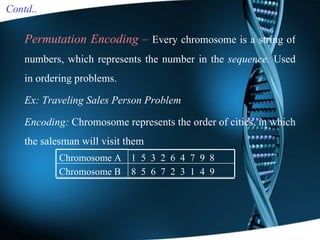
Permutation Encoding –   Every chromosome is a string of numbers, which represents the number in the  sequence.  Used in  ordering problems. Ex: Traveling Sales Person Problem Encoding:  Chromosome represents the order of cities, in which the salesman will visit them Contd.. 8  5  6  7  2  3  1  4  9 Chromosome B 1  5  3  2  6  4  7  9  8 Chromosome A
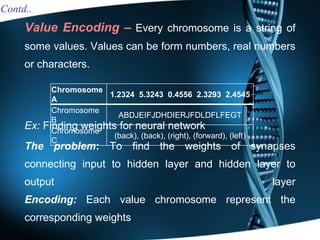
Value Encoding –   Every chromosome is a string of some values. Values can be form numbers, real numbers or characters. Ex:  Finding weights for neural network The problem :  To find the weights of synapses connecting input to hidden layer and hidden layer to output layer Encoding:   Each value chromosome represent the corresponding weights  Contd.. Chromosome A 1.2324  5.3243  0.4556  2.3293  2.4545 Chromosome B ABDJEIFJDHDIERJFDLDFLFEGT Chromosome C (back), (back), (right), (forward), (left)

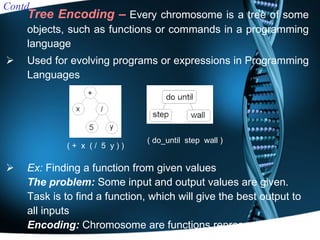
Tree Encoding –   E very chromosome is a tree of some objects, such as functions or commands in a programming language  Used  for evolving programs or expressions in Programming Languages Ex:  Finding a function from given values The problem:  Some input and output values are given. Task is to find a function, which will give the best output to all inputs Encoding:   Chromosome are functions represented in a tree Contd.. ( +  x  ( /  5  y ) ) ( do_until  step  wall )
Operators of GA Three Basic operators: Reproduction  Crossover  Mutation The new poopulation is further evaluated and tested for termination If the termination criteria are not met, the population is iteratively operated  One cycle of operations and the subsequent evaluation –  Generation  in GA
Reproduction Chromosomes are selected from the population to be parents to crossover and produce offspring Also known as  Selection Operator Parents are selected according to their fitness There are many methods  to select the best chromosomes Roulette Wheel Selection Rank Selection Tournament Selection Steady State Selection   Elitism The better the chromosomes are, the more chances to be selected they have
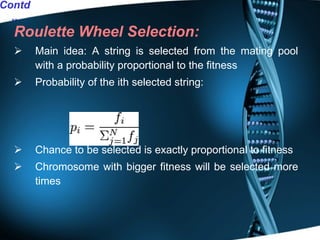
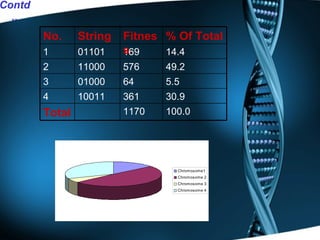
Roulette Wheel Selection: Main idea: A string is selected from the mating pool with a probability proportional to the fitness Probability of the ith selected string: Chance to be selected is exactly proportional to fitness Chromosome with bigger fitness will be selected more times Contd..
Contd.. 100.0 1170 Total 30.9 361 10011 4 5.5 64  01000 3 49.2 576 11000  2 14.4 169 01101 1 % Of Total Fitness String No.
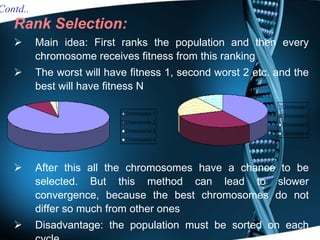
Rank Selection: Main idea: First ranks the population and then every chromosome receives fitness from this ranking The worst will have fitness 1, second worst 2 etc. and the best will have fitness N  After this all the chromosomes have a chance to be selected. But this method can lead to slower convergence, because the best chromosomes do not differ so much from other ones Disadvantage: the population must be sorted on each cycle Contd..
Tournment Selection: Binary Tournament:  Two individuals are randomly chosen; the fitter of the two is selected as a parent Probabilistic Binary Tournament:  Two individuals are randomly chosen, with a chance p, 0.5<p<1, the fitter of the two is selected as a parent Larger Tournaments:  ‘n’ individuals are randomly chosen, the fittest one is selected as a parent Contd..
Steady-State Selection: Main idea: Big part of chromosomes should survive to next generation Working: In every generation is selected a few (good - with high fitness) chromosomes for creating a new offspring Then some (bad - with low fitness) chromosomes are removed and the new offspring is placed in their place The rest of population survives to new generation Contd..
Elitism:   Main idea:  copy the best chromosomes (solutions)  to new population before applying crossover and mutation When creating a new population by crossover or mutation the best chromosome might be lost Forces GAs to retain some number of the best individuals at each generation. Improves performance Contd..
Crossover Applied to create a better string Proceeds in three steps The reproduction operator selects at random a pair of two individual strings for mating  A cross-site is selected at random along the string length The position values are swapped between two strings following the cross-site MAY NOT ALWAYS  yield a better or good solution Since parents are good, probability of the child being good is high If offspring is not good, it will be removed in the next iteration during “Selection”
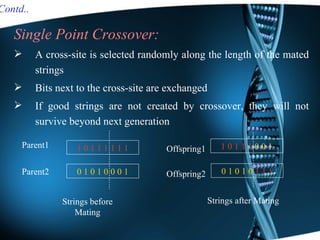
Single Point Crossover: A cross-site is selected randomly along the length of the mated strings Bits next to the cross-site are exchanged If good strings are not created by crossover, they will not survive beyond next generation Offspring1 Offspring2 Parent2 Parent1 Strings before Mating Contd.. 0 1 0 1 0 0 0 1 1 0 1 1 1 1 1 1 0 1 0 1 0 1 1 1 1 0 1 1 1 0 0 1 Strings after Mating Single Point Crossover: A cross-site is selected randomly along the length of the mated strings Bits next to the cross-site are exchanged If good strings are not created by crossover, they will not survive beyond next generation Offspring1 Offspring2 Strings before Mating Contd.. 0 1 0 1 0   1 1 1 1 0 1 1 1  0 0 1 Strings after Mating Parent2 Parent1 0 1 0 1 0 0 0 1 1 0 1 1 1   1 1 1
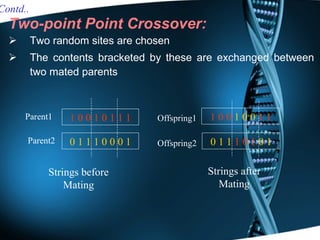
Two-point Point Crossover: Two random sites are chosen The contents bracketed by these are exchanged between two mated parents Offspring1 Offspring2 Strings before Mating Contd.. 0 1 1   1 0 1   0 1 1 0 0  1 0 0  1 1 Strings after Mating Parent2 Parent1 0 1 1 1 0 0 0 1 1 0 0 1 0 1 1 1
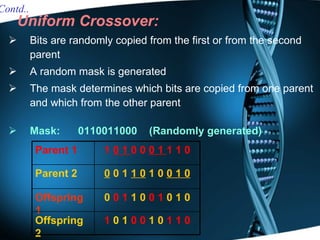
Uniform Crossover: Bits are randomly  copied from the first or from the second parent A random mask is generated The mask determines which bits are copied from one parent and which from the other parent Mask:  0110011000  (Randomly generated) Contd.. Parent 1 1  0 1  0 0  0 1  1 1 0 Parent 2 0  0 1  1 0  1 0  0 1 0 Offspring 1 0   0 1  1 0  0 1  0 1 0 Offspring 2 1  0 1   0 0  1 0   1 1 0
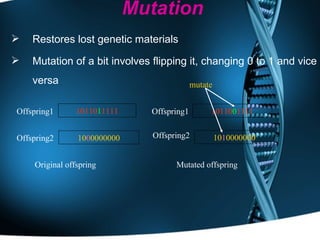
Mutation restores lost genetic materials Mutation of a bit involves flipping it, changing 0 to 1 and vice versa Offspring2 10110 1 1111 10 1 0000000 Offspring1 10110 0 1111 10 0 0000000 Offspring1 Offspring2 mutate Original offspring Mutated offspring Restores lost genetic materials Mutation of a bit involves flipping it, changing 0 to 1 and vice versa Offspring2 10110 1 1111 10 0 0000000 Offspring1 10110 0 1111 10 1 0000000 Offspring1 Offspring2 mutate Original offspring Mutated offspring Mutation
Parameters of GA Crossover probability:   How often will be crossover performed If there is no crossover, offspring is exact copy of parents If there is a crossover, offspring is made from parts of parents' chromosome If crossover probability is 100%, then all offspring is made by crossover If it is 0%, whole new generation is made from exact copies of chromosomes from old population
Mutation Probability: How often will be parts of chromosome mutated If there is no mutation, offspring is taken after crossover (or copy) without any change If mutation is performed, part of chromosome is changed If mutation probability is 100%, whole chromosome is changed If it is 0%, nothing is changed Contd..
Population Size: Describes how many chromosomes are in population  If there are too few chromosomes, GA have a few possibilities to perform crossover and only a small part of search space is explored If there are too many chromosomes, GA slows down Contd..
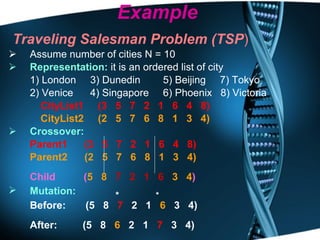
Example Traveling Salesman Problem (TSP ) Assume number of cities N = 10 Representation:  it is an ordered list of city 1) London  3) Dunedin  5) Beijing  7) Tokyo 2) Venice  4) Singapore  6) Phoenix  8) Victoria CityList1  (3  5  7  2  1  6  4  8) CityList2  (2  5  7  6  8  1  3  4) Crossover:   Parent1  (3  5  7  2  1  6  4  8) Parent2  (2  5  7  6  8  1  3  4) Child  ( 5  8  7   2  1  6   3  4 ) Mutation:   *   * Before:  (5  8  7   2  1  6   3  4) After:  (5  8  6   2  1  7   3  4)
Benefits Easy to understand Modular, separate from application Supports multi-objective optimization Easy to exploit previous or alternate solutions Flexible in forming building blocks for hybrid applications Substantial history and range of use Disadvantage: GA requires more computational time It is slower than some other methods
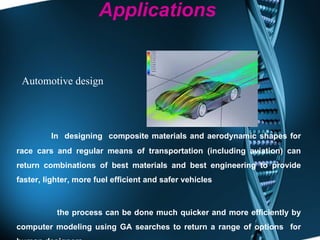
Applications In  designing  composite materials and aerodynamic shapes for race cars and regular means of transportation (including aviation) can return combinations of best materials and best engineering to provide faster, lighter, more fuel efficient and safer vehicles  the process can be done much quicker and more efficiently by computer modeling using GA searches to return a range of options  for human designers  Automotive design
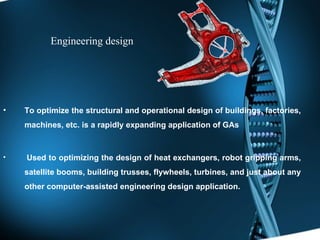
Engineering design To optimize the structural and operational design of buildings, factories, machines, etc. is a rapidly expanding application of GAs Used to optimizing the design of heat exchangers, robot gripping arms, satellite booms, building trusses, flywheels, turbines, and just about any other computer-assisted engineering design application.
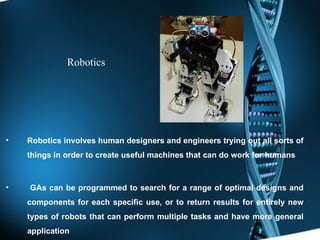
Robotics Robotics involves human designers and engineers trying out all sorts of things in order to create useful machines that can do work for humans   GAs can be programmed to search for a range of optimal designs and components for each specific use, or to return results for entirely new types of robots that can perform multiple tasks and have more general application
Optimized Telecommunications Routing GAs are being developed that it will allow for dynamic and anticipatory routing of circuits for telecommunications networks   These could take notice of your system's instability and anticipate your re-routing needs. optimize placement and routing of cell towers for best coverage and ease of switching
Trip, Traffic and Shipment Routing Traveling Salesman Problem or TSP can be used to plan the most efficient routes and scheduling for travel planners, traffic routers and even shipping companies The shortest routes for traveling and the  timing to avoid traffic tie-ups and rush hours GA contributed more to it than the  travel agent did
Computer Gaming Encryption and Code Breaking Computer Aided Molecular Design  Gene Expression Profiling Finance and Investment strategies Marketing and Marchandising
Conclusion Genetic algorithms are original systems based on the supposed functioning of the Living. The method is very different from classical optimization algorithms. These algorithms are nevertheless extremely efficient, and are used in many fields.
Bibliography Neural Networks, Fuzzy Logic, and Genetic Algorithms - S. Rajasekaran - G. A. Vijayalakshmi Pai
Thank You

Genetic algorithms

  • 1.
    Genetic Algorithms PresentationBy: Divya Rani R, Fazeelath Naziya
  • 2.
    Presentation Outline IntroductionHistory Search Techniques Basic concepts Biological Background Search Space Fitness Function Simple Genetic Algorithm Encoding GA Operators Reproduction Crossover Mutation Parameters of GA Example Benefits Applications Conclusion Bibliography
  • 3.
    Introduction Introduction Computerizedsearch and optimization algorithms based on Darwin’s Principle of Natural Selection Part of Evolutionary Algorithms Basic concept - to simulate processes in natural system necessary for evolution Structural Engineering Problems, Biology, Computer Science, Image processing and Pattern Recognition, physical science, social sciences and Neural Networks Provide efficient, effective techniques for optimization
  • 4.
    History Evolutionary Computing– 1960 by Rechenberg Developed by John Holland , University of Michigan - 1970 Got popular in the late 1980’s Based on ideas from Darwinian Evolution theory “Survival of the fittest” 1986 – Optimization of a Ten Member Plane
  • 5.
  • 6.
    GA converts designspace into genetic space Works with a coding variables Traditional optimization techniques are deterministic in nature, but GA uses randomized operators Three important aspects: Definition of objective function Definition and implementation of genetic representation Definition and implementation of genetic operators Basic Concepts
  • 7.
    Biological Background Eachcell of a living organisms contains chromosomes - strings of DNA Each chromosome contains a set of genes - blocks of DNA A collection of genes – genotype A collection of aspects (like eye colour) – phenotype Reproduction involves recombination of genes from parents The fitness of an organism is how much it can reproduce before it dies Genetic operators Biological Background
  • 8.
    Search Space Thespace for all possible feasible solutions Each feasible solution can be &quot;marked&quot; by its value of the fitness of the problem GA is started with a set of solutions called populations Used to form a new population More suitable, more chances to select This is repeated until best population is obtained
  • 9.
    Fitness Function Particularsolution may be ranked against all Measures the quality of the represented solution It is always problem dependent The fitness of a solution is measured, how best it gives the result For instance, Knapsack problem Fitness Function = Total value of the things in the knapsack
  • 10.
    Simple Genetic AlgorithmStep 1: Encoding of the problem in a binary string Step 2: Random generation of a population Step 3: Calculate fitness of each solution Step 4: S elect pairs of parent strings based on fitness Step 5: Generate new string with crossover and mutation until a new population has been produced Repeat step 2 to 5 until satisfying solution is obtained
  • 11.
    Encoding Theprocess of representing the solution in the form of a string Binary Encoding – E very chromosome is a string of bits, 0 or 1 Ex: Knapsack Problem Encoding: Each bit specifies if the thing is in knapsack or not 010011001100 Chromosome B 101101100011 Chromosome A
  • 12.
    Permutation Encoding – Every chromosome is a string of numbers, which represents the number in the sequence. Used in ordering problems. Ex: Traveling Sales Person Problem Encoding: Chromosome represents the order of cities, in which the salesman will visit them Contd.. 8  5  6  7  2  3  1  4  9 Chromosome B 1  5  3  2  6  4  7  9  8 Chromosome A
  • 13.
    Value Encoding – Every chromosome is a string of some values. Values can be form numbers, real numbers or characters. Ex: Finding weights for neural network The problem : To find the weights of synapses connecting input to hidden layer and hidden layer to output layer Encoding: Each value chromosome represent the corresponding weights Contd.. Chromosome A 1.2324  5.3243  0.4556  2.3293  2.4545 Chromosome B ABDJEIFJDHDIERJFDLDFLFEGT Chromosome C (back), (back), (right), (forward), (left)
  • 14.
    Tree Encoding – E very chromosome is a tree of some objects, such as functions or commands in a programming language Used for evolving programs or expressions in Programming Languages Ex: Finding a function from given values The problem: Some input and output values are given. Task is to find a function, which will give the best output to all inputs Encoding: Chromosome are functions represented in a tree Contd.. ( +  x  ( /  5  y ) ) ( do_until  step  wall )
  • 15.
    Operators of GAThree Basic operators: Reproduction Crossover Mutation The new poopulation is further evaluated and tested for termination If the termination criteria are not met, the population is iteratively operated One cycle of operations and the subsequent evaluation – Generation in GA
  • 16.
    Reproduction Chromosomes areselected from the population to be parents to crossover and produce offspring Also known as Selection Operator Parents are selected according to their fitness There are many methods to select the best chromosomes Roulette Wheel Selection Rank Selection Tournament Selection Steady State Selection Elitism The better the chromosomes are, the more chances to be selected they have
  • 17.
    Roulette Wheel Selection:Main idea: A string is selected from the mating pool with a probability proportional to the fitness Probability of the ith selected string: Chance to be selected is exactly proportional to fitness Chromosome with bigger fitness will be selected more times Contd..
  • 18.
    Contd.. 100.0 1170Total 30.9 361 10011 4 5.5 64 01000 3 49.2 576 11000 2 14.4 169 01101 1 % Of Total Fitness String No.
  • 19.
    Rank Selection: Mainidea: First ranks the population and then every chromosome receives fitness from this ranking The worst will have fitness 1, second worst 2 etc. and the best will have fitness N After this all the chromosomes have a chance to be selected. But this method can lead to slower convergence, because the best chromosomes do not differ so much from other ones Disadvantage: the population must be sorted on each cycle Contd..
  • 20.
    Tournment Selection: BinaryTournament: Two individuals are randomly chosen; the fitter of the two is selected as a parent Probabilistic Binary Tournament: Two individuals are randomly chosen, with a chance p, 0.5<p<1, the fitter of the two is selected as a parent Larger Tournaments: ‘n’ individuals are randomly chosen, the fittest one is selected as a parent Contd..
  • 21.
    Steady-State Selection: Mainidea: Big part of chromosomes should survive to next generation Working: In every generation is selected a few (good - with high fitness) chromosomes for creating a new offspring Then some (bad - with low fitness) chromosomes are removed and the new offspring is placed in their place The rest of population survives to new generation Contd..
  • 22.
    Elitism: Main idea: copy the best chromosomes (solutions) to new population before applying crossover and mutation When creating a new population by crossover or mutation the best chromosome might be lost Forces GAs to retain some number of the best individuals at each generation. Improves performance Contd..
  • 23.
    Crossover Applied tocreate a better string Proceeds in three steps The reproduction operator selects at random a pair of two individual strings for mating A cross-site is selected at random along the string length The position values are swapped between two strings following the cross-site MAY NOT ALWAYS yield a better or good solution Since parents are good, probability of the child being good is high If offspring is not good, it will be removed in the next iteration during “Selection”
  • 24.
    Single Point Crossover:A cross-site is selected randomly along the length of the mated strings Bits next to the cross-site are exchanged If good strings are not created by crossover, they will not survive beyond next generation Offspring1 Offspring2 Parent2 Parent1 Strings before Mating Contd.. 0 1 0 1 0 0 0 1 1 0 1 1 1 1 1 1 0 1 0 1 0 1 1 1 1 0 1 1 1 0 0 1 Strings after Mating Single Point Crossover: A cross-site is selected randomly along the length of the mated strings Bits next to the cross-site are exchanged If good strings are not created by crossover, they will not survive beyond next generation Offspring1 Offspring2 Strings before Mating Contd.. 0 1 0 1 0 1 1 1 1 0 1 1 1 0 0 1 Strings after Mating Parent2 Parent1 0 1 0 1 0 0 0 1 1 0 1 1 1 1 1 1
  • 25.
    Two-point Point Crossover:Two random sites are chosen The contents bracketed by these are exchanged between two mated parents Offspring1 Offspring2 Strings before Mating Contd.. 0 1 1 1 0 1 0 1 1 0 0 1 0 0 1 1 Strings after Mating Parent2 Parent1 0 1 1 1 0 0 0 1 1 0 0 1 0 1 1 1
  • 26.
    Uniform Crossover: Bitsare randomly copied from the first or from the second parent A random mask is generated The mask determines which bits are copied from one parent and which from the other parent Mask: 0110011000 (Randomly generated) Contd.. Parent 1 1 0 1 0 0 0 1 1 1 0 Parent 2 0 0 1 1 0 1 0 0 1 0 Offspring 1 0 0 1 1 0 0 1 0 1 0 Offspring 2 1 0 1 0 0 1 0 1 1 0
  • 27.
    Mutation restores lostgenetic materials Mutation of a bit involves flipping it, changing 0 to 1 and vice versa Offspring2 10110 1 1111 10 1 0000000 Offspring1 10110 0 1111 10 0 0000000 Offspring1 Offspring2 mutate Original offspring Mutated offspring Restores lost genetic materials Mutation of a bit involves flipping it, changing 0 to 1 and vice versa Offspring2 10110 1 1111 10 0 0000000 Offspring1 10110 0 1111 10 1 0000000 Offspring1 Offspring2 mutate Original offspring Mutated offspring Mutation
  • 28.
    Parameters of GACrossover probability: How often will be crossover performed If there is no crossover, offspring is exact copy of parents If there is a crossover, offspring is made from parts of parents' chromosome If crossover probability is 100%, then all offspring is made by crossover If it is 0%, whole new generation is made from exact copies of chromosomes from old population
  • 29.
    Mutation Probability: Howoften will be parts of chromosome mutated If there is no mutation, offspring is taken after crossover (or copy) without any change If mutation is performed, part of chromosome is changed If mutation probability is 100%, whole chromosome is changed If it is 0%, nothing is changed Contd..
  • 30.
    Population Size: Describeshow many chromosomes are in population If there are too few chromosomes, GA have a few possibilities to perform crossover and only a small part of search space is explored If there are too many chromosomes, GA slows down Contd..
  • 31.
    Example Traveling SalesmanProblem (TSP ) Assume number of cities N = 10 Representation: it is an ordered list of city 1) London 3) Dunedin 5) Beijing 7) Tokyo 2) Venice 4) Singapore 6) Phoenix 8) Victoria CityList1 (3 5 7 2 1 6 4 8) CityList2 (2 5 7 6 8 1 3 4) Crossover: Parent1 (3 5 7 2 1 6 4 8) Parent2 (2 5 7 6 8 1 3 4) Child ( 5 8 7 2 1 6 3 4 ) Mutation: * * Before: (5 8 7 2 1 6 3 4) After: (5 8 6 2 1 7 3 4)
  • 32.
    Benefits Easy tounderstand Modular, separate from application Supports multi-objective optimization Easy to exploit previous or alternate solutions Flexible in forming building blocks for hybrid applications Substantial history and range of use Disadvantage: GA requires more computational time It is slower than some other methods
  • 33.
    Applications In designing composite materials and aerodynamic shapes for race cars and regular means of transportation (including aviation) can return combinations of best materials and best engineering to provide faster, lighter, more fuel efficient and safer vehicles the process can be done much quicker and more efficiently by computer modeling using GA searches to return a range of options for human designers Automotive design
  • 34.
    Engineering design Tooptimize the structural and operational design of buildings, factories, machines, etc. is a rapidly expanding application of GAs Used to optimizing the design of heat exchangers, robot gripping arms, satellite booms, building trusses, flywheels, turbines, and just about any other computer-assisted engineering design application.
  • 35.
    Robotics Robotics involveshuman designers and engineers trying out all sorts of things in order to create useful machines that can do work for humans GAs can be programmed to search for a range of optimal designs and components for each specific use, or to return results for entirely new types of robots that can perform multiple tasks and have more general application
  • 36.
    Optimized Telecommunications RoutingGAs are being developed that it will allow for dynamic and anticipatory routing of circuits for telecommunications networks These could take notice of your system's instability and anticipate your re-routing needs. optimize placement and routing of cell towers for best coverage and ease of switching
  • 37.
    Trip, Traffic andShipment Routing Traveling Salesman Problem or TSP can be used to plan the most efficient routes and scheduling for travel planners, traffic routers and even shipping companies The shortest routes for traveling and the timing to avoid traffic tie-ups and rush hours GA contributed more to it than the travel agent did
  • 38.
    Computer Gaming Encryptionand Code Breaking Computer Aided Molecular Design Gene Expression Profiling Finance and Investment strategies Marketing and Marchandising
  • 39.
    Conclusion Genetic algorithmsare original systems based on the supposed functioning of the Living. The method is very different from classical optimization algorithms. These algorithms are nevertheless extremely efficient, and are used in many fields.
  • 40.
    Bibliography Neural Networks,Fuzzy Logic, and Genetic Algorithms - S. Rajasekaran - G. A. Vijayalakshmi Pai
  • 41.