This document introduces genetic algorithms. It describes that genetic algorithms are adaptive procedures inspired by Darwin's theory of natural selection. The document outlines the key components of genetic algorithms, including chromosomes, genes, individuals, populations, fitness functions, selection, crossover, and mutation. It provides examples of where genetic algorithms can be applied, such as optimization problems. The document also discusses the general algorithm of genetic algorithms and their advantages and limitations.
Contents
Introduction
WhereGAs can be used?
Key Points
General Algorithm of GA
Recombination (crossover)
Mutation
Advantages of GA
Limitations of GA
Conclusion
3.
Introduction
Genetic algorithmsare adaptive procedures derived
from Darwin’s principal of survival of the fittest in
natural genetics.
GA maintains the population of potential solutions
of the candidate problem termed as individuals.
By manipulation of these individuals through genetic
operators such as selection, crossover and mutation,
GA evolves towards better solutions over a no. of
generations.
4.
Where GAs canbe used?
OPTIMIZATION:
Where there are large solutions to the problem but we
have to find the best one.
best moves in chess
mathematical problems
financial problems
5.
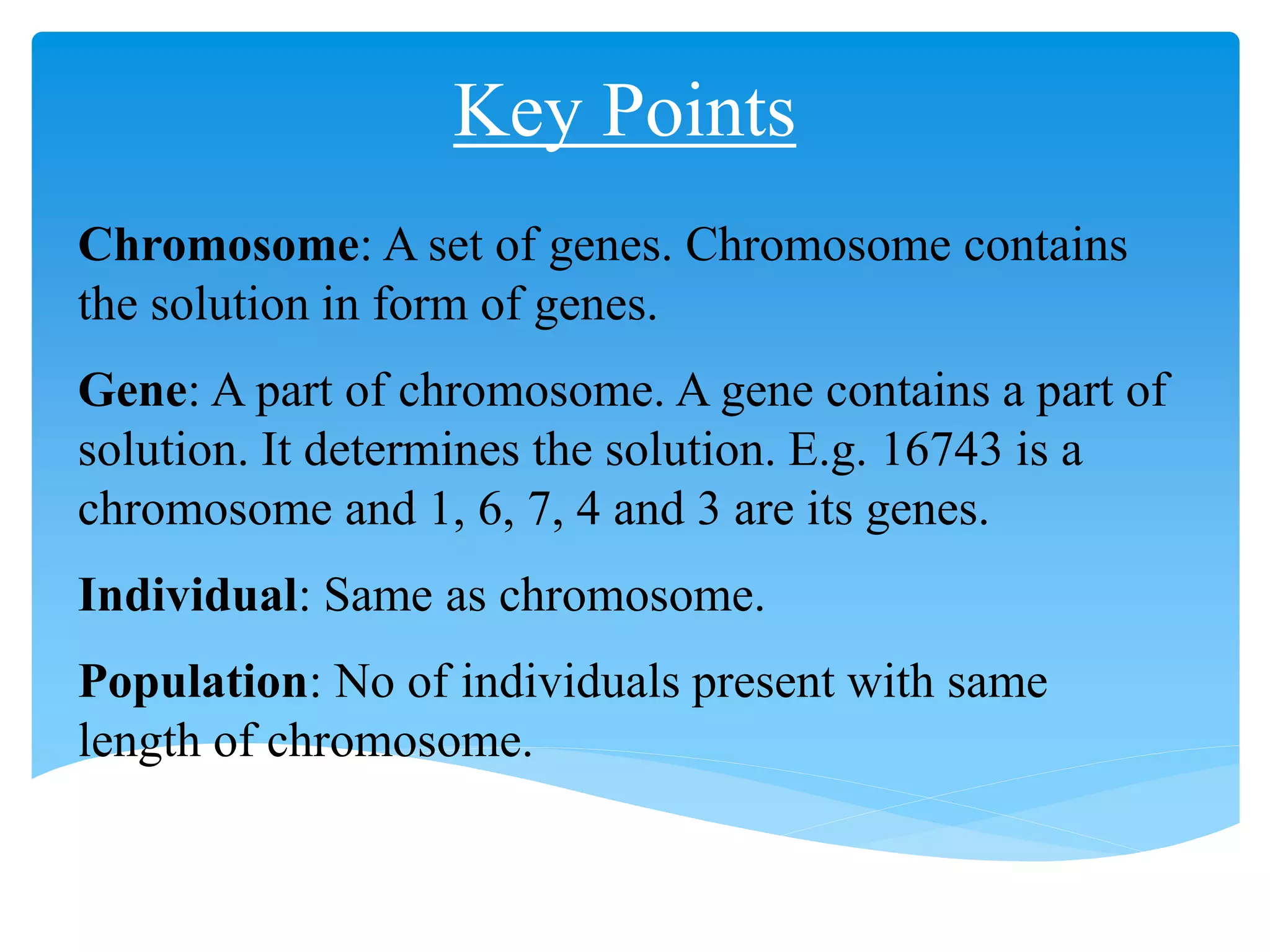
Key Points
Chromosome: Aset of genes. Chromosome contains
the solution in form of genes.
Gene: A part of chromosome. A gene contains a part of
solution. It determines the solution. E.g. 16743 is a
chromosome and 1, 6, 7, 4 and 3 are its genes.
Individual: Same as chromosome.
Population: No of individuals present with same
length of chromosome.
6.
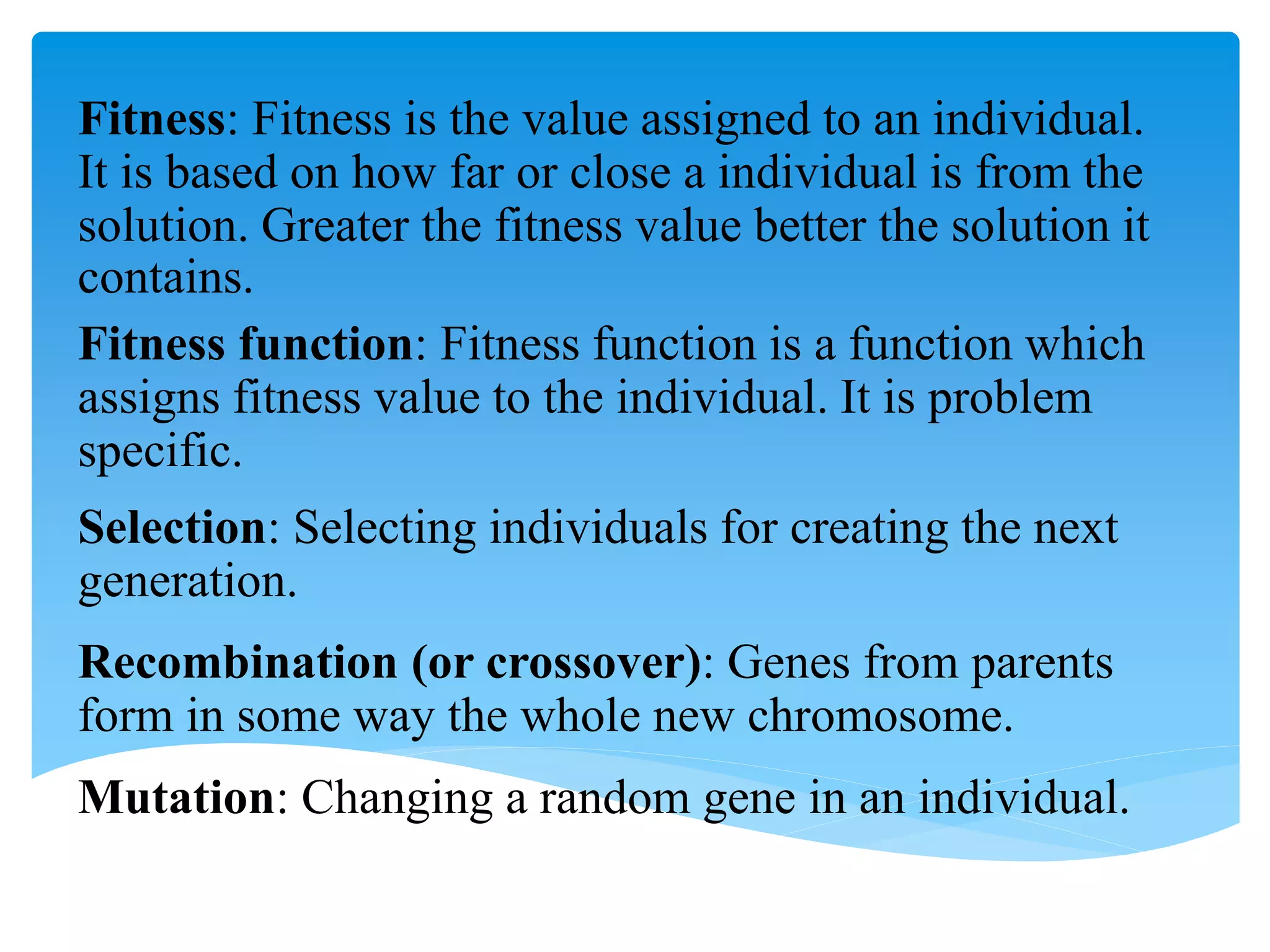
Fitness: Fitness isthe value assigned to an individual.
It is based on how far or close a individual is from the
solution. Greater the fitness value better the solution it
contains.
Fitness function: Fitness function is a function which
assigns fitness value to the individual. It is problem
specific.
Selection: Selecting individuals for creating the next
generation.
Recombination (or crossover): Genes from parents
form in some way the whole new chromosome.
Mutation: Changing a random gene in an individual.
7.
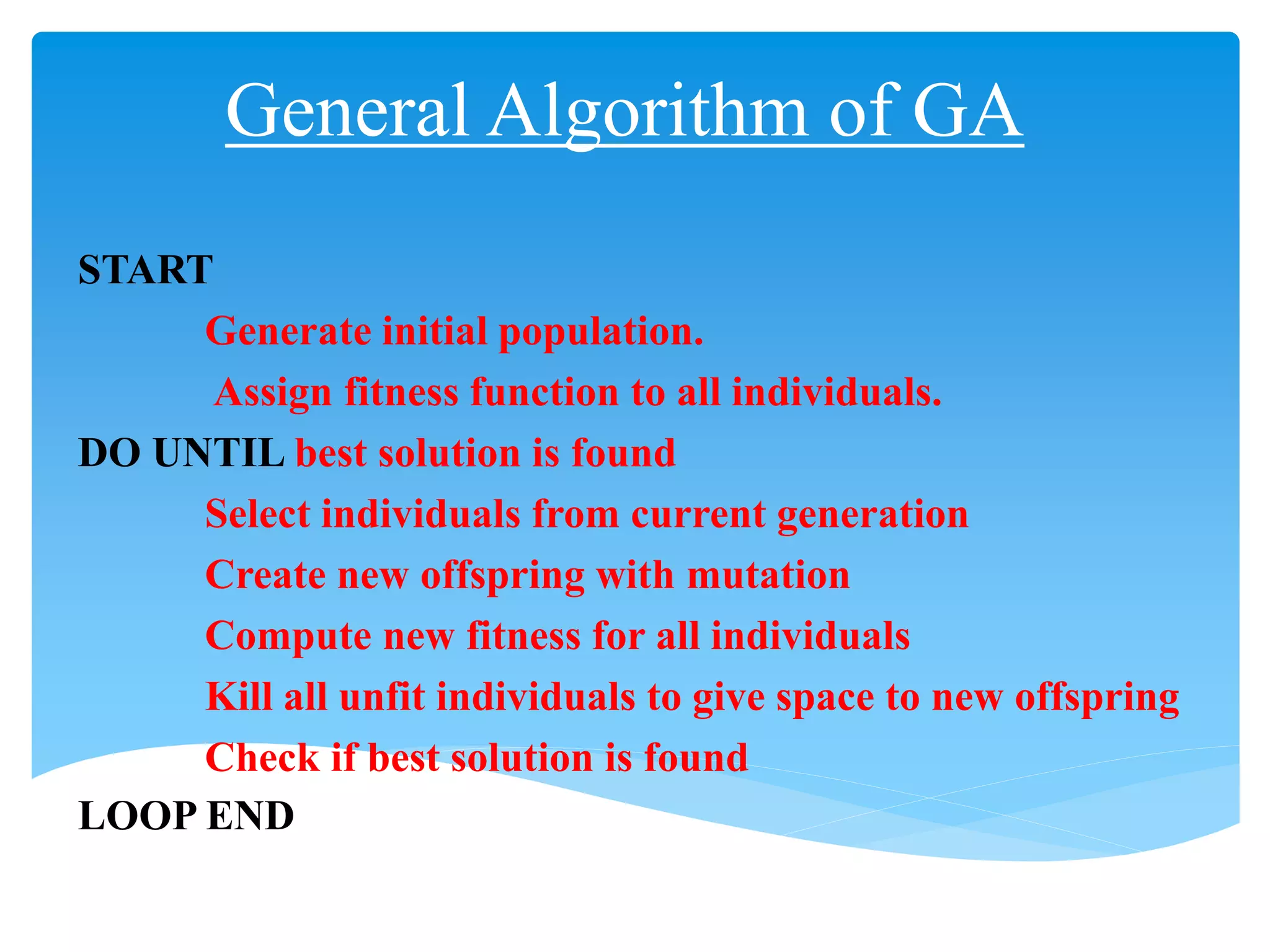
General Algorithm ofGA
START
Generate initial population.
Assign fitness function to all individuals.
DO UNTIL best solution is found
Select individuals from current generation
Create new offspring with mutation
Compute new fitness for all individuals
Kill all unfit individuals to give space to new offspring
Check if best solution is found
LOOP END
8.
Recombination (crossover)
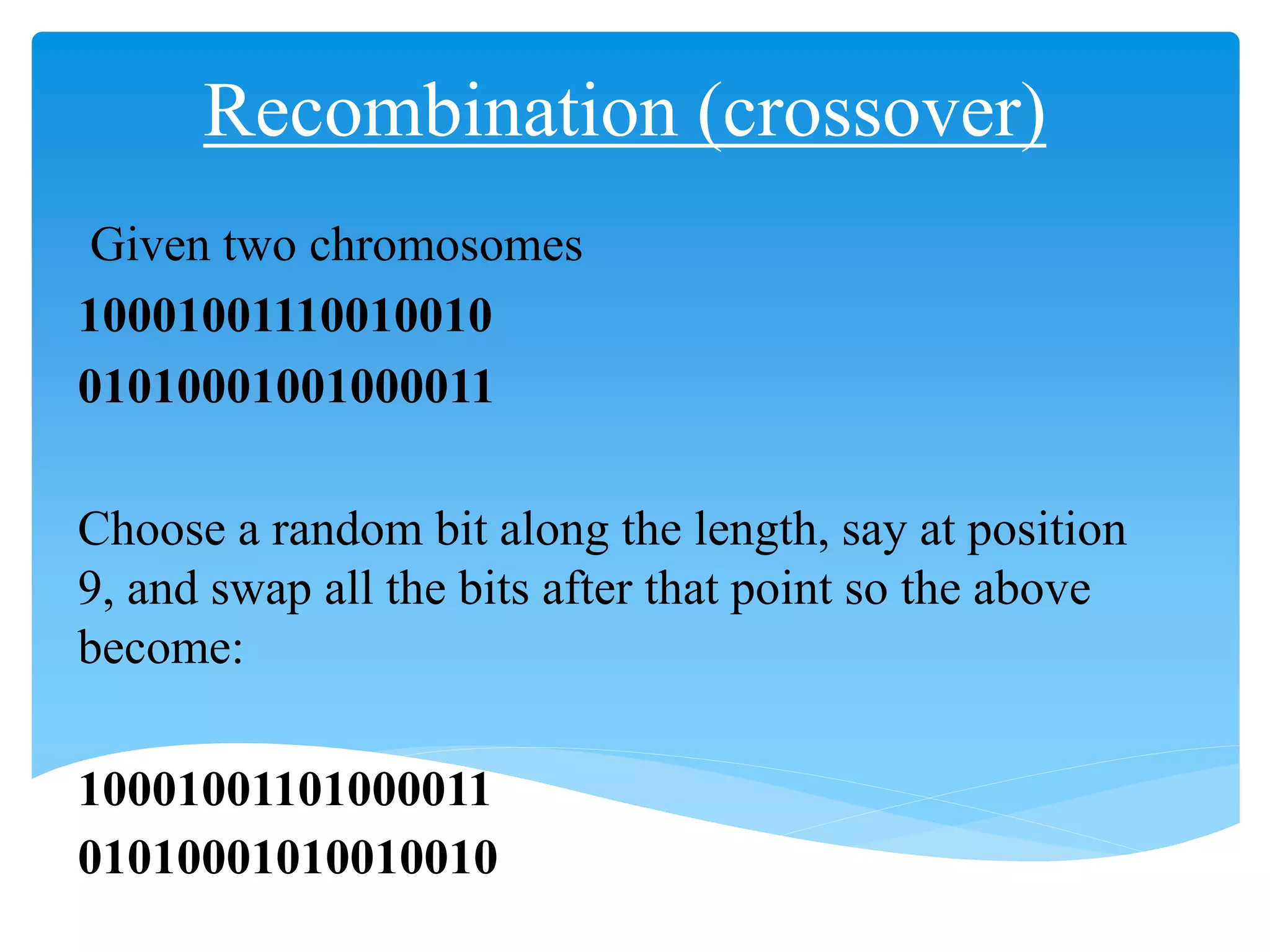
Given twochromosomes
10001001110010010
01010001001000011
Choose a random bit along the length, say at position
9, and swap all the bits after that point so the above
become:
10001001101000011
01010001010010010
9.
Mutation
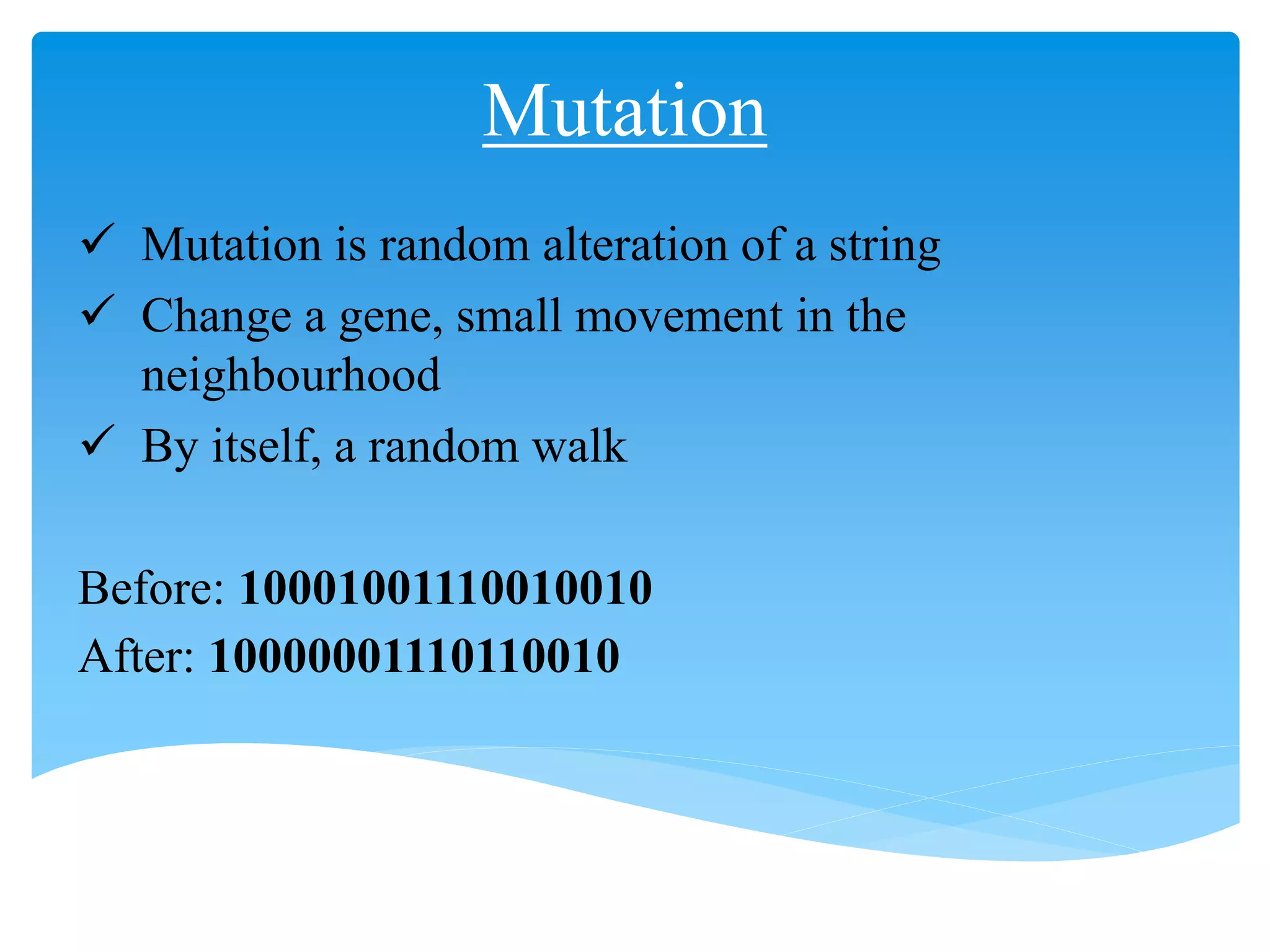
Mutation israndom alteration of a string
Change a gene, small movement in the
neighbourhood
By itself, a random walk
Before: 10001001110010010
After: 10000001110110010
10.
Advantages of GA
Concepts are easy to understand
Algorithms are intrinsically parallel.
Always an answer; answer gets better with time
Inherently parallel; easily distributed
Less time required for some special applications
Chances of getting optimal solution are more
11.
Limitations of GA
The population considered for the evolution should
be moderate or suitable one for the problem
(normally 20-30 or 50-100)
Crossover rate should be 80%-95%
Mutation rate should be low i.e. 0.5%-1% assumed
as best
The method of selection should be appropriate
Writing of fitness function must be accurate
12.
Conclusion
Genetic algorithmsare rich in application across a
large and growing number of disciplines.
Genetic Algorithms are used in Optimization and in
Classification in Data Mining
Genetic algorithm has changed the way we do
computer programming.



![Genetic Algorithm: A Crisp And Concise Introduction [Shakeeb A.]](https://cdn.slidesharecdn.com/ss_thumbnails/119m0027geneticalgo-200921155612-thumbnail.jpg?width=640&height=640&fit=bounds)


