
PREM SANKAR C
Research Scholar
Dept of Futures Studies,University of Kerala
Social Network Analysis
It's is all about connections ..... It's all about networking .....
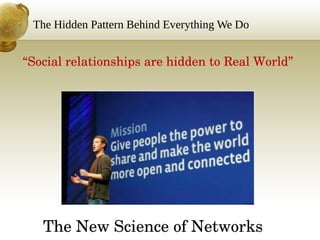
The Hidden Pattern Behind Everything We Do
“Social relationships are hidden to Real World”
The New Science of Networks 
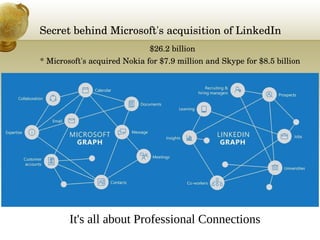
Secret behind Microsoft's acquisition of LinkedIn
 $26.2 billion
* Microsoft's acquired Nokia for $7.9 million and Skype for $8.5 billion 
It's all about Professional Connections
We live in networks !!! 
•  We live in networks all the time: communities, organizations, teams.
• There is science to support the understanding of network structure.
• The structure of a network provides insights into how the network 
“works”
•  Once  you  understand  the  structure,  you  can  make  decisions  about 
how to manage the network’s context.
•  Network analysis tools help you understand the structure.
Understanding how networks 
work is an essential 21 st
century literacy.. 
What is SNA?

Social network analysis (SNA) is a collection of techniques, 
tools, and methods by which one can map and analyze the 
connections across individuals or groups or institutions. 
Why SNA?
SNA is multidisciplinary and deals with
• Influencing groups (public health, propaganda, marketing)
• Increasing engagement with stakeholders (Management/Recommendation)
• Cool algorithms/ Analytics (math, computer science)
• Study of social behaviour (sociology, cognitive science)
• Organizational behavior (leadership, management)
Actors (Nodes/ Vertices)
Actors –are the smallest unit of a network
 Persons
 Organizations
 Countries
 Companies
 Animals
 Words
 Web pages
 Families
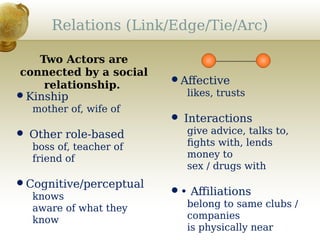
Relations (Link/Edge/Tie/Arc)
Kinship
mother of, wife of
 Other role-based
boss of, teacher of
friend of
Cognitive/perceptual
knows
aware of what they
know
Affective
likes, trusts
 Interactions
give advice, talks to,
fights with, lends
money to
sex / drugs with
• Affiliations
belong to same clubs /
companies
is physically near
Two Actors are
connected by a social
relationship.
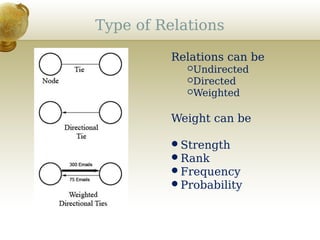
Type of Relations
Relations can be
Undirected
Directed
Weighted
Weight can be
Strength
Rank
Frequency
Probability
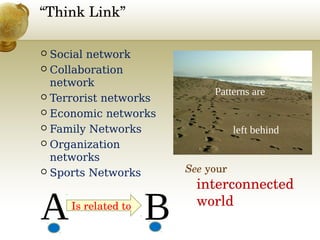
“Think Link”
 Social network
 Collaboration
network
 Terrorist networks
 Economic networks
 Family Networks
 Organization
networks
 Sports Networks
A BIs related to
Patterns are
left behind
See your 
interconnected 
world
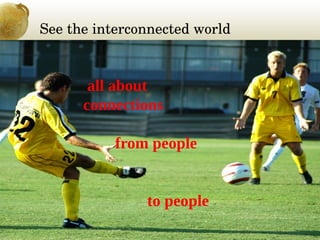
See the interconnected world 
all about
connections
from people
to people
Network Measures... 
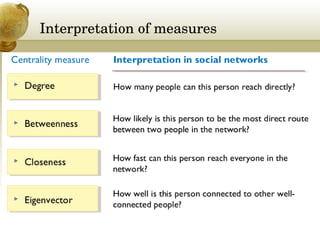
 Identifying people who are well positioned to influence 
the network or to move information around
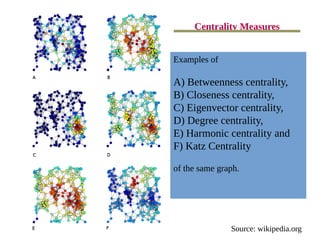
Examples of
A) Betweenness centrality,
B) Closeness centrality,
C) Eigenvector centrality,
D) Degree centrality,
E) Harmonic centrality and
F) Katz Centrality
of the same graph.
Source: wikipedia.org
Centrality Measures
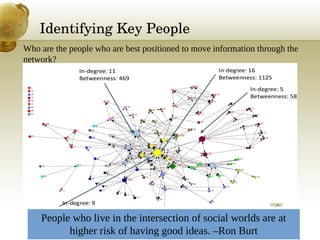
Identifying Key People
Who are the people who are best positioned to move information through the
network?
People who live in the intersection of social worlds are at
higher risk of having good ideas. –Ron Burt
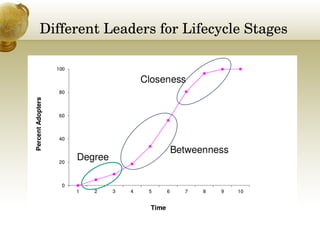
Different Leaders for Lifecycle Stages
Interpretation of measures
Interesting Facts and 
Studies ... 
helping you see your interconnected world
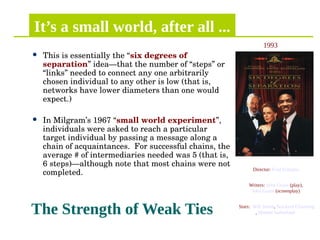
It’s a small world, after all ...
 This is essentially the “six degrees of 
separation” idea—that the number of “steps” or 
“links” needed to connect any one arbitrarily 
chosen individual to any other is low (that is, 
networks have lower diameters than one would 
expect.)
 In Milgram’s 1967 “small world experiment”, 
individuals were asked to reach a particular 
target individual by passing a message along a 
chain of acquaintances.  For successful chains, the 
average # of intermediaries needed was 5 (that is, 
6 steps)—although note that most chains were not 
completed.
The Strength of Weak Ties
Director: Fred Schepisi
Writers: John Guare (play),
John Guare (screenplay)
Stars: Will Smith, Stockard Channing
, Donald Sutherland
1993
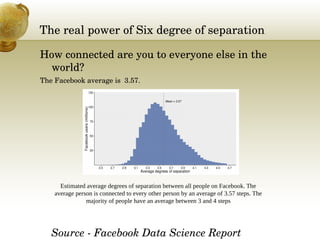
The real power of Six degree of separation 
How connected are you to everyone else in the 
world?
The Facebook average is  3.57.
Source ­ Facebook Data Science Report
Estimated average degrees of separation between all people on Facebook. The
average person is connected to every other person by an average of 3.57 steps. The
majority of people have an average between 3 and 4 steps
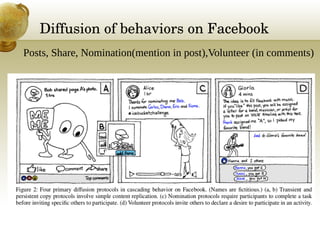
Diffusion of behaviors on Facebook
Posts, Share, Nomination(mention in post),Volunteer (in comments)
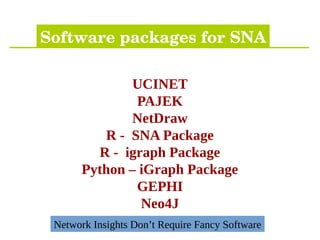
UCINET
PAJEK
NetDraw
R - SNA Package
R - igraph Package
Python – iGraph Package
GEPHI
Neo4J
Software packages for SNA
Network Insights Don’t Require Fancy Software
23
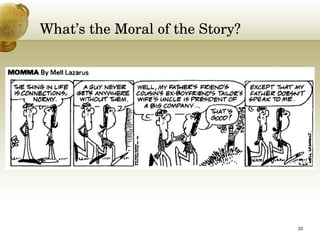
What’s the Moral of the Story?
24
Thank You
Dept of Futures Studies
Kerala University

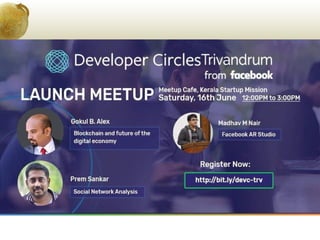
Introductory Talk on Social Network Analysis at Facebook Developer Circle Meetup