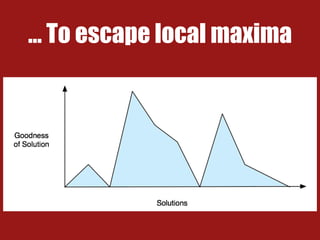
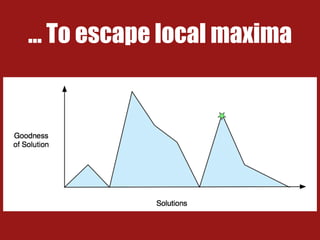
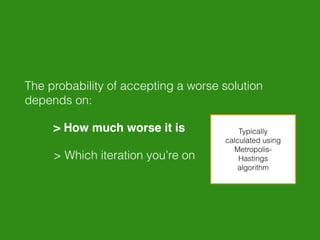
Simulated annealing is an algorithm for finding good solutions to optimization problems, such as the traveling salesman problem, where the goal is to find the shortest route between cities. It is inspired by annealing in metalworking, where heating and controlled cooling produces strong, defect-free metal. The algorithm starts with a random solution and finds neighboring solutions, accepting worse solutions with probability related to cost difference and iteration number, to avoid local optima. This allows big jumps early on, but the algorithm hones in on a local optimum over many iterations, usually finding a good enough solution. Parameters must be tuned correctly through trial and error. Overall, simulated annealing is considered effective for optimization problems.