Genetic Algorithm
By:
ANKIT KUMAR CHAUDHARY
(15/IEE/055)
Submitted to:
Dr. M. A. Ansari
Department of Electrical Engineering
School of Engineering
Gautam Buddha University
Gautam Budh Nagar UP, India
Contents
1. Introduction
2. Classes of Search Techniques
3. Components of a GA
4. The GA Cycle of Reproduction
5. A Simple Example
6. Overview of Performance
7. Benefits of Genetic Algorithms
8. When to Use a GA
9. Some GA Applications
Introduction
• Directed search algorithms based on the mechanics of biological
evolution
• Developed by John Holland, University of Michigan (1970’s)
• To understand the adaptive processes of natural systems
• To design artificial systems software that retains the robustness of natural
systems
• Provide efficient, effective techniques for optimization and machine
learning applications
• Widely-used today in business, scientific and engineering circles
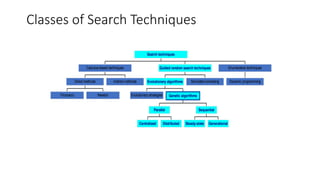
Classes of Search Techniques
Finonacci Newton
Direct methods Indirect methods
Calculus-based techniques
Evolutionary strategies
Centralized Distributed
Parallel
Steady-state Generational
Sequential
Genetic algorithms
Evolutionary algorithms Simulated annealing
Guided random search techniques
Dynamic programming
Enumerative techniques
Search techniques
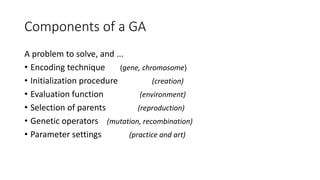
Components of a GA
A problem to solve, and ...
• Encoding technique (gene, chromosome)
• Initialization procedure (creation)
• Evaluation function (environment)
• Selection of parents (reproduction)
• Genetic operators (mutation, recombination)
• Parameter settings (practice and art)
The GA Cycle of Reproduction
reproduction
population evaluation
modification
discard
deleted
members
parents
children
modified
children
evaluated children
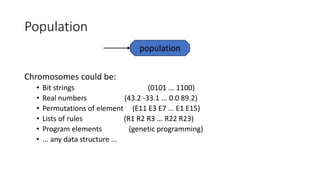
Population
Chromosomes could be:
• Bit strings (0101 ... 1100)
• Real numbers (43.2 -33.1 ... 0.0 89.2)
• Permutations of element (E11 E3 E7 ... E1 E15)
• Lists of rules (R1 R2 R3 ... R22 R23)
• Program elements (genetic programming)
• ... any data structure ...
population
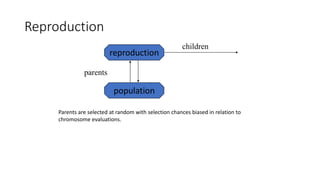
Reproduction
reproduction
population
parents
children
Parents are selected at random with selection chances biased in relation to
chromosome evaluations.
Chromosome Modification
modification
children
• Modifications are stochastically triggered
• Operator types are:
• Mutation
• Crossover (recombination)
modified children
Mutation: Local Modification
Before: (1 0 1 1 0 1 1 0)
After: (0 1 1 0 0 1 1 0)
Before: (1.38 -69.4 326.44 0.1)
After: (1.38 -67.5 326.44 0.1)
• Causes movement in the search space
(local or global)
• Restores lost information to the population
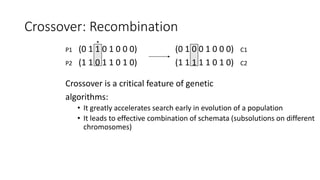
Crossover: Recombination
P1 (0 1 1 0 1 0 0 0) (0 1 0 0 1 0 0 0) C1
P2 (1 1 0 1 1 0 1 0) (1 1 1 1 1 0 1 0) C2
Crossover is a critical feature of genetic
algorithms:
• It greatly accelerates search early in evolution of a population
• It leads to effective combination of schemata (subsolutions on different
chromosomes)
*
Evaluation
• The evaluator decodes a chromosome and assigns it a fitness
measure
• The evaluator is the only link between a classical GA and the problem
it is solving
evaluation
evaluated
children
modified
children
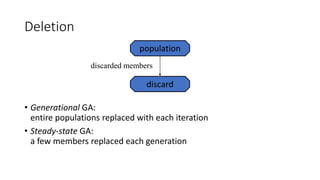
Deletion
• Generational GA:
entire populations replaced with each iteration
• Steady-state GA:
a few members replaced each generation
population
discard
discarded members
A Simple Example
The Traveling Salesman Problem:
Find a tour of a given set of cities so that
• each city is visited only once
• the total distance traveled is minimized
Representation
Representation is an ordered list of city
numbers known as an order-based GA.
1) London 3) Dunedin 5) Beijing 7) Tokyo
2) Venice 4) Singapore 6) Phoenix 8) Victoria
CityList1 (3 5 7 2 1 6 4 8)
CityList2 (2 5 7 6 8 1 3 4)
Crossover
Crossover combines inversion and
recombination:
* *
Parent1 (3 5 7 2 1 6 4 8)
Parent2 (2 5 7 6 8 1 3 4)
Child (5 8 7 2 1 6 3 4)
This operator is called the Order1 crossover.
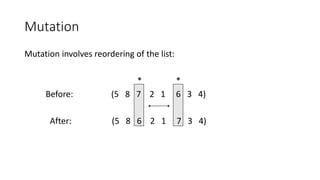
Mutation involves reordering of the list:
* *
Before: (5 8 7 2 1 6 3 4)
After: (5 8 6 2 1 7 3 4)
Mutation
TSP Example: 30 Cities
0
20
40
60
80
100
120
0 10 20 30 40 50 60 70 80 90 100
y
x
Solution i (Distance = 941)
0
20
40
60
80
100
120
0 10 20 30 40 50 60 70 80 90 100
y
x
TSP30 (Performance = 941)
Solution j(Distance = 800)
44
62
69
67
78
64
62
54
42
50
40
40
38
21
35
67
60
60
40
42
50
99
0
20
40
60
80
100
120
0 10 20 30 40 50 60 70 80 90 100
y
x
TSP30 (Performance = 800)
Solution k(Distance = 652)
0
20
40
60
80
100
120
0 10 20 30 40 50 60 70 80 90 100
y
x
TSP30 (Performance = 652)
Best Solution (Distance = 420)
42
38
35
26
21
35
32
7
38
46
44
58
60
69
76
78
71
69
67
62
84
94
0
20
40
60
80
100
120
0 10 20 30 40 50 60 70 80 90 100
y
x
TSP30 Solution (Performance = 420)
Overview of Performance
0
200
400
600
800
1000
1200
1400
1600
1800
1 3 5 7 9 11 13 15 17 19 21 23 25 27 29 31
D
is
ta
n
c
e
Generations (1000)
TSP30 - Overview of Performance
Best
Worst
Average
Benefits of Genetic Algorithms
• Concept is easy to understand
• Modular, separate from application
• Supports multi-objective optimization
• Good for “noisy” environments
• Always an answer; answer gets better with time
• Inherently parallel; easily distributed
Benefits of Genetic Algorithms (cont.)
• Many ways to speed up and improve a GA-based application as
knowledge about problem domain is gained
• Easy to exploit previous or alternate solutions
• Flexible building blocks for hybrid applications
• Substantial history and range of use
When to Use a GA
• Alternate solutions are too slow or overly complicated
• Need an exploratory tool to examine new approaches
• Problem is similar to one that has already been successfully solved by using
a GA
• Want to hybridize with an existing solution
• Benefits of the GA technology meet key problem requirements
Some GA Applications
Domain Application Types
Control gas pipeline, pole balancing, missile evasion, pursuit
Design semiconductor layout, aircraft design, keyboard
configuration, communication networks
Scheduling manufacturing, facility scheduling, resource allocation
Robotics trajectory planning
Machine Learning designing neural networks, improving classification
algorithms, classifier systems
Signal Processing filter design
Game Playing poker, checkers, prisoner’s dilemma
Combinatorial
Optimization
set covering, travelling salesman, routing, bin packing,
graph colouring and partitioning
Thank You

Genetic Algorithm

  • 1.
    Genetic Algorithm By: ANKIT KUMARCHAUDHARY (15/IEE/055) Submitted to: Dr. M. A. Ansari Department of Electrical Engineering School of Engineering Gautam Buddha University Gautam Budh Nagar UP, India
  • 2.
    Contents 1. Introduction 2. Classesof Search Techniques 3. Components of a GA 4. The GA Cycle of Reproduction 5. A Simple Example 6. Overview of Performance 7. Benefits of Genetic Algorithms 8. When to Use a GA 9. Some GA Applications
  • 3.
    Introduction • Directed searchalgorithms based on the mechanics of biological evolution • Developed by John Holland, University of Michigan (1970’s) • To understand the adaptive processes of natural systems • To design artificial systems software that retains the robustness of natural systems • Provide efficient, effective techniques for optimization and machine learning applications • Widely-used today in business, scientific and engineering circles
  • 4.
    Classes of SearchTechniques Finonacci Newton Direct methods Indirect methods Calculus-based techniques Evolutionary strategies Centralized Distributed Parallel Steady-state Generational Sequential Genetic algorithms Evolutionary algorithms Simulated annealing Guided random search techniques Dynamic programming Enumerative techniques Search techniques
  • 5.
    Components of aGA A problem to solve, and ... • Encoding technique (gene, chromosome) • Initialization procedure (creation) • Evaluation function (environment) • Selection of parents (reproduction) • Genetic operators (mutation, recombination) • Parameter settings (practice and art)
  • 6.
    The GA Cycleof Reproduction reproduction population evaluation modification discard deleted members parents children modified children evaluated children
  • 7.
    Population Chromosomes could be: •Bit strings (0101 ... 1100) • Real numbers (43.2 -33.1 ... 0.0 89.2) • Permutations of element (E11 E3 E7 ... E1 E15) • Lists of rules (R1 R2 R3 ... R22 R23) • Program elements (genetic programming) • ... any data structure ... population
  • 8.
    Reproduction reproduction population parents children Parents are selectedat random with selection chances biased in relation to chromosome evaluations.
  • 9.
    Chromosome Modification modification children • Modificationsare stochastically triggered • Operator types are: • Mutation • Crossover (recombination) modified children
  • 10.
    Mutation: Local Modification Before:(1 0 1 1 0 1 1 0) After: (0 1 1 0 0 1 1 0) Before: (1.38 -69.4 326.44 0.1) After: (1.38 -67.5 326.44 0.1) • Causes movement in the search space (local or global) • Restores lost information to the population
  • 11.
    Crossover: Recombination P1 (01 1 0 1 0 0 0) (0 1 0 0 1 0 0 0) C1 P2 (1 1 0 1 1 0 1 0) (1 1 1 1 1 0 1 0) C2 Crossover is a critical feature of genetic algorithms: • It greatly accelerates search early in evolution of a population • It leads to effective combination of schemata (subsolutions on different chromosomes) *
  • 12.
    Evaluation • The evaluatordecodes a chromosome and assigns it a fitness measure • The evaluator is the only link between a classical GA and the problem it is solving evaluation evaluated children modified children
  • 13.
    Deletion • Generational GA: entirepopulations replaced with each iteration • Steady-state GA: a few members replaced each generation population discard discarded members
  • 14.
    A Simple Example TheTraveling Salesman Problem: Find a tour of a given set of cities so that • each city is visited only once • the total distance traveled is minimized
  • 15.
    Representation Representation is anordered list of city numbers known as an order-based GA. 1) London 3) Dunedin 5) Beijing 7) Tokyo 2) Venice 4) Singapore 6) Phoenix 8) Victoria CityList1 (3 5 7 2 1 6 4 8) CityList2 (2 5 7 6 8 1 3 4)
  • 16.
    Crossover Crossover combines inversionand recombination: * * Parent1 (3 5 7 2 1 6 4 8) Parent2 (2 5 7 6 8 1 3 4) Child (5 8 7 2 1 6 3 4) This operator is called the Order1 crossover.
  • 17.
    Mutation involves reorderingof the list: * * Before: (5 8 7 2 1 6 3 4) After: (5 8 6 2 1 7 3 4) Mutation
  • 18.
    TSP Example: 30Cities 0 20 40 60 80 100 120 0 10 20 30 40 50 60 70 80 90 100 y x
  • 19.
    Solution i (Distance= 941) 0 20 40 60 80 100 120 0 10 20 30 40 50 60 70 80 90 100 y x TSP30 (Performance = 941)
  • 20.
    Solution j(Distance =800) 44 62 69 67 78 64 62 54 42 50 40 40 38 21 35 67 60 60 40 42 50 99 0 20 40 60 80 100 120 0 10 20 30 40 50 60 70 80 90 100 y x TSP30 (Performance = 800)
  • 21.
    Solution k(Distance =652) 0 20 40 60 80 100 120 0 10 20 30 40 50 60 70 80 90 100 y x TSP30 (Performance = 652)
  • 22.
    Best Solution (Distance= 420) 42 38 35 26 21 35 32 7 38 46 44 58 60 69 76 78 71 69 67 62 84 94 0 20 40 60 80 100 120 0 10 20 30 40 50 60 70 80 90 100 y x TSP30 Solution (Performance = 420)
  • 23.
    Overview of Performance 0 200 400 600 800 1000 1200 1400 1600 1800 13 5 7 9 11 13 15 17 19 21 23 25 27 29 31 D is ta n c e Generations (1000) TSP30 - Overview of Performance Best Worst Average
  • 24.
    Benefits of GeneticAlgorithms • Concept is easy to understand • Modular, separate from application • Supports multi-objective optimization • Good for “noisy” environments • Always an answer; answer gets better with time • Inherently parallel; easily distributed
  • 25.
    Benefits of GeneticAlgorithms (cont.) • Many ways to speed up and improve a GA-based application as knowledge about problem domain is gained • Easy to exploit previous or alternate solutions • Flexible building blocks for hybrid applications • Substantial history and range of use
  • 26.
    When to Usea GA • Alternate solutions are too slow or overly complicated • Need an exploratory tool to examine new approaches • Problem is similar to one that has already been successfully solved by using a GA • Want to hybridize with an existing solution • Benefits of the GA technology meet key problem requirements
  • 27.
    Some GA Applications DomainApplication Types Control gas pipeline, pole balancing, missile evasion, pursuit Design semiconductor layout, aircraft design, keyboard configuration, communication networks Scheduling manufacturing, facility scheduling, resource allocation Robotics trajectory planning Machine Learning designing neural networks, improving classification algorithms, classifier systems Signal Processing filter design Game Playing poker, checkers, prisoner’s dilemma Combinatorial Optimization set covering, travelling salesman, routing, bin packing, graph colouring and partitioning
  • 28.