FRACTURES
AND
JOINT INJURIES
AIM OF TREATMENT
SAVE LIFE RESTORE ACTIVITY
Definition
Fracture is a break in the
continuity of bone ,
associated with variable
degrees of damage to the
overlying skin and soft
tissues.
 simple ( closed )
 compound ( open )
Simple fr Compound fr
Simple fr.
Compound fr.
Shape of the fracture line
 transverse
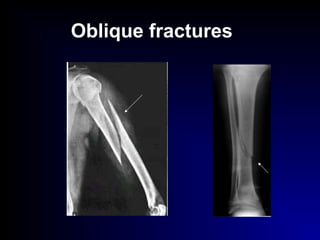
 oblique
 spiral
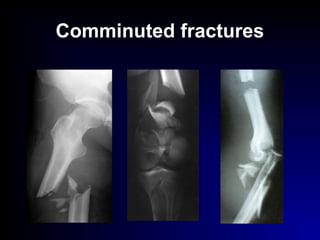
 comminuted
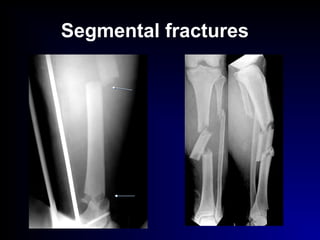
 segmental
Transverse fractures
Oblique fractures
Comminuted fractures
Segmental fractures
Types of Fractures
 Traumatic fr.
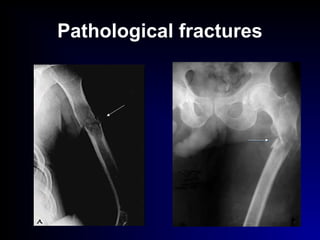
 Pathological fr.:
- general causes : senile osteoporosis
endocrinal diseases:
( hyperparathyroidism, Cushing syndrome)
- local causes : inflammation
tumor
bone cyst, fibrous lesion
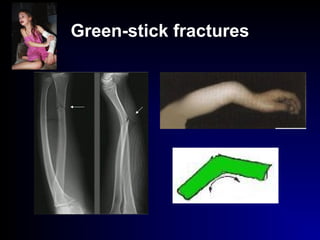
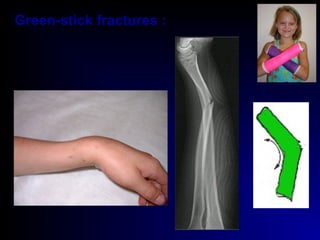
 Green-stick fr. ( in children )
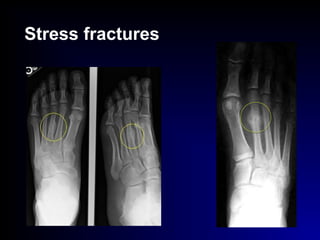
 Stress fr.
Pathological fractures
Green-stick fractures
Stress fractures
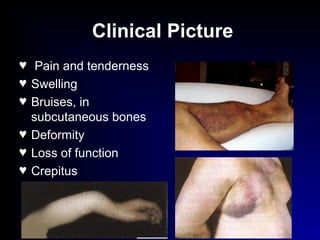
Clinical Picture
♥ Pain and tenderness
♥ Swelling
♥ Bruises, in
subcutaneous bones
♥ Deformity
♥ Loss of function
♥ Crepitus
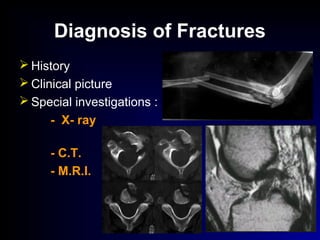
Diagnosis of Fractures
 History
 Clinical picture
 Special investigations :
- X- ray
- C.T.
- M.R.I.
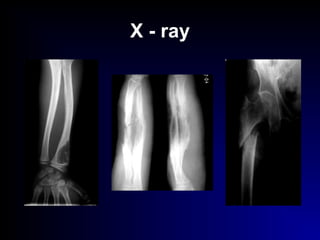
X - ray
Complications
General AND Local
General Complications
 shock : - neurogenic
- oligaemic
 fat embolism
 complications of prolonged recumbency :
- osteoporosis
- pulmonary & U.T. infections
- D.V.T.
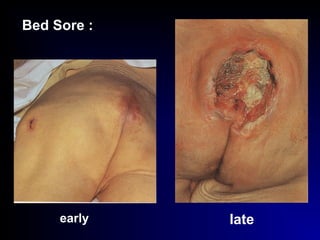
- bed sores
- joint stiffness
- psychosis
Bed Sore :
early late
Local Complications
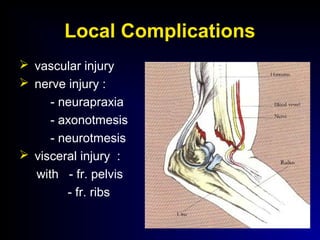
 vascular injury
 nerve injury :
- neurapraxia
- axonotmesis
- neurotmesis
 visceral injury :
with - fr. pelvis
- fr. ribs
 infection : in compound fr.
 Avascular necrosis:
- fr. neck femur
- fr. scaphoid
- fr. talus
 Myositis ossificans
around the joints :
- elbow
- hip
 complications of union :
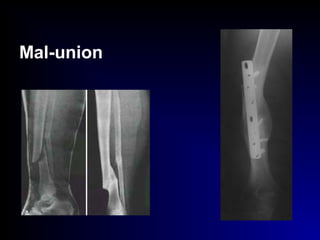
• Mal-union:
[angulation, shortening, rotation]
ttt. : corrective osteotomy + I.F.
• Delayed union
ttt. : further immobilization, then B.G.
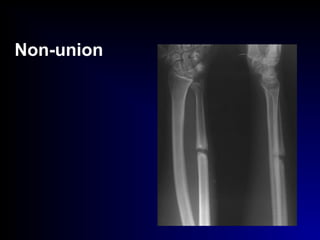
• Non-union :(pseudo-arthrosis)
ttt. : I.F. + B.G.
Mal-union
Non-union
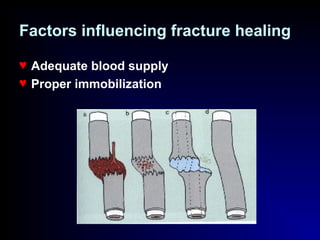
Healing of Fractures
Fr. hematoma, invaded by fibroblasts and
osteoblasts from surrounding tissues and
periostium, forms soft woven bone [ callus],
precipitation of calcium salts enhances the
formation of hard lamellae of trabecular
bone.
Remodeling restores the
original contour .
Factors influencing fracture healing
♥ Adequate blood supply
♥ Proper immobilization
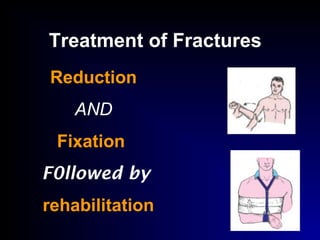
Treatment of Fractures
Reduction
AND
Fixation
F0llowed by
rehabilitation
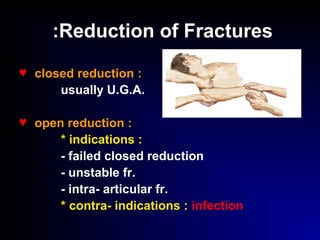
Reduction of Fractures:
♥ closed reduction :
usually U.G.A.
♥ open reduction :
* indications :
- failed closed reduction
- unstable fr.
- intra- articular fr.
* contra- indications : infection
Fixation of Fractures
♥ Conservative fixation [ Splintage ] :
- plaster
- traction
♥ Surgical fixation :
A - internal
B - external
Conservative Fixation ( Splintage)
♥ Plaster casts :
stable fr. in distal parts of the
limbs .
♥ Skin traction : [ Thomas splint ]
in fr. femur in children
and as a first aid in adults .
♥ Skeletal traction
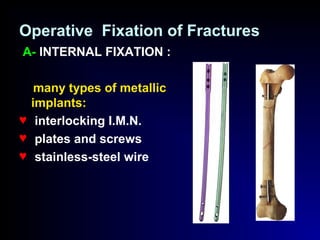
Operative Fixation of Fractures
A- INTERNAL FIXATION :
many types of metallic
implants:
♥ interlocking I.M.N.
♥ plates and screws
♥ stainless-steel wire
Interlocking intramedullary nail
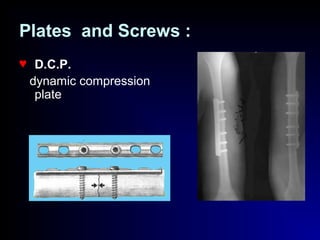
Plates and Screws :
♥ D.C.P.
dynamic compression
plate
♥ T – plate
♥ Reconstruction plateReconstruction plate
♥ Stainless – steel wireStainless – steel wire
B - External Fixation
A number of thick metallic
pins inserted into each
bone fragment , then
connected together by
common rods.
♥excellent in comp., infected fr.
♥Used either as temporarily, or
definitive treatment.
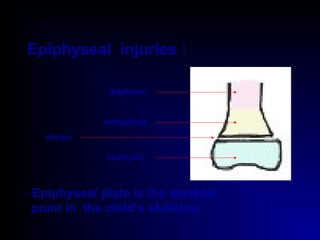
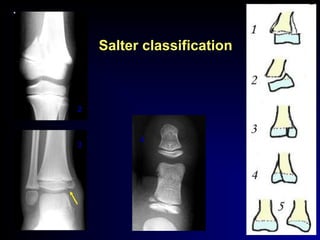
Epiphyseal injuries :
epiphysis
metaphysis
diaphysis
physis
- Epiphyseal plate is the weakest
point in the child’s skeleton
Bone growth
Salter classification
2
3
4
Green-stick fractures :
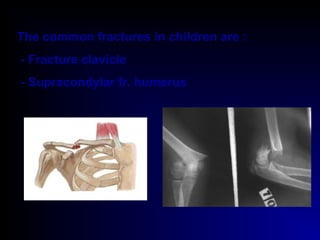
The common fractures in children are :
- Fracture clavicle
- Supracondylar fr. humerus
Special characters :
- Green – stick fractures are common
- Healing is much faster than in adults
- Remodeling is much more pronounced
- Epiphyseal injuries are common
Introduction to Fractures

Introduction to Fractures