Cast & Slab
Dr. Ahmed Shedeed Abdel Ghaffar
Resident of Orthopaedics
Railways Hospital
Member of AOTrauma foundation
Member of Egyptian Orthopaedic Association
dr.ahmedshedeed@yahoo.com
objectives
• Definitions
• Indications
• Advantages & disadvantages
• Steps of applying cast and slab
• Medical treatment and precautions
Cast & slab
are methods of a temporary immobilization for a wide
variety of musculoskeletal conditions not only for disorders
of bones but also for many other disorders related with
tendons , muscles and soft tissues
Cast : are circumferential immobilizers which is surrounding the
whole circumference of the limb
But
Slab : are non circumferential immobilizers which is only support
apart of the circumference of the limb
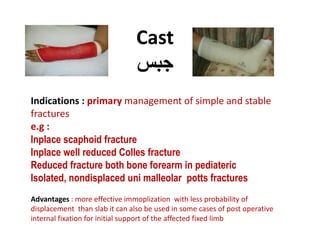
Cast
‫جبس‬
Indications : primary management of simple and stable
fractures
e.g :
Inplace scaphoid fracture
Inplace well reduced Colles fracture
Reduced fracture both bone forearm in pediateric
Isolated, nondisplaced uni malleolar potts fractures
Advantages : more effective immoplization with less probability of
displacement than slab it can also be used in some cases of post operative
internal fixation for initial support of the affected fixed limb
Disadvantages :
Casts provide better immobilization, but are less
forgiving as it doesn’t allow for swelling and can act as a
compressive force and irritating material for the skin so
it have higher complication rates:
ischemia
heat injury
pressure sores
skin breakdown
Infections
Dermatitis
neurologic injury
Joint stiffness
and compartment syndrome
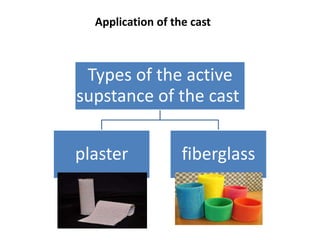
Application of the cast
Types of the active
supstance of the cast
plaster fiberglass
Application of the cast
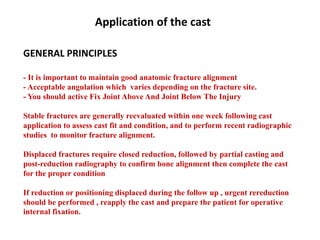
GENERAL PRINCIPLES
- It is important to maintain good anatomic fracture alignment
- Acceptable angulation which varies depending on the fracture site.
- You should active Fix Joint Above And Joint Below The Injury
Stable fractures are generally reevaluated within one week following cast
application to assess cast fit and condition, and to perform recent radiographic
studies to monitor fracture alignment.
Displaced fractures require closed reduction, followed by partial casting and
post-reduction radiography to confirm bone alignment then complete the cast
for the proper condition
If reduction or positioning displaced during the follow up , urgent rereduction
should be performed , reapply the cast and prepare the patient for operative
internal fixation.
Application of the cast
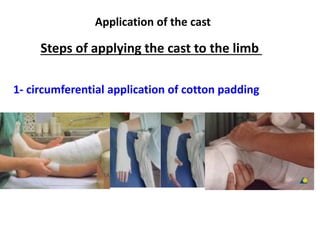
Steps of applying the cast to the limb
1- circumferential application of cotton padding
Application of the cast
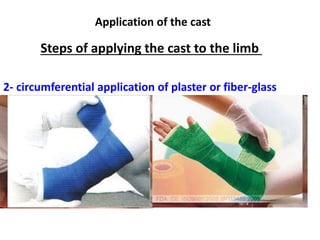
Steps of applying the cast to the limb
2- circumferential application of plaster or fiber-glass
Application of the cast
Steps of applying the cast to the limb
3-Molding of the cast layer by layer
Application of the cast
Steps of applying the cast to the limb
4- Maintain the limb in the position of function
Application of the cast
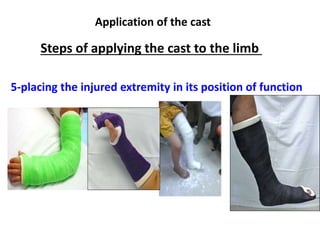
Steps of applying the cast to the limb
5-placing the injured extremity in its position of function
Application of the cast
Steps of applying the cast to the limb
Finally You Should Assess the Pulse and Capillary
Refilling For the Casted Limb To Ensure That There’s No
Any Compressive Force Over The Vessels
Prescribe the medical treatment for the patient in
the form of
Analgesic & Anti Eadematous
And tell the patient about the important cautions to be monitored
1- Constantly make range of movements with the exposed fingers of
the casted limb to avoid the stiffness
2-Keep eyes on the edema and the color of the exposed fingers and go
to the emergency room quickly if there's bluish discoloration or sever
edema
3- essential limb elevation
4- Initiate the Proper Physiotherapy for the affected limb after
removing the cast
IT’S BETTER TO MAKE FOLLOW UP SHEAT FOR THE INJURED
PATIENT FOR BETTER MONITORING OF THE INJURY AND REGISTER
EVERY INCIDENT , CAUTIONS , AND THE TREATMENT
THIS IS NOT ONLY BETTER FOR THE PATIENT BUT ALSO FOR THE
DOCTOR AS A MEDICOLEGALITY
Slab
‫جبيرة‬
Indications : management of a variety of acute musculoskeletal conditions in
which swelling is occurred or anticipated, such as edematous fracture site ,
sprains, or for initial stabilization of reduced, displaced, or unstable fractures
up till orthopedic intervention
e.g : Ankle sprain
Swollen fractured limb
Preoperative mangment
Postoperative support
Open fractures
Advantages : More safe than the Cast as it allows for swelling with no
compressive force and give the chance for following up the wound in
compound fractures and the incision in post operative internal fixation
Disadvantages : less effective immobilization with more possibility for
dislacment
Application of the cast
Steps of applying the Slab to the limb
1- circumferential application of cotton padding
Application of the cast
Steps of applying the Slab to the limb
2- Take the length of the area you will apply the slab
as it fixes joint below and joint above the injury
3- Make 6 Double layer plaster slab for the upper
limb & 8 Double layer for the lower Limb
Application of the cast
Steps of applying the Slab to the limb
4- One Side application of plaster or fiber-glass
Application of the cast
Steps of applying the Slab to the limb
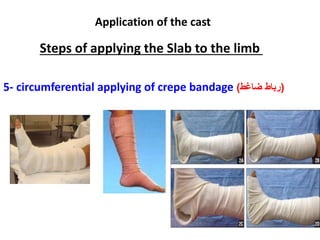
5- circumferential applying of crepe bandage (‫ضاغط‬ ‫رباط‬)
Prescribe the medical treatment for the patient in the form of
Analgesic & Anti Eadematous and range of movements for the
fingers of the affected limb
Initiate the Proper Physiotherapy for the affected limb after
removing the slab
Finally
Immobilization with Cast or Slab is a
race between the cure and the
complications so try as much as you
can to help the cure to win the race
before the complications , and this
will be achieved by good management
, monitoring the case and remove the
cast or slab as soon as possible .
Take Home Message
• Cast and Slab are primary initial management
with a high risk of failure
• Fix active joint above and joint below
• Assess pulse and capillary refilling after cast
• Antiedematous drugs are very important
• Monitoring and follow up are mandatory
• Cast and Slab are easy procedure but you should
respect their complication
• Remove as soon as possible
• Start physiotherapy as soon as possible

Cast & slab by dr. ahmed shedeed

  • 1.
    Cast & Slab Dr.Ahmed Shedeed Abdel Ghaffar Resident of Orthopaedics Railways Hospital Member of AOTrauma foundation Member of Egyptian Orthopaedic Association dr.ahmedshedeed@yahoo.com
  • 2.
    objectives • Definitions • Indications •Advantages & disadvantages • Steps of applying cast and slab • Medical treatment and precautions
  • 3.
    Cast & slab aremethods of a temporary immobilization for a wide variety of musculoskeletal conditions not only for disorders of bones but also for many other disorders related with tendons , muscles and soft tissues Cast : are circumferential immobilizers which is surrounding the whole circumference of the limb But Slab : are non circumferential immobilizers which is only support apart of the circumference of the limb
  • 4.
    Cast ‫جبس‬ Indications : primarymanagement of simple and stable fractures e.g : Inplace scaphoid fracture Inplace well reduced Colles fracture Reduced fracture both bone forearm in pediateric Isolated, nondisplaced uni malleolar potts fractures Advantages : more effective immoplization with less probability of displacement than slab it can also be used in some cases of post operative internal fixation for initial support of the affected fixed limb
  • 5.
    Disadvantages : Casts providebetter immobilization, but are less forgiving as it doesn’t allow for swelling and can act as a compressive force and irritating material for the skin so it have higher complication rates: ischemia heat injury pressure sores skin breakdown Infections Dermatitis neurologic injury Joint stiffness and compartment syndrome
  • 6.
    Application of thecast Types of the active supstance of the cast plaster fiberglass
  • 7.
    Application of thecast GENERAL PRINCIPLES - It is important to maintain good anatomic fracture alignment - Acceptable angulation which varies depending on the fracture site. - You should active Fix Joint Above And Joint Below The Injury Stable fractures are generally reevaluated within one week following cast application to assess cast fit and condition, and to perform recent radiographic studies to monitor fracture alignment. Displaced fractures require closed reduction, followed by partial casting and post-reduction radiography to confirm bone alignment then complete the cast for the proper condition If reduction or positioning displaced during the follow up , urgent rereduction should be performed , reapply the cast and prepare the patient for operative internal fixation.
  • 8.
    Application of thecast Steps of applying the cast to the limb 1- circumferential application of cotton padding
  • 9.
    Application of thecast Steps of applying the cast to the limb 2- circumferential application of plaster or fiber-glass
  • 10.
    Application of thecast Steps of applying the cast to the limb 3-Molding of the cast layer by layer
  • 11.
    Application of thecast Steps of applying the cast to the limb 4- Maintain the limb in the position of function
  • 12.
    Application of thecast Steps of applying the cast to the limb 5-placing the injured extremity in its position of function
  • 13.
    Application of thecast Steps of applying the cast to the limb Finally You Should Assess the Pulse and Capillary Refilling For the Casted Limb To Ensure That There’s No Any Compressive Force Over The Vessels
  • 14.
    Prescribe the medicaltreatment for the patient in the form of Analgesic & Anti Eadematous And tell the patient about the important cautions to be monitored 1- Constantly make range of movements with the exposed fingers of the casted limb to avoid the stiffness 2-Keep eyes on the edema and the color of the exposed fingers and go to the emergency room quickly if there's bluish discoloration or sever edema 3- essential limb elevation 4- Initiate the Proper Physiotherapy for the affected limb after removing the cast IT’S BETTER TO MAKE FOLLOW UP SHEAT FOR THE INJURED PATIENT FOR BETTER MONITORING OF THE INJURY AND REGISTER EVERY INCIDENT , CAUTIONS , AND THE TREATMENT THIS IS NOT ONLY BETTER FOR THE PATIENT BUT ALSO FOR THE DOCTOR AS A MEDICOLEGALITY
  • 15.
    Slab ‫جبيرة‬ Indications : managementof a variety of acute musculoskeletal conditions in which swelling is occurred or anticipated, such as edematous fracture site , sprains, or for initial stabilization of reduced, displaced, or unstable fractures up till orthopedic intervention e.g : Ankle sprain Swollen fractured limb Preoperative mangment Postoperative support Open fractures Advantages : More safe than the Cast as it allows for swelling with no compressive force and give the chance for following up the wound in compound fractures and the incision in post operative internal fixation Disadvantages : less effective immobilization with more possibility for dislacment
  • 16.
    Application of thecast Steps of applying the Slab to the limb 1- circumferential application of cotton padding
  • 17.
    Application of thecast Steps of applying the Slab to the limb 2- Take the length of the area you will apply the slab as it fixes joint below and joint above the injury 3- Make 6 Double layer plaster slab for the upper limb & 8 Double layer for the lower Limb
  • 18.
    Application of thecast Steps of applying the Slab to the limb 4- One Side application of plaster or fiber-glass
  • 19.
    Application of thecast Steps of applying the Slab to the limb 5- circumferential applying of crepe bandage (‫ضاغط‬ ‫رباط‬)
  • 20.
    Prescribe the medicaltreatment for the patient in the form of Analgesic & Anti Eadematous and range of movements for the fingers of the affected limb Initiate the Proper Physiotherapy for the affected limb after removing the slab
  • 21.
    Finally Immobilization with Castor Slab is a race between the cure and the complications so try as much as you can to help the cure to win the race before the complications , and this will be achieved by good management , monitoring the case and remove the cast or slab as soon as possible .
  • 22.
    Take Home Message •Cast and Slab are primary initial management with a high risk of failure • Fix active joint above and joint below • Assess pulse and capillary refilling after cast • Antiedematous drugs are very important • Monitoring and follow up are mandatory • Cast and Slab are easy procedure but you should respect their complication • Remove as soon as possible • Start physiotherapy as soon as possible