FRACTURE
Presented by DR NDAYISABA CORNEILLE
CEO of CHG, MBChB, DCM,BCSIT,CCNA
Email: ndayicoll@gmail.com
Supported by
 Define the term fracture, dislocation and Subluxation
 Identify the general causes, signs , symptoms of fractures
 Classify the different types of fractures
 Discus the general principles of the management of fractures
 Describe the role of radiography in the management of fractures
 Explain the process of fracture healing
 State the local and general complications of fractures
DR NDAYISABA CORNEILLE
What is fracture(#)?
common causes of fractures:
 Fall from a height
 car accidents
 Direct blow
 Repetitive forces
 Pathology
Signs and Symptoms
 Swelling or tenderness
 pain
 Numbness
 Bleeding
 Broken skin with bone protruding
 Limitation or unwillingness to move a limb
a break in the continuity of a bone or cartilage.
DR NDAYISABA CORNEILLE
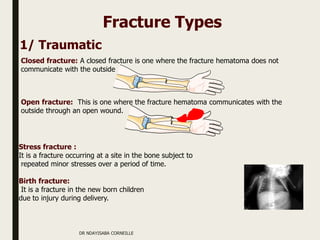
Closed fracture: A closed fracture is one where the fracture hematoma does not
communicate with the outside
Open fracture: This is one where the fracture hematoma communicates with the
outside through an open wound.
1/ Traumatic
Fracture Types
Stress fracture :
It is a fracture occurring at a site in the bone subject to
repeated minor stresses over a period of time.
Birth fracture:
It is a fracture in the new born children
due to injury during delivery.
DR NDAYISABA CORNEILLE
2/ Pathological
It is a fracture occurring after a trivial violence in a bone weakened by some
pathological lesion. This lesion may be :
- Localized disorder
(e.g. secondary malignant deposit)
- Generalized disorder
(e.g. osteoporosis).
Fracture Types
DR NDAYISABA CORNEILLE
Transverse Fracture
A fracture in which the # line is
perpendicular to the long axis of
the bone .
Oblique Fracture
A fracture in which the # line is at
oblique angle to the long axis of the
bone.
According to the Path of the # Line
Fracture Types
DR NDAYISABA CORNEILLE
Spiral Fracture
A severe form of oblique fracture in
which the # plane rotates along the
long axis of the bone. These #s occur
secondary to rotational force.
Longitudinal Fracture
A fracture in which the # line runs
nearly parallel to the long axis of the
bone. A longitudinal fracture can be
considered a long oblique fracture.
According to the Path of the # Line
Fracture Types
DR NDAYISABA CORNEILLE
Anatomical classification of fractures
Fractures
Comminuted # :
The bone is broken into than two
fragments.
Stellate fracture:
This # occurs in the flat bones of the
skull and in the patella, where the
fracture lines run in various directions
from one point.
DR NDAYISABA CORNEILLE
Anatomical classification of fractures
Impacted fracture:
This # where a vertical force drives
the distal fragment of the fracture
into the proximal fragment.
Fracture Types
Depressed fracture:
This # occurs in the skull where a
segment of bone gets depressed
into the cranium.
DR NDAYISABA CORNEILLE
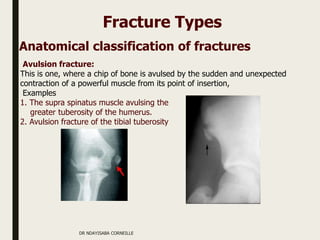
Avulsion fracture:
This is one, where a chip of bone is avulsed by the sudden and unexpected
contraction of a powerful muscle from its point of insertion,
Examples
1. The supra spinatus muscle avulsing the
greater tuberosity of the humerus.
2. Avulsion fracture of the tibial tuberosity
Fracture Types
Anatomical classification of fractures
DR NDAYISABA CORNEILLE
Fracture Types
Simple little or no bone displacement
Compound fracture ruptures the skin & bone protrudes
Green stick occurs mostly in children whose bones have not calcified or hardened
Transverse crack perpendicular to long axis of the bone - displacement may occur
Oblique diagonal crack across the long axis of the bone
Spiral diagonal crack involving a "twisting" of the bone about the longitudinal axis
Comminuted "crushing" fracture - more common in elderly
Impacted one end of bone is driven up into the other
Depressed broken bone is pressed inward (skull fracture)
Avulsion fragment of bone is pulled away by tendon
Summary
DR NDAYISABA CORNEILLE
Other Terms used in describing fracture
Greenstick
is the fracture in the young bone of children where the break is incomplete,
leaving one cortex intact .
Plastic - Bowing fracture in children without disruption of cortex.
Distraction Is a separation of fragments that have been pulled apart.
Greenstick #
Distraction #
DR NDAYISABA CORNEILLE
1.Position - changed or unchanged
Terms used in fracture follow-up
.2. Healing -central or peripheral
bony bridging
DR NDAYISABA CORNEILLE
Delayed union - the healing process is slower than normal.
Non-union - the healing stopped before union occurred.
Malunion - the fracture healed in unacceptable position.
Terms used in fracture follow-up
DR NDAYISABA CORNEILLE
Fractures
management and healing
DR NDAYISABA CORNEILLE
Principles of Management:
Aims : (A)- save life (B)-save the limb (C)-save the function
1. Efficient First Aid: This relieves the pain and prevents complications.
2. Safe transport: This help to minimize complications in injures to the spine, fracture
of the lower limbs, ribs etc (all fractures should be immobilized immediately ) .
3. Assessment of condition of the patients for shock & other injuries.
4. Assessment of local condition of the injured limb regarding complications like
vascular injury, nerve involvement and injury to neighboring joints .
5. Resuscitation. If needed
6. Radiography of the part
 X-ray before plaster AP & LAT( to determine site and degree of displacement)
 Post Reduction films ( wet plaster) for insurance of good alignment
 Follow up films to assess healing
 Films Before removal of plaster to confirm complete healing
7. Reduction of the fracture(correction of displacement of fragments and done by :
 closed Manipulation
open reduction
DR NDAYISABA CORNEILLE
8. Immobilization of the fragments.
External fixation
Cast (plaster)
Internal fixation
Screws
Plates
intramedullary nails and rod
wires & pins
Principles of Management:
DR NDAYISABA CORNEILLE
9. Early physiotherapy : for the preservation of function of the limb (local complication such as
ischemia ,nerve damage ,joint stiffness ,infection ..etc may endanger the function of the limb.
10. Rehabilitation : After union of the fracture to restore full muscle power and joint
movements and to make the patient fit for his original job.
NOTE:
Fractures are treated by reduction (realignment) &immediate immobilization
In most cases, simple fractures heal completely in approximately 6 - 8 weeks
Compound # better to deal with it within6hrs of injury to avoid infection
The accurate diagnosis of the fracture (site ,lines and displacement ) is made from X-
ray examination.
Tow projections is required AP or PA +lateral or oblique
Tow joints above and below the site of the # should be included in the radiographs
Tow limbs radiographs for comparison of value in children.
DR NDAYISABA CORNEILLE
FRACTURE HEALING
Fracture healing is considered as a series of phases which occur in
sequence as follows:
(I) Inflammatory Phase.
(A) Stage or hematoma formation.
(B) Stage of granulation tissue. (more fibrin
to the hematoma and increase blood flow
(II) Reparative Phase.
(A) Stage of fibro cartilaginous callus.
(B) Stage of bony callus (woven bone become
calcified)).
(III) Remodeling Phase.
Excess material inside bone shaft is
replaced by more compact bone
DR NDAYISABA CORNEILLE
Factors Affecting Bone Healing
Enhancing
Youth
Early Immobilization of fracture
fragments
Bone fragments contact
Adequate blood supply
Proper Nutrition
Adequate hormones
Growth hormone
Thyroxin
Calcitonin
Inhibiting
Age (e.g. Average # Femur HealingTime)
Infant: 4 weeks
Teenager: 12 to 16 weeks
Extensive local soft tissue trauma
Bone loss due to the severity of the fracture
Inadequate immobilization (motion at the
fracture site)
Infection
Avascular Necrosis
DR NDAYISABA CORNEILLE
Fracture - Complications
At time of injury (Immediate)
– Haemorrhage
– Damage to important internal structures (brain ,heart..)
– Skin loss ,Shock ,Nerve damage
Later Complications
Local General
Tissue necrosis Deep Vein Thrombosis,
Local wound Infection Pulmonary embolism
Loss of alignment Osteoarthritis
Delayed and malunion
Joint stiffness
DR NDAYISABA CORNEILLE
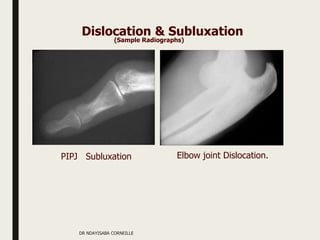
What is Dislocation?
Joints Dislocation
Is the total displacement of the articular end of a bone from the joint cavity.
Subluxation : Is an incomplete displacement.
Reduction : Is the restoration of the normal alignment of the bones.
Classification:
Dislocations are classified
as follows:
A. Congenital
B. Traumatic
C. Pathological
D. Paralytic
DR NDAYISABA CORNEILLE
PIPJ Subluxation Elbow joint Dislocation.
Dislocation & Subluxation
(Sample Radiographs)
DR NDAYISABA CORNEILLE
THANKS
DR NDAYISABA CORNEILLE
Text book of radiographic positioning and related anatomy; by Kenneth
L.Bontrager,5th edition
M.A.Seraj , The new manual of basic emergency
procedures, first aid and updated CPR.
References
DR NDAYISABA CORNEILLE

Fracture

  • 1.
    FRACTURE Presented by DRNDAYISABA CORNEILLE CEO of CHG, MBChB, DCM,BCSIT,CCNA Email: ndayicoll@gmail.com Supported by
  • 2.
     Define theterm fracture, dislocation and Subluxation  Identify the general causes, signs , symptoms of fractures  Classify the different types of fractures  Discus the general principles of the management of fractures  Describe the role of radiography in the management of fractures  Explain the process of fracture healing  State the local and general complications of fractures DR NDAYISABA CORNEILLE
  • 3.
    What is fracture(#)? commoncauses of fractures:  Fall from a height  car accidents  Direct blow  Repetitive forces  Pathology Signs and Symptoms  Swelling or tenderness  pain  Numbness  Bleeding  Broken skin with bone protruding  Limitation or unwillingness to move a limb a break in the continuity of a bone or cartilage. DR NDAYISABA CORNEILLE
  • 4.
    Closed fracture: Aclosed fracture is one where the fracture hematoma does not communicate with the outside Open fracture: This is one where the fracture hematoma communicates with the outside through an open wound. 1/ Traumatic Fracture Types Stress fracture : It is a fracture occurring at a site in the bone subject to repeated minor stresses over a period of time. Birth fracture: It is a fracture in the new born children due to injury during delivery. DR NDAYISABA CORNEILLE
  • 5.
    2/ Pathological It isa fracture occurring after a trivial violence in a bone weakened by some pathological lesion. This lesion may be : - Localized disorder (e.g. secondary malignant deposit) - Generalized disorder (e.g. osteoporosis). Fracture Types DR NDAYISABA CORNEILLE
  • 6.
    Transverse Fracture A fracturein which the # line is perpendicular to the long axis of the bone . Oblique Fracture A fracture in which the # line is at oblique angle to the long axis of the bone. According to the Path of the # Line Fracture Types DR NDAYISABA CORNEILLE
  • 7.
    Spiral Fracture A severeform of oblique fracture in which the # plane rotates along the long axis of the bone. These #s occur secondary to rotational force. Longitudinal Fracture A fracture in which the # line runs nearly parallel to the long axis of the bone. A longitudinal fracture can be considered a long oblique fracture. According to the Path of the # Line Fracture Types DR NDAYISABA CORNEILLE
  • 8.
    Anatomical classification offractures Fractures Comminuted # : The bone is broken into than two fragments. Stellate fracture: This # occurs in the flat bones of the skull and in the patella, where the fracture lines run in various directions from one point. DR NDAYISABA CORNEILLE
  • 9.
    Anatomical classification offractures Impacted fracture: This # where a vertical force drives the distal fragment of the fracture into the proximal fragment. Fracture Types Depressed fracture: This # occurs in the skull where a segment of bone gets depressed into the cranium. DR NDAYISABA CORNEILLE
  • 10.
    Avulsion fracture: This isone, where a chip of bone is avulsed by the sudden and unexpected contraction of a powerful muscle from its point of insertion, Examples 1. The supra spinatus muscle avulsing the greater tuberosity of the humerus. 2. Avulsion fracture of the tibial tuberosity Fracture Types Anatomical classification of fractures DR NDAYISABA CORNEILLE
  • 11.
    Fracture Types Simple littleor no bone displacement Compound fracture ruptures the skin & bone protrudes Green stick occurs mostly in children whose bones have not calcified or hardened Transverse crack perpendicular to long axis of the bone - displacement may occur Oblique diagonal crack across the long axis of the bone Spiral diagonal crack involving a "twisting" of the bone about the longitudinal axis Comminuted "crushing" fracture - more common in elderly Impacted one end of bone is driven up into the other Depressed broken bone is pressed inward (skull fracture) Avulsion fragment of bone is pulled away by tendon Summary DR NDAYISABA CORNEILLE
  • 12.
  • 13.
    Other Terms usedin describing fracture Greenstick is the fracture in the young bone of children where the break is incomplete, leaving one cortex intact . Plastic - Bowing fracture in children without disruption of cortex. Distraction Is a separation of fragments that have been pulled apart. Greenstick # Distraction # DR NDAYISABA CORNEILLE
  • 14.
    1.Position - changedor unchanged Terms used in fracture follow-up .2. Healing -central or peripheral bony bridging DR NDAYISABA CORNEILLE
  • 15.
    Delayed union -the healing process is slower than normal. Non-union - the healing stopped before union occurred. Malunion - the fracture healed in unacceptable position. Terms used in fracture follow-up DR NDAYISABA CORNEILLE
  • 16.
  • 17.
    Principles of Management: Aims: (A)- save life (B)-save the limb (C)-save the function 1. Efficient First Aid: This relieves the pain and prevents complications. 2. Safe transport: This help to minimize complications in injures to the spine, fracture of the lower limbs, ribs etc (all fractures should be immobilized immediately ) . 3. Assessment of condition of the patients for shock & other injuries. 4. Assessment of local condition of the injured limb regarding complications like vascular injury, nerve involvement and injury to neighboring joints . 5. Resuscitation. If needed 6. Radiography of the part  X-ray before plaster AP & LAT( to determine site and degree of displacement)  Post Reduction films ( wet plaster) for insurance of good alignment  Follow up films to assess healing  Films Before removal of plaster to confirm complete healing 7. Reduction of the fracture(correction of displacement of fragments and done by :  closed Manipulation open reduction DR NDAYISABA CORNEILLE
  • 18.
    8. Immobilization ofthe fragments. External fixation Cast (plaster) Internal fixation Screws Plates intramedullary nails and rod wires & pins Principles of Management: DR NDAYISABA CORNEILLE
  • 19.
    9. Early physiotherapy: for the preservation of function of the limb (local complication such as ischemia ,nerve damage ,joint stiffness ,infection ..etc may endanger the function of the limb. 10. Rehabilitation : After union of the fracture to restore full muscle power and joint movements and to make the patient fit for his original job. NOTE: Fractures are treated by reduction (realignment) &immediate immobilization In most cases, simple fractures heal completely in approximately 6 - 8 weeks Compound # better to deal with it within6hrs of injury to avoid infection The accurate diagnosis of the fracture (site ,lines and displacement ) is made from X- ray examination. Tow projections is required AP or PA +lateral or oblique Tow joints above and below the site of the # should be included in the radiographs Tow limbs radiographs for comparison of value in children. DR NDAYISABA CORNEILLE
  • 20.
    FRACTURE HEALING Fracture healingis considered as a series of phases which occur in sequence as follows: (I) Inflammatory Phase. (A) Stage or hematoma formation. (B) Stage of granulation tissue. (more fibrin to the hematoma and increase blood flow (II) Reparative Phase. (A) Stage of fibro cartilaginous callus. (B) Stage of bony callus (woven bone become calcified)). (III) Remodeling Phase. Excess material inside bone shaft is replaced by more compact bone DR NDAYISABA CORNEILLE
  • 21.
    Factors Affecting BoneHealing Enhancing Youth Early Immobilization of fracture fragments Bone fragments contact Adequate blood supply Proper Nutrition Adequate hormones Growth hormone Thyroxin Calcitonin Inhibiting Age (e.g. Average # Femur HealingTime) Infant: 4 weeks Teenager: 12 to 16 weeks Extensive local soft tissue trauma Bone loss due to the severity of the fracture Inadequate immobilization (motion at the fracture site) Infection Avascular Necrosis DR NDAYISABA CORNEILLE
  • 22.
    Fracture - Complications Attime of injury (Immediate) – Haemorrhage – Damage to important internal structures (brain ,heart..) – Skin loss ,Shock ,Nerve damage Later Complications Local General Tissue necrosis Deep Vein Thrombosis, Local wound Infection Pulmonary embolism Loss of alignment Osteoarthritis Delayed and malunion Joint stiffness DR NDAYISABA CORNEILLE
  • 23.
    What is Dislocation? JointsDislocation Is the total displacement of the articular end of a bone from the joint cavity. Subluxation : Is an incomplete displacement. Reduction : Is the restoration of the normal alignment of the bones. Classification: Dislocations are classified as follows: A. Congenital B. Traumatic C. Pathological D. Paralytic DR NDAYISABA CORNEILLE
  • 24.
    PIPJ Subluxation Elbowjoint Dislocation. Dislocation & Subluxation (Sample Radiographs) DR NDAYISABA CORNEILLE
  • 25.
  • 26.
    Text book ofradiographic positioning and related anatomy; by Kenneth L.Bontrager,5th edition M.A.Seraj , The new manual of basic emergency procedures, first aid and updated CPR. References DR NDAYISABA CORNEILLE