FINANCIAL MANAGEMENT - SCOPE - ROLE OF FINANCAIL MANAGEER - GOALS - INTRODUCTION TO GLOBAL PERSPECTIVE OF FINANCIAL MANAGEMENT
1.
Unit I -Introduction to Financial Management
Scope of Financial Management
Role of Financial Manager
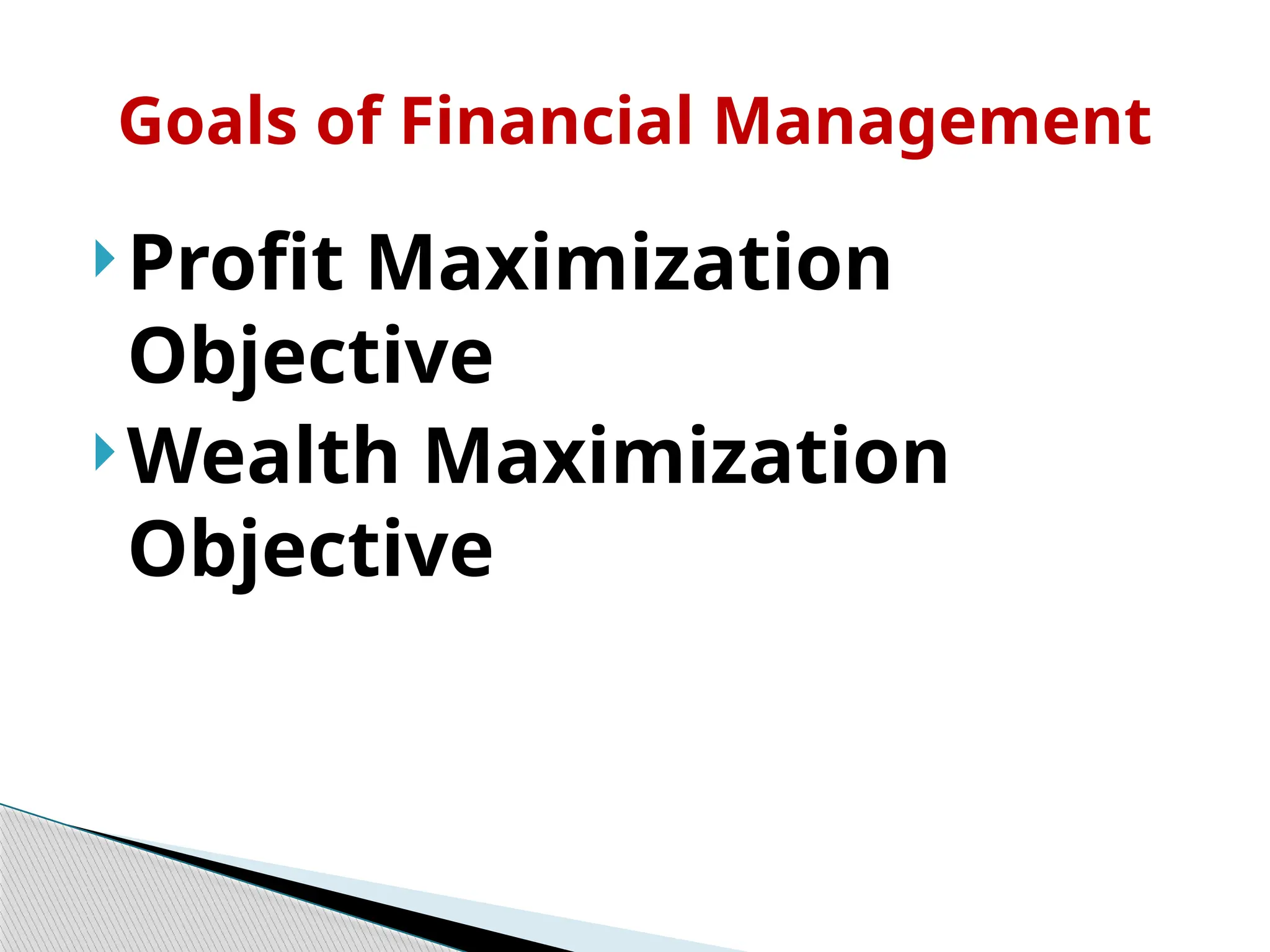
Goals of Financial Management
Introduction to Global Perspective of Financial
Management
2.
What is Finance?
Financeis the art & science
of managing 'MONEY'.
Finance is the life blood of
Business (funds).
Finance v/s Money
3.
Finance vs Money
Moneyis medium of exchange
Finance is the management
and study of money including
its creation, use and flow
within an economy.
4.
Definition of BusinessFinance
“Business finance is that business
activity which concerns with the
acquisition and conversation of
capital funds in meeting financial
needs and overall objectives of a
business enterprise”.
DEFINITION OF FINANCIAL
MANAGEMENT
“Financialmanagement is the activity
concerned with planning, raising,
controlling and administering of funds
used in the business.” – Guthman and
Dougal
7.
MEANING OF FINANCIAL
MANAGEMENT
FinancialManagement means
planning, organizing, directing and
controlling the financial activities
such as procurement and
utilization of funds of the
enterprise
8.
MEANING OF FINANCIAL
MANAGEMENT
Financialmanagement is the
operational activity of a business that
is responsible for obtaining and
effectively utilizing the funds
necessary for efficient operations
9.
IMPORTANCE OF FINANCIAL
MANAGEMENT
FinancialPlanning
Acquisition of Funds
Proper Use of Funds
Financial Decision
Improve Profitability
Increase the Value of the Firm
Promoting Savings
10.
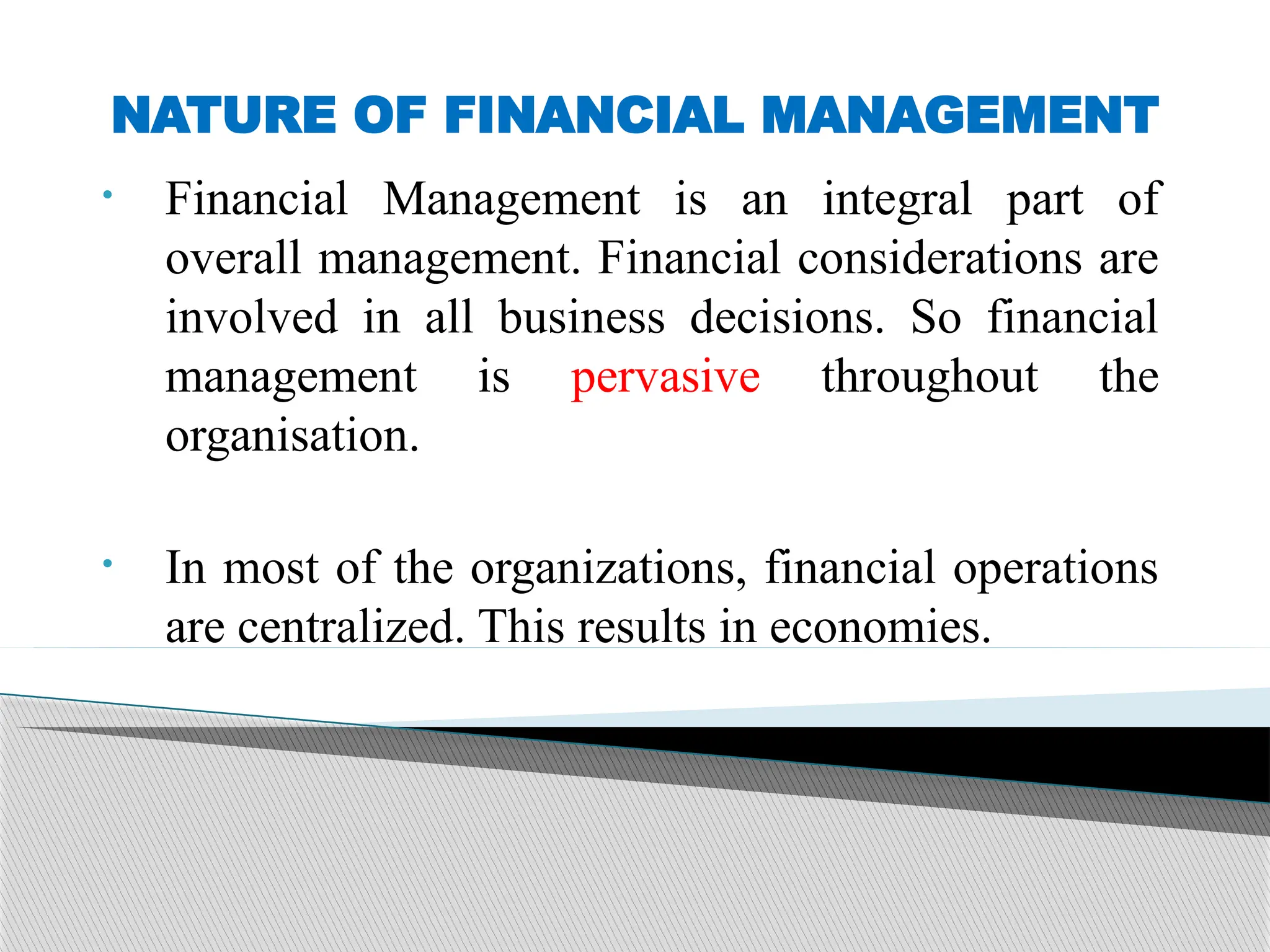
NATURE OF FINANCIALMANAGEMENT
• Financial Management is an integral part of
overall management. Financial considerations are
involved in all business decisions. So financial
management is pervasive throughout the
organisation.
• In most of the organizations, financial operations
are centralized. This results in economies.
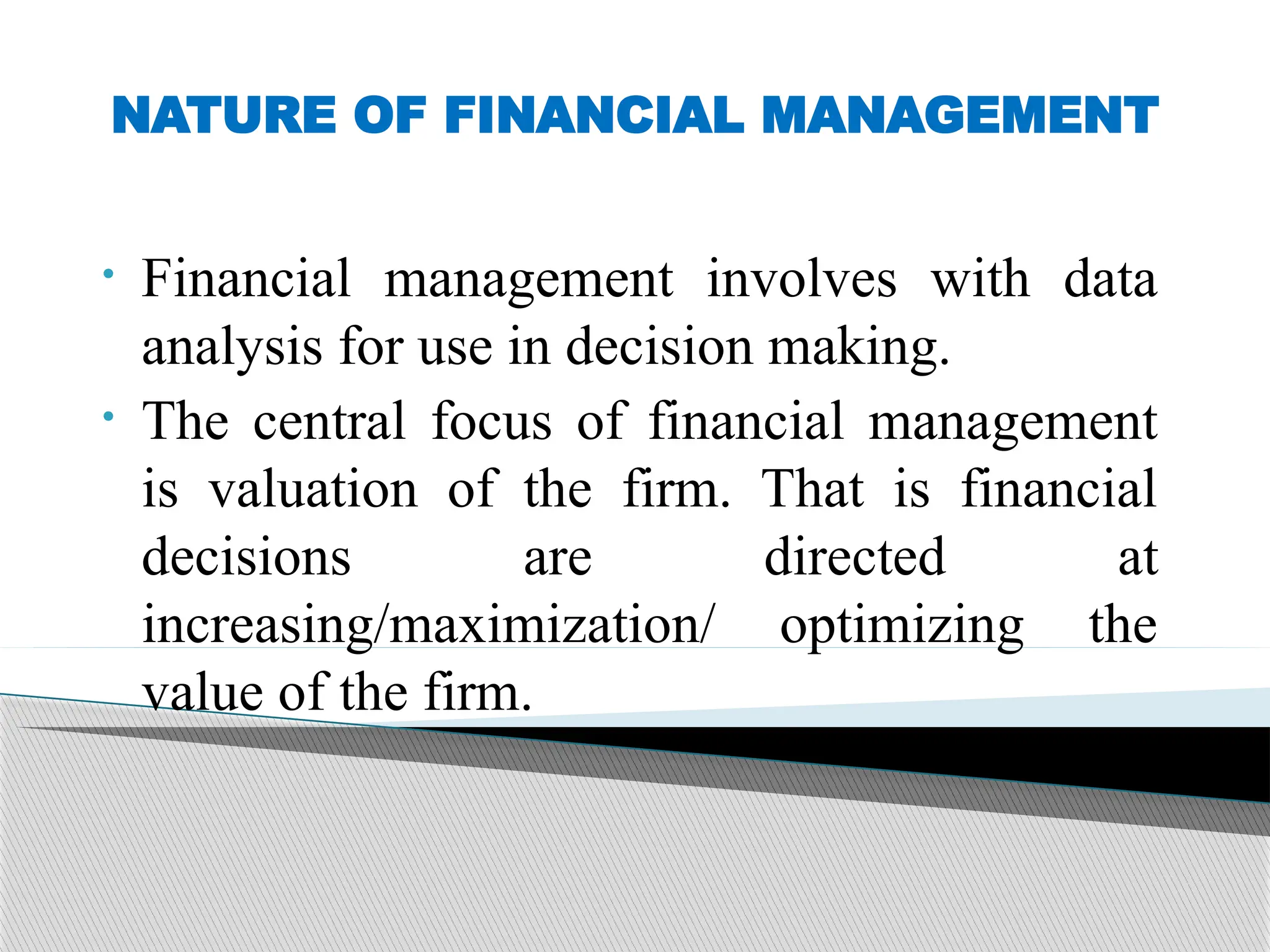
11.
NATURE OF FINANCIALMANAGEMENT
• Financial management involves with data
analysis for use in decision making.
• The central focus of financial management
is valuation of the firm. That is financial
decisions are directed at
increasing/maximization/ optimizing the
value of the firm.
12.
NATURE OF FINANCIALMANAGEMENT
Financial management affects the survival,
growth and vitality of the firm. Finance is
said to be the life blood of business.
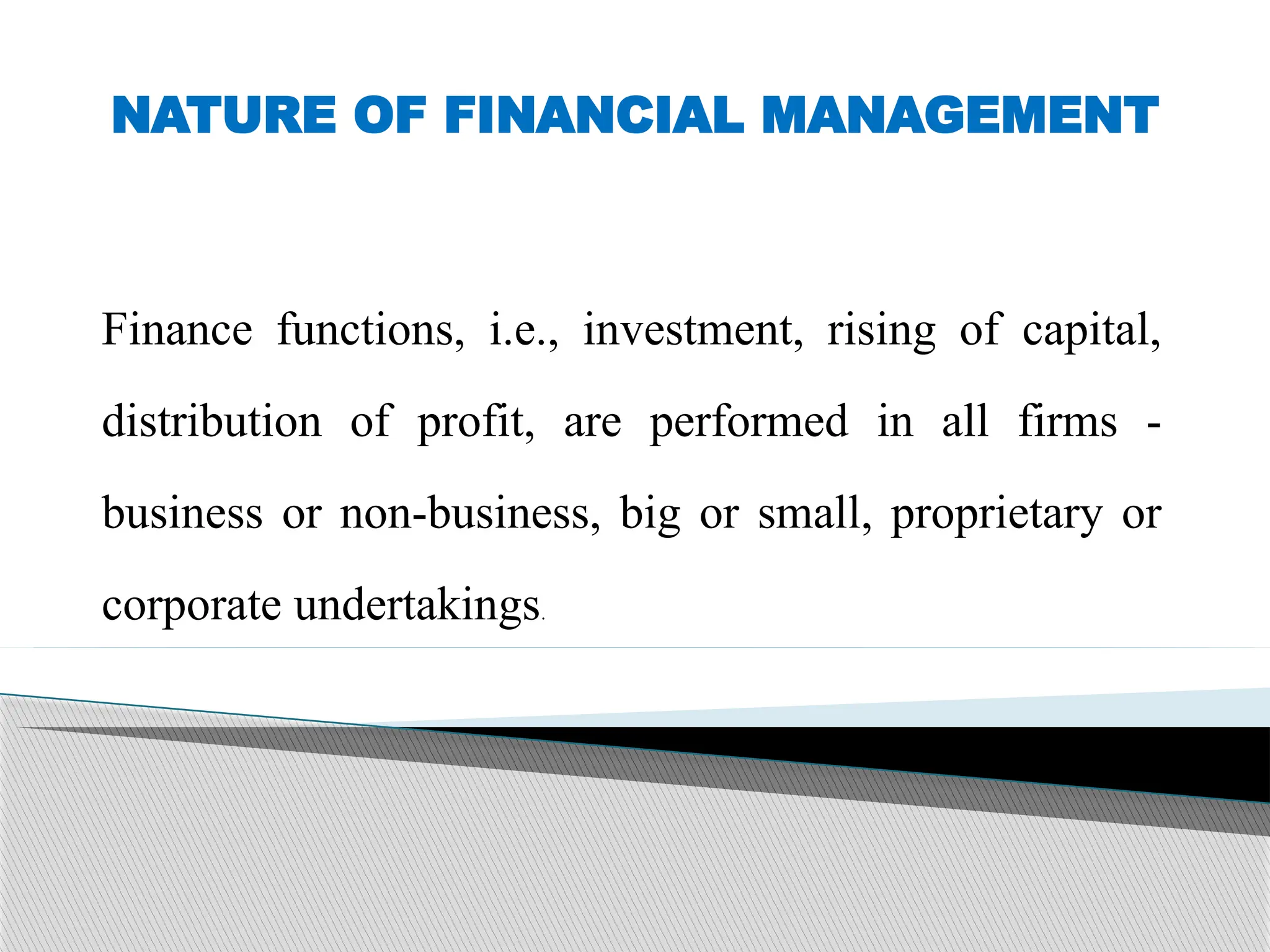
13.
NATURE OF FINANCIALMANAGEMENT
Finance functions, i.e., investment, rising of capital,
distribution of profit, are performed in all firms -
business or non-business, big or small, proprietary or
corporate undertakings.
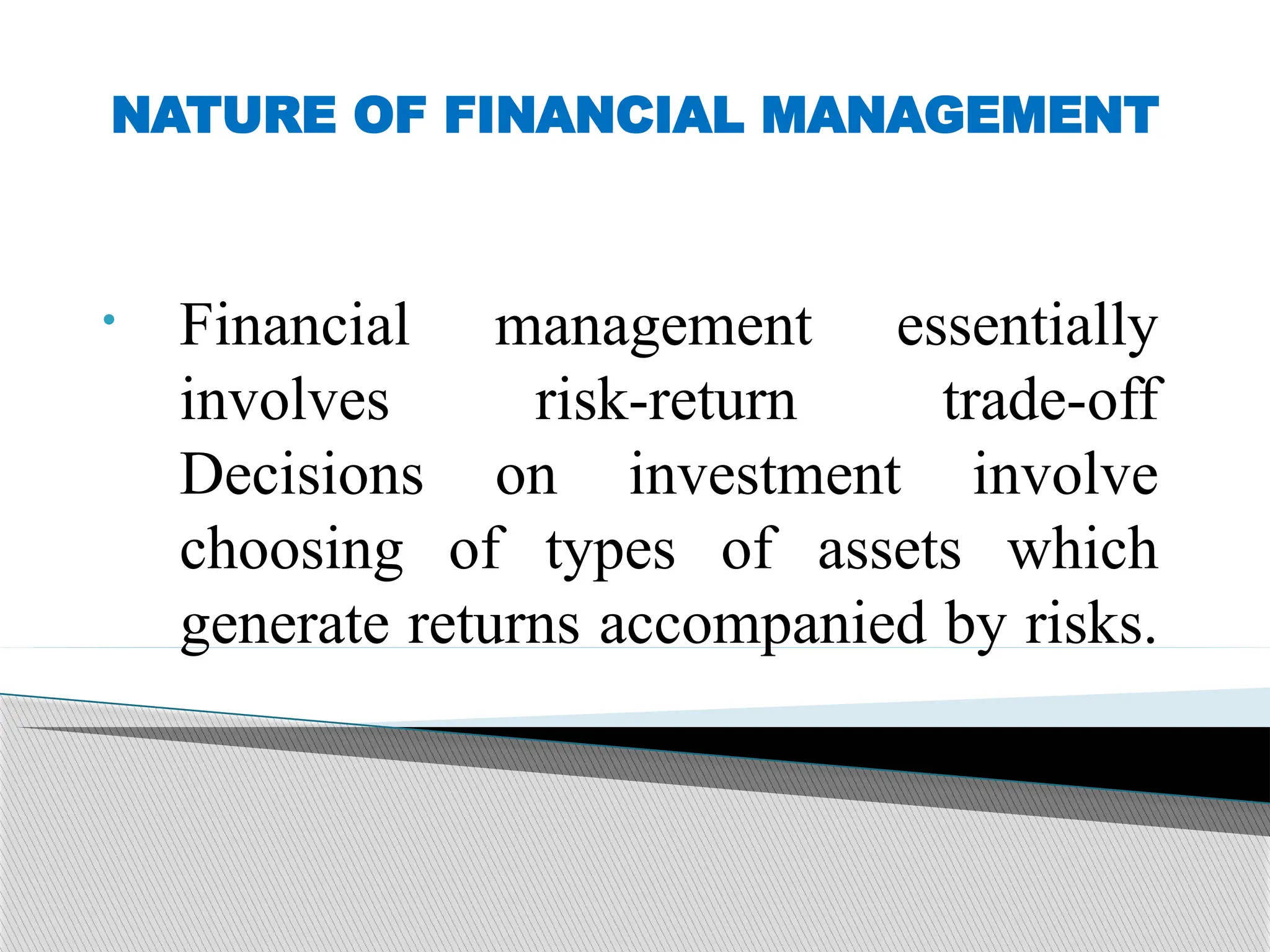
14.
NATURE OF FINANCIALMANAGEMENT
• Financial management essentially
involves risk-return trade-off
Decisions on investment involve
choosing of types of assets which
generate returns accompanied by risks.
15.
NATURE OF FINANCIALMANAGEMENT
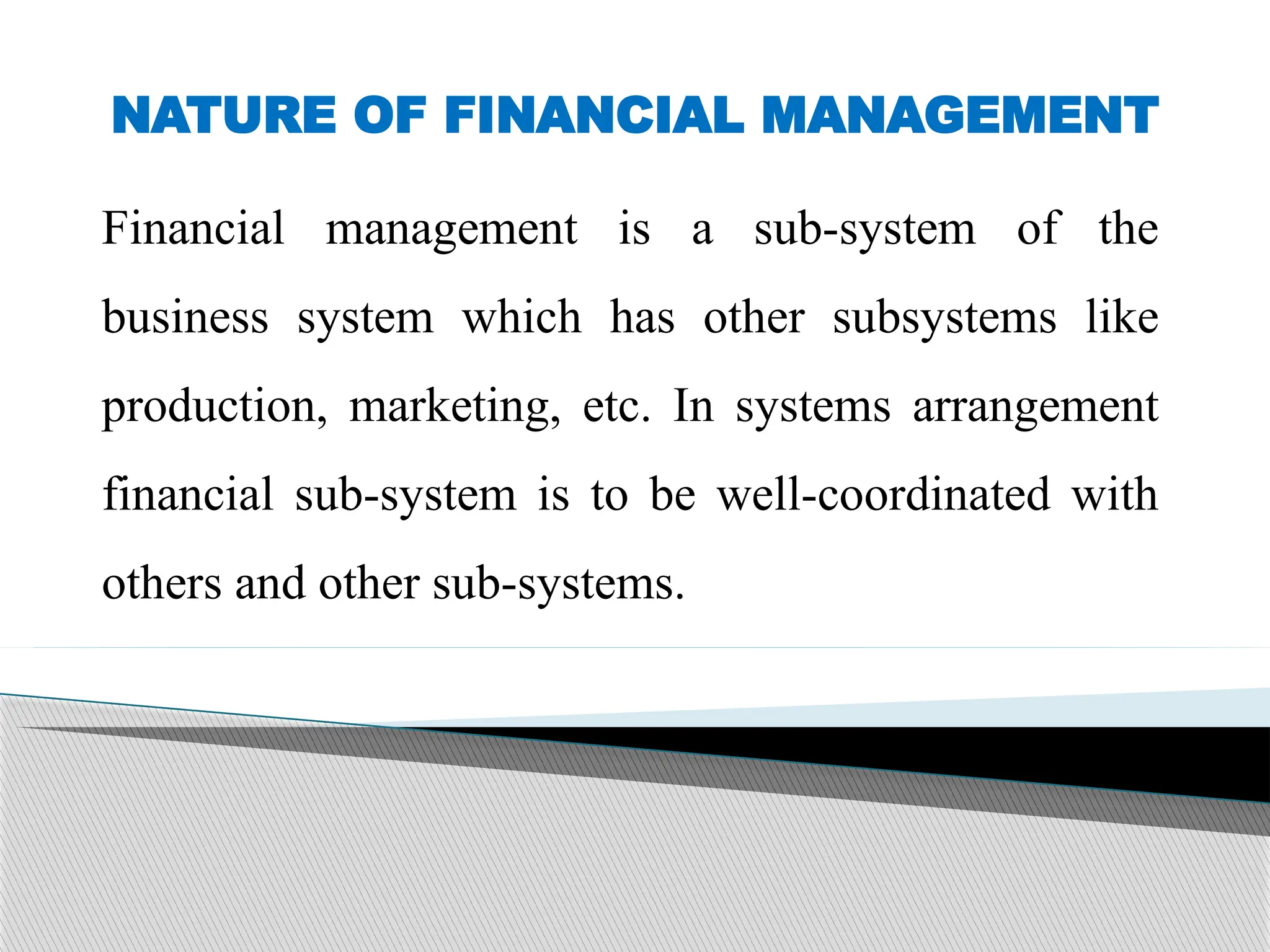
Financial management is a sub-system of the
business system which has other subsystems like
production, marketing, etc. In systems arrangement
financial sub-system is to be well-coordinated with
others and other sub-systems.
16.
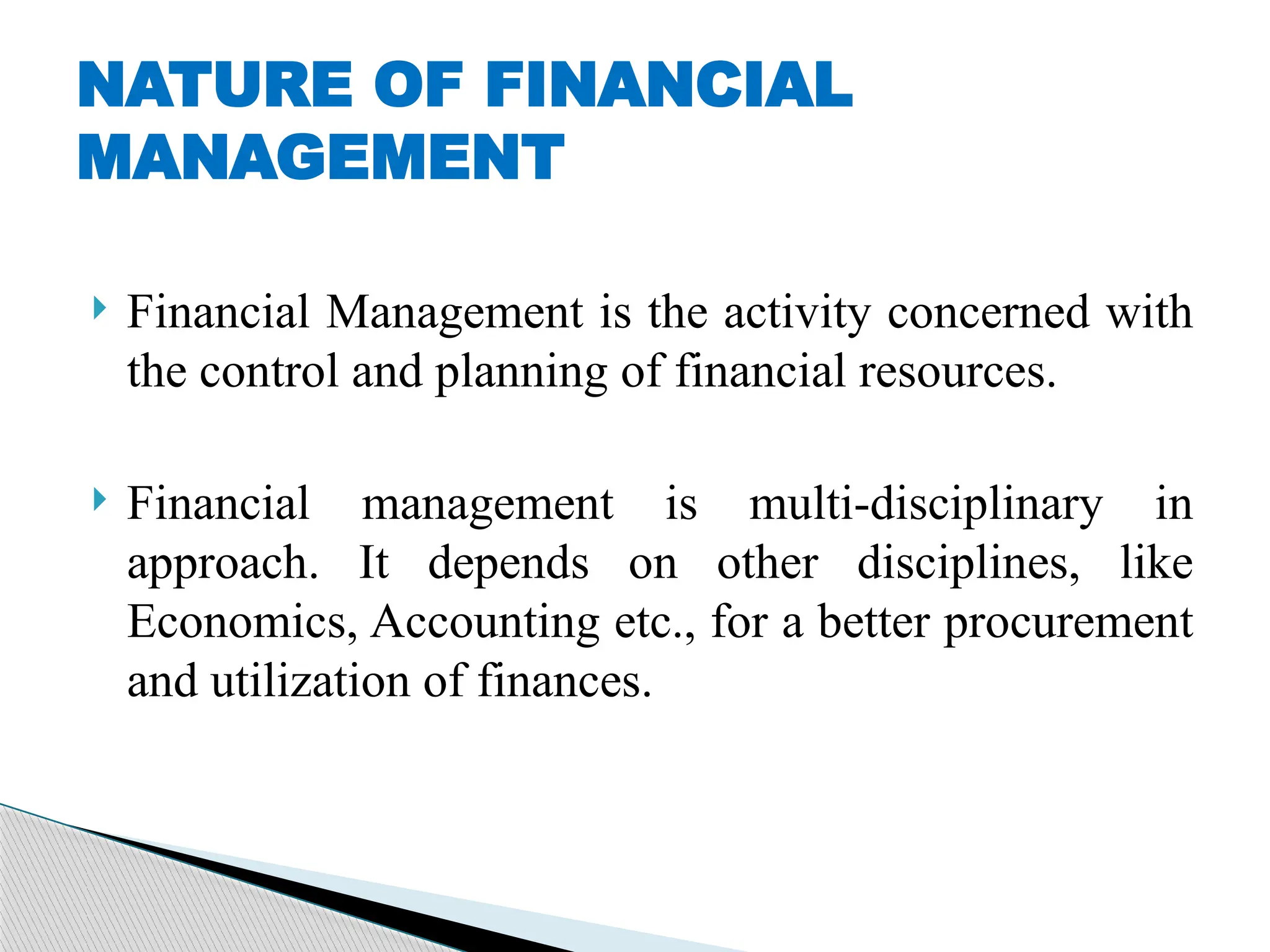
Financial Managementis the activity concerned with
the control and planning of financial resources.
Financial management is multi-disciplinary in
approach. It depends on other disciplines, like
Economics, Accounting etc., for a better procurement
and utilization of finances.
NATURE OF FINANCIAL
MANAGEMENT
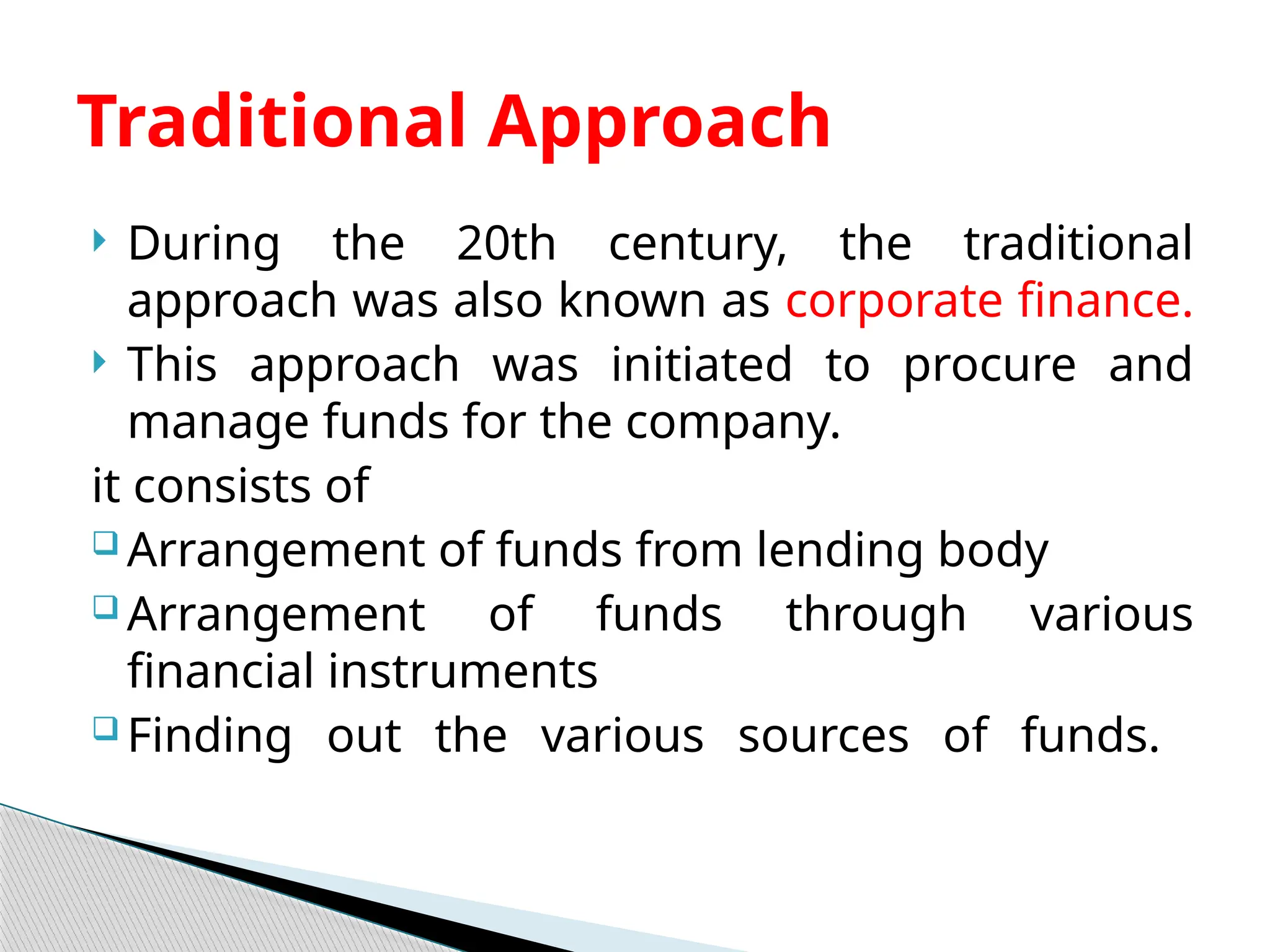
During the20th century, the traditional
approach was also known as corporate finance.
This approach was initiated to procure and
manage funds for the company.
it consists of
Arrangement of funds from lending body
Arrangement of funds through various
financial instruments
Finding out the various sources of funds.
Traditional Approach
19.
It focuson the profit maximization
Short term objectives are prioritized
Limited Decision making
Traditional Approach
20.
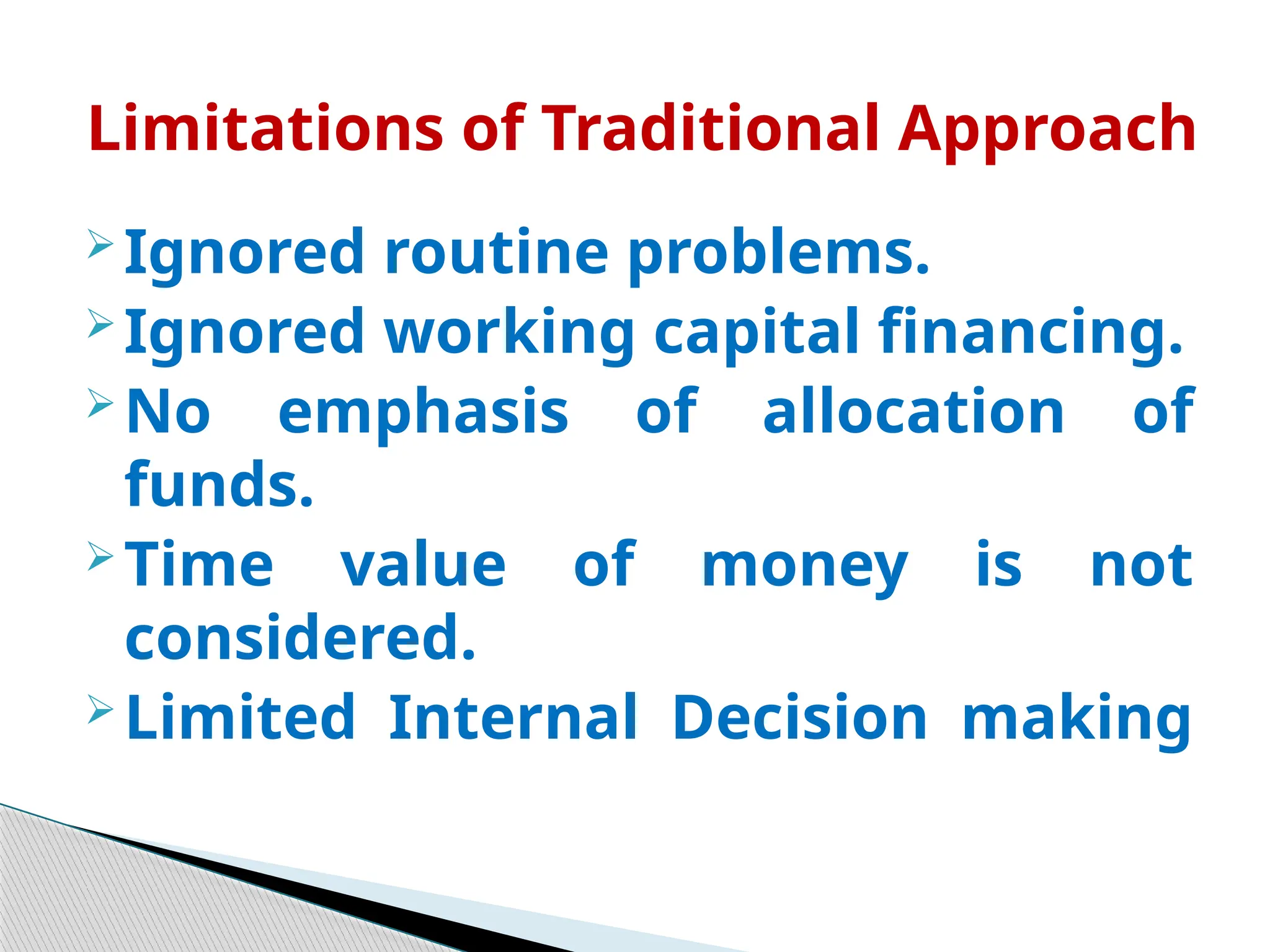
Ignored routineproblems.
Ignored working capital financing.
No emphasis of allocation of
funds.
Time value of money is not
considered.
Limited Internal Decision making
Limitations of Traditional Approach
21.
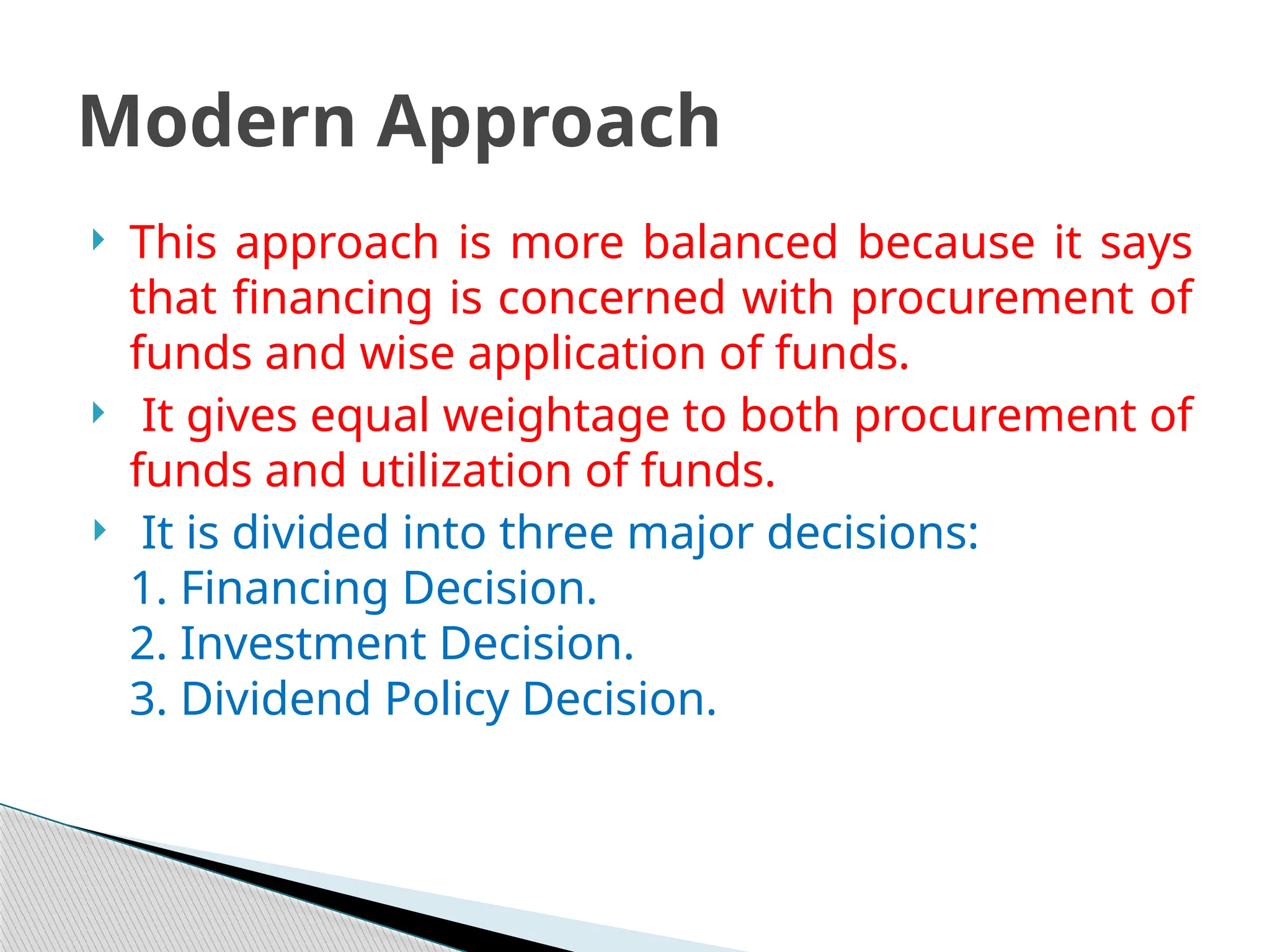
This approachis more balanced because it says
that financing is concerned with procurement of
funds and wise application of funds.
It gives equal weightage to both procurement of
funds and utilization of funds.
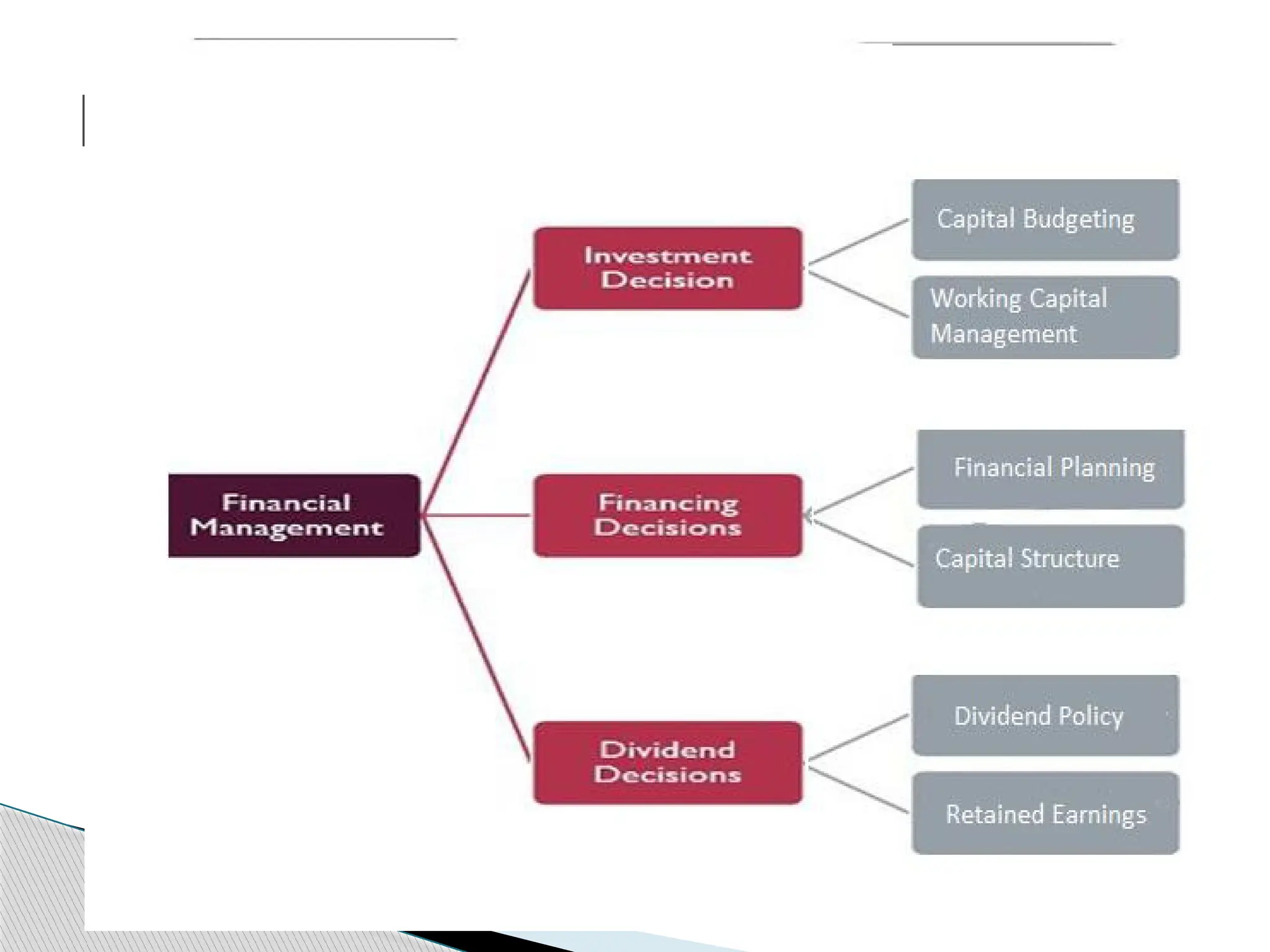
It is divided into three major decisions:
1. Financing Decision.
2. Investment Decision.
3. Dividend Policy Decision.
Modern Approach
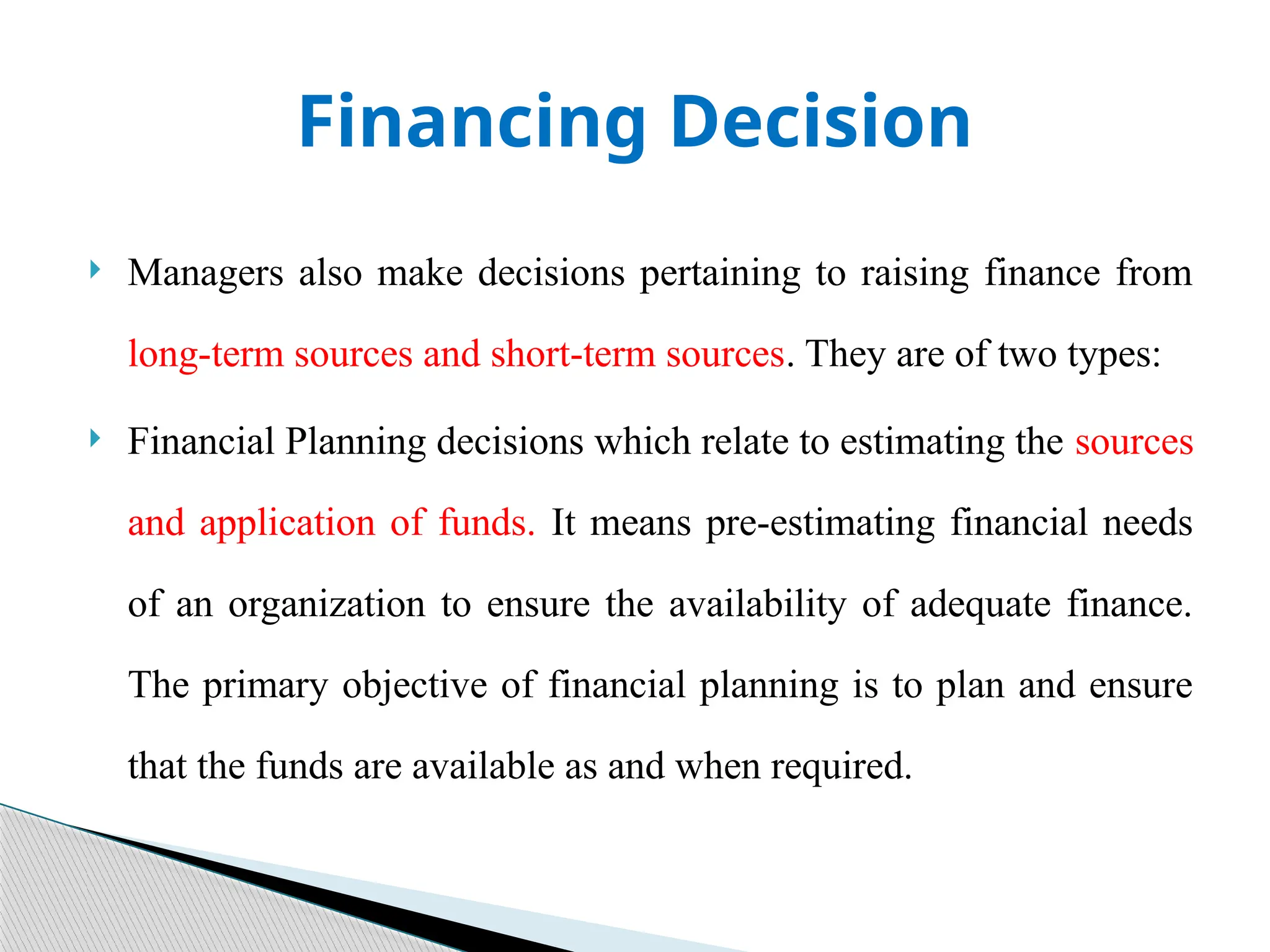
Financing Decision
Managersalso make decisions pertaining to raising finance from
long-term sources and short-term sources. They are of two types:
Financial Planning decisions which relate to estimating the sources
and application of funds. It means pre-estimating financial needs
of an organization to ensure the availability of adequate finance.
The primary objective of financial planning is to plan and ensure
that the funds are available as and when required.
24.
Financing Decision
CapitalStructure decisions which involve identifying
sources of funds. They also involve decisions with respect to
choosing external sources like issuing shares, bonds,
borrowing from banks or internal sources like retained
earnings for raising funds. The decisions are made in the light
of the cost of capital, risk factor involved and returns to the
shareholders.
25.
Investment Decision
InvestmentDecisions: Managers need to decide on the amount of
investment available out of the existing finance, on a long-term and
short-term basis. They are of two types: Long-term investment
decisions or Capital Budgeting mean committing funds for a long
period of time like fixed assets. These decisions are irreversible and
usually include the ones pertaining to investing in a building and/or
land, acquiring new plants/machinery or replacing the old ones, etc.
26.
Investment Decision
Short-terminvestment decisions or Working Capital
Management means committing funds for a short period of
time like current assets. These involve decisions pertaining
to the investment of funds in the inventory, cash, bank
deposits, and other short-term investments. They directly
affect the liquidity and performance of the business.
27.
Dividend Decisions
Theseinvolve decisions related to the portion of profits that
will be distributed as dividend. Dividend is that portion of
divisible profits that is distributed to the owners i.e. the
shareholders. Retained earnings is the proportion of profits
kept in, that is, reinvested in the business for the business.
Shareholders always demand a higher dividend, while the
management would want to retain profits for business needs.
28.
Dividend Decisions
Dividenddecision is to whether to distribute
earnings to shareholder as dividends or retain
earnings to finance long-term profits of the firm.
It must be done keeping in mind the firms overall
objective of maximizing the shareholders wealth.
29.
1. Estimationof the capital requirements - to
make an estimate with regards to the capital
of the company.
2. Determination of the capital compositions.
This depends on the proportion of the equity
capital, the company is proposing.
3. Choice of the source of funds. Issue of
shares and debentures, loan to be taken,
public deposits.
4. Investment of funds. Allocation funds into
a profitable venture.
Functional Areas of Financial
Management
30.
5. Disposalof surplus. By the dividend
declaration, retained profits.
6. Management of cash. Cash has to be
managed for various purposes like bill
payment and the maintenance of the
stocks.
7. Financial controls. The manager has
the use of financial ratios, financial
forecasting, and profit analysis.
Functional Areas of Financial
Management
31.
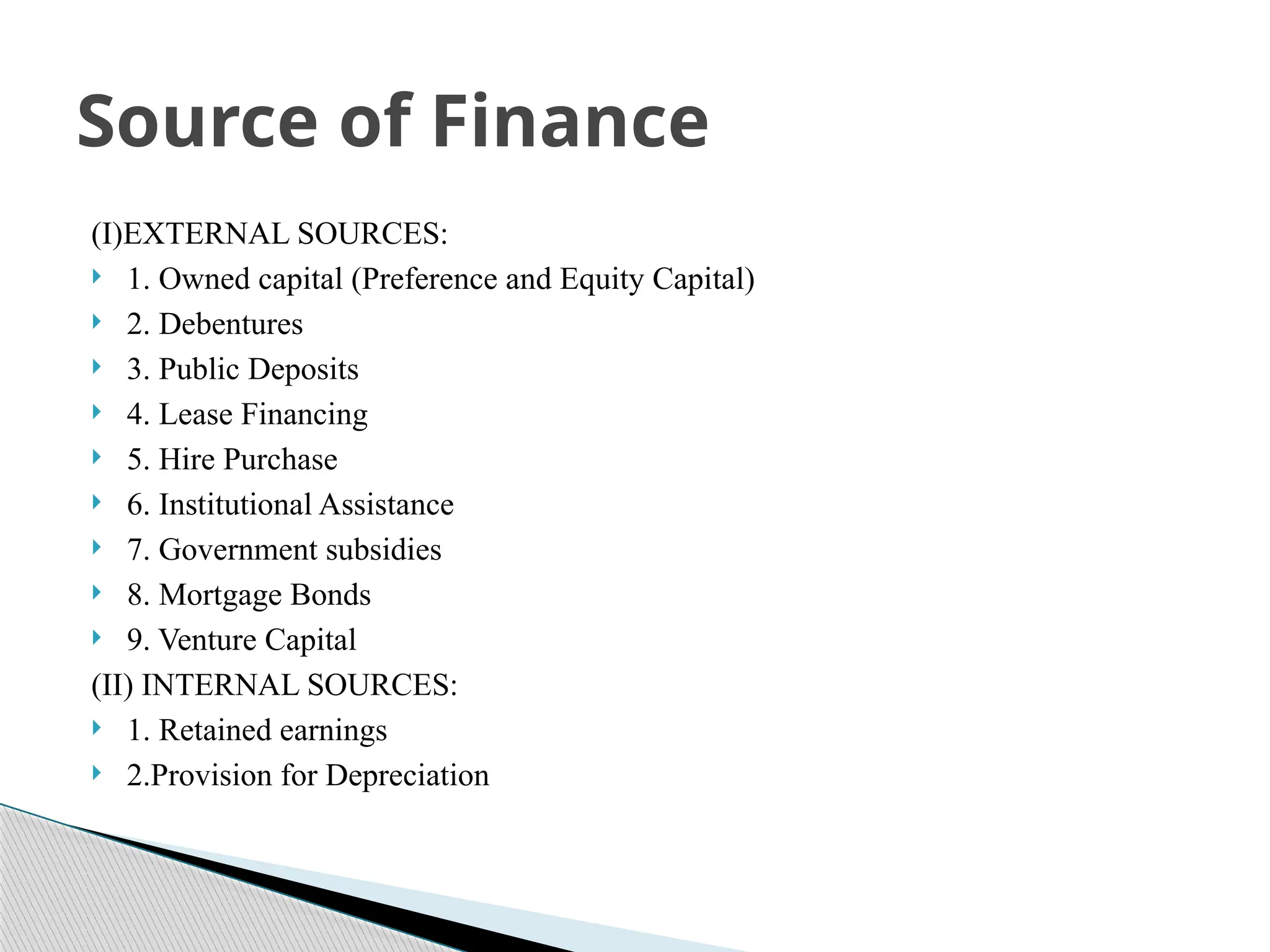
(I)EXTERNAL SOURCES:
1.Owned capital (Preference and Equity Capital)
2. Debentures
3. Public Deposits
4. Lease Financing
5. Hire Purchase
6. Institutional Assistance
7. Government subsidies
8. Mortgage Bonds
9. Venture Capital
(II) INTERNAL SOURCES:
1. Retained earnings
2.Provision for Depreciation
Source of Finance
32.
1. Loansfrom Commercial Banks
2. Public Deposits
3. Trade Credit
4. Discounting Bills of Exchange
5. Factoring
6. Bank Overdraft
7. Cash Credit
8. Advances from Customers
9. Accrual Accounts
B] SHORT TERM SOURCES
33.
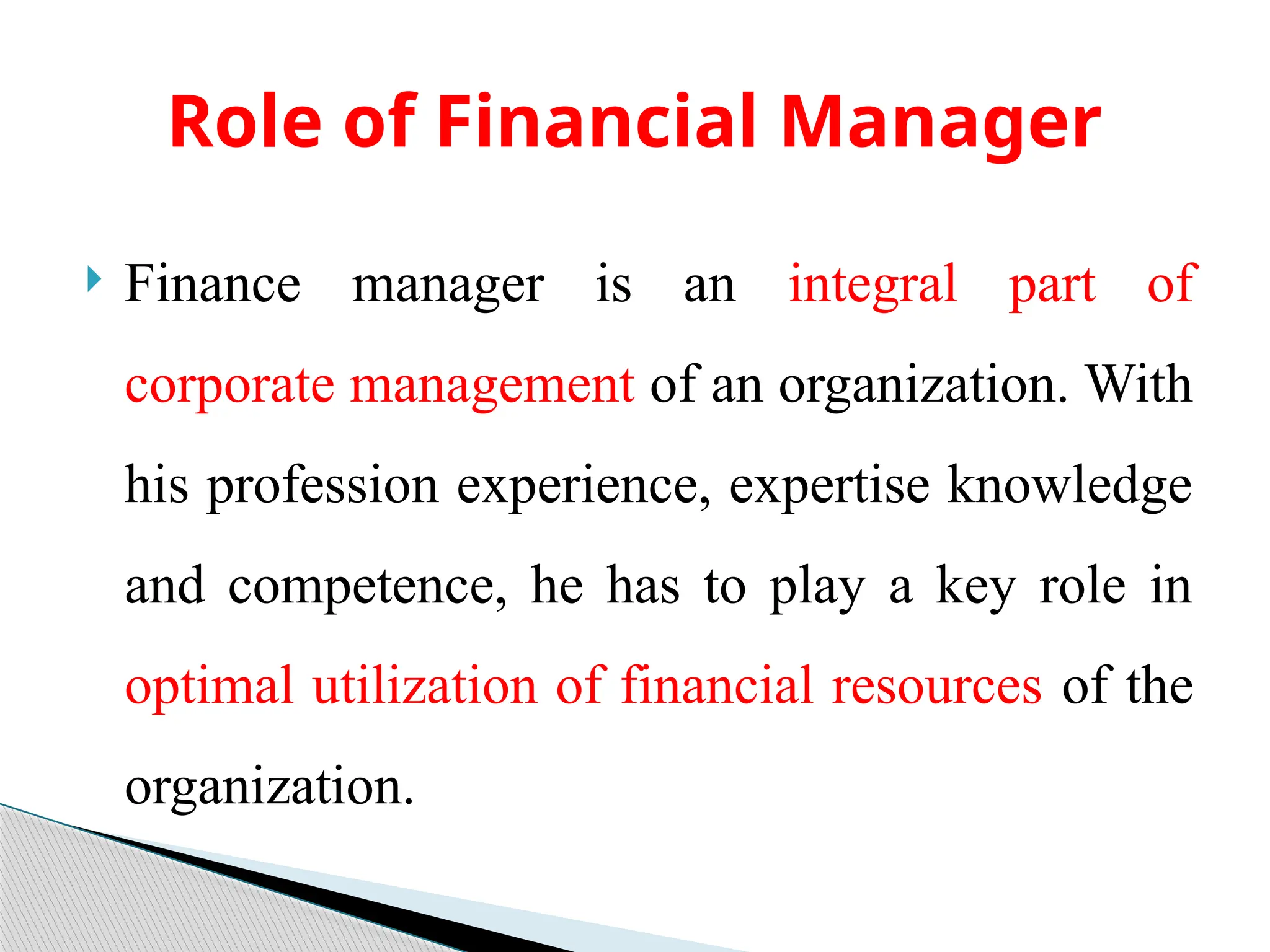
Finance manageris an integral part of
corporate management of an organization. With
his profession experience, expertise knowledge
and competence, he has to play a key role in
optimal utilization of financial resources of the
organization.
Role of Financial Manager
34.
In largeundertakings, the finance manager is a top
management executive who participants in various
decision making functions.
Role of Financial Manager
35.
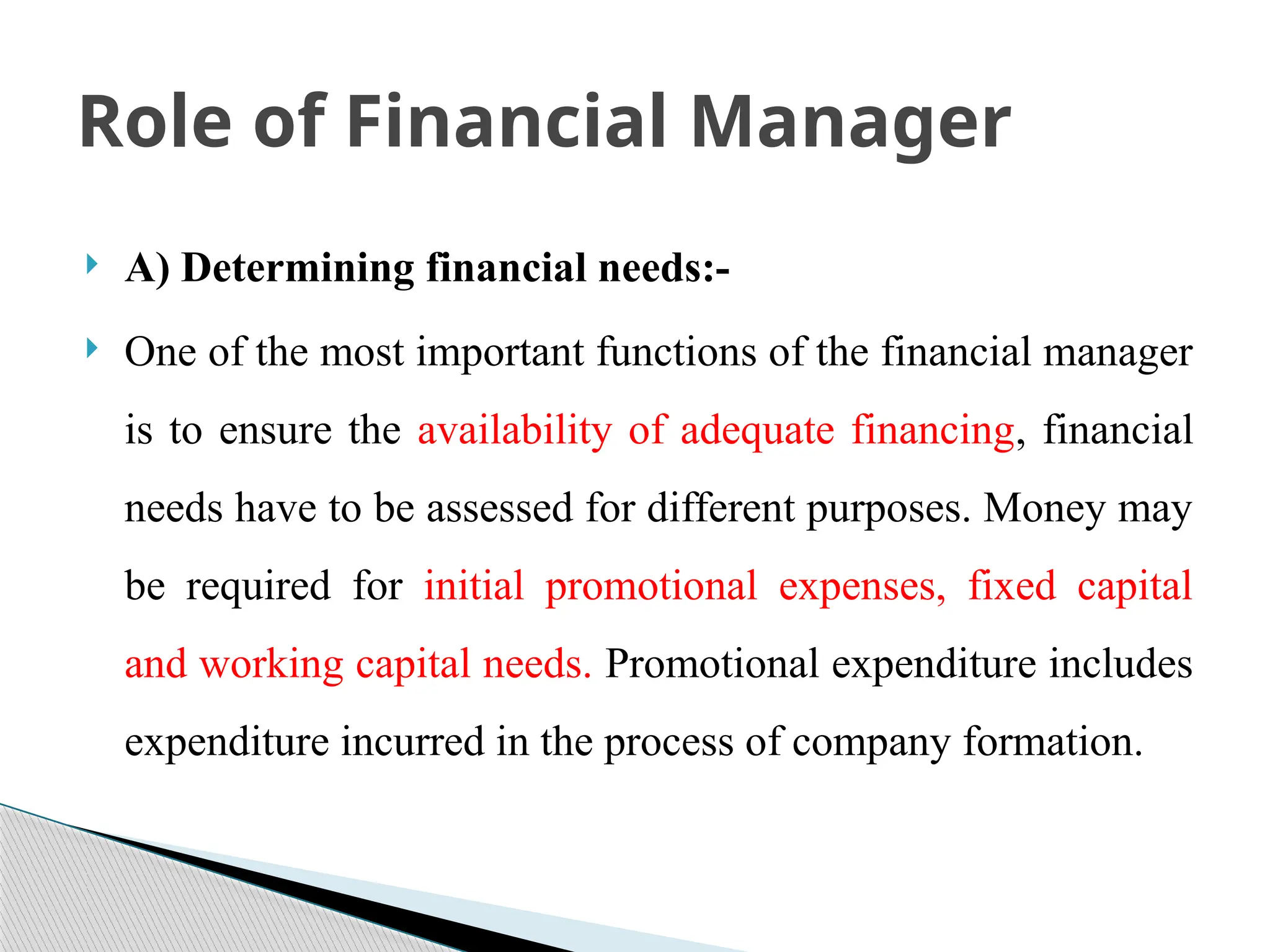
A) Determiningfinancial needs:-
One of the most important functions of the financial manager
is to ensure the availability of adequate financing, financial
needs have to be assessed for different purposes. Money may
be required for initial promotional expenses, fixed capital
and working capital needs. Promotional expenditure includes
expenditure incurred in the process of company formation.
Role of Financial Manager
36.
B) Determiningsources of funds:-
The financial manager has to choose source of funds.
He may issue different types of securities and
debenture, may borrow form a number of finance
institutional and the public. The financial manager
must definitely know what he is doing, workout
strategies to ensure good financial health of the
firm. .
Role of Financial Manager
37.
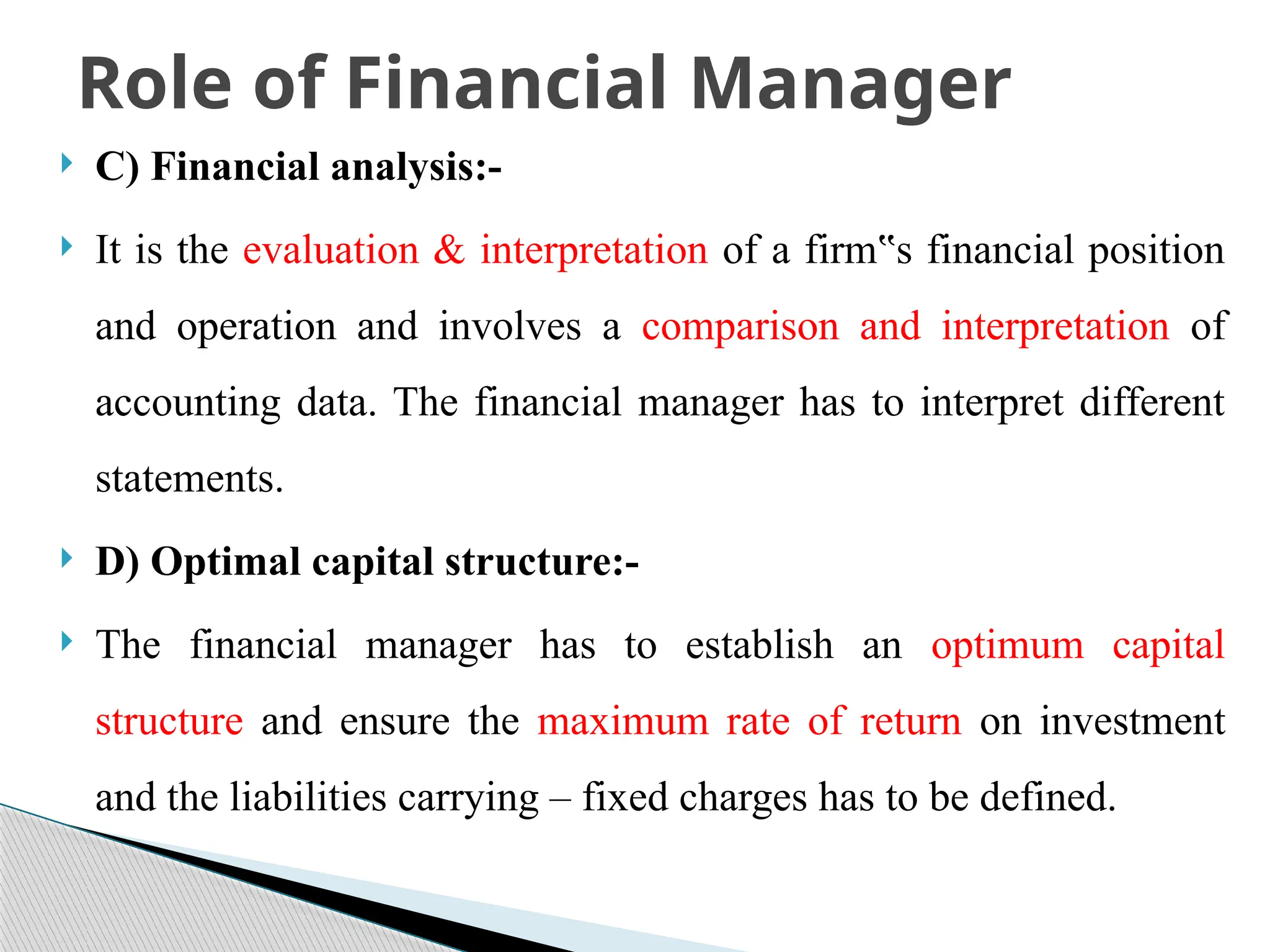
C) Financialanalysis:-
It is the evaluation & interpretation of a firm s financial position
‟
and operation and involves a comparison and interpretation of
accounting data. The financial manager has to interpret different
statements.
D) Optimal capital structure:-
The financial manager has to establish an optimum capital
structure and ensure the maximum rate of return on investment
and the liabilities carrying – fixed charges has to be defined.
Role of Financial Manager
38.
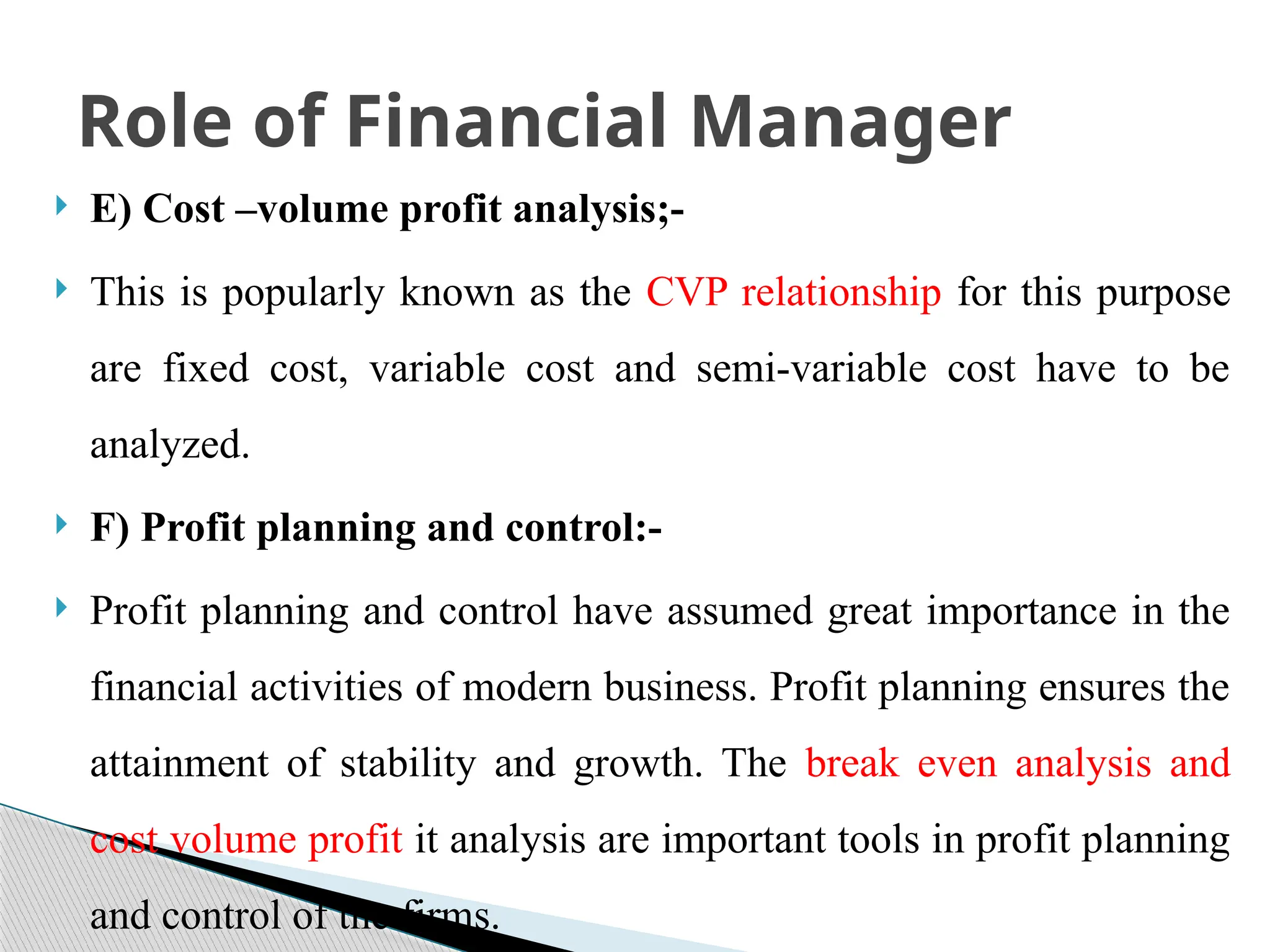
E) Cost–volume profit analysis;-
This is popularly known as the CVP relationship for this purpose
are fixed cost, variable cost and semi-variable cost have to be
analyzed.
F) Profit planning and control:-
Profit planning and control have assumed great importance in the
financial activities of modern business. Profit planning ensures the
attainment of stability and growth. The break even analysis and
cost volume profit it analysis are important tools in profit planning
and control of the firms.
Role of Financial Manager
39.
G) Fixedassets management
A firms fixed assets are land, building, machinery and equipment,
furniture and such intangibles as patents, copy rights and goodwill.
These fixed assets are justified to the extent of the utility or their
production capacity.
Role of Financial Manager
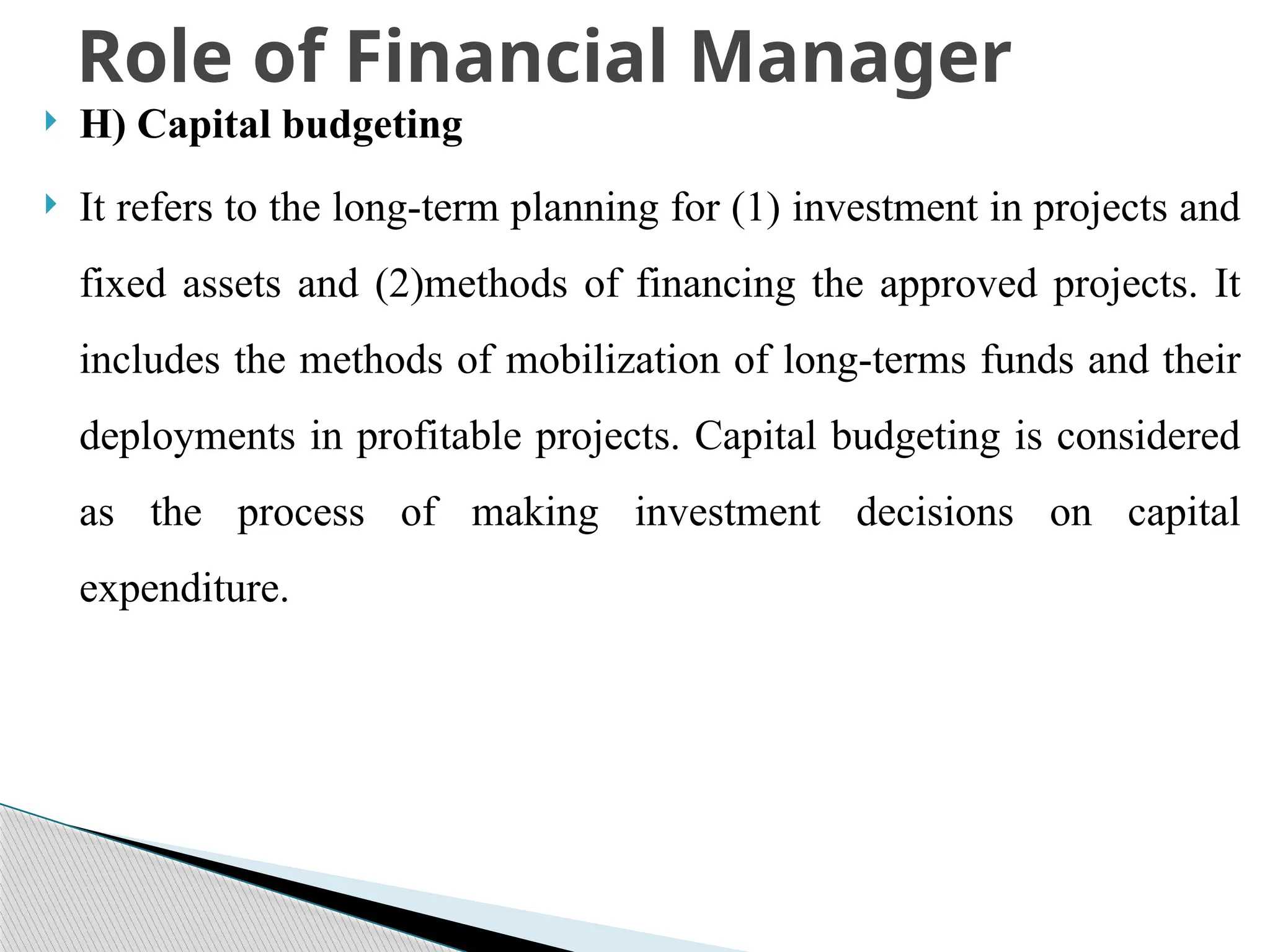
40.
H) Capitalbudgeting
It refers to the long-term planning for (1) investment in projects and
fixed assets and (2)methods of financing the approved projects. It
includes the methods of mobilization of long-terms funds and their
deployments in profitable projects. Capital budgeting is considered
as the process of making investment decisions on capital
expenditure.
Role of Financial Manager
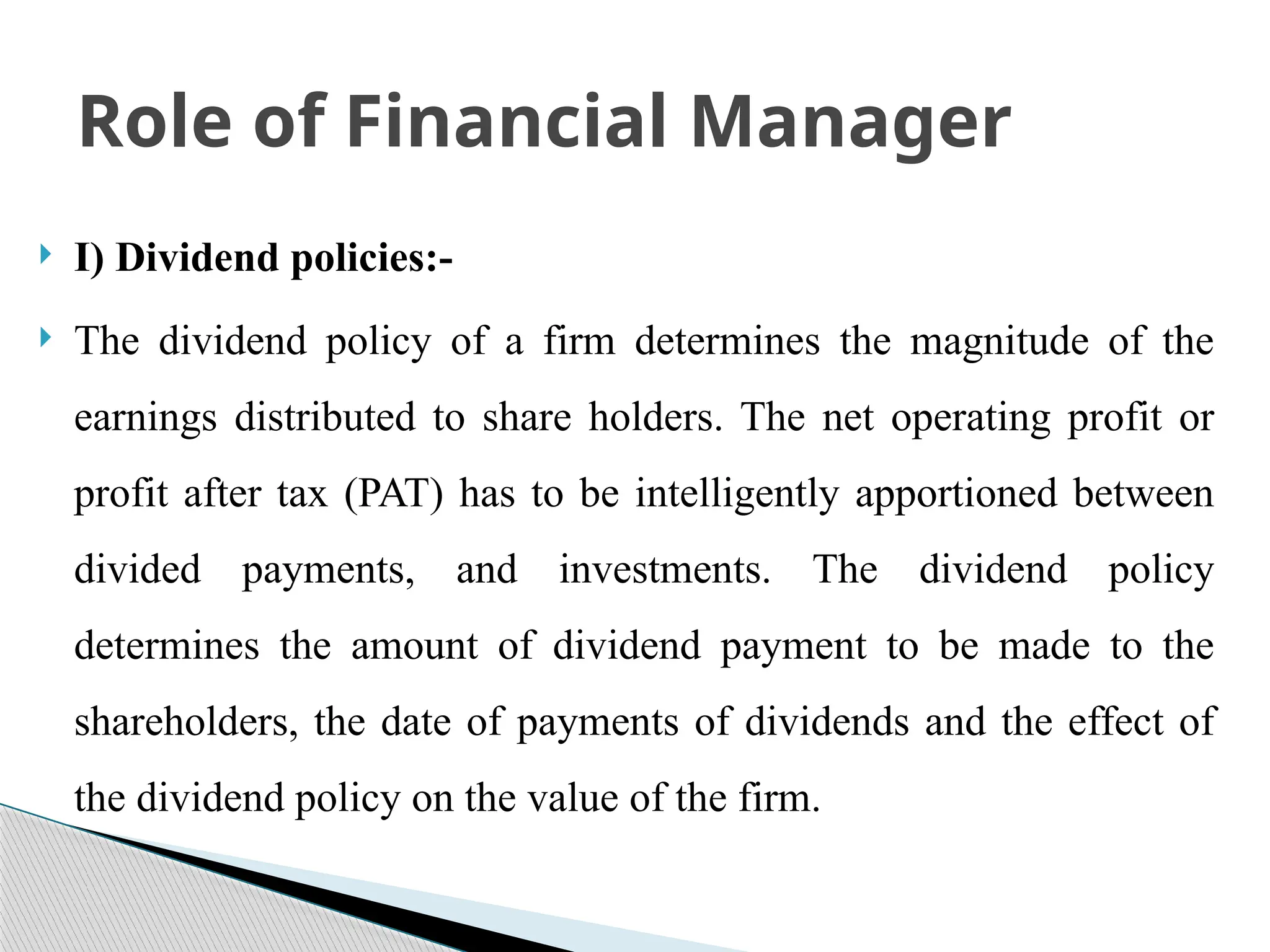
41.
I) Dividendpolicies:-
The dividend policy of a firm determines the magnitude of the
earnings distributed to share holders. The net operating profit or
profit after tax (PAT) has to be intelligently apportioned between
divided payments, and investments. The dividend policy
determines the amount of dividend payment to be made to the
shareholders, the date of payments of dividends and the effect of
the dividend policy on the value of the firm.
Role of Financial Manager
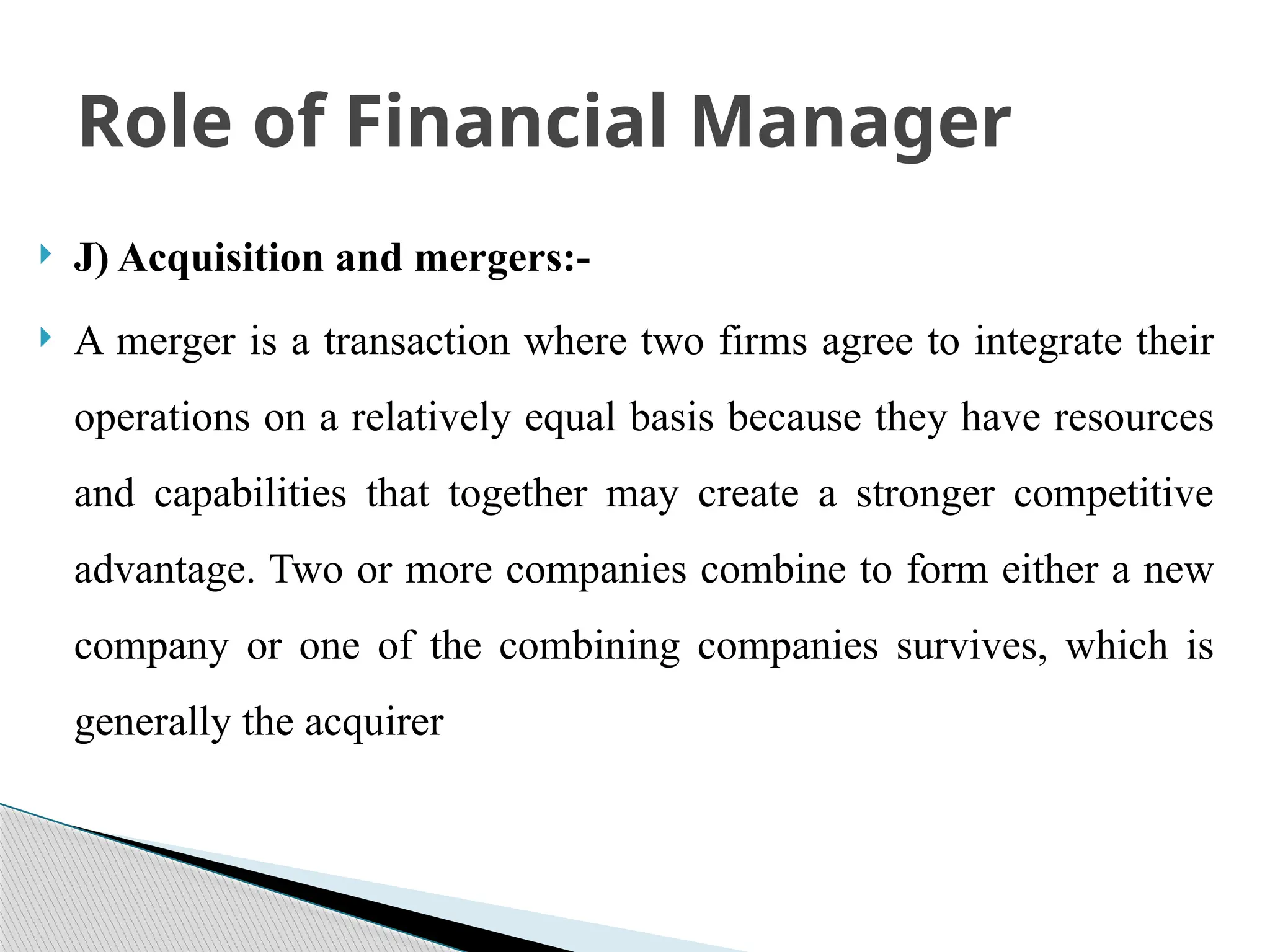
42.
J) Acquisitionand mergers:-
A merger is a transaction where two firms agree to integrate their
operations on a relatively equal basis because they have resources
and capabilities that together may create a stronger competitive
advantage. Two or more companies combine to form either a new
company or one of the combining companies survives, which is
generally the acquirer
Role of Financial Manager
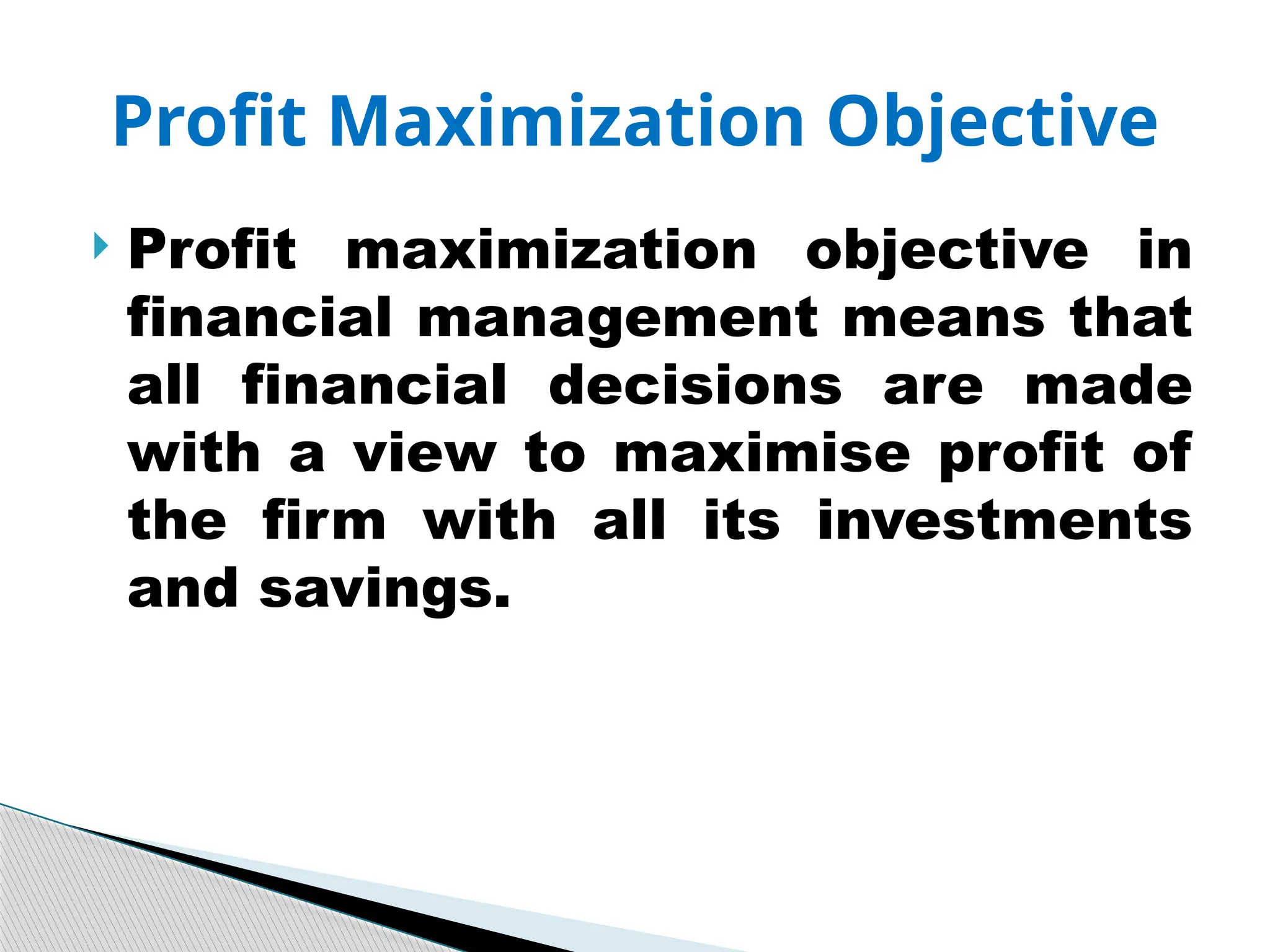
Profit maximizationobjective in
financial management means that
all financial decisions are made
with a view to maximise profit of
the firm with all its investments
and savings.
Profit Maximization Objective
45.
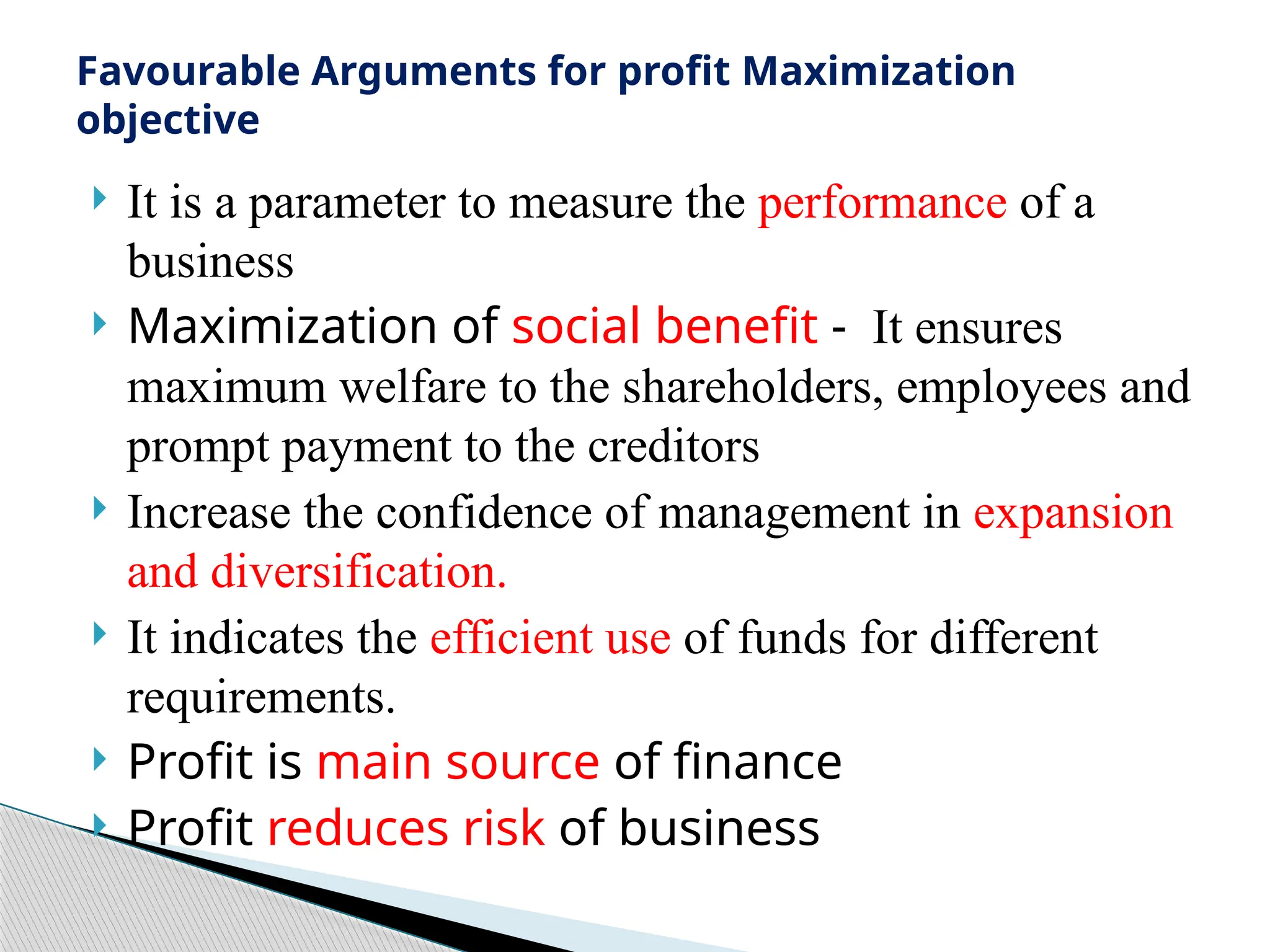
It isa parameter to measure the performance of a
business
Maximization of social benefit - It ensures
maximum welfare to the shareholders, employees and
prompt payment to the creditors
Increase the confidence of management in expansion
and diversification.
It indicates the efficient use of funds for different
requirements.
Profit is main source of finance
Profit reduces risk of business
Favourable Arguments for profit Maximization
objective
46.
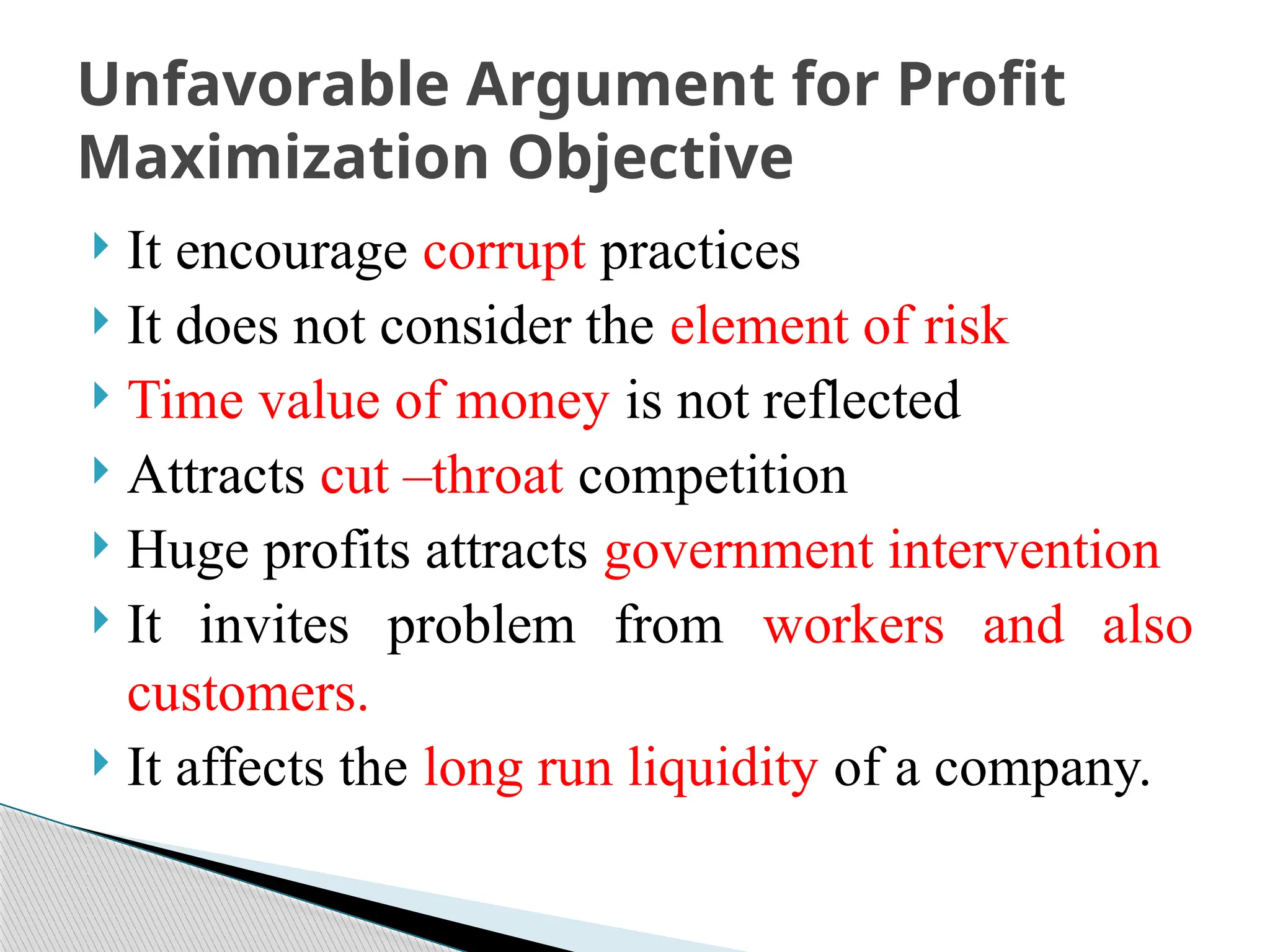
It encouragecorrupt practices
It does not consider the element of risk
Time value of money is not reflected
Attracts cut –throat competition
Huge profits attracts government intervention
It invites problem from workers and also
customers.
It affects the long run liquidity of a company.
Unfavorable Argument for Profit
Maximization Objective
47.
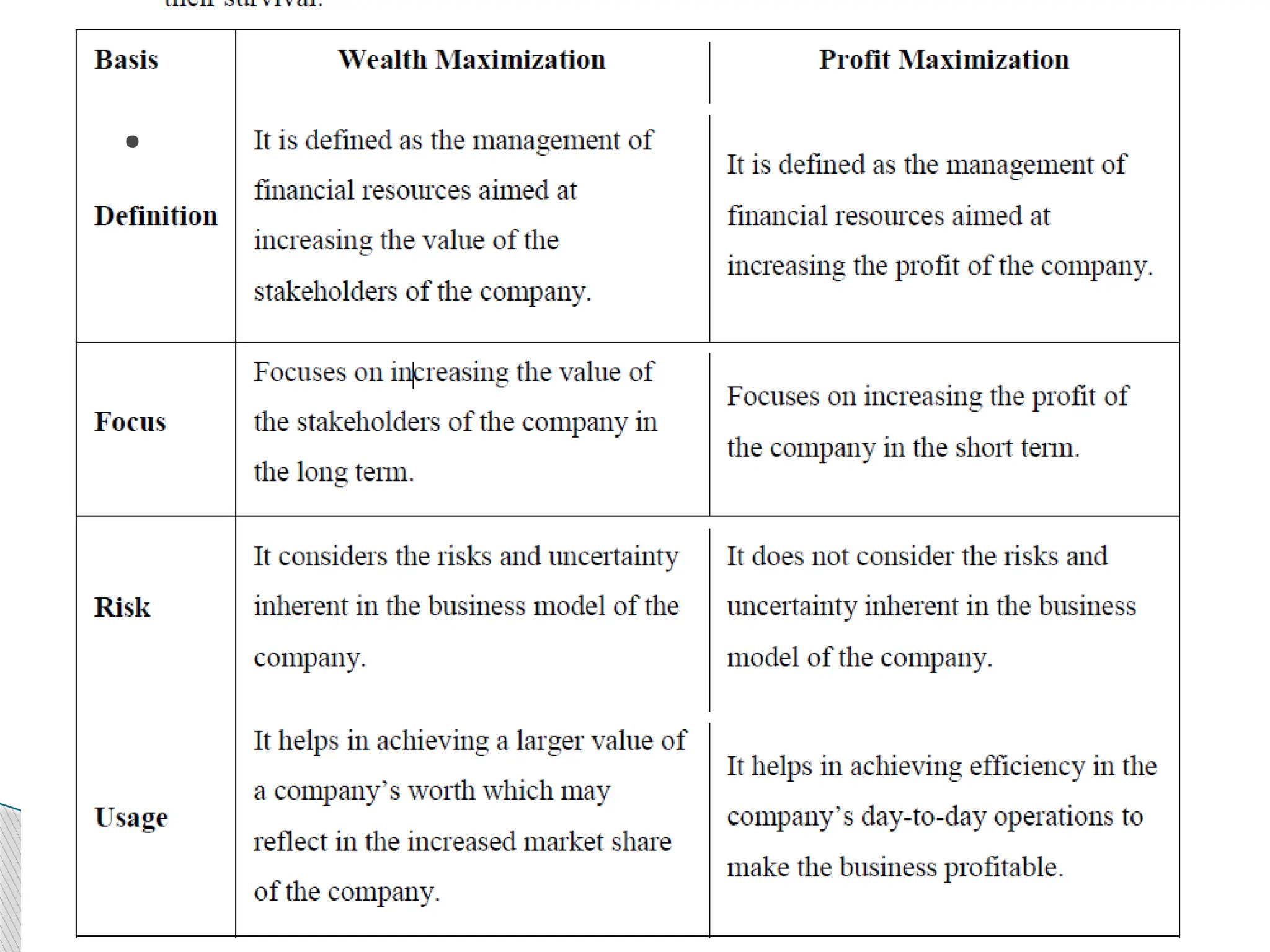
Wealth maximizationobjective considers time
value of money and assign different values to
cash inflows occurring at different point of
time.
The goal of the finance function is to maximize the
wealth of the owners for whom the firm is being
carried on.
Wealth Maximization Objective of Financial
Management
48.
The wealthof corporate owners is measured by the share
prices of the stock which is turn is based on the timing of
return, cash flows and risk. While taking decisions, only that
action that is expected to increase share price should be taken.
It considers :
(a) Time value of money on investment decision
(b) The risk or uncertainty of future earnings and
(c) effects of dividend policy on the market price of shares.
Wealth Maximization Objective of Financial
Management
49.
It issuperior, precise and unambiguous
Net effect of investment and benefits can be measured
clearly.
It considers the time value for money and also risk
It should be accepted universally
It guides the management in framing a consistent
strong dividend policy to reach
maximum return to the equity holders
It Ensures efficient allocation of resources and
economic interest of society
Arguments in favor of Wealth Maximization objective
50.
Creates owner-managementproblem
Criteria of market value is not fair
Management alone enjoy certain benefits.
It is not suitable for present day businesses.
This concept is useful for equity share holders not for debenture holders and
other share holders.
The expectations of workers, consumers and various interest groups create a
greater influence that must be respected to achieve long run wealth
maximization and also for their survival.
Unfavorable arguments for wealth maximization
objective
International financialmanagement is concerned with the
management of International Business related financial
functions commonly known as international financial
functions.
The commonly stated goal of a firm is to maximize its value
and thereby maximize shareholder wealth. This goal is
applicable not only to firms that focus on domestic business
but also to firms that focus on international business.
Global Perspective of Financial
Management
53.
Many firmshave expanded their international
business as a means of enhancing their value.
Financial Management extends beyond national
borders.
Global Operations require knowledge of international
finance.
Global Perspective of Financial
Management
54.
It involvesmultiple currencies
Global financial management refers to the process of
managing finances in a business environment that
operates across multiple countries and currencies.
It involves financial decision-making that takes into
account the economic, legal, political and cultural
differences between nations.
Global Perspective of Financial
Management
55.
Global financialmanagement is the management of
financial resources in an international context,
including decisions related to investment, financing,
risk management and repatriation of profits, while
dealing with diverse currencies, markets and
regulations.
Global Perspective of Financial
Management - Definition
56.
International financeis subject to several external forces. The more
important of them namely foreign exchange markets currency
convertibility international monetary system balance of payments and the
international financial system.
Scope of IFM
Foreign exchange market
Currency convertibility
International monetary system
Balance of payments
International financial system
SCOPE OF INTERNATIONAL FINANCIAL
MANAGEMENT
57.
The foreign exchangemarket is the place where
money denominated in one currency is bought
and sold with money denominated in another
currency.
FOREIGN EXCHANGE MARKET
58.
The discussionof the foreign exchange market
was based on the assumption that the currencies.
This assumption is not valid. Many countries
result in the ability of residents and non-residents
to convert the local currency into foreign currency
making international business more difficult.
CURRENCY CONVERTIBILITY
59.
Every countryneeds to have its own monetary
system and authority to maintain order in the
system. The monetary system facilitates trade and
investment. India has its own monetary policy that is
administered by the reserve bank of india. Primarily
RBI aims at controlling inflation and money supply
and maintaining an interest rate regime that is
helpful to economic growth.
INTERNATIONAL MONETARY SYSTEM
60.
Balance ofpayments is a statistical statement that
systematically summarizes for a specified period time
the monetary transactions of an economy with the rest
of the world. BOP data help measure financial transitions
between residents of the country and residents of all
other countries. Transactions include exports and
imports of goods and services income flow capital and
gifts and similar one-sided transfer payments.
BALANCE OF PAYMENTS
61.
The internationalfinancial system consists of the numerous rules
customs instruments facilities markets and organizations that
enable international payments to be made and funds to flow
across borders. In recent years the international financial system
has experienced tremendous growth. New financial instruments
have been created and the volume of transactions has exploded.
The dramatic metamorphosis of international financial markets is
driven by technological changes in the growth in world trade and
the breakdown of barriers to financial flows.
INTERNATIONAL FINANCIAL SYSTEM
62.
a. Increasein the volume of international trade
b. Globalization of business
c. Increase in the movement of capital and
labor with lesser restrictions
d. Increase in speed of communication and
transport.
e. The emergence of international capital and
money markets
Need for International Financial
Management
63.
CURRENCY RISKS
Currencyrisk arises from a mismatch between the
value of assets and that of capital and liabilities
denominated in foreign currency or because of
mismatch between foreign receivables and foreign
payable that are expressed in domestic currency.
RISKS IN INTERNATIONAL
FINANCIAL MANAGEMENT
64.
The politicalrisk or in other sources called country
risk is explained ad risks related to either the country
of a foreign buyer or borrower or to a third country
which can cause the exporter financial or investor
credit loss. Political risks also include restrictions on
the transfer of the credit currency rescheduling of
debts expropriation and war or insurrection.
POLITICAL/COUNTRY RISKS
65.
Financial riskin accompany is associated with the
method through which it plans its financial structure.
If the capital structure of a company tends to make
earnings unstable the company may fail financially.
How a company raises funds to finance its needs and
growth will have an impact on its future earnings
and consequently on the stability of earnings.
FINANCIAL RISKS
66.
Interest raterisk refers to possible changes in
cash flow or into eh value of assets and
liabilities resulting from changes in interest
rate. In other words, the interest rate is the
chance that an unexpected change in interest
rates will negatively affect the value of an
investment.
INTEREST RATE RISK
67.
Typical commercialrisks include the buyer’s
guarantors or borrower’s unwillingness or
insolvency to pay its debts. This kind of risk can
also be explained as a risk that arises if a
customer or the other party of a financial
instrument fails to meet its contractual
obligation.
COMMERCIAL RISKS:
68.
Liquidity riskrefers to the possibility of the
company's financial assets providing that they
are insufficient to cover its business needs or a
situation in which arranging such funding
would result in additional cost.
LIQUIDITY RISK







![ 1. Loans from Commercial Banks
2. Public Deposits
3. Trade Credit
4. Discounting Bills of Exchange
5. Factoring
6. Bank Overdraft
7. Cash Credit
8. Advances from Customers
9. Accrual Accounts
B] SHORT TERM SOURCES](https://image.slidesharecdn.com/uniti-250719035953-dc6e751d/75/FINANCIAL-MANAGEMENT-SCOPE-ROLE-OF-FINANCAIL-MANAGEER-GOALS-INTRODUCTION-TO-GLOBAL-PERSPECTIVE-OF-FINANCIAL-MANAGEMENT-32-2048.jpg)